
Common Dream Symbols and Their Meanings Across Cultures
Quick Summary
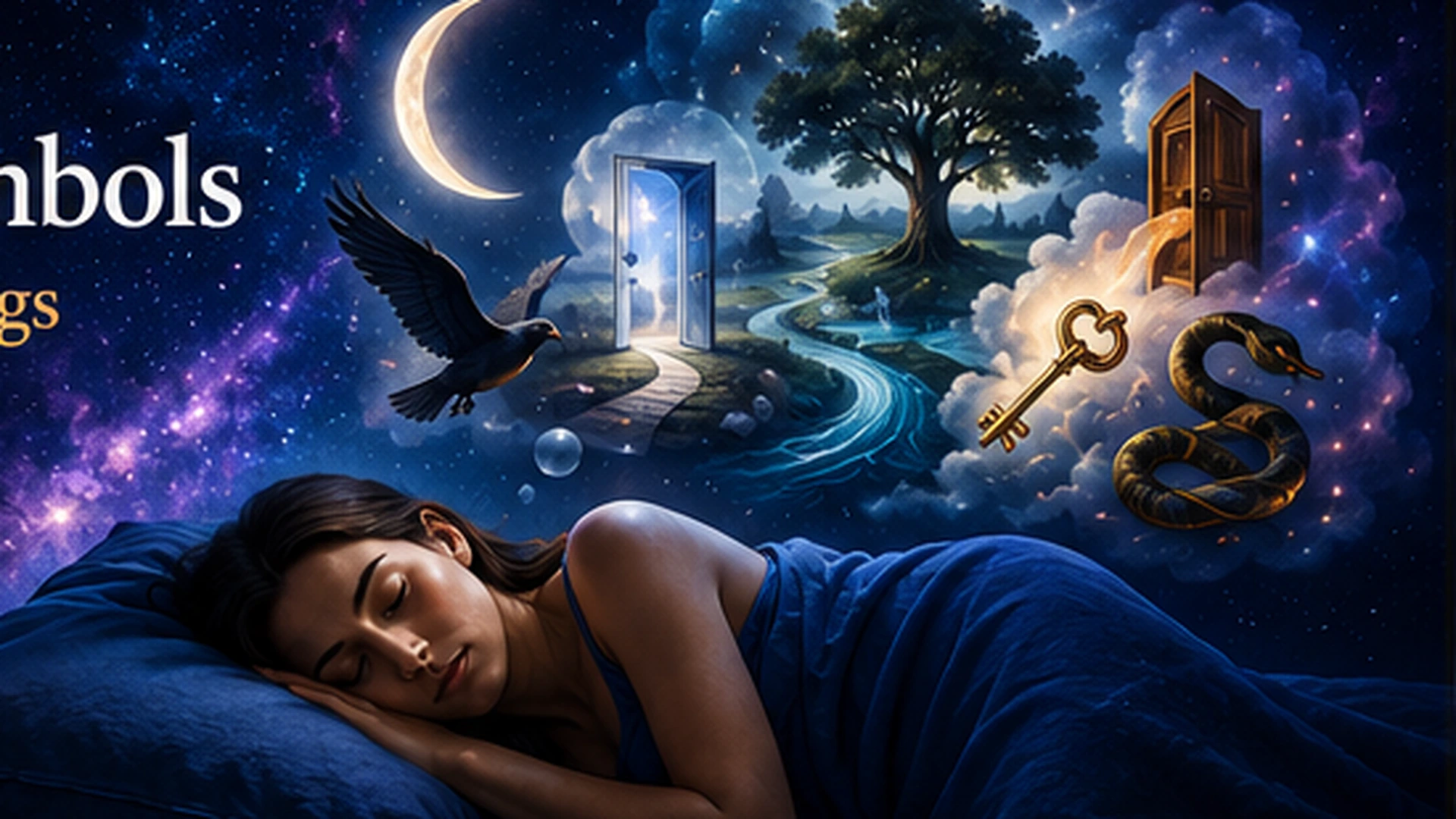
Dreams can make ordinary images feel urgent. Water rises through a family home. A road disappears into darkness. A snake crosses a doorway. A deceased relative speaks. Teeth loosen...
Dreams can make ordinary images feel urgent. Water rises through a family home. A road disappears into darkness. A snake crosses a doorway. A deceased relative speaks. Teeth loosen, a body falls, or a person flies above a familiar town. Because these scenes feel vivid, readers often search for a single meaning that will explain them.
No universal dream dictionary has been scientifically validated, and cultures do not assign identical meanings to the same image. A river may suggest danger to someone who survived a flood, livelihood to a fishing family, sacred geography within a religious tradition, or simply yesterday’s weather. The most responsible interpretation therefore begins with the complete dream, the dreamer’s emotion and waking life, then considers cultural associations without borrowing authority from traditions that are not the dreamer’s own.
This guide compares recurring dream symbols, historical interpretation systems and current dream research. It distinguishes documented evidence, living cultural belief, personal reflection and medical concerns so that symbolism can be explored without becoming a prediction, accusation or diagnosis.
Quick Answer
Common dream symbols do not have one fixed meaning across cultures. Water, snakes, ancestors, houses, journeys, falling, flying and teeth may draw on personal memory, emotion, bodily sensations, local environment, religion and inherited stories. Cultural traditions can offer context, but a dream cannot reliably prove future events, hidden enemies, illness or supernatural messages.
What Is a Dream Symbol?
A dream symbol is an image, person, place, action, object, sensation or event that a dreamer experiences as meaningful. The word “symbol” can be useful, but it can also mislead. Not every element is a coded message. Some images may directly reflect recent experiences, old memories, physical sensations, current concerns, stories, films, environmental knowledge or the brain’s loose recombination of material during sleep.
A useful distinction is between a recurring image and a universal interpretation. People in many societies dream about falling, being chased, animals, family members, houses or bodily changes. Recurrence shows that human bodies and lives share many conditions. It does not prove that the image predicts the same event or carries one inherited meaning everywhere.
Why There Is No Universal Dream Dictionary
Modern neuroscience has not established a hidden symbolic language in which every image has a stable translation. Dreaming occurs in both REM and non-REM sleep, although remembered REM dreams are often longer, more vivid and more emotional. Research frequently supports some form of continuity between waking life and dream content: emotionally important people, concerns and experiences can reappear in distorted or recombined form. [1][2]
Interpretation is also motivated. Experiments involving participants from Eastern and Western cultural backgrounds found that many people regarded dreams as meaningful, yet they gave more weight to dreams that matched beliefs and preferences they already held. A dream can therefore feel persuasive partly because the dreamer selects the interpretation that fits existing expectations. [3]
Cultural knowledge matters because it supplies images, narratives and rules. A snake can be feared as a dangerous animal, respected in a religious story, recognized as a medical emblem or understood through local water-spirit traditions. The same person may carry several associations at once. The responsible question is not “What does a snake always mean?” but “What was this snake doing, how did the dreamer feel, and which associations are genuinely part of the dreamer’s life?”
How Cultures Have Approached Dreams
Ancient Egypt: A Written Dream Manual
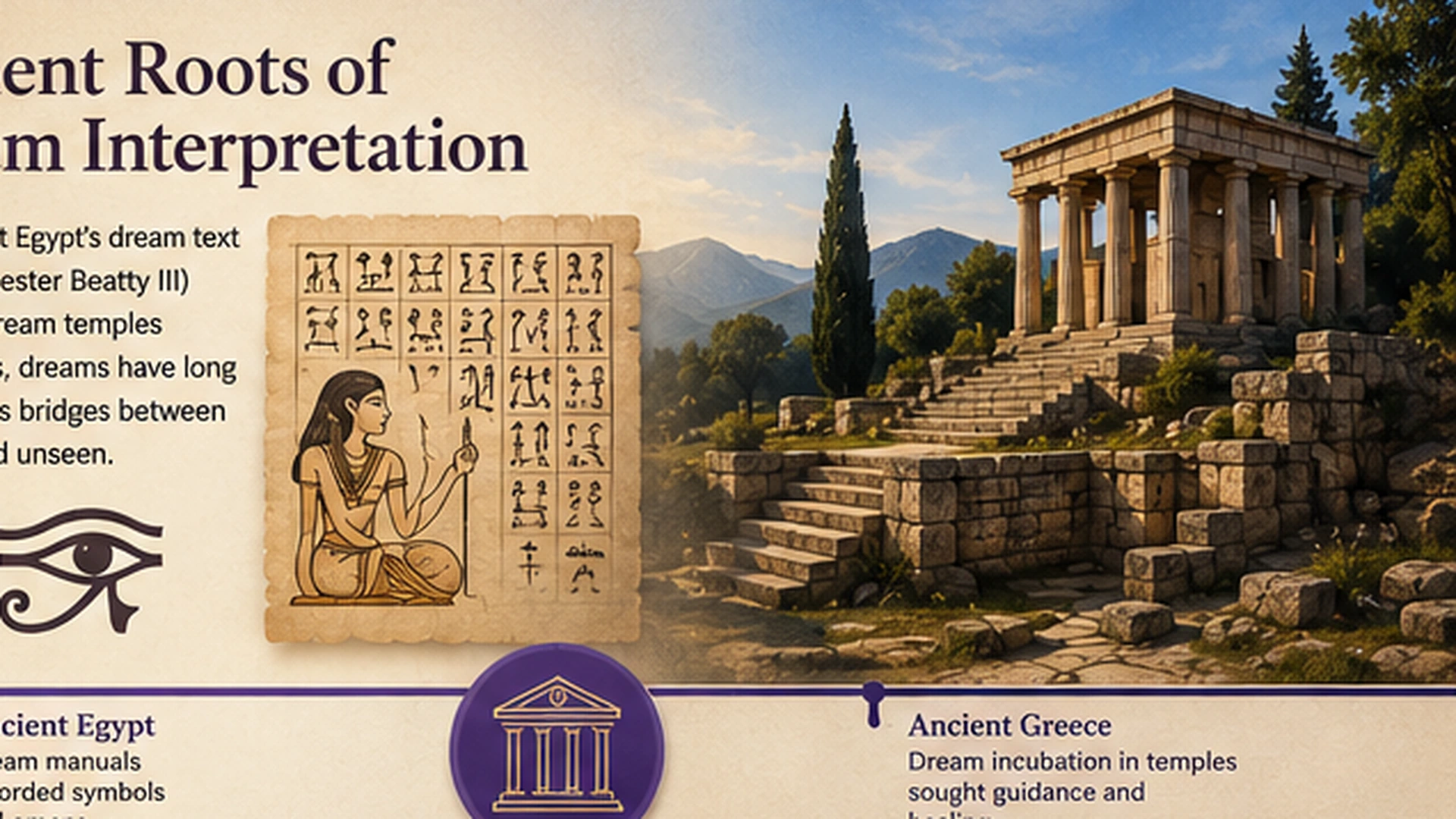
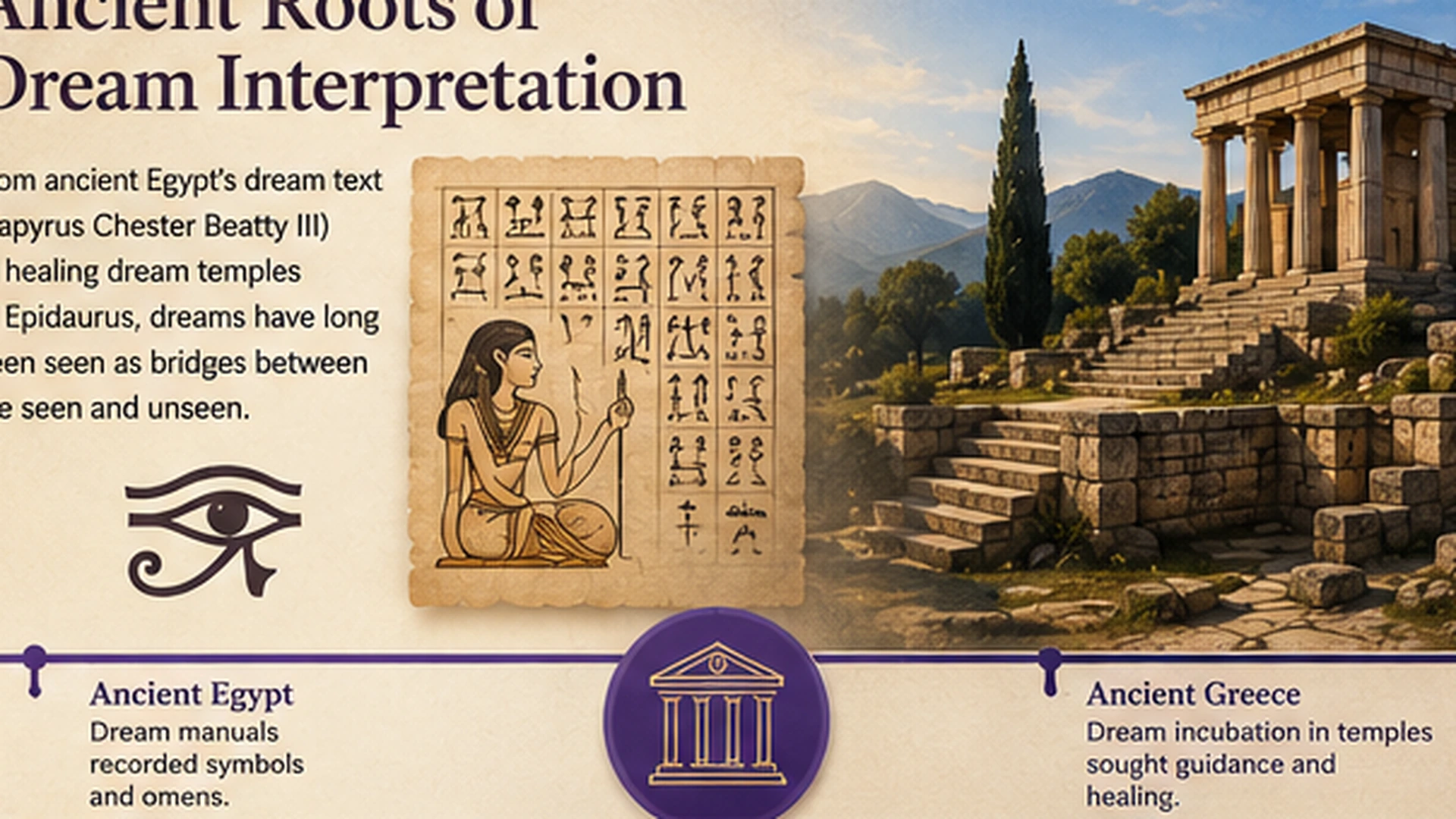
The British Museum preserves Papyrus Chester Beatty III, produced around 1220 BCE and found at Deir el-Medina. Its recto contains a hieratic manual for interpreting dreams, showing that Egyptian scribes organized dream scenes into written categories and judgments. The papyrus is evidence for one historical system, not a dictionary for every Egyptian period or every modern dreamer. [4]
Ancient Egyptian interpretations depended on wordplay, social status, religious ideas and the structure of the manual. Removing one line from that linguistic and historical setting can produce a misleading modern slogan. The safest use of the papyrus is to demonstrate that systematic dream interpretation has a long history—and that old systems were culturally constructed rather than universally self-evident.
Ancient Greece and Rome: Healing Through Dream Incubation
At sanctuaries of Asklepios, including Epidaurus, some patients prepared themselves and slept in a designated healing context in a practice called enkoimesis or incubation. UNESCO describes the sanctuary’s enkoimeterion and the use of a dream-like induced sleep within a wider system that also included worship, exercise and care. The Metropolitan Museum notes that worshippers expected the god to appear in a dream and prescribe treatment. [5][6]
This history should not be simplified into “all dreams heal” or used to replace medicine. The sanctuary illustrates how dreaming could be organized institutionally, interpreted through a specific religious system and connected with the long history of healthcare. Archaeological evidence documents buildings, inscriptions and practices; it does not authorize modern readers to copy a cure from an ancient dream account.
Japan: Hatsuyume and the First Dream of the Year
In Japan, hatsuyume refers to the first dream of the new year and is popularly treated as an indication of the year ahead. Japan’s official tourism information places hatsuyume among several valued “firsts,” alongside the first sunrise and the first shrine or temple visit. [7]
Popular sayings connect fortunate hatsuyume with Mount Fuji, a hawk and an eggplant, but interpretation and practice are not identical in every household. This example shows that timing can make a dream culturally significant: an ordinary image may receive special attention because it appears at a calendrical turning point. It should not be presented as a scientifically reliable forecast.
African Cross-Cultural Research: Community and Dream Content
A 2023 cross-cultural study compared 896 dreams from BaYaka participants in the Republic of Congo, Hadza participants in Tanzania and populations in Europe and North America. The researchers found, among other differences, more community-oriented content among the BaYaka dream reports. The study does not provide an “African dream dictionary.” It demonstrates that social organization and cultural life can shape patterns in dream narratives. [8]
BaYaka and Hadza communities are distinct peoples with different languages, environments and social histories. Their dream reports should not be combined into one African spiritual theory, and research findings should not be used to expose private knowledge or assign meanings to an individual merely because that person is African.
A Necessary Clarification: Aboriginal Dreaming Is Not Simply a Sleep Dream
In Australian First Nations contexts, the capitalized term Dreaming can refer to identity, ancestral creation, law, country, social rules, ceremony and continuing relationships. The Australian Museum emphasizes that meanings differ among Aboriginal people and that the concept structures spiritual and physical life. It must not be reduced to the ordinary experience of having a dream while asleep. [9]
A person dreaming of an animal does not automatically possess authority to claim a Rainbow Serpent story, a songline or restricted cultural knowledge. Public discussion must respect community ownership and the difference between an English word that sounds familiar and a complex Indigenous concept.
Common Dream Symbols: A Responsible Comparison
| Dream image | Possible associations—not fixed meanings | Context questions |
|---|---|---|
| Water | Emotion, danger, cleansing, travel, fertility or memory are possible associations | Flood exposure, swimming, rainfall, thirst, local rivers, religious practice and the dream emotion |
| Snakes and animals | Danger, protection, medicine, transformation or environmental knowledge | Species, behaviour, local wildlife, recent encounters and the dreamer’s cultural tradition |
| Deceased relatives or ancestors | Grief, memory, continuing bonds, family responsibility or religious belief | Relationship, recent loss, family teaching, funeral context and whether the dream was comforting or frightening |
| Houses and rooms | Self, family, privacy, memory or unexplored concerns | Whose house, which room, childhood history, safety, maintenance and current living conditions |
| Roads, vehicles and journeys | Direction, transition, agency, delay or uncertainty | Who was driving, destination, breakdowns, migration, travel plans and real transport stress |
| Falling, flying or being chased | Loss of control, freedom, threat rehearsal or bodily sensation | Emotion, waking stress, sleep transitions, trauma and whether escape was possible |
| Teeth or body changes | Vulnerability, appearance, aging or physical sensation | Jaw tension, dental health, pain, body concerns and recent medical experiences |
| Fire and storms | Danger, destruction, warmth, renewal or overwhelming change | Wildfire, cooking, electricity, conflict, weather and religious imagery |
| Sun, moon and stars | Time, guidance, divinity, seasons, wonder or anxiety | Actual sky observation, calendars, astrology, religion, night work and recent media |
Water in Dreams
Water can be calm, contaminated, scarce, overflowing, deep, moving or frozen. Those differences matter more than the isolated word “water.” A dream of clear drinking water during a drought is not the same as a dream of a flood entering a childhood home. The dream may draw on thirst, weather, swimming, pregnancy, travel, a dangerous river, a sacred-water tradition or a recent news image.
Across religions and cultures, water can be associated with life, purification, danger, boundaries, fertility, memory and passage. These associations are not interchangeable. Christian baptism, Islamic ablution, Hindu sacred-river bathing, Shinto purification and a family libation have different teachings, authorities and purposes. A dreamer should begin with the water actually known in their own life.
Snakes and Other Animals
Animals in dreams combine biological attention with learned stories. A snake may be a realistic environmental danger, a protected species, a medical emblem, a religious figure, a remembered encounter or a metaphor chosen after waking. There is no single African, Asian or global snake meaning.
AncestralTemple.com already has a dedicated guide, “Dreams About Snakes: Meanings Across Cultures,” which should receive the detailed snake-search intent. This hub should summarize the principle and link to that page rather than repeat every scenario. The same method applies to dogs, birds, insects, livestock and wild animals: identify the species, behaviour, setting, emotion and the dreamer’s actual relationship with it.
Deceased Relatives, Ancestors and Unknown Dead People
Dreams of deceased people are common during grief and can feel unusually vivid. They may continue a relationship through memory, revisit unresolved emotion, recreate familiar conversation or reflect a religious understanding of the dead. Some people experience such dreams as comforting visits; others treat them as ordinary memory processing. Science cannot verify from the dream alone that an ancestor communicated, and it cannot prove that no spiritual interpretation is meaningful within a person’s faith.
The safest approach is to distinguish personal belief from public fact. A dream should not be used to accuse a relative, change an inheritance, stop medical care, demand payment for protection or reveal private family matters. Ask what the deceased person represented, what was said, how the dream ended and whether a recent anniversary, photograph, conflict or bereavement may have influenced the dream.
Houses, Rooms and Buildings
A house dream may involve privacy, family, safety, neglect, memory or identity, but the building’s actual history matters. A locked room in a childhood home can carry different associations from an unfamiliar hotel corridor. A leaking roof may reflect real housing stress. A crowded compound may connect with family obligations. A new room may simply be the brain recombining architecture seen during the day.
Cultural ideas about home, inheritance, gendered space, hospitality and ancestral land can influence interpretation. It is careless to announce that every basement means the unconscious or every kitchen means motherhood. Begin with ownership, location, condition, occupants and the dreamer’s emotional response.
Roads, Vehicles, Bridges and Journeys
Journey dreams are often interpreted as life direction, but they may also reflect literal commuting, migration, travel planning, traffic danger or dependence on unreliable transport. Who was driving? Was the destination known? Did the road belong to the dreamer’s childhood, a pilgrimage route, a border crossing or a daily taxi journey?
A bridge can suggest connection or risk because it physically connects separated places, yet the meaning changes if the dreamer repairs bridges for work, fears heights, recently crossed a flooded bridge or lives where a damaged bridge has political importance. Symbolic reflection becomes stronger when it is grounded in concrete experience.
Falling, Flying and Being Chased
Falling and chase dreams are widely reported typical themes. They may express loss of control, urgency, threat, embarrassment or the bodily sensations that occur during sleep transitions. Flying can feel joyful and free, frightening and unstable, or simply normal within the dream. No single emotional label fits all versions.
Threat-simulation theories propose that some dreams rehearse danger, while continuity theories emphasize waking concerns and emotional patterns. Current research does not establish one complete function for all dreams. A recurring chase dream is more usefully explored by asking who or what pursues the dreamer, what prevents escape, whether the threat resembles waking stress and whether the nightmare follows trauma.
Teeth Falling Out and Other Body Changes
Dreams of teeth falling out are common enough to have inspired many traditional interpretations involving death, speech, appearance, family or loss. Those claims vary and should not be presented as forecasts. A 2018 study of 210 university students found that teeth dreams were associated with sensations of tension in teeth, gums or jaws upon waking, while the study did not support a simple psychological-distress explanation. The result was preliminary but shows how physical sensation may be transformed into vivid dream imagery. [10]
If a dreamer wakes with jaw pain, tooth sensitivity, grinding, bleeding or another symptom, the useful response is appropriate dental or medical assessment—not a prediction. A dream can also reflect recent dental treatment, fear of aging, appearance concerns or a child losing teeth. Several influences may coexist.
Fire, Storms and Natural Disasters
Fire may provide heat, cook food, destroy a home, clear land, power industry or appear in religious imagery. Storms can bring needed rain or catastrophic loss. Dream interpretation must therefore consider the dreamer’s environment. A person living through wildfire, flooding or severe weather may be processing real threat rather than receiving a symbolic prophecy.
Online claims that fire always means purification or that a storm guarantees spiritual attack are unsafe. Ask whether the dream involved escape, responsibility, guilt, warmth, community response or actual disaster preparation. Dreams should never replace emergency planning or climate and weather information.
Sun, Moon, Stars and Darkness
Celestial images can draw on calendars, religion, astrology, astronomy, navigation, night work, seasonal change and wonder. A darkened sun may echo an eclipse seen in media. A moon dream may connect with night travel, menstruation, prayer, folklore or an ordinary bright moon outside the bedroom window. Cultural meaning depends on the specific tradition and time period.
A dream involving the sky does not prove an astronomical event, divine command or astrological prediction. Record the scene and emotion, then identify the dreamer’s actual knowledge and associations before applying a public symbolic tradition.
What Modern Dream Research Can Say
Dream research can examine sleep stage, recall, emotion, memory, physiology and patterns across groups. It cannot directly inspect a private dream as it happens in the same way researchers measure heart rate or brain electrical activity. Most studies depend on reports after awakening, which are shaped by memory and language.
Evidence supports several cautious conclusions. Dreaming occurs in REM and non-REM sleep. Personal concerns and emotional reactions often continue into dreams, even when dream scenes become bizarre. Cross-cultural studies show both shared features and group differences. Recent work comparing BaYaka, Hadza and Global North samples found differences in social and emotional content, while large-scale research continues to find strong individual influences. [1][2][8]
What research does not support is a universally validated translation table that predicts future events from a symbol. Psychoanalytic, religious, spiritual and folk systems can be historically and personally meaningful, but their claims should be identified as interpretations rather than laboratory-established facts.
How to Interpret a Dream Responsibly
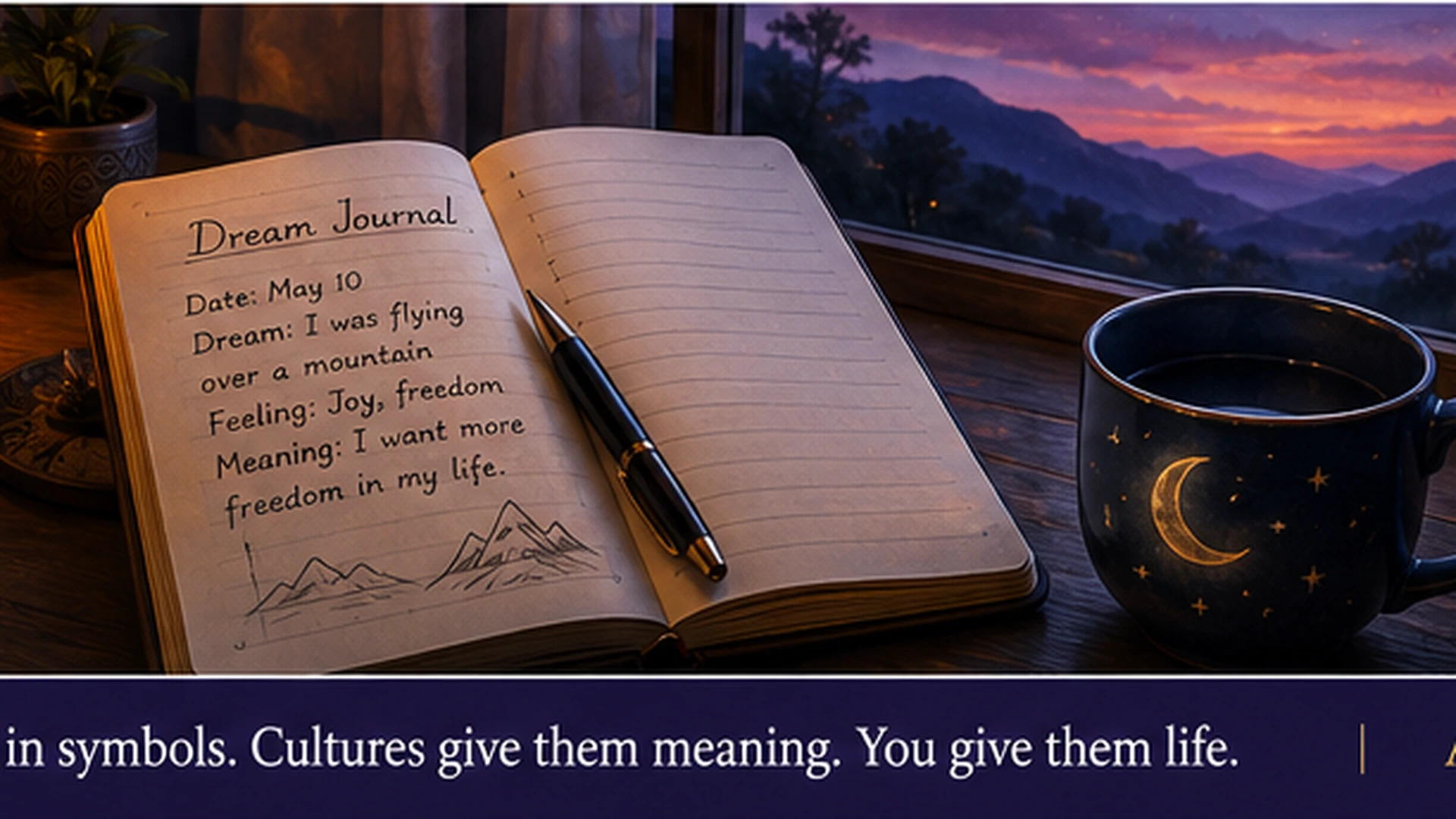
1. Record the dream before interpretation. Write the setting, people, actions, objects, words, colours, body sensations and ending before memory fades.
2. Identify the strongest emotion. Fear, relief, wonder, shame and curiosity can change the significance of the same image.
3. Check recent waking influences. Consider news, films, conversations, illness, travel, work, grief, conflict, weather and real encounters.
4. Ask for personal associations. A river, dog, school or uniform can mean something highly specific to one life.
5. Add cultural context carefully. Use traditions the dreamer genuinely belongs to or has responsibly studied; do not borrow restricted authority.
6. Allow more than one possibility. Dreams can combine direct memory, emotion, physical sensation and symbolic thought.
7. Avoid predictions and accusations. A dream does not prove infidelity, witchcraft, crime, pregnancy, illness, death or financial change.
8. Use real-world evidence for decisions. Health, safety, relationships, money and law require observation, communication and qualified help.
9. Review patterns rather than one dramatic image. A dream diary may reveal repeated people, places, emotions and waking triggers.
10. Seek support when dreams cause harm. Recurrent trauma nightmares, severe sleep loss or dream enactment deserve professional attention.
When Nightmares Need More Than Symbolic Interpretation
Occasional nightmares are common. Professional support becomes more important when nightmares are frequent, cause major daytime distress, follow trauma, prevent sleep or lead a person to avoid necessary activities. The American Academy of Sleep Medicine identifies imagery rehearsal therapy as a recommended treatment for nightmare disorder and PTSD-associated nightmares; treatment decisions belong with qualified clinicians. [11]
Physically acting out dreams—kicking, punching, shouting, jumping from bed or injuring a sleeping partner—should not be treated as a spiritual sign alone. REM sleep behavior disorder is a recognized sleep condition that requires medical assessment, particularly when episodes are repeated or violent. [12]
Common Misunderstandings
| Claim | Responsible answer |
|---|---|
| “Every dream image has one meaning.” | False. Context, emotion, culture, experience and physiology can change interpretation. |
| “A deceased relative in a dream definitely delivered a message.” | The dream may be spiritually meaningful to the dreamer, but the experience alone cannot verify communication as public fact. |
| “Snake dreams always reveal an enemy.” | False. Snakes can relate to real wildlife, fear, religion, medicine, stories or personal fascination. |
| “Teeth falling out predicts death.” | There is no reliable scientific basis for that prediction; physical jaw or dental sensations may contribute. |
| “Aboriginal Dreaming is a dream-symbol system.” | False. Dreaming is a complex First Nations concept of law, country, identity, creation and continuing relationships. |
| “A frightening dream proves witchcraft or spiritual attack.” | No. Such claims can cause accusation, exploitation and delayed healthcare. |
| “A positive dream guarantees success.” | No dream reliably guarantees wealth, marriage, healing, fertility or protection. |
| “Science has proved dreams are meaningless.” | Also false. Science studies memory, emotion, physiology and patterns, but does not settle every personal, cultural or religious question. |
People Also Ask
Do dream symbols have universal meanings?
No. Some images recur widely, but interpretations differ by person, culture, emotion and context.
What are the most common dream symbols?
Frequently reported themes include falling, being chased, flying, animals, houses, deceased people, bodily changes, water and travel. Frequency does not create one meaning.
What does water mean in a dream?
It may connect with emotion, danger, thirst, weather, travel, cleansing, fertility or a specific body of water. The condition of the water and the dreamer’s experience matter.
What does dreaming about a dead relative mean?
It may reflect grief, memory, a continuing bond, family responsibility or spiritual belief. A dream alone cannot publicly verify a message from the dead.
Why do I dream about falling?
Falling may relate to loss of control, fear, bodily sensation or ordinary dream construction. Repeated distressing dreams should be considered alongside waking stress and sleep health.
Why do teeth fall out in dreams?
Possible factors include dental or jaw sensations, recent treatment, appearance concerns and personal associations. One study linked teeth dreams with waking dental tension rather than a simple distress symbol.
Can dreams predict the future?
There is no reliable scientific method for forecasting future events from ordinary dreams. People may interpret dreams within faith or tradition, but predictions should not replace evidence.
Does culture affect dreams?
Yes. Culture shapes stories, social concerns, language, religious interpretations and which dreams are shared or valued.
Should I use a dream dictionary?
Use it only as a source of possible prompts, not as authority. Compare its claims with your own experience and cultural context.
When should I seek help for nightmares?
Seek professional help when nightmares are frequent, trauma-related, severely disruptive or accompanied by physical dream enactment or injury.
Frequently Asked Questions
1. Is dreaming only associated with REM sleep?
No. Dreams are reported from both REM and non-REM sleep, although remembered REM dreams are often more vivid, emotional and extended.
2. Does dreaming about an ancestor mean I must perform a ritual?
No. Ritual obligations belong to specific traditions and legitimate custodians. A public article cannot assign private obligations from one dream.
3. Can the same symbol be positive and negative?
Yes. Fire can warm or destroy; water can sustain or drown; a snake can threaten or protect within different experiences and traditions.
4. Why do dreams combine people from different periods of life?
Dream cognition can recombine memories, emotions and places without following waking chronology.
5. Are recurring dreams more important?
They may indicate a repeated concern, memory, sensation or sleep pattern, but repetition does not prove a supernatural message.
6. Should I tell someone they appeared in my dream?
Only when doing so is respectful and safe. A dream is not evidence about another person’s intentions or behaviour.
7. Can medication or illness affect dreams?
Yes, sleep disruption, fever, substances and some medications can change dream vividness or recall. Discuss concerning changes with a qualified healthcare professional.
8. Is lucid dreaming safe?
Many people experience lucid dreams without harm, but deliberate techniques can disrupt sleep for some people. Anyone with significant sleep or mental-health concerns should seek professional guidance.
9. Can children use dream-symbol guides?
Adults should avoid frightening children with predictions or accusations. Help them describe feelings, reassure safety and seek support for persistent nightmares.
10. What is the best first question after a dream?
Ask: “What emotion stayed with me, and what in my current life carries a similar feeling?”
Key Takeaways
Common dream images recur across societies, but no universal interpretation has been scientifically validated.
Personal experience, emotion, culture, environment, physical sensation and media can all influence dream content.
Ancient Egyptian dream manuals and Greek incubation practices document specific historical systems, not timeless dictionaries.
Japan’s hatsuyume gives special significance to the first dream of the year within a particular New Year context.
BaYaka and Hadza dream research shows why cross-cultural patterns must be studied without creating one African theory.
Aboriginal Dreaming is a complex concept of law, country, identity and creation—not simply a sleep dream.
Water, snakes, ancestors, houses, journeys, falling, teeth, fire and celestial images should be interpreted through complete context.
Dreams cannot reliably prove betrayal, witchcraft, pregnancy, illness, death, crime or future money.
Recurrent nightmares and physical dream enactment may require professional sleep or mental-health care.
The most useful interpretation creates questions for reflection rather than certainty about hidden events.
Conclusion
Dreams are both widely human and deeply local. Bodies sleep, memories recombine and emotions continue across cultures, yet communities teach different ways to value, share and interpret what happens at night. A river, snake, ancestor, house or falling body may feel familiar to millions of dreamers without carrying one universal message.
Responsible dream interpretation preserves that tension. It takes the experience seriously without claiming certainty. It studies history without turning a museum object into a modern command. It respects living cultural authority, checks personal and physical context, and uses evidence for real-world decisions. The result is not a secret dictionary but a better method: record the dream, examine emotion, identify waking influences, consider genuine cultural context and remain open to more than one explanation.
Research Sources and Further Reading
[1] National Library of Medicine / PMC — Dreaming and Offline Memory Processing. Reviews evidence connecting dreams with memory reactivation and notes limited support for a hidden universal symbolic language.
[2] Frontiers in Psychology / PubMed — The Functional Role of Dreaming in Emotional Processes. Review of dream experience, REM sleep, emotion and memory processing.
[3] Journal of Personality and Social Psychology / PubMed — When Dreaming Is Believing: The (Motivated) Interpretation of Dreams. Cross-cultural experiments on how prior beliefs influence dream interpretation.
[4] The British Museum — Papyrus Chester Beatty III. Ramesside papyrus containing a manual for interpreting dreams, dated to about 1220 BCE.
[5] UNESCO World Heritage Centre — Sanctuary of Asklepios at Epidaurus. Documents the healing sanctuary, enkoimeterion and dream-like induced sleep within its therapeutic practices.
[6] The Metropolitan Museum of Art — Medicine in Classical Antiquity. Explains incubation and dream-prescribed treatment in the cult of Asklepios.
[7] Japan National Tourism Organization — New Year Customs and Hatsuyume. Describes hatsuyume as the first dream of the year and a popular sign of the year ahead.
[8] Scientific Reports — Evidence for an Emotional Adaptive Function of Dreams: A Cross-Cultural Study. Compares dream reports from BaYaka, Hadza and Global North participants.
[9] Australian Museum — Indigenous Australians: The Dreaming. Explains Dreaming as a complex network of identity, knowledge, law, faith and practice.
[10] Frontiers in Psychology / PMC — Dreams of Teeth Falling Out: An Empirical Investigation. Finds an association with waking dental tension in a student sample and no simple link with psychological distress.
[11] American Academy of Sleep Medicine — Position Paper for the Treatment of Nightmare Disorder in Adults. Identifies imagery rehearsal therapy as a recommended treatment for nightmare disorder and PTSD-associated nightmares.
[12] Mayo Clinic — REM Sleep Behavior Disorder. Explains physical dream enactment, injury risk and the need for medical assessment.
[13] AncestralTemple.com — Dreams About Snakes: Meanings Across Cultures. Existing dedicated child article for detailed snake-dream intent.
[14] AncestralTemple.com — Spiritual Symbols Shared Worldwide. Related guide on why recurring symbols do not have identical meanings across cultures.
5. Internal and External Link Plan
| Internal destination | Suggested path | Placement / anchor |
|---|---|---|
| Dreams About Snakes: Meanings Across Cultures | /blogs/dreams-about-snakes-meanings | Link from the snake section with anchor text “dreams about snakes across cultures.” |
| Spiritual Symbols Shared Worldwide | /blog/spiritual-symbols-shared-worldwide | Link from the universal-symbol warning and celestial-symbol section. |
| Ancestor Reverence: Meaning, History and Cultural Importance | /blogs/ancestor-reverence-meaning-history-cultural-importance | Link from dreams of deceased relatives and ancestors. |
| What Is Spiritual Cleansing? A Cultural Overview | /blog/what-is-spiritual-cleansing-cultural-overview | Link from the water section while emphasizing distinct ritual meanings. |
| Dreams & Symbolism category | /blogs?category=dreams-symbolism | Use in breadcrumb or related-reading block. |
| External authority | Recommended citation location |
|---|---|
| British Museum — Papyrus Chester Beatty III | Ancient Egypt subsection |
| UNESCO — Sanctuary of Asklepios at Epidaurus | Greek incubation subsection |
| Australian Museum — The Dreaming | Cultural terminology clarification |
| Scientific Reports — Cross-cultural dream study | African cross-cultural research |
| National Library of Medicine / PMC | Modern dream science |
| American Academy of Sleep Medicine | Nightmare treatment and support |
6. Supporting Article Recommendations
| Proposed supporting article | Priority | Strategic reason |
|---|---|---|
| Dreaming of a Deceased Relative: Grief, Memory and Cultural Beliefs | High | Strong emotional and spiritual intent; include grief science and cultural caution. |
| Teeth Falling Out in Dreams: Meanings, Dental Sensations and Myths | High | Strong typical-dream query with a useful evidence-based differentiator. |
| Water Dreams: Floods, Rivers, Oceans and Cultural Meaning | Medium | Only publish if Search Console shows distinct water-related demand. |
| Why Do I Keep Dreaming I Am Being Chased? | Medium | Combine recurring dreams, stress, trauma cautions and nightmare support. |
| Ancient Dream Interpretation: Egypt, Greece and the History of Oneiromancy | Medium | Historical cluster page; avoid copying sacred or restricted instructions. |
| How to Keep a Dream Journal Without Treating Dreams as Predictions | Medium | Practical, low-risk informational page supporting the hub. |
Article Information
- Publisher
- Ancestral Temple
- Editor
- Ancestral Temple
- Last updated
- Jul 26, 2026
- Last reviewed
- Jul 26, 2026
- Content version
- 2442683a7d
This educational article should be read as cultural and spiritual information, not as medical, legal, financial, or emergency advice.
Helpful Related Guidance
Explore This Topic
Related Topic Cluster
Dreams & Symbolism
About the Author
 Ancestral Temple
Spiritual guide and practitioner with decades of experience in ancestral wisdom, rituals, and divine guidance.
Related Posts
View All






Leave a Comment
We'd love to hear your thoughts.