
Keeping a Dream Journal
Cornerstone Content

Quick Summary
A dream journal can help preserve details that fade quickly after waking, reveal recurring themes, and support thoughtful personal reflection. This practical guide explains what to record, how to improve recall, how to avoid universal symbol claims, and when distressing dreams require professional support.
A dream can feel vivid at the moment of waking and disappear within minutes.
A person may remember a deceased relative speaking, a river crossing, an animal entering a home, a flight over a city, or a powerful emotion without remembering the complete story. By the time they check messages, begin work, or speak to another person, much of the dream may already be gone.
A dream journal provides a simple way to preserve those details.
It may be a paper notebook, a secure digital document, an audio recording, or a structured form completed after waking. The goal is not to prove that every dream predicts the future or contains a hidden spiritual message. The goal is to create an accurate record before memory changes.
Research on dream recall has repeatedly used diaries because immediate or near-immediate reports are generally more detailed than distant retrospective estimates. Researchers also note that keeping a dream diary can increase recall, especially among people who normally remember few dreams. (Dream Recall Frequency, Lucid Dream Frequency, and Big Five Personality Factors)
A dream journal can support curiosity, memory, creativity, cultural reflection, grief work, or clinical discussion. It should remain private, ethical, and grounded in uncertainty.
Key Points
- A dream journal is a record of dreams written or recorded soon after waking.
- Dream details often fade quickly, so timing matters.
- Keeping a journal can increase dream recall and attention to dreams.
- A journal should capture the complete narrative, emotions, people, places, sensations, and exact words where possible.
- Short fragments are worth recording even when the whole dream is missing.
- Personal and cultural associations are more useful than universal online symbol dictionaries.
- Dream journaling does not prove prophecy, spiritual attack, betrayal, pregnancy, illness, or future events.
- Recording dreams may change how often they are remembered, which is useful personally but important to acknowledge scientifically.
- A dream journal can support therapy, but it is not a substitute for professional treatment.
- People with trauma-related nightmares should avoid repeatedly forcing themselves to relive distressing content without support.
- Dangerous dream enactment, hallucinations while fully awake, or severe sleep disruption requires professional assessment.
- Privacy matters because dream journals may contain intimate family, religious, sexual, medical, or traumatic material.
Clear Definition
A dream journal is a written, typed, drawn, or audio record of dreams and dream fragments, usually created shortly after waking to preserve details for later reflection.
Plain-Language Meaning
Keeping a dream journal means recording what happened in a dream before the memory fades.
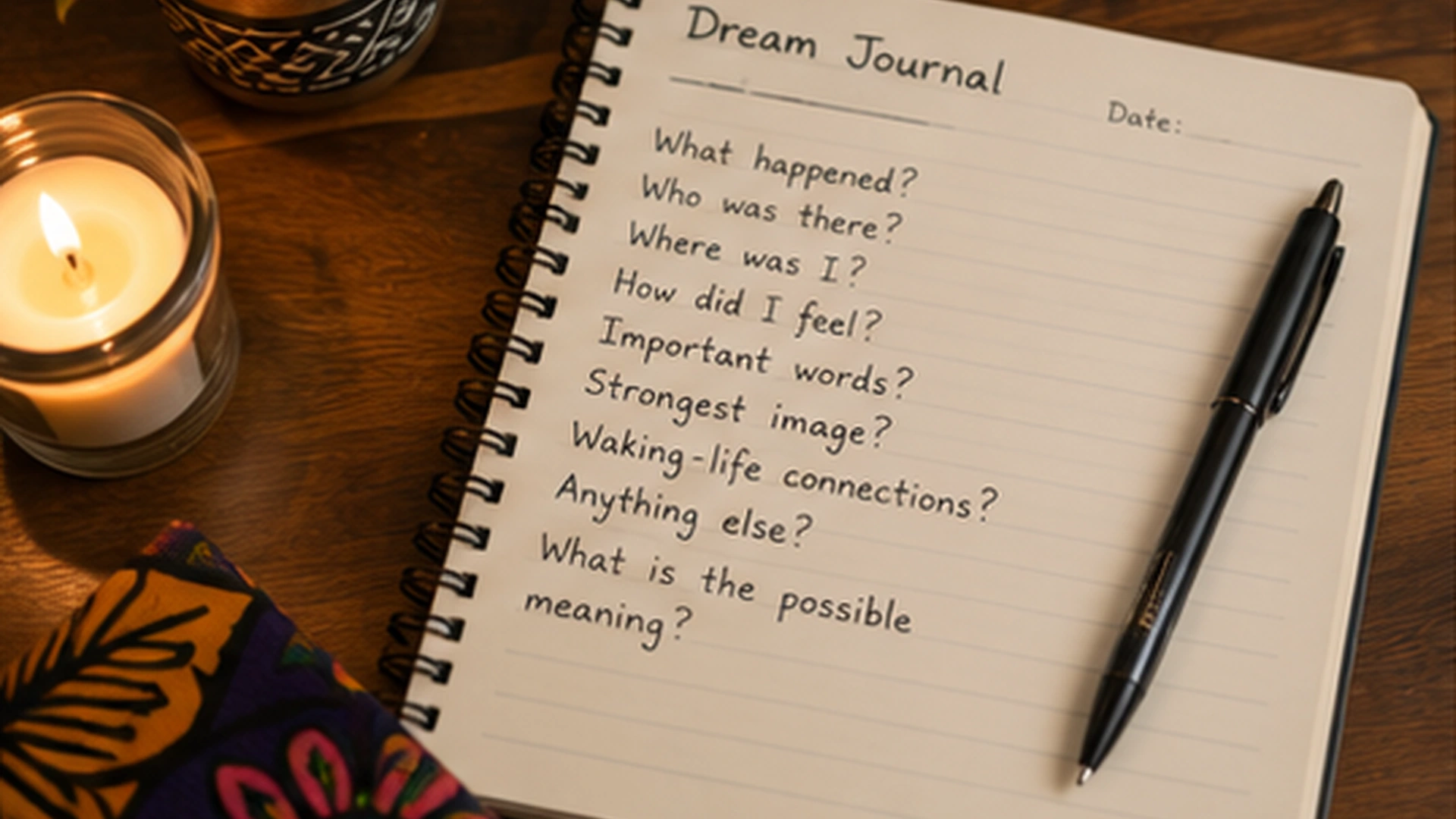
A useful entry might include:
- What happened
- Who appeared
- Where the dream took place
- How the dreamer felt
- Any exact words remembered
- Important colours, sounds, smells, or physical sensations
- Recent waking events that may be connected
The journal does not need to provide an immediate interpretation.
Recording first and reflecting later usually produces a more honest account.
A Brief History of Recording Dreams
Humans were documenting and organizing dream material long before modern psychology.
The British Museum preserves Papyrus Chester Beatty III, dated to approximately 1220 BCE. Its recto contains an ancient Egyptian manual for interpreting dreams. The document demonstrates that dreams could be written down, classified, copied, and consulted within a particular historical system. (British Museum: Papyrus Chester Beatty III)
That papyrus was not a personal diary in the modern sense. It was an interpretive manual. Still, it shows the longstanding human desire to preserve dream experiences rather than rely only on memory.
Later religious, literary, medical, and personal writings also recorded dreams for different reasons, including:
- Guidance
- Healing
- Biography
- Poetry
- Political legitimacy
- Spiritual testimony
- Psychological analysis
- Creative inspiration
Modern dream journals usually focus more on the individual dreamer's repeated experiences over time.
The historical lesson is not that ancient meanings should be copied without context. It is that dream recording has long been connected with memory, interpretation, authority, and culture.
Why Keep a Dream Journal?
To Preserve Details Before They Fade
Dream memory can be fragile.
The dreamer may remember the emotion but lose the sequence, or remember a person but forget what they said. Writing quickly preserves details that might otherwise disappear.
Research on morning dream recall indicates that recall varies among people and is influenced by factors including attitudes toward dreaming and sleep patterns. A 2025 prospective study used verbal morning diaries and found that dream recall is shaped by several interacting individual and sleep-related factors. (The Individual Determinants of Morning Dream Recall)
To Improve Dream Recall
Keeping a journal can train attention.
When a person expects to record a dream, they may remain still after waking, search memory more carefully, and notice fragments they previously ignored. Researchers have warned that diaries themselves can change dream-recall frequency, particularly among people who began with low or moderate recall. (Methodological Recommendations to Control for Factors Influencing Dream Recall)
This is not a problem for personal journaling.
It simply means that the journal is an active practice rather than a completely neutral measuring device.
To Notice Recurring Themes
A single dream can be difficult to understand.
Twenty entries may reveal repeated patterns involving:
- Being late
- Returning to a childhood home
- Water
- Animals
- Deceased relatives
- Examinations
- Travel
- Being chased
- Losing important objects
- Trying to speak but being unheard
A recurring theme does not automatically have one meaning. It may help the dreamer identify repeated emotions, responsibilities, memories, or life situations worth considering.
To Separate Memory From Later Interpretation
Dream stories can change when retold.
A person may add details unconsciously, emphasize the parts that fit a later event, or forget uncertainty. A dated record helps distinguish what was actually remembered that morning from what was interpreted afterward.
This is especially important when someone later believes a dream predicted an event.
The journal allows them to compare the original wording rather than relying on memory reconstructed after the event.
To Support Creativity
Dreams can inspire:
- Poems
- Stories
- Music
- Paintings
- Film ideas
- Design concepts
- Personal essays
A survey study found that some people reported dreams influencing waking creativity, although creative usefulness varies and should not be treated as a universal function of dreaming. (Self-Reported Effects of Dreams on Waking-Life Creativity)
A journal preserves unusual images and combinations that can later become creative material.
To Support Grief and Personal Reflection
Dreams involving deceased relatives may be comforting, painful, or confusing.
Writing them down can preserve memories and help the dreamer identify what they felt. The journal should not force one explanation. A dream may be understood through grief, family memory, religion, ancestor reverence, or several perspectives at once.
To Prepare for a Clinical Conversation
A record can help a doctor, psychologist, therapist, or sleep specialist understand:
- Nightmare frequency
- Repeated themes
- Sleep disruption
- Dream enactment
- Medication timing
- Trauma-related changes
- Associated symptoms
The journal should include sleep and waking symptoms, not only symbolic interpretation.
What Science Says About Dream Journals
Dreams Occur Across Sleep Stages
Dreams can occur during all stages of sleep, although they are usually most vivid and story-like during REM sleep. (NINDS: Brain Basics - Understanding Sleep)
A morning journal cannot identify the exact sleep stage of a dream unless the person was monitored in a sleep laboratory.
Dream Diaries Can Increase Recall
Studies and methodological reviews note that regular dream reporting can increase recall, particularly among low dream recallers. (Dream Recall Frequency, Lucid Dream Frequency, and Big Five Personality Factors)
This supports the practical advice to record dreams consistently rather than waiting for an unusually dramatic dream.
Structured Journals Can Capture More Than a Free Narrative
A validated structured dream diary called the Dreamland Questionnaire was designed to record features such as emotions, sensory experiences, people, settings, and actions. Its validation study showed that structured prompts can help capture content that a person may omit in a free written report. (The Dreamland: Validation of a Structured Dream Diary)
A useful personal journal can combine both approaches:
- Write the dream freely.
- Use prompts afterward to capture missing details.
Dreams May Reflect Memory Processing
Research reviews suggest that dreaming is influenced by memory consolidation and the reactivation of recent experiences during sleep. Dream content often transforms those experiences instead of reproducing them exactly. (Dreaming and Offline Memory Consolidation)
A journal can help identify possible waking-life connections, but it cannot prove why a specific image appeared.
Dreaming May Relate to Emotional Memory
A 2024 study found associations between dream reporting and overnight processing of emotional memories. The researchers presented evidence for an active role of dreaming in emotional-memory processing, but one study does not establish one complete function for all dreams. (Evidence of an Active Role of Dreaming in Emotional Memory Processing)
The responsible conclusion is that dreams may relate to memory and emotion, while their exact functions remain under investigation.
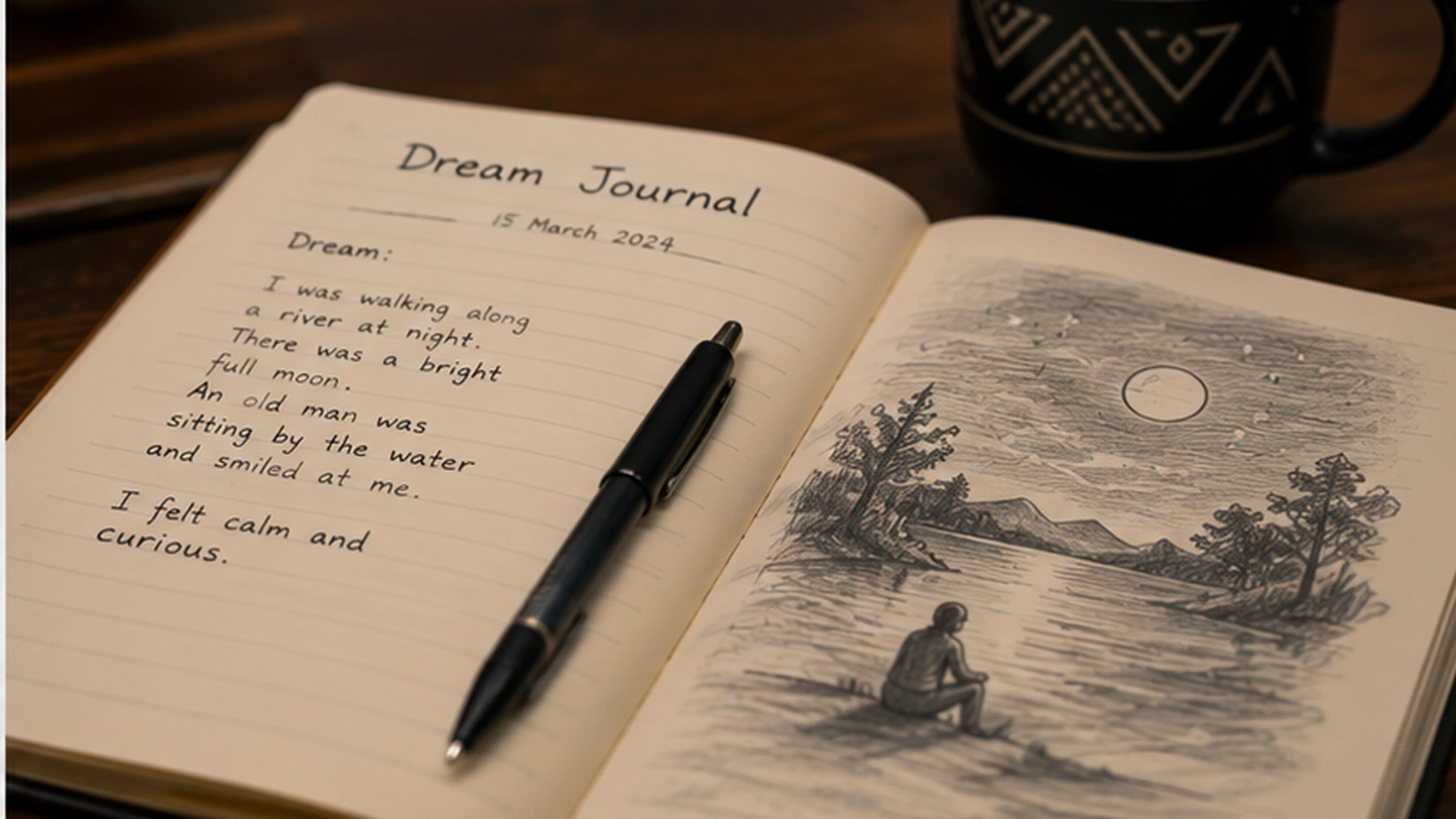
How to Start a Dream Journal
Choose a Format You Will Actually Use
A dream journal can be:
- A notebook beside the bed
- A secure notes application
- A password-protected document
- An audio recorder
- A printed template
- A combination of voice and writing
The best format is the one that can be used quickly and consistently.
Keep the Journal Within Reach
Place the notebook and pen beside the bed.
For digital recording, prepare the application before sleeping so that opening it requires minimal effort. Avoid becoming distracted by messages, news, or social media before recording the dream.
Set a Simple Intention Before Sleep
A person may quietly remind themselves:
“When I wake, I will pause and remember what I was dreaming.”
This is not a guarantee, but it can strengthen attention to dream recall.
Record Immediately After Waking
Do not wait until breakfast or the journey to work.
Even a delay of several minutes can reduce detail.
Begin With Fragments
A complete dream is not required.
Write whatever remains:
- “Red doorway”
- “Grandmother laughing”
- “Rain inside the house”
- “Fear, but no image”
- “Someone said my name”
Fragments may trigger additional memory later.
The Best Dream Journal Method
Step 1: Stay Still for a Moment
When waking naturally, remain still briefly if it is safe and comfortable.
Changing body position, checking the time, or thinking about the day may interrupt recall.
Step 2: Recover the Last Scene First
Begin with the final remembered moment.
Then move backward:
- What happened immediately before that?
- How did the dreamer arrive there?
- Who appeared earlier?
Step 3: Give the Dream a Temporary Title
Examples:
- “The Flooded School”
- “Grandfather at the Bus Station”
- “Flying Over Kampala”
- “The Silent Black Dog”
A title makes later review easier.
Step 4: Write the Narrative in Present Tense
Present tense can preserve the immediacy of the experience:
“I am standing beside a river. My sister is calling from the opposite bank.”
Past tense is also acceptable. Accuracy matters more than style.
Step 5: Record Emotion Separately
List emotions during the dream and after waking.
These may differ.
A dream may feel normal while it is happening but frightening after waking.
Step 6: Mark Uncertain Details
Use language such as:
- “I think…”
- “Possibly…”
- “The person looked like…”
- “I am not sure whether…”
This prevents uncertain memories from becoming fixed as facts.
Step 7: Add Waking Context Later
After recording the dream itself, add recent experiences that may be relevant.
Keeping the two stages separate reduces the risk of rewriting the dream to fit the interpretation.
What to Write in Every Entry
- Field
- What to record
- Date
- The morning date and approximate waking time
- Sleep context
- Bedtime, awakenings, unusual sleep, illness, travel, or medication changes
- Dream title
- A short descriptive name
- Narrative
- Events in the order remembered
- People
- Known people, strangers, deceased relatives, groups, or unclear figures
- Places
- Homes, roads, schools, workplaces, religious places, landscapes, or unknown settings
- Emotions
- Feelings during the dream and after waking
- Sensory details
- Sound, touch, movement, temperature, smell, colour, pain, or taste
- Exact words
- Any sentence, name, warning, song, or repeated phrase
- Strongest image
- The image that remained most clearly
- Waking connections
- Recent events, worries, media, travel, grief, work, family, or religious activity
- Cultural context
- A family, religious, linguistic, or community association that genuinely belongs to the dreamer
- Confidence
- How certain the dreamer is about the details
- Action
- Whether any safe reflection or practical follow-up is needed
A Simple Dream Journal Template
Date and waking time:
Dream title:
What happened:
People or beings present:
Location:
Strongest emotions during the dream:
Emotion after waking:
Sounds, colours, movement, touch, smell, or physical sensations:
Exact words remembered:
Recent waking events that may be connected:
Personal or cultural associations:
What remains uncertain:
Possible meanings, written as possibilities rather than facts:
Safe action, if any:
Example Dream Journal Entry
Date and waking time: 14 July, 6:20 a.m.
Dream title: The Closed Bridge
What happened: I am walking toward a bridge with my younger brother. The river is calm, but the bridge gate is locked. An older woman standing nearby says, “Not today.” We turn back without arguing.
People present: My younger brother and an older woman I do not recognize.
Emotions during the dream: Concern, patience, slight disappointment.
Emotion after waking: Calm but curious.
Strongest image: A red lock on the bridge gate.
Recent waking events: My brother and I discussed postponing a journey yesterday.
Possible personal association: The bridge may relate to the planned journey or another transition, but I cannot know that with certainty.
Safe action: Confirm the real travel plan and practical safety details. Do not assume the dream predicts danger.
This entry records the dream, identifies a possible waking connection, and avoids presenting the interpretation as proven.
How to Improve Dream Recall
Protect Enough Time for Sleep
Longer sleep opportunities may provide more opportunities for dream recall, including later-night REM periods. A diary study found that variations in sleep duration were associated with variations in dream recall. (Dream Recall, Dream Length, and Sleep Duration)
Dream journaling should not encourage sleep deprivation.
Avoid Reaching for the Phone Immediately
Messages and news introduce new thoughts before the dream has been recorded.
Use the phone only if it is the journal tool, and open the prepared recording application directly.
Record Every Fragment
Writing only dramatic dreams teaches the mind to ignore quieter material.
A one-line fragment still counts.
Review Without Forcing
Reading recent entries before sleep may increase attention to dreams, but repeated review should not become obsessive or interfere with rest.
Use Voice Notes When Writing Feels Too Slow
A voice note can preserve sequence and emotion quickly.
Transcribe it later and delete the recording if privacy is a concern.
Add Drawings or Maps
Some dreams are spatial rather than verbal.
A quick sketch of a room, road, compound, river, or route may preserve more than a paragraph.
Keep the Routine Gentle
A dream journal should support sleep, not turn every awakening into work.
When exhausted, record a title and three keywords, then return to sleep.
How to Review a Dream Journal Responsibly
Review Patterns, Not Isolated Symbols
Look across several weeks or months.
Ask:
- Which emotions repeat?
- Which places recur?
- Which people appear during periods of stress or change?
- Are nightmares linked with poor sleep, medication, grief, or media?
- Do certain dreams follow travel, religious events, family conflict, or illness?
Begin With Personal Associations
A snake may mean danger to one person and professional interest to a wildlife worker.
A river may represent home to one person and displacement to another.
The dreamer's lived experience comes before a generic dictionary.
Preserve Cultural Specificity
A dream may have a recognized meaning within a family, religious institution, or community.
Record the specific source of that meaning:
- “My grandmother explained…”
- “In our church…”
- “Within this Yoruba family tradition…”
- “According to this Islamic teacher…”
Do not label an interpretation simply “African,” “traditional,” or “spiritual” when a more precise description is available.
Keep Several Possible Explanations
A deceased relative in a dream may relate to grief and also be spiritually meaningful to the dreamer.
A frightening animal may reflect a recent video, a real environmental fear, and a symbolic association.
One possibility does not always eliminate another.
Separate Reflection From Evidence
A journal can reveal patterns in the dreamer's experience.
It cannot prove:
- Another person's guilt
- Witchcraft
- Infidelity
- Pregnancy
- A medical diagnosis
- Future death
- Guaranteed wealth
- Divine permission to harm someone
Paper, Digital, or Audio?
- Format
- Advantages
- Cautions
- Paper notebook
- Fast, private when stored safely, no screen distraction
- Can be lost, read by others, or damaged
- Notes application
- Searchable, easy to organize, can include photos or tags
- Requires strong device security and may invite distraction
- Password-protected document
- Searchable and suitable for long-term organization
- Password loss or cloud exposure can create access problems
- Voice recording
- Fast and useful for detailed narratives
- Voices may reveal identity; files require secure storage
- Printed template
- Encourages consistent fields
- May feel restrictive or omit unexpected details
- Drawing journal
- Preserves visual and spatial information
- May not capture words or sequence without notes
The journal format should match the dreamer's abilities, privacy needs, and routine.
Privacy and Ethical Boundaries
Dream journals can contain highly personal material involving:
- Family conflict
- Sexual experiences
- Religion
- Trauma
- Health fears
- Deceased relatives
- Private cultural practices
- Accusations
- Financial concerns
Protect the Journal
Consider:
- A locked drawer
- Device encryption
- A strong password
- Offline storage
- Neutral filenames
- Deleting temporary voice recordings after transcription
- Avoiding automatic public cloud sharing
Do Not Publish Other People's Private Information
A dream may include a real person's name or intimate details.
The dreamer owns the journal, but other people still have privacy and dignity.
Do Not Use the Journal to Build Accusations
Repeatedly dreaming about someone does not prove that the person is guilty, dangerous, spiritually harmful, or unfaithful.
Respect Restricted Cultural Knowledge
Do not copy private prayers, initiation details, ritual medicines, or restricted teachings into a public blog or social-media post without permission.
Dream Journals, Nightmares, and Therapy
A dream journal may help identify nightmare frequency and patterns.
It is not the same as treatment.
The American Academy of Sleep Medicine recommends imagery rehearsal therapy for nightmare disorder and PTSD-associated nightmares. The method involves changing the nightmare narrative and rehearsing a less distressing version while awake under an appropriate therapeutic framework. (AASM Position Paper for the Treatment of Nightmare Disorder in Adults)
Simply writing a frightening nightmare repeatedly is not automatically imagery rehearsal therapy.
For some trauma survivors, detailed repeated recording may intensify distress. A person should pause and seek qualified support if journaling causes:
- Panic
- Flashbacks
- Severe sleep avoidance
- Worsening self-harm thoughts
- Inability to function
- Intense dissociation

When to Seek Professional Support
Most dream journaling is harmless when it remains voluntary and balanced.
Professional support is appropriate when dreams or sleep experiences:
- Repeatedly disrupt sleep
- Cause fear of going to bed
- Follow trauma, violence, disaster, or bereavement and remain severely distressing
- Include commands to harm oneself or another person
- Occur with hallucinations while fully awake
- Create confusion between dreams and waking events
- Involve punching, kicking, shouting, or leaving the bed
- Cause injury to the dreamer or a sleeping partner
- Begin after a medication change
- Occur with choking, gasping, or serious breathing concerns
Dream enactment can be associated with REM sleep behaviour disorder and requires medical assessment rather than symbolic interpretation alone.
Spiritual or pastoral support may accompany professional care, but it should not replace medical or mental-health evaluation.
Common Dream Journal Mistakes
Waiting Too Long to Write
Delay allows details to fade and waking assumptions to enter the story.
Interpreting Before Recording
The interpretation can reshape the memory.
Record first. Reflect later.
Using a Universal Symbol Dictionary
Fixed formulas ignore personal, cultural, environmental, and religious context.
Recording Only Dramatic Dreams
Ordinary fragments may reveal patterns over time.
Treating Every Dream as Prophecy
A journal is a memory record, not a guaranteed forecasting system.
Ignoring Sleep and Health Information
Bedtime, medication changes, awakenings, stress, alcohol, illness, and breathing symptoms may be more important than symbolism.
Sharing Without Consent
A private dream involving relatives or religious matters should not automatically become public content.
Becoming Obsessed With Interpretation
If journaling creates anxiety, compulsive checking, or fear of sleeping, reduce or pause the practice and seek appropriate support.
A Seven-Day Dream Journal Starter Plan
Day 1: Prepare
Choose the journal format and place it beside the bed.
Day 2: Record One Fragment
Do not demand a complete dream. Write the smallest remembered detail.
Day 3: Add Emotion
Record how the dream felt during sleep and after waking.
Day 4: Add Sensory Detail
Note sounds, colours, movement, touch, temperature, or bodily sensations.
Day 5: Add Waking Context
After recording the dream, list one or two possible waking connections.
Day 6: Review Without Decoding
Look for repeated emotions or places without deciding what they “must” mean.
Day 7: Build a Sustainable Routine
Choose a simple format you can continue: full entry, short entry, or voice note.
Key Takeaways
- A dream journal preserves details before they fade.
- Recording dreams consistently may improve recall.
- The journal itself can influence recall, so it is an active practice.
- Free writing and structured prompts work well together.
- Record the dream before interpreting it.
- Include emotions, exact words, sensory details, uncertainty, sleep context, and recent waking events.
- Personal and culturally specific associations are more useful than universal symbol dictionaries.
- A journal can support creativity, grief reflection, and clinical discussion.
- Dream journaling does not prove prophecy, witchcraft, pregnancy, guilt, or future events.
- Protect privacy and do not publish other people's intimate information without consent.
- Nightmare journaling is not automatically therapy.
- Severe distress, trauma symptoms, hallucinations while awake, or dangerous dream enactment requires professional support.
People Also Ask
Does keeping a dream journal help you remember dreams?
It can. Research and methodological reviews note that regular dream recording may increase recall, especially among people who initially remember few dreams.
What should I write in a dream journal?
Record the narrative, people, places, emotions, sensory details, exact words, uncertainty, sleep context, and possible waking-life connections.
When is the best time to write a dream down?
Immediately after waking, before checking messages or beginning another activity.
Is a paper or digital dream journal better?
Neither is universally better. Choose the format that is quick, private, secure, and easy to use consistently.
Can dream journaling make nightmares worse?
It may intensify distress for some people, especially after trauma. Pause and seek professional support when writing causes panic, flashbacks, severe sleep avoidance, or worsening mental health.
Frequently Asked Questions
1. How do I start a dream journal if I never remember dreams?
Write down any fragment, emotion, image, or sense that remains after waking. Consistency may gradually improve recall.
2. Should I interpret the dream immediately?
Record it first. Interpretation can be added afterward so it does not change the original memory.
Frequently Asked Questions
What should readers know first about african spirituality and cultural history?
African spirituality and cultural history: Read clear guidance, key signs, practical steps, and private support from Ancestral Temple.
What causes keeping-a-dream-journal?
The safest next step is to compare the signs, prepare clear details, and request private guidance when the matter feels personal.
How does keeping-a-dream-journal work?
The safest next step is to compare the signs, prepare clear details, and request private guidance when the matter feels personal.
Is it possible to get private guidance for keeping-a-dream-journal?
The safest next step is to compare the signs, prepare clear details, and request private guidance when the matter feels personal.
How long does keeping-a-dream-journal take to understand?
The safest next step is to compare the signs, prepare clear details, and request private guidance when the matter feels personal.
Can keeping-a-dream-journal affect relationships, family, work, or personal peace?
The safest next step is to compare the signs, prepare clear details, and request private guidance when the matter feels personal.
Why do people seek spiritual guidance for keeping-a-dream-journal?
The safest next step is to compare the signs, prepare clear details, and request private guidance when the matter feels personal.
What signs should someone notice before asking about keeping-a-dream-journal?
The safest next step is to compare the signs, prepare clear details, and request private guidance when the matter feels personal.
When should someone contact a private spiritual guide?
The safest next step is to compare the signs, prepare clear details, and request private guidance when the matter feels personal.
What causes african spirituality and cultural history?
African spirituality and cultural history: Read clear guidance, key signs, practical steps, and private support from Ancestral Temple. The safest next step is to compare the signs, prepare clear details, and request private guidance when the matter feels perso
Article Information
- Publisher
- Ancestral Temple
- Editor
- Ancestral Temple
- Last updated
- Jul 26, 2026
- Last reviewed
- Jul 13, 2026
- Content version
- a5dc3df203
This educational article should be read as cultural and spiritual information, not as medical, legal, financial, or emergency advice.
Helpful Related Guidance
Explore This Topic
Dreams & Symbolism · Spiritual Protection After A Nightmare
Related Topic Cluster
African Spirituality And Cultural History
Complete Guide Why Homes Have Been Blessed Throughout HistoryAbout the Author
 Ancestral Temple
Spiritual guide and practitioner with decades of experience in ancestral wisdom, rituals, and divine guidance.
Related Posts
View All







Leave a Comment
We'd love to hear your thoughts.
This is a strong foundation for printable templates, nightmare journals, and lucid-dream diaries.
The conclusion made dream journaling feel gentle rather than compulsory.
The article clearly warned against making financial or relationship decisions from journal entries.
The five image placements are distributed well throughout the article.
I liked the reminder that enough sleep matters more than forcing dream recall.
The FAQ answer about voice notes was concise and useful.
The article challenged the habit of interpreting every dream immediately.
Could you write more about journals for recurring dreams after major life changes?
The sleep-context fields make the journal more useful than a list of symbols.
I appreciated that religious and psychological approaches were not treated as enemies.
This article will connect well with the broader dream interpretation knowledge hub.
The distinction between a nightmare journal and imagery rehearsal therapy was important.
I learned that structured prompts can capture details that free writing may miss.
The article was practical and avoided supernatural guarantees.
Please create a separate guide for keeping a secure digital dream journal.
The instruction to recover the last dream scene first was helpful.
The advice to keep cultural interpretations specific was respectful.
I liked the comparison between paper, digital, audio, and drawing formats.
The article correctly stated that a journal cannot prove witchcraft or betrayal.
Could you write about organizing a long-term dream journal by themes and dates?
I would like a guide to drawing dream maps for journeys and landscapes.
The section on grief dreams was compassionate and balanced.
The article explained why personal associations should come before generic symbol lists.
I appreciated the advice about trauma and pausing when journaling increases distress.
The example entry showed how to make a practical interpretation without claiming certainty.
Please write a future article about dream journaling after nightmares.
I learned that dream diaries can influence the amount of recall they are measuring.
The Quick Summary made the main steps easy to understand.
The warning about obsessive interpretation was necessary.
I liked the suggestion to use voice notes and transcribe them later.
Could you write more about recording proverbs and original-language words heard in dreams?
The seven-day starter plan feels manageable for a beginner.
The article respected spiritual reflection while keeping evidence and safety boundaries clear.
Please consider an article about dream journaling within Christian prayer routines.
Thank you for explaining that journaling can improve recall without proving prophecy.
The advice to record exact words before they fade was practical.
I would enjoy a follow-up about keeping a dream journal during grief.
The section on recording uncertainty was especially useful.
Could you create a downloadable one-page dream journal template for printing?
The article correctly warned against using journal entries to accuse another person.
I liked the distinction between a dream diary and a general sleep diary.
The privacy section was important because dream journals may contain very personal material.
Thank you for explaining that even one remembered emotion can be a valid entry.
The simple template makes it easier to begin without overthinking the process.
I appreciated the advice to record the dream before trying to interpret it.