
Family Blessings Across Generations
Cornerstone Content
Quick Summary
Family blessings can take the form of prayers, names, advice, stories, introductions, shared meals, and responsibilities passed from elders to younger relatives. This guide explores how such blessings operate in different African cultural and religious settings without treating the continent as one uniform tradition.
Family Blessings Across Generations explains the meaning, background and cultural context of family blessings across generations in clear educational language. The article answers the main topic near the beginning, preserves the original examples and highlights important distinctions for respectful understanding.
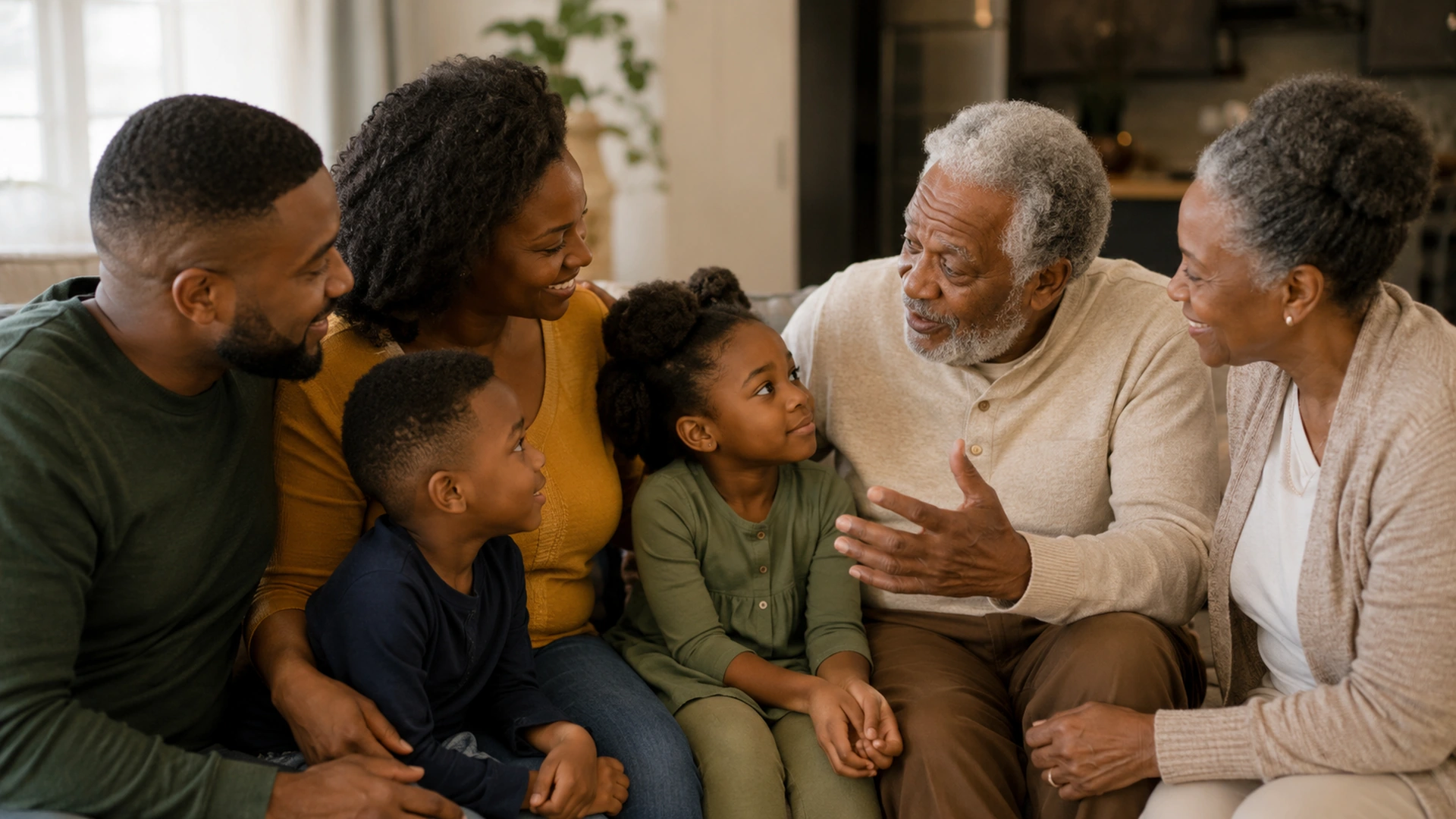
Family blessings are among the many ways families express hope, responsibility, affection, faith, and continuity. A blessing may be spoken by a grandparent, offered during prayer, communicated through a meaningful name, or expressed through advice given before an important life transition.
In some families, blessings are explicitly religious. In others, they are cultural, moral, or relational. They may involve Christian prayer, Muslim supplication, Indigenous religious practice, family storytelling, the remembrance of deceased relatives, or a combination of traditions shaped by local history.
There is no single system of “African family blessings.” Africa contains thousands of communities, languages, religious institutions, migration histories, and family structures. A Yoruba family in southwestern Nigeria, a Baganda family in central Uganda, an Ethiopian Orthodox household, and a Muslim family in coastal Senegal may understand blessing in very different ways.
Even within the same community, practices can differ according to denomination, lineage, age, gender, location, family history, and personal conviction.
This article therefore examines family blessings as a broad intergenerational idea while identifying specific cultural examples where reliable information is available.
Key Points
- Family blessings communicate hope, approval, responsibility, identity, and belonging.
- They may be given through words, prayers, names, stories, gifts, introductions, or acts of care.
- Elders often participate because of their experience or family position, but not every elder holds religious authority.
- Ancestors, living elders, divinities, family heads, priests, and recently deceased relatives are not interchangeable categories.
- Naming ceremonies are important occasions for intergenerational welcome in certain communities, including some Yoruba families.
- Oral traditions help families transmit values and collective memory.
- Christianity, Islam, Indigenous traditions, and secular family customs may coexist or influence one another.
- Traditions should be preserved with the consent and guidance of the communities that hold them.
Clear Definition
Family blessings across generations are words, prayers, values, names, responsibilities, or acts of goodwill passed between older and younger family members to express hope, belonging, guidance, and continuity.
Plain-Language Meaning
A family blessing is a way of saying:
“You belong to this family. We want good things for your life. Remember where you come from, live responsibly, and carry what is valuable into the future.”
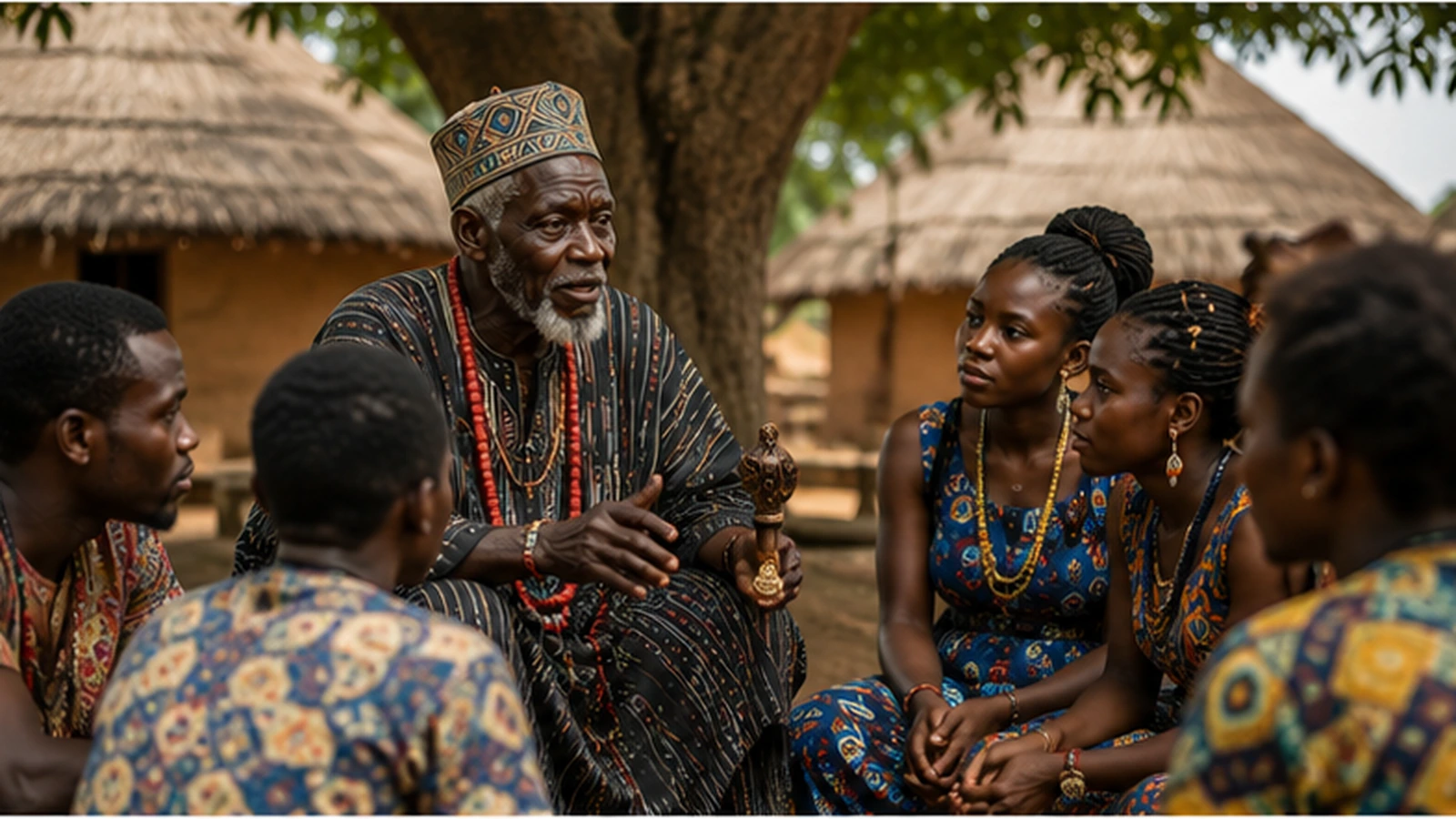
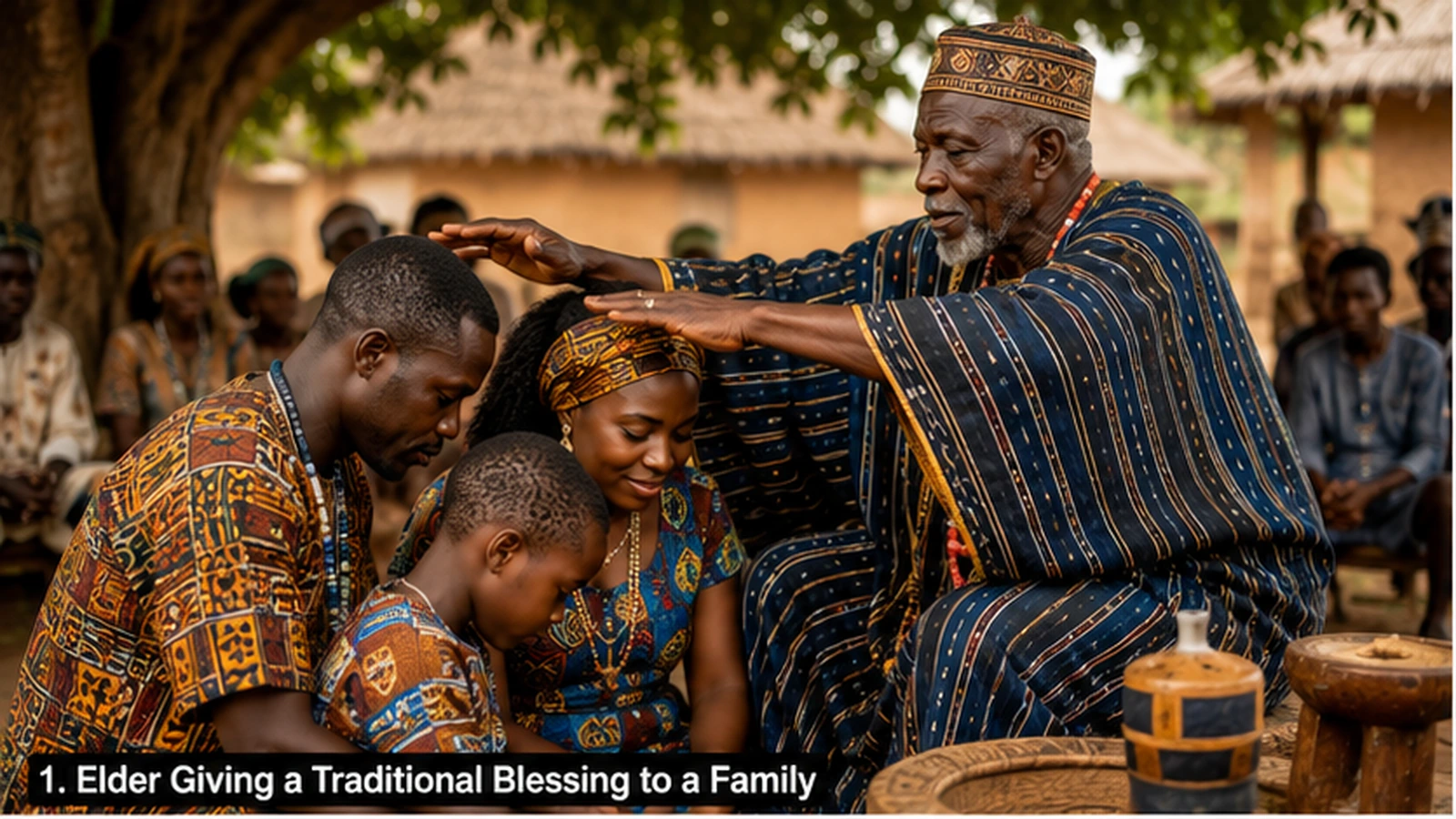
The blessing may be religious, but it does not have to be. A grandmother praying for a child, a father explaining the meaning of a family name, or an elder encouraging a young adult before marriage can all be forms of intergenerational blessing.
Why Family Blessings Matter
Family blessings often connect personal identity with a larger story.
A child may learn that their name remembers a relative. A young adult may receive advice based on challenges experienced by earlier generations. A family gathering may preserve stories about migration, work, marriage, conflict, faith, loss, or survival.
UNESCO explains that oral traditions transmit knowledge, cultural values, social values, and collective memory. These traditions include stories, proverbs, songs, prayers, chants, and other spoken forms. They do not merely preserve the past; they help communities interpret the present.
In this sense, a family blessing may carry several messages at once:
- You are welcomed.
- You are connected to others.
- You have responsibilities.
- Your life has value.
- Your actions affect the family.
- You should remember those who came before you.
- You should prepare something meaningful for those who come after you.
Common Forms of Intergenerational Blessing
Spoken Prayers and Good Wishes
The most recognizable blessing is a spoken prayer or wish.
A parent, grandparent, family head, religious leader, or respected relative may pray for health, wisdom, patience, peace, responsible adulthood, a safe journey, or harmony in marriage.
The words depend on the family’s religion and cultural background. A Christian family may pray in the name of God during a baptism, graduation, wedding, or departure. A Muslim family may offer supplications and Qur’anic expressions of goodwill. A family connected to an Indigenous religious tradition may use community-specific invocations or forms of acknowledgment.
These practices should not be blended together as though they are interchangeable. They are rooted in different theological understandings, institutions, languages, and histories.
Religious life across sub-Saharan Africa is highly diverse. Pew Research Center’s estimates for 2020 describe Christianity and Islam as the region’s largest religious affiliations while also noting that Indigenous beliefs and practices may be integrated into the lives of people who identify as Christian or Muslim.
Naming and Welcoming a Child
A name can function as a blessing when it communicates hope, remembrance, circumstances of birth, family history, gratitude, or religious commitment.
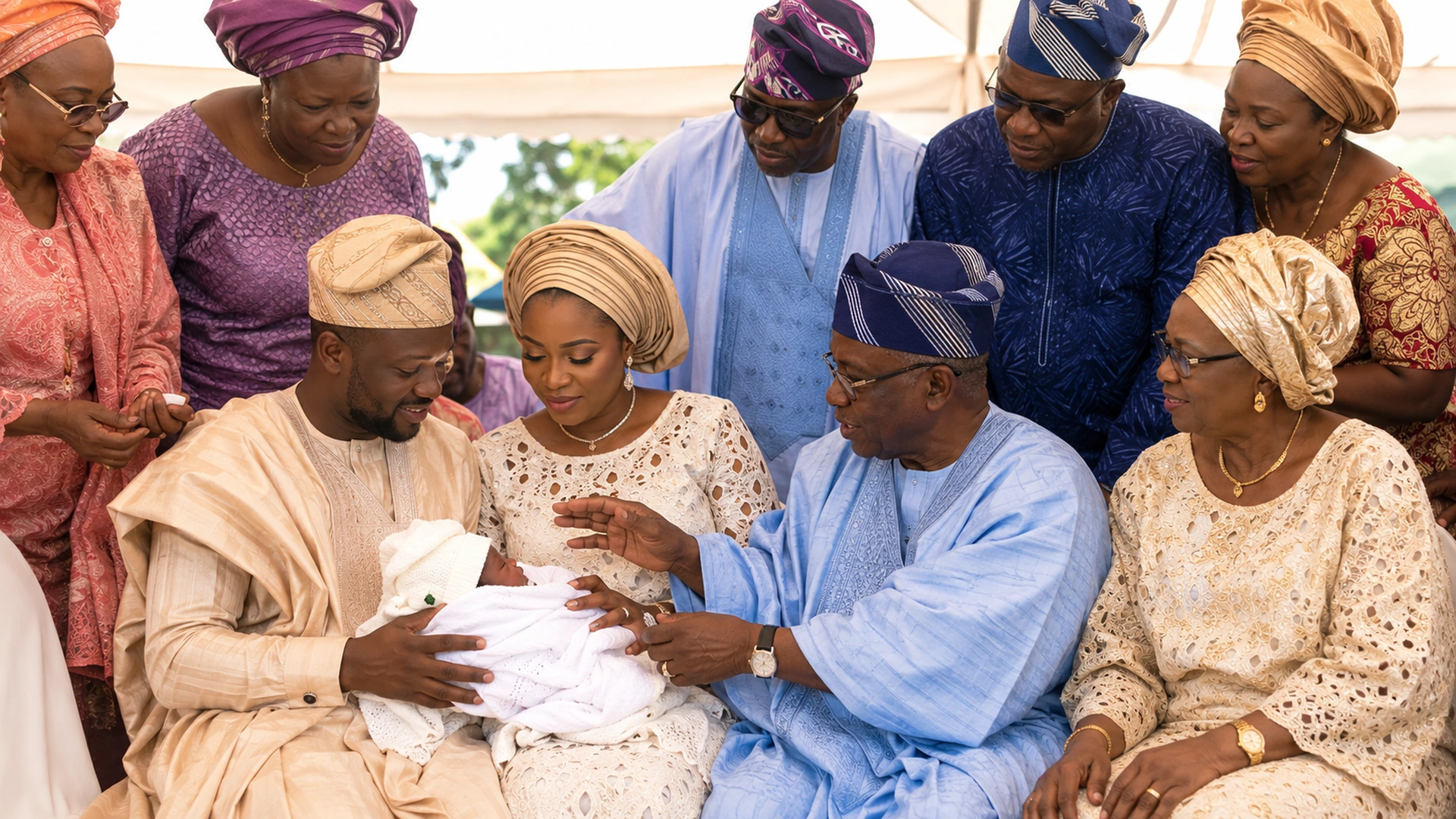
In some Yoruba families, naming is a formal occasion attended by relatives and friends. A Smithsonian Folklife account of a Yoruba naming ceremony in Washington, D.C., illustrates how family members gathered to welcome a child and participate in the naming process. The example also demonstrates how a tradition can continue in the diaspora while adapting to a new location.
Not every Yoruba family follows the same procedure. Christian, Muslim, and Indigenous religious affiliations may influence the timing, wording, leadership, and structure of a ceremony.
A meaningful name may connect a child with:
- Family circumstances
- Religious faith
- Hopes for the child’s character
- The memory of a relative
- A historical event
- The family’s language
- A place of origin
- Gratitude after difficulty or loss
However, naming a child after a deceased person does not automatically mean that the child is believed to be the same person reborn. Interpretations vary considerably.
Advice Before a Life Transition
Family blessings are frequently given before important transitions, including:
- Starting school
- Leaving home
- Entering adulthood
- Beginning employment
- Marriage
- Parenthood
- Migration
- Military or public service
- Religious initiation
- Assuming family responsibility
An older relative may combine a blessing with practical advice: respect others, manage money carefully, avoid destructive conflict, care for children, remember home, or seek help before a problem becomes unmanageable.
This advice may sound ordinary, but its importance comes from context. It is delivered as inherited experience rather than as an isolated opinion.
Stories, Proverbs, and Family Memory
Families bless younger generations not only by wishing them well but also by giving them knowledge.
Stories may explain:
- Why the family moved
- How land was obtained or lost
- Which occupations sustained earlier generations
- How relatives survived war, displacement, illness, or poverty
- Why a family follows a particular faith
- How a surname, clan, or praise name developed
- Which conflicts should not be repeated
- Which virtues the family seeks to preserve
UNESCO identifies mother languages as important carriers of values and knowledge, especially in oral traditions, songs, and rituals. When younger family members lose access to a family language, they may also lose proverbs, forms of address, praise expressions, and concepts that are difficult to translate fully.
Translation can preserve meaning, but families should also document the original wording whenever speakers are willing to share it.
Gifts and Material Inheritance
A blessing can be communicated through a gift.
The gift may be land, clothing, religious literature, family photographs, tools, jewelry, a household object, or a written record. Its financial value may be less important than its connection to a person or story.
A cooking pot may represent hospitality. A farming tool may remember work that sustained a household. A book may represent education. A piece of cloth may mark marriage, leadership, mourning, or belonging.
Not every inherited object is sacred. Families should avoid attaching religious meaning to an item without evidence from knowledgeable relatives or community custodians.
Service, Care, and Responsibility
Blessing also appears through action.
Grandparents may care for children. Adult children may support aging parents. Relatives may contribute to education, medical treatment, funerals, weddings, housing, or business development.
These forms of support can express intergenerational responsibility even when no ceremonial words are spoken.
At the same time, cultural expectations should not be used to excuse exploitation. Respect for elders does not mean that younger relatives must accept abuse, financial manipulation, forced marriage, secrecy, or unsafe demands.
The Role of Elders
Elders may be respected because of age, experience, family position, community service, or knowledge. However, age alone does not automatically make someone a priest, healer, diviner, medium, chief, or ritual specialist.
These roles must be distinguished carefully:
- An elder is usually an older or senior member of a family or community.
- A family head holds responsibility within a particular household or lineage.
- A chief occupies a recognized political or cultural office.
- A priest or religious leader serves within a defined religious institution.
- A healer may work with physical, herbal, spiritual, or combined systems of care.
- A diviner uses a culturally specific system to interpret questions or uncertainty.
- A medium is understood within some traditions as communicating with spirits.
- An ancestor is a deceased forebear who holds recognized ancestral status in a particular community.
- The recently deceased are not automatically regarded as ancestors.
Classic anthropological research has emphasized that ancestral relationships, where they exist, are often structured through kinship and social authority rather than being a vague belief that all dead people possess equal status.
Living Elders and Deceased Ancestors Are Not the Same
A blessing from a living grandparent is a direct act between living relatives.
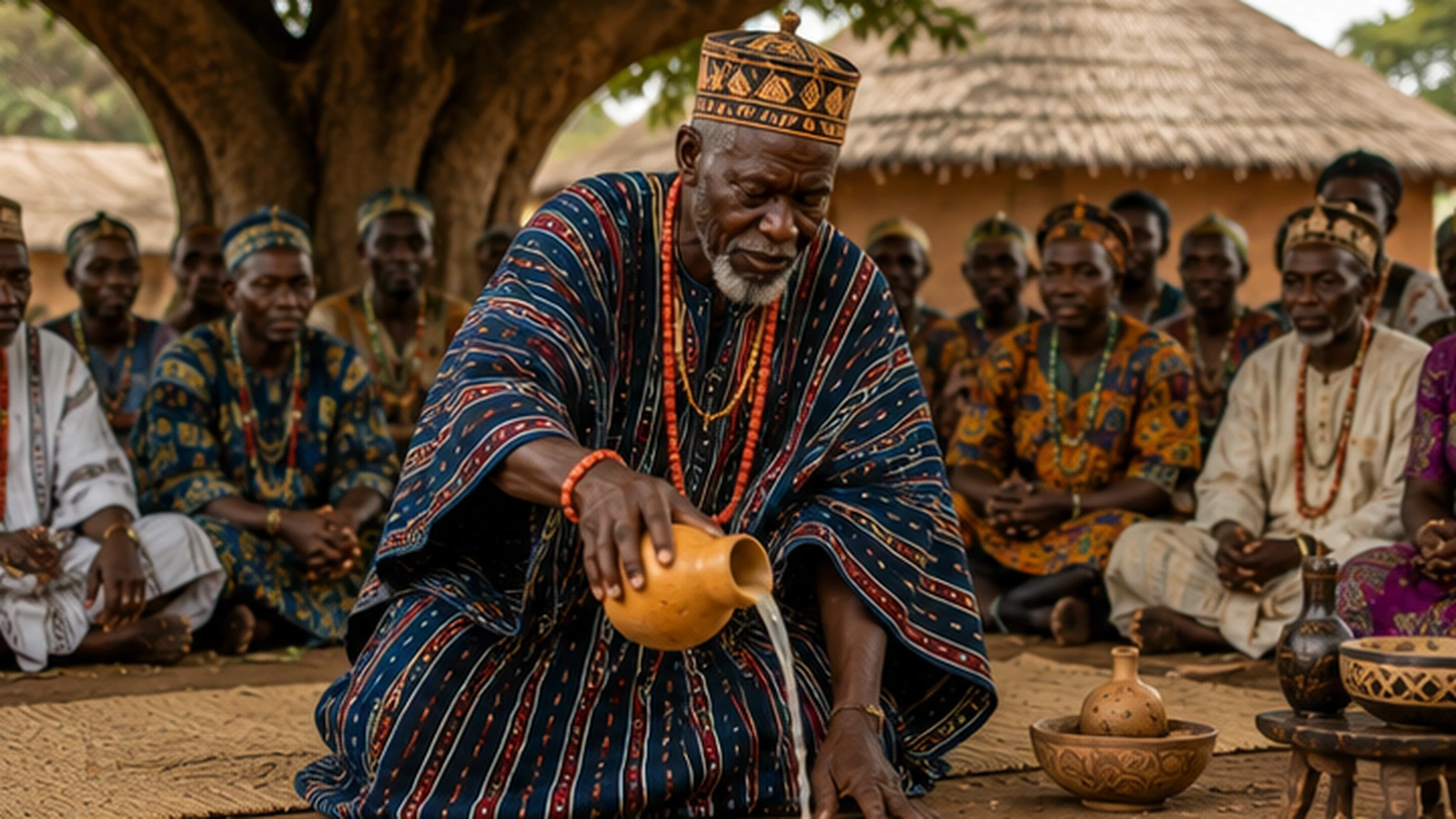
Ancestor reverence, where practiced, concerns relationships with certain deceased forebears. It may involve remembrance, moral obligation, family history, graveside observance, prayer, offerings, or ritual communication, depending on the community.
It is misleading to label every form of respect for ancestors as “ancestor worship.” The word worship may imply that ancestors are treated as supreme deities, which does not accurately describe every tradition.
It is also incorrect to assume that every African family venerates ancestors. Some Christian and Muslim families reject ritual communication with the dead while continuing to respect genealogy, visit graves, preserve names, and tell family stories.
Culturally Specific Examples
Yoruba Naming and Family Participation
Among particular Yoruba families, naming ceremonies welcome a child into a network of relatives and responsibilities. Names may refer to family circumstances, religious commitments, social expectations, or hopes for the child.
Relatives may contribute names, prayers, gifts, or words of guidance. The ceremony is therefore not only about selecting what the child will be called. It can also make the family’s acceptance of the child publicly visible.
The structure varies among regions and households. A ceremony led by Muslim relatives may differ from one organized by an Anglican, Catholic, Pentecostal, or Indigenous religious family.
The safest educational approach is to document the practice of a particular family or community rather than presenting one version as universally Yoruba.
Clan and Lineage Identity in Buganda
In Buganda, clan identity has historically been an important part of social belonging. Buganda heritage organizations describe the clan as a group connected through descent from a common ancestor and as a central institution within Ganda cultural identity.
A family blessing in this context may include teaching a child their clan identity, relationships, responsibilities, and marriage restrictions. It may also involve introducing younger people to relatives and places associated with family history.
Clan identity should not be reduced to a decorative totem or social-media symbol. Its meaning may include genealogy, responsibility, historical memory, relationships, and community organization.
Comparable clan systems also exist elsewhere in Uganda, but they should not be described as identical. For example, an official Hoima City cultural resource describes Banyoro clans as descent groups associated with shared ancestry and historical territorial organization.
Xhosa Kinship and the Rural Homestead
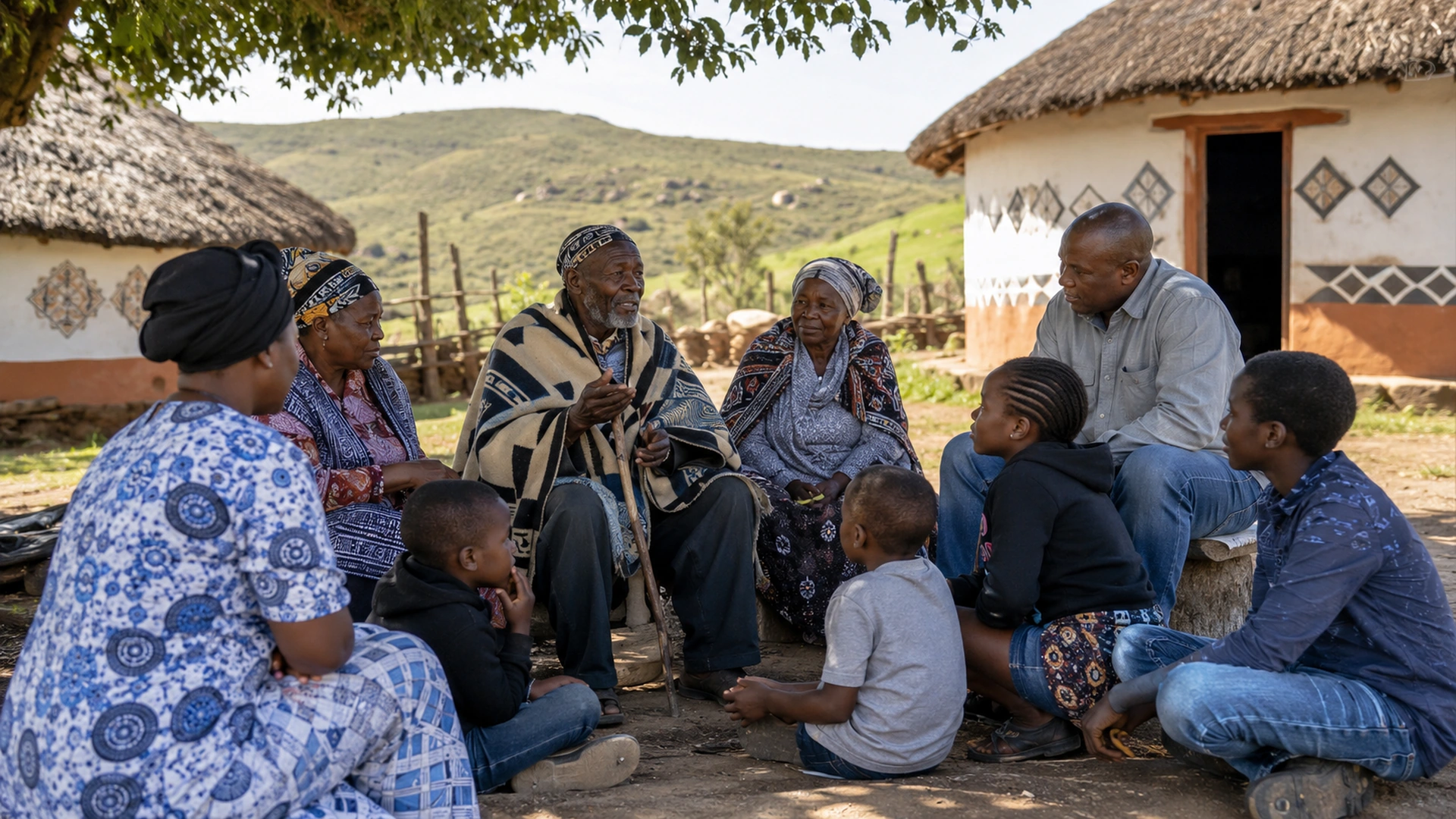
Research from South Africa’s Eastern Cape has examined how some Xhosa families use gatherings and ritual activity to maintain relationships between rural homesteads and relatives living in towns or cities.
Such occasions may reinforce kinship, responsibility, trust, and continued investment in the family home. They may include Christian prayer, ancestral acknowledgment, or combinations shaped by the family’s religious history.
This example shows that intergenerational blessing is not only about private spiritual experience. It can also concern land, residence, caregiving, migration, and the maintenance of relationships.
Royal Ancestry in the Historical Kingdom of Benin
Royal ancestral practice should not be confused with ordinary household customs.
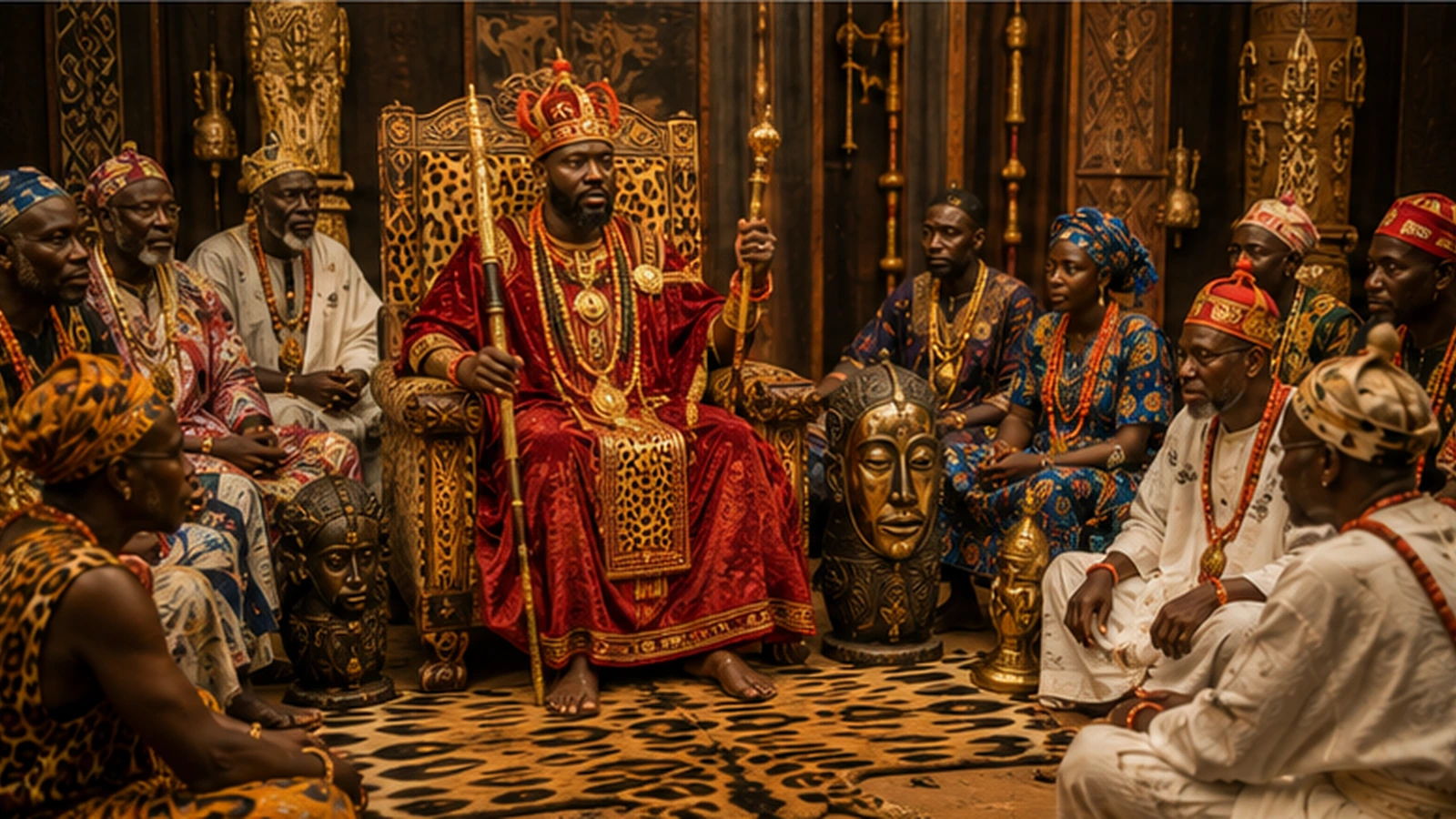
The Metropolitan Museum of Art explains that in the historical Benin court, a succeeding oba established a shrine for his deceased predecessor. This practice supported royal memory and dynastic continuity.
This is a specific court tradition connected to kingship. It should not be used as evidence that all Edo families—or all African families—maintained royal-style ancestral shrines.
The example is valuable precisely because it demonstrates why office, rank, and political institution must be considered when discussing ancestors.
Blessings in Christian Families
Christian families may bless children through baptism, dedication, confirmation, family prayer, Scripture reading, laying on of hands, or prayer before major decisions.
In many households, grandparents and parents pray for younger relatives during birthdays, weddings, school examinations, travel, illness, and bereavement.
Practices differ across:
- Ethiopian Orthodox Tewahedo communities
- Coptic Orthodox communities
- Roman Catholic families
- Anglican families
- African Independent Churches
- Pentecostal and Charismatic churches
- Lutheran, Methodist, Baptist, and Reformed communities
A family should not assume that a practice accepted in one denomination will be accepted in another.
Christian language may also coexist with older cultural forms such as praise names, family introductions, clan gatherings, or the use of local-language proverbs. Coexistence does not mean that every family interprets these forms in the same theological way.
Blessings in Muslim Families
Muslim families may use Qur’anic recitation, duʿāʾ, charitable giving, naming practices, greetings of peace, and prayers for guidance or protection.
Older relatives may bless younger family members by praying that they develop good character, religious discipline, lawful livelihoods, healthy marriages, and care for parents.
African Muslim communities are internally diverse. Practices among Hausa families in northern Nigeria, Swahili families along the East African coast, Somali families, Senegalese Sufi communities, and Muslim households in South Africa should not be treated as one identical culture.
A cultural custom associated with a Muslim-majority community should also not automatically be presented as a requirement of Islam.
Blessings in Indigenous Religious Contexts
Within some Indigenous African religious traditions, blessings may involve ancestors, divinities, family shrines, lineage authorities, sacred places, or qualified ritual specialists.
Public education must maintain boundaries.
It is appropriate to explain:
- The social purpose of a ceremony
- Who generally participates
- Its public history
- Its relationship to family or community identity
- How it has changed over time
It may be inappropriate to publish:
- Restricted prayers
- Initiation formulas
- Sacred names
- Private divination records
- Detailed ritual instructions
- Knowledge limited to office-holders
- Information shared under conditions of confidentiality
Indigenous religions in West Africa have changed through interaction with colonial rule, Christianity, Islam, urbanization, migration, and modern cultural movements. They should not be described as frozen remains of a distant past.
How Traditions Change Across Generations
Traditions are rarely copied without change.
A grandparent may have grown up in a rural extended household, while their grandchildren live in a city or another country. Ceremonies that once involved an entire village may become smaller family gatherings. A blessing once spoken only in a local language may be translated for younger relatives.
Change may occur because of:
- Migration
- Intercultural marriage
- Conversion
- Denominational change
- Formal education
- Urbanization
- Economic pressure
- Digital communication
- War or displacement
- Changes in family structure
- Loss of language
- New ethical or legal expectations
Adaptation does not automatically destroy tradition. It can help families preserve meaning under new conditions.
However, adaptation should be distinguished from invention. A newly created ceremony may be meaningful, but it should not be marketed as an unchanged ancient practice without evidence.
Family Blessings in the Diaspora
Families in the diaspora may preserve blessings through video calls, recorded prayers, online family groups, visits to places of origin, language lessons, naming practices, food, music, and storytelling.
Distance can make family history more intentional. Younger relatives may ask questions because they no longer live near the people or places connected to their heritage.
Diaspora families may also combine several traditions. A wedding might include a church service, a family introduction, regional clothing, prayers from grandparents, and a reception shaped by the country of residence.
The respectful question is not, “Is this perfectly traditional?” but:
- Which parts come from a documented community practice?
- Which parts are family adaptations?
- Who has authority to explain them?
- Have private elements been protected?
- Are different traditions identified honestly?
Preserving Blessings Responsibly
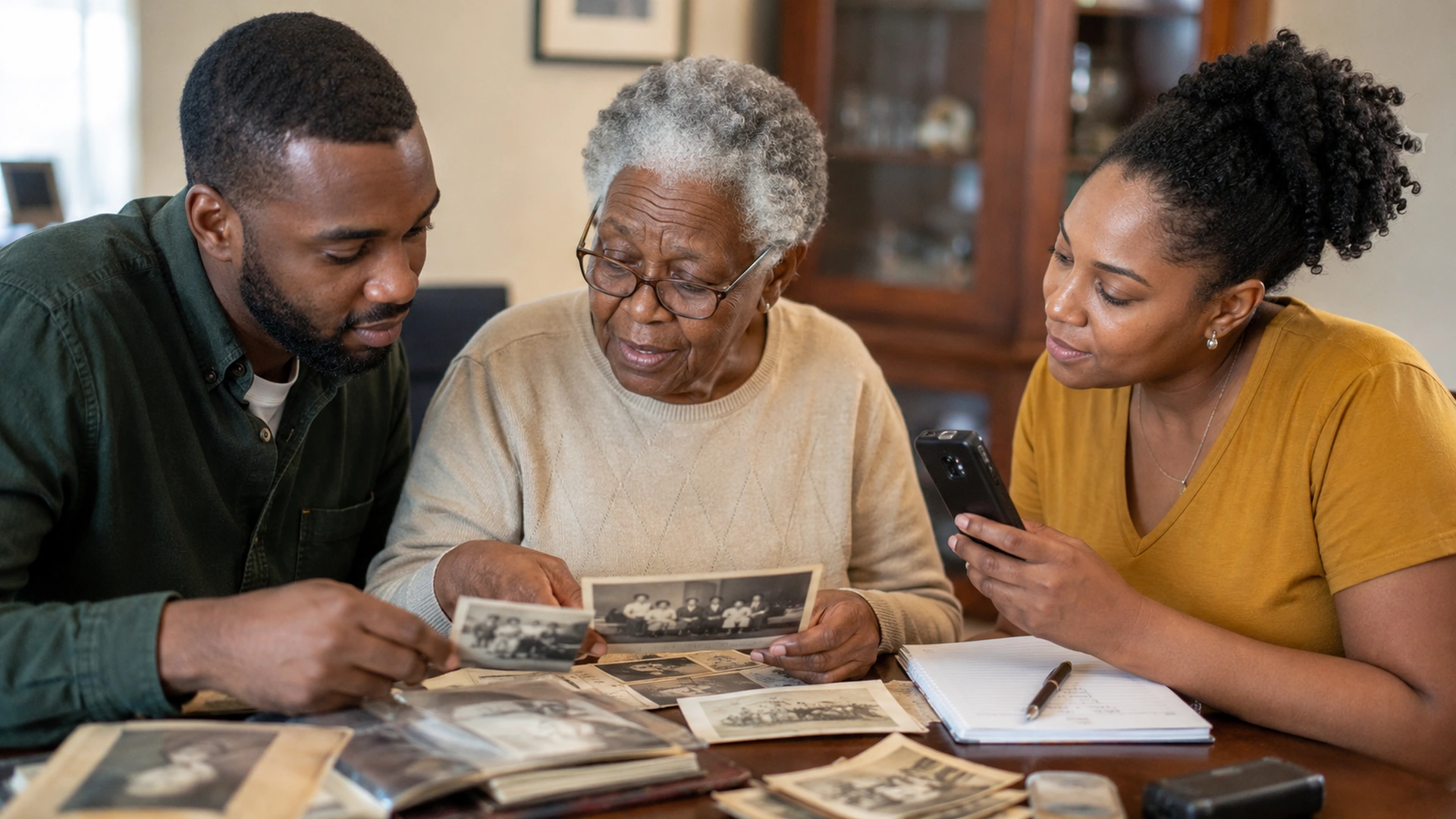
Record Family Stories With Consent
Ask relatives whether they are comfortable being recorded.
Explain:
- Where the recording will be stored
- Who can access it
- Whether it may be published
- Whether names should be removed
- Whether parts must remain private
Consent to a family recording is not automatically consent to post it publicly.
Write Down Names Correctly
Document:
- Full names
- Correct spelling
- Diacritical marks
- Pronunciation
- Language
- Meaning
- Who selected the name
- Why it was given
Avoid guessing a name’s meaning from an unrelated website.
Preserve Original Languages
When possible, record a blessing in both the original language and translation.
Some concepts cannot be carried fully into English. Tone, repetition, rhythm, honorifics, and kinship terms may contain additional meaning.
Identify the Speaker’s Authority
A relative may accurately describe their own family experience but may not speak for an entire ethnic group or religion.
Use wording such as:
“In our branch of the family…”
“In the village where I grew up…”
“In our church…”
“According to the practice taught by my grandmother…”
These phrases preserve valuable testimony without turning one person’s experience into a universal rule.
Separate Public and Restricted Knowledge
Before publishing a ceremony, ask whether it is:
- Public
- Family-only
- Gender-restricted
- Age-restricted
- Connected to initiation
- Restricted to an office-holder
- Sacred but publicly observable
- Sacred and non-public
Not everything that can be recorded should be uploaded.
Common Misconceptions
“All African Families Bless Children in the Same Way”
False. Practices differ among communities, religions, families, and historical periods.
“Every Elder Is a Spiritual Authority”
False. Elders may be respected for experience without holding ritual office.
“Every Deceased Relative Becomes an Ancestor”
False. Some traditions have specific conditions for ancestral status, while other families do not practice ancestor reverence.
“Ancestor Reverence Always Means Ancestor Worship”
False. Remembrance, respect, mediation, ritual communication, and worship are not identical concepts.
“Every Family Blessing Promises Wealth or Protection”
False. Many blessings emphasize wisdom, responsibility, peace, endurance, character, and belonging.
“A Blessing Replaces Practical Help”
False. Prayer and cultural support should not replace medical care, mental-health assistance, legal advice, financial planning, emergency services, or safety planning.
“Old Traditions Never Change”
False. Living heritage is transmitted across generations and continually interpreted in present circumstances. UNESCO defines living heritage as traditions and expressions inherited from earlier generations and passed to descendants.
Ethical and Safety Boundaries
Family blessings should never be used to justify:
- Forced marriage
- Abuse
- Financial exploitation
- Isolation from medical treatment
- Threats involving ancestors or spirits
- Control over another person
- Discrimination against children
- Dangerous ritual activity
- Secrecy around criminal conduct
- Claims of guaranteed healing or success
A person experiencing abuse or immediate danger should seek appropriate local emergency, medical, legal, or safeguarding assistance.
Traditional and spiritual practices may provide comfort and identity, but they do not guarantee pregnancy, wealth, healing, legal victory, business success, protection, or control over another person.
Key Takeaways
- Family blessings connect hope with responsibility.
- Blessings may be spoken, prayed, sung, written, named, gifted, or demonstrated through care.
- African communities should be discussed specifically rather than as one cultural system.
- Living elders, ancestors, divinities, priests, chiefs, healers, and family heads hold different roles.
- Oral traditions preserve cultural memory but should be recorded with consent.
- Naming can connect children with family identity and hopes for the future.
- Christianity, Islam, Indigenous traditions, and secular family customs may interact in complex ways.
- Restricted cultural knowledge should not be published without authorization.
- A blessing should support human dignity, never coercion or harm.
- The most enduring intergenerational blessing may be a combination of wise words, honest history, responsible care, and ethical example.
People Also Ask
What is an intergenerational family blessing?
It is a blessing, value, prayer, name, responsibility, or expression of goodwill passed between older and younger family members.
Why are elders involved in family blessings?
Elders may participate because of experience, family position, knowledge, or respect. However, not every elder is a religious or ritual authority.
Can a name be considered a blessing?
Yes. In some families, a name expresses hope, gratitude, memory, religious commitment, or connection to a relative.
Are family blessings always religious?
No. Some are religious, while others consist of advice, encouragement, family history, practical support, or moral responsibility.
How can diaspora families preserve blessing traditions?
They can record consenting elders, preserve language, document names, organize family gatherings, and clearly distinguish inherited traditions from modern adaptations.
Frequently Asked Questions
1. What do family blessings across generations mean?
They refer to prayers, advice, names, values, stories, responsibilities, and acts of goodwill passed between generations.
2. Do all African communities practice family blessings?
Families throughout Africa express goodwill and guidance, but the forms, meanings, and religious interpretations differ greatly. There is no single African blessing system.
Related Family Blessing Context
Family blessing traditions naturally connect with fertility blessings when communities speak about continuity, children, care, and the responsibilities shared across generations.
Frequently Asked Questions
What should readers know first about african spirituality and cultural history?
African spirituality and cultural history: Read clear guidance, key signs, practical steps, and private support from Ancestral Temple.
What causes Family Blessings Across Generations?
The safest next step is to compare the signs, prepare clear details, and request private guidance when the matter feels personal.
How does Family Blessings Across Generations work?
The safest next step is to compare the signs, prepare clear details, and request private guidance when the matter feels personal.
Is it possible to get private guidance for Family Blessings Across Generations?
The safest next step is to compare the signs, prepare clear details, and request private guidance when the matter feels personal.
How long does Family Blessings Across Generations take to understand?
The safest next step is to compare the signs, prepare clear details, and request private guidance when the matter feels personal.
Can Family Blessings Across Generations affect relationships, family, work, or personal peace?
The safest next step is to compare the signs, prepare clear details, and request private guidance when the matter feels personal.
Why do people seek spiritual guidance for Family Blessings Across Generations?
The safest next step is to compare the signs, prepare clear details, and request private guidance when the matter feels personal.
What signs should someone notice before asking about Family Blessings Across Generations?
The safest next step is to compare the signs, prepare clear details, and request private guidance when the matter feels personal.
When should someone contact a private spiritual guide?
The safest next step is to compare the signs, prepare clear details, and request private guidance when the matter feels personal.
What causes african spirituality and cultural history?
African spirituality and cultural history: Read clear guidance, key signs, practical steps, and private support from Ancestral Temple. The safest next step is to compare the signs, prepare clear details, and request private guidance when the matter feels perso
Article Information
- Publisher
- Ancestral Temple
- Editor
- Ancestral Temple
- Last updated
- Jul 26, 2026
- Last reviewed
- Jul 13, 2026
- Content version
- ffeb88a78b
This educational article should be read as cultural and spiritual information, not as medical, legal, financial, or emergency advice.
Helpful Related Guidance
Explore This Topic
Ancestor Reverence In African Cultures · Traditional African Ways Of Seeking Blessings
Related Topic Cluster
African Spirituality And Cultural History
Complete Guide Why Homes Have Been Blessed Throughout HistoryAbout the Author
 Ancestral Temple
Spiritual guide and practitioner with decades of experience in ancestral wisdom, rituals, and divine guidance.
Related Posts
View All

Leave a Comment
We'd love to hear your thoughts.
This was a thoughtful introduction to how families pass hope, responsibility, and identity from one generation to another.
The key takeaways summarized the topic well without oversimplifying it.
A follow-up about how family blessings are expressed in Francophone West African communities would be interesting.
The article gave me several ideas for interviewing my grandparents respectfully.
I appreciated the statement that prayer should not replace medical or mental-health support.
The checklist for identifying public and restricted knowledge was one of the strongest parts.
Could you add a future guide explaining praise names, surnames, and personal names separately?
The article would be useful for families trying to document their histories before older relatives pass away.
I liked the idea that practical support can itself be an intergenerational blessing.
The Yoruba naming example was presented carefully without claiming that every family follows one procedure.
The explanation of living heritage was useful. Traditions can adapt without losing all their meaning.
Please create an article about Luganda proverbs that relate to family responsibility and wisdom.
I found the safety boundaries responsible and appropriate.
The point about consent should also apply to family photographs and funeral recordings.
The article encouraged me to ask older relatives about the history of our family names.
The difference between preserving tradition and inventing an ancient history was well explained.
I would appreciate a future article focused on family blessings in Ethiopian Orthodox households.
The diaspora section reflects many conversations in families whose children understand English better than their grandparents’ language.
The article was informative without claiming that one practice represents the whole continent.
Could you write a related guide about wedding blessings across different Southern African communities?
I enjoyed the section on names as expressions of gratitude and family memory.
The warning against using tradition to excuse financial exploitation was necessary.
This article shows that religious faith and family culture can interact without being exactly the same thing.
The advice about preserving pronunciation and original-language meanings is very practical.
I would like to read more about how clan identity is taught to younger Baganda living abroad.
Thank you for separating ancestors, divinities, healers, and family heads. Those roles are frequently confused.
The mobile-friendly paragraphs made this long article easy to read.
Could you include more East African naming traditions in a future article?
My favorite section was about blessings being expressed through service and care, not only words.
I liked the point that a cultural practice associated with Muslims is not automatically a requirement of Islam.
The common misconceptions section could help many students who are beginning to study African religions.
A future article about family names and the stories behind them would connect well with this topic.
The discussion about African Muslim communities being diverse was a valuable addition.
I appreciated that the article did not present every elder as a ritual leader.
The explanation of cultural continuity was clear and easy to understand.
Please consider writing more about the role of aunts and uncles in passing family values to children.
The article made me think about the advice my grandmother gave me before I left home for university.
This was balanced and respectful. Muslim family blessings and prayers are often left out of broader discussions about African traditions.
I liked the reminder that inherited family objects are not automatically sacred objects.
Could you write a follow-up about how urban families preserve traditions when children grow up far from their ancestral villages?
The section about recording family stories with consent is important. People sometimes upload an elder’s words without asking permission.
Thank you for showing that Yoruba naming traditions can differ between Christian, Muslim, and Indigenous religious families.
The Buganda clan section was especially interesting. I would enjoy a separate article focused on introducing children to their clan history.
The distinction between living elders and ancestors was very helpful. Many articles combine the two without explaining the difference.
I appreciated the explanation that a family blessing does not always have to be a formal religious ceremony.