
Breakup Reconciliation Rituals: Spiritual Traditions for Healing and Reconnection
Pillar Article

Quick Summary
A breakup can feel like more than the loss of a partner. It may disrupt daily routines, shared friendships, family expectations, financial plans and a person's sense of identi...
A breakup can feel like more than the loss of a partner. It may disrupt daily routines, shared friendships, family expectations, financial plans and a person's sense of identity. Recent clinical writing describes severe breakup distress as a form of traumatic relational loss for some people, while relationship research shows that recovery varies widely. [11]
Because separation creates uncertainty, people often turn to prayer, family elders, sacred spaces, symbolic acts, apology letters, fasting, counselling or online rituals that promise an ex-partner's return. These practices do not belong to one universal tradition, and they do not have equal ethical value.
A responsible breakup reconciliation ritual cannot override another person's consent. It can create space for reflection, truth, apology, restitution and a decision about future contact. It cannot make someone love, forgive, answer messages or resume a relationship.
Quick Answer
A breakup reconciliation ritual is a spiritual, cultural or personal practice used after separation to process grief, acknowledge harm, seek forgiveness, communicate safely or decide whether reconnection is appropriate.
Healthy reconciliation requires mutual consent, honesty, changed behaviour and respect for boundaries. No ritual, prayer, candle, offering or practitioner can guarantee that an ex-partner will return. Where there has been violence, coercive control, stalking or threats, safety should come before mediation or reunion.
What Is a Breakup Reconciliation Ritual?
A breakup reconciliation ritual is a structured act intended to address separation and the possibility of renewed relationship. It may be religious, cultural, family-based or personally created.
Possible forms include:
The phrase bring back an ex ritual usually describes a different claim: that spiritual actions can compel a particular person to return. That promise conflicts with consent and cannot be guaranteed.
Healing, Reconciliation, Reconnection and Reunion
| Term | Meaning | Who decides? | Does it require romance? |
|---|---|---|---|
| Healing | Recovery of personal emotional and practical stability | Each person | No |
| Closure | Sufficient understanding or acceptance to move forward | Each person; it may occur without the ex | No |
| Forgiveness | A change in one's relationship to resentment or revenge | The person harmed | No |
| Reconciliation | Restoration of peaceful or workable relations | Everyone involved | No |
| Reconnection | Renewed communication or contact | Everyone involved | No |
| Reunion | Mutually resuming a romantic partnership | Both former partners | Yes |
| Trust | Confidence based on evidence of safety and reliability | The person deciding whether to trust | No automatic restoration |
A couple may reconcile enough to co-parent respectfully without reuniting romantically. Former partners may forgive each other and remain permanently separated. Someone may heal without receiving an apology.
These distinctions prevent spiritual language from turning every form of healing into pressure to resume the relationship.
Why Breakups Inspire Ritual
Breakups disrupt identity
Research on romantic separation suggests that recovery of self-concept matters for psychological well-being. People may ask, “Who am I without this relationship?” Ritual can mark the movement from a shared identity toward a reorganized personal life. [9]
Separation creates unfinished questions
People may not know whether the relationship ended because of temporary stress, incompatible values, betrayal, repeated conflict or abuse. A structured process can slow impulsive contact and make the questions more specific.
Apology needs a form
A person who caused harm may feel remorse but not know how to approach the injured partner. Religious and cultural traditions often provide language for confession, restitution and asking forgiveness.
Communities are affected
Breakups can involve children, relatives, shared property, workplaces, churches or friendship networks. Some cultures therefore treat reconciliation as a family or community concern rather than a private couple decision.
Symbolic closure can support action
Returning belongings, changing routines, deleting an unsent message or placing a written commitment in a safe place may help mark a decision. The symbol becomes useful when it supports behaviour; it does not magically control another person.
African Contexts: Family Meetings, Elders and Mediation
There is no single African breakup reconciliation ritual. African societies contain different kinship systems, religions, legal frameworks and attitudes toward marriage, dating and separation.
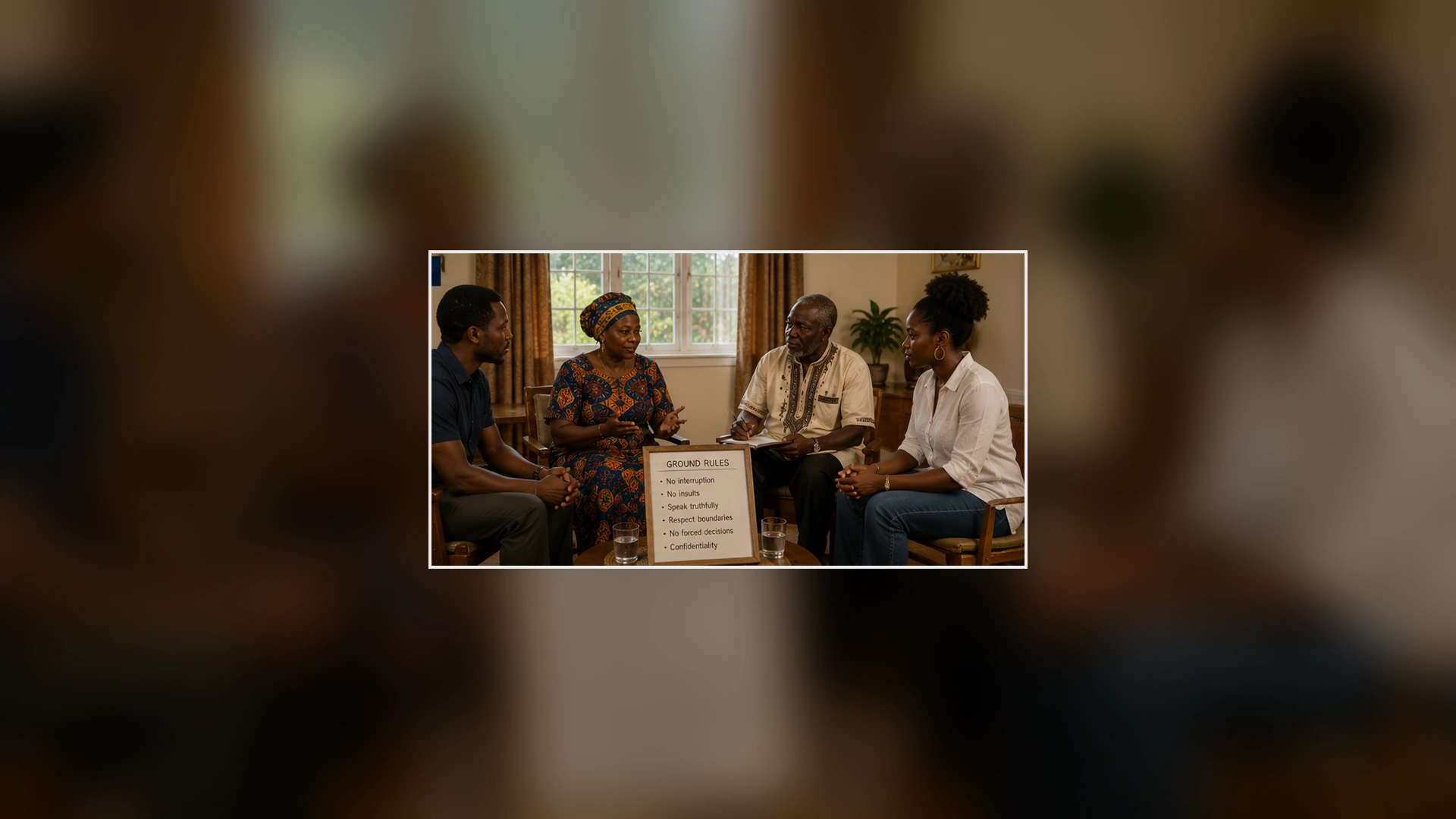
A Makerere University qualitative study of ten married women from Kampala and nearby towns found that family meetings could follow structured cultural protocols with elders serving as mediators and facilitators. The study was small and focused on married women, so it should not be generalized to every Ugandan family or to unmarried breakups. [1]
Research and practice on mediation in Uganda also emphasize competent facilitators, voluntary participation, trust and sensitivity to language, age, gender and power. A respected elder may understand family history, but age alone does not guarantee neutrality, confidentiality or skill. [2]
For former partners, a family meeting may be useful when:

Ho'oponopono: Making Relationships Right
Native Hawaiian ho'oponopono is often described online as repeating four short sentences. University of Hawai'i sources present a fuller tradition: making right, restoring goodness and peace within families and close groups, speaking truth and using ritual communication for healing. Knowledgeable facilitators, or haku ho'oponopono, may guide the process. [3]
Ho'oponopono is relevant to breakup reconciliation because it emphasizes responsibility and relational truth. It is not a technique for silently controlling an absent ex-partner.
A respectful application would require actual consent to a guided process. It would not assume that private repetition of phrases has bound the other person to return.

Jewish Teshuvah: Return, Restitution and Asking Forgiveness
In Jewish thought, teshuvah is often translated as repentance or return. Maimonides' Mishneh Torah teaches that interpersonal wrongs are not repaired by ritual observance alone. The person responsible must return what is owed, appease the injured person and ask forgiveness. [4]
This model is useful after a breakup because it places responsibility before reunion. Returning money or belongings is not the same as repairing humiliation, deception or harmful speech. The person responsible may also need to acknowledge the relational injury.
Teshuvah does not entitle someone to endless access. After appropriate attempts to repair, the injured person may still choose distance. Modern safety practice should also reject repeated approaches that become harassment, even when older texts discuss repeated requests for forgiveness.
A breakup-related teshuvah process might include:

Christian Reconciliation After Separation
Christian teachings about forgiveness differ across denominations, but many connect reconciliation with confession, repentance, justice and mercy. Catholic teaching distinguishes forgiveness from excusing wrongdoing and stresses that justice and responsibility remain necessary. [5]
A prayer for restoration should therefore not be a demand that God remove another person's freedom. It may ask for wisdom, humility, truth, healing and the courage to accept either reconciliation or a final separation.
Pastoral counselling can help former partners discuss:
Christian resources on domestic violence also warn that religious beliefs about forgiveness can pressure victims to remain in unsafe relationships. Forgiveness does not require reunion with an abusive person. [6]
Buddhist Beginning Anew
Plum Village's Beginning Anew is a four-part communication practice associated with conscious breathing, loving speech and compassionate listening. It is used to address misunderstandings before they accumulate and can support couples and families who are trying to restore communication. [7]
Beginning Anew is not a universal Buddhist ritual and does not guarantee reunion. Its value lies in slowing the conversation and changing how people speak and listen.
A former couple might use similar principles only when both freely agree:
Can a Ritual Bring an Ex Back?
No spiritual or cultural practice can reliably guarantee that a specific person will return. A former partner has the right to decline contact, forgiveness or reunion.
A ritual may affect the participant by creating calm, motivation or clarity. It may improve the quality of an apology. It may help a family organize a meeting. Those human effects are different from supernatural control over another person's decision.
Claims such as “your ex will call within 24 hours,” “pay again to remove resistance” or “the ritual has bound your partner” should be treated as warning signs of exploitation.
What Research Says About Breakup Recovery and Reconnection
Breakups are common but can produce significant distress. A 2026 clinical article describes severe breakup crises as traumatic relational loss for some people and recommends integrating grief-oriented, trauma-focused and relational approaches. [11]
Research on self-concept suggests that difficulty rebuilding a sense of self after separation is associated with poorer well-being. [9]
Contact with an ex is not automatically good or bad. In a study of recently separated adults, more frequent in-person contact predicted greater later separation-related distress among people without children. Another study found that monitoring an ex on Facebook was associated with greater distress, longing and lower personal growth. [8]
Repeated breakup-and-reunion cycles also deserve caution. Research links on-again/off-again relationship patterns with distress and recommends strengthening intentional decision-making, communication and attention to power or control dynamics before renewal. [10]
These findings do not create one universal “no-contact rule.” Co-parenting, shared work, property or community obligations may require contact. The important questions are purpose, safety, emotional effect and whether contact is consensual.
When Temporary No Contact May Help
A temporary no-contact boundary may help when:
No contact should not be used as a hidden tactic to punish or manipulate the ex into chasing. It is most responsible when it is a clear boundary for safety or recovery.
When Reconnection May Be Worth Considering
Reconnection may be reasonable when:
Longing alone is not evidence that the relationship has become safe or compatible.
Questions to Ask Before Contacting an Ex
A useful first message is brief and gives the other person a real choice:
I have reflected on how the relationship ended and would like to apologize and discuss whether a calm conversation would be useful. There is no pressure to reply. I will respect your decision and your boundaries.
A Respectful Reconnection Practice
The following is a modern, non-denominational structure. It is not an inherited ritual from any named community.
A reunion should follow evidence of change, not the emotional intensity of one meeting.
A Personal Breakup-Healing Ritual
The following modern practice is for personal reflection and closure. It does not contact or control the ex-partner.
Expressive writing is not automatically beneficial for everyone. One study found that emotionally expressive writing could worsen outcomes among some separated adults who were actively searching for meaning, so stop if the exercise increases rumination or distress. [12]
Apology Without Pressure
A responsible apology includes:
Example:
I lied about the debt and allowed you to make plans using false information. That damaged your trust and placed financial stress on you. I take responsibility. I have prepared a repayment schedule and will provide proof of each payment. I understand that you may not want contact or reconciliation, and I will respect that.
Avoid:
Abuse, Stalking and Coercive Control
Reconciliation rituals should never be used where one person cannot participate freely. The World Health Organization defines intimate partner violence to include physical aggression, sexual coercion, psychological abuse and controlling behaviours by a current or former partner. [13]
Do not arrange a joint ritual or mediation when there are threats, stalking, forced sex, strangulation, weapon access, intimidation, surveillance or fear of retaliation. Safety planning, specialized support and legal protection may be necessary.
A person who has been harmed does not owe forgiveness, a meeting, a final conversation or spiritual closure to the former partner.
Breakup-Reconciliation Scam Warning Signs
Be cautious when a practitioner:
An ethical spiritual service describes its tradition accurately, discloses fees and never guarantees control of another person.
Cultural and Ethical Boundaries
Do not invent a pan-African ex-return ritual
Ugandan family meetings, Yoruba religious traditions, Acoli restorative justice and other African practices are not interchangeable.
Do not reduce ho'oponopono to a spell
Its documented context involves families, close groups, facilitators, truth and responsibility.
Do not use repentance to demand access
Apology and restitution do not entitle the person responsible to renewed romance.
Do not confuse forgiveness with reconciliation
Someone may forgive privately while maintaining permanent distance.
Do not present contact as always necessary
Closure can occur without a final conversation, particularly where contact is unsafe or repeatedly destabilizing.
Common Misunderstandings
“If we still love each other, reunion is the right choice”
Love does not resolve incompatibility, dishonesty, violence or unequal goals.
“A powerful ritual can overcome resistance”
Resistance may be a person's clear refusal. Consent is not a spiritual blockage.
“No contact always makes an ex return”
No contact is a boundary or recovery strategy, not a guaranteed manipulation technique.
“Family elders should decide whether a couple reunites”
Elders may facilitate, but the former partners retain the decision.
“Forgiveness means restoring trust”
Trust requires evidence and may never return.
“One emotional meeting proves change”
Sustainable change is shown over time.
Key Takeaways
People Also Ask
What is a breakup reconciliation ritual?
It is a spiritual, cultural or personal practice used after separation to process grief, acknowledge harm, seek forgiveness, communicate safely or decide whether reconnection is appropriate.
Can a ritual make an ex come back?
No. A ritual cannot reliably or ethically override another person's consent or guarantee reunion.
Is reconciliation the same as getting back together?
No. Reconciliation can mean peaceful relations, respectful co-parenting or mutual closure without resuming romance.
What is ho'oponopono?
Ho'oponopono is a Native Hawaiian practice of making relationships right through guided truth-telling, responsibility and ritual communication within families and close groups.
What is teshuvah in a relationship?
Teshuvah involves stopping wrongdoing, acknowledging it, making restitution and asking forgiveness. The injured person still decides whether to forgive or renew contact.
Can family elders help former partners reconcile?
They may help when both former partners consent and the elders are fair, confidential and acceptable to both. Elders should not force reunion.
Should I contact my ex?
Consider the purpose, previous boundaries, evidence of change, safety and whether you can accept no response. Do not contact someone who has clearly asked you to stop.
Do on-again/off-again relationships cause distress?
Research associates repeated relationship cycling with distress and instability, although individual experiences vary.
Can someone forgive without taking an ex back?
Yes. Forgiveness does not require contact, trust or reunion.
Frequently Asked Questions
How long should I wait before contacting an ex?
There is no universal number of days. Wait until the purpose is clear, emotions are manageable, boundaries have been respected and contact would be safe.
Is a closure meeting necessary?
No. Some people gain closure from a conversation; others recover better without renewed contact.
Can prayer help after a breakup?
Prayer may support reflection, comfort and wise decision-making. It cannot guarantee another person's return.
Can couples counselling help former partners reunite?
Counselling may help people understand patterns and decide whether reunion is appropriate. It should not predetermine the outcome.
What if my ex blocks me?
Treat the block as a boundary. Do not use new numbers, fake accounts, relatives or spiritual claims to bypass it.
What if children require contact?
Use structured, child-focused communication and consider mediation or legal guidance. Co-parenting contact does not require romantic reconciliation.
What if a spiritual adviser guarantees reconciliation?
Do not rely on the guarantee. Ask for written fees and terms, protect your financial information and leave if pressure or threats begin.
When should I seek professional help?
Seek help when grief is overwhelming, daily functioning is deteriorating, the relationship involved trauma or abuse, or repeated reconciliation cycles continue despite serious harm.
Conclusion
Breakup reconciliation rituals reflect a real human need: the desire to make meaning after separation and to know whether a relationship can be repaired. Spiritual and cultural traditions can provide language for apology, restitution, prayer, listening and discernment.
Their value depends on honesty and freedom. A meaningful ritual cannot replace consent, erase abuse or prove that reunion is right. Sometimes healing leads to renewed partnership. Sometimes it leads to peaceful distance.
The safest question is not “How can I make my ex return?” It is: What truth, responsibility, boundaries and evidence would make any future contact healthy for both people?
Final Summary
A breakup reconciliation practice may help former partners communicate, apologize or decide what happens next. It should never promise control over another person's emotions.
Healthy reconnection is mutual, specific and supported by changed behaviour. Where there is coercion, stalking or violence, safety and separation take priority over ritual or reunion.
Article Information
- Publisher
- Ancestral Temple
- Editor
- Ancestral Temple
- Last updated
- Jul 30, 2026
- Last reviewed
- Jul 30, 2026
- Content version
- b661389971
This educational article should be read as cultural and spiritual information, not as medical, legal, financial, or emergency advice.
Helpful Related Guidance
About the Author
 Ancestral Temple
Spiritual guide and practitioner with decades of experience in ancestral wisdom, rituals, and divine guidance.
Related Posts
View All












Comments
We'd love to hear your thoughts.