
Exam Success Rituals: Urgent Prayers and Practices for Focus and Confidence
Pillar Article

Quick Summary
Exams can make even a prepared student feel as though everything depends on a single morning. The heart races, the mind jumps between topics and the desire for one powerful prayer...
Exams can make even a prepared student feel as though everything depends on a single morning. The heart races, the mind jumps between topics and the desire for one powerful prayer or ritual becomes urgent. A responsible exam-success ritual does not promise supernatural access to answers. It combines prayer or reflection with the study, sleep, honesty and calm execution that make success more likely.
| Quick Answer Say a short prayer for wisdom and steadiness, then take one practical step: test yourself on the highest-priority material, correct mistakes, prepare your exam items and sleep. In the exam room, breathe slowly, read instructions carefully and begin with questions you can answer. Prayer can strengthen meaning and confidence, but it cannot replace preparation or guarantee a result. |
|---|
What Is an Exam Success Ritual?
An exam success ritual is a repeatable sequence used to prepare the mind and body for study or performance. It may include prayer, a family blessing, breathing, arranging materials, reviewing a short list of priorities, drinking water and entering the exam room with a clear plan. The sequence matters because it turns a vague fear into specific actions.
The spiritual meaning depends on the person’s faith. A Christian student may pray for wisdom and honesty. A Muslim student may make du’a and begin with words already familiar in their religious life. A Hindu student may use a prayer learned from family or temple. A student from an African family may receive an elder’s blessing. A non-religious student may use silence, gratitude and a values statement. These practices should not be mixed into a single invented “universal ritual.”
A ritual cannot make unstudied information appear, identify leaked questions or force an examiner to award marks. Its realistic value is attention, emotional steadiness, ethical commitment and a smoother transition from preparation to performance.
Urgent Prayer for Exam Success, Focus and Confidence
| General Exam Prayer God of wisdom and truth, calm my fear and help me use what I have learned. Give me focus to read carefully, memory to recall what I understand, patience when a question is difficult and honesty in every answer. Guide my preparation, protect my health and help me accept the result without losing courage. May my effort become useful knowledge, and may I act with discipline, clarity and peace. Amen. |
|---|
This prayer is intentionally general. Use the language and forms authorized by your own faith. The prayer asks for wisdom and steadiness; it does not claim that faith removes the need to study or guarantees a particular grade.
A 15-Minute Urgent Practice When the Exam Is Soon
1. Stop collecting new materials. Put away extra websites, group chats and videos. Choose the syllabus, teacher’s revision guide or one trusted source.
2. Pray or breathe for one minute. Keep both feet on the floor. Inhale comfortably and exhale slowly. Do not force long breath holds if you feel dizzy.
3. Write the three highest-priority topics. Choose topics that are heavily weighted, repeatedly tested or still weak—not the easiest chapters.
4. Use retrieval, not rereading. Close the book and write everything you can remember about topic one. Then check and correct the gaps.
5. Answer two or three practice questions. Mark them immediately. Study the errors, not only the correct answers.
6. Prepare the next action. Decide exactly what you will study for the next 25–40 minutes, or stop and sleep if the exam is in the morning.
Why Active Recall Beats Passive Rereading
Retrieval practice means trying to recall or use information without looking at the answer first. Examples include practice questions, flashcards, explaining a process aloud, writing an outline from memory or solving a problem from a blank page. Research has repeatedly found that retrieval can produce stronger later learning than repeated exposure alone. [1][2]
Spacing means returning to material across separate sessions rather than repeating everything in one block. A major quantitative review found a robust distributed-practice effect, and later classroom research has also favored spaced over massed practice. [3][4]
For an urgent exam, spacing time is limited, but you can still create small gaps: test topic A, move to topic B, then return to A later. Correct feedback is essential. Repeating a wrong answer without checking it can strengthen the mistake.

The Night Before the Exam
| Time remaining | Best use of time | Avoid |
|---|---|---|
| More than 6 hours before bed | One or two focused retrieval blocks, practice questions and error review | Starting an entirely new textbook or copying long notes |
| 1–2 hours before bed | Prepare ID, pens, calculator where permitted, route, clothes, water and alarm | Arguing in group chats or searching for leaked papers |
| Final 30 minutes | Light review of a small error sheet, prayer, shower and wind-down | Energy drinks, intense cramming and bright-screen panic scrolling |
| At bedtime | Sleep rather than “just one more chapter” | All-night study unless an unavoidable emergency makes sleep impossible |
Healthy adults are generally advised to obtain at least seven hours of sleep regularly. Teenagers aged 13–18 are generally advised to obtain eight to ten hours, and children aged 6–12 nine to twelve hours. Individual needs vary, but deliberate all-nighters work against attention, emotional regulation and learning. [5][6]
The Exam-Morning Routine
1. Wake early enough to avoid rushing. Check the venue, start time and transport plan.
2. Eat a familiar meal if you normally eat before exams. Avoid experimenting with unfamiliar supplements, herbs or stimulant drinks.
3. Review one page only: formulas, key definitions, error patterns or an outline. Do not reopen the entire syllabus.
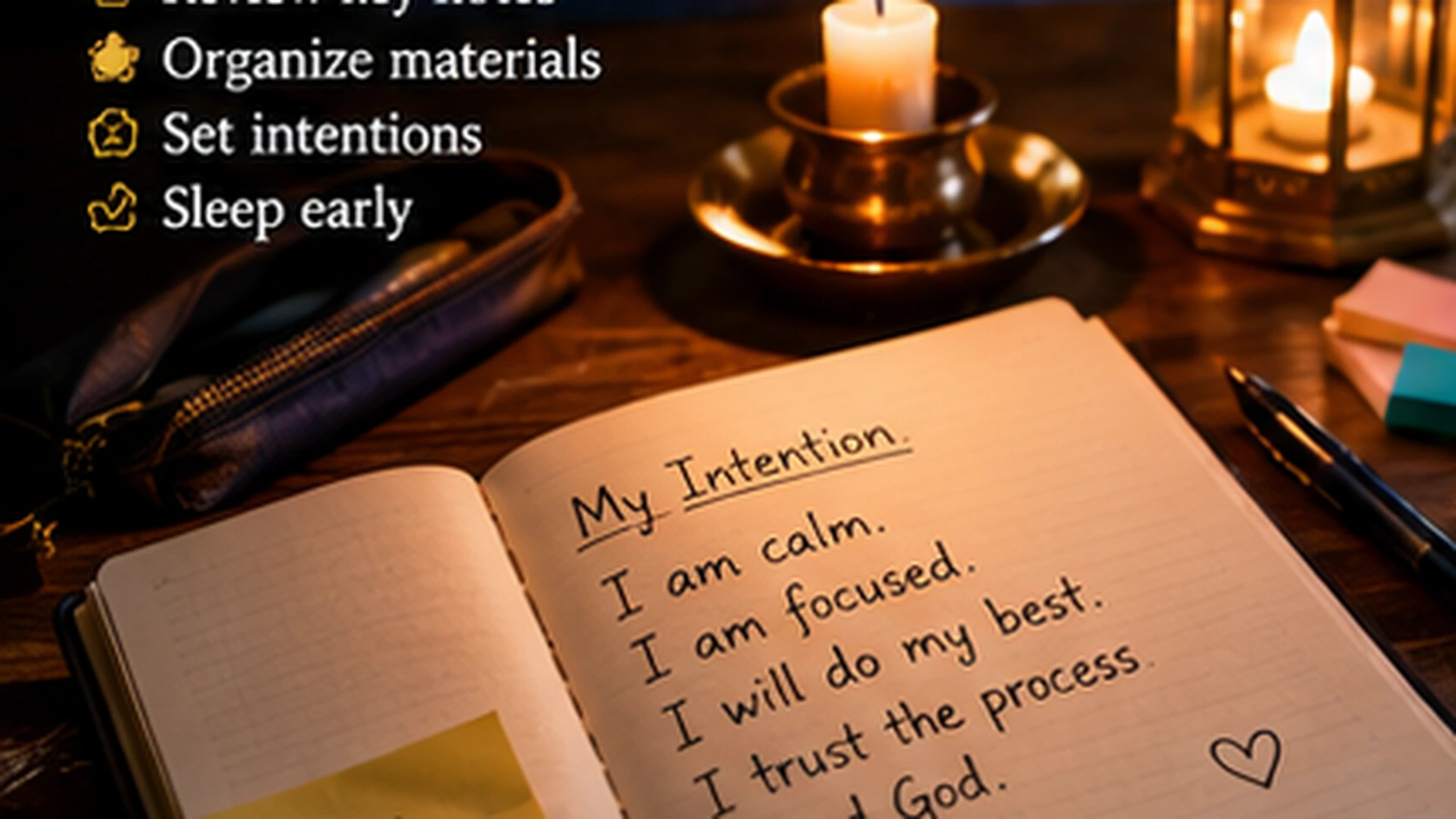
4. Say your prayer or intention: “I will read carefully, use what I know and remain honest.”
5. Carry permitted identification and materials. Leave unauthorized notes, phones or devices outside the exam process as required.
6. Arrive early enough to settle, but step away from panic-heavy conversations if they increase confusion.
Caffeine and Energy Drinks
Caffeine can increase alertness, but more is not always better. The U.S. Food and Drug Administration states that about 400 mg per day is not generally associated with negative effects for most healthy adults, while sensitivity varies greatly. Too much can cause anxiety, tremor, rapid heartbeat, nausea and sleep disruption. Energy drinks are discouraged for children and teenagers, and pure or highly concentrated caffeine can cause severe toxicity. [7][8]
For an exam, use only a familiar amount if caffeine is already part of your routine. Do not combine multiple energy products, use powdered caffeine or take another person’s medication. A racing heart caused by excessive stimulant use can feel like panic and reduce concentration.
A Five-Minute Practice for Test Anxiety
1. Name the response: “My body is activated because this matters.”
2. Release physical tension: lower the shoulders, loosen the jaw and place both feet on the floor.
3. Breathe gently: inhale normally and let the exhale become a little longer. Repeat without forcing breath holds.
4. Orient to the room: silently identify three things you see, two sounds and one physical sensation.
5. Choose the first task: read the instructions, write your name or begin with one answerable question.
Research on arousal reappraisal suggests that interpreting activation as useful preparation can improve performance in some settings. Brief breathing practices may reduce anxiety or physiological arousal, but findings vary, and no breathing pattern guarantees better marks. [9][10]
Single-session expressive writing is sometimes recommended before tests, but recent evidence is mixed. A meta-analysis found little reliable support for one brief writing session as a treatment for test anxiety. Use it only if it personally helps, not as a proven universal method. [11]
What to Do Inside the Exam Room
1. Read the instructions before answering. Check whether every question is required, how marks are allocated and whether calculators or extra sheets are permitted.
2. Scan the paper. Mark questions you can answer, questions that require work and questions you may return to.
3. Budget time by marks. A 20-mark question should not receive the same time as a 2-mark question.
4. Begin with a manageable question when the format allows. Early progress can reduce panic and create rhythm.
5. If your mind goes blank, pause for two slow breaths, write any relevant keywords and rebuild the answer from basic principles.
6. Leave space and return. Do not sacrifice the rest of the paper to one difficult item.
7. Use the final minutes to check names, question numbers, units, missing pages and accidental skipped items.
Faith-Sensitive Practices and Cultural Boundaries
| Context | Respectful option | Important boundary |
|---|---|---|
| Christian | Prayer for wisdom, peace, honesty and disciplined effort; familiar Scripture or a family blessing | Do not treat prayer as a bargain that guarantees marks or shame a student for anxiety |
| Muslim | Personal du’a, dhikr and familiar prayers such as asking God to increase knowledge | Do not use copied Arabic phrases as magic or mix them with unrelated rituals |
| Hindu | A prayer taught by family, temple or tradition before study or examination | Do not invent mantras, fire offerings or deity claims without cultural authority |
| African family/community | An elder’s blessing, prayer, encouragement or meal before the exam | There is no single universal “African exam ritual”; practices differ by family, faith and community |
| Non-religious | Breathing, gratitude, values statement, prepared materials and quiet reflection | Do not present psychological techniques as guaranteed performance enhancers |
A Parent or Elder’s Blessing for a Student
| Family Blessing May your mind be clear, your body steady and your effort honest. May you remember what you have learned, read every question carefully and remain courageous when the work is difficult. We bless your discipline, not only the result. Whatever the grade, may this exam become one step in wisdom, responsibility and future opportunity. |
|---|
When Preparation Is Incomplete
Panic often creates the fantasy that one secret ritual can replace missing study. A better emergency strategy is triage: identify the highest-value topics, retrieve what you already know, learn core definitions or methods, practice representative questions and stop before exhaustion destroys accuracy.
Study likely high-weight topics, but do not rely on rumors or leaked questions.
Learn the structure of good answers: definitions, steps, evidence, examples and conclusions.
Secure partial marks by knowing core formulas, units, vocabulary and methods.
Ask the teacher or institution about legitimate support when illness, disability or crisis affected preparation.
Accept that one exam may not go perfectly. Ethical recovery is better than cheating, dangerous stimulants or financial exploitation.

What Exam Success Rituals Cannot Do
They cannot guarantee a pass, distinction, scholarship or admission.
They cannot reveal future questions or change an examiner’s marking unfairly.
They cannot replace sleep, study, practice, identification or arriving on time.
They cannot make unauthorized notes, impersonation, leaked papers or electronic assistance acceptable.
They cannot prove that poor performance was caused by a curse, jealous person or weak faith.
They cannot replace medical or psychological care for severe anxiety, fainting, persistent insomnia or other health problems.
Scam and Exploitation Warnings
Students and families under pressure may be targeted by people promising guaranteed grades, leaked papers, special spiritual access or urgent curse removal. Treat the following as serious warnings:
A guaranteed pass, exact score or rank in exchange for money.
Claims that failure is certain unless a ritual is paid for immediately.
Repeated demands for larger payments to “complete,” “seal” or “activate” the work.
Requests for exam portal passwords, identity documents, intimate images or access to accounts.
Instructions to burn books, school documents, medication or personal property.
Pressure to keep payments secret from parents, teachers, banks or trusted adults.
When to Seek More Help
Ask for qualified help when anxiety repeatedly causes vomiting, fainting, panic attacks, inability to sleep, avoidance of school or inability to complete exams. A clinician, school counselor, disability service or trusted educator can assess whether therapy, accommodations or treatment may help. Seek urgent assistance when there is chest pain, severe breathing difficulty, collapse, medication misuse or thoughts of self-harm.

Key Takeaways
Prayer can support meaning, calm and confidence, but does not replace preparation or guarantee a grade.
Active recall, practice questions, correction and spaced review are stronger than passive rereading alone.
Sleep is part of preparation; all-night cramming can undermine attention and emotional control.
Use familiar caffeine cautiously and avoid energy drinks for young people, unknown stimulants and concentrated caffeine.
Interpret nervous activation as a signal to begin a clear process, not proof that failure is inevitable.
Academic honesty, safety and practical support are part of any responsible spiritual practice.
People Also Ask
What is a powerful prayer for exam success?
A responsible prayer asks for wisdom, calm, memory, honesty and disciplined effort. It should not promise a particular score or replace study.
Can prayer help you pass an exam?
Prayer may help some students feel grounded, hopeful and focused. Passing still depends on preparation, understanding, health, exam conditions and performance.
What should I do if the exam is tomorrow?
Prioritize high-value topics, use active recall and practice questions, prepare your materials, stop caffeine late in the day and sleep rather than studying all night.
How can I calm down five minutes before a test?
Lower your shoulders, breathe gently with a slightly longer exhale, notice the room and choose the first simple action—such as reading instructions or answering one manageable question.
Is it better to sleep or study all night?
For most students, sleep is the better choice once late-night study becomes exhausted and inaccurate. Sleep supports attention and learning, while deliberate all-nighters can impair performance.
Can I pray for my child before an exam?
Yes. A family blessing can affirm effort, courage, honesty and unconditional support. Avoid making the child feel that a disappointing grade would mean weak faith.
Frequently Asked Questions
What objects are needed for an exam ritual?
None are required. A glass of water, prepared pens, a closed prayer book, an LED candle or a simple study plan may help create order, but more objects do not increase spiritual power.
Should I light a candle before studying?
Only where it is safe and permitted. An LED candle or ordinary lamp carries the same symbolic meaning without open-flame risk.
What if my mind goes blank in the exam?
Pause, breathe twice, write relevant keywords, begin with basic definitions or formulas and return later if necessary.
Does rereading notes count as studying?
It can help with orientation, but it often creates familiarity without reliable recall. Close the notes and retrieve, solve or explain the material.
Should I use energy drinks before an exam?
Young people should avoid them, and adults should be cautious. High caffeine can worsen anxiety, palpitations and sleep loss.
Can I study while praying continuously?
Use prayer to frame the work, then give full attention to retrieval and practice. Constant switching may reduce concentration.
What if I have not covered the syllabus?
Triage the highest-value content, learn core principles and practice representative questions. Do not seek leaked papers or dangerous shortcuts.
Is exam anxiety a sign that I will fail?
No. Some activation is normal. The goal is not zero anxiety but enough control to read, recall and act.
Can a spiritual leader guarantee my result?
No ethical spiritual leader can guarantee a grade, rank or admission. Guarantees and urgent payment demands are warning signs.
What should I do after the exam?
Eat, rest and avoid obsessive answer comparison. Record useful lessons later, then prepare for the next responsibility.
Can I ask for accommodations for anxiety?
Policies vary, but students with significant, documented difficulties can ask their institution about legitimate support or accommodations.
What matters more: confidence or knowledge?
Both help, but confidence cannot substitute for knowledge. The best confidence comes from preparation, practice and a realistic process.
Conclusion
An exam-success ritual should make a student more prepared, honest and steady—not more dependent on promises. Pray for wisdom, test what you know, correct mistakes, prepare the practical details and protect sleep. When the paper begins, focus on the next question rather than the entire future. Success may mean a high grade, but it also means disciplined learning, ethical effort and the courage to continue after any result.
Article Information
- Publisher
- Ancestral Temple
- Editor
- Ancestral Temple
- Last updated
- Jul 30, 2026
- Last reviewed
- Jul 30, 2026
- Content version
- a22af99254
This educational article should be read as cultural and spiritual information, not as medical, legal, financial, or emergency advice.
Helpful Related Guidance
About the Author
 Ancestral Temple
Spiritual guide and practitioner with decades of experience in ancestral wisdom, rituals, and divine guidance.
Related Posts
View All












Comments
We'd love to hear your thoughts.