
What Are the Twelve Zodiac Signs? Dates, Order and Meanings
Quick Summary
The twelve zodiac signs form a symbolic system of twelve equal thirty-degree divisions used in Western astrology. This guide explains their dates, symbols, elements, modalities, rulers, history, cultural variations, common meanings, misconceptions, and scientific limits.
The twelve zodiac signs in standard tropical order are Aries, Taurus, Gemini, Cancer, Leo, Virgo, Libra, Scorpio, Sagittarius, Capricorn, Aquarius and Pisces. Each sign is a thirty-degree division of the zodiac with traditional dates, an element, a modality and symbolic meanings. These signs are not the same as uneven astronomical constellations.
The twelve zodiac signs are among the most recognizable symbols in modern astrology. Aries, Taurus, Gemini, Cancer, Leo, Virgo, Libra, Scorpio, Sagittarius, Capricorn, Aquarius, and Pisces appear in birth charts, calendars, jewelry, social media, newspapers, and popular discussions about personality.
A zodiac sign, however, is not simply a personality category.
In Western astrology, each sign is one of twelve equal thirty-degree divisions of the zodiac. Together, the twelve signs form a 360-degree circle centered on the ecliptic—the apparent yearly path of the Sun across the sky. The Moon and visible planets also remain relatively close to this region because the major bodies of the solar system move within broadly similar orbital planes.
The familiar twelve-sign system developed through a long history of Mesopotamian observation, Babylonian mathematical astronomy, Hellenistic interpretation, Egyptian adaptation, Indian transformation, Islamic scholarship, European transmission, and modern popular culture.
A Late Babylonian clay tablet dated to about 500 BCE lists months together with their associated zodiac signs. Other surviving Babylonian and Neo-Assyrian tablets contain zodiac calculations, astronomical reports, constellation imagery, and early personal horoscopes.
This guide explains the signs in their standard tropical order, including their approximate dates, symbols, elements, modalities, traditional rulers, common astrological themes, strengths, and possible challenges.
These descriptions belong to astrological traditions. They are not scientifically established personality laws, and no sign determines a person’s moral character, intelligence, health, relationships, or future.
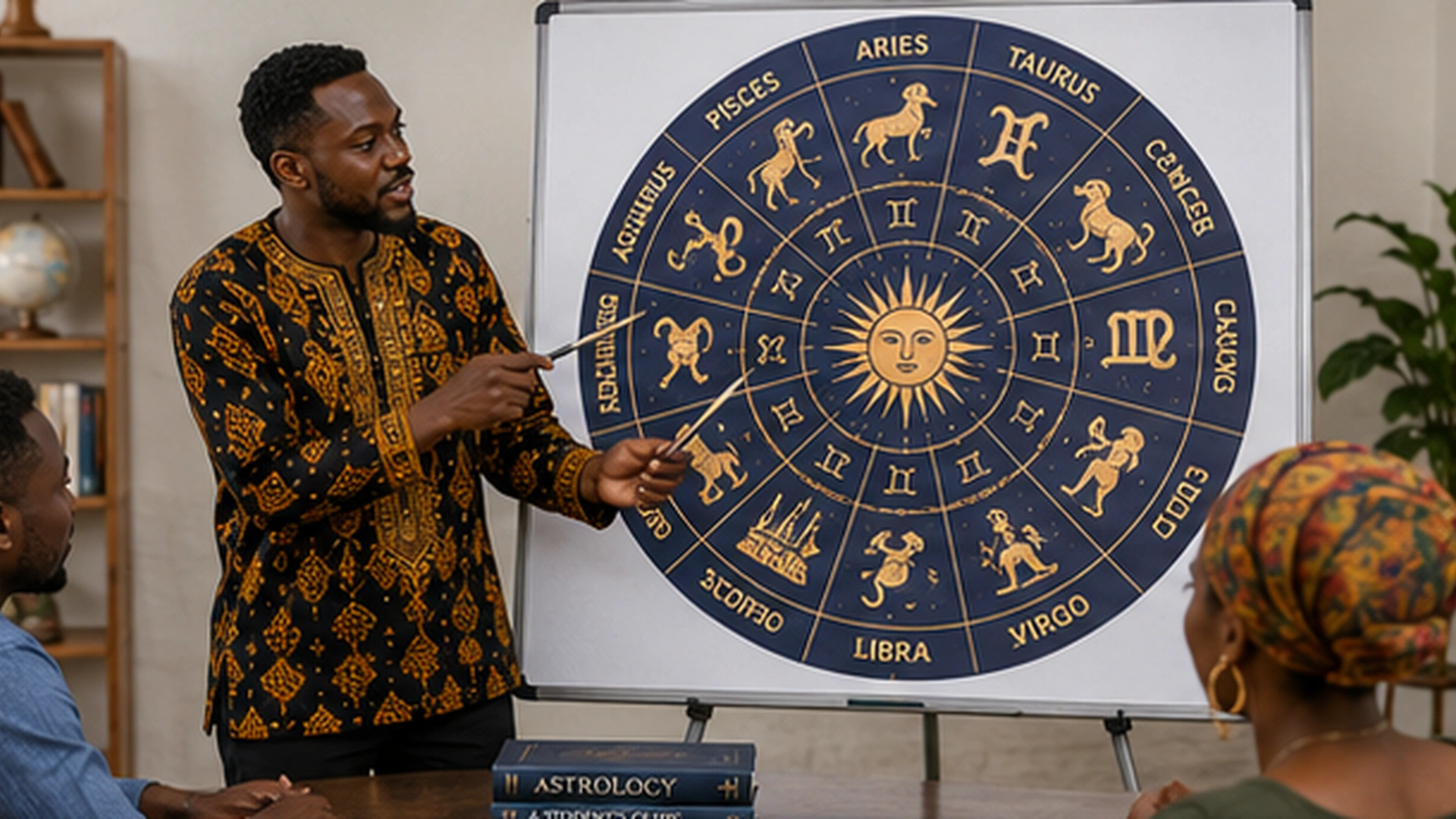
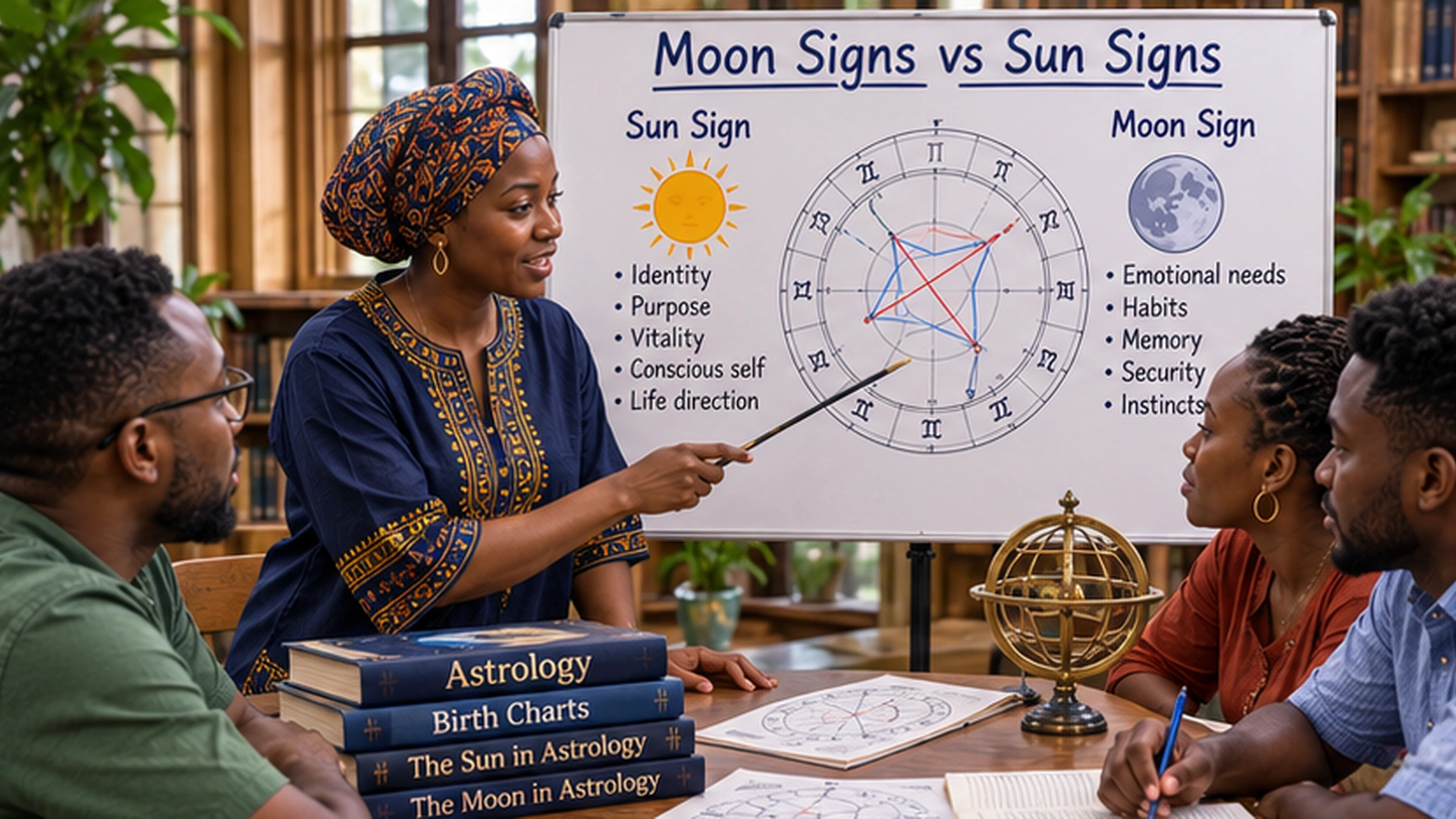
Suggested scene: Black African astrology educator introducing a circular zodiac chart to adult learners in a bright, realistic classroom.
Quick Summary
- The Western zodiac contains twelve equal signs of thirty degrees each.
- The signs follow the ecliptic, the apparent yearly path of the Sun.
- Aries begins the tropical zodiac at the March equinox.
- Every sign belongs to one of four elements: fire, earth, air, or water.
- Every sign belongs to one of three modalities: cardinal, fixed, or mutable.
- Traditional astrology assigns each sign a planetary ruler.
- Sun-sign descriptions are only one part of a complete birth chart.
- Zodiac signs are mathematical divisions; astronomical constellations are unequal regions of sky.
- Tropical and sidereal systems place signs differently.
- The Chinese zodiac is a separate twelve-year calendrical system.
- Astrological personality claims remain culturally influential but are not scientifically validated.
What Are the Twelve Zodiac Signs?
In Western astrology, a zodiac sign is one of twelve equal divisions along the ecliptic. Each division covers thirty degrees of celestial longitude.
The signs are named after constellations or figures historically associated with corresponding parts of the sky. Because signs are equal mathematical divisions while constellations vary in size, a sign is not identical to its astronomical constellation.
Modern astronomers use constellations as defined regions of the sky. Their boundaries are irregular, and they do not each occupy thirty degrees of the ecliptic.
Astrologers interpret signs as styles, qualities, or modes of expression.
A useful beginner formula is:
- Planet: What is being expressed?
- Sign: How is it expressed?
- House: Where in life is it expressed?
- Aspect: How does it interact with other chart factors?
For example, Mars is traditionally associated with action and drive. Mars in Aries may be interpreted differently from Mars in Cancer because Aries and Cancer symbolize different styles of expression.
Where Did the Twelve-Sign Zodiac Come From?
The standardized twelve-sign zodiac has important roots in ancient Babylonia.
Babylonian scholars observed eclipses, planetary movements, lunar phases, and unusual celestial events. They created mathematical systems that made it possible to describe where the Moon and planets appeared along the ecliptic.
A Late Babylonian tablet from approximately 500 BCE preserves a list of months and associated zodiac signs. This demonstrates that zodiacal signs had become incorporated into calendrical and astronomical organization by this period.
Earlier Mesopotamian scholars also produced constellation catalogues, circular planispheres, royal astronomical reports, and collections of celestial omens. These traditions were often concerned with rulers, kingdoms, warfare, harvests, disease, and public events rather than modern personality descriptions.
Greek-speaking scholars later combined Babylonian zodiacal knowledge with:
- Geometry
- Planetary rulerships
- Philosophical theories
- Astrological houses
- Angular relationships
- Techniques for interpreting individual births
The Metropolitan Museum of Art identifies the twelve Sun signs as having origins in ancient Babylonian astrology before further codification in Hellenistic traditions.
Hellenistic and Roman Egypt became major centers of adaptation and transmission.
The Dendera Zodiac was created around 50 BCE for a chapel associated with the Temple of Hathor in Upper Egypt. It contains zodiacal constellations, decans, planets known to ancient observers, and representations of celestial events. It belongs to the Ptolemaic period rather than the earliest phases of pharaonic Egypt.
The zodiac then continued to develop in India, the medieval Islamic world, Europe, and later global astrology.
Its history is one of cultural exchange rather than the isolated invention of one person or civilization.
Why Are There Twelve Signs?
Twelve divides a 360-degree circle into equal sections of thirty degrees.
This organization is mathematically convenient because twelve can be divided by:
- Two
- Three
- Four
- Six
It also corresponds broadly with twelve-month calendrical structures.
The division allowed ancient astronomers and astrologers to record positions more precisely. Instead of saying that a planet appeared somewhere near an irregular constellation, they could describe it as occupying a particular degree within a standardized sign.
The signs therefore functioned as a coordinate system as well as an interpretive system.
Zodiac Signs Versus Constellations
Astrological signs and astronomical constellations are historically related, but they are not the same.
Astrological Signs
- Twelve equal divisions
- Thirty degrees each
- Used in horoscope calculations
- Defined through an astrological zodiac
- Total of 360 degrees
Astronomical Constellations
- Unequal regions of sky
- Defined through astronomical boundaries
- Contain stars at widely different distances
- Used to map celestial regions
- Do not each cover thirty degrees
Earth’s axis also undergoes a slow motion called axial precession. NASA describes this as a gradual shift in the equinox points along the ecliptic, completing a cycle over approximately 26,000 years.
This means the March equinox no longer aligns with the same background stars that it aligned with in ancient times.
The tropical zodiac remains tied to the equinoxes and seasons. Sidereal systems instead use stellar reference points.
This is why the same planet may appear in one sign in a tropical chart and another sign in a sidereal chart.
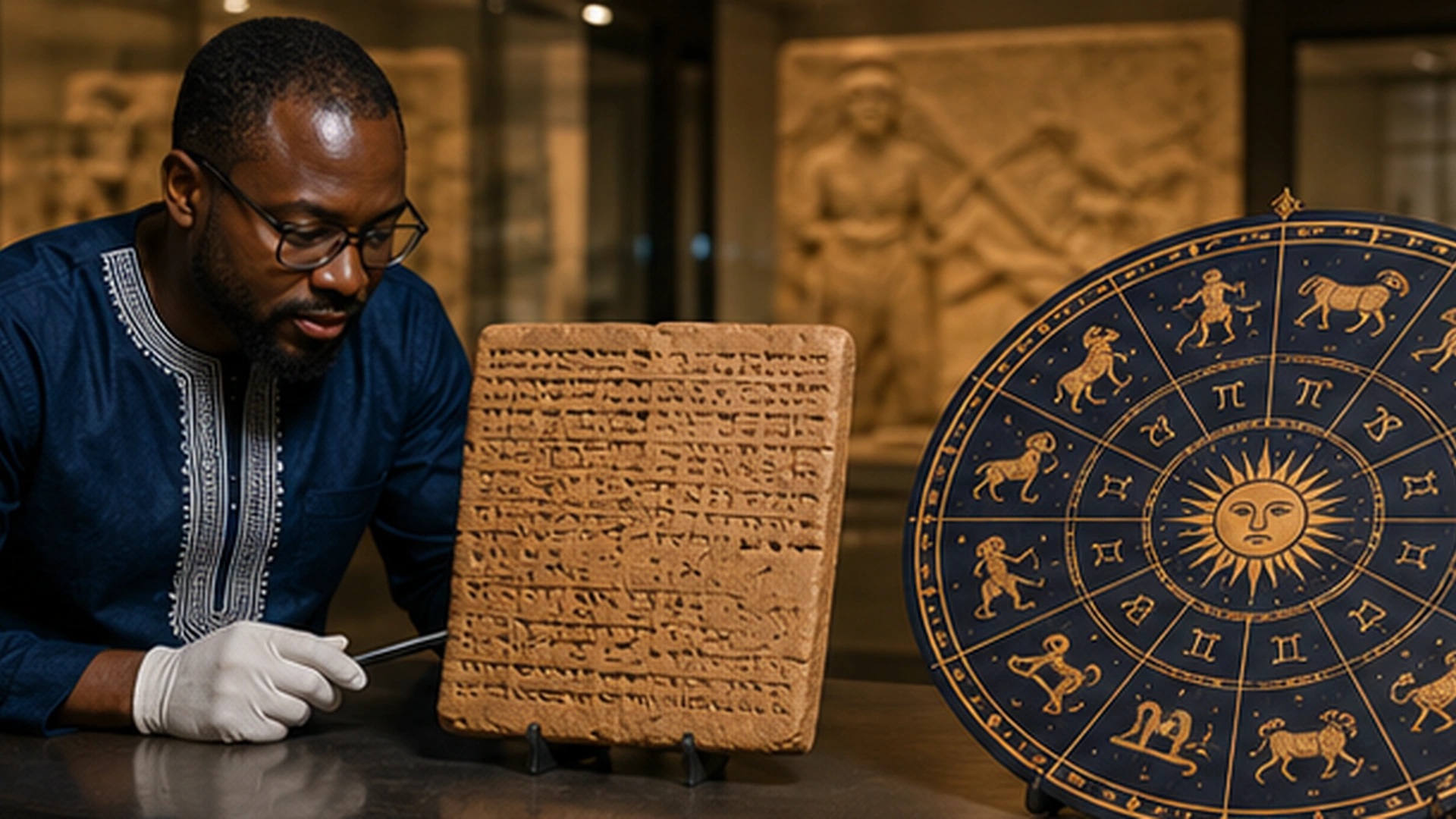
Suggested scene: African museum historian examining a Late Babylonian zodiac tablet beside an accurate educational zodiac wheel, with no readable fabricated inscriptions.
The Twelve Zodiac Signs in Order: Dates, Elements and Modalities
- Sign
- Approximate tropical dates
- Element
- Modality
- Traditional ruler
- Core keyword
- Aries
- March 21–April 19
- Fire
- Cardinal
- Mars
- Initiating
- Taurus
- April 20–May 20
- Earth
- Fixed
- Venus
- Stabilizing
- Gemini
- May 21–June 20
- Air
- Mutable
- Mercury
- Connecting
- Cancer
- June 21–July 22
- Water
- Cardinal
- Moon
- Protecting
- Leo
- July 23–August 22
- Fire
- Fixed
- Sun
- Expressing
- Virgo
- August 23–September 22
- Earth
- Mutable
- Mercury
- Refining
- Libra
- September 23–October 22
- Air
- Cardinal
- Venus
- Balancing
- Scorpio
- October 23–November 21
- Water
- Fixed
- Mars
- Intensifying
- Sagittarius
- November 22–December 21
- Fire
- Mutable
- Jupiter
- Exploring
- Capricorn
- December 22–January 19
- Earth
- Cardinal
- Saturn
- Structuring
- Aquarius
- January 20–February 18
- Air
- Fixed
- Saturn
- Reforming
- Pisces
- February 19–March 20
- Water
- Mutable
- Jupiter
- Blending
These dates are approximate conventions. Exact Sun-sign entry times vary slightly by year and time zone.
Why Zodiac Sign Dates Can Vary
The common date ranges are approximate tropical-zodiac conventions. The Sun does not enter each sign at the exact same clock time every year, and time zones can shift the boundary for people born near the start or end of a sign. A full birth chart uses exact birth time, date and location rather than the Sun sign alone.

Suggested scene: African learners organizing twelve symbolic sign cards by element and modality in an educational workshop, with no written labels in the image.
1. Aries: The Ram
Approximate dates: March 21–April 19
Element: Fire
Modality: Cardinal
Traditional ruler: Mars
Core keyword: Initiating
Aries begins the tropical zodiac at the March equinox.
Astrologers associate Aries with beginnings, direct action, courage, competition, urgency, independence, and the desire to move first.
As a cardinal fire sign, Aries combines initiation with enthusiasm. It may symbolize the first attempt, the immediate response, or the impulse to begin before every detail has been resolved.
Common Astrological Strengths
- Initiative
- Bravery
- Decisiveness
- Energy
- Direct communication
- Willingness to begin
- Ability to respond quickly
Possible Challenges
- Impatience
- Unnecessary conflict
- Acting before considering consequences
- Difficulty sustaining interest
- Discomfort with delay
- Treating cooperation as competition
Aries in a Birth Chart
An Aries Sun may be interpreted as emphasizing self-directed expression and initiative.
An Aries Moon may be associated with quick emotional responses and a need for movement.
An Aries Ascendant may be interpreted as approaching situations directly or energetically.
These meanings can change considerably depending on houses, aspects, cultural background, age, and personal development.
Responsible Interpretation
An Aries placement is not automatically aggressive, violent, selfish, or immature.
The sign describes an astrological style, not a fixed moral character.
2. Taurus: The Bull
Approximate dates: April 20–May 20
Element: Earth
Modality: Fixed
Traditional ruler: Venus
Core keyword: Stabilizing
Taurus is associated with stability, continuity, physical comfort, resources, patience, craftsmanship, and the desire to preserve what has value.
As a fixed earth sign, Taurus combines practical awareness with endurance.
Its symbolism often concerns:
- Building security
- Protecting resources
- Establishing routines
- Developing skills
- Appreciating physical beauty
- Maintaining commitments
Common Astrological Strengths
- Reliability
- Endurance
- Practical judgment
- Loyalty
- Patience
- Consistency
- Appreciation of beauty
Possible Challenges
- Resistance to change
- Possessiveness
- Stubbornness
- Remaining too long in familiar conditions
- Becoming overly attached to comfort
- Difficulty responding quickly
Taurus in a Birth Chart
A Taurus Sun may emphasize persistence, stability, and tangible achievement.
A Taurus Moon may be interpreted as seeking emotional security through familiarity, comfort, and dependable routines.
A Taurus Ascendant may appear calm, deliberate, or grounded.
Responsible Interpretation
Taurus does not automatically mean laziness, greed, or materialism.
Careful pacing may reflect concentration and commitment rather than passivity.
Article Information
- Publisher
- Ancestral Temple
- Editor
- Ancestral Temple
- Last updated
- Jul 26, 2026
- Last reviewed
- Jul 26, 2026
- Content version
- 97b5d54958
This educational article should be read as cultural and spiritual information, not as medical, legal, financial, or emergency advice.
Helpful Related Guidance
Explore This Topic
What Is Astrology · Moon & Astrology
About the Author
 Ancestral Temple
Spiritual guide and practitioner with decades of experience in ancestral wisdom, rituals, and divine guidance.
Related Posts
View All






Leave a Comment
We'd love to hear your thoughts.
This is a balanced beginner guide to all twelve zodiac signs.
A downloadable worksheet for learning the signs would be useful.
The key takeaways summarized a long subject clearly.
I liked that every sign included both strengths and possible challenges.
How should beginners decide between traditional and modern rulers?
The Chinese zodiac comparison prevented a common misunderstanding.
I would enjoy a follow-up article about zodiac signs in Islamic art.
The explanation of cusp birthdays was practical.
Could you write a detailed article about Aquarius and traditional Saturn rulership?
The Pisces section avoided the usual stereotype that the sign is helpless.
I appreciated the explanation that difficult traits are possibilities, not destiny.
A mobile-friendly zodiac reference chart would be useful.
The section on African cultural history was careful and respectful.
I did not know that Libra developed from the region of the Scorpion’s claws.
The history showed clearly that the zodiac developed through cultural exchange.
The article was detailed but still easy to scan.
Could you explain why the tropical zodiac begins at the March equinox?
The ethical section is necessary for astrology-service websites.
I would enjoy a full article comparing elements and modalities.
The sign stereotypes section should be shared widely.
How accurate are generic zodiac date ranges near the start and end of a sign?
The glossary would work well as a separate knowledge-base page.
The explanation that a Sun sign is only one chart placement was helpful.
Could you write more about zodiac signs in Indian horoscope scrolls?
The article correctly avoided inventing one universal African zodiac.
I liked the simple keywords for every sign.
A historical comparison of Babylonian and Greek sign images would be interesting.
The Libra section explained more than the usual idea of being friendly.
Why do some astrologers use Mars for Scorpio while others use Pluto?
I appreciated the scientific-evidence section at the end.
The statement that no sign proves moral character was important.
I would like a full article about the Dendera Zodiac.
The explanation of tropical and sidereal systems was balanced.
Could you create a printable table of all signs, elements, and modalities?
Thank you for explaining why Gemini does not mean a person is two-faced.
The Ophiuchus section answered a common question in a simple way.
The distinction between traditional and modern rulers was clear.
I would enjoy a detailed article about the goat-fish origin of Capricorn.
The warning that Aquarius is an air sign was surprisingly helpful.
Can a Sun sign change depending on the exact time of birth near a boundary?
I liked that the article explained the signs without presenting stereotypes as facts.
The historical section corrected the idea that one person invented the zodiac.
A separate article about traditional planetary rulers would be useful.
I appreciated the explanation that signs and constellations are not identical.
The element and modality tables made the signs much easier to compare.