
Rising Signs Explained
Cornerstone Content
Quick Summary
The rising sign, also called the Ascendant, is the zodiac sign appearing on the eastern horizon for a specific time and place. This guide explains how it is calculated, what astrologers say it represents, why accurate birth data matters, and how to interpret all twelve rising signs responsibly.
Rising Signs Explained is best understood as a symbolic and cultural subject, not a scientifically validated system for guaranteed prediction. This article explains the main meaning, historical background and related ideas while keeping astrology separate from astronomy and avoiding medical, legal or financial claims.
A rising sign is the zodiac sign containing the Ascendant, the calculated point where the ecliptic intersects the eastern horizon at a particular time and location. It is one of the most important time-sensitive factors in a Western birth chart.
Popular astrology often describes the rising sign as a social mask, first impression, physical appearance, or the personality shown to strangers. These descriptions can be useful starting points, but they are incomplete. In many astrological traditions, the Ascendant establishes the first house, organizes the entire house structure, identifies the chart ruler, and describes the person’s approach to circumstances.
The Ascendant changes because Earth rotates. Celestial bodies appear to rise in the east and move westward across the sky as Earth turns eastward. The exact section of the zodiac on the eastern horizon therefore depends on the time, location, latitude, and calculation system.
A rising sign is an astrological interpretation of a real horizon calculation. Scientific research has not established that the Ascendant reliably determines appearance, personality, or future events.
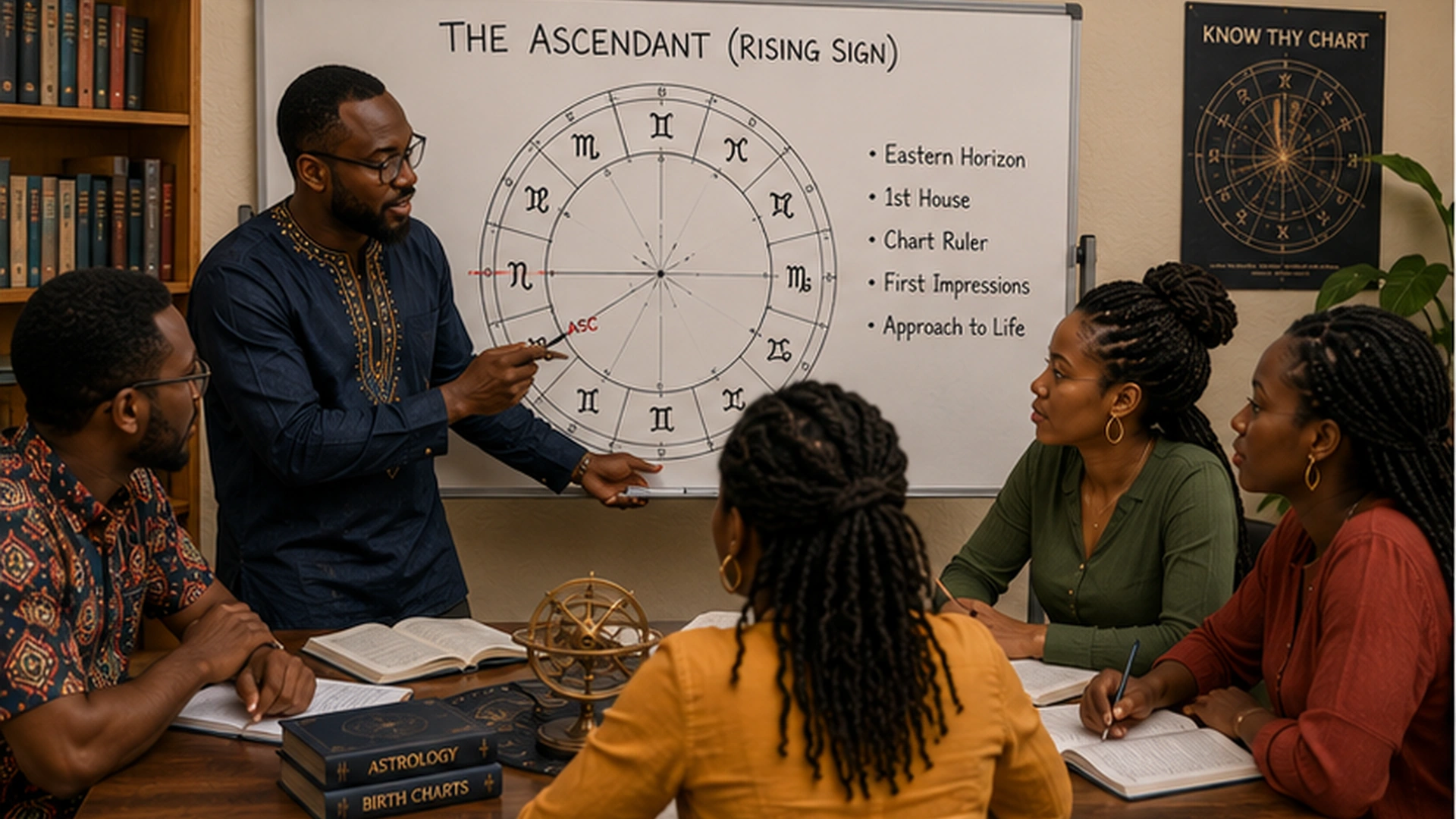
Suggested scene: Black African astrology educator showing learners where the eastern horizon and Ascendant appear on a clean birth-chart wheel in a bright classroom.
Key Points
The Ascendant is the zodiac degree rising on the eastern horizon for a selected time and place.
The rising sign is the zodiac sign containing the Ascendant.
Earth’s rotation causes different zodiac degrees to rise throughout the day.
An accurate birth time is normally essential for calculating the rising sign and houses.
The rising sign may change roughly every two hours on average, but actual timing varies by latitude and sign.
The planet ruling the rising sign is usually called the chart ruler.
The Ascendant is one of four major chart angles.
A rising sign does not prove physical appearance, morality, intelligence, health, or destiny.
Tropical and sidereal charts can produce different rising signs.
Birth-data privacy matters because calculating the Ascendant usually requires an exact date, time, and place.
What Is a Rising Sign?
The rising sign is the zodiac sign located on the eastern horizon at a calculated moment. The exact degree is called the Ascendant, commonly abbreviated ASC.
The sign provides a broad symbolic style. The precise Ascendant degree determines the starting point used by many house systems and can form aspects with planets or other chart points.
Plain-Language Meaning
Imagine standing outside and facing east at the moment of birth. Astrology calculates which zodiac degree was rising across that horizon. The sign containing that degree becomes the rising sign.
A beginner formula is:
Ascendant degree: the exact eastern-horizon point
Rising sign: the sign containing that point
First house: the chart area beginning from or associated with the Ascendant
Chart ruler: the planet ruling the rising sign
Why Does the Eastern Horizon Matter?
Earth rotates eastward, causing the Sun, Moon, planets, and stars to appear to rise in the east and set in the west. The eastern horizon therefore changes continuously relative to the zodiac.
The Ascendant is location-dependent. Two people born at the same universal moment in different places can have different Ascendants because their horizons are different.
Latitude also matters. Signs do not rise for equal lengths of time at every latitude. The popular statement that the rising sign changes exactly every two hours is only an average teaching shortcut.
How Is the Ascendant Calculated?
Convert the recorded local birth time into the correct time-zone and daylight-saving context.
Use the birthplace coordinates to establish latitude and longitude.
Determine local sidereal time, which relates Earth’s rotation to the celestial sphere.
Calculate where the ecliptic intersects the eastern horizon.
Identify the zodiac degree and sign at that intersection.
Apply the chosen zodiac and house system.
Modern chart software performs these calculations automatically, but incorrect birth data, time-zone settings, or daylight-saving assumptions can change the result.
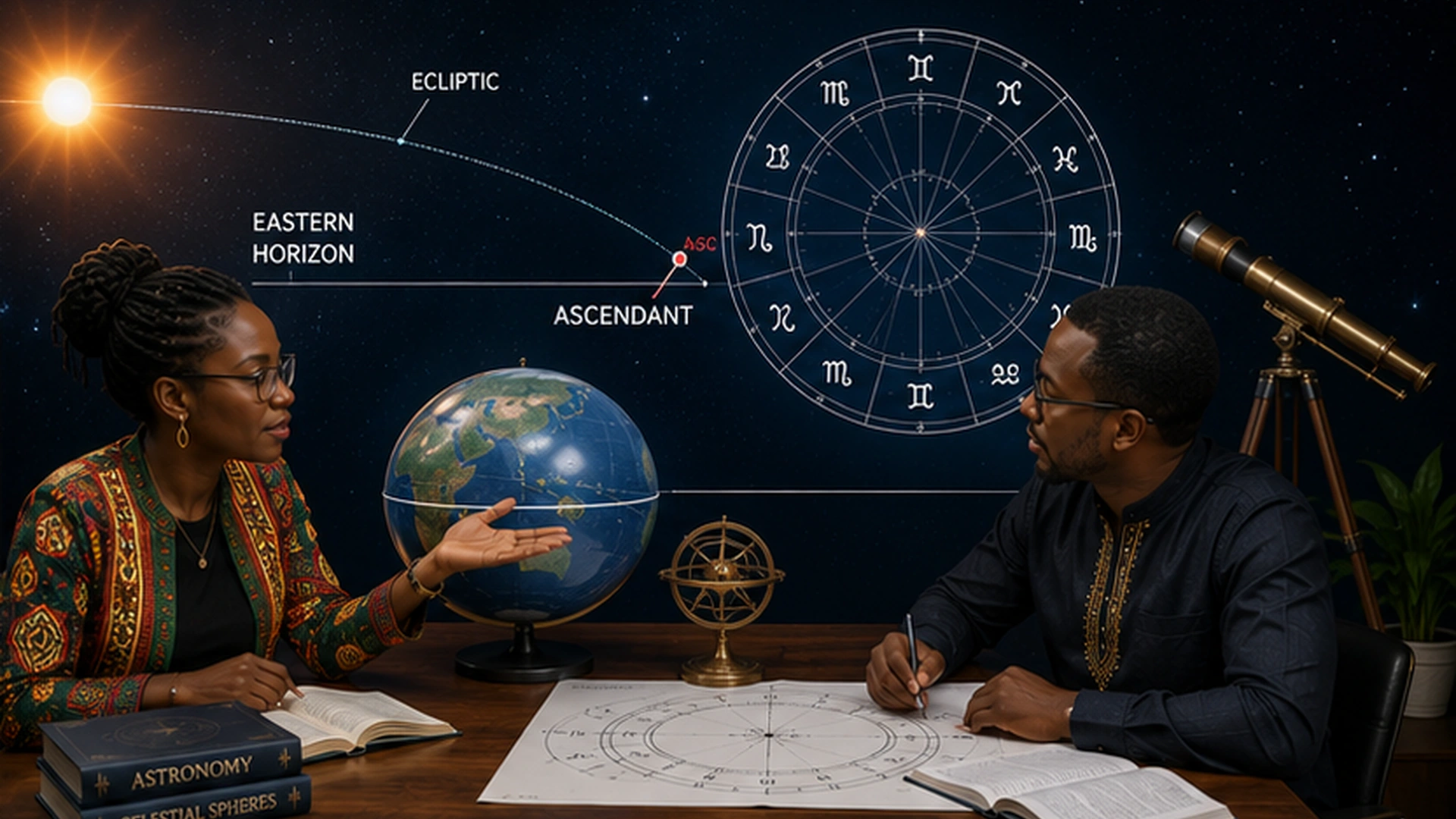
Suggested scene: Accurate educational model showing Earth, the observer’s eastern horizon, the ecliptic, and a clean chart wheel, guided by Black African science and astrology educators.
Why Exact Birth Time Matters
The birth date alone is rarely enough to calculate a reliable rising sign. The Ascendant moves through the zodiac as Earth rotates, and a difference of minutes can shift the exact degree. A larger time error can change the rising sign completely.
Ascendant degree
Rising sign
House cusps
Midheaven
Planets near angles
Chart ruler
Time-sensitive forecasting techniques
What if the Birth Time Is Approximate?
The chart should be labeled approximate. An astrologer should test the possible Ascendant range rather than present one sign as certain.
What if the Birth Time Is Unknown?
Planetary sign placements may still be calculated for the date, but the Ascendant and houses should normally be treated as unknown. A noon chart can display approximate daily planetary positions, but noon is not an invented birth time.
Birth-Time Rectification
Rectification is an astrological attempt to estimate an unknown birth time from life events and symbolic chart correspondence. It is interpretive, may produce different results between practitioners, and cannot replace an official record.
Rising Sign, Sun Sign and Moon Sign
Placement
How it is calculated
Common astrological themes
Sun sign
The zodiac sign occupied by the Sun
Identity, purpose, vitality, conscious expression
Moon sign
The zodiac sign occupied by the Moon
Emotional needs, habits, memory, security
Rising sign
The sign on the eastern horizon
Approach, presentation, orientation, chart structure
These three factors are popularly called the Big Three. They are not three separate personalities. Astrologers attempt to describe how their themes interact within one chart and one life.
The Ascendant and the First House
In many Western systems, the Ascendant is the beginning of the first house or the defining point from which the first house is established.
Astrologers commonly connect the first house with the body, identity, immediate approach, self-presentation, and how a person begins situations. Signs and houses are different categories: Aries is not automatically the first house, and a Libra Ascendant does not turn Libra into a house.
What Is the Chart Ruler?
The chart ruler is normally the planet ruling the rising sign. Its sign, house, aspects, and condition can become an organizing feature in a birth-chart interpretation.
Rising sign
Traditional chart ruler
Common modern alternative
Aries
Mars
Mars
Taurus
Venus
Venus
Gemini
Mercury
Mercury
Cancer
Moon
Moon
Leo
Sun
Sun
Virgo
Mercury
Mercury
Libra
Venus
Venus
Scorpio
Mars
Pluto sometimes used
Sagittarius
Jupiter
Jupiter
Capricorn
Saturn
Saturn
Aquarius
Saturn
Uranus sometimes used
Pisces
Jupiter
Neptune sometimes used
Traditional and modern rulership systems should be identified clearly rather than combined without explanation.
The Four Main Chart Angles
Angle
Abbreviation
General location
Common astrological themes
Ascendant
ASC
Eastern horizon
Approach, body, identity, beginnings
Descendant
DSC
Western horizon
Partnership, encounters, open opposition
Midheaven
MC
Upper meridian region
Public role, vocation, reputation
Imum Coeli
IC
Opposite the Midheaven
Home, roots, private foundations
Planets close to an angle are often interpreted as especially prominent. The allowable distance varies by tradition and practitioner.
All Twelve Rising Signs at a Glance
Rising sign
Element
Modality
Traditional ruler
Core approach
Aries
Fire
Cardinal
Mars
Direct and initiating
Taurus
Earth
Fixed
Venus
Steady and stabilizing
Gemini
Air
Mutable
Mercury
Curious and connecting
Cancer
Water
Cardinal
Moon
Protective and responsive
Leo
Fire
Fixed
Sun
Expressive and visible
Virgo
Earth
Mutable
Mercury
Observant and refining
Libra
Air
Cardinal
Venus
Relational and balancing
Scorpio
Water
Fixed
Mars
Private and intense
Sagittarius
Fire
Mutable
Jupiter
Open and exploratory
Capricorn
Earth
Cardinal
Saturn
Reserved and structured
Aquarius
Air
Fixed
Saturn
Independent and system-focused
Pisces
Water
Mutable
Jupiter
Receptive and adaptive
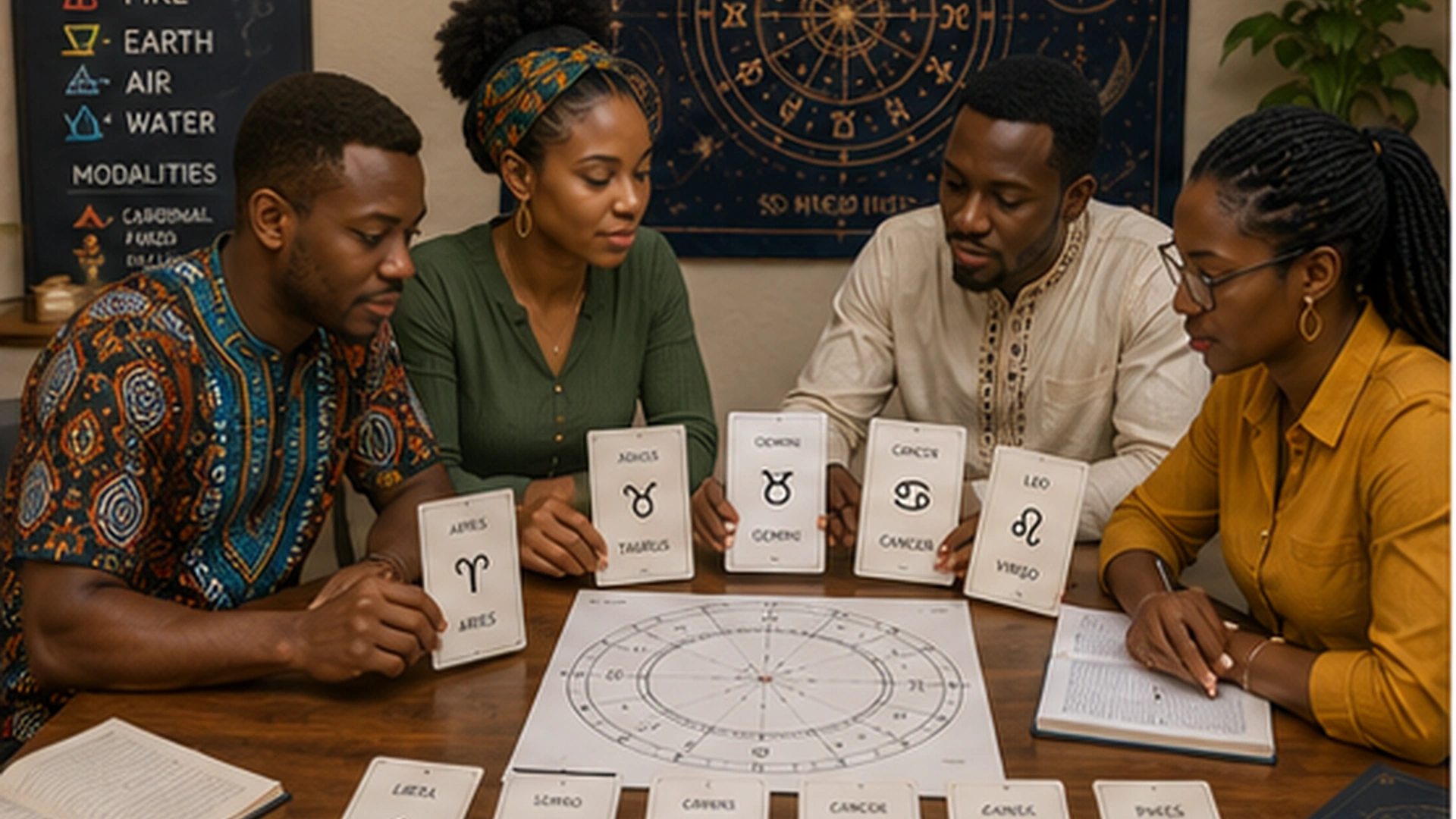
Suggested scene: African learners arranging twelve rising-sign cards by element and modality around a blank chart wheel in an educational workshop.
Aries Rising
Traditional ruler: Mars
Astrologers may describe this rising sign as direct, fast, independent, or ready to initiate.
Constructive possibilities include courage, decisiveness, willingness to begin.
Possible challenges include impatience, unnecessary conflict, acting before reflection.
Aries Rising does not prove a fixed appearance, moral quality, profession, diagnosis, or future. The ruling planet and full chart can substantially change the expression.
Taurus Rising
Traditional ruler: Venus
Astrologers may describe this rising sign as calm, deliberate, grounded, or steady.
Constructive possibilities include reliability, patience, continuity, sensory awareness.
Possible challenges include resistance to change, possessiveness, remaining too long in familiar conditions.
Taurus Rising does not prove a fixed appearance, moral quality, profession, diagnosis, or future. The ruling planet and full chart can substantially change the expression.
Gemini Rising
Traditional ruler: Mercury
Astrologers may describe this rising sign as curious, verbal, observant, or adaptable.
Constructive possibilities include communication, learning, versatility, social connection.
Possible challenges include scattered attention, nervousness, inconsistency, overthinking.
Gemini Rising does not prove a fixed appearance, moral quality, profession, diagnosis, or future. The ruling planet and full chart can substantially change the expression.
Cancer Rising
Traditional ruler: Moon
Astrologers may describe this rising sign as protective, cautious, receptive, or emotionally aware.
Constructive possibilities include caregiving, memory, hospitality, responsiveness.
Possible challenges include defensiveness, withdrawal, overprotection, indirect conflict.
Cancer Rising does not prove a fixed appearance, moral quality, profession, diagnosis, or future. The ruling planet and full chart can substantially change the expression.
Leo Rising
Traditional ruler: Sun
Astrologers may describe this rising sign as warm, visible, dignified, creative, or expressive.
Constructive possibilities include confidence, leadership, generosity, creative presence.
Possible challenges include dependence on recognition, pride, dramatic reactions.
Leo Rising does not prove a fixed appearance, moral quality, profession, diagnosis, or future. The ruling planet and full chart can substantially change the expression.
Virgo Rising
Traditional ruler: Mercury
Astrologers may describe this rising sign as observant, careful, practical, or reserved.
Constructive possibilities include precision, organization, service, problem-solving.
Possible challenges include perfectionism, worry, excessive criticism, difficulty resting.
Virgo Rising does not prove a fixed appearance, moral quality, profession, diagnosis, or future. The ruling planet and full chart can substantially change the expression.
Libra Rising
Traditional ruler: Venus
Astrologers may describe this rising sign as diplomatic, polished, relational, or aesthetically aware.
Constructive possibilities include cooperation, fairness, negotiation, social intelligence.
Possible challenges include indecision, approval-seeking, avoidance of necessary conflict.
Libra Rising does not prove a fixed appearance, moral quality, profession, diagnosis, or future. The ruling planet and full chart can substantially change the expression.
Scorpio Rising
Traditional ruler: Mars
Astrologers may describe this rising sign as private, concentrated, guarded, or intense.
Constructive possibilities include focus, resilience, strategic awareness, emotional courage.
Possible challenges include suspicion, control, difficulty trusting, holding resentment.
Scorpio Rising does not prove a fixed appearance, moral quality, profession, diagnosis, or future. The ruling planet and full chart can substantially change the expression.
Sagittarius Rising
Traditional ruler: Jupiter
Astrologers may describe this rising sign as open, direct, enthusiastic, or exploratory.
Constructive possibilities include optimism, learning, humor, broad perspective.
Possible challenges include overpromising, bluntness, restlessness, overlooking details.
Sagittarius Rising does not prove a fixed appearance, moral quality, profession, diagnosis, or future. The ruling planet and full chart can substantially change the expression.
Capricorn Rising
Traditional ruler: Saturn
Astrologers may describe this rising sign as serious, composed, cautious, or goal-oriented.
Constructive possibilities include discipline, accountability, endurance, strategic planning.
Possible challenges include rigidity, pessimism, overwork, fear of failure.
Capricorn Rising does not prove a fixed appearance, moral quality, profession, diagnosis, or future. The ruling planet and full chart can substantially change the expression.
Aquarius Rising
Traditional ruler: Saturn
Astrologers may describe this rising sign as independent, unusual, thoughtful, or group-aware.
Constructive possibilities include originality, systems thinking, principled independence.
Possible challenges include emotional distance, contrarianism, rigid ideology.
Aquarius Rising does not prove a fixed appearance, moral quality, profession, diagnosis, or future. The ruling planet and full chart can substantially change the expression.
Pisces Rising
Traditional ruler: Jupiter
Astrologers may describe this rising sign as receptive, gentle, imaginative, or difficult to categorize.
Constructive possibilities include empathy, adaptability, creativity, symbolic awareness.
Possible challenges include unclear boundaries, avoidance, idealization, confusion.
Pisces Rising does not prove a fixed appearance, moral quality, profession, diagnosis, or future. The ruling planet and full chart can substantially change the expression.
Do Rising Signs Determine Physical Appearance?
Astrological traditions have long connected the Ascendant and first house with the body and visible presentation. Modern descriptions sometimes claim that each rising sign produces a specific face, height, body type, skin tone, or style.
Such claims should be treated cautiously. Appearance is shaped by genetics, ancestry, nutrition, health, age, environment, disability, clothing, culture, and personal choice. A rising sign cannot reliably predict race, body size, facial structure, attractiveness, or health.
It is safer to discuss presentation or manner symbolically than to make biological claims.
How House Systems Affect the Ascendant
The Ascendant degree itself can remain the same while different house systems organize the chart around it differently.
House system
Basic approach
Whole Sign
The entire rising sign becomes the first house; each following sign becomes the next house.
Equal House
The first house begins at the Ascendant degree and every house spans thirty degrees.
Placidus
A time-based quadrant system widely used in modern Western astrology.
Porphyry
Divides each quadrant between the major angles into three equal sections.
Regiomontanus
A quadrant system often associated with particular traditional practices.
Beginners should identify the house system and avoid changing systems only to obtain a preferred interpretation.
Tropical and Sidereal Rising Signs
Tropical astrology anchors zero degrees Aries to the March equinox. Sidereal systems use stellar reference points and apply an offset for precession.
The same birth data can therefore produce different rising signs in tropical and sidereal calculations. Neither result is necessarily a software error; the charts may use different zodiac frameworks.
Indian Jyotisha commonly gives major importance to the Ascendant, called the lagna in many contexts, but uses its own calculation rules, terminology, planetary periods, divisional charts, and interpretive traditions. It should not be reduced to a Western rising-sign description with shifted signs.
Rising Signs in Hellenistic and Historical Astrology
Horoscopic astrology developed through interaction among Babylonian, Greek, Egyptian, and other intellectual traditions. The ability to identify a rising zodiac degree was essential to constructing an individual horoscope and organizing chart places or houses.
Medieval scholars in Islamic societies translated, calculated, debated, and expanded astronomical and astrological knowledge inherited from Greek, Persian, Indian, and earlier sources. Accurate horizon and planetary calculations supported calendars, astronomy, instruments, and horoscope construction.
Timbuktu manuscript collections preserve evidence of astronomy, seasonal calculation, and horoscope casting within West African Islamic scholarly networks. This history should not be generalized into one universal African rising-sign tradition.
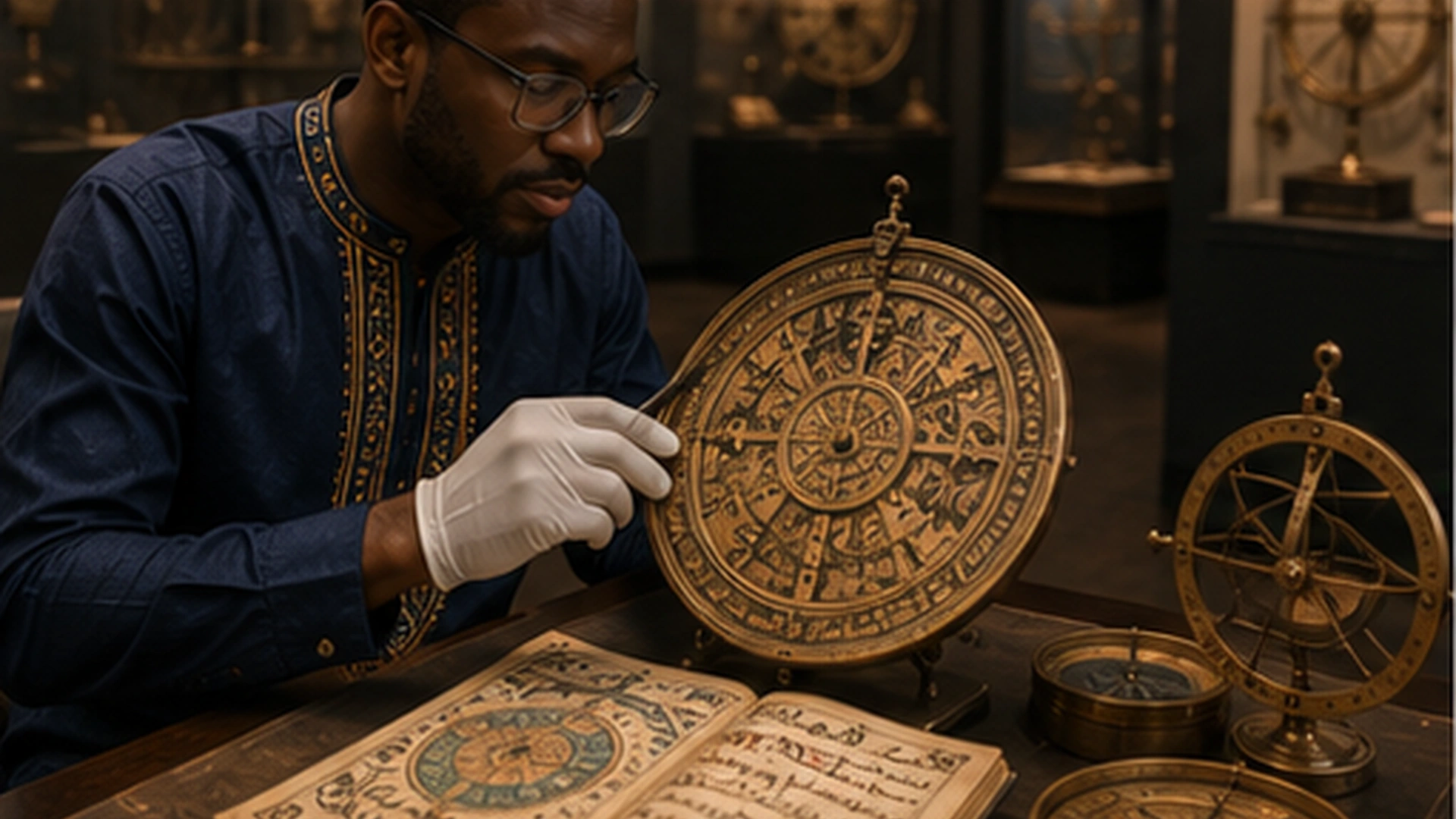
Suggested scene: Black African museum conservator examining a historical horoscope or astrolabe in a scholarly setting, without readable fabricated text.
Rising Sign Compatibility
Popular astrology may compare rising signs to discuss first impressions, attraction, social rhythm, or house overlays. This is highly simplified.
A complete synastry reading may compare Ascendants, rulers, planets, aspects, and houses. Even then, astrology cannot establish whether a relationship is safe, respectful, honest, or sustainable.
Consent
Respect
Communication
Shared values
Accountability
Emotional and physical safety
Freedom from coercion and violence
Birth-Data Privacy
Calculating a reliable Ascendant usually requires a full birth date, exact time, and birthplace. These details can reveal age and identity information.
Use reputable chart services.
Check how data is stored or shared.
Remove names and exact details before posting charts publicly.
Do not publish another person’s birth data without permission.
Protect children’s birth information carefully.
Are Rising-Sign Meanings Scientifically Proven?
The Ascendant is based on a real astronomical horizon calculation. Earth’s rotation genuinely changes what is rising in the east for a given place and time.
Scientific research has not established that the zodiac sign at the eastern horizon determines personality, appearance, compatibility, career, or future events. A widely discussed double-blind test of natal astrology did not support the tested claim that charts could match standardized personality profiles beyond chance expectations.
A person may still use rising-sign symbolism for reflection, spirituality, identity, community, or entertainment. Cultural meaning should be distinguished from scientific validation.
Common Misconceptions
“Your rising sign is a fake personality.”
Oversimplified. Astrologers may connect it with approach and presentation, but it also organizes the chart and identifies the chart ruler.
“The rising sign changes exactly every two hours.”
Not exactly. Two hours is an average; rising times vary with latitude and sign.
“The birth date alone reveals the rising sign.”
Usually false. Accurate time and place are normally required.
“A noon chart gives a noon rising sign for everyone.”
False. Noon may be used as a neutral placeholder for daily positions, not as a factual Ascendant.
“The Ascendant proves physical appearance.”
False. Appearance is influenced by biology, health, culture, environment, and choice.
“Scorpio rising means dangerous.”
False. No rising sign proves violence, manipulation, or criminality.
“Compatible rising signs guarantee a relationship.”
False. Real relationship quality depends on behavior, consent, respect, and safety.
“A difficult chart ruler means failure.”
False. Astrological condition does not establish human worth or destiny.
Ethical Boundaries
Rising-sign interpretations should not be used to:
Diagnose illness or mental-health conditions
Judge race, body type, attractiveness, intelligence, or morality
Identify an abuser without behavioral evidence
Predict death as certainty
Guarantee marriage, pregnancy, wealth, healing, or success
Discriminate in employment or education
Pressure someone to remain in a harmful relationship
Demand payment to correct a supposedly damaged Ascendant
How to Interpret a Rising Sign Responsibly
Verify the birth date, exact time, location, time zone, and daylight-saving setting.
Identify the zodiac and house system.
Find the Ascendant sign and exact degree.
Identify the traditional chart ruler.
Read the ruler by sign, house, and aspects.
Check planets close to the Ascendant.
Examine the first house and aspects to the Ascendant.
Look for repeated themes elsewhere in the chart.
Compare the symbolism with the person’s actual experience.
Avoid diagnosis, stereotypes, and guaranteed predictions.

Suggested scene: Multigenerational African study group comparing rising signs, chart rulers, and complete birth charts in a realistic library.
Key Takeaways
The Ascendant is the exact zodiac degree rising on the eastern horizon.
The rising sign is the sign containing the Ascendant.
Earth’s rotation causes the horizon point to change throughout the day.
Birth time, location, latitude, time zone, and calculation system matter.
The rising sign may change roughly every two hours on average, but not at a fixed universal rate.
The chart ruler is normally the planet ruling the rising sign.
The Ascendant is one of four major chart angles.
The rising sign is not simply a fake or public personality.
Physical-appearance claims should be treated cautiously.
Tropical and sidereal charts can produce different rising signs.
Unknown birth times make the Ascendant and houses uncertain.
Rising-sign compatibility cannot establish relationship health.
Ascendant symbolism is culturally influential but not scientifically validated as a personality or forecasting effect.
People Also Ask
What is a rising sign?
It is the zodiac sign containing the Ascendant, the calculated point on the eastern horizon at a specific time and place.
Is the rising sign the same as the Ascendant?
The Ascendant is the exact degree; the rising sign is the zodiac sign containing that degree.
Why is birth time important?
The eastern horizon changes as Earth rotates, so the Ascendant and houses depend strongly on the recorded time.
How often does the rising sign change?
Roughly every two hours on average, but actual rising times vary by latitude and sign.
What does the rising sign represent?
Astrologers associate it with approach, presentation, orientation, the body, and the organization of the chart.
What is the chart ruler?
It is usually the planet ruling the rising sign.
Can I find my rising sign without a birth time?
Not reliably in most cases. A time range may produce several possible Ascendants.
Does the rising sign determine appearance?
No reliable evidence shows that it determines facial features, body type, race, or attractiveness.
Can rising signs predict compatibility?
No. They cannot establish whether a relationship is safe, respectful, or lasting.
Are rising-sign traits scientifically proven?
No. Scientific research has not validated rising signs as reliable predictors of personality or future events.
Key Takeaways
The rising sign is more than a short personality label. It is the zodiac sign containing the Ascendant, a time- and location-sensitive point where the ecliptic meets the eastern horizon.
In many forms of astrology, the Ascendant establishes the chart’s orientation, begins or defines the first house, identifies the chart ruler, and provides a starting point for interpreting planets and houses.
Its calculation depends on accurate data. An incorrect birth time, location, time zone, or daylight-saving setting can shift the degree, houses, or rising sign.
Rising-sign symbolism can be studied as part of astrology’s history, cultural traditions, or personal reflection. It should not be used to diagnose illness, determine appearance, prove character, guarantee compatibility, or predict destiny.
Final Summary
A rising sign is the zodiac sign on the eastern horizon at birth. The exact point is called the Ascendant. It changes as Earth rotates and normally requires an accurate birth time and place. Astrologers associate it with approach, presentation, the first house, and the chart ruler. Its personality and appearance claims are not scientifically established.
Research Sources and Further Reading
NASA educational material on Earth’s rotation, horizons, celestial reference systems, and apparent sky motion.
The Metropolitan Museum of Art: Astronomy and Astrology in the Medieval Islamic World.
The Metropolitan Museum of Art: Following the Stars - Images of the Zodiac in Islamic Art.
Library of Congress: Ancient Manuscripts from the Desert Libraries of Timbuktu.
Shawn Carlson, A Double-Blind Test of Astrology, Nature, 1985.
The Metropolitan Museum of Art: zodiac and seven-planet objects from medieval Islamic collections.
Frequently Asked Questions
What should readers know first about african spirituality and cultural history?
African spirituality and cultural history: Read clear guidance, key signs, practical steps, and private support from Ancestral Temple.
What causes rising-signs-explained?
The safest next step is to compare the signs, prepare clear details, and request private guidance when the matter feels personal.
How does rising-signs-explained work?
The safest next step is to compare the signs, prepare clear details, and request private guidance when the matter feels personal.
Is it possible to get private guidance for rising-signs-explained?
The safest next step is to compare the signs, prepare clear details, and request private guidance when the matter feels personal.
How long does rising-signs-explained take to understand?
The safest next step is to compare the signs, prepare clear details, and request private guidance when the matter feels personal.
Can rising-signs-explained affect relationships, family, work, or personal peace?
The safest next step is to compare the signs, prepare clear details, and request private guidance when the matter feels personal.
Why do people seek spiritual guidance for rising-signs-explained?
The safest next step is to compare the signs, prepare clear details, and request private guidance when the matter feels personal.
What signs should someone notice before asking about rising-signs-explained?
The safest next step is to compare the signs, prepare clear details, and request private guidance when the matter feels personal.
When should someone contact a private spiritual guide?
The safest next step is to compare the signs, prepare clear details, and request private guidance when the matter feels personal.
What causes african spirituality and cultural history?
African spirituality and cultural history: Read clear guidance, key signs, practical steps, and private support from Ancestral Temple. The safest next step is to compare the signs, prepare clear details, and request private guidance when the matter feels perso
Article Information
- Publisher
- Ancestral Temple
- Editor
- Ancestral Temple
- Last updated
- Jul 26, 2026
- Last reviewed
- Jul 13, 2026
- Content version
- c3fc922c66
This educational article should be read as cultural and spiritual information, not as medical, legal, financial, or emergency advice.
Helpful Related Guidance
Explore This Topic
Planetary Influence Meaning · Traditional African Ways Of Seeking Blessings
Related Topic Cluster
African Spirituality And Cultural History
Complete Guide Why Homes Have Been Blessed Throughout HistoryAbout the Author
 Ancestral Temple
Spiritual guide and practitioner with decades of experience in ancestral wisdom, rituals, and divine guidance.
Related Posts
View All






Leave a Comment
We'd love to hear your thoughts.
This was a balanced and comprehensive introduction to rising signs.
A beginner quiz on rising signs and chart rulers would be useful.
The key takeaways summarized the full topic clearly.
The article showed that every rising sign can have constructive and difficult expressions.
How should beginners interpret the chart ruler when it is retrograde?
The explanation of physical-appearance myths was realistic.
I would enjoy an article about astrolabes and historical horizon calculations.
The article clearly explained why exact time and location both matter.
Could you create a guide to planets conjunct the Ascendant?
I liked that Scorpio rising was not described as dangerous.
The warning against changing house systems just to get a preferred result was responsible.
A mobile-friendly rising-sign calculator guide would be useful.
The Timbuktu scholarship section added important African historical context.
Can tropical and sidereal charts produce completely different chart rulers?
I appreciated the distinction between the exact Ascendant and the whole first house.
The article was detailed but still easy to scan.
Could you explain local sidereal time in a beginner-friendly article?
The relationship-safety section should appear on every compatibility article.
I would enjoy a detailed guide to rising-sign compatibility myths.
The Cancer rising section did not confuse sensitivity with weakness.
Does a planet exactly on the Ascendant become more important than the chart ruler?
The glossary would work well as a separate knowledge-base page.
The explanation of traditional and modern rulers was balanced.
Could you write more about lagna in Indian Jyotisha?
I liked that African astrological history was not generalized into one tradition.
The chart-angle table made the Ascendant and Midheaven easier to compare.
I would enjoy an article about the history of the Ascendant in Hellenistic astrology.
The Big Three table was simple and easy to understand.
Can the Ascendant change signs within a few minutes near a boundary?
I appreciated the scientific-evidence and ethical-boundaries sections.
The section on unknown birth times was honest and responsible.
I would like a comparison between Whole Sign and Placidus houses.
The birth-data privacy section was necessary and practical.
A printable worksheet for finding the chart ruler would be useful.
Thank you for clarifying that the rising sign is not simply a fake personality.
Could you explain how latitude changes the speed at which signs rise?
The appearance section avoided a lot of harmful stereotypes.
I would enjoy a full article about Aries rising and Mars as chart ruler.
The table of all twelve rising signs was useful for beginners.
How accurate can a rising sign be when the recorded time is rounded to the nearest hour?
I liked that the article respected astrology without presenting it as proven science.
The eastern-horizon explanation made the calculation easier to understand.
A separate article about chart rulers would be helpful.
I appreciated the warning that the sign does not change at an exact universal two-hour rate.
The explanation of the Ascendant degree versus the rising sign was very clear.