
Great Zimbabwe and Cultural History
Quick Summary
Great Zimbabwe was a major Shona urban, political and trading center that flourished between roughly the eleventh and fifteenth centuries. Its dry-stone architecture, long-distance trade, cattle wealth, ritual authority and later national symbolism make it one of Africa’s most important heritage sites.
Great Zimbabwe and Cultural History describes a culturally specific topic that should not be reduced to one universal African belief or practice. The article explains meaning, context and variation across communities while avoiding broad claims about all cultures or all practitioners.
Great Zimbabwe is one of the most important archaeological and cultural sites in Africa. Located near modern Masvingo in southeastern Zimbabwe, it was built and occupied by ancestors of Shona-speaking communities and flourished especially between the eleventh and fifteenth centuries.
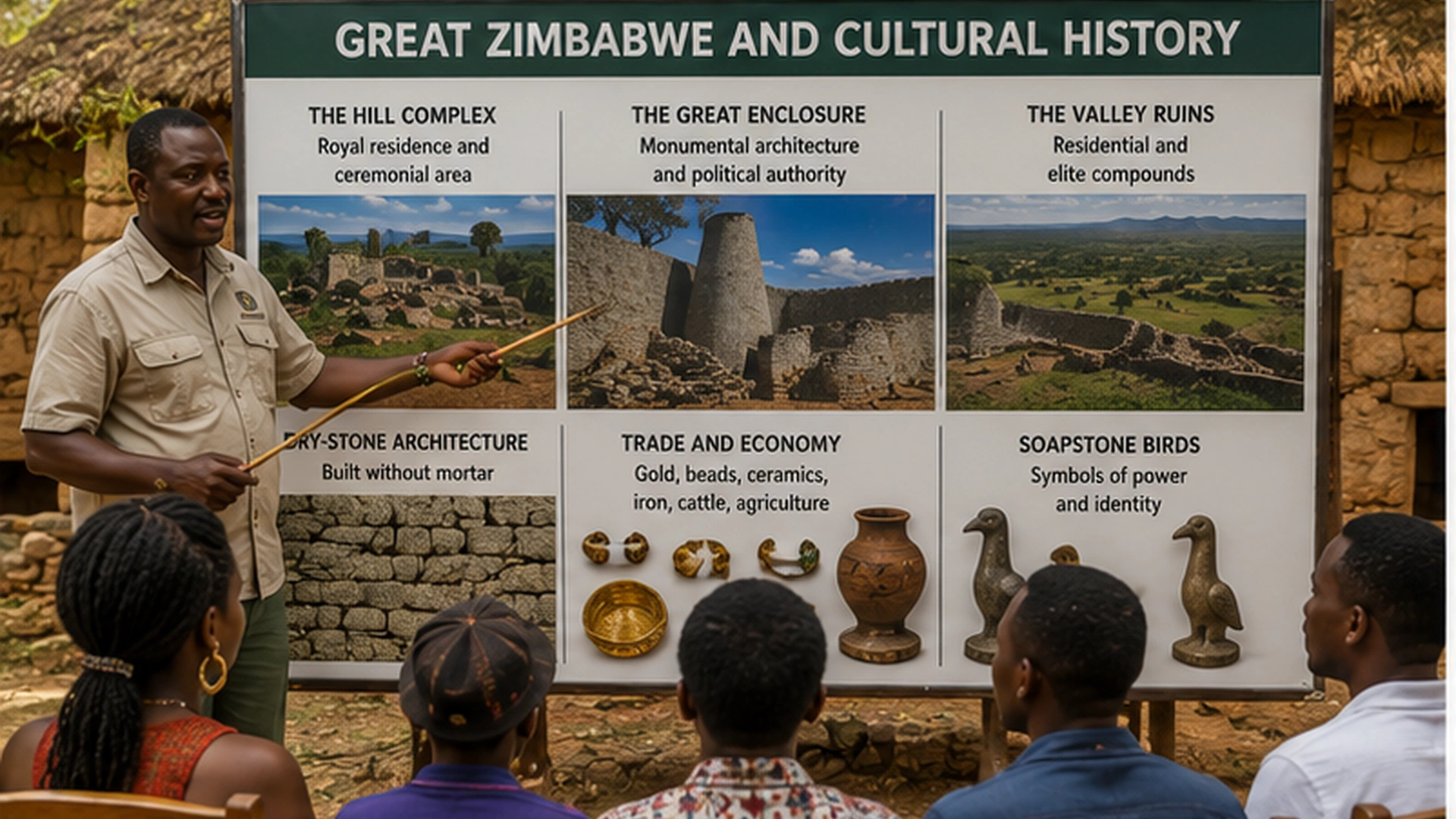
The site covers nearly eighty hectares and contains the Hill Complex, the Great Enclosure and extensive Valley Ruins. Its monumental walls were built without mortar through highly skilled dry-stone masonry.
Great Zimbabwe was not an isolated ruin. It belonged to a wider southern African world of farming communities, cattle wealth, mining, craft production, regional states and Indian Ocean commerce.
Colonial writers once denied that Africans could have built the site. Archaeology later demonstrated its local African authorship, making Great Zimbabwe a powerful symbol of historical truth, cultural dignity and national identity.
This article distinguishes established archaeological evidence from legend. It also recognizes that Great Zimbabwe remains important to Zimbabwean communities, heritage professionals, spiritual custodians and the modern nation.
Suggested scene: Zimbabwean archaeologist introducing the Hill Complex, Great Enclosure, Valley Ruins, dry-stone masonry, trade goods and soapstone birds through separate educational displays.
Key Points
Great Zimbabwe was built by ancestors of Shona-speaking peoples.
The city flourished mainly from the eleventh to fifteenth centuries.
Its walls were built without mortar using carefully shaped granite blocks.
The Hill Complex, Great Enclosure and Valley Ruins served different residential, political and ceremonial functions.
Cattle, agriculture, gold, iron, craft production and trade supported the city.
Imported glass beads, ceramics and other objects link Great Zimbabwe with Indian Ocean networks.
Soapstone birds became major symbols of authority and later of the Zimbabwean nation.
The site was wrongly attributed to foreign builders during colonial rule.
African archaeologists and earlier scientific excavation established its local authorship.
Great Zimbabwe remains a UNESCO World Heritage Site and living national heritage.
Historical Timeline
Period
Approximate dates
Historical significance
Early farming communities
First millennium CE
Agriculture, cattle keeping, ironworking and regional settlement developed before the rise of the city.
Mapungubwe era
c. 1050-1270
A major regional center south of the Limpopo whose status architecture and trade preceded Great Zimbabwe’s peak.
Great Zimbabwe growth
c. 1100-1300
Expansion of elite settlement, stone construction, cattle wealth and long-distance trade.
Great Zimbabwe peak
c. 1300-1450
Monumental building, political authority, craft specialization and regional influence.
Political transition
15th century onward
Power shifted toward centers associated with Mutapa, Torwa, Khami and later Rozvi states.
Colonial archaeology
late 19th-early 20th centuries
Looting, destructive excavation and racist denial of African authorship.
National heritage era
1980-present
Zimbabwe birds and the site became central symbols of independence and national identity.
1. What the Name Zimbabwe Means
The name Zimbabwe is commonly connected with the Shona phrase dzimba dzemabwe, usually translated as houses of stone or stone houses. The modern country adopted the name Zimbabwe at independence in 1980, directly linking national identity with the precolonial city.
2. Who Built Great Zimbabwe?
Archaeological evidence shows that Great Zimbabwe was constructed by local African communities ancestral to Shona-speaking peoples. Pottery, architecture, settlement patterns, environmental evidence and regional continuity connect the site with southern African farming societies rather than foreign colonists.
Article Information
- Publisher
- Ancestral Temple
- Editor
- Ancestral Temple
- Last updated
- Jul 26, 2026
- Last reviewed
- Jul 26, 2026
- Content version
- 30982f0fba
This educational article should be read as cultural and spiritual information, not as medical, legal, financial, or emergency advice.
Helpful Related Guidance
Explore This Topic
Spiritual Knowledge · Full Moon Rituals
About the Author
 Ancestral Temple
Spiritual guide and practitioner with decades of experience in ancestral wisdom, rituals, and divine guidance.
Related Posts
View All
Leave a Comment
We'd love to hear your thoughts.
I appreciated the distinction between evidence and colonial legend.
The article clearly explained that Great Zimbabwe was built by African communities.