
Sacred Mountains, Rivers, and Forests in African Spirituality
Pillar Article
Quick Summary
Explore how mountains, rivers, forests, caves, and sacred trees connect African communities with ancestors, divinities, history, identity, healing, and environmental responsibility.
Sacred mountains, rivers, and forests in African spirituality are natural places that particular communities associate with divinities, ancestors, historical events, healing, rain, fertility, protection, initiation, or collective identity.
They are not sacred merely because they are visually beautiful. Their importance usually comes from relationships developed through oral history, religious practice, family memory, political authority, settlement, burial, and long-term community use.
A mountain may be understood as the dwelling place of a creator or powerful spirits. A river may be connected with a divinity, purification, fertility, migration, or community survival. A forest may protect graves, shrines, former settlements, medicinal knowledge, or places where elders conduct ceremonies.
These beliefs differ significantly across Africa.
The Osun River and its sacred grove belong to Yoruba religious history in Nigeria. Mount Kenya holds particular spiritual significance for neighboring communities, including Kikuyu and Meru peoples. The Kaya forests are connected with Mijikenda ancestry and identity along the Kenyan coast. The Matobo Hills in Zimbabwe contain living traditions associated with shrines, ancestors, rainmaking, and community pilgrimage. These places cannot be combined into one generalized system.
Key Points
Sacred natural places in African spirituality may include:
- Mountains and hills
- Rivers and streams
- Forests and groves
- Springs and pools
- Caves and rock shelters
- Ancient trees
- Burial grounds
- Waterfalls
- Lakes
- Unusual rock formations
- Former settlements
- Paths used for pilgrimage or ceremony
Depending on the tradition, these places may be connected with:
- A creator or divinity
- Ancestors
- Spirit beings
- Rainmaking
- Healing
- Initiation
- Burial
- Fertility
- Protection
- Political authority
- Community identity
- Oral history
- Environmental responsibility
No mountain, river, tree, or forest has one universal African spiritual meaning.
What Is a Sacred Natural Place?
A sacred natural place is a location whose landscape, plants, water, animals, history, or physical features hold recognized religious, spiritual, ancestral, or ceremonial importance.
Clear Definition
A sacred natural place is a landscape or natural feature that a community recognizes as spiritually, ancestrally, historically, or ritually significant.
Plain-Language Meaning
A sacred place is not simply somewhere people believe has mysterious power.
It is often a place connected with a community’s history and responsibilities. People may remember ancestors there, pray, protect graves, seek rain, perform ceremonies, teach younger generations, or preserve rules governing the use of land and water.
The Place and the Meaning Are Connected
A sacred landscape may contain:
- Physical features such as rivers, rocks, caves, or trees
- Oral traditions explaining its importance
- Ceremonies performed at particular times
- Custodians responsible for protecting it
- Rules concerning access and behavior
- Stories about ancestors, founders, or divinities
- Ecological knowledge developed over generations
The physical landscape and its cultural meanings often support one another.
Africa Does Not Have One Nature Religion
It is misleading to say that African spiritual traditions simply “worship nature.”
Many communities distinguish among:
- A creator
- Divinities
- Ancestors
- Spirits
- Natural places
- Sacred forces
- Human custodians
A river may be associated with a divinity without being considered identical to the entire physical river. A mountain may be respected as a place connected with a creator rather than worshipped as a god. A forest may be sacred because it contains ancestral graves and shrines.
Key Point
Sacredness comes from a culturally specific relationship, not from a universal property assigned to every mountain, river, or forest.
Why Mountains Become Sacred
Mountains attract spiritual meaning for many reasons.
Their height, distance, clouds, water sources, weather, caves, forests, and visibility can connect them with ideas of divine presence, protection, origin, authority, or separation from ordinary life.
A sacred mountain may be regarded as:
- A dwelling place of a creator or spirits
- A point of communication between earth and sky
- A source of rain or rivers
- An ancestral homeland
- A location for pilgrimage
- A place of healing
- A refuge during conflict
- A boundary between communities
- A symbol of national or cultural identity
Not every community living near a mountain necessarily shares the same interpretation.
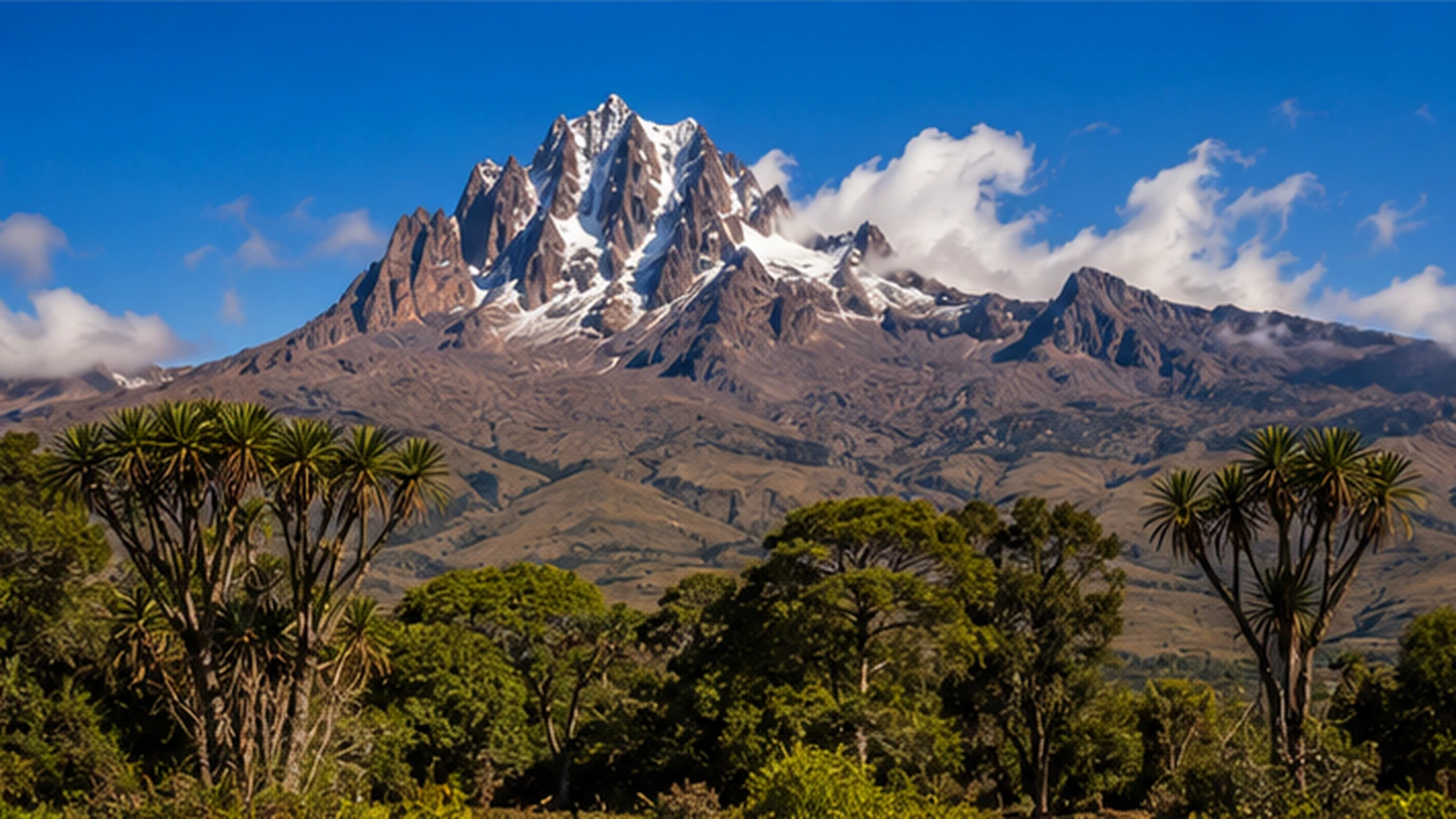
Mount Kenya and Sacred Orientation
Mount Kenya is regarded as a holy mountain by several communities living around it. UNESCO notes that Kikuyu and Meru communities use the mountain in traditional rituals connected with beliefs about Ngai and Mumbi.
Within Kikuyu traditions, the mountain is often known as Kĩrĩnyaga and is associated with Ngai. Historical and contemporary accounts describe prayers and homesteads oriented toward the mountain, although customs and religious identities have changed over time.
What Mount Kenya May Represent
For communities that recognize its sacredness, the mountain may communicate:
- Divine presence
- Creation and origin
- Rain and fertility
- Protection
- Cultural identity
- The relationship between land and community
- Continuity with earlier generations
Lesson From Mount Kenya
A sacred mountain can function simultaneously as:
- A physical ecosystem
- A source of water
- A cultural symbol
- A religious location
- A place of national heritage
Reducing it to only one of these roles leaves out much of its meaning.
Mount Mulanje as a Living Sacred Landscape
Mount Mulanje in Malawi is associated with living spiritual traditions among several communities, including Lhomwe, Man’ganja, and Yao peoples. UNESCO describes the landscape as inseparable from local beliefs, traditional healing, sacred trees, ancestral associations, and community practices.
The mountain may be approached as:
- A sacred abode
- A source of healing knowledge
- A place associated with spirits and ancestors
- A landscape governed by customary rules
- A source of water and plant resources
- A symbol shared across different communities
Important Caution
A sacred mountain is not an open ritual site for tourists to use freely.
Certain paths, trees, caves, pools, or shrines may have restrictions. Visitors should follow local guidance and avoid removing plants, stones, or ritual materials.
Hills, Rocks, and Rainmaking Traditions
Sacred landscapes are not limited to high mountains.
Hills, rock formations, caves, and shelters may hold religious meaning because they preserve:
- Rock art
- Ancestral shrines
- Burial places
- Rainmaking sites
- Oral histories
- Routes of migration
- Protected natural features
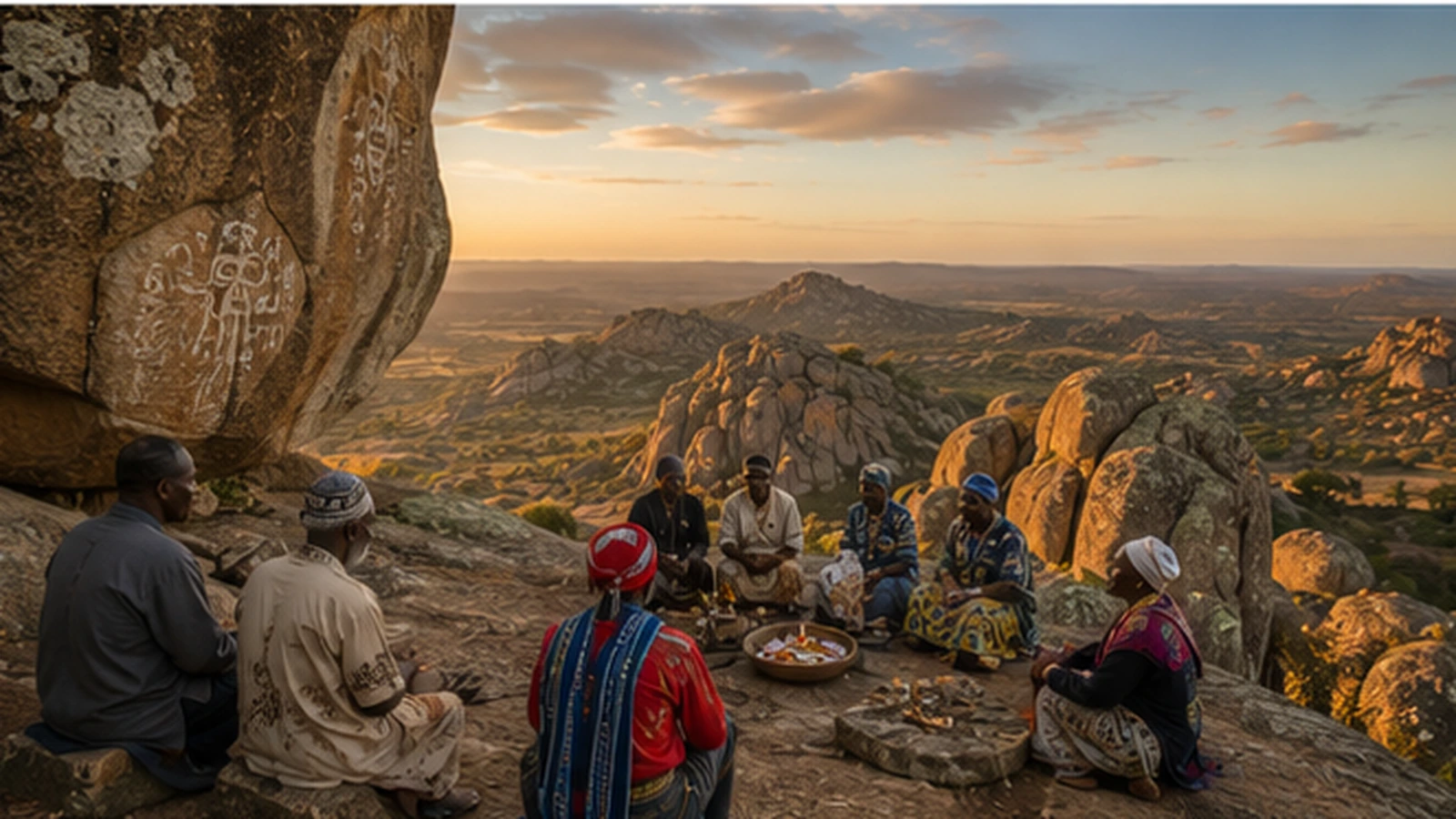
The Matobo Hills
The Matobo Hills in Zimbabwe contain rock formations, archaeological evidence, shrines, and living spiritual traditions. UNESCO documentation describes sacred shrines within the hills as places of contact with the spiritual world and recognizes the strength of continuing traditions connected with ancestors and community practice.
The landscape has been associated with:
- Ancestral spirits
- Rainmaking
- Fertility
- Pilgrimage
- Community identity
- Historical memory
- Consultation at shrines
Landscape Rather Than Isolated Monument
The sacred meaning of Matobo is not contained in one building.
It may involve:
- Hills
- Caves
- paths
- Animals
- Shrines
- Oral history
- Ritual activity
- Community custodians
This illustrates why sacred landscapes cannot always be protected by fencing off one object.
The Vumba Mountains
The Vumba mountain region of Zimbabwe contains sites where community ritual activities have continued. UNESCO’s tentative-list documentation notes that the Chinhamapere rock-art site remains connected with practices such as rainmaking, divination, and healing.
This continuity demonstrates that rock art can remain part of a living landscape rather than existing only as archaeological evidence.
Why Rivers Become Sacred
Rivers sustain human life.
They provide:
- Drinking water
- Agriculture
- Fish
- Transportation
- Boundaries
- Trade routes
- Fertile soil
- Places for settlement
Their movement and life-giving qualities can also support spiritual meanings involving cleansing, fertility, divine presence, healing, transformation, and continuity.
A sacred river may be connected with:
- A divinity
- A founding ancestor
- A migration
- A covenant
- Healing
- Birth
- Death
- Rain
- Community survival
- Annual festivals
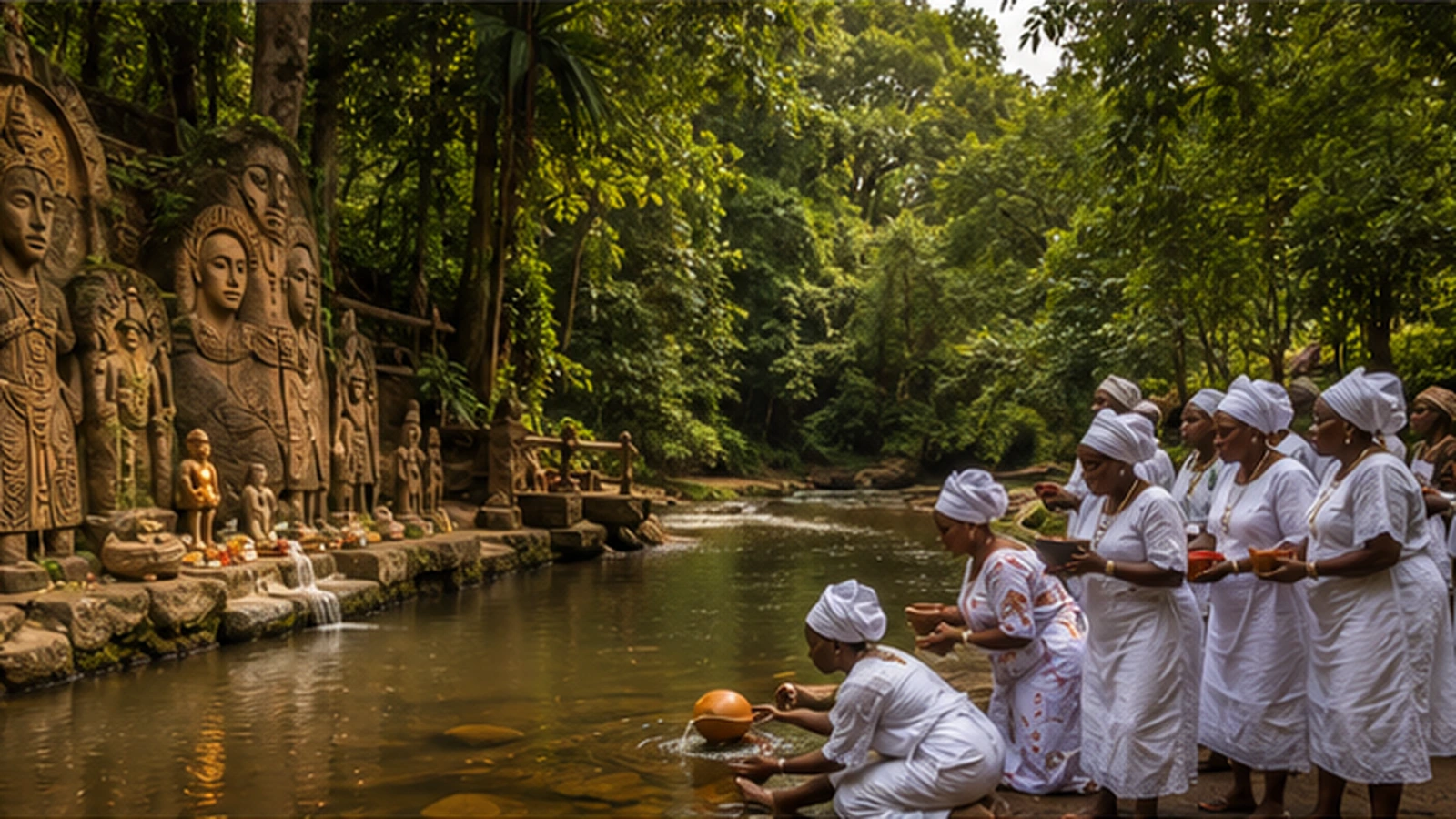
The Osun River and Osun-Osogbo Sacred Grove
The Osun-Osogbo Sacred Grove in Nigeria is one of the most prominent examples of a living sacred forest and river landscape.
The grove contains the Osun River, shrines, sanctuaries, sculptures, worship points, and other features honoring Osun and additional Yoruba divinities. UNESCO describes the river as the spiritual abode of Osun and identifies the grove as a major expression of Yoruba cosmology and living cultural tradition.
Meaning of Water in This Context
Within this specific Yoruba setting, water may communicate ideas associated with:
- Life
- Fertility
- Divine action
- Healing
- Femininity
- Renewal
- Community identity
UNESCO documentation for the grove describes water as expressing the relationship among nature, spirit, and human beings in Yoruba cosmology.
The Annual Festival
The grove supports daily, periodic, and annual religious activity, including the Osun-Osogbo festival. The annual observance connects local residents, priests and priestesses, visitors, artists, and members of the wider Yoruba and diaspora communities.
Important Distinction
The Osun River should not be used as evidence that all African rivers represent fertility goddesses.
Its religious meaning belongs to Yoruba traditions associated with Osun.
Symbolic Rivers and Ceremonial Pools
In Malawi, the Khulubvi and associated Mbona rain-shrine landscape includes spirit-associated forests, ceremonial pools, symbolic rivers, ritual structures, oral traditions, and annual practices. UNESCO describes this setting as a living religious landscape where spirituality and indigenous ecological knowledge are closely connected.
This example shows that water may function as part of a larger ceremonial landscape rather than as an isolated sacred object.
Why Forests and Groves Become Sacred
Forests can protect places and knowledge that communities do not want exposed to unrestricted access.
They may contain:
- Graves
- Shrines
- Former settlements
- Ritual grounds
- Medicinal plants
- Sacred trees
- Springs
- Initiation areas
- Paths known to custodians
- Habitats associated with religious stories
A sacred forest may also represent separation between ordinary space and restricted ceremonial space.
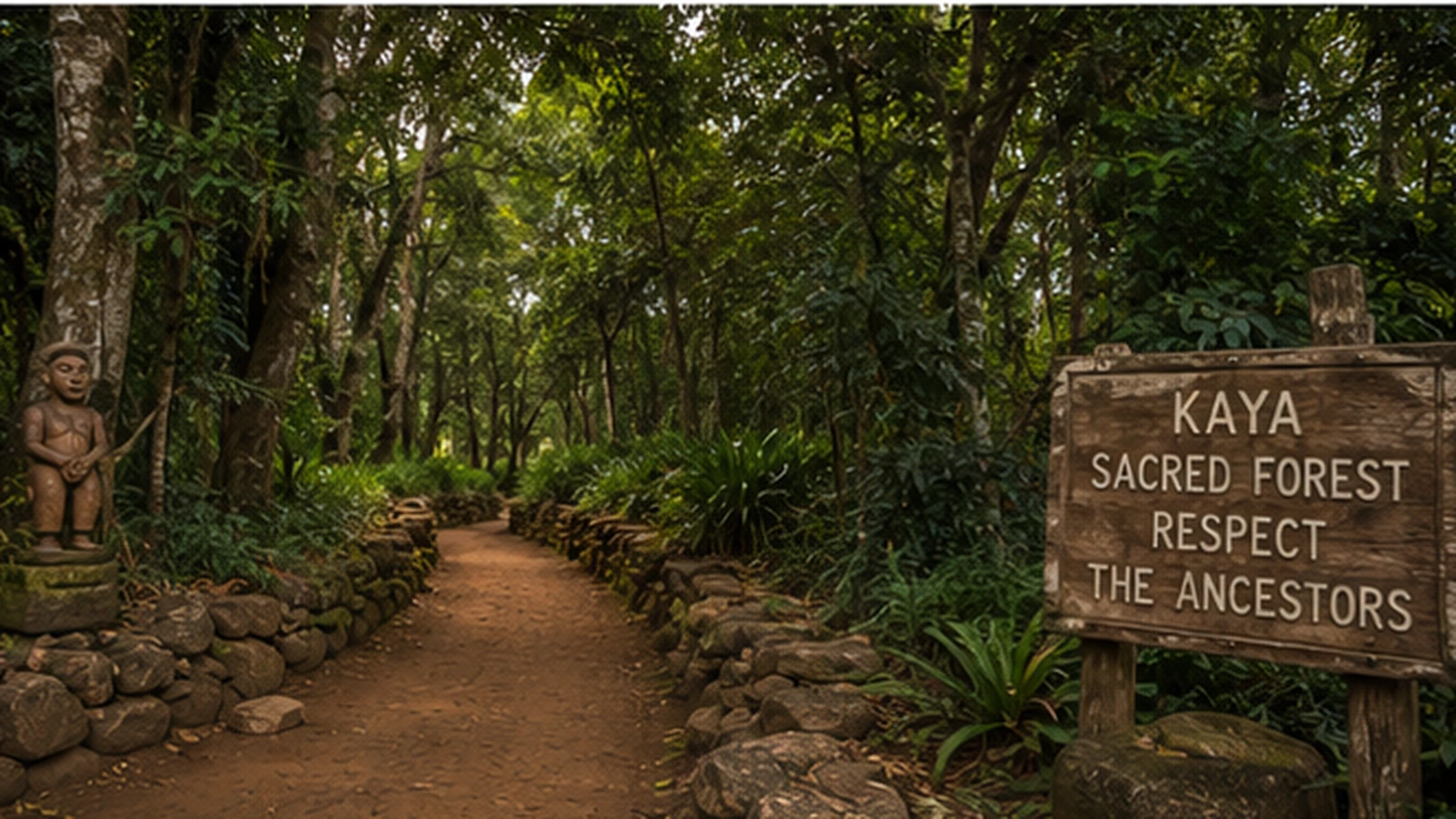
The Sacred Mijikenda Kaya Forests
The Kaya forests along the Kenyan coast are associated with the Mijikenda peoples.
They contain traces of fortified ancestral settlements, paths, gates, burial areas, ritual grounds, and forest environments that continue to support cultural and spiritual identity. UNESCO identifies the Kayas as ancestral homes, sacred places, and repositories of Mijikenda spiritual beliefs.
From Settlement to Sacred Landscape
The Kayas were historically places of settlement and refuge. As communities moved away, the former settlements increasingly entered the spiritual sphere of Mijikenda life.
They continued to serve as:
- Ancestral places
- Burial grounds
- Religious sites
- Sources of identity
- Locations for ceremonies
- Places protected through customary restrictions
Elders and Custodianship
Kaya elders help preserve knowledge, rules, and ceremonial responsibilities associated with the forests. UNESCO has emphasized the importance of recognizing their authority in conservation and management.
Sacred Rules and Biodiversity
Restrictions on access and resource extraction helped preserve parts of the forests and their biodiversity. UNESCO connects the survival of the Kaya forests with cultural rules governing their use.
This does not mean every sacred forest automatically protects biodiversity perfectly. It shows how cultural obligations can sometimes support ecological conservation.
Sacred Forests as Ancestral Homes
A forest may be considered an ancestral home even when most people no longer live inside it.
Its importance may come from:
- Graves
- Founding settlements
- Clan histories
- Earlier defensive sites
- Community law
- Places where elders meet
- Ritual paths
- Memories of migration
The forest becomes a living archive held in the landscape.
Ancient Trees as Sacred Markers
Individual trees may become sacred through:
- Great age
- Association with a founder
- Location beside a grave
- Use as a meeting place
- Connection with a divinity
- Ritual use
- Protection of a spring
- Importance in oral history
Common sacred trees vary by region and ecology.
They may include:
- Fig trees
- Baobabs
- Large indigenous hardwoods
- Trees growing near shrines
- Trees marking former settlements
A Tree Is Not Automatically Worshipped
A sacred tree may function as:
- An altar
- A meeting point
- A historical marker
- A place of prayer
- A symbol of continuity
- A boundary
- A protected habitat
Its importance depends on the community’s explanation.
Caves and Rock Shelters
Caves may represent:
- Refuge
- Burial
- Healing
- Initiation
- Spiritual presence
- Ancestral memory
- Protection
- Entry into another realm
The Sof Omar cave system in Ethiopia has living religious significance maintained through spiritual guardianship and community practice. UNESCO documentation describes the caves as a holy place with continuing ritual traditions.
Why Caves Carry Symbolic Meaning
Caves occupy an unusual position between visible landscape and hidden interior space.
They can therefore become associated with:
- Mystery
- Origin
- Death and rebirth
- Withdrawal
- Protection
- Communication with spiritual beings
These are possible themes, not universal definitions.
Sacred Landscapes and Ancestors
Natural places may connect communities with ancestors because they contain:
- Graves
- Former homes
- Settlement ruins
- Paths used by earlier generations
- Land inherited through lineages
- Sites of important events
- Shrines maintained by descendants
Ancestral presence does not always mean that people believe invisible beings permanently inhabit every part of the landscape.
It may also mean that the place preserves history, identity, responsibility, and belonging.
Sacred Landscapes and Community Identity
A sacred place can answer questions such as:
- Where did our community come from?
- Which ancestors settled here?
- Which land belongs to which lineage?
- Where were agreements made?
- Which places must remain protected?
- Which routes connect us with earlier generations?
- What responsibilities do we inherit?
This gives the landscape social meaning beyond its economic value.
Sacred Places and Environmental Protection
Sacred rules may restrict:
- Cutting trees
- Hunting
- Fishing
- Farming
- Building
- Grazing
- Removing stones
- Entering without permission
- Collecting medicinal plants
- Visiting at certain times
These restrictions may preserve habitats, water sources, or forests.
Spiritual Conservation Is Not the Same as Modern Conservation
Traditional protection may be motivated by:
- Respect for ancestors
- Fear of violating sacred rules
- Protection of a shrine
- Religious obligation
- Maintenance of community identity
Modern conservation may focus more explicitly on:
- Biodiversity
- Climate
- endangered species
- Scientific monitoring
- Tourism management
The two approaches can support one another, but they are not identical.
Indigenous Knowledge and Natural Cycles
Custodians, elders, healers, farmers, and herders may preserve knowledge about:
- Rain patterns
- Plant seasons
- Springs
- Animal movement
- Soil
- Fire
- Medicinal plants
- Drought
- Floods
- Safe travel routes
Religious and ecological knowledge may overlap.
A rule protecting a grove can carry both spiritual meaning and ecological consequences.
Sacredness Does Not Mean Untouched Wilderness
Sacred landscapes may show evidence of long human interaction.
They can contain:
- Former villages
- Farms
- walls
- Graves
- paths
- Shrines
- Rock art
- Ritual clearings
- Water-management structures
The term natural should not imply that people had no role in shaping the landscape.
The Kaya forests, for example, preserve the traces of settlements and ritual spaces within environments maintained through community practice.
Who Protects Sacred Landscapes?
Custodians may include:
- Elders
- Priests or priestesses
- Shrine guardians
- Family heads
- Spirit mediums
- Healers
- Royal institutions
- Community councils
- Women’s associations
- Government heritage bodies
Their responsibilities may involve:
- Controlling access
- Organizing ceremonies
- Preserving oral histories
- Maintaining paths or shrines
- Settling disputes
- Protecting trees and water
- Teaching younger people
- Negotiating with government agencies
Tourism and Sacred Places
Tourism can bring:
- Employment
- Public recognition
- Funding for conservation
- Cultural exchange
- Infrastructure
It can also create:
- Photography without consent
- Damage to shrines
- Removal of objects
- Noise
- Waste
- Commercialization
- Disrespectful behavior
- Pressure on restricted sites
How Visitors Should Behave
Visitors should:
- Follow local instructions.
- Ask before photographing people or ceremonies.
- Remain on permitted paths.
- Avoid touching shrines or offerings.
- Never remove stones, plants, soil, or objects.
- Dress appropriately where guidance is provided.
- Avoid imitating prayers or rituals.
- Respect areas closed to visitors.
- Use authorized guides where required.
- Avoid treating sacred spaces as entertainment venues.
Colonialism and Displacement
Colonial governments, missionaries, mining, commercial agriculture, conservation policies, and forced relocation changed access to many African sacred landscapes.
Communities were sometimes removed from:
- Forests
- Hills
- Game reserves
- Water sources
- Burial grounds
- Ritual places
Some spiritual practices were prohibited or described as superstition.
Heritage conservation itself has occasionally restricted local religious use when management prioritized monuments or tourism over living traditions. UNESCO studies have documented tensions where formal heritage systems excluded community ceremonies from culturally significant sites.
Key Lesson
Protecting a sacred site should include protecting the living community’s relationship with it, not only the physical landscape.
Christianity, Islam, and Sacred Landscapes
Christian and Muslim communities also maintain sacred natural places in Africa.
Examples may include:
- Mountains connected with monasteries
- Springs associated with healing
- Caves used for prayer
- Pilgrimage routes
- Forest monasteries
- Graves of religious teachers
- Sacred wells
African religious history includes interaction among indigenous traditions, Christianity, Islam, and local cultural practices.
A landscape’s spiritual meaning may therefore change or contain several interpretations.
Modern Threats to Sacred Natural Places
Sacred landscapes may face pressure from:
- Mining
- Logging
- Road construction
- Urban expansion
- Tourism
- Pollution
- Dams
- Commercial farming
- Climate change
- Religious conflict
- Loss of oral knowledge
- Unauthorized development
The Mijikenda Kaya forests, for example, face threats connected with development, extraction, poaching, and the decline of traditional knowledge.
Climate Change
Changing rainfall, drought, wildfires, floods, erosion, and species loss can affect sacred places and the ceremonies associated with them.
A sacred spring that dries up or a protected tree species that disappears represents both ecological and cultural loss.
Sacred Landscapes in Modern Life
Sacred natural places remain relevant to:
- Rural residents
- Urban families
- Diaspora communities
- Religious practitioners
- Heritage organizations
- Environmental activists
- Researchers
- Tourists
Modern tools may be used to:
- Map sacred sites
- Record oral histories
- Monitor deforestation
- Preserve local-language place names
- Document ecological knowledge
- Coordinate community protection
Digital Risks
Publishing exact locations can expose vulnerable sites to:
- Looting
- vandalism
- Unauthorized tourism
- Plant extraction
- Ritual imitation
- Commercial exploitation
Not every sacred site should be publicly mapped.
Common Misconceptions
Misconception 1: Africans Worship Mountains and Rivers
Reality: Communities may respect a place because it is connected with a divinity, ancestor, creator, historical event, or ritual responsibility.
Misconception 2: Every Forest Is Sacred
Reality: Sacred status belongs to particular forests or groves recognized by specific communities.
Misconception 3: Sacred Places Are Empty Wilderness
Reality: Many contain settlements, graves, paths, ritual grounds, and evidence of long human use.
Misconception 4: Sacredness Has One Meaning Across Africa
Reality: Meanings vary by community, religion, region, and historical period.
Misconception 5: Anyone Can Perform a Ritual at a Sacred Site
Reality: Some practices require permission, initiation, lineage authority, or specialist training.
Misconception 6: Sacred Forests Are Automatically Protected
Reality: They may remain vulnerable to development, pollution, religious change, and loss of custodial knowledge.
Misconception 7: Tourism Always Helps Preservation
Reality: Tourism can support conservation but can also cause damage and commercialization.
Misconception 8: Taking a Stone or Plant Causes No Harm
Reality: Removing material can damage the environment, violate community rules, and disrespect the site.
How to Study Sacred African Landscapes Respectfully
Step 1: Identify the Community
Ask:
- Which people recognize the site?
- What language names it?
- Which religious tradition is involved?
- Who serves as custodian?
Step 2: Learn the Site’s History
Research:
- Oral traditions
- Settlement history
- Religious practices
- Colonial disruption
- Environmental change
- Current community use
Step 3: Distinguish Public From Restricted Knowledge
Do not assume that every shrine, path, cave, tree, or ritual can be photographed or described publicly.
Step 4: Use Community-Informed Sources
Prioritize:
- Local historians
- Elders
- Community heritage groups
- African researchers
- Recognized custodians
- Reputable cultural institutions
Step 5: Avoid Romanticizing
Sacred landscapes may contain conflict, disputed ownership, changing beliefs, and environmental pressure.
Step 6: Respect Professional Support
Spiritual visits or traditional healing at sacred places do not replace medical care, emergency services, mental-health support, legal advice, financial advice, or professional safety assistance.
Key Takeaways
- Sacred mountains, rivers, and forests belong to specific African communities and traditions.
- Natural places may connect spirituality with history, ancestry, identity, water, healing, rain, or political authority.
- Mount Kenya is sacred within particular neighboring traditions.
- Mount Mulanje remains connected with living spiritual and healing practices.
- The Matobo Hills contain active shrines and ancestral traditions.
- The Osun River and grove belong to Yoruba traditions associated with Osun.
- Kaya forests preserve Mijikenda ancestral settlements, graves, rituals, and identity.
- Sacred rules can sometimes support biodiversity conservation.
- Sacred landscapes are shaped by both nature and long human interaction.
- Tourism, development, pollution, and knowledge loss can threaten them.
- Protecting a sacred landscape should include respecting its living custodians.
- No natural feature has one universal African meaning.
People Also Ask
Why are mountains sacred in African spirituality?
Some mountains are connected with creators, spirits, ancestors, rain, healing, origin stories, political identity, or pilgrimage.
What do rivers symbolize in African spirituality?
Depending on the culture, rivers may represent life, fertility, movement, cleansing, divine presence, healing, or community survival.
What is a sacred grove?
A sacred grove is a protected forested place recognized for religious, ancestral, historical, or ceremonial importance.
Why are the Kaya forests sacred?
The Kaya forests are ancestral homes and repositories of Mijikenda spiritual beliefs, burial traditions, settlements, and cultural identity.
What is special about the Osun River?
Within Yoruba traditions, the Osun River is associated with Osun and forms part of the living religious landscape of the Osun-Osogbo Sacred Grove.
Can tourists visit sacred African sites?
Some are open to visitors, while others contain restricted areas. Visitors must follow community and heritage rules.
Frequently Asked Questions
1. Do African spiritual traditions worship nature?
The phrase is usually too broad. Communities may relate to natural places through creators, divinities, ancestors, spirits, history, and ethical responsibilities.
2. Is Mount Kenya spiritually important?
Yes. It is regarded as holy by communities including the Kikuyu and Meru and is connected with traditional beliefs and rituals.
Related Cultural Guides
For more context, continue with sacred forests in African traditions, rivers in African spiritual heritage, mountains and cultural significance, sacred caves through history and African trees with cultural significance.
Frequently Asked Questions
What should readers know first about Sacred natural places in African spirituality?
Sacred natural places in African spirituality: Explore how mountains, rivers, forests, caves, and sacred trees connect African communities with ancestors, div
What causes Sacred natural places in African spirituality?
Explore how mountains, rivers, forests, caves, and sacred trees connect African communities with ancestors, divinities, history, identity, healing, and environmental responsibility. The safest next step is to compare the signs, prepare clear details, and reque
How does Sacred natural places in African spirituality work?
Explore how mountains, rivers, forests, caves, and sacred trees connect African communities with ancestors, divinities, history, identity, healing, and environmental responsibility. The safest next step is to compare the signs, prepare clear details, and reque
Is it possible to get private guidance for Sacred natural places in African spirituality?
Explore how mountains, rivers, forests, caves, and sacred trees connect African communities with ancestors, divinities, history, identity, healing, and environmental responsibility. The safest next step is to compare the signs, prepare clear details, and reque
How long does Sacred natural places in African spirituality take to understand?
Explore how mountains, rivers, forests, caves, and sacred trees connect African communities with ancestors, divinities, history, identity, healing, and environmental responsibility. The safest next step is to compare the signs, prepare clear details, and reque
Can Sacred natural places in African spirituality affect relationships, family, work, or personal peace?
Explore how mountains, rivers, forests, caves, and sacred trees connect African communities with ancestors, divinities, history, identity, healing, and environmental responsibility. The safest next step is to compare the signs, prepare clear details, and reque
Why do people seek spiritual guidance for Sacred natural places in African spirituality?
Explore how mountains, rivers, forests, caves, and sacred trees connect African communities with ancestors, divinities, history, identity, healing, and environmental responsibility. The safest next step is to compare the signs, prepare clear details, and reque
What signs should someone notice before asking about Sacred natural places in African spirituality?
Explore how mountains, rivers, forests, caves, and sacred trees connect African communities with ancestors, divinities, history, identity, healing, and environmental responsibility. The safest next step is to compare the signs, prepare clear details, and reque
When should someone contact a private spiritual guide?
Explore how mountains, rivers, forests, caves, and sacred trees connect African communities with ancestors, divinities, history, identity, healing, and environmental responsibility. The safest next step is to compare the signs, prepare clear details, and reque
Article Information
- Publisher
- Ancestral Temple
- Editor
- Ancestral Temple
- Last updated
- Jul 26, 2026
- Last reviewed
- Jul 13, 2026
- Content version
- 4ce8e49f2d
This educational article should be read as cultural and spiritual information, not as medical, legal, financial, or emergency advice.
Helpful Related Guidance
Explore This Topic
African Spiritual Traditions · Sacred Natural Places In African Spirituality
Related Topic Cluster
Sacred Natural Places In African Spirituality
Complete Guide Understanding African Spiritual Traditions: A Historical IntroductionAbout the Author
 Ancestral Temple
Spiritual guide and practitioner with decades of experience in ancestral wisdom, rituals, and divine guidance.
Related Posts
View All
Leave a Comment
We'd love to hear your thoughts.
This was detailed and respectful without suggesting that every African community believes the same thing.
Are there books or documentaries about the Matobo Hills and Mijikenda Kaya forests?
The article made me think more carefully about responsible tourism.
The idea that a spring drying up can be both an environmental and cultural loss was powerful.
I had not considered how climate change can also destroy cultural and spiritual knowledge.
A strong explanation of how natural heritage and cultural heritage can be inseparable.
The misconceptions section answered many incorrect statements I have seen about African nature worship.
This article respected religious belief while staying factual and educational.
The warning against sharing exact locations of vulnerable sacred sites online was responsible.
The Osun-Osogbo section was detailed without treating Yoruba beliefs as representative of the whole continent.
It would be helpful to include interviews with African heritage custodians in future articles.
The Kaya forests sound like an important example of cultural traditions supporting conservation.
The main lesson for me was that place, memory, belief, and identity cannot always be separated.
I liked that the article did not encourage readers to copy rituals at sacred sites.
The role of elders and custodians in protecting sacred forests deserves more public attention.
The point that sacredness does not mean untouched wilderness corrected one of my assumptions.
Could you write next about African rivers associated with divinities and healing?
The article is long, but the short sections made it easy to read on mobile.
The language was clear even though the topic has many cultural and historical layers.
This would be useful reading for students studying religion, environmental history, or heritage conservation.
Thank you for including clear health and safety boundaries without dismissing traditional practices.
Sacred caves are an interesting topic that deserves a longer article.
The article explains why land disputes can also become cultural and spiritual disputes.
I would like to read more about rainmaking traditions in Zimbabwe and Malawi.
The glossary made terms such as sacred landscape and custodianship easy to understand.
The section about heritage conservation sometimes excluding local ceremonies was important.
I liked the idea of a forest acting as a living archive for a community.
The Mount Mulanje example showed how healing knowledge and landscape can be connected.
This article avoided both colonial stereotypes and unrealistic romantic descriptions.
The Matobo Hills section made it clear that a sacred landscape can include shrines, rocks, animals, paths, and oral history together.
Could you write a full article about sacred trees and the communities that protect them?
I liked that each example was linked to a particular community and country.
The tourism guidelines were practical and respectful.
Visitors should definitely ask before taking photographs at sacred places.
It was helpful that the article included indigenous traditions, Christianity, and Islam instead of treating African religion as one category.
I appreciated the reminder that sacred landscapes often contain evidence of long human activity.
The difference between traditional spiritual conservation and modern scientific conservation was explained clearly.
A separate article about the Osun River and Yoruba water symbolism would be useful.
I had heard of the Osun festival but did not know the grove contained so many shrines and worship points.
The discussion of sacred rules helping to protect biodiversity was one of the strongest sections.
Very respectful article. It connected spirituality with nature without making everything sound mystical.
The Mijikenda Kaya forests were new to me. Their history as settlements and later sacred sites is fascinating.
I appreciated the correction that respecting a river is not always the same as worshipping the physical water.
The section about Mount Kenya helped me understand why a mountain can be both an ecosystem and a spiritual landmark.
I liked the explanation that sacred places are connected with specific communities rather than having one meaning across Africa.