
Maasai Cultural Beliefs
Quick Summary
Maasai cultural beliefs are living systems of pastoral knowledge, spirituality, kinship, age-set organization, cattle stewardship, blessing, oral tradition, beadwork, and responsibility to land and community. Practices differ among Maasai communities in Kenya and Tanzania and continue to change through education, religion, conservation, tourism, and land pressure.
The Maasai are an Eastern Nilotic people living mainly in southern Kenya and northern Tanzania. Their language, Maa, connects communities across a region often described as Maasailand.
Maasai culture is not one frozen or uniform system. Beliefs and customs differ among territorial sections, families, age sets, churches, towns, conservation areas, and national contexts.
Historically, Maasai cultural life has centered on:
- Pastoralism
- Cattle
- Age-set institutions
- Elders
- Family responsibility
- Oral knowledge
- Ritual blessing
- Mobility
- Relationships with land and water
UNESCO recognizes Enkipaata, Eunoto, and Olng’esherr as three interrelated male rites of passage within the Maasai community. Enkipaata prepares boys for initiation, Eunoto marks the transition of morans toward adulthood, and Olng’esherr marks the end of moranhood and entry into elderhood. The tradition was placed on UNESCO’s Urgent Safeguarding List because changing land use, schooling, migration, and social conditions have weakened transmission.
This article discusses public cultural information. It does not reproduce restricted initiation teachings, private blessings, medicinal formulas, or confidential ceremonial procedures.
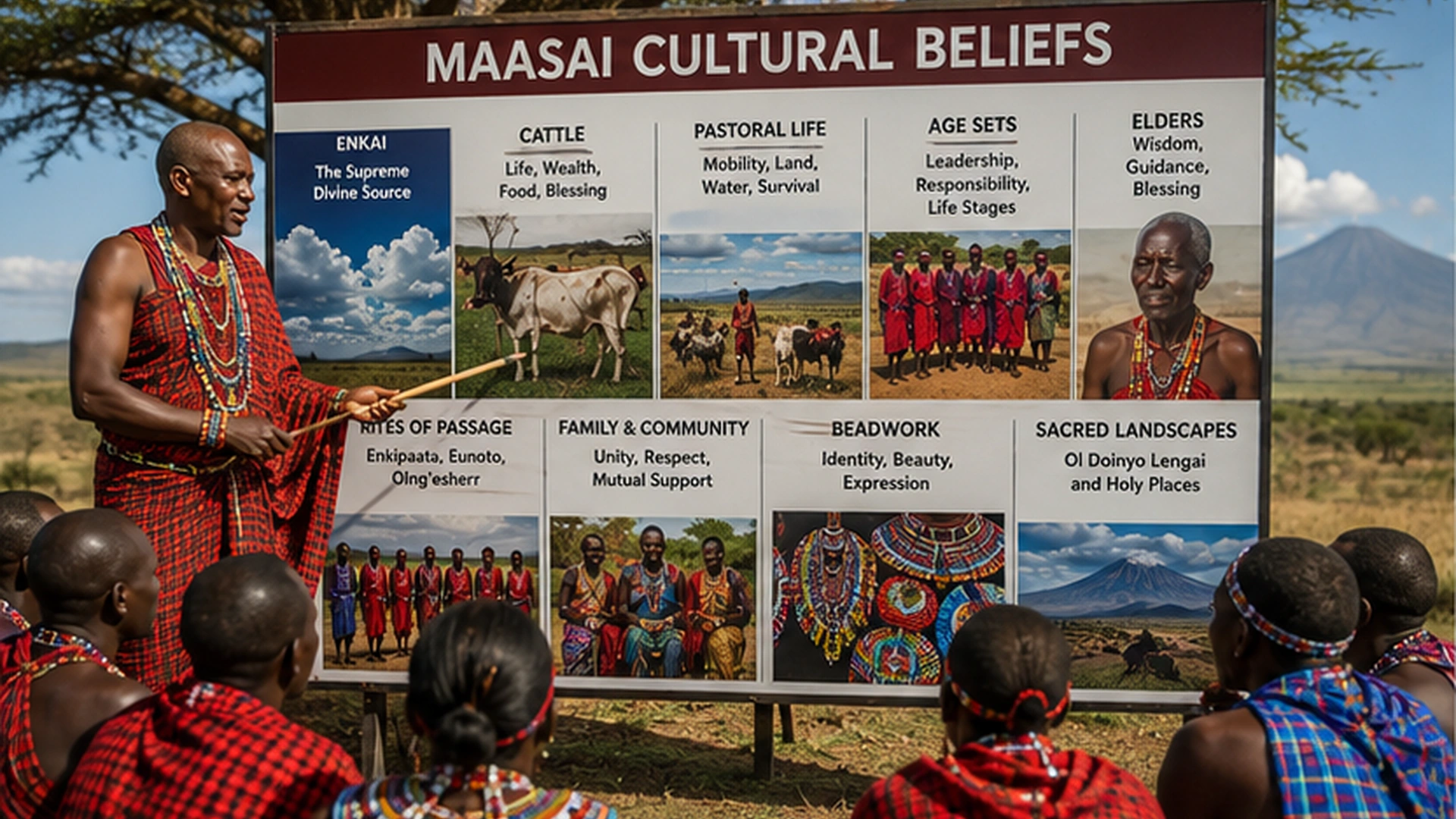
Suggested scene: Maasai cultural historian introducing Enkai, cattle, pastoral mobility, age sets, elders, rites of passage, beadwork, sacred landscapes, and community values through separate educational displays.
Key Points
- Maasai cultural beliefs vary across communities in Kenya and Tanzania.
- Enkai or Engai is understood as the supreme divine source, although interpretations differ.
- Cattle are central to food, wealth, marriage, identity, blessing, and social relationships.
- Pastoral mobility is a planned knowledge system for managing pasture, water, drought, livestock health, and risk.
- Age sets organize responsibility, education, leadership, and life transitions.
- Enkipaata, Eunoto, and Olng’esherr are major rites of passage recognized by UNESCO.
- Elders guide blessing, dispute resolution, moral instruction, and community decisions.
- Women hold major responsibilities in households, beadwork, food systems, ceremony, trade, and cultural transmission.
- Beadwork communicates beauty, identity, age, status, relationship, and local creativity.
- Christianity, schooling, conservation, land loss, tourism, and urbanization have reshaped Maasai life.
Important Terms
- Term
- General meaning
- Enkai or Engai
- Supreme divine source in Maasai belief; interpretations vary
- Maa
- The Maasai language
- Enkang
- Homestead or family settlement, sometimes translated as boma
- Age set
- A named generation of people initiated during a related period
- Ilmurran or moran
- Warrior-age category historically associated with young men
- Elder
- Senior social and moral authority within family and community
- Enkipaata
- Induction phase leading boys toward initiation
- Eunoto
- Ceremony marking movement from moranhood toward adulthood
- Olng’esherr
- Ceremony marking the end of moranhood and beginning of elderhood
- Pastoralism
- Livelihood centered on livestock, mobility, pasture, water, and ecological knowledge
1. Maasailand and Community Diversity
Maasai communities live across national borders and several ecological zones, including:
- Grasslands
- Highlands
- Drylands
- Conservation areas
- Towns
- Farming regions
Differences may involve:
- Territorial section
- Dialect
- Livelihood
- Education
- Church affiliation
- Land tenure
- Proximity to tourism or wildlife areas
No one village, elder, tourism center, or photograph can represent every Maasai community.
2. Enkai or Engai
Enkai is commonly described as the supreme divine source associated with:
- Life
- Rain
- Fertility
- Blessing
- Moral order
Some traditions describe divine qualities through colors or conditions associated with rain and drought, but public summaries often oversimplify these ideas.
Modern Maasai Christians may identify Enkai with the Christian God, while other families preserve distinct ancestral and ritual interpretations.
Article Information
- Publisher
- Ancestral Temple
- Editor
- Ancestral Temple
- Last updated
- Jul 26, 2026
- Last reviewed
- Jul 26, 2026
- Content version
- 10be6b4a93
This educational article should be read as cultural and spiritual information, not as medical, legal, financial, or emergency advice.
Helpful Related Guidance
Explore This Topic
Dreams & Symbolism · Harvest Celebrations Across Cultures
About the Author
 Ancestral Temple
Spiritual guide and practitioner with decades of experience in ancestral wisdom, rituals, and divine guidance.
Related Posts
View All

Leave a Comment
We'd love to hear your thoughts.
This was a balanced and culturally respectful introduction.
A beginner quiz about Maasai cultural beliefs would be useful.
The Kenya and Tanzania distinctions made the topic clearer.
The key takeaways summarized the subject well.
How can young people learn Maa through digital tools?
The healthcare boundaries were responsible.
I would enjoy an article about Maasai conservation knowledge.
The article respected elders, women, youth, and pastoralists.
Could you create an ethical checklist for cultural tourism?
I liked the connection between cattle, land, and family responsibility.
The article did not reduce morans to warriors.
A visual guide to the age-set life cycle would be useful.
The UNESCO and Smithsonian sources made the article trustworthy.
How do Maasai families negotiate marriage today?
I appreciated the explanation that modern life does not erase identity.
The article was detailed but easy to scan.
Can museum-held Maasai objects be returned or loaned?
The article respected consent and photography boundaries.
I would enjoy a detailed article about Maasai beadwork history.
The mother-tongue education section was important.
How are community conservancy benefits distributed?
The glossary would work well as a Maasai heritage knowledge hub.
The article separated public culture from restricted ceremony.
Could you write more about pastoral climate forecasting?
I liked that Christianity and Maasai belief were discussed together.
The glossary made the cultural terms easier to understand.
I would enjoy an article about Maa oral traditions.
The colonial land-loss section added important context.
How do women participate in age-set ceremonies?
I appreciated the medical and veterinary safety boundaries.
The tourism section offered practical ethical guidance.
I would like a full article about Ol Doinyo Lengai.
The discussion of elders and modern governance was balanced.
A printable map of Maasailand would be helpful.
Thank you for avoiding a universal bead-color dictionary.
Can urban Maasai families remain active in age-set institutions?
The land-rights section was necessary.
I would enjoy a detailed guide to Enkipaata, Eunoto, and Olng’esherr.
The explanation of cattle went far beyond wealth alone.
How do age-set names differ between Maasai sections?
I liked that women were recognized as knowledge holders and leaders.
The pastoral mobility section corrected many stereotypes.
A separate article about Maasai age sets would be useful.
I appreciated the explanation of Enkai without forcing one definition.
The article clearly explained that Maasai communities are diverse.