
Akan Cultural Traditions
Quick Summary
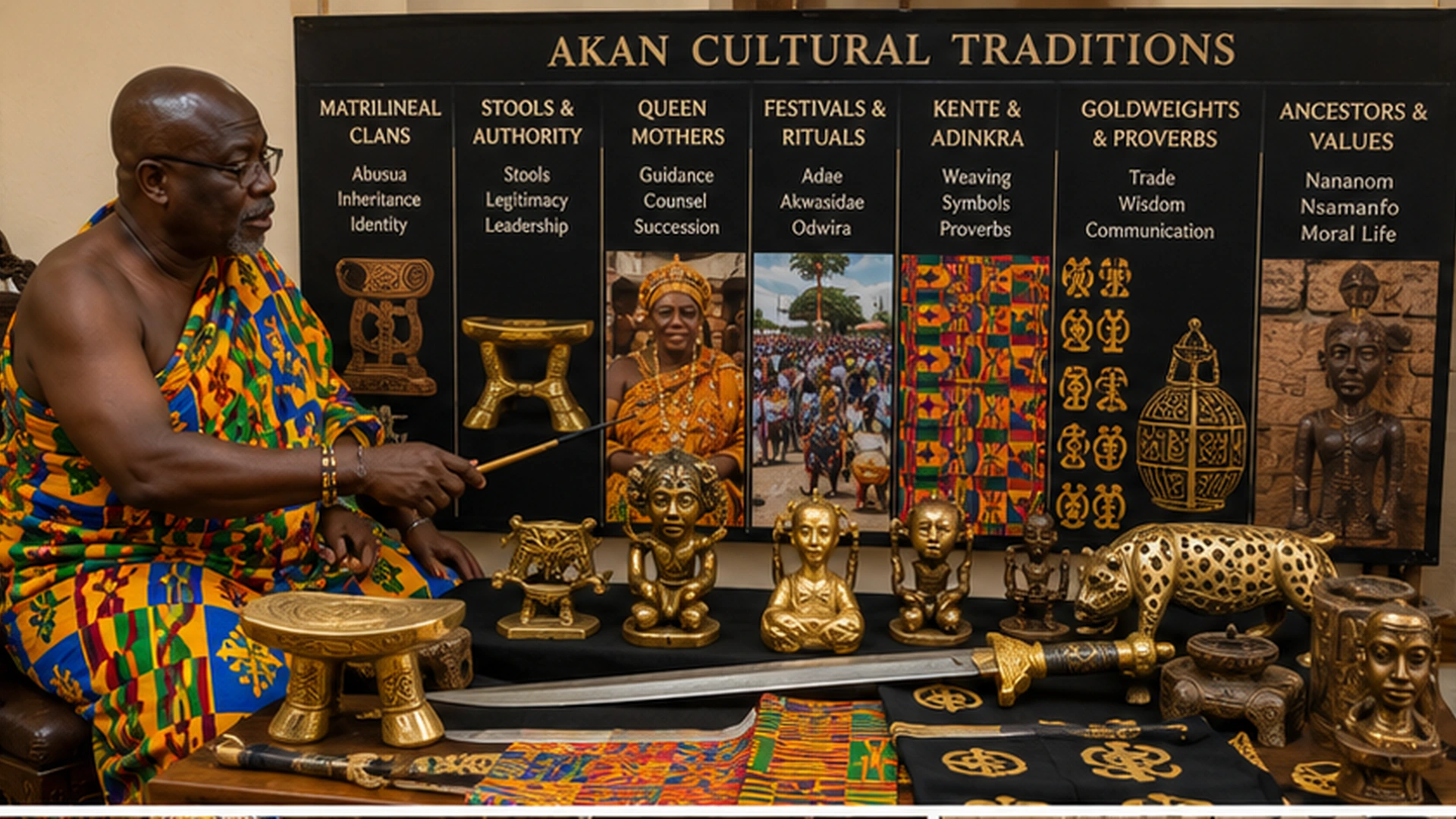
Akan cultural traditions form a diverse living heritage shared by related communities in Ghana and Côte d’Ivoire. They include matrilineal descent, sacred stools, queen-mother authority, ancestor remembrance, festivals, funerals, kente, adinkra, goldweights, proverbs, music, customary law, foodways, and global diaspora connections.
The Akan are a broad family of related peoples living mainly in Ghana and Côte d’Ivoire.
Major Akan communities include:
- Asante
- Fante
- Akuapem
- Akyem
- Bono
- Kwahu
- Wassa
- Nzema
- Sefwi
- Agona
- Other related communities
Akan culture is not one perfectly uniform system.
These communities share related languages, matrilineal principles, political institutions, artistic traditions, and spiritual concepts, but their local histories and practices differ.
Akan traditions connect:
- Family
- Ancestry
- Land
- Political office
- Craft
- Trade
- Religion
- Music
- Food
- Funerals
- Moral education
They remain active in villages, towns, cities, royal institutions, schools, churches, mosques, families, and diaspora associations.
Kente craftsmanship was added to UNESCO’s Representative List of the Intangible Cultural Heritage of Humanity in 2024. UNESCO explains that kente designs and colors can communicate identity, status, proverbs, social situations, and community history while continuing to evolve through the creativity of weavers.
This article discusses public cultural and historical evidence. It does not reveal private shrine knowledge, restricted stool-room practices, burial secrets, or confidential royal ceremonies.
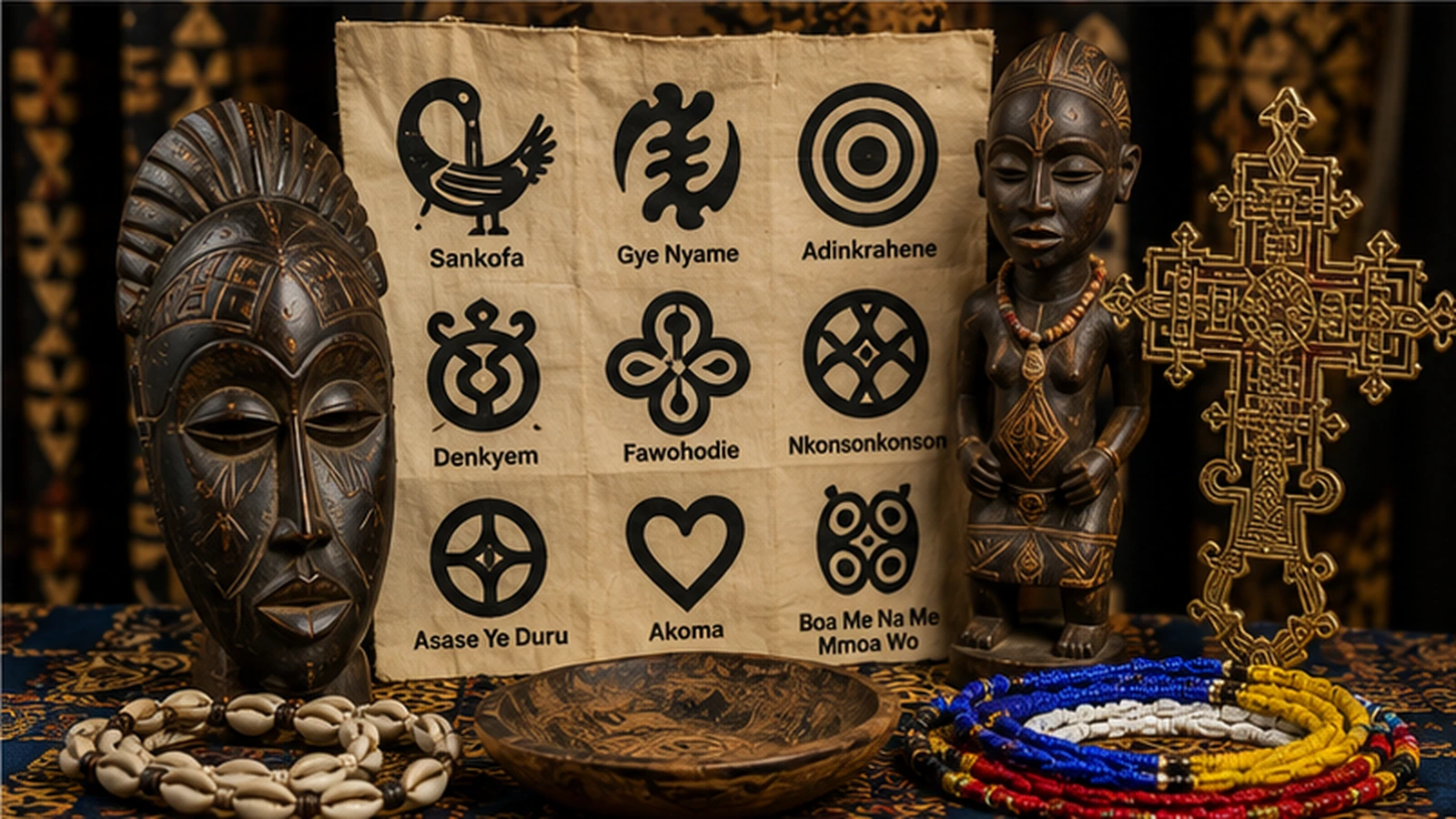
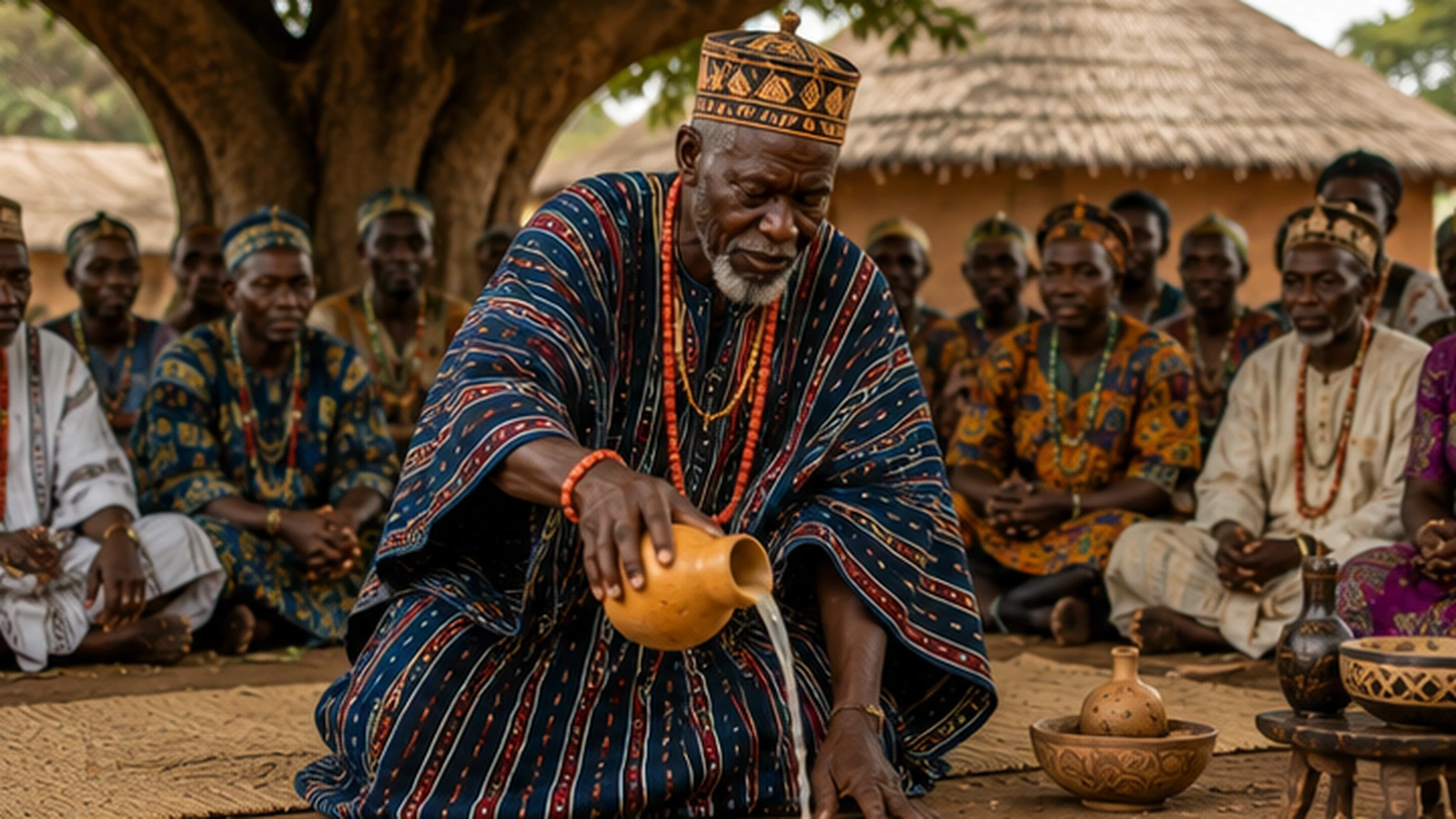
Suggested scene: Akan cultural historian introducing matrilineal clans, stools, queen mothers, kente, adinkra, goldweights, festivals, and ancestral remembrance through clearly separated displays.
Key Points
- Akan culture includes many related but distinct communities in Ghana and Côte d’Ivoire.
- Matrilineal descent organizes clan belonging, inheritance, political succession, and family responsibility in many Akan societies.
- Stools can represent personhood, office, ancestry, authority, and community continuity.
- Queen mothers hold important roles in succession, counsel, dispute resolution, and public leadership.
- Nyame, abosom, ancestors, and moral responsibility form part of Akan religious and ethical life.
- Festivals renew relationships among rulers, communities, ancestors, land, and history.
- Funerals are major social institutions involving mourning, kinship, status, music, cloth, and remembrance.
- Kente, adinkra, goldweights, state swords, drums, and regalia communicate proverbs, history, and authority.
- Christianity and Islam have long interacted with Akan cultural life.
- Akan traditions continue globally through migration, language, family practice, music, art, and diaspora associations.
Akan Communities and Regional Diversity
- Community or region
- Examples of distinctive historical emphasis
- Asante
- Kumasi-centered state traditions, the Golden Stool, Akwasidae, court regalia, and the historical gold economy
- Fante
- Coastal states, asafo companies, fishing and maritime history, town flags, and civic organizations
- Akuapem
- Mountain towns, chieftaincy, Odwira traditions, Christianity, and language history
- Akyem
- Historic states, royal institutions, land, agriculture, mining regions, and festivals
- Bono
- Early Akan state traditions, sacred sites, agriculture, trade, and royal history
- Nzema
- Western coastal traditions, the Kundum festival, language, and cross-border heritage
- Kwahu
- Mountain settlements, trade networks, chieftaincy, and major homecoming celebrations
- Sefwi and Wassa
- Forest-region traditions, farming, mining, chieftaincy, and local festivals
1. Matrilineal Descent and the Abusua
Many Akan societies organize descent through the mother’s lineage, known as the abusua.
A person generally belongs to the maternal clan of the mother and shares inherited identity and obligations with its members.
The abusua may influence:
- Clan identity
- Inheritance
- Marriage restrictions
- Political succession
- Funeral responsibility
- Land claims
- Mutual assistance
Matrilineal descent does not mean that fathers are unimportant or that women control every political institution.
Fathers, paternal relatives, spouses, elders, chiefs, and other family members all hold significant responsibilities.
2. Ntoro and Paternal Relationships
Akan understandings of personhood may also include ntoro, a paternal spiritual or social identity connected with the father’s line.
Interpretations differ among Akan communities.
Abusua and ntoro show that Akan kinship cannot be reduced to one descent line.
Maternal and paternal relationships can provide different forms of:
- Identity
- Care
- Ritual obligation
- Moral education
- Family support
- Inheritance
Article Information
- Publisher
- Ancestral Temple
- Editor
- Ancestral Temple
- Last updated
- Jul 26, 2026
- Last reviewed
- Jul 26, 2026
- Content version
- 2691d6811d
This educational article should be read as cultural and spiritual information, not as medical, legal, financial, or emergency advice.
Helpful Related Guidance
Explore This Topic
Spiritual Knowledge · African Spiritual Traditions
About the Author
 Ancestral Temple
Spiritual guide and practitioner with decades of experience in ancestral wisdom, rituals, and divine guidance.
Related Posts
View All

Leave a Comment
We'd love to hear your thoughts.
This was a balanced and culturally respectful introduction.
A beginner quiz about Akan cultural traditions would be useful.
The separate community examples made the article easier to understand.
The key takeaways summarized the subject well.
How can young Akan people learn proverbs and language online?
The scientific and spiritual boundaries were necessary.
I would enjoy an article about Akan foodways and hospitality.
The article respected craftspeople, chiefs, queen mothers, and historians.
Could you create an ethical checklist for photographing funerals?
I liked the section on Ananse and moral ambiguity.
The article did not present matriliny as female rule over everything.
A visual guide to Akan stools and regalia would be useful.
The UNESCO and museum sources made the article trustworthy.
How are kente pattern names preserved and taught to younger weavers?
I appreciated the explanation of Sankofa beyond a simple slogan.
The article was detailed but easy to scan.
Can museum-held regalia be returned for royal ceremonies?
The article respected community authority and local variation.
I would enjoy a detailed article about Odwira.
The explanation of funeral cloth colors was appropriately cautious.
How are chiefs and queen mothers selected in different Akan states?
The glossary would work well as an Akan heritage knowledge hub.
The article separated public festivals from restricted ceremonies.
Could you write more about Bono cultural traditions?
I liked that Christianity and Islam were included in modern Akan life.
The regional comparison table was useful.
I would enjoy an article about Fante asafo flags.
The provenance discussion about Asante regalia was necessary.
How do goldweight images connect with particular proverbs?
I appreciated the warning against oversimplified adinkra meanings.
The kente section avoided treating every Ghanaian cloth as identical.
I would like a full article about the okyeame and proverb staffs.
The discussion of queen mothers and succession was important.
A printable map of major Akan communities would be helpful.
Thank you for explaining that not every stool is sacred.
Can an ordinary family stool become an ancestral stool?
The funeral section showed why mourning and celebration can coexist.
I would enjoy a detailed guide to Akwasidae.
The explanation of the Golden Stool was respectful and clear.
How does the abusua system operate for Akan families living abroad?
I liked that Fante, Nzema, Bono, and Akuapem traditions were included.
The stool section made Akan political symbolism easier to understand.
A separate article about queen mothers would be useful.
I appreciated the explanation of matrilineal descent and paternal relationships.
The article clearly explained that Akan does not mean only Asante.