
Sacred Caves Through History: Meaning, Worship, and Living Heritage
Quick Summary
Caves have served as shelters, burial places, shrines, monasteries, pilgrimage destinations, and sacred landscapes. This guide explores culturally specific cave traditions without assuming every ancient cave had one universal spiritual meaning.
[HERO IMAGE PLACEMENT]
sacred-caves-through-history-hero.jpg
Alt text: A respectful global collage of natural sacred caves, rock-cut temples, cave art, monastic cells, and pilgrimage spaces shown as separate cultural traditions.
Sacred Caves Through History: Meaning, Worship, and Living Heritage
What This Topic Means
Caves have sheltered human beings for tens of thousands of years. They have protected families from weather, preserved burials and artworks, hidden communities during conflict, and provided secluded places for prayer, meditation, initiation, and pilgrimage.
Their physical qualities make them powerful cultural spaces. A cave can feel enclosed yet immense, silent yet full of echoes, hidden yet connected to springs, rivers, cliffs, and mountains. Entering may require bending, crawling, descending, crossing water, or leaving daylight behind. Communities have interpreted these experiences in many different ways.
The phrase sacred caves through history is therefore a comparative doorway, not evidence of one universal cave religion. Tsodilo, Sof Omar, Ajanta, Mogao, Cappadocia, and Kyiv-Pechersk Lavra belong to distinct peoples, religions, languages, and institutions.
This article discusses public and educational aspects of cave heritage. It does not disclose restricted rites, identify private sacred locations, or provide instructions for collecting ritual materials.
What Makes a Cave Sacred?
A sacred cave is a natural or human-shaped underground space that a community recognizes as spiritually, historically, or morally significant.
Sacredness may arise from an origin story, ancestral presence, a deity or saint, a burial, a healing tradition, an oracle, a miraculous event, a monastic lineage, or the long use of the site for prayer and pilgrimage.
The meaning may belong to the whole cave system or to one chamber, spring, passage, wall, entrance, or rock formation. Rules may govern who can enter, what can be carried inside, when prayers are performed, whether photography is allowed, and which areas remain closed.
A cave can also be culturally important without being sacred. Archaeological value, geological rarity, biodiversity, and evidence of ancient habitation should not automatically be translated into religion.
Natural Caves, Rock Shelters, Grottoes, and Rock-Cut Temples
A natural cave is formed through geological processes such as water dissolving limestone, volcanic activity, erosion, or collapse. A rock shelter is usually shallower and more open to daylight.
A grotto can refer to a small natural cave or to a constructed or modified cave-like shrine. Rock-cut temples and cave monasteries are deliberately excavated architectural spaces shaped from cliffs or living rock.
These forms may overlap. A natural cavern can be adapted with altars or paths, while an excavated sanctuary may imitate the atmosphere of a natural cave. Accurate description matters because the labour, theology, and community use of a carved monastery differ from those of a naturally formed ancestral cave.
Why Caves Became Spiritually Powerful
Caves often appear to form thresholds between the surface world and hidden depths. Descent, darkness, echo, underground water, unusual stone formations, and the return to daylight can support ideas about death, rebirth, revelation, protection, or passage between visible and spiritual realities.
Their seclusion can support meditation, fasting, prayer, healing, or the training of specialists. Their stability can preserve burials, relics, paintings, manuscripts, and material evidence over long periods.
Caves can also be dangerous. Flooding, falling rock, narrow passages, darkness, poor air, wildlife, and difficult rescue conditions may become part of a site’s cultural reputation. Spiritual meaning must never replace physical safety.
Prehistoric Caves: Art, Burial, and the Limits of Interpretation
Some of the earliest surviving human artworks and burials were preserved in caves and rock shelters. The decorated Chauvet Cave in France contains exceptionally preserved Upper Palaeolithic art, while the caves of Altamira and northern Spain document a long flowering of painting, engraving, and sculpture.
These works demonstrate symbolism, skilled observation, and deliberate use of underground space. They do not provide a complete explanation of what the artists believed. Scholars have proposed ritual, teaching, storytelling, memory, hunting symbolism, and other interpretations, but no single theory explains every cave.
Kenya’s Panga ya Saidi preserves an unusually long archaeological record from roughly 78,000 years ago to recent centuries. Its importance demonstrates how caves can hold evidence of changing human life across immense periods. Archaeological continuity should not be confused with proof that the cave had one unchanged sacred function.
Sacred Caves and Rock Landscapes in Africa
African cave heritage includes prehistoric art, ancestral shrines, oracular spaces, Islamic pilgrimage sites, healing places, burial locations, and caves connected with political history. There is no single African understanding of caves.
The safest approach is to identify the exact community, language, landscape, and recognized custodians. Labels such as ancestral cave, shrine, oracle, mosque, rock shelter, and archaeological site should not be used interchangeably.
Tsodilo: Rock Art, Worship, and Ancestral Presence in Botswana
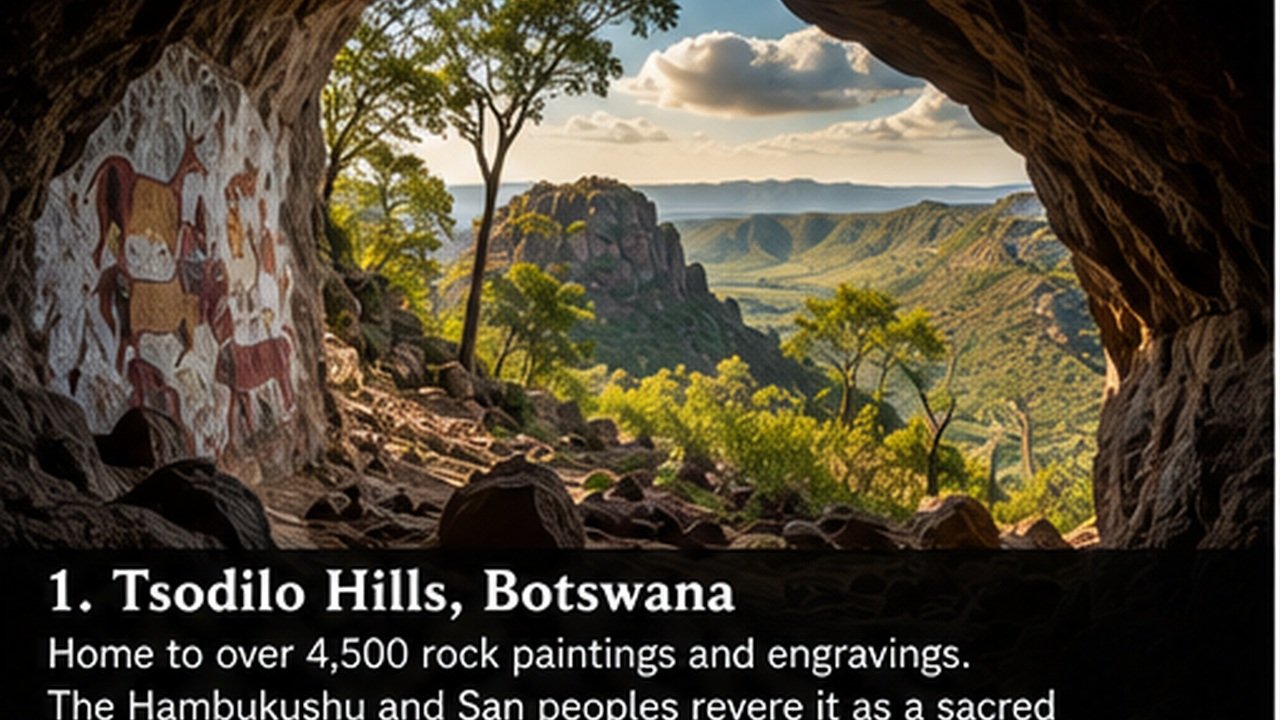
Tsodilo contains more than 4,500 rock paintings within a concentrated Kalahari landscape and preserves evidence of human activity stretching back at least 100,000 years.
UNESCO records that Hambukushu and San communities revere Tsodilo as a place of worship and a home of ancestral spirits. Hills, water holes, caves, and rock shelters form one sacred cultural landscape rather than a collection of isolated paintings.
Visitors should not assume that visible rock art gives unrestricted access to every story or sacred place. Community authority and conservation rules remain essential because touching, water, dust, smoke, and repeated visitation can damage fragile surfaces.
Matobo Hills: Shrines and the Mwari Tradition in Zimbabwe
The granite formations, caves, rock shelters, and painted surfaces of the Matobo Hills form a landscape with deep archaeological and living religious importance.
UNESCO describes sacred shrines within the hills as places where contact is made with the spiritual world. The Mwari religion remains a major oracular tradition, and the rocks are understood as seats of divine and ancestral presence.
Matobo demonstrates that caves cannot be separated from the wider hills, paths, communities, oral traditions, and custodians who sustain the shrines. Public heritage status does not make every ritual or sacred chamber available for tourism.
Sof Omar: Islamic Pilgrimage and Older Sacred Memory in Ethiopia
The Sof Omar cave system in Ethiopia was formed by the Weib River and contains extensive limestone passages, chambers, pillars, and underground water.
The caves are an important Islamic shrine associated with Sheikh Sof Omar Ahmed, who is remembered as having taken refuge there around the early eleventh century. Ethiopia’s World Heritage tentative-list documentation also describes older traditions of venerating caves and natural features in the region.
Annual religious observances, pilgrimage, and the work of spiritual guardians have helped sustain Sof Omar as a living sacred landscape. The site illustrates how a cave can carry several historical layers without those layers becoming one undifferentiated religion.
Arochukwu Cave Temple and the Ethics of Difficult Heritage
The Arochukwu Long Juju cave complex in southeastern Nigeria was associated with the Ibini Ukpabi oracle and with judicial, political, and commercial authority.
The site is also connected with the history of enslavement. UNESCO’s tentative-list documentation describes tunnels through which people judged guilty could disappear and become incorporated into slave-trading networks.
This history should not be romanticized as mysterious spirituality. Sacred places can be connected with power, coercion, conflict, and historical trauma. Responsible interpretation must include the experiences of those harmed as well as the religious and political importance of the oracle.
Ajanta: Buddhist Monastic and Devotional Caves in India
The Ajanta Caves were excavated in phases and include monasteries, prayer halls, sculpture, and major cycles of Buddhist painting.
Early caves used symbolic and aniconic forms, while later phases included images of the Buddha and bodhisattvas as central devotional objects. Architecture, painting, recitation, teaching, residence, and worship were joined within the cliff complex.
Ajanta shows that a cave monastery was not simply a place of solitary meditation. It was also an institution supported by patrons, artisans, monks, routes of travel, and systems of religious education.
Ellora and Elephanta: Hindu, Buddhist, and Jain Rock-Cut Sanctuaries
Ellora contains thirty-four monasteries and temples excavated into basalt cliffs between approximately the sixth and tenth centuries. Buddhist, Hindu, and Jain sanctuaries stand within the same extended complex.
Their proximity demonstrates historical coexistence and artistic exchange, not that the three religions were identical. Each group of caves expresses its own devotional, architectural, and philosophical traditions.
The Elephanta Caves, on an island near Mumbai, are especially associated with the cult of Shiva and monumental rock-cut reliefs. The sacred meaning belongs to Shaiva traditions and should not be reduced to a generic cave-energy narrative.
Dambulla: A Living Buddhist Cave Pilgrimage in Sri Lanka
The Rangiri Dambulla Cave Temple has served as a Buddhist pilgrimage and monastic site for more than two millennia. Five principal sanctuaries contain extensive mural paintings and numerous statues.
Dambulla is important because it remains a living religious place rather than only an archaeological monument. Worship, conservation, tourism, and monastic authority must coexist within fragile painted interiors.
Visitors should dress appropriately, follow photography rules, avoid touching painted surfaces, and recognize that a famous heritage site remains a place of devotion.
Mogao Caves: Buddhist Art on the Silk Roads
The Mogao Caves near Dunhuang were developed from the fourth to the fourteenth century and preserve hundreds of caves, tens of thousands of square metres of murals, and thousands of painted sculptures.
Their art reflects Buddhist devotion as well as cultural exchange along routes linking China, Central Asia, India, and other regions. Donors, monks, rulers, merchants, artists, and pilgrims all contributed to the complex.
Mogao demonstrates how sacred caves can also become archives of language, clothing, music, trade, and changing artistic styles. Their conservation requires strict control of light, humidity, visitor numbers, and physical contact.
Cappadocia: Christian Cells, Churches, and Refuge
The volcanic landscape of Cappadocia contains rock-hewn cells, churches, villages, and subterranean settlements. Christian communities shaped the soft rock into places of prayer, communal life, burial, and refuge.
Many churches contain painted programmes that transformed enclosed rock spaces into theological environments. Caves were not selected only because they were hidden; they also supported monastic discipline, community organization, and sacred art.
The modern tourism image of Cappadocia can obscure its religious history. Frescoes, graves, and chapels require the same respect as above-ground churches.
Kyiv-Pechersk Lavra: Relics and Christian Cave Monasticism
Kyiv-Pechersk Lavra developed around caves associated with early monastic life. Relics of saints buried in the cave complexes helped make the monastery an important Orthodox Christian pilgrimage centre.
The caves connect burial, sainthood, memory, prayer, and institutional growth. Above-ground churches and monastic buildings later formed part of the same religious complex.
Conflict and political instability can place sacred heritage at severe risk. Conservation must protect monuments while respecting worshippers, religious communities, and the safety of staff and visitors.
Hinglaj Mata: Cave Pilgrimage and Ritual Landscape
The Hinglaj Mata shrine lies within a natural cave in the Hingol landscape of present-day Pakistan. Pilgrimage includes movement through ravines, river landscapes, and sacred natural features before entering the cave shrine.
UNESCO tentative-list documentation describes pilgrims entering deeply into the cave and leaving through narrow openings in a ritual interpreted as rebirth.
The example shows that the meaning of a sacred cave can depend on the entire journey. River crossings, rocky paths, mud volcanoes, songs, and collective movement form part of the pilgrimage rather than serving as scenery around the shrine.
Caves as Places of Burial, Relics, and Ancestral Memory
Caves preserve human remains and can become places where communities maintain relationships with ancestors, saints, founders, or the dead.
Burial does not carry one universal meaning. Remains may be protected, visited, hidden, translated into relic traditions, or subject to strict rules of kinship and religious authority.
Archaeological excavation and tourism can create ethical problems when human remains are displayed or removed without consent. Respectful practice requires legal compliance, descendant-community consultation, and recognition that graves are not simply research materials.
Water, Fire, Sound, and Images Underground
Underground springs, dripping water, rivers, smoke, lamps, incense, and acoustics can shape cave ritual. A chamber may amplify chant, conceal a flame, or centre attention on a pool, stone, painting, relic, or sculpted image.
These features do not carry universal meanings. Water may bless in one cave, mark danger in another, or simply make entry impossible during the rainy season. Fire may illuminate worship, damage paintings, or create dangerous air.
Conservation rules restricting candles, incense, flash photography, or visitor numbers are not attacks on spirituality. They are often necessary to protect both people and irreplaceable heritage.
Caves, Initiation, and the Language of Rebirth
Entering darkness and returning to daylight can support imagery of death, initiation, purification, or rebirth. Some traditions explicitly interpret cave passage this way, while others do not.
Writers should avoid imposing rebirth symbolism wherever a narrow passage appears. The meaning must come from community teaching, historical texts, ritual evidence, or careful archaeological interpretation.
Restricted initiation caves should not be photographed, mapped, or publicized without permission. Publishing exact locations can expose sites to vandalism, looting, or intrusive tourism.
Threats to Sacred Caves
Sacred caves face threats from quarrying, mining, road construction, uncontrolled tourism, graffiti, smoke, litter, theft, religious conflict, water diversion, and climate-related changes in moisture and flooding.
Even breathing and body heat can affect delicate cave environments when visitor numbers are high. Touching walls transfers oils and microorganisms, while flash, lamps, and candles can alter fragile surfaces.
Protection must involve community custodians, religious authorities, archaeologists, geologists, conservation scientists, government agencies, and local residents. Physical preservation without living community participation can turn heritage into an empty shell.
How to Visit Sacred Caves Respectfully
Use recognized local guides or custodians and follow all access restrictions.
Ask before photographing people, altars, relics, burials, paintings, or ritual activity.
Do not touch walls, carvings, statues, bones, offerings, or mineral formations.
Do not remove stones, soil, water, plants, ash, wax, textiles, or other materials.
Do not light candles, incense, or fires unless explicitly permitted and safely managed.
Wear appropriate clothing and footwear, and follow rules concerning silence, head coverings, and sacred boundaries.
Never enter flooded, unstable, unventilated, or restricted passages without trained supervision.
Do not market a cave as guaranteeing visions, healing, protection, fertility, wealth, or supernatural power.
Key Takeaways
Sacred caves through history reveal how communities transform geology into relationship. A natural chamber can become an ancestral shrine, a cliff can become a monastery, and an underground passage can become a pilgrimage route, burial place, archive, or centre of political authority.
The most important lesson is not that all caves share one hidden spiritual meaning. It is that darkness, enclosure, stone, water, echo, and descent have been interpreted through many different cultural worlds.
To respect a sacred cave is to protect its physical fabric, honour the community that gives it meaning, preserve uncertainty where evidence is limited, and recognize that some spaces and teachings are not ours to enter or reproduce.
Article Information
- Publisher
- Ancestral Temple
- Editor
- Ancestral Temple
- Last updated
- Jul 26, 2026
- Last reviewed
- Jul 26, 2026
- Content version
- 409e5d5b1c
This educational article should be read as cultural and spiritual information, not as medical, legal, financial, or emergency advice.
Helpful Related Guidance
Explore This Topic
Sacred Natural Places In African Spirituality · What Is Spiritual Cleansing
About the Author
 Ancestral Temple
Spiritual guide and practitioner with decades of experience in ancestral wisdom, rituals, and divine guidance.
Related Posts
View All


Leave a Comment
We'd love to hear your thoughts.
The final message respects both the physical cave and the community that gives it meaning.
I appreciate the instruction not to remove water, stones, ash, soil, or offerings.
The treatment of African cave heritage is specific, balanced, and free from vague stereotypes.
The source foundation is strong and mainly uses authoritative heritage institutions.
The article avoids calling every cave a place of rebirth simply because it has a narrow entrance.
The conclusion about transforming geology into relationship is memorable.
The SEO metadata, glossary, FAQ schema, and comments are ready for publication.
The article gives community custodians a central role in interpretation and protection.
I valued the point that conservation limits are not attacks on spirituality.
The safety guidance about flooding, poor air, and unstable passages is responsible.
The writing remains respectful while still being detailed and engaging.
The Hinglaj section is a strong example of movement, landscape, and ritual meaning working together.
The article explains that a pilgrimage route may include the wider landscape, not only the cave chamber.
The discussion of Panga ya Saidi carefully separates archaeology from unsupported claims of sacredness.
The image plan is culturally specific and avoids mixing unrelated rituals in one scene.
The article shows that caves can preserve beauty, faith, trauma, and political history at once.
The internal-link plan creates a strong topic cluster for the website.
I appreciate the instruction never to touch paintings, carvings, bones, or mineral formations.
The Kyiv-Pechersk section connects monastic life, relics, and pilgrimage clearly.
This would be useful for students of religion, archaeology, heritage, and art history.
The section about initiation avoids publishing instructions or exact locations.
The article treats cave conservation as both a cultural and scientific responsibility.
The FAQ answers are direct and suitable for search snippets.
The prehistoric section preserves uncertainty instead of inventing confident spiritual claims.
I liked the explanation of sound, water, fire, and darkness without assigning universal meanings.
The distinction between public heritage and unrestricted access is especially important.
The article explains why relics and burials require special ethical care.
The Cappadocia section avoids reducing the region to tourism photographs.
The glossary will help readers understand terms such as karst, chaitya, and anchoritic life.
The Mogao discussion shows how sacred art can preserve wider histories of exchange.
The Dambulla section makes clear that a famous heritage site can remain a living place of worship.
The article responsibly avoids promises of healing, visions, or supernatural power.
The comparison between Ellora’s three religions is careful and does not erase their differences.
The Ajanta section explains that cave monasteries were also institutions of teaching and patronage.
I appreciate that the article does not romanticize spiritual authority or historical coercion.
The section on difficult heritage gives the Arochukwu history the seriousness it deserves.
The article avoids exposing restricted rites or private sacred locations.
The visitor guidance is practical and protects both people and fragile heritage.
I liked the distinction between a natural cave and a deliberately excavated cave temple.
The Sof Omar section explains how several historical layers can exist within one sacred place.
The Matobo discussion shows why a shrine belongs to a wider living landscape.
The article gives African cave traditions substantial attention without presenting them as one system.
The Tsodilo section connects rock art, ancestors, water holes, and community authority very well.
I appreciated the warning against assuming that every prehistoric painting had one religious meaning.
The article clearly distinguishes a sacred cave from an archaeological cave or ordinary rock shelter.