
Mountains with Cultural Significance: Sacred Peaks, Identity, and Li
Quick Summary
Mountains can be ancestors, divine dwellings, pilgrimage routes, national symbols, artistic inspirations, and living cultural landscapes. This guide compares culturally significant peaks without treating them as one universal tradition.
Mountains with Cultural Significance: Sacred Peaks, Identity, and Living Heritage
What This Topic Means
Mountains dominate landscapes, shape weather, feed rivers, mark horizons, and challenge the limits of human movement. Their physical presence has also made them powerful centres of memory, identity, spirituality, governance, pilgrimage, and art.
A mountain may be understood as the dwelling of a deity, the body of an ancestor, a place of revelation, a guardian of a territory, a source of medicine and water, or a route through which people discipline themselves and renew communal obligations.
The phrase “mountains with cultural significance” is useful only when it preserves difference. Mount Kenya, Kilimanjaro, Mount Mulanje, Mount Fuji, Tongariro, Mauna Kea, Mount Sinai, and Mount Athos do not represent one universal mountain religion. Each belongs to a particular history, language, institution, and living community.
This article discusses public educational aspects of selected mountain traditions. It does not reveal restricted rites, identify private sacred locations, or provide instructions for reproducing community ceremonies.
What Makes a Mountain Culturally Significant?
A mountain becomes culturally significant when people recognize it as part of their history, spirituality, identity, law, livelihood, or artistic world. The significance may centre on the summit, but it can also include forests, caves, springs, glaciers, pilgrimage routes, shrines, burial places, rock formations, and nearby settlements.
Cultural meaning may be carried through oral histories, place names, prayers, songs, visual art, customary law, seasonal ceremonies, climbing restrictions, monastic communities, or stories of migration and revelation.
Not every culturally important mountain is worshipped. A mountain may instead function as a sacred witness, ancestral relative, national emblem, source of water, protected landscape, place of retreat, or reminder of collective survival.
Why Mountains Become Sacred or Symbolically Powerful
Mountains rise above ordinary settlement and appear to connect earth, sky, cloud, rain, snow, and celestial movement. Their elevation can support ideas of closeness to the divine, although communities interpret that closeness differently.
Mountains also create boundaries and refuge. They can separate territories, shelter communities during conflict, preserve rare plants, or hold caves and secluded places used for prayer, burial, initiation, and retreat.
Because mountains feed springs, rivers, forests, and agricultural systems, spiritual respect may be closely connected with practical dependence. Protecting the mountain can also mean protecting water, soil, wildlife, farms, and future generations.
Their danger matters as much as their beauty. Storms, altitude, volcanic activity, rockfall, cold, and difficult access can make mountains symbols of power, discipline, humility, and human limitation.
Common Cultural Roles of Mountains
Mountains can serve several roles at the same time:
Ancestral presence or genealogical origin
Dwelling or manifestation of a deity, spirit, or sacred power
Pilgrimage destination or route of spiritual training
Place of revelation, law, covenant, or sacred history
Political boundary, royal symbol, or national emblem
Source of water, medicine, grazing, forest resources, and ecological knowledge
Centre of art, poetry, photography, architecture, and tourism
Refuge, burial landscape, or memorial of conflict and survival
These roles should be treated as possibilities, not as a checklist applied automatically to every mountain.
Mountains with Cultural Significance in Africa
Africa contains many mountain traditions shaped by Indigenous religions, Christianity, Islam, migration histories, colonial change, national identity, and environmental stewardship.
There is no single African belief about mountains. The most accurate approach names the mountain, the adjacent communities, the language of the tradition, and the people who retain authority to explain or protect the place.
Mount Kenya: Holy Mountain in Kikuyu and Meru Traditions
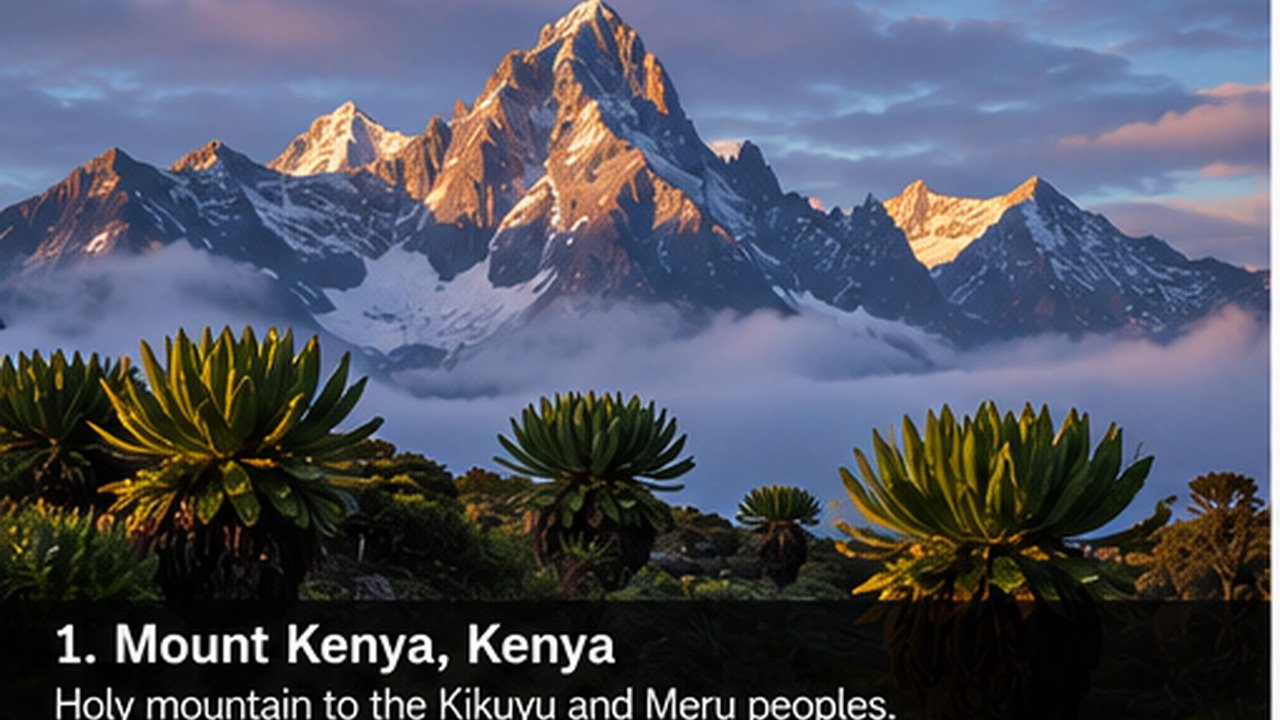
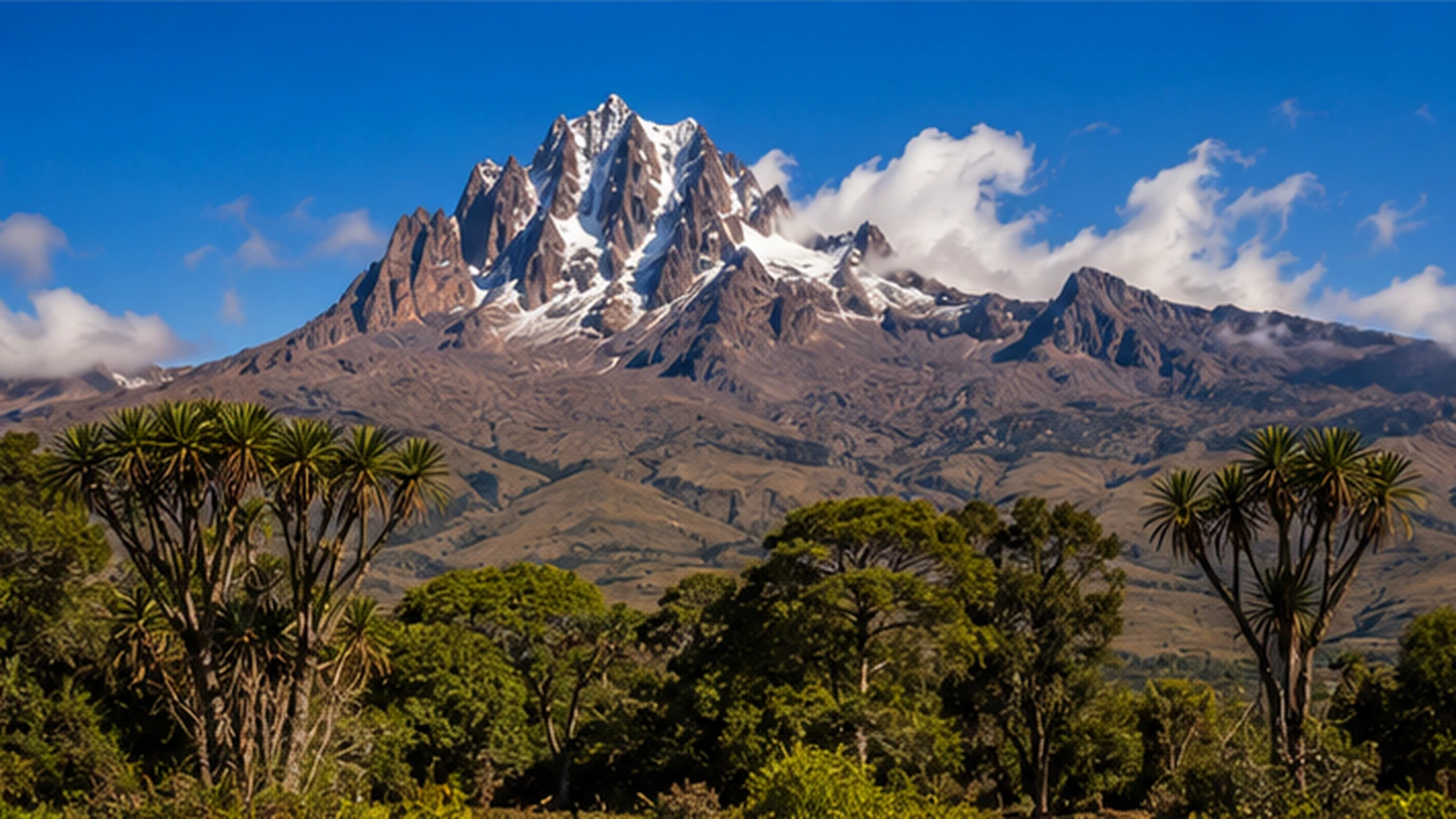
Mount Kenya is Africa’s second-highest peak and a UNESCO World Heritage property. UNESCO records that neighbouring Kikuyu and Meru communities regard it as a holy mountain and use it in traditional rituals. In Kikuyu tradition, the mountain is closely associated with Ngai, and the peak forms an important point of spiritual orientation.
The mountain’s cultural meaning is larger than its summit. Forests, rivers, agricultural lands, wildlife corridors, named places, and views of the peak connect communities with livelihood, memory, and sacred geography.
Colonial mapping and mountaineering introduced new names and forms of access, but they did not erase older relationships. Responsible interpretation should therefore avoid describing Mount Kenya only as a climbing destination or scenic national park.
Conservation also matters culturally. Fire, glacier loss, forest degradation, and disrupted water systems affect both biodiversity and the communities whose histories and practices depend on the mountain.
Research basis: UNESCO World Heritage Centre documents Mount Kenya as a holy mountain for neighbouring Kikuyu and Meru communities.
Mount Kilimanjaro: Chagga Heritage and the “Roof of Africa”
Mount Kilimanjaro is Africa’s highest mountain and an international symbol of Tanzania. The mountain’s lower slopes have long supported Chagga communities through farming, water channels, forests, settlement, and local knowledge.
Tanzania National Parks identifies the Kifinika Cultural Site along the Marangu route as a sacred site historically used by Chagga people for cultural rituals. This demonstrates that the mountain is not only a summit challenge; it contains culturally meaningful places embedded in specific routes and landscapes.
Kilimanjaro also functions as a national and global image. Its snow and glaciers appear in tourism, conservation campaigns, literature, and discussions of climate change. These modern meanings exist alongside local histories rather than replacing them.
Visitors should distinguish between commercial climbing culture and community heritage. A trail open to hikers does not make every nearby sacred site, story, or practice public property.
Research basis: Tanzania National Parks identifies Kifinika as a sacred Chagga cultural site along the Marangu route.
Mount Mulanje: Sacred Landscape of Malawi
Mount Mulanje Cultural Landscape was inscribed on the UNESCO World Heritage List in 2025. UNESCO recognizes the mountain as a sacred cultural landscape shaped by the relationships of Yao, Mang’anja, and Lhomwe communities with forests, water, sacred trees, paths, caves, ancestors, spirits, healing practices, and customary management.
The significance of Mulanje cannot be confined to one summit. Peaks, cliffs, streams, forest zones, burial areas, ritual sites, and named pathways form an interconnected landscape.
The mountain demonstrates how spirituality and ecology can reinforce each other without being identical. A sacred tree may be protected because of ritual importance, while the surrounding forest also supports water, biodiversity, livelihoods, and climate resilience.
Safeguarding Mulanje requires community authority, environmental management, intergenerational transmission, and protection from pressures such as fire, deforestation, uncontrolled extraction, and poorly managed tourism.
Research basis: UNESCO inscribed the Mount Mulanje Cultural Landscape in 2025 and recognizes the spiritual and ecological relationships of Yao, Mang’anja, and Lhomwe communities.
Table Mountain: Identity, Memory, and Multiple Communities
Table Mountain is central to the identity of Cape Town and carries layers of Indigenous, colonial, enslaved, Muslim, political, and environmental history.
South African National Parks describes Table Mountain National Park as a cultural landscape with ties extending from early Khoi naming and heritage to the spiritual and historical experiences of enslaved and Muslim communities. The mountain remains connected with belonging, memory, and public identity across diverse Cape communities.
This example shows that cultural significance can accumulate. A mountain can hold Indigenous place knowledge, colonial violence, sacred burial and shrine traditions, recreational use, biodiversity conservation, and contemporary debates about access within the same landscape.
Interpreting Table Mountain responsibly means resisting the idea that it has only one story or one community of meaning.
Research basis: South African National Parks describes Table Mountain as a layered cultural landscape tied to Khoi heritage and Cape Muslim, enslaved, civic, and environmental histories.
Mount Fuji: Pilgrimage, Ascetic Practice, and Art
UNESCO describes Fujisan as a sacred place and source of artistic inspiration. Mount Fuji has long attracted pilgrims, and from the twelfth century it became a centre of ascetic Buddhist training incorporating Shinto elements.
The World Heritage property includes shrines, pilgrimage routes, lodging houses, lakes, springs, and viewpoints, showing that the sacred landscape extends far beyond the cone of the volcano itself.
Fuji also became one of the world’s most recognizable artistic mountains through poetry, painting, woodblock prints, photography, and modern media. Its religious and artistic meanings developed together, but they should not be reduced to a tourist logo.
Modern climbing requires environmental management, safety rules, and respect for shrine spaces and pilgrimage history.
Research basis: UNESCO identifies Fujisan as a sacred place and source of artistic inspiration shaped by pilgrimage and ascetic traditions.
Tongariro: Māori Sacred Mountains and Cultural Landscape
Tongariro National Park in Aotearoa New Zealand was the first property inscribed under UNESCO’s revised cultural-landscape criteria. UNESCO states that the mountains at the heart of the park hold cultural and religious significance for Māori and symbolize spiritual links between community and environment.
The mountains are understood within whakapapa, history, tapu, and responsibilities of care. Their meaning is not limited to dramatic volcanic scenery.
Tourism language should therefore avoid presenting the landscape as empty wilderness. Trails cross a living cultural environment, and visitors should follow guidance concerning names, conduct, access, waste, weather, and sacred features.
Tongariro is an important example of heritage recognition moving beyond monuments toward relationships between Indigenous peoples and entire landscapes.
Research basis: UNESCO recognizes Tongariro’s cultural and religious significance for Māori and the spiritual links between community and environment.
Uluru and Kata Tjuta: Anangu Law and Living Landscape
Uluru and Kata Tjuta are not conventional mountain ranges, but their towering rock formations belong in discussions of culturally significant high places because they are central to Anangu law, spirituality, and landscape.
UNESCO explains that Tjukurpa forms the foundation of the Anangu living cultural landscape, expressing relationships among people, ancestral beings, animals, plants, and physical features of the land.
The formations are not simply geological attractions. Paths, waterholes, rock faces, stories, gendered responsibilities, and restricted knowledge form part of a living system of law and custodianship.
Respectful visitation follows Anangu guidance, accepts that some places and stories are not available to everyone, and avoids photographing or reproducing restricted features.
Research basis: UNESCO describes Tjukurpa as the foundation of the Anangu living cultural landscape.
Mauna Kea: Native Hawaiian Sacredness, Ancestry, and the Heavens
Mauna Kea—also written Maunakea and known in Hawaiian traditions as Mauna a Wākea—is culturally significant and considered sacred by many Native Hawaiians.
Hawai‘i state cultural-management materials describe the mountain as connected with ancestors, creation traditions, shrines, burial, high-altitude resource use, and study of the heavens. Its height and position support relationships among earth, sky, genealogy, and sacred responsibility.
Mauna Kea also hosts major astronomical facilities, making it a prominent site of debate about science, development, consent, cultural rights, and land stewardship.
The conflict should not be simplified as religion against science. It involves governance, historical power, consultation, protection of cultural sites, environmental management, and competing understandings of responsibility.
Research basis: Hawai‘i state cultural-management materials document Native Hawaiian sacred, ancestral, customary, and astronomical relationships with Mauna Kea.
Mount Sinai: Revelation and Shared Sacred History
The Saint Catherine Area in Egypt is centred on Mount Sinai, also known as Jebel Musa and associated with Mount Horeb. UNESCO recognizes the area as sacred to Judaism, Christianity, and Islam.
The mountain is connected with traditions concerning Moses and divine revelation, while the Monastery of Saint Catherine at its foot preserves a continuous Christian monastic presence dating from the sixth century.
Pilgrims, monks, Bedouin communities, visitors, and guides interact within a desert mountain landscape whose significance is religious, historical, ecological, and economic.
The mountain’s shared importance does not mean the three religions interpret every event or place identically. Responsible comparison preserves theological and historical differences.
Research basis: UNESCO recognizes the Saint Catherine Area and Mount Sinai/Jebel Musa as sacred to Judaism, Christianity, and Islam.
Mount Athos: Orthodox Monastic Mountain
Mount Athos in Greece is known as the Holy Mountain and has been a major Orthodox spiritual centre for centuries. UNESCO records its autonomous status, its monastic communities, and its influence on Orthodox architecture, painting, spirituality, and religious life.
Athos is a mountain, peninsula, monastic republic, artistic landscape, agricultural system, and place of prayer. Its cultural significance arises through continuous community practice rather than the peak alone.
Access is governed by specific religious and administrative rules. Visitors should not treat those restrictions as decorative folklore or assume that heritage recognition creates unrestricted public access.
Mount Athos shows how mountains can sustain long-term institutions of retreat, scholarship, craftsmanship, agriculture, liturgy, and transnational religious identity.
Research basis: UNESCO documents Mount Athos as a long-standing Orthodox spiritual, monastic, and artistic centre.
Mountains as Pilgrimage Routes and Places of Discipline
Mountain pilgrimage often makes physical effort part of religious meaning. Walking, fasting, cold, steep ascent, silence, or temporary separation from ordinary life can express devotion, repentance, training, gratitude, or readiness.
However, difficulty should not be romanticized into preventable harm. Altitude sickness, exposure, volcanic hazards, heat, crowds, and limited rescue access require preparation and compliance with local safety rules.
A modern hiking route may overlap with an older pilgrimage route without being identical to it. Completing a climb does not automatically grant religious authority or cultural membership.
Mountains, Water, Forests, and Ecological Responsibility
Mountain ecosystems feed rivers, store water, influence rainfall, support forests and grazing, and shelter species adapted to high elevations. These functions can become inseparable from cultural ideas of blessing, guardianship, fertility, and responsibility.
When glaciers shrink, springs fail, forests burn, or slopes erode, communities may lose both material resources and places central to prayer, memory, and identity.
Conservation must therefore address cultural rights as well as biodiversity. Community knowledge, customary governance, sacred access rules, scientific monitoring, and public policy can complement one another when partnerships are fair.
Mountains as National Symbols and Political Landscapes
Mountains frequently appear on flags, currency, seals, advertisements, military narratives, and national art. Mount Kenya gave its name to a country; Fuji became an emblem of Japan; Kilimanjaro represents Tanzania internationally; Table Mountain is inseparable from Cape Town’s visual identity.
National symbolism can support conservation and shared pride, but it can also hide local communities whose relationships with the mountain predate the modern state.
Responsible heritage interpretation distinguishes between national branding and community authority. A mountain can be a symbol for millions while still containing places whose meanings and access are governed locally.
Tourism, Climbing, and Commercialization
Tourism can create employment, conservation funding, cultural exchange, and wider recognition. It can also cause waste, trail erosion, crowding, intrusive photography, displacement, pressure on water, and the commercialization of sacred imagery.
Problems arise when visitors treat mountains as trophies, use ceremonies as entertainment, ignore place names, or assume payment purchases access to every sacred area.
Fair tourism supports local guides and businesses, follows waste and safety rules, asks before photographing people or ceremonies, and respects restrictions even when they limit a visitor’s preferred experience.
Climate Change and the Future of Mountain Heritage
Mountain heritage is particularly vulnerable to environmental change. Glacier retreat, altered rainfall, wildfire, invasive species, heat, storms, and shifting vegetation affect water, pilgrimage routes, agriculture, biodiversity, and the visual forms through which communities recognize the mountain.
Loss is not only physical. When a glacier, spring, species, or seasonal pattern disappears, songs, place-based knowledge, ceremonies, and identities may also be disrupted.
Adaptation should include knowledge holders, local residents, religious custodians, scientists, park authorities, and younger generations. Cultural continuity cannot be protected by environmental policy that excludes the people whose heritage is at stake.
How to Approach Culturally Significant Mountains Respectfully
1. Use the exact mountain name preferred by the community and include Indigenous or local names where appropriate.
2. Identify the people, religion, language, and historical period connected with the mountain.
Article Information
- Publisher
- Ancestral Temple
- Editor
- Ancestral Temple
- Last updated
- Jul 26, 2026
- Last reviewed
- Jul 26, 2026
- Content version
- db85779bb8
This educational article should be read as cultural and spiritual information, not as medical, legal, financial, or emergency advice.
Helpful Related Guidance
Explore This Topic
Sacred Natural Places In African Spirituality · Spiritual Knowledge
About the Author
 Ancestral Temple
Spiritual guide and practitioner with decades of experience in ancestral wisdom, rituals, and divine guidance.
Related Posts
View All
Leave a Comment
We'd love to hear your thoughts.
The final message about inheriting both the mountain and the duty of care is memorable.
I valued the instruction to follow current access rules rather than assuming sacred mountains are open to everyone.
The article explains why a mountain can be both a national symbol and a living local heritage site.
The image plan is culturally specific and avoids mixing unrelated rituals in one scene.
The article keeps public education separate from restricted ceremonies and sacred knowledge.
The conclusion connects landscape, law, ecology, and future generations beautifully.
The article provides strong material for future posts about African sacred mountains.
The section on national branding and older local relationships is thoughtful.
The article uses exact names and communities instead of inventing one worldwide mountain religion.
The safety guidance about altitude, weather, and rescue access is responsible.
The writing makes clear that tourism payment does not purchase access to every sacred place.
The Table Mountain section is one of the best examples of layered cultural significance.
The article recognizes that shared sacred history does not mean identical theology.
The Mauna Kea section avoids simplifying a complex cultural and governance debate.
The SEO metadata, image plan, glossary, and FAQ schema are ready for publication.
The discussion of mountains as water sources adds ecological depth.
The article distinguishes personal hiking from formal pilgrimage or community ritual.
I appreciate the instruction not to remove stones, plants, soil, or sacred materials.
The Mount Athos section explains how a mountain can sustain a complete religious institution.
This would be useful for students of religion, geography, tourism, and cultural heritage.
The article treats community-led conservation as essential rather than optional.
The climate-change section explains how environmental loss can also damage songs, rituals, and identity.
The FAQ answers are direct and suitable for search snippets.
The African examples are culturally specific and avoid vague claims about the continent.
The article shows that a sacred landscape can include forests, springs, routes, caves, and settlements.
The Mount Sinai section respects the differences among Judaism, Christianity, and Islam.
The article balances spirituality, history, tourism, and conservation.
The Tongariro section centres Māori relationships with the landscape rather than scenery alone.
The internal-linking plan creates a strong topic cluster for the website.
The explanation of national symbolism and local community authority is especially useful.
The Fuji section connects pilgrimage and art without reducing the mountain to a tourist image.
The article responsibly avoids promising visions, healing, or spiritual power from visiting a mountain.
The glossary makes terms such as sacred geography and cultural landscape easy to understand.
The pilgrimage section explains why physical effort can carry spiritual meaning without romanticizing danger.
I appreciate the warning against treating every mountain tradition as one universal belief.
The Mount Mulanje section is a strong example of a living sacred cultural landscape.
The article treats mountain conservation as both environmental and cultural responsibility.
The visitor guidance is practical and respectful of sacred access rules.
The Table Mountain section recognizes Indigenous, enslaved, Muslim, political, and environmental histories.
I liked the explanation that cultural significance can accumulate across several communities and historical periods.
The Kilimanjaro section avoids reducing the mountain to a climbing challenge.
The article gives African mountain traditions substantial attention within a global comparison.
The Mount Kenya section connects spirituality, forests, water, and community identity very well.
I appreciated the strong distinction among Mount Kenya, Kilimanjaro, and Mount Mulanje.
The article explains that mountains become culturally significant through relationships, not simply because they are tall.