
What Is the First Zodiac Sign? Why Aries Begins the Zodiac

Quick Summary
Aries is the first sign of the modern Western tropical zodiac. The reason is structural rather than personal: the tropical zodiac begins at the March equinox, and that starting poi...
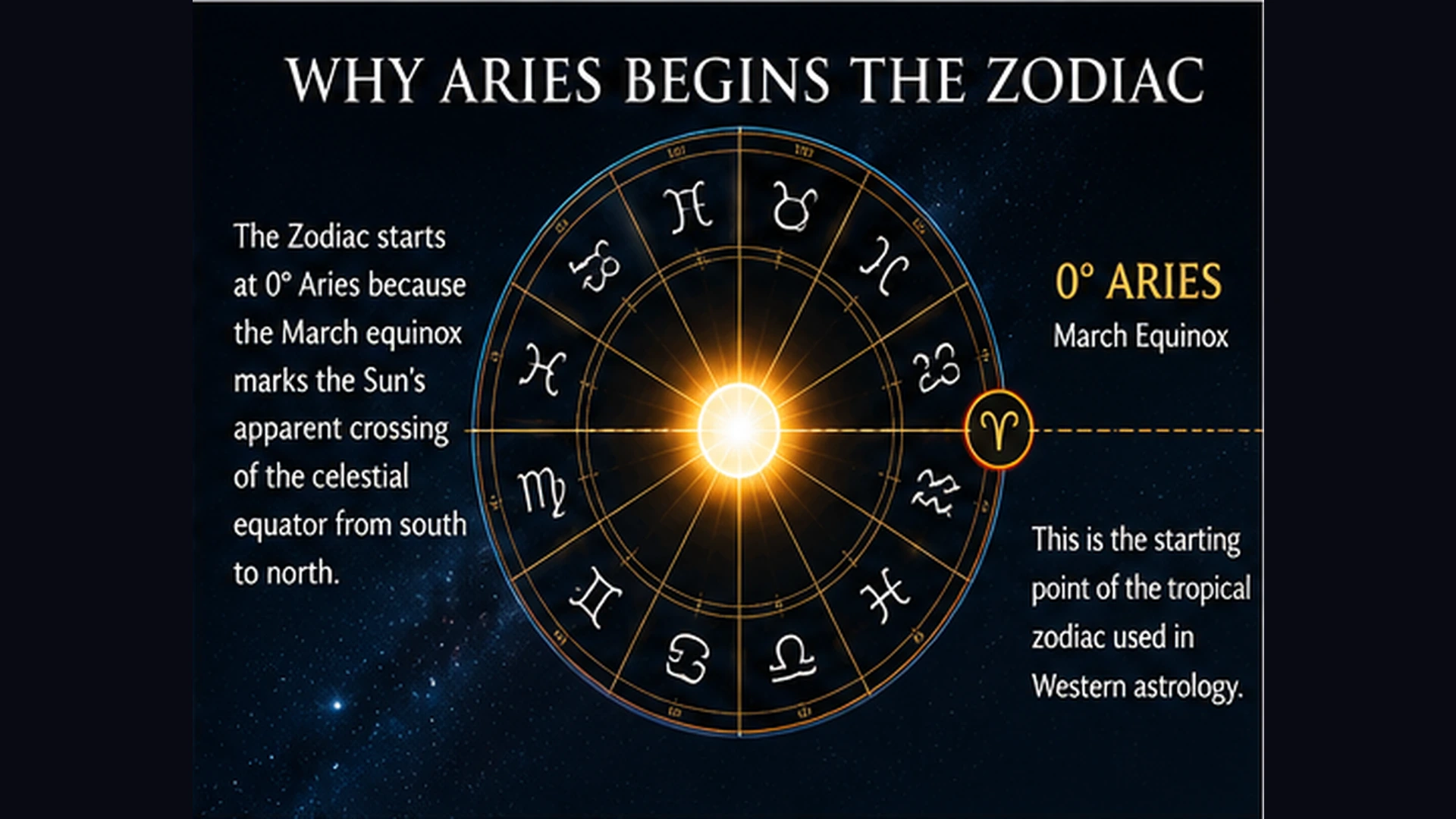
Aries is the first sign of the modern Western tropical zodiac. The reason is structural rather than personal: the tropical zodiac begins at the March equinox, and that starting point is defined as 0 degrees Aries. From there, the zodiac proceeds through Taurus, Gemini, Cancer, Leo, Virgo, Libra, Scorpio, Sagittarius, Capricorn, Aquarius and Pisces before returning to Aries.
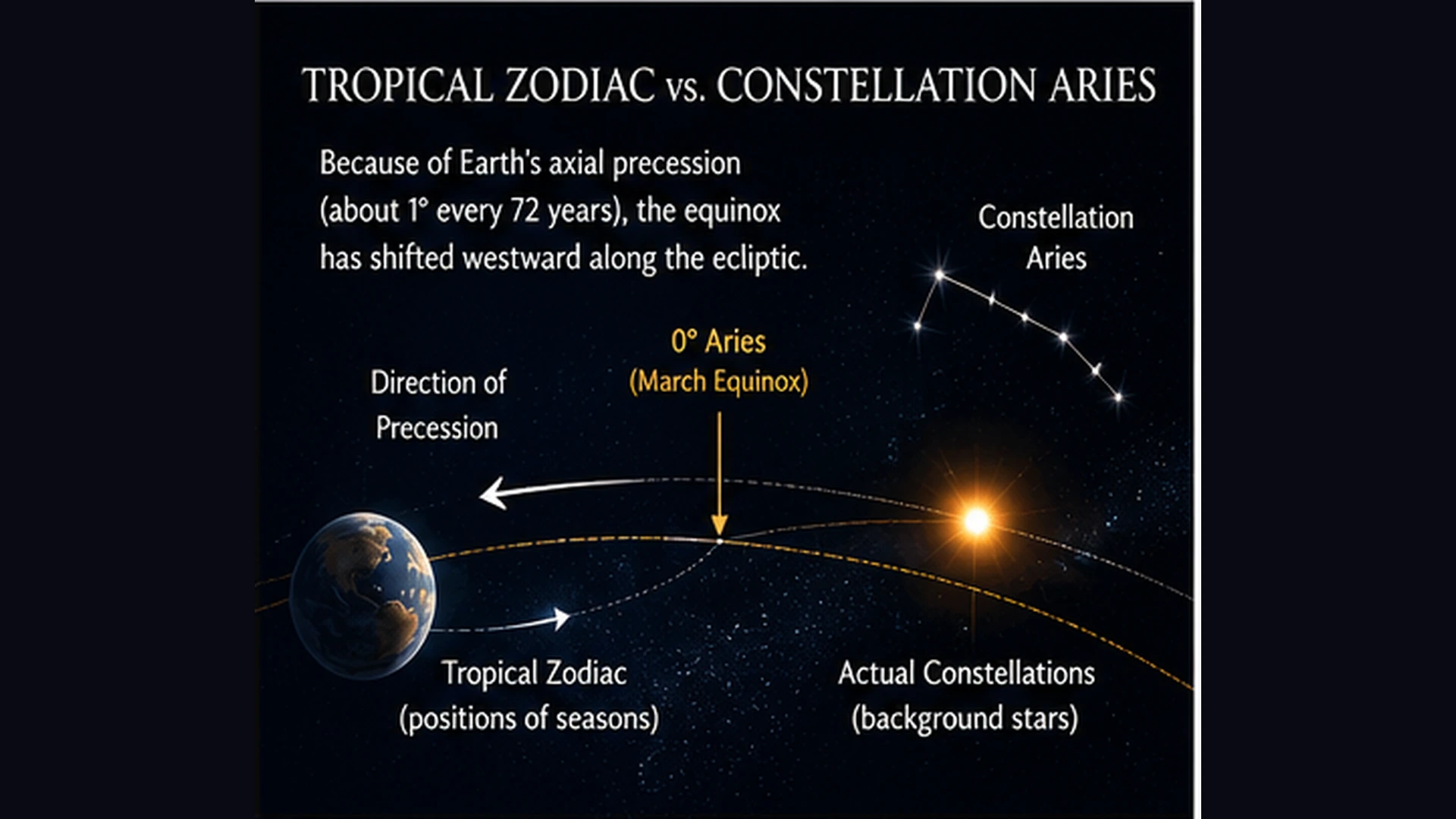
This answer becomes confusing because the word Aries can refer to three related but different things: an astrological sign, a constellation and an old astronomical reference called the First Point of Aries. They once aligned more closely than they do today. Because Earth's axis slowly changes direction through precession, the March equinox is now located against the background stars of Pisces, even though tropical astrology still calls the equinox 0 degrees Aries.[1][2][3]
The zodiac is a circle, so it has no unavoidable natural beginning. Ancient and classical scholars chose a starting point, and the March equinox became especially important because it marks the Sun crossing the celestial equator northward. In the Northern Hemisphere, it also marks the beginning of astronomical spring; in the Southern Hemisphere, the same moment marks autumn. The familiar idea that Aries is the zodiac's "first" sign therefore reflects a historical astronomical convention and a seasonal symbolic system, not a universal law of nature.
Specific culture or historical context: Contemporary educational setting in Uganda or the wider Great Lakes region; no invented traditional ritual.
People shown: One Black African adult educator or researcher, naturally posed and focused.
Location: Lake Victoria shoreline or another open East African lakeshore with a clear eastern horizon.
Clothing: Contemporary modest field clothing, light jacket or sweater, practical footwear.
Architecture: A simple lakeside shelter may appear at the edge; no fantasy temple.
Objects: Twelve-sector zodiac teaching wheel with no readable text, notebook, pencil, small armillary sphere or globe, compass and binoculars.
Lighting: Realistic golden dawn with cool predawn shadows and natural water reflections.
Composition: Wide 16:9 editorial frame; educator and table on one side, sunrise and open horizon on the other for website cropping.
SEO-friendly filename: first-zodiac-sign-why-aries-begins-zodiac.webp
Image title: Why Aries Begins the Zodiac at the March Equinox
Alt text: African astronomy educator observing the March equinox with a zodiac wheel beside an East African lake
Caption: In the tropical zodiac, Aries begins at the March equinox, the point where the Sun crosses the celestial equator northward.
Recommended placement: After the introduction and before the Quick Answer.
Article section supported: Introduction, equinox definition and featured-snippet answer.
Important elements to avoid: Embedded text, glowing zodiac signs in the sky, inaccurate Sun direction, crystal balls, fantasy robes, logos, watermarks, distorted hands or mystical beams.
Quick Answer
Aries is the first sign of the modern Western tropical zodiac because the zodiac is measured from the March equinox, defined as 0 degrees Aries. The order then moves through eleven more equal signs and returns to Aries. This convention is historical and seasonal; the actual constellation Aries is no longer located at the equinox because of precession.
The first zodiac sign is Aries in the modern Western tropical zodiac. Aries occupies the first 30-degree sector of the zodiac, from 0 degrees to just under 30 degrees Aries. Taurus follows, then Gemini, and the sequence continues until Pisces closes the cycle.
The sign is conventionally associated with dates around March 20 or 21 to April 19 or 20, but exact ingress times vary by year and time zone. A person born near a sign boundary cannot determine the Sun sign reliably from a generic date list alone; an accurate chart uses the date, time and location of birth.
Aries is traditionally classified as a cardinal fire sign. "Cardinal" refers to a sign that begins a seasonal quarter in the tropical system. "Fire" belongs to an astrological symbolic classification. These are traditional interpretive categories, not physical measurements of a person or of the stars.
| Order | Sign | Tropical sector | Traditional classification |
|---|---|---|---|
| 1 | Aries | 0-30 degrees | Cardinal fire |
| 2 | Taurus | 30-60 degrees | Fixed earth |
| 3 | Gemini | 60-90 degrees | Mutable air |
| 4 | Cancer | 90-120 degrees | Cardinal water |
| 5 | Leo | 120-150 degrees | Fixed fire |
| 6 | Virgo | 150-180 degrees | Mutable earth |
| 7 | Libra | 180-210 degrees | Cardinal air |
| 8 | Scorpio | 210-240 degrees | Fixed water |
| 9 | Sagittarius | 240-270 degrees | Mutable fire |
| 10 | Capricorn | 270-300 degrees | Cardinal earth |
| 11 | Aquarius | 300-330 degrees | Fixed air |
| 12 | Pisces | 330-360 degrees | Mutable water |
Why Does Aries Begin the Zodiac?
Aries begins the tropical zodiac because 0 degrees Aries is defined at the March equinox. At that moment, the center of the Sun crosses the plane of Earth's equator moving northward. Astronomers call this the northward equinox; older Northern Hemisphere language often calls it the vernal or spring equinox.[1][4]
The ecliptic is the apparent annual path of the Sun against the sky. The celestial equator is the projection of Earth's equator onto the celestial sphere. These two great circles intersect at two equinox points. The northward crossing became the zero point from which tropical zodiac longitude is measured. The opposite point, 180 degrees away, is 0 degrees Libra and corresponds to the September equinox.
Classical authors were explicit that a circle has no natural first point. In the Tetrabiblos, Ptolemy explained that astrologers treated the sign beginning with the vernal equinox - Aries - as the starting point of the zodiac, then related the following signs to the cycle of seasons.[5] The choice was therefore conventional, but it was not arbitrary in the sense of being meaningless: it anchored the zodiac to a repeatable solar event.
| Reference point | Tropical zodiac position | Seasonal role |
|---|---|---|
| March equinox | 0 degrees Aries | Begins Northern Hemisphere spring / Southern Hemisphere autumn |
| June solstice | 0 degrees Cancer | Begins Northern Hemisphere summer / Southern Hemisphere winter |
| September equinox | 0 degrees Libra | Begins Northern Hemisphere autumn / Southern Hemisphere spring |
| December solstice | 0 degrees Capricorn | Begins Northern Hemisphere winter / Southern Hemisphere summer |
Why the Zodiac Starts Near March Instead of January
The zodiac order is not based on the modern civil calendar. January 1 is a calendar convention inherited through Roman and later reforms; it is not an astronomical turning point of the Sun's path. The tropical zodiac instead uses the March equinox as its zero point.
This difference explains why Aries is first even though Aries season begins in the third month of the modern Gregorian year. The calendar and the zodiac answer different questions. A civil calendar organizes social time. The tropical zodiac divides the Sun's annual apparent path into twelve equal sectors beginning at an equinox.
The equinox also has opposite seasonal meanings across hemispheres. Calling Aries the "spring sign" is accurate only within the Northern Hemisphere framework inherited by much of Western astrology. In Uganda, which lies across the equator, local seasonal patterns are shaped more by rainfall, altitude and regional climate than by a four-season temperate model. A globally responsible explanation should therefore distinguish the astronomical equinox from Northern Hemisphere spring symbolism.
How the Twelve-Sign Zodiac Developed
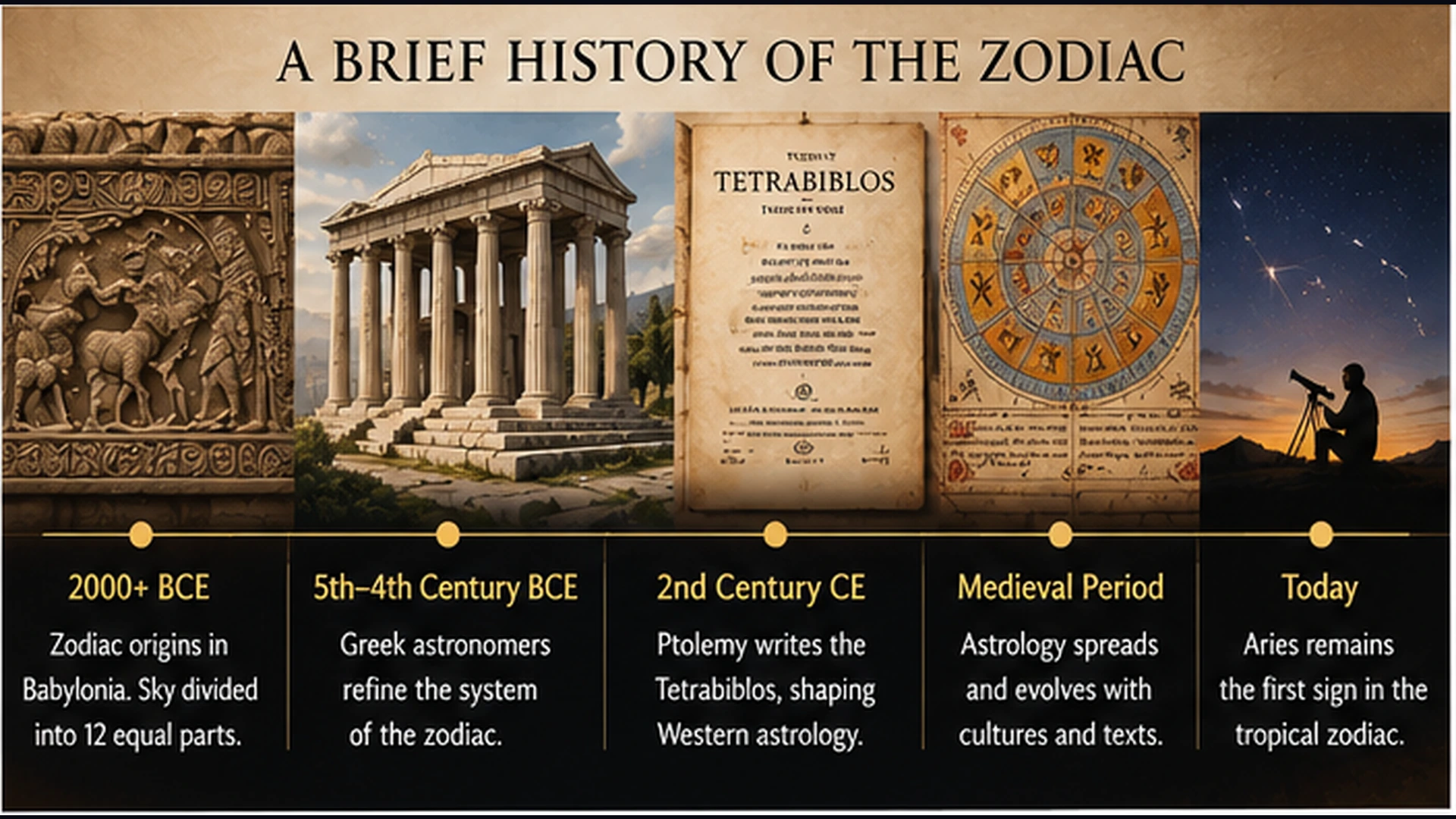
The twelve-part zodiac did not appear fully formed in one moment. Mesopotamian scholars observed the Moon, planets and stars for centuries, developed star lists and omen traditions, and gradually organized the ecliptic into a standardized system. The British Museum notes that the twelve-part zodiac derives from ancient Mesopotamian ideas and images and was established as a major framework by the end of the first millennium BCE.[6]
Babylonian astronomy included observation, prediction, star cataloguing and forms of celestial divination. Modern historians emphasize that what we call astronomy and astrology were not cleanly separated in the same way in ancient scholarship.[7] The regular twelve-sign zodiac provided equal 30-degree sectors that were useful for calculation as well as interpretation.
Greek-speaking scholars adopted and transformed Mesopotamian celestial knowledge. In Hellenistic and Roman astrology, the signs became a technical framework for horoscopes and seasonal theory. The signs were derived from named constellations but were not identical to those irregular star groups. By the second century CE, Ptolemy described a zodiac anchored to the spring equinox, the basis of the tropical system familiar in Western astrology.[8]
The zodiac later circulated through Arabic, Persian, Indian, Byzantine, Jewish and Latin intellectual worlds. Medieval Islamic art and scientific objects retained the sequence of zodiac figures, including the ram for Aries, while scholars developed astronomy, mathematical astrology and instruments such as astrolabes.[9] The modern Western zodiac is therefore the result of transmission, translation and reinterpretation across many societies.
Specific culture or historical context: Late Babylonian or Seleucid-period scholarly astronomy in Mesopotamia, first millennium BCE; educational reconstruction rather than ritual fantasy.
People shown: Two West Asian adult scholar-scribes, one observing and one recording, with natural focused expressions.
Location: Urban rooftop in Babylon or another southern Mesopotamian scholarly center; mud-brick architecture and distant temple massing used carefully.
Clothing: Historically plausible woven garments and head coverings based on museum research; no generic Roman togas.
Architecture: Mud-brick rooftop, parapet and distant urban forms; no pyramids or fantasy ziggurat close-up.
Objects: Clay tablets, reed stylus, oil lamp with controlled flame, simple angular measuring or sighting tools.
Lighting: Natural moonlight and dim warm oil-lamp light, with realistic night visibility.
Composition: Wide 16:9 editorial scene with observers in foreground and the open ecliptic sky above.
SEO-friendly filename: babylonian-zodiac-history-aries-first-sign.webp
Image title: Babylonian Astronomy and the Development of the Zodiac
Alt text: Mesopotamian scholar-scribes observing the night sky and recording positions on clay tablets
Caption: The twelve-sign zodiac developed gradually from Mesopotamian traditions of observation, calculation and celestial interpretation.
Recommended placement: After the section on the development of the twelve-sign zodiac.
Article section supported: Babylonian origins and historical development.
Important elements to avoid: Invented readable cuneiform, floating zodiac animals, Egyptian architecture, fantasy magic, glowing tablets, modern telescopes, embedded text, logos, watermarks or distorted hands.
Did the Ram Symbol Make Aries First?
No. The ram is the emblem of Aries, but the image does not explain why the sign begins the tropical zodiac. The order comes from the equinox-based coordinate system. Ram mythology and symbolism helped people remember and interpret the sign, but the technical starting point is 0 degrees Aries at the March equinox.
The familiar sequence of zodiac images - ram, bull, twins, crab and so on - was transmitted through Greek and later Islamic visual traditions.[9] Different ancient cultures did not always describe every star figure in exactly the same way. The standardized sign and the stories attached to it developed through layers of cultural exchange.
In later Western astrology, the ram became associated with initiative, force, leadership, contest and beginnings. Those meanings fit the sign's position at the start of the tropical cycle, but they should be understood as traditional symbolism rather than scientific personality findings.
The First Point of Aries Explained
The First Point of Aries is an astronomical name for the March equinox point on the celestial sphere. It is where the ecliptic crosses the celestial equator from south to north. Astronomers use this direction as the zero point for right ascension and related celestial coordinate systems.[1][10]
The phrase is historical. When the name was established, the equinox lay among stars associated with Aries. Today it lies in the IAU constellation Pisces because Earth's rotation axis slowly precesses. NASA describes precession as a roughly 26,000-year change in the direction of Earth's spin axis.[3]
The astronomical coordinate point still keeps its traditional name, just as many scientific terms preserve historical language. Therefore, "First Point of Aries" does not mean that the March equinox is currently inside the modern constellation boundary of Aries.
| Term | What it is | How it is defined | Where it is now |
|---|---|---|---|
| Aries sign | First 30-degree sector of tropical zodiac | Begins at March equinox | Always 0-30 degrees tropical longitude |
| Aries constellation | IAU-defined region of the starry sky | Official constellation boundaries | East of the current March equinox point |
| First Point of Aries | March equinox coordinate point | Sun crosses celestial equator northward | Against background stars of Pisces |
Specific culture or historical context: Contemporary astronomy education in Uganda or East Africa; science communication, not ritual.
People shown: One Black African educator and a small diverse group of adult learners.
Location: Planetarium classroom, university science room or museum education space.
Clothing: Contemporary professional-casual clothing.
Architecture: Clean modern educational interior with subdued displays.
Objects: Armillary sphere or celestial-sphere teaching model, globe, star chart, pointer and notebooks; no readable labels required.
Lighting: Balanced indoor museum lighting with clear visibility of the model.
Composition: Wide 16:9 frame, educator and model central, learners to one side, no split-screen collage.
SEO-friendly filename: first-point-of-aries-sign-vs-constellation.webp
Image title: The First Point of Aries, Sign and Constellation
Alt text: African astronomy educator demonstrating the ecliptic and March equinox on a celestial sphere model
Caption: The First Point of Aries is the March equinox coordinate point; it is not the same thing as the modern Aries constellation.
Recommended placement: After the First Point of Aries comparison table.
Article section supported: Astronomical definition, sign-versus-constellation distinction and precession.
Important elements to avoid: Incorrect geometry, floating neon zodiac symbols, fake readable equations, fantasy planetarium effects, logos, watermarks or distorted hands.
Why the Aries Sign and Constellation No Longer Match
Earth spins like a slowly wobbling top. The gravitational influence of the Sun and Moon on Earth's equatorial bulge causes the direction of the planet's axis to change gradually. This motion, called axial precession, shifts the equinox points westward relative to the background stars.[3]
Tropical astrology keeps 0 degrees Aries tied to the March equinox, so the signs remain aligned with the seasonal solar cycle. The IAU constellation Aries, by contrast, is a defined region of the actual sky. The IAU emphasizes that constellations are Earth-based patterns and formal sky regions rather than physically connected groups of stars.[11]
Because the equinox point moves relative to the constellations, the tropical sign Aries and the constellation Aries no longer overlap as they once did. This does not mean an astronomer has "disproved" the coordinate definition of 0 degrees Aries; it means the tropical and constellation frameworks answer different questions.
Tropical Zodiac vs Sidereal Zodiac
The tropical zodiac defines its starting point by the March equinox. The signs remain twelve equal 30-degree sectors tied to equinoxes and solstices. This is the main system used in modern Western astrology.
A sidereal zodiac defines its signs relative to the stars or to a chosen stellar reference, with an offset often called an ayanamsha. Sidereal systems are important in Indian astrology and are also used by some Western astrologers. Different sidereal schools may calculate the exact starting point differently, so there is not one universally agreed sidereal zero point.
Many sidereal systems still begin their sign sequence with Aries, called Mesha in Sanskrit traditions, but their 0 degrees Aries is not identical to the tropical March equinox. For that reason, a person's tropical Sun sign and sidereal Sun sign may differ.
| Feature | Tropical zodiac | Sidereal zodiac | Key caution |
|---|---|---|---|
| Starting reference | March equinox = 0 degrees Aries | Stellar reference plus chosen offset | Sidereal methods vary |
| Relationship to seasons | Fixed to equinoxes and solstices | Shifts relative to tropical seasons | Seasonal symbolism is system-specific |
| Relationship to constellations | Signs are not current constellation boundaries | Closer to stellar framework, but still equal signs | Neither system equals irregular IAU constellation widths |
| Common use | Modern Western astrology | Indian astrology and some Western schools | Do not mix charts without stating the system |
Is Aries First in Every Astrology Tradition?
Aries is first in the standard twelve-sign order used by tropical Western astrology and in many sidereal sign sequences. However, astrology is not one universal culture. Chinese, Mesoamerican and many Indigenous African systems of time, divination and celestial knowledge do not organize the sky through the same Aries-to-Pisces structure.
Even within traditions that use the twelve zodiac signs, the reference point, interpretive rules, calendars and methods can differ. A responsible article should identify the system rather than claiming that "all astrology" begins with Aries.
The phrase "first zodiac sign" is therefore best answered as follows: Aries is first in the modern Western tropical zodiac and in the familiar twelve-sign sequence inherited from ancient Mediterranean and Mesopotamian traditions.
What Does Aries Being First Mean Symbolically?
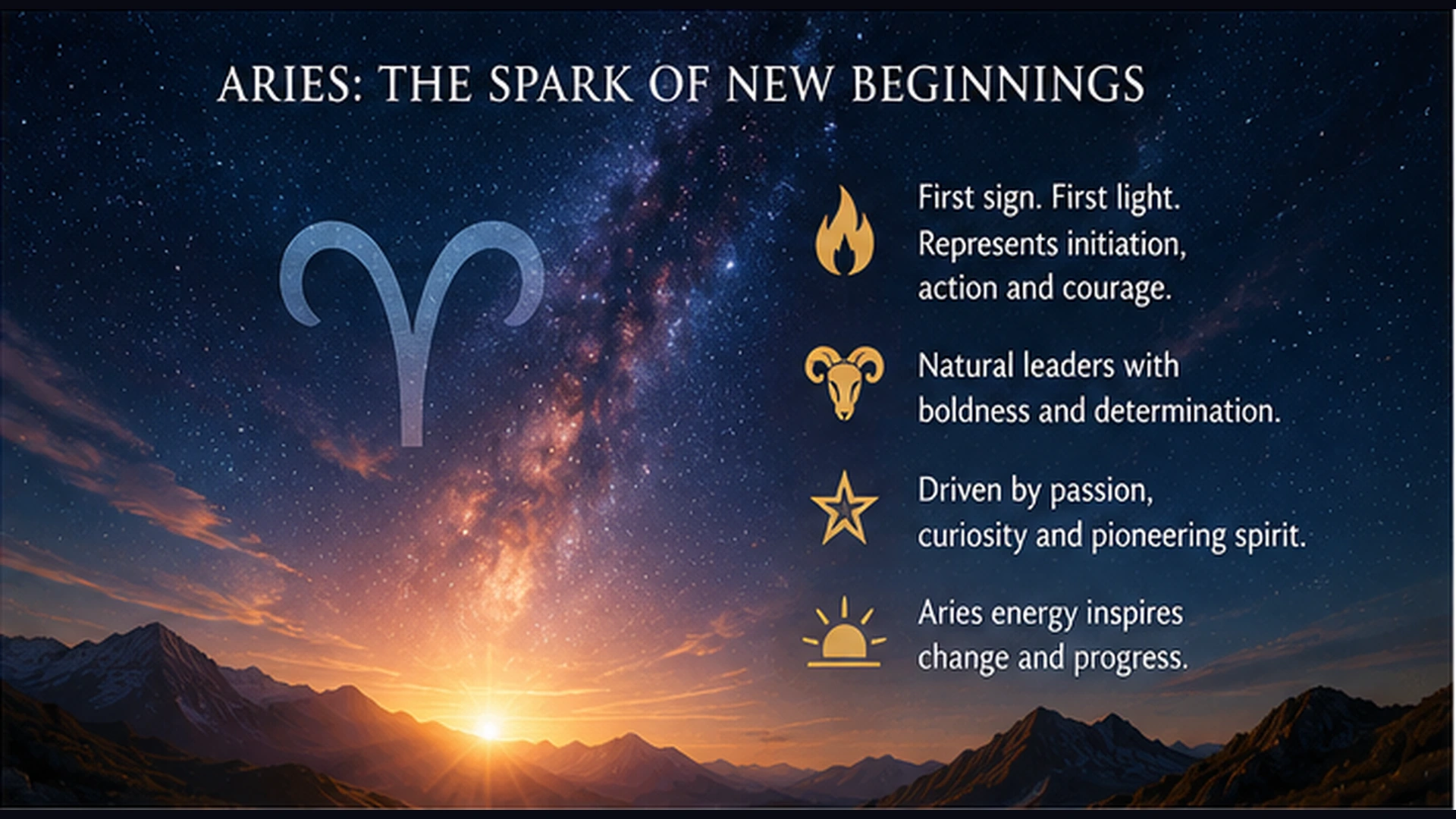
In astrology, the first position gives Aries a symbolic association with initiation. The sign is often interpreted through beginnings, direct action, courage, urgency, independence and the impulse to move before every detail is settled.
Its cardinal modality reinforces the theme of starting a new seasonal quarter. Its fire element is interpreted as vitality, enthusiasm and expression. Traditional rulership by Mars adds imagery of assertion, conflict, effort and decisive movement.
These symbolic themes do not mean every person with an Aries Sun has the same personality. A full astrological chart contains many placements, and human behavior is also shaped by family, culture, education, health, opportunity and personal choice. Astrology should not be used to diagnose, stereotype or excuse harmful behavior.
Specific culture or historical context: Hellenistic or Roman-period scholarly astronomy and astrology, approximately last centuries BCE to second century CE; inspired by classical technical learning rather than a named portrait of Ptolemy.
People shown: Two Mediterranean or North African adult scholars, naturally engaged in measurement and discussion.
Location: Scholarly courtyard or library workspace in Alexandria or the eastern Mediterranean.
Clothing: Historically plausible tunics and mantles, understated and practical.
Architecture: Stone or plaster columns, shaded study area and wooden furniture; no fantasy palace.
Objects: Armillary sphere, papyrus, reed pens, small globe, measuring cord; no modern telescope.
Lighting: Warm directional daylight with realistic shadows on the instrument.
Composition: Wide 16:9 editorial frame with the armillary sphere as the visual focus and scholars placed asymmetrically.
SEO-friendly filename: hellenistic-tropical-zodiac-march-equinox.webp
Image title: Classical Astronomy and the Equinox-Based Zodiac
Alt text: Hellenistic scholars using an armillary sphere to study the Sun and equinox geometry
Caption: Classical astrologers treated the sign beginning at the March equinox as the starting point of the zodiac.
Recommended placement: After the section on Aries symbolism or the tropical-versus-sidereal comparison.
Article section supported: Classical transmission, Ptolemy and the equinox-based tropical zodiac.
Important elements to avoid: Claiming the scene depicts Ptolemy exactly, readable fake Greek, modern instruments, glowing symbols, fantasy libraries, embedded text, logos, watermarks or distorted hands.
Common Misunderstandings About the First Zodiac Sign
| Misunderstanding | More accurate explanation |
|---|---|
| "Aries is first because January is the first month." | The zodiac does not start with the civil calendar. Tropical Aries starts at the March equinox. |
| "The Sun is in the constellation Aries at the March equinox." | The equinox is currently in the constellation Pisces; 0 degrees Aries is a tropical sign coordinate. |
| "Aries is scientifically the first constellation." | Constellations are regions of the sky and a circle has no natural first region. "First" belongs to a chosen zodiac order. |
| "The ram myth created the zodiac order." | Ram symbolism shaped interpretation and imagery, but the starting point comes from equinox-based geometry. |
| "All cultures use Aries as the first sign." | Many cultures have different celestial systems. Aries is first in the familiar twelve-sign zodiac tradition. |
| "Precession makes tropical astrology use the wrong constellation." | Tropical astrology intentionally defines signs by the equinoxes, not by current IAU constellation boundaries. |
| "Being an Aries scientifically determines personality." | Astrological traits are cultural interpretations; controlled scientific evidence does not establish zodiac signs as personality causes. |
Scientific Limits and Responsible Use
Astronomy can measure the equinox, the ecliptic, constellation boundaries and precession. These are physical and geometric facts. Astrology adds symbolic meanings to those structures. Scientific research has not established that zodiac signs cause personality traits or reliably predict individual events.
This distinction does not prevent people from studying astrology as history, art, cultural tradition or a tool for personal reflection. It does require accurate language. Historical belief should not be described as scientific proof, and a birth chart should not replace medical, legal, financial or psychological expertise.
Responsible astrology avoids rigid labels. Saying "Aries traditionally symbolizes initiative" is more accurate than saying "all Aries people are impulsive." It also recognizes that astrology systems differ and that the Northern Hemisphere seasonal language inherited by tropical astrology does not describe every local climate.
How to Explain the Zodiac Order Clearly
1. Start with the direct answer: Aries is the first sign in the modern Western tropical zodiac.
2. Explain the geometry: 0 degrees Aries is the March equinox, where the Sun crosses the celestial equator northward.
3. Separate the sign from the constellation: the tropical sign remains at the equinox while the constellation is a star region.
4. Introduce precession: Earth's axis changes direction slowly, moving the equinox relative to the background stars.
5. Add history: Mesopotamian and Greek scholars developed and transmitted the twelve-sign framework over centuries.
6. Qualify the scope: not every culture or astrological system uses the same zodiac or starting reference.
7. Separate belief from evidence: Aries traits are traditional interpretations, not scientifically established personality facts.
Specific culture or historical context: Contemporary East African adult education and cultural discussion; no ritual or fortune-teller framing.
People shown: Three Black African adults with varied ages and styles, participating equally.
Location: Open-air café, community education terrace or lakeside university setting.
Clothing: Contemporary casual-smart clothing.
Architecture: Simple modern furniture and subtle local urban-lakeside context.
Objects: Printed zodiac wheel with no readable text, star map, notebooks, pens, small globe or armillary model and drinks.
Lighting: Warm natural late-afternoon light with realistic lake reflections.
Composition: Wide 16:9 group scene, educational materials visible but not close enough for distorted text, water in background.
SEO-friendly filename: aries-first-zodiac-sign-responsible-learning.webp
Image title: Understanding Why Aries Comes First
Alt text: African adults discussing a zodiac wheel and astronomy chart beside Lake Victoria
Caption: The first-sign question is best understood by combining history, astronomy and careful interpretation.
Recommended placement: After the responsible-use section and before People Also Ask.
Article section supported: Scientific limits, responsible learning and key takeaways.
Important elements to avoid: Fortune-teller stereotypes, candles, smoke, glowing charts, tarot cards, readable fake text, logos, watermarks, exaggerated reactions or distorted hands.
People Also Ask
Aries is the first sign of the modern Western tropical zodiac. It begins at 0 degrees Aries, the March equinox.
Why is Aries the first zodiac sign?
Aries comes first because the tropical zodiac uses the March equinox as its zero point. The zodiac then divides the ecliptic into twelve equal 30-degree signs.
Why does the zodiac start in March?
The zodiac is based on the Sun's annual path and begins at an equinox, not on January 1 of the civil calendar.
What is the First Point of Aries?
It is the March equinox point where the ecliptic crosses the celestial equator northward. Astronomers use it as a coordinate reference.
Is the First Point of Aries still in Aries?
No. Because of precession, the equinox point is now in the IAU constellation Pisces, although its traditional name remains.
Is Aries the first constellation?
No constellation is naturally first in a circular sky. Aries is first in a chosen zodiac order; the modern IAU constellation Aries is simply one defined sky region.
What sign comes before Aries?
Pisces is the twelfth sign and comes immediately before Aries. Because the zodiac is circular, Pisces flows back into Aries.
Is Aries first in sidereal astrology?
Many sidereal systems also list Aries first, but their 0 degrees Aries is tied to a stellar reference rather than the March equinox, and methods vary.
Who created the zodiac?
No single person created it. The twelve-sign zodiac developed gradually from Mesopotamian astronomy and astrology and was later adapted by Greek, Roman, Islamic and other scholarly traditions.
Is astrology scientifically proven?
No. Astronomy verifies the sky geometry used by astrology, but scientific evidence does not establish zodiac signs as causes of personality or reliable predictors of life events.
Frequently Asked Questions
What are the zodiac signs in order?
Aries, Taurus, Gemini, Cancer, Leo, Virgo, Libra, Scorpio, Sagittarius, Capricorn, Aquarius and Pisces.
What degree does Aries begin?
In the tropical zodiac, Aries begins at 0 degrees, exactly at the March equinox.
When does Aries season begin?
It usually begins around March 20 or 21, but the exact time changes slightly by year and time zone.
Why is Aries called cardinal fire?
Cardinal signs begin seasonal quarters in tropical astrology, while fire is a traditional symbolic element associated with vitality and expression.
Does Aries begin spring everywhere?
No. The March equinox begins astronomical spring in the Northern Hemisphere and autumn in the Southern Hemisphere. Equatorial regions have different local seasonal patterns.
Is Aries a constellation or a zodiac sign?
It is both a constellation name and a zodiac sign name, but the constellation and sign are different frameworks and no longer occupy the same part of the sky.
Where is the constellation Aries?
Aries is an IAU-recognized constellation along the ecliptic, with Hamal as its brightest star. It lies east of the current March equinox point.
Why is the March equinox called the First Point of Aries?
The name was established when the equinox was associated with the Aries region of the ancient sky. The name survived after precession moved the point into Pisces.
How fast does precession move the equinox?
The direction changes by roughly 50 arcseconds per year, completing a cycle in about 26,000 years. Exact values depend on the reference model.
Does precession change tropical Aries dates?
The tropical zodiac remains anchored to the equinox, so precession changes its relationship to the stars rather than moving it away from the seasonal starting point.
Why do sidereal and tropical charts differ?
They use different zero points. Tropical astrology begins at the March equinox, while sidereal astrology uses a stellar reference and an offset.
Can someone be Pisces in tropical astrology and Aquarius in sidereal astrology?
Yes. The offset between systems can place the Sun in different named signs, especially away from sign boundaries.
Did Ptolemy invent Aries?
No. The zodiac existed before Ptolemy. He described and systematized a classical tropical framework that begins at the spring equinox.
Did Babylonians use the same Aries personality traits as modern horoscopes?
Not in the same modern psychological form. Ancient Mesopotamian astrology focused heavily on celestial omens, timing, kingship, states and later horoscopic techniques.
Why is Aries represented by a ram?
The ram became the standard emblem transmitted through ancient and medieval zodiac imagery. Cultural stories and interpretations accumulated around it over time.
Does the zodiac have a real first point?
A circle has no inherent beginning. A system chooses a zero point; tropical astrology chooses the March equinox.
Can the zodiac start with Capricorn instead?
For a specialized calculation or presentation, someone could begin listing the circular sequence elsewhere, but the standard tropical sign order defines Aries as sign one.
Are zodiac traits factual personality categories?
They are traditional symbolic categories. They should not be treated as scientific diagnoses or fixed judgments about individuals.
Key Takeaways
Aries is the first sign of the modern Western tropical zodiac.
The zodiac starts at the March equinox, defined as 0 degrees Aries.
The zodiac is circular, so its starting point is a convention anchored to a real solar event.
The Aries sign, Aries constellation and First Point of Aries are related but not identical.
Precession moved the March equinox into the constellation Pisces while the tropical sign remained at the equinox.
The twelve-sign zodiac developed gradually from Mesopotamian astronomy and was adapted through Greek, Roman, Islamic and other traditions.
Not every culture or astrological system uses the same zodiac framework.
Aries personality traits are traditional interpretations, not scientifically proven causes of behavior.
Conclusion
Aries is first because the tropical zodiac needs a zero point and places that point at the March equinox. From 0 degrees Aries, the zodiac divides the Sun's apparent path into twelve equal signs. The convention links the zodiac to an observable event: the Sun's northward crossing of the celestial equator.
The deeper history shows why a simple horoscope answer can be misleading. Mesopotamian scholars developed the twelve-sign framework over time; Greek and Roman astrologers organized it into technical systems; Ptolemy described an equinox-based starting point; and later scholars transmitted the zodiac across languages and regions. Meanwhile, precession separated the equinox from the constellation that gave the point its name.
The most accurate answer is therefore precise and limited: Aries is the first sign in the modern Western tropical zodiac because 0 degrees Aries is defined at the March equinox. That fact explains the order. The meanings attached to Aries - initiative, fire, courage and beginnings - belong to astrological tradition rather than scientific proof.
Final Summary
Aries is the first zodiac sign in the tropical Western system. It begins at the March equinox, known historically as the First Point of Aries. The actual equinox now lies in the constellation Pisces because of precession, so the sign Aries and constellation Aries should not be confused. The zodiac order developed through ancient Mesopotamian and Mediterranean scholarship and later spread across many intellectual traditions.
Research Sources and Further Reading
[1] NASA Science, "Chapter 2: Reference Systems." Explains the ecliptic, celestial equator, right ascension and the vernal equinox as the First Point of Aries.
[2] NASA Goddard Space Flight Center, "Description of Epoch." Describes the First Point of Aries as a moving equinox reference and gives its long-term drift.
[3] NASA Goddard Space Flight Center, "Nutation and Precession." Explains the roughly 26,000-year precession of Earth's spin axis.
[4] NASA Science, "Embracing the Equinox." Defines equinoxes and explains the Sun's crossing of Earth's equatorial plane and opposite hemispheric seasons.
[5] Ptolemy, Tetrabiblos, Book I, section 10, English translation hosted by the University of Chicago LacusCurtius. States that the zodiac is circular but begins conventionally with the sign at the vernal equinox.
[6] British Museum, Babylonian zodiac list tablet. Museum interpretation describing the Mesopotamian development of the twelve-part zodiac.
[7] John Steele, "Astronomy, Babylonia," Oxford Classical Dictionary / Oxford Research Encyclopedias. Scholarly overview of Babylonian observation, prediction, zodiacal knowledge and celestial divination.
[8] Dorian Gieseler Greenbaum, "Astrology in Ancient Greek and Roman Culture," Oxford Research Encyclopedia of Planetary Science. Explains the 12 equal signs, their relationship to constellations and Ptolemy's tropical framework.
[9] Metropolitan Museum of Art, "Astronomy and Astrology in the Medieval Islamic World." Discusses zodiac imagery, including Aries as the ram, and the transmission of astronomical and astrological learning.
[10] NASA Planetary Data System and NASA educational materials on right ascension. Define the March equinox as the coordinate zero point traditionally called the First Point of Aries.
[11] International Astronomical Union, "The Constellations." Explains official constellation regions, names and the fact that star patterns are Earth-based perspectives rather than physically connected objects.
[12] Francesca Rochberg, The Heavenly Writing: Divination, Horoscopy, and Astronomy in Mesopotamian Culture. Academic study of the long development of Babylonian celestial divination and horoscopy.
Supporting Article Recommendations
Zodiac Signs in Order: From Aries to Pisces - Target the broader sequence query and link back to this first-sign explanation.
Tropical vs Sidereal Zodiac: What Is the Difference? - Expand the system comparison with ayanamsha, sign changes and regional traditions.
What Is the First Point of Aries? - Create a focused astronomy-history article once this page gains impressions for the term.
Aries Traits Explained: Cardinal Fire, Strengths and Challenges - Develop the personality-intent cluster without duplicating the historical question.
How the Twelve-Sign Zodiac Developed - Build a careful historical article centered on Mesopotamia, the Hellenistic world and later transmission.
Why Zodiac Signs and Constellations Do Not Match - Target precession, IAU boundaries and the difference between equal signs and irregular constellations.
Cardinal, Fixed and Mutable Signs Explained - Support the modality cluster and link to Aries as cardinal fire.
Fire Signs Explained: Aries, Leo and Sagittarius - Connect Aries with elemental symbolism while keeping scientific limitations clear.
Suggested Internal Links
Water Signs Explained: Cancer, Scorpio and Pisces Traits - link from the element comparison or supporting-content section.
Aries Traits Explained - link from the symbolic meaning section when published.
Fire Signs Explained - link from the cardinal fire explanation.
Zodiac Signs in Order - link from the sign-order table.
Tropical vs Sidereal Zodiac - link from the systems comparison.
Understanding Astrology as Cultural Tradition - link from the scientific-limits section.
How Equinoxes and Solstices Shape Seasonal Traditions - link from the March equinox section.
African Sky Knowledge and Seasonal Observation - link where discussing global and equatorial seasonal context, if a carefully researched page exists.
Post-Publication Optimization Plan
1. Publish with the recommended title and request indexing through Google Search Console.
2. After 28-42 days, review impressions, clicks, CTR and average position for "first zodiac sign," "why is Aries first" and "First Point of Aries."
3. If impressions rise but CTR remains weak, test Alternative SEO Title 1 before changing the article body.
4. Add internal links from the Water Signs article, future Aries profile, zodiac order page and zodiac elements overview.
5. If "First Point of Aries" gains meaningful impressions with a distinct technical intent, publish a dedicated supporting article and differentiate it clearly from this page.
6. Update the equinox date wording annually only if the article includes a current-year date; otherwise keep the evergreen "around March 20 or 21" wording.
7. Add Article, BreadcrumbList and FAQ structured data only when it accurately reflects visible page content and current search-engine guidelines.
8. Use descriptive image filenames and alt text when the five planned images are generated and uploaded.
9. Review the page after six months for query cannibalization with any zodiac-order or tropical-versus-sidereal articles.
Article Information
- Publisher
- Ancestral Temple
- Editor
- Ancestral Temple
- Last updated
- Jul 26, 2026
- Last reviewed
- Jul 26, 2026
- Content version
- 0376e1ea04
This educational article should be read as cultural and spiritual information, not as medical, legal, financial, or emergency advice.
Helpful Related Guidance
Explore This Topic
Related Topic Cluster
Dreams & Symbolism
About the Author
 Ancestral Temple
Spiritual guide and practitioner with decades of experience in ancestral wisdom, rituals, and divine guidance.
Related Posts
View All












Leave a Comment
We'd love to hear your thoughts.