
Common Astrology Myths
Cornerstone Content
Quick Summary
Astrology is surrounded by repeated claims that are historically inaccurate, scientifically unsupported, or oversimplified. This guide separates common myths from documented history, astronomical facts, responsible interpretation, and the limits of predictive claims.
Common Astrology Myths is best understood as a symbolic and cultural subject, not a scientifically validated system for guaranteed prediction. This article explains the main meaning, historical background and related ideas while keeping astrology separate from astronomy and avoiding medical, legal or financial claims.
Astrology is one of the world’s most recognizable symbolic traditions, but it is also surrounded by misinformation. Some myths come from simplified newspaper horoscopes. Others arise from social media, commercial spiritual services, inaccurate history, or confusion between astronomy and astrology.
A responsible discussion should neither insult people who value astrology nor present symbolic claims as scientifically established facts. Astrology can be culturally important, historically influential, spiritually meaningful, or useful as a reflective language while still lacking reliable scientific evidence for predicting personality and future events.
NASA distinguishes astronomy from astrology: astronomy uses scientific observation, evidence, and testing, whereas astrology assigns predictive or personality meaning to celestial positions without established scientific support. citeturn192603search0
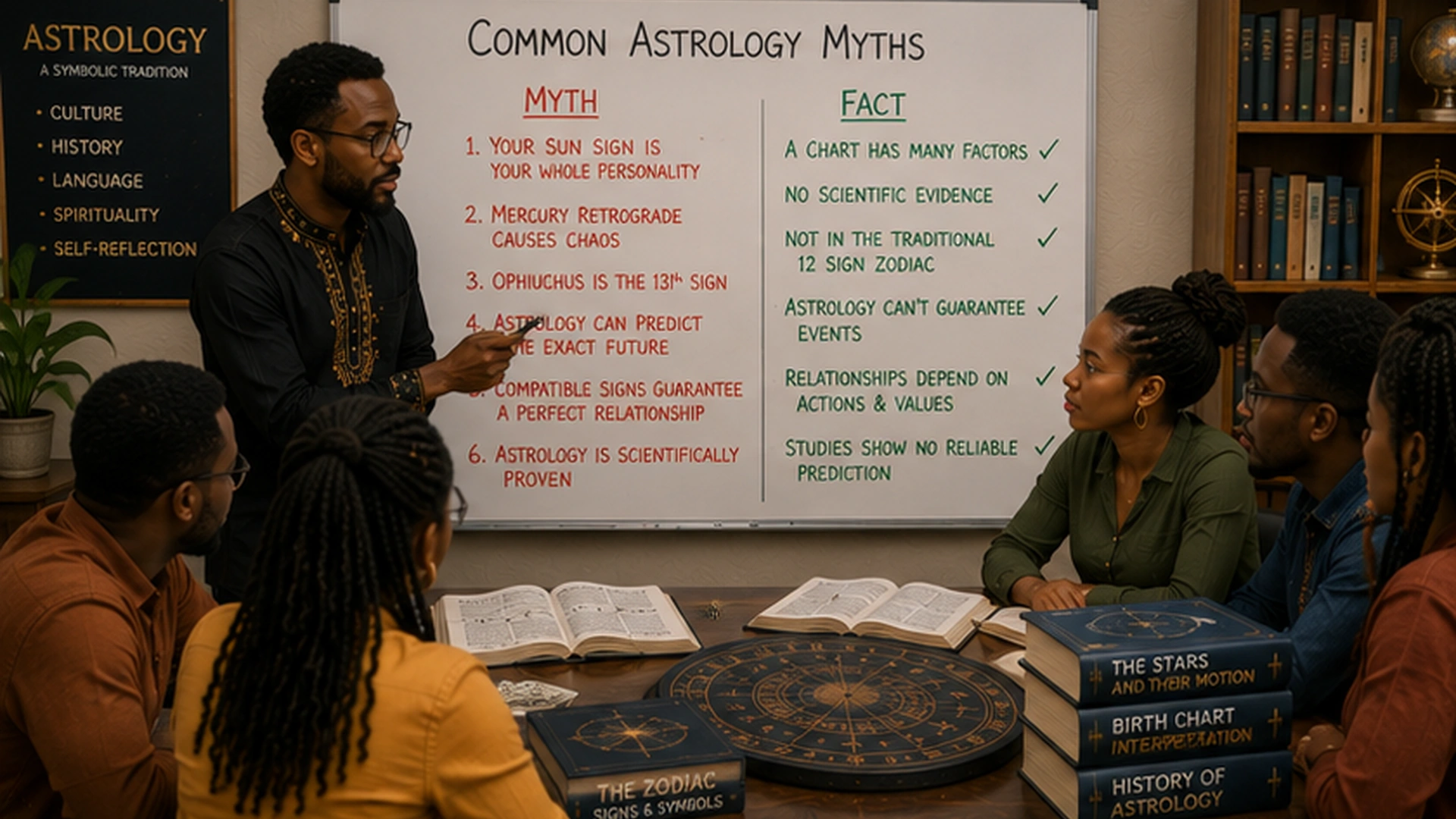
Suggested scene: Black African educator leading a myth-versus-fact astrology lesson using astronomy books, a chart wheel, and historical sources.
Key Points
Astrology and astronomy are not the same field.
A Sun sign is only one part of a birth chart.
Zodiac signs are equal mathematical divisions; constellations are unequal sky regions.
Ophiuchus does not automatically create a thirteenth sign in the traditional twelve-part zodiac.
Axial precession was not a recent discovery that suddenly invalidated every form of astrology.
Mercury retrograde is real apparent motion, but it has not been shown to cause universal communication or technology failures.
Zodiac compatibility cannot determine whether a relationship is safe or healthy.
Astrology cannot reliably diagnose illness, identify abuse, or guarantee wealth, marriage, pregnancy, protection, or success.
Ancient Egypt did not independently invent the complete modern zodiac.
Controlled testing has not established natal astrology as a reliable predictor of personality. citeturn192603search1
Myth 1: Astrology and Astronomy Are the Same
Astronomy is a natural science. It studies stars, planets, galaxies, matter, energy, motion, and the structure of the universe using observation, mathematics, testable hypotheses, and reproducible evidence.
Astrology interprets celestial positions symbolically or predictively. Historically, the two fields overlapped because accurate astrological calculation required astronomical observation. Modern astronomy, however, does not treat horoscopes as scientifically validated explanations.
Astrology can be studied as cultural history, art, religion, divination, or personal symbolism without being classified as astronomy.
Myth 2: Your Sun Sign Describes Your Entire Personality
The Sun sign is the zodiac sign occupied by the Sun at birth. Traditional and modern astrologers may also examine the Moon, Ascendant, Mercury, Venus, Mars, Jupiter, Saturn, houses, angles, aspects, and chart ruler.
Two people with the same Sun sign can have different Moon signs, rising signs, houses, aspects, cultures, families, opportunities, and life choices.
Even within astrology, reducing a person to one sign is an oversimplification. Outside astrology, personality is studied through genetics, development, learning, culture, relationships, and environment.
Myth 3: Zodiac Signs and Constellations Are Identical
Astrological signs are twelve equal thirty-degree divisions of the zodiac. Astronomical constellations are unequal regions of the sky with official boundaries.
The twelve-sign system is mathematical. A sign can retain its thirty-degree size even though the corresponding constellation occupies a different width along the ecliptic.
NASA describes Western astrological signs as twelve thirty-degree sectors beginning from the equinox-based Aries point. citeturn192603search30
Myth 4: Ophiuchus Proves Everyone Has the Wrong Sign
Ophiuchus is a real constellation crossed by the Sun under modern astronomical boundaries.
The traditional Western zodiac, however, is not simply a list of every constellation crossed by the Sun. It is a twelve-part division of the ecliptic.
A thirteen-sign system can be designed, but it is a modified astrological framework rather than the rediscovery of a universally forgotten sign.
Myth 5: Precession Was Discovered Recently
Axial precession is the slow change in the direction of Earth’s rotational axis. It changes the relationship between the equinoxes and background stars.
The phenomenon was recognized in antiquity and is associated historically with the Greek astronomer Hipparchus. NASA educational material discusses this long-known astronomical motion. citeturn192603search16
Tropical astrology anchors signs to equinoxes and seasons. Sidereal systems use stellar reference points. Precession explains why their sign positions differ; it is not a recent surprise.
Myth 6: Mercury Retrograde Makes Every Device Fail
Retrograde motion is an apparent reversal of a planet’s movement against the background stars caused by the relative motions of Earth and the other planet.
Mercury does not physically reverse its orbit. Communication problems, transport delays, and technical failures occur during direct and retrograde periods.
People may notice and remember failures that fit the expectation while overlooking normal periods, successful outcomes, or contradictory evidence.
Myth 7: Retrograde Planets Are Cursed or Broken
In natal astrology, retrograde planets receive different symbolic interpretations depending on the tradition. Common modern descriptions include internalization, revision, unusual expression, or delayed confidence.
A retrograde symbol does not prove disability, dishonesty, bad luck, spiritual blockage, or permanent failure.
Fear-based practitioners may exploit retrograde periods to sell unnecessary remedies. No payment can scientifically ‘repair’ a planet.
Myth 8: Compatible Zodiac Signs Guarantee Love
Popular compatibility lists usually compare Sun signs or elements. Real relationships depend on consent, respect, communication, emotional safety, accountability, shared values, and freedom from coercion.
Two people with supposedly compatible signs can have an unhealthy relationship. People with supposedly difficult combinations can build strong partnerships.
Astrological compatibility cannot establish whether someone is trustworthy, safe, faithful, or suitable for marriage.
Myth 9: Difficult Signs or Aspects Make Someone Dangerous
No sign, planet, house, or aspect proves violence, abuse, criminality, manipulation, or moral character.
Claims that Scorpio placements are dangerous, Mars placements are violent, or Pluto placements prove trauma are irresponsible.
Risk assessment must be based on behavior, credible evidence, professional evaluation, and safety planning—not birth charts.
Myth 10: Astrology Can Diagnose Health Conditions
Historical medical astrology connected signs and planets with body parts, illnesses, and treatment timing. Those systems are important for cultural history.
They are not scientifically validated diagnostic tools. A chart cannot diagnose cancer, infertility, pregnancy, mental illness, neurological conditions, or infectious disease.
Astrology must not replace medical testing, licensed care, medication, emergency treatment, or mental-health support.
Myth 11: Astrology Can Predict Exact Events With Certainty
Astrological traditions may interpret periods, themes, possibilities, or symbolic timing. These interpretations do not reliably guarantee a particular event.
A chart cannot promise marriage, pregnancy, immigration approval, court victory, investment returns, healing, death dates, or lottery success.
Precise certainty is especially concerning when used to frighten clients or demand money.
Myth 12: Jupiter Is Always Lucky and Saturn Is Always Bad
Traditional astrology often classifies Jupiter and Venus as benefics and Saturn and Mars as malefics, but these are technical categories rather than simple good-and-evil labels.
Jupiter can symbolize growth, but growth may include excess, overconfidence, waste, or unrealistic promises.
Saturn can symbolize limits and delay, but also discipline, endurance, structure, accountability, and mastery.
Myth 13: Full Moons Make Everyone Irrational
The Moon has real physical relationships with Earth, including its role in ocean tides. This does not establish that every full Moon causes crime, psychiatric crisis, childbirth, or irrational behavior.
Expectations about full Moons can influence attention and memory. Dramatic events may be noticed more readily when they occur near a culturally significant lunar phase.
Medical or safety decisions should not be based on lunar stereotypes.
Myth 14: Ancient Egypt Invented the Complete Modern Zodiac
Ancient Egypt had sophisticated calendars, decans, temple astronomy, and religious sky traditions.
The standardized twelve-sign zodiac has major Babylonian foundations and entered Egypt through the Hellenistic world. Egypt became a major center of adaptation and transmission.
Presenting every modern zodiac feature as purely pharaonic removes the important roles of Mesopotamian, Greek-speaking, Egyptian, Indian, Islamic, and later scholars.
Myth 15: All Civilizations Used the Same Astrology
Mesopotamian omen astrology, Hellenistic horoscopy, Indian Jyotisha, Chinese calendrical systems, Islamic scholarly astrology, and modern Western astrology differ substantially.
They may use different calendars, zodiacs, lunar mansions, planets, timing methods, philosophical assumptions, and religious frameworks.
Shared observation of the Sun, Moon, and stars does not prove identical interpretation.
Myth 16: Africa Has One Universal Zodiac
Africa contains thousands of communities with different languages, religions, histories, and celestial traditions.
Relevant histories include Greco-Roman Egypt, North African scholarship, Arabic manuscript traditions, and Timbuktu’s intellectual networks.
Many African communities also used the sky for seasons, farming, navigation, rain knowledge, ceremony, and oral history without Western-style birth horoscopes. Commercial ‘African zodiac’ systems require evidence tied to a specific community and source.
Myth 17: Chinese Astrology Is Western Astrology With Animals
The Chinese zodiac is commonly a twelve-year animal cycle within a broader system of heavenly stems, earthly branches, yin and yang, and five phases.
The Western zodiac divides the ecliptic into twelve thirty-degree signs.
Both use twelve-part structures, but their calendars, symbols, histories, and techniques are different.
Myth 18: Indian Astrology Is Just Western Astrology Shifted Backward
Indian Jyotisha commonly uses a sidereal zodiac, but it also includes nakshatras, planetary periods, divisional charts, electional timing, and distinct textual and philosophical traditions.
Greek and other influences were adapted within existing South Asian astronomy, calendars, ritual life, and scholarship.
It should not be reduced to a sign offset.
Myth 19: Astrology Is Either Completely Ancient or Completely Modern
Astrology contains ancient foundations and many later developments.
Babylonian zodiacal calculation, Hellenistic houses, medieval Islamic scholarship, Renaissance astrology, newspaper horoscopes, psychological astrology, and mobile applications belong to different historical periods.
A modern interpretation may be recent even when it uses old symbols.
Myth 20: Scientific Criticism Erases Cultural Value
A tradition can be historically, artistically, spiritually, or socially meaningful without being scientifically validated.
Museum objects show that zodiac and planetary imagery were important in medieval Islamic art. The Metropolitan Museum documents zodiac signs and seven-planet imagery on bowls, trays, and other objects. citeturn192603search3turn192603search21
Scientific criticism addresses claims about reliable prediction or causation. It does not require denying cultural history.
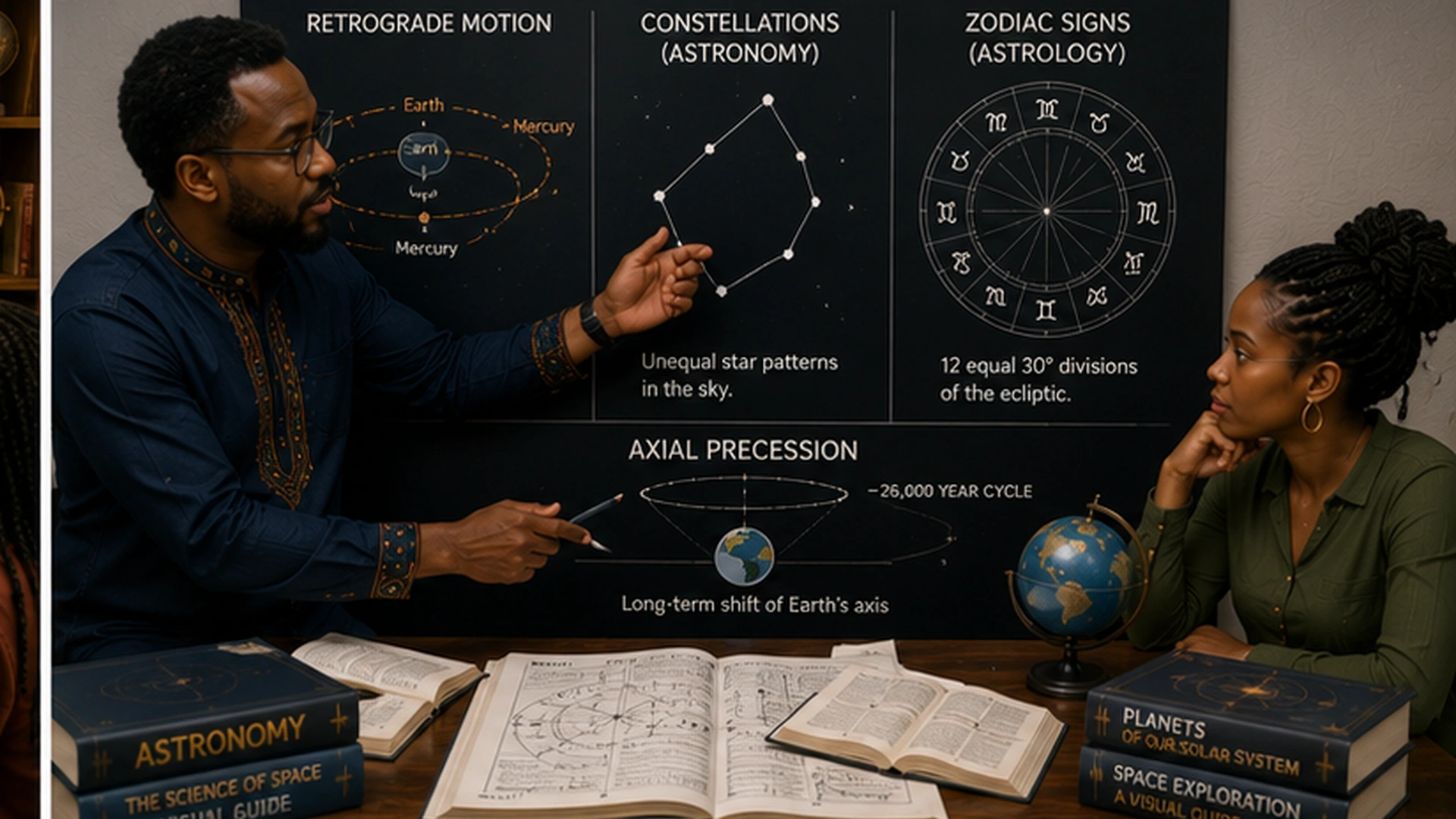
Suggested scene: African science educator comparing real retrograde motion, constellations, signs, and precession with an astrology student.
Why Astrology Myths Spread
Short social-media content rewards certainty and dramatic claims.
General personality statements can feel personally accurate.
Confirmation bias encourages people to notice supporting examples.
Incorrect historical claims may be repeated without checking museums or academic sources.
Fear-based services may profit from retrogrades, curses, or difficult transits.
Astrology applications can generate authoritative-sounding interpretations automatically.
People often confuse symbolic meaning with physical causation.
The Barnum or Forer Effect
The Barnum effect describes the tendency to accept broad, favorable, or widely applicable descriptions as uniquely personal. Statements such as ‘You value independence but also need reassurance’ can apply to many people.
This effect helps explain why generalized horoscope text can feel precise. It does not mean that every astrology user is unintelligent or dishonest. It shows why personal validation is not the same as controlled evidence.
What Scientific Testing Has Found
A widely discussed double-blind study published in Nature tested whether astrologers could match natal charts with standardized personality profiles. The results did not support the tested claim that natal charts could describe personality accurately beyond chance expectations. citeturn192603search1
One study cannot answer every possible formulation of astrology. However, reliable scientific claims require repeatable evidence, clear predictions, appropriate controls, and results that consistently exceed chance.
How to Evaluate an Astrology Claim
Ask exactly what is being claimed.
Check whether the statement is specific enough to test.
Look for evidence that could prove the claim wrong.
Distinguish a cultural interpretation from a physical-causation claim.
Check dates, museum records, academic sources, and original documents.
Watch for guaranteed outcomes and fear-based selling.
Compare the claim with ordinary explanations such as chance, memory, and selective attention.
Keep medical, legal, financial, and safety decisions grounded in qualified advice.
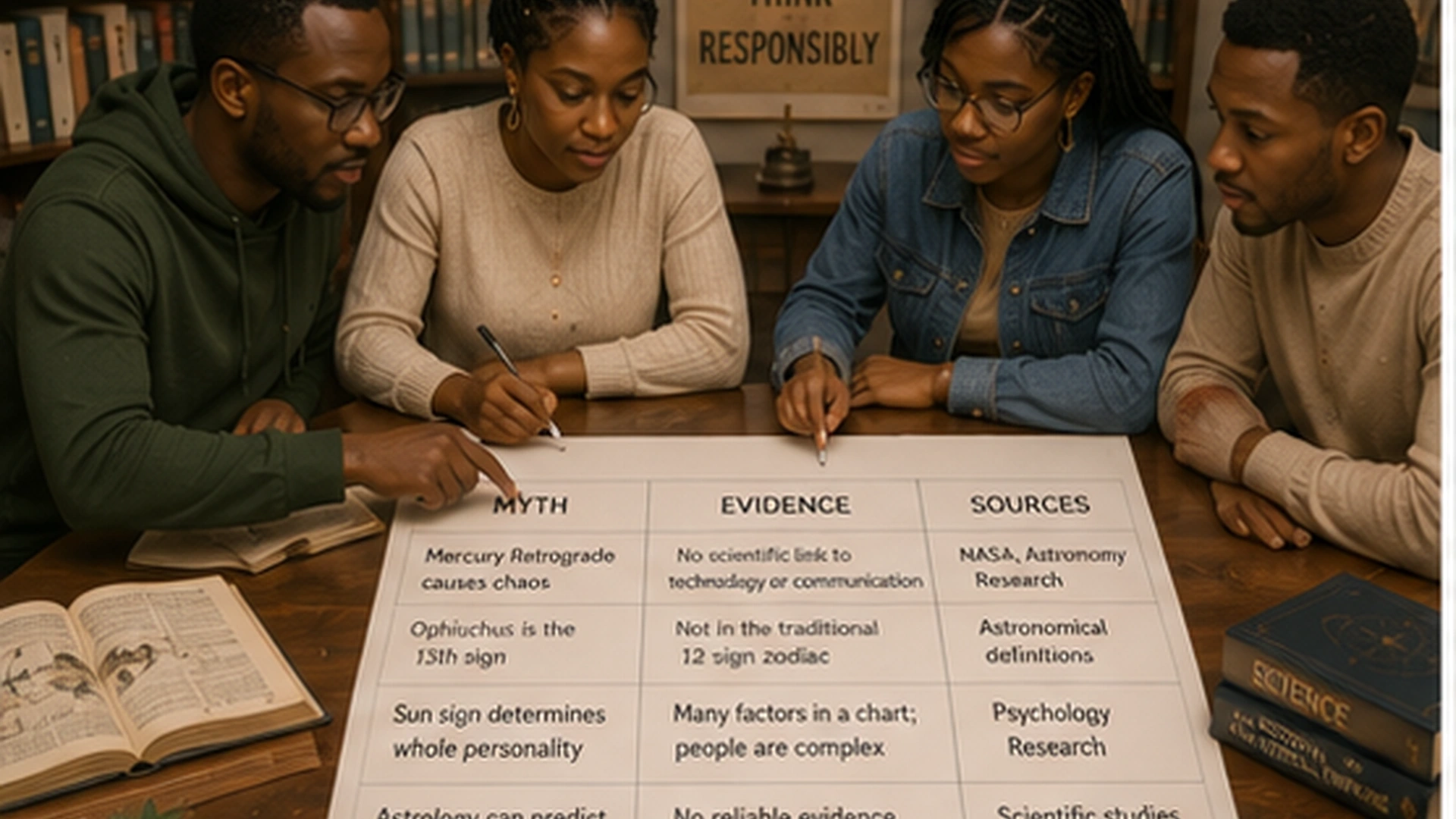
Suggested scene: Black African learners reviewing a myth, evidence, and source-checking worksheet with astronomy and history references.
Ethical Boundaries
Astrology should not be used to:
Diagnose illness or mental-health conditions
Predict death as certainty
Identify an abuser without behavioral evidence
Guarantee marriage, pregnancy, wealth, healing, or legal success
Tell someone to stop medical treatment
Discriminate in employment or education
Judge a child’s intelligence or future
Demand money to remove a planetary curse
Pressure someone to remain in an unsafe relationship
Present a newly invented system as an ancient community tradition
Responsible Language
Prefer
Avoid
May emphasize…
Will definitely cause…
Is traditionally associated with…
Proves that you are…
One possible interpretation is…
Your chart guarantees…
This tradition developed in…
All ancient people believed…
The evidence does not establish…
Science is hiding the truth…
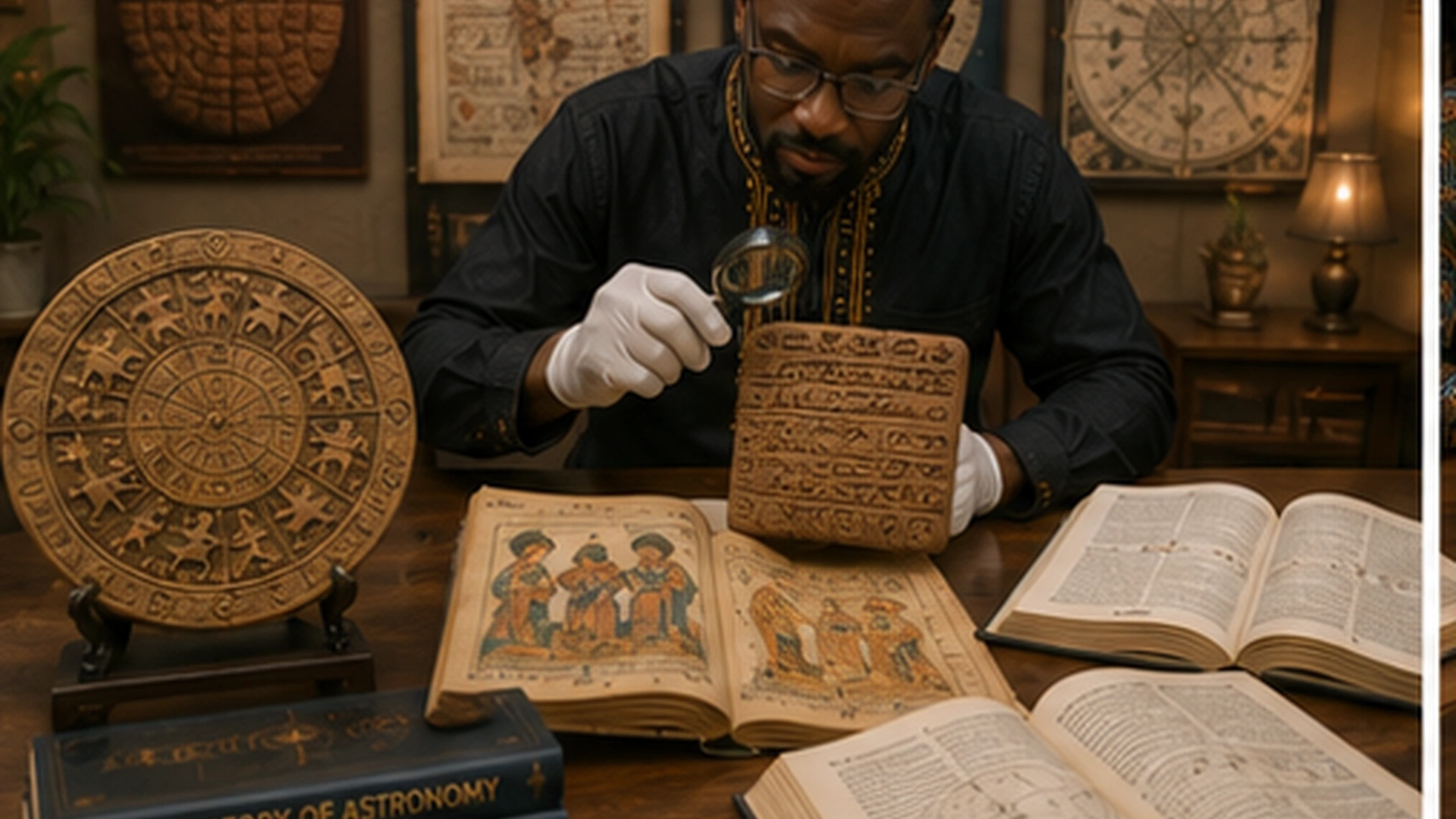
Suggested scene: African museum historian verifying zodiac and planetary claims using catalogues, tablets, manuscripts, and conservation records.
Key Takeaways
Astrology and astronomy are different fields.
Sun signs do not describe complete personalities.
Signs are equal zodiac divisions, while constellations are unequal sky regions.
Ophiuchus does not automatically replace the traditional twelve-sign structure.
Precession is an old astronomical discovery, not a recent correction.
Retrograde motion does not prove universal disruption.
Compatibility lists cannot determine relationship safety.
Charts cannot diagnose health, abuse, morality, or destiny.
Astrology developed through multiple civilizations and should be described with cultural specificity.
Controlled research has not validated natal astrology as a reliable personality predictor.
Cultural meaning and scientific proof are different questions.
People Also Ask
Is astrology the same as astronomy?
No. Astronomy is a science based on observation and testing. Astrology assigns symbolic or predictive meaning to celestial positions.
Does Ophiuchus make thirteen zodiac signs?
Ophiuchus is an astronomical constellation, but the traditional astrological zodiac is a twelve-part mathematical division.
Does Mercury retrograde cause technology failures?
No reliable evidence shows that Mercury retrograde causes universal communication, travel, or technology problems.
Do zodiac signs determine personality?
Scientific research has not established zodiac signs as reliable personality predictors.
Are some zodiac signs dangerous?
No sign proves violence, abuse, criminality, or moral character.
Can astrology predict marriage or pregnancy?
Astrology cannot guarantee marriage, pregnancy, wealth, health, or other specific outcomes.
Did ancient Egypt invent the zodiac?
Egypt contributed significantly to astrology, but the standardized twelve-sign zodiac has Babylonian foundations.
Is Chinese astrology the same as Western astrology?
No. Chinese calendrical and animal-cycle traditions differ from the Western ecliptic zodiac.
Can astrology be culturally meaningful without being scientific?
Yes. It can hold historical, artistic, religious, spiritual, or personal meaning without having scientifically validated predictive power.
Is astrology scientifically proven?
No. Controlled studies have not established natal charts as reliable predictors of personality or events.
Frequently Asked Questions
1. Is astrology the same as astronomy?
No. Astronomy is a science based on observation and testing. Astrology assigns symbolic or predictive meaning to celestial positions.
2. Does Ophiuchus make thirteen zodiac signs?
Ophiuchus is an astronomical constellation, but the traditional astrological zodiac is a twelve-part mathematical division.
Frequently Asked Questions
What should readers know first about african spirituality and cultural history?
African spirituality and cultural history: Read clear guidance, key signs, practical steps, and private support from Ancestral Temple.
What causes common-astrology-myths?
The safest next step is to compare the signs, prepare clear details, and request private guidance when the matter feels personal.
How does common-astrology-myths work?
The safest next step is to compare the signs, prepare clear details, and request private guidance when the matter feels personal.
Is it possible to get private guidance for common-astrology-myths?
The safest next step is to compare the signs, prepare clear details, and request private guidance when the matter feels personal.
How long does common-astrology-myths take to understand?
The safest next step is to compare the signs, prepare clear details, and request private guidance when the matter feels personal.
Can common-astrology-myths affect relationships, family, work, or personal peace?
The safest next step is to compare the signs, prepare clear details, and request private guidance when the matter feels personal.
Why do people seek spiritual guidance for common-astrology-myths?
The safest next step is to compare the signs, prepare clear details, and request private guidance when the matter feels personal.
What signs should someone notice before asking about common-astrology-myths?
The safest next step is to compare the signs, prepare clear details, and request private guidance when the matter feels personal.
When should someone contact a private spiritual guide?
The safest next step is to compare the signs, prepare clear details, and request private guidance when the matter feels personal.
What causes african spirituality and cultural history?
African spirituality and cultural history: Read clear guidance, key signs, practical steps, and private support from Ancestral Temple. The safest next step is to compare the signs, prepare clear details, and request private guidance when the matter feels perso
Article Information
- Publisher
- Ancestral Temple
- Editor
- Ancestral Temple
- Last updated
- Jul 26, 2026
- Last reviewed
- Jul 13, 2026
- Content version
- a01c18e51c
This educational article should be read as cultural and spiritual information, not as medical, legal, financial, or emergency advice.
Helpful Related Guidance
Explore This Topic
What Is Astrology · Planetary Influence Meaning
Related Topic Cluster
African Spirituality And Cultural History
Complete Guide Why Homes Have Been Blessed Throughout HistoryAbout the Author
 Ancestral Temple
Spiritual guide and practitioner with decades of experience in ancestral wisdom, rituals, and divine guidance.
Related Posts
View All





Leave a Comment
We'd love to hear your thoughts.
I appreciated the balanced distinction between cultural meaning and scientific proof.
The explanation of signs versus constellations was very clear.