
Birth Charts for Beginners

Quick Summary
A birth chart is an astrological diagram of the sky for a particular time and place. This beginner-friendly guide explains the planets, signs, houses, angles, and aspects, presents a practical reading order, and clarifies the limits of astrological interpretation.
Birth Charts for Beginners describes a culturally specific topic that should not be reduced to one universal African belief or practice. The article explains meaning, context and variation across communities while avoiding broad claims about all cultures or all practitioners.
A birth chart can look overwhelming the first time you see one. The circular wheel may contain unfamiliar symbols, numbered sections, colored lines, degrees, abbreviations, and several layers of information. Beginners often try to understand everything at once and quickly become confused.
The easiest way to read a birth chart is to treat it as a structured map rather than a mysterious code. Start with the basic birth data. Then identify the Sun, Moon, and Ascendant. After that, study the planets, the zodiac signs they occupy, the houses where they appear, and the aspects connecting them.
A birth chart—also called a natal chart or natal horoscope—is an astrological diagram representing the apparent positions of the Sun, Moon, planets, and selected celestial points for a particular date, time, and location. Astrology services normally calculate a chart using the birth date, birth time, and birthplace entered by the user.
Astrologers interpret the resulting chart symbolically. Astronomy can calculate celestial positions, but scientific testing has not established that natal charts reliably predict personality or life events.
This guide explains how birth charts are constructed and interpreted within modern Western astrology while noting that Indian, Hellenistic, Chinese, and other astrological traditions may use different calculations, terminology, and interpretive rules.
Suggested scene: Black African teacher guiding an adult learner through a printed circular natal chart in a bright, realistic educational setting.
Key Points
- A birth chart is calculated for a specific date, time, and place.
- The chart wheel usually contains planets, zodiac signs, houses, angles, and aspects.
- Planets describe astrological functions or themes.
- Signs describe how those themes are traditionally expressed.
- Houses describe the life areas where those themes are interpreted.
- Aspects describe angular relationships between planets.
- The Sun, Moon, and rising sign are useful starting points, but they are not the whole chart.
- An exact birth time is especially important for the Ascendant and houses.
- Different zodiac and house systems can produce different chart layouts.
- Astrology may be used for reflection, but it is not scientifically validated as a reliable predictor of personality or future events.
What Is a Birth Chart?
A birth chart is a two-dimensional astrological representation of the sky at a selected moment, viewed from a selected location on Earth. For natal astrology, that moment is normally the person’s birth.
The chart does not show planets physically surrounding the person. It converts astronomical positions into an astrological diagram based on a chosen zodiac, house system, and set of interpretive conventions.
Most modern Western chart wheels show:
- The twelve zodiac signs
- The Sun and Moon
- Planets used by the astrologer
- Twelve houses
- The Ascendant and Midheaven
- Planetary degrees
- Aspect lines
- Lunar nodes or other optional points
Plain-Language Meaning
A birth chart is a symbolic map of where celestial bodies appeared when and where someone was born.
Astrologers read the chart by asking three basic questions:
- Which planet or point is being interpreted?
- Which zodiac sign contains it?
- Which house contains it, and what aspects connect it to other planets?
A simple formula is:
Planet = what
Sign = how
House = where
Aspect = how different parts of the chart interact
What Information Do You Need?
Birth Date
The date determines the broad planetary positions.
The Sun changes zodiac signs roughly once a month, while the Moon moves much faster and can change signs within approximately two and a half days. Exact change times vary by year and time zone.
Birth Time
The time is especially important because Earth rotates continuously.
The eastern horizon changes throughout the day, so the Ascendant can change signs approximately every two hours, although the exact timing depends on latitude. House cusps and the Midheaven also depend heavily on the recorded time.
Astrology chart services therefore recommend entering the birth time as accurately as possible.
Birth Location
The location provides latitude, longitude, and time-zone context.
Two people born at the same clock time in different places can have different Ascendants and house placements.
What if the Recorded Time Is Approximate?
Use the chart cautiously.
The Sun and slower planets may remain reliable, but the Moon, Ascendant, Midheaven, and houses may be uncertain. A chart should clearly state when the birth time is unknown or estimated.
How to Understand the Chart Wheel
A typical Western chart looks like a circle divided into twelve wedges.
The outer ring shows zodiac signs and degrees. The inner sections show houses. Planetary symbols appear inside the wheel. Lines across the center often represent aspects.
The Outer Zodiac Ring
The zodiac is divided into twelve equal signs of thirty degrees each.
Modern Western astrology commonly uses the tropical zodiac, which begins Aries at the March equinox. Sidereal traditions use stellar reference points and place the signs differently because of axial precession.
NASA describes the ecliptic as the apparent yearly path followed by the Sun against the background sky. Earth’s axial precession slowly changes the relationship between the equinoxes and the background stars over thousands of years.
The House Wheel
The houses divide the chart according to the time and place.
They do not necessarily align one-to-one with zodiac signs. The first house begins near the Ascendant in many systems, but exact boundaries differ by house system.
The Aspect Grid or Center Lines
Many chart programs use colored lines to display major angular relationships.
Colors vary between programs, so beginners should rely on the aspect labels or degree list rather than assuming every red or blue line has the same meaning everywhere.
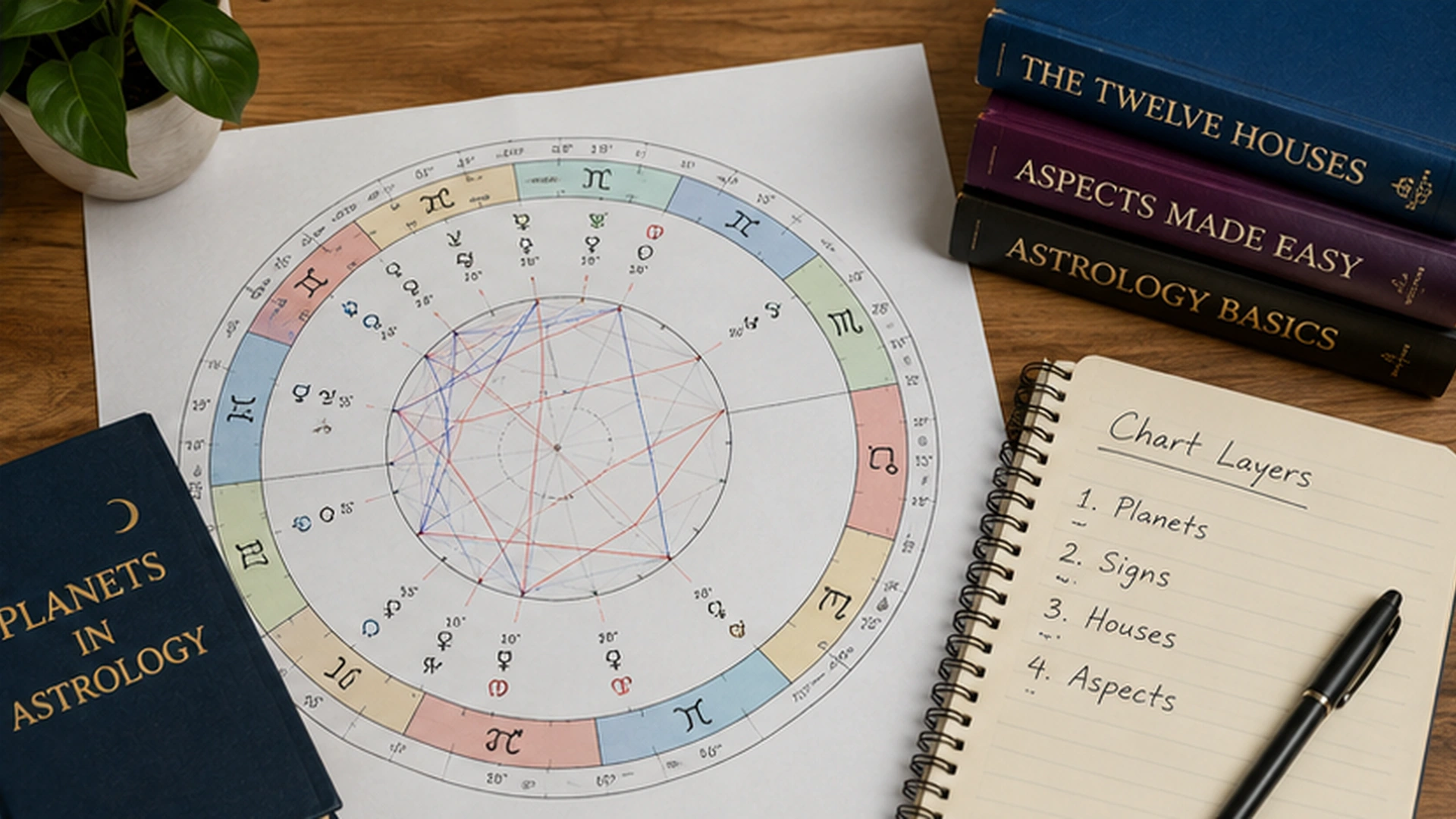
Suggested scene: Clean close-up of a birth-chart wheel beside a notebook representing the four reading layers—planets, signs, houses, and aspects—without readable fabricated text.
The Best Reading Order for Beginners
- Confirm the birth data and chart system.
- Find the Ascendant and identify the chart ruler.
- Read the Sun, Moon, and Ascendant.
- Study the personal planets: Mercury, Venus, and Mars.
- Add Jupiter and Saturn.
- Notice the outer planets only after the basic structure is clear.
- Check which houses contain the planets.
- Study the major aspects.
- Look for repeated elements, modalities, signs, houses, or themes.
- Write a balanced summary rather than interpreting one placement as destiny.
Step 1: Confirm the Chart Settings
Before interpreting anything, verify the:
- Date
- Time
- Location
- Time zone
- Daylight-saving setting
- Zodiac type
- House system
A chart generated with the wrong location or daylight-saving setting can shift the Ascendant and houses.
Beginners should also note whether the chart is geocentric or uses another specialized setting. Most ordinary natal charts are geocentric, meaning positions are calculated from Earth’s viewpoint.
Step 2: Read the Sun, Moon, and Rising Sign
The Sun Sign
Astrologers commonly associate the Sun with:
- Identity
- Purpose
- Vitality
- Conscious direction
- The desire to express oneself
The Sun sign is the sign most people mean when they ask for someone’s zodiac sign.
The Moon Sign
The Moon is traditionally associated with:
- Emotional habits
- Instinctive reactions
- Security
- Memory
- Caregiving
- Private needs
Because the Moon moves quickly, the correct date and time can matter when it changes signs on the day of birth.
The Rising Sign or Ascendant
The Ascendant is the zodiac degree rising on the eastern horizon at the selected moment and location.
Astrologers often associate it with:
- Approach
- Presentation
- Physical orientation
- Immediate reactions
- The overall structure of the chart
The planet traditionally ruling the Ascendant’s sign is called the chart ruler.
Some modern astrologers use modern planetary rulerships, while traditional astrologers usually use the seven celestial bodies visible without a telescope.
Step 3: Learn What the Planets Represent
- Planet or point
- Common astrological themes
- Beginner question
- Sun
- Identity, purpose, vitality
- What am I trying to become or express?
- Moon
- Emotions, habits, security
- What helps me feel safe and settled?
- Mercury
- Thinking, communication, learning
- How do I process and exchange information?
- Venus
- Affection, attraction, values, pleasure
- What do I appreciate and how do I relate?
- Mars
- Action, drive, conflict, desire
- How do I pursue goals and respond to obstacles?
- Jupiter
- Growth, meaning, opportunity, belief
- Where do I seek expansion or perspective?
- Saturn
- Limits, structure, duty, endurance
- Where do I meet responsibility or delay?
- Uranus
- Change, disruption, independence
- Where do I seek freedom or innovation?
- Neptune
- Imagination, ideals, uncertainty
- Where can inspiration or confusion arise?
- Pluto
- Power, intensity, deep change
- Where are control and transformation emphasized?
- North Node
- Developmental direction in some traditions
- What unfamiliar qualities are emphasized?
- South Node
- Habitual or inherited patterns in some traditions
- What comes easily but may become repetitive?
These are traditional astrological associations, not scientifically demonstrated effects caused by the planets.
Step 4: Understand the Zodiac Signs
In astrology, the sign modifies the manner in which a planet is interpreted.
A Mars placement describes action and drive. Its sign describes the style through which those themes are expressed.
- Sign
- Element
- Modality
- Traditional ruler
- Beginner keyword
- Aries
- Fire
- Cardinal
- Mars
- Initiating
- Taurus
- Earth
- Fixed
- Venus
- Stabilizing
- Gemini
- Air
- Mutable
- Mercury
- Connecting
- Cancer
- Water
- Cardinal
- Moon
- Protecting
- Leo
- Fire
- Fixed
- Sun
- Expressing
- Virgo
- Earth
- Mutable
- Mercury
- Refining
- Libra
- Air
- Cardinal
- Venus
- Balancing
- Scorpio
- Water
- Fixed
- Mars
- Intensifying
- Sagittarius
- Fire
- Mutable
- Jupiter
- Exploring
- Capricorn
- Earth
- Cardinal
- Saturn
- Structuring
- Aquarius
- Air
- Fixed
- Saturn
- Reforming
- Pisces
- Water
- Mutable
- Jupiter
- Blending
Elements
- Fire: Action, enthusiasm, expression
- Earth: Practicality, stability, material concerns
- Air: Ideas, language, relationships, social exchange
- Water: Feeling, sensitivity, memory, intuition
Modalities
- Cardinal: Beginning, directing, initiating
- Fixed: Maintaining, concentrating, stabilizing
- Mutable: Adapting, distributing, transitioning
Repeated elements or modalities can create a strong theme in a chart, but counting them is only one interpretive method.
A planet’s condition, house placement, rulership, and aspects can be more important than a simple tally.
Step 5: Read the Twelve Houses
Houses are chart sectors associated with areas of life.
Their meanings developed historically and vary somewhat among traditions. The following table gives common modern Western interpretations.
- House
- Common topics
- Beginner question
- 1st
- Self, body, approach, appearance
- How do I enter situations?
- 2nd
- Money, possessions, personal values
- What do I value and maintain?
- 3rd
- Communication, learning, siblings, local environment
- How do I learn and exchange information?
- 4th
- Home, family, roots, private life
- What creates a sense of foundation?
- 5th
- Creativity, pleasure, children, romance
- How do I play and express creativity?
- 6th
- Work routines, service, health habits
- How do I manage daily responsibilities?
- 7th
- Partnerships, agreements, open opponents
- How do I meet others one-to-one?
- 8th
- Shared resources, inheritance, intimacy, crisis
- How do I handle entanglement and change?
- 9th
- Religion, philosophy, higher learning, long travel
- How do I seek wider meaning?
- 10th
- Career, reputation, authority, public role
- What responsibilities become visible?
- 11th
- Friends, groups, alliances, aspirations
- How do I participate in communities?
- 12th
- Solitude, hidden matters, confinement, retreat
- What operates outside immediate awareness?
Do Houses Equal Signs?
No.
The first house is not automatically Aries, the second is not automatically Taurus, and so on.
Some modern teaching systems use sign-house analogies, but traditional astrologers distinguish signs from houses.
A house describes a life area. A sign describes a zodiacal quality.
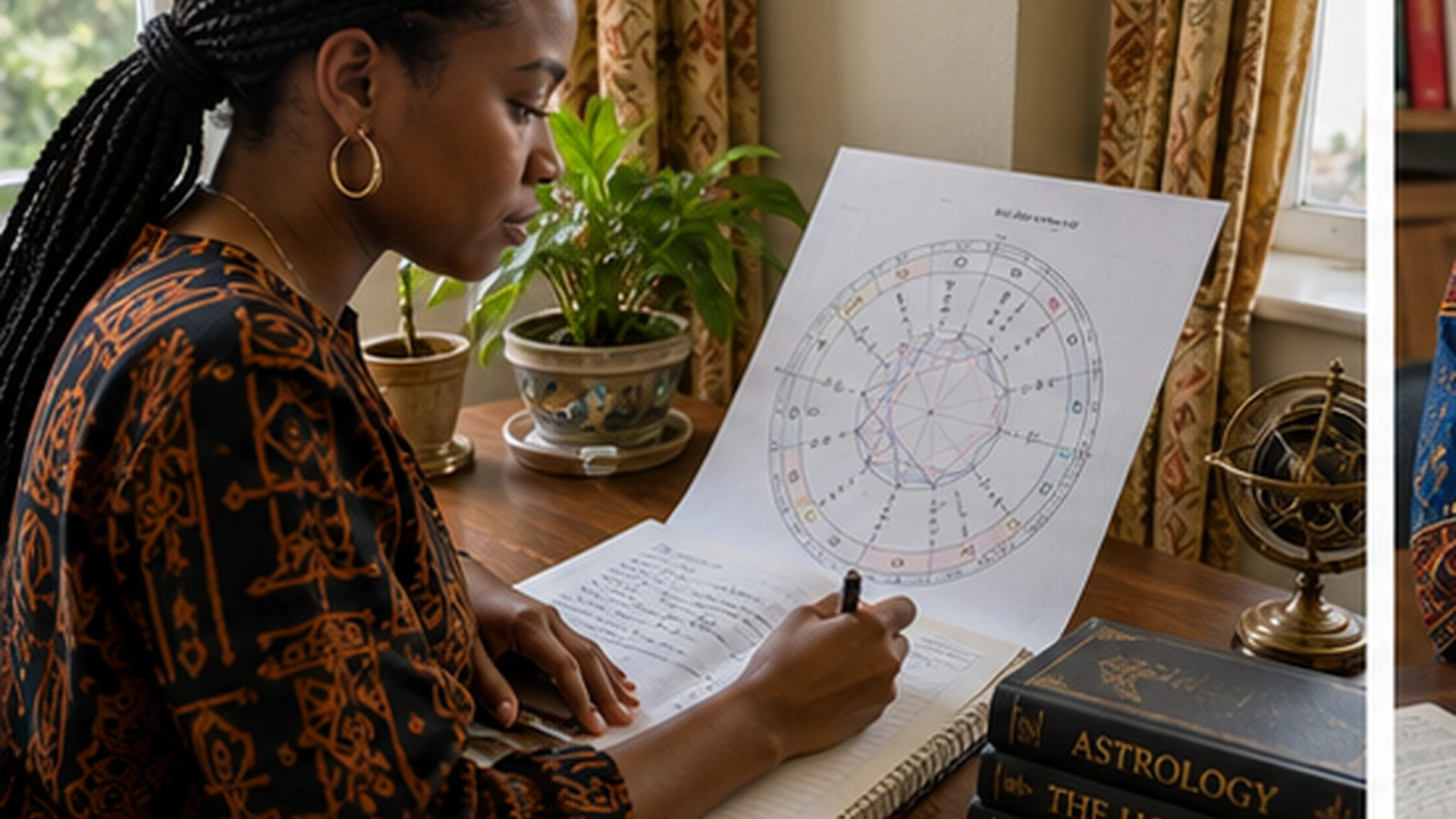
Suggested scene: Educational chart wheel with houses clearly separated beside an African learner taking notes; no captions or generated labels inside the image.
Step 6: Identify the Four Main Angles
- Angle
- Location
- Common interpretation
- Ascendant (ASC)
- Eastern horizon
- Approach, body, immediate presentation
- Descendant (DSC)
- Opposite the Ascendant
- Partnerships and qualities encountered through others
- Midheaven (MC)
- Upper meridian area
- Public role, direction, reputation, vocation
- Imum Coeli (IC)
- Opposite the Midheaven
- Home, private roots, foundations
Angles are highly time-sensitive.
A planet close to an angle is often treated as especially prominent, although the allowable distance depends on the astrologer’s rules.
Step 7: Understand Planetary Aspects
Aspects are measured angular relationships between planets or chart points.
Astrologers interpret them as describing how different chart functions cooperate, combine, or create tension.
- Aspect
- Exact angle
- Common interpretation
- Simple example
- Conjunction
- 0°
- Blending or intensification
- Moon with Venus
- Sextile
- 60°
- Opportunity or cooperation
- Mercury sextile Jupiter
- Square
- 90°
- Friction, effort, conflict
- Mars square Saturn
- Trine
- 120°
- Ease or flowing expression
- Sun trine Moon
- Opposition
- 180°
- Polarity, awareness, negotiation
- Venus opposite Mars
What Is an Orb?
An orb is the distance from an exact aspect.
If two planets are 92 degrees apart, they form a square with a two-degree orb.
Astrologers use different allowable orbs depending on the planets, aspect, tradition, and purpose of the reading.
Applying and Separating Aspects
Some traditions distinguish an aspect that is moving toward exactness from one moving away.
This requires attention to planetary motion and is better studied after a beginner understands the basic chart structure.
Step 8: Learn Basic Rulership and Planetary Condition
Traditional astrology does not interpret every planet as equally comfortable in every sign.
Concepts such as domicile, exaltation, detriment, and fall describe symbolic relationships between planets and signs.
- Domicile: A sign traditionally ruled by the planet
- Exaltation: A sign where the planet receives special honor in traditional doctrine
- Detriment: The sign opposite a domicile
- Fall: The sign opposite an exaltation
These terms describe astrological condition, not whether a person is good or bad.
A planet in a difficult condition can still be expressed constructively, especially when supported by house placement, aspects, or other factors.
What Does Retrograde Mean in a Birth Chart?
Retrograde motion is an apparent reversal in a planet’s movement against the background stars, caused by the relative motions of Earth and the planet.
In a natal chart, an “R” may mark a planet as retrograde.
Astrologers interpret natal retrogrades in different ways, often associating them with:
- Internalization
- Revision
- Unconventional expression
- Delayed development
A retrograde planet is not automatically negative, cursed, blocked, or doomed.
What Are Degrees and Minutes?
Each zodiac sign contains thirty degrees, and each degree contains sixty minutes of arc.
A placement written as 17°42′ Leo means seventeen degrees and forty-two minutes within Leo.
Degrees help astrologers judge:
- Aspect accuracy
- Sign boundaries
- House cusps
- Planetary proximity
- Other timing and interpretive techniques
Tropical and Sidereal Birth Charts
Tropical Zodiac
The tropical zodiac anchors zero degrees Aries to the March equinox.
It remains aligned with the seasonal cycle and is widely used in modern Western astrology.
Sidereal Zodiac
Sidereal systems use stellar reference points and apply an offset often called an ayanamsha.
Indian astrology commonly uses sidereal calculations, although schools may differ over the exact offset.
Because axial precession changes the relationship between equinoxes and background stars over long periods, tropical and sidereal charts can place planets in different signs.
A beginner should not combine interpretations from both systems without understanding the underlying method.
Why House Systems Produce Different Charts
Astrologers have developed several ways to divide the chart into houses.
Common systems include:
- Whole Sign
- Equal House
- Placidus
- Porphyry
- Regiomontanus
Whole Sign
Each zodiac sign becomes one complete house.
Equal House
Each house spans thirty degrees from the Ascendant degree.
Placidus
A time-based quadrant system widely used in modern Western astrology.
Porphyry
Each quadrant between the major angles is divided into three equal sections.
Different systems can move planets from one house to another, especially near a cusp.
Beginners should select one system, learn its logic, and avoid changing systems simply to obtain a preferred interpretation.
A Simple Hypothetical Example
Consider a fictional chart with the following placements:
- Sun in Taurus in the 10th house
- Moon in Pisces in the 8th house
- Leo Ascendant
- Mercury in Gemini in the 11th house
- Venus in Aries in the 9th house
- Mars in Cancer in the 12th house
- Jupiter in Virgo in the 2nd house
- Saturn in Aquarius in the 7th house
A beginner might summarize the chart in stages:
- Leo rising gives the Sun special importance as chart ruler.
- The Sun in Taurus suggests a steady or consolidating style, while the 10th house emphasizes public responsibility or career themes.
- The Moon in Pisces is interpreted as sensitive or porous, while the 8th house brings attention to intimacy, shared resources, or periods of change.
- Mercury in Gemini emphasizes communication, learning, and networks through the 11th house.
- Saturn in the 7th may symbolize seriousness, caution, duty, or delay in one-to-one commitments.
- The final interpretation should examine aspects before making a broad conclusion.
This is a teaching example, not a real person’s chart and not a prediction of actual events.

Suggested scene: Beginner-friendly consultation using a fictional printed chart; Black African astrologer and client reviewing notes in a professional, non-mystical setting.
How to Combine Placements Without Becoming Overwhelmed
Do not read placements as isolated labels.
Combine them in short sentences using the planet-sign-house structure.
For example:
Mercury in Gemini in the 11th house can be framed as communication and learning expressed through a curious, flexible style in groups, friendships, or networks.
Then add aspects.
If Saturn squares Mercury, an astrologer might explore tension between free communication and caution, discipline, fear of judgment, or the need to develop precision.
Look for Repetition
- Several planets in one sign
- Several planets in one house
- A repeated element or modality
- A planet ruling several important placements
- Multiple aspects involving one planet
- Planets close to the angles
Repeated themes usually deserve more attention than a single minor placement.
What if You Do Not Know Your Birth Time?
A chart can still be calculated for the date, but several features become uncertain.
- The Ascendant cannot be trusted
- Houses may be inaccurate
- The Midheaven may be inaccurate
- The Moon may change sign during the day
- Fast-moving aspects may shift
- Time-sensitive predictive techniques become less reliable
A time-unknown chart should not invent a noon Ascendant and present it as factual.
Some websites use noon only as a neutral calculation time for daily planetary positions.
Birth-Time Rectification
Rectification is an astrological attempt to estimate a birth time from life events and chart symbolism.
It is interpretive and cannot replace an official birth record. Results can differ between practitioners.
Common Beginner Mistakes
Reading Only the Sun Sign
The Sun sign is one component.
The Moon, Ascendant, chart ruler, houses, and aspects may create very different emphases.
Treating One Placement as Destiny
A single difficult aspect does not prove:
- Divorce
- Illness
- Poverty
- Criminality
- Infertility
- Failure
Responsible interpretation considers the entire chart and avoids guaranteed outcomes.
Confusing Signs with Houses
Signs and houses are different categories.
Aries is not the same thing as the first house, even though modern teaching sometimes compares them.
Ignoring the Birth Time
The Ascendant and houses can change significantly when the time is wrong.
Mixing Systems Without Explanation
Combining tropical signs, sidereal nakshatras, modern rulerships, traditional dignities, and several house systems can create contradictions.
Assuming Every Line Is Negative or Positive
Aspect colors differ between chart programs.
A square can motivate effort, while a trine can become underused. Context matters.
Using Astrology to Judge Character
No placement proves that a person is:
- Dishonest
- Abusive
- Dangerous
- Unintelligent
- Unfaithful
- Spiritually superior
Birth-Data Privacy
A birth chart requires personal information that may include a full date of birth, birthplace, and exact time.
These details can contribute to identity verification or reveal age and family information.
- Use reputable chart services
- Avoid sharing full birth data publicly unless necessary
- Check whether the website stores or sells data
- Remove identifying details before posting a chart
- Do not publish another person’s birth chart without permission
- Be especially careful with children’s data
Ethical Boundaries for Birth-Chart Readings
A responsible astrologer should not use a chart to:
- Diagnose medical or mental-health conditions
- Predict death as certainty
- Tell someone to stop medication
- Guarantee marriage, pregnancy, wealth, or legal success
- Pressure a client to remain in an unsafe relationship
- Claim a chart proves abuse, infidelity, or criminality
- Demand large payments to remove a curse
- Make irreversible decisions for the client
- Discriminate against a child, employee, or partner
Astrology can be framed as symbolic reflection, but serious decisions should rely on evidence, consent, qualified professionals, and practical planning.
Are Birth Charts Scientifically Proven?
Birth charts are calculated from real astronomical positions, but the astrological meanings assigned to those positions are not established scientific effects.
A well-known double-blind study published in Nature tested whether astrologers could match natal charts with standardized personality profiles. The results did not support the tested claim that natal charts could describe personality accurately beyond chance expectations.
NASA explains the astronomical ecliptic and precession, but those astronomical phenomena do not establish that zodiac placements determine personality.
A person may still use a chart as a cultural, spiritual, narrative, or reflective tool.
That personal meaning should be distinguished from scientific validation.
Do All Astrological Traditions Read the Same Chart?
No.
Hellenistic, medieval, modern Western, Indian, Chinese, and other traditions can differ in:
- Zodiac reference
- House calculation
- Planetary rulership
- Timing techniques
- Philosophical foundations
Western Natal Astrology
Western natal astrology commonly uses:
- The tropical zodiac
- A circular chart wheel
- Twelve houses
- Planetary aspects
- Modern or traditional planetary symbolism
Indian Jyotisha
Indian Jyotisha commonly uses:
- A sidereal zodiac
- Nakshatras
- Planetary periods
- Divisional charts
- Tradition-specific rules
It should not be reduced to a Western chart with shifted signs.
Historical horoscope scrolls known as janampatri could serve as birth records and include planetary and zodiac imagery prepared after a child’s birth.
Chinese Birth Systems
Chinese systems may use:
- Heavenly stems
- Earthly branches
- Animal cycles
- Elements
- Birth year, month, day, and hour
They are not simply another layout of the twelve Western signs.
The safest approach is to study one tradition at a time and identify the system used in every reading.
Birth Charts and African Scholarly History
Africa does not have one universal birth-chart tradition.
Greco-Roman Egypt was an important setting in the development of horoscopic astrology. Islamic scholarly networks later carried astronomical and astrological knowledge through North Africa and West Africa.
The Library of Congress documents a Timbuktu manuscript that discusses calculating seasons from stellar movements and casting horoscopes. Another manuscript discusses determining which star is ascendant and what that was believed to portend.
This history should not be turned into an invented universal “African zodiac.”
African communities have developed many different traditions of celestial observation, calendars, seasonal knowledge, divination, and religious interpretation.
A Beginner’s Ten-Minute Reading Checklist
- Check the date, time, location, zodiac, and house system.
- Find the rising sign and its ruling planet.
- Read the Sun by sign and house.
- Read the Moon by sign and house.
- Read Mercury, Venus, and Mars.
- Add Jupiter and Saturn.
- Identify planets near the Ascendant or Midheaven.
- Find the closest major aspects.
- Notice repeated signs, houses, elements, and modalities.
- Write a balanced summary with strengths, tensions, choices, and uncertainty.
Key Takeaways
- A birth chart is an astrological diagram calculated for a date, time, and place.
- The birth time is critical for the Ascendant, Midheaven, and houses.
- Planets, signs, houses, and aspects are separate layers of interpretation.
- The Sun, Moon, and rising sign are useful starting points but do not summarize the entire chart.
- Signs describe astrological style; houses describe areas of life.
- Aspects describe angular relationships between planets.
- Chart rulership and repeated themes help organize interpretation.
- Retrograde does not automatically mean negative or blocked.
- Tropical and sidereal charts use different reference systems.
- House systems may place planets in different houses.
- Unknown birth times limit what can be interpreted responsibly.
- A chart should not be used to diagnose illness, guarantee outcomes, or judge moral character.
- Natal astrology remains culturally influential but is not scientifically validated as a reliable personality or forecasting method.
People Also Ask
What Is a Birth Chart in Simple Terms?
It is an astrological map showing where the Sun, Moon, planets, and selected points appeared for a particular time and location.
What Are the Most Important Parts of a Birth Chart?
Beginners usually start with the Sun, Moon, Ascendant, chart ruler, houses containing personal planets, and major aspects.
Do I Need My Exact Birth Time?
An exact time is especially important for the Ascendant, Midheaven, and houses. Without it, those features may be unreliable.
What Do Planets Mean in a Birth Chart?
Astrologers treat planets as symbolic functions such as identity, emotion, communication, affection, action, growth, and responsibility.
What Do Houses Mean?
Houses are chart sectors associated with life areas such as identity, money, communication, home, partnership, work, and career.
What Are Aspects?
Aspects are measured angles between planets or chart points, such as conjunctions, squares, trines, and oppositions.
Why Is My Sidereal Sign Different?
Sidereal and tropical astrology use different zodiac reference systems, so the same planet can appear in different signs.
Can I Read a Chart Without Knowing the Birth Time?
You can study many planetary sign placements, but you should avoid treating the Ascendant and houses as certain.
Can a Birth Chart Predict Marriage or Wealth?
No chart can guarantee marriage, pregnancy, wealth, health, legal victory, or another specific outcome.
Are Birth Charts Scientifically Accurate?
Astronomical positions can be calculated accurately, but scientific research has not validated the astrological interpretation of those positions as reliable personality or forecasting tools.
Frequently Asked Questions
1. What Is a Birth Chart?
A birth chart is an astrological diagram showing celestial positions for a particular date, time, and location.
2. What Information Is Needed to Calculate a Birth Chart?
A birth date, birth time, and birthplace are normally used to calculate a natal chart.
Article Information
- Publisher
- Ancestral Temple
- Editor
- Ancestral Temple
- Last updated
- Jul 26, 2026
- Last reviewed
- Jul 26, 2026
- Content version
- 0be276016b
This educational article should be read as cultural and spiritual information, not as medical, legal, financial, or emergency advice.
Helpful Related Guidance
Explore This Topic
Planetary Influence Meaning · What Is Astrology
About the Author
 Ancestral Temple
Spiritual guide and practitioner with decades of experience in ancestral wisdom, rituals, and divine guidance.
Related Posts
View All






Leave a Comment
We'd love to hear your thoughts.
This is a detailed and balanced introduction for someone seeing a natal chart for the first time.
A printable beginner worksheet would be useful for studying this article.
The conclusion clearly explains how to read a chart in layers.
I appreciated that Chinese birth systems were not treated as Western astrology with different symbols.
How should a beginner choose one house system without constantly changing it?
The warning about posting children’s birth charts publicly was important.
I would enjoy an article about the historical development of the twelve houses.
The article remained readable even though it covered many technical ideas.
Could you add a future guide to applying and separating aspects?
I liked the explanation that trines are not always good and squares are not always bad.
The discussion of repeated themes was more helpful than isolated placement descriptions.
A mobile-friendly chart-symbol guide would make a useful related article.
The reminder to verify daylight-saving settings was practical.
Would the Moon sign always be reliable when the birth time is unknown?
I appreciated the explanation of traditional versus modern planetary rulers.
The chart-reading checklist makes the subject feel much less overwhelming.
Could you explain which aspects beginners should study first?
The ethical boundaries should be included on astrology-service pages.
A future article about angular planets would be interesting.
The article helped me stop confusing zodiac signs with houses.
Can chart rectification ever be confirmed by an official record?
The glossary would be useful as a separate reference page.
The scientific-evidence section was balanced and clearly separated calculation from interpretation.
Could you write more about how Indian astrology reads a kundali?
I appreciate that the article does not promise wealth, marriage, or pregnancy from a chart.
The explanation of degrees and minutes was simple enough for a beginner.
I would like a detailed article comparing Whole Sign and Placidus houses.
The example showed how the pieces can be combined into a short interpretation.
How much can the rising sign change if the recorded time is wrong by thirty minutes?
The warning against judging character from one placement was necessary.
A downloadable sample chart worksheet would be useful for beginners.
I liked the distinction between tropical and sidereal charts.
The privacy section is important because birth details are personal information.
Could you create a guide for reading aspects without using technical language?
Thank you for explaining that retrograde does not automatically mean something negative.
The section on house systems answered a question I had about different calculators.
The table of planets and beginner questions was especially useful.
I would enjoy a full article about chart rulers and traditional planetary rulership.
The beginner reading order is practical and easy to follow.
Can a useful chart still be made when a birth time is only approximate?
I liked that the article explains astrology respectfully without treating it as proven science.
The explanation of why exact birth time matters was very clear.
A separate visual guide to the Ascendant and Midheaven would be helpful.
I appreciated the warning that the first house is not automatically the same as Aries.
The planet-sign-house formula made the chart much easier to understand.