
Rituals to Honor Ancestors: Respectful Practices Across Cultures
Quick Summary
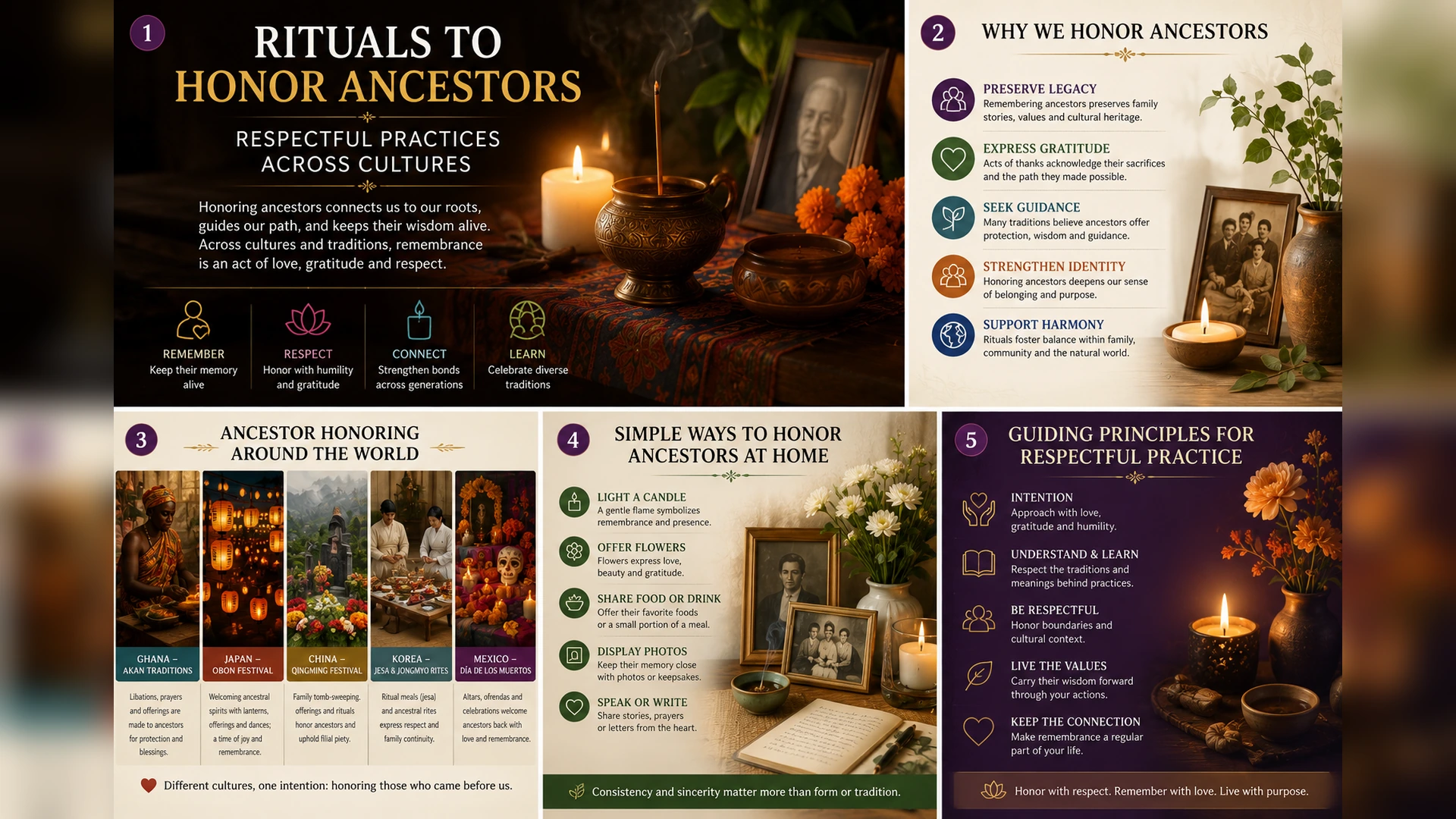
Rituals to honor ancestors are practices through which families and communities remember deceased people, preserve relationships, express gratitude, maintain lineage, care for grav...
Rituals to honor ancestors are practices through which families and communities remember deceased people, preserve relationships, express gratitude, maintain lineage, care for graves, teach history, pray, share food, or mark a recurring time of remembrance. These practices can be religious, spiritual, cultural, civic, domestic, or deeply personal.
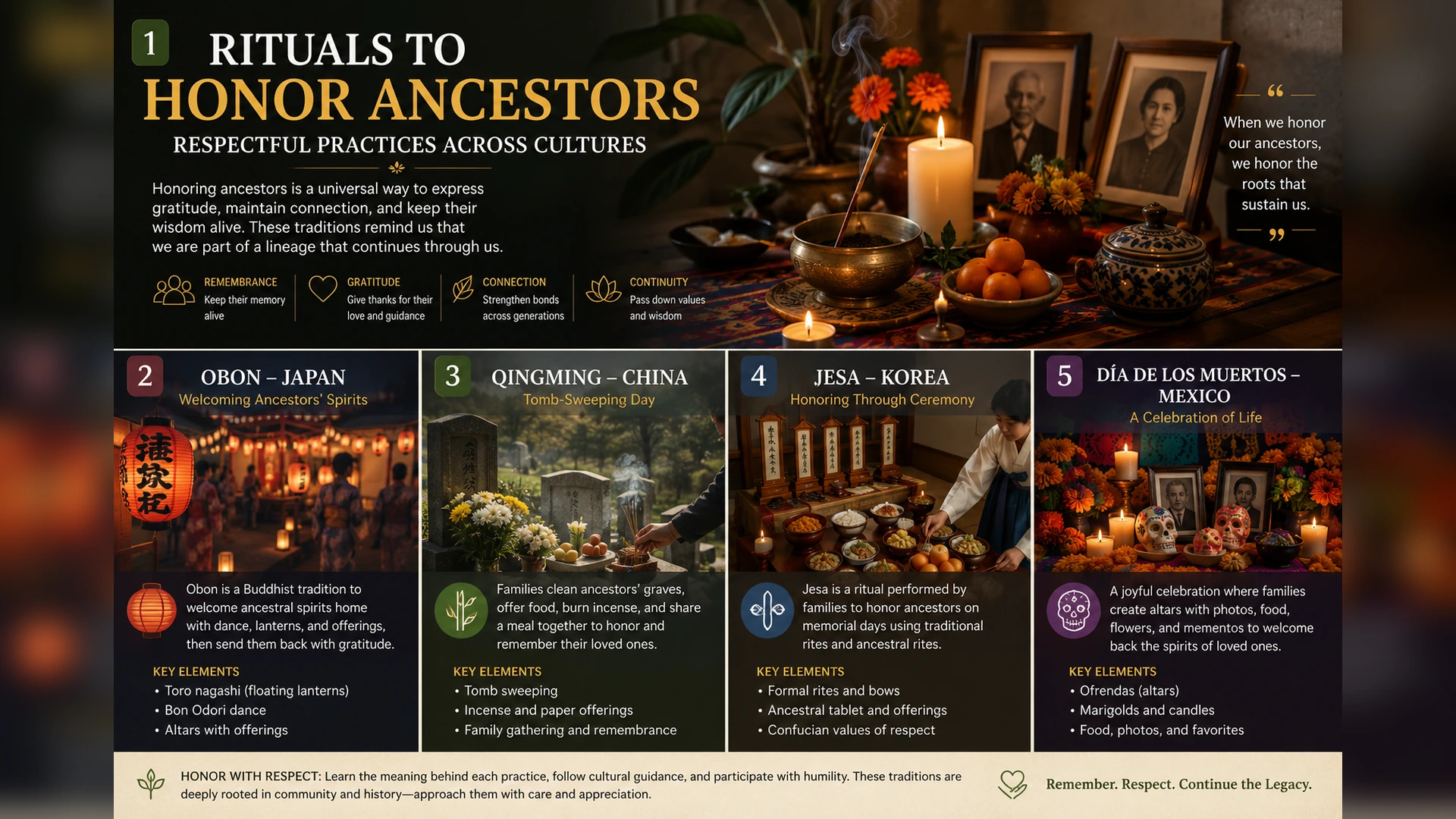
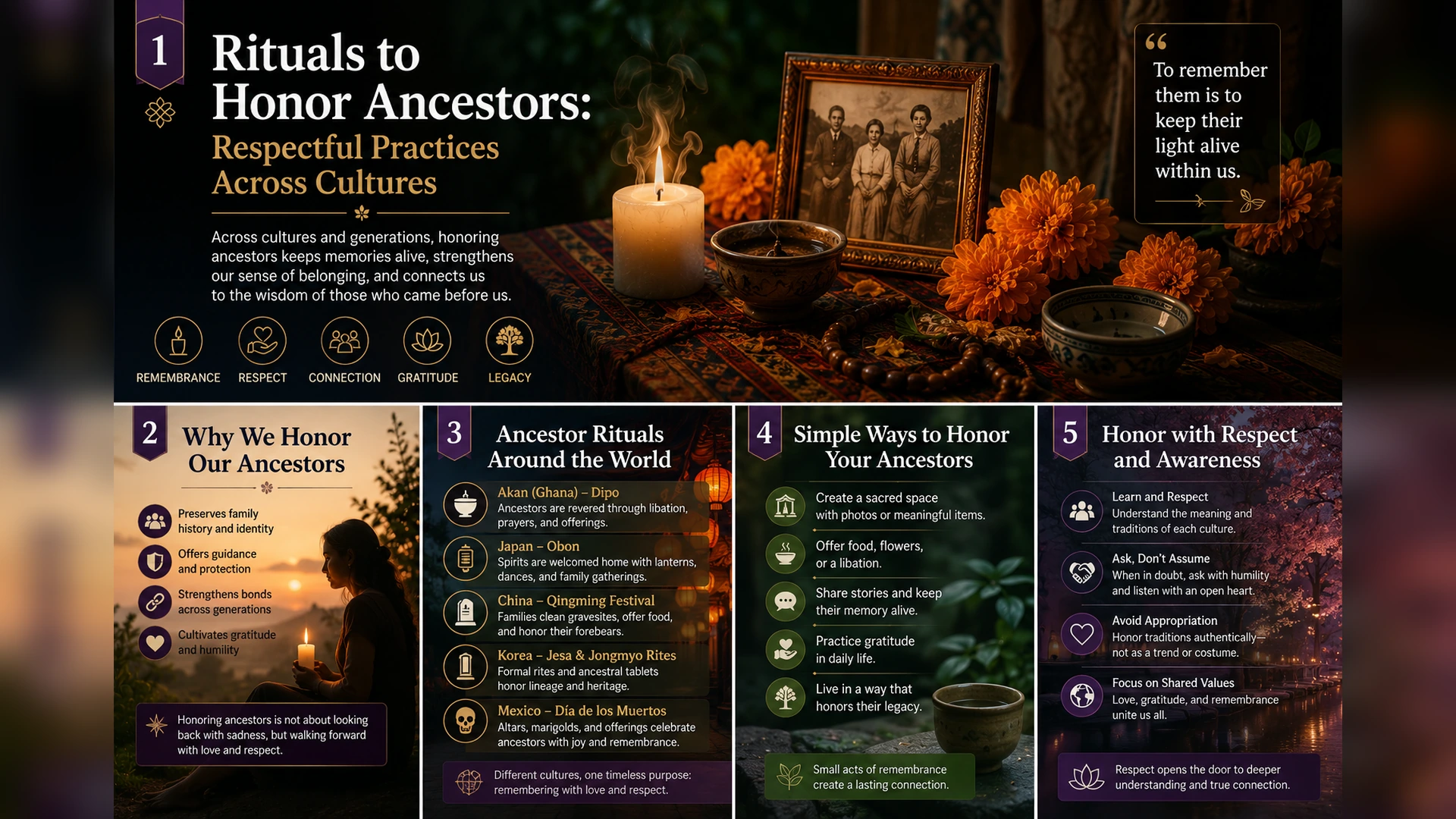
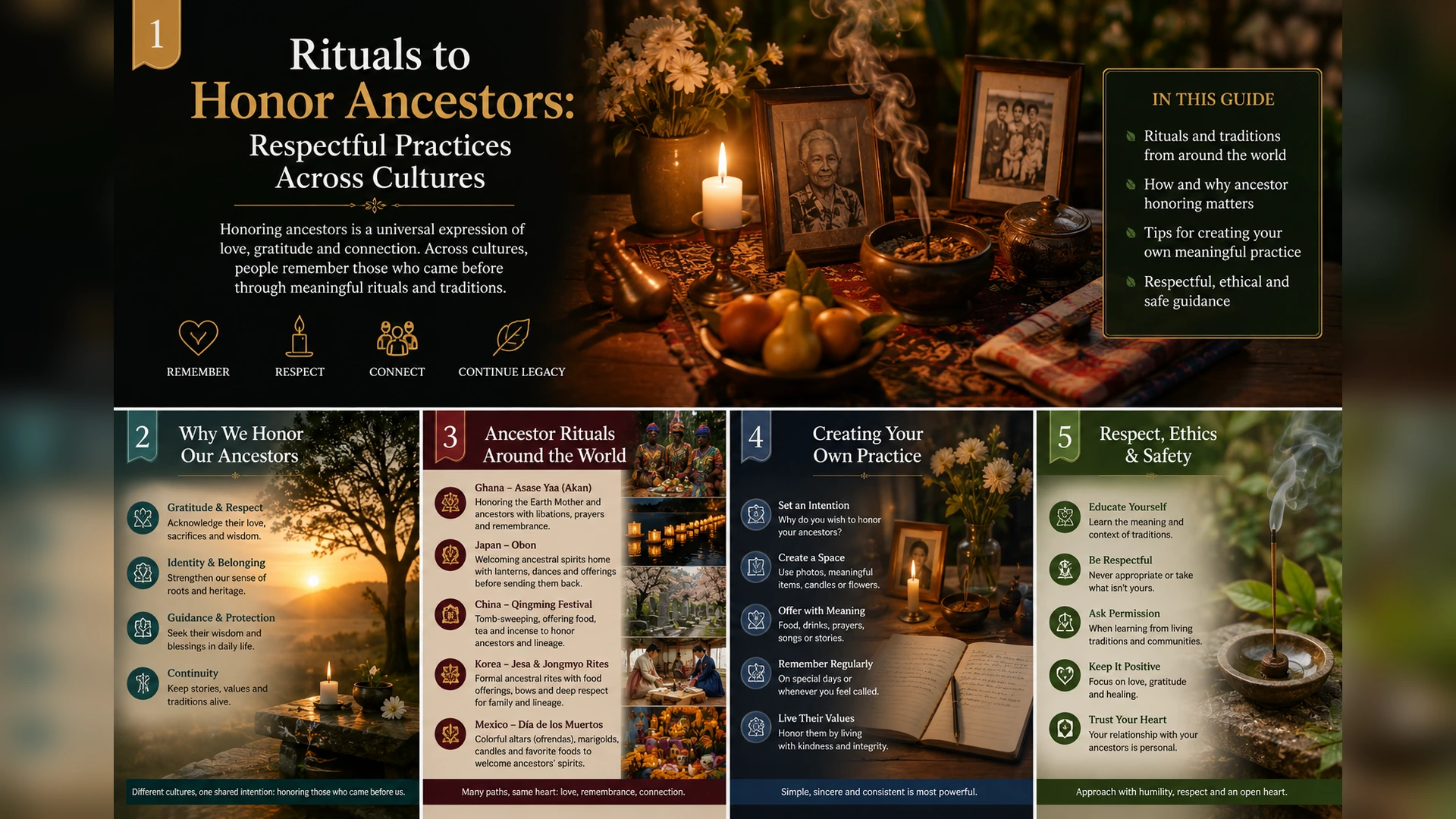
There is no single ancestor ritual shared by all cultures. A Japanese Obon gathering, a Chinese Qingming grave visit, an Akan prayer or libation in Ghana, a Korean jesa memorial ceremony, and an Indigenous Mexican Día de los Muertos observance belong to different histories, languages, authorities, and beliefs. They may share themes of memory and family continuity without being interchangeable.
The most respectful place to begin is not by copying the most visually striking ceremony found online. Begin with the people you are remembering, the traditions they actually followed, the wishes of living relatives, and the forms of remembrance that your family can sustain with honesty and care.
Quick Answer
Respectful rituals to honor ancestors can include speaking their names, preserving photographs and stories, visiting or caring for graves, preparing a family recipe, praying within your own faith, creating a memory book, giving charity in their name, sharing music, or holding an annual remembrance meal. Learn your own family context first, ask permission, and do not copy restricted ceremonies or claim guaranteed spiritual results.
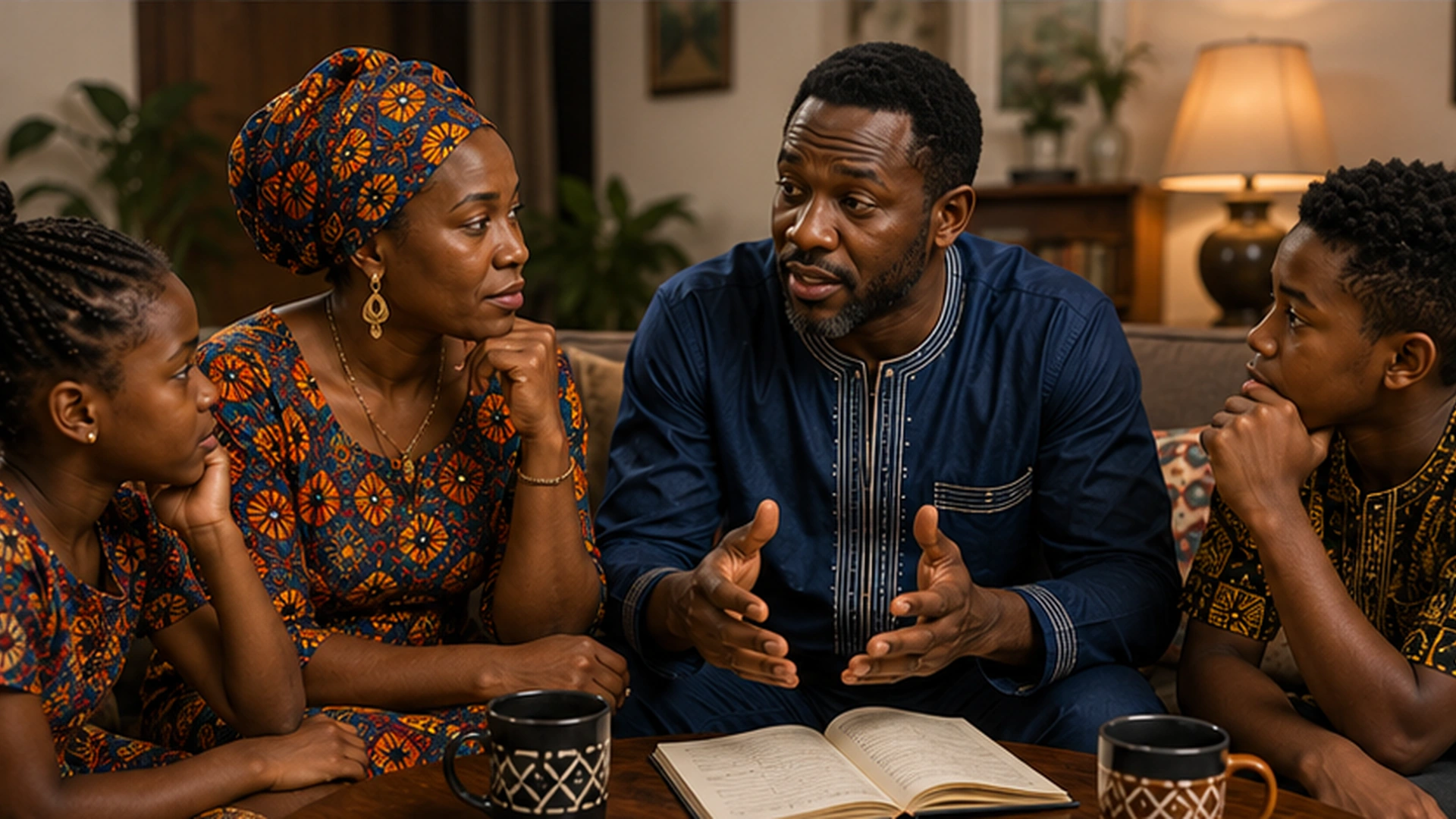
Specific culture or historical context: Contemporary family remembrance in an African or African-diaspora household, presented as a general family practice rather than one named traditional ceremony.
People shown: A Black elder, two middle-aged adults, one young adult, and one teenager.
Location: Comfortable modern family living room with bookshelves and family photographs.
Clothing: Contemporary everyday clothing; no ceremonial costumes.
Architecture: Modern domestic interior with natural materials and subtle family heritage objects.
Objects: Framed photographs, memory book, pen, flowers, fruit, enclosed candle, family letters.
Lighting: Soft late-afternoon window light with warm domestic illumination.
Composition: 16:9 documentary scene; family interaction central, table visible, clean negative space at upper left for website cropping. No text in the image.
SEO-friendly filename: rituals-to-honor-ancestors-respectfully.webp
Image title: A Family Practice of Ancestral Remembrance
Alt text: Black family arranging photographs, flowers and a memory book to honor deceased relatives
Caption: Ancestor remembrance can begin with names, photographs, stories, food, gratitude, and time shared across generations.
Recommended placement: After the Quick Answer.
Article section supported: Definition and practical introduction.
Important elements to avoid: Fantasy spirits, glowing ancestors, skull décor, random masks, occult symbols, open flames near fabric, readable embedded text, logos, distorted hands, or a collage.
What Does It Mean to Honor Ancestors?
To honor an ancestor is to recognize that a deceased person still matters within a family, lineage, community, religion, or personal history. Honor may involve affection, gratitude, duty, grief, moral reflection, spiritual relationship, or responsibility to preserve what that person entrusted to later generations.
Not every deceased relative is formally classified as an ancestor in every tradition. Some communities distinguish between ordinary dead relatives, elders, lineage founders, titled leaders, royal ancestors, saints, or people who received particular funerary rites. The qualifications can depend on age, descendants, social role, character, burial, manner of death, or community recognition.
UNESCO describes living heritage as traditions and knowledge inherited from earlier generations and continually recreated by communities. That framework is useful here: ancestor practices are not museum exhibits or universal recipes. They are living relationships governed by people who inherit, teach, adapt, protect, and sometimes restrict them. [1]
Ancestor Reverence, Worship and Remembrance
| Term | Useful meaning | Important caution |
|---|---|---|
| Ancestor remembrance | Keeping the memory, name, story, image or values of deceased people present. | Can be religious or nonreligious. |
| Ancestor reverence | Deep respect for deceased family, lineage or community members who remain morally, socially or spiritually significant. | Does not automatically mean treating ancestors as gods. |
| Ancestor veneration | A scholarly term for formal or informal practices of respect, prayer, offerings, memorialization or consultation. | Meanings vary by culture and religious tradition. |
| Ancestor worship | A term sometimes used when acts resemble worship, but historically applied too broadly by outsiders. | Use the community’s own terminology whenever possible. |
| Memorial ritual | A repeated act that marks grief, memory or relationship, such as lighting a candle or visiting a grave. | Not every memorial practice claims contact with spirits. |
Language matters because a person may honor deceased parents while worshipping only God, while another tradition may understand ancestors as active spiritual members of the family. A third person may use no spiritual explanation at all. The visible action—food, flowers, prayer, a photograph—does not tell us the entire belief behind it.
Why Families Create Ancestor-Honoring Rituals
To preserve identity
Names, migration stories, clan relationships, occupations, languages, songs, land histories, recipes and photographs help descendants understand where they came from.
To maintain relationships
Many people experience an ongoing inner relationship with someone who died. Bereavement researchers call this a continuing bond. A systematic review found that such bonds can involve both comfort and distress and should be understood in relation to the person, the previous relationship, meaning-making and cultural or spiritual context. [2]
To teach values
Families may remember courage, generosity, endurance, craft, care, faith, public service or mistakes that should not be repeated.
To organize grief
A recurring date, meal, cemetery visit or prayer gives grief a place in the calendar. It does not make grief follow a fixed timetable.
To connect generations
Children can learn family history through objects, stories and visits with elders. Participation should be age-appropriate and never forced.
To express religious duty
Some religions include prayers, offerings, memorial services, graveside practices or household observances for the dead.
Respectful Practices You Can Begin With
The practices below are intentionally broad. They do not reproduce a closed ceremony. Adapt them to your family, religion, legal environment, health needs, and the wishes of living relatives.
1. Speak and record names
Create a written or audio list of parents, grandparents, guardians, elders, founders, or other deceased people important to your family. Include correct spellings, nicknames, languages, places, and relationships. Do not invent details to fill gaps.
2. Ask elders for stories
Use open questions: What did this person enjoy? What work did they do? Which difficulties did they face? What should younger relatives understand? Obtain consent before recording or publishing the conversation.
3. Preserve photographs and documents
Digitize photographs, letters, certificates, recipes, funeral programs and recordings. Add dates and names while knowledgeable relatives are available. Store copies in more than one location.
4. Create a family remembrance space
A shelf, table, wall, box or digital album can hold photographs and meaningful objects. It does not need to imitate a shrine from another religion. Consider fire safety, privacy, children, pets, and whether relatives are comfortable displaying particular images.
5. Prepare a family recipe
Cook a dish associated with the person and tell its story. The goal is not to create a universal “food offering,” but to preserve a relationship through taste, labor and shared memory.
6. Visit and care for a grave or memorial
Follow cemetery rules, obtain family permission, use safe cleaning methods, and do not remove objects or disturb neighboring graves. Where a grave is inaccessible, visit a meaningful place or create a home memorial.
7. Hold an annual remembrance meal
Choose a death anniversary, birthday, religious memorial day, family reunion or another suitable date. Invite relatives to share memories, photographs, music or readings. Make participation optional.
8. Pray within your own tradition
Use prayers authorized or familiar within your religion. People who are not religious may observe silence, read a letter, recite a poem, or express gratitude.
9. Continue a value or skill
Teach a craft, plant a tree where legal and ecologically appropriate, support education, repair a family home, preserve a language, mentor a child, or continue service the person valued.
10. Give in the person’s name
Donate, volunteer, support a family member, fund a scholarship, care for a public space, or assist a cause connected with the person’s life. Avoid claiming that charity guarantees spiritual favor.
11. Use music and storytelling
Play songs the person loved, learn a family song, retell a migration story, or invite relatives to contribute to a shared archive. Obtain permission before posting private recordings online.
12. Write to the deceased or about them
A private letter, journal entry, poem or biography can help organize memory. It may be spiritual for some readers and simply reflective for others.
Documented Ancestor Practices Across Cultures
The following examples show how different communities create relationships between memory, family, place, food, material objects and time. They are not interchangeable templates.
Akan and Asante Remembrance in Ghana
Akan-speaking communities include multiple peoples in Ghana and Côte d’Ivoire; they do not follow one identical practice. Museum records document royal and chiefly forms of ancestral remembrance among Asante and related Akan contexts. Memorial terracotta heads called nsodie represented deceased rulers and were placed in sacred cemetery areas with other figures. At particular times, these places received prayers, libations and offerings. [3]
Asante stools also carry personal and political meaning. The Smithsonian National Museum of African Art notes that, for some important individuals, a libation-blackened stool could become the focus of a family shrine after death. [4] These are not generic African altar objects. Their authority comes from specific family, chiefly and community institutions.
University of Ghana material also documents libation before a Dagaaba harvest dance, offered to gods and ancestors in gratitude for a rich harvest. [5] The example shows why “African libation” should not be presented as one standardized script: language, speaker, recipients, occasion and authority vary.
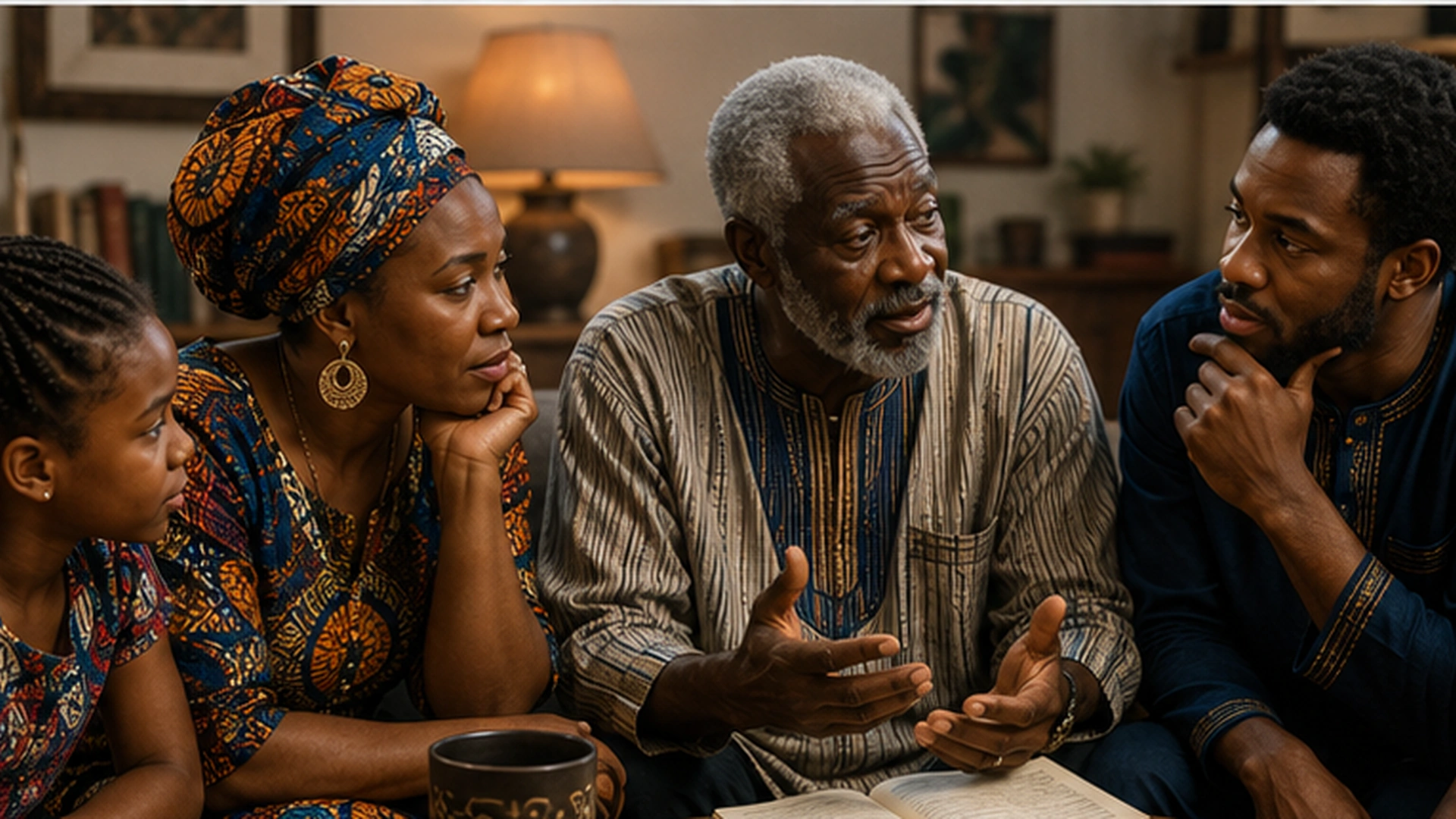
Specific culture or historical context: Contemporary Akan family history in southern Ghana, informed by documented relationships among lineage, memorial objects and ancestral respect.
People shown: One older Ghanaian man or woman and two younger Black Ghanaian adults.
Location: Family courtyard in southern Ghana.
Clothing: Contemporary Ghanaian clothing with locally appropriate textiles; no invented priestly costume.
Architecture: Plastered courtyard house with shaded veranda and wooden doors.
Objects: Genealogy notebook, family photographs, pencils, covered calabash, water vessel, inherited stool placed respectfully.
Lighting: Natural morning shade with warm reflected light.
Composition: Wide 16:9 documentary portrait; elder and younger relatives centered, objects secondary and clearly contextualized.
SEO-friendly filename: akan-family-ancestor-remembrance-ghana.webp
Image title: Family Lineage and Ancestral Memory in Ghana
Alt text: Ghanaian elder sharing family photographs and lineage history with younger relatives in a courtyard
Caption: In Akan and other Ghanaian settings, ancestral respect is connected with specific families, lineages, memorial objects, prayers and community authority.
Recommended placement: After the Ghana section.
Article section supported: African cultural specificity and oral history.
Important elements to avoid: Performing a fabricated libation, royal regalia without authority, generic masks, poverty stereotypes, fantasy spirits, readable text, or combining unrelated Ghanaian traditions.
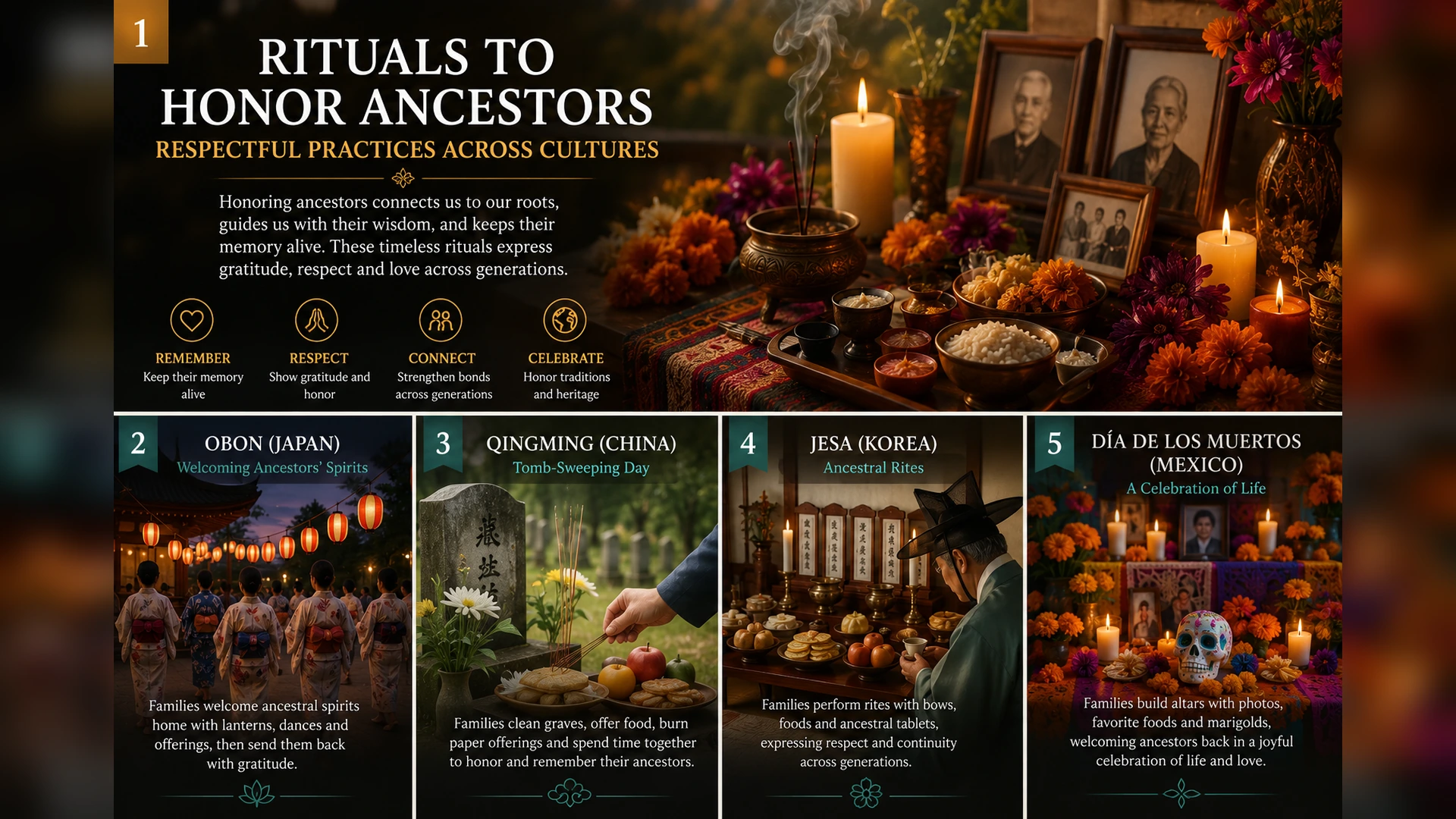
Obon in Japan
Obon is a Japanese Buddhist period for commemorating ancestors. Dates and customs vary by region, but many people return to family homes, visit and clean graves, make offerings, participate in temple observances, and join community dances. The Japan National Tourism Organization describes August as a period when deceased family members are believed to return and relatives gather in their hometowns. [6]
Fire and lantern imagery appears in several regional observances. At Koyasan, candles are associated with guiding ancestral spirits at the close of Obon, while Kyoto’s Gozan Okuribi uses large mountain fires at the end of the period. [7] These are place-specific traditions with religious, municipal and safety authorities; they are not instructions for visitors to light their own fires.
A respectful learner can attend public events according to local guidance, support community institutions, avoid obstructing graves or ceremonies, and refrain from treating Obon as a costume theme.
Specific culture or historical context: Contemporary Japanese Buddhist Obon remembrance; regional variation acknowledged.
People shown: Three generations of a Japanese family.
Location: Well-maintained temple cemetery in Japan during summer.
Clothing: Modest contemporary summer clothing suitable for cemetery work.
Architecture: Japanese Buddhist temple roofs and stone grave markers in the background.
Objects: Water bucket, ladle, cloth, flowers, incense holder present but not producing heavy smoke, lanterns along a safe path.
Lighting: Soft late-afternoon summer light.
Composition: 16:9 environmental scene; family and grave on the right, temple landscape and path on the left.
SEO-friendly filename: obon-family-grave-cleaning-japan.webp
Image title: Obon Family Remembrance in Japan
Alt text: Japanese family cleaning a grave and arranging flowers during Obon
Caption: Obon practices vary, but family return, grave care, offerings and community observances are common themes.
Recommended placement: After the Obon section.
Article section supported: Japanese ancestor remembrance and cemetery care.
Important elements to avoid: Ghost figures, anime styling, costume stereotypes, festival crowds at a private grave, excessive smoke, unsafe fire, readable grave inscriptions, or logos.
Qingming in China
Qingming, often translated as Clear and Bright or Tomb-Sweeping Day, is both a seasonal marker and a time for honoring deceased relatives. Public sources describe tomb sweeping, tribute to ancestors and spring outings as major themes. [8]
Families may clean graves, offer flowers or food, burn incense or paper items where permitted, bow, and spend time outdoors. Practices vary by region, religion, family and generation. In recent years, Chinese authorities have reported growth in low-carbon practices such as flowers, electric candles and online memorial platforms. [9]
Visitors should follow cemetery regulations and fire restrictions. Copying the burning of paper offerings without cultural understanding—or where it is illegal or unsafe—is not respectful participation.
Specific culture or historical context: Contemporary Qingming remembrance in China, using an eco-friendly form of tomb sweeping.
People shown: Four Chinese family members across two or three generations.
Location: Green hillside cemetery in China during early spring.
Clothing: Contemporary practical clothing in subdued colors.
Architecture: Orderly stone grave markers and distant trees; no fantasy temple setting.
Objects: Flowers, soft cleaning brush, cloth, water bottle, photograph folder.
Lighting: Overcast spring light after light rain, with realistic wet stone.
Composition: 16:9 landscape; family grouped naturally near one grave, hillside providing depth.
SEO-friendly filename: qingming-tomb-sweeping-family-china.webp
Image title: Qingming Family Tomb Sweeping
Alt text: Chinese family cleaning a grave and placing flowers during Qingming Festival
Caption: Qingming joins ancestor remembrance, grave care and the seasonal return of spring, with practices varying across families and regions.
Recommended placement: After the Qingming section.
Article section supported: Chinese seasonal ancestor remembrance.
Important elements to avoid: Unregulated fire, piles of burning paper, invented costumes, exaggerated sadness, readable inscriptions, political imagery, or a staged tourist scene.
Korean Jesa and the Jongmyo Royal Ancestral Rite
Jesa is a Korean term used for memorial rites, including family ceremonies held on death anniversaries or significant holidays. A family table may include carefully arranged foods, a photograph or name tablet, incense or candles, bows, and a shared meal after the formal observance. Arrangements and participation have changed over time, and families differ in how strictly they follow older Confucian forms. [10]
Jongmyo Jerye is a distinct royal ancestral rite honoring kings and queens of the Joseon dynasty. It includes formal offerings, ritual music and dance at Jongmyo Shrine. [11] It should not be described as an ordinary household ceremony or reproduced casually outside its heritage context.
The distinction between a family jesa and a state or royal rite demonstrates a broader rule: practices that look similar from a distance may belong to very different levels of authority.
Día de los Muertos in Mexico
UNESCO’s inscription concerns the Indigenous festivity dedicated to the dead as practiced in Mexican communities. It describes a period from late October into early November in which deceased relatives and loved ones are commemorated through flowers, candles, food, home shrines, graves and community preparations. [12]
There is no single Mexican ofrenda that every household must reproduce. Customs vary among Indigenous peoples, towns, cities, families and religious settings. The celebration has also changed through migration, public art, schools and popular media.
Non-Mexican readers can learn from museums, community educators and public events, but should avoid turning sacred grief into party décor, using stereotyped “tribal” imagery, or claiming that painted skull makeup automatically constitutes traditional participation.
Specific culture or historical context: Contemporary Día de los Muertos family observance in Mexico; presented as one household expression within diverse Indigenous, regional, Catholic and urban traditions.
People shown: Mexican grandmother, two adults and two children.
Location: Family home in Mexico.
Clothing: Contemporary family clothing; no theatrical skeleton costumes.
Architecture: Modern Mexican home with locally plausible furnishings and warm wall colors.
Objects: Framed photos, marigolds, pan de muerto, water, fruit, candles in glass, papel picado, personal keepsakes.
Lighting: Warm evening domestic light with safe candle glow.
Composition: 16:9 documentary scene; ofrenda central but family interaction equally important.
SEO-friendly filename: dia-de-los-muertos-family-ofrenda-mexico.webp
Image title: Día de los Muertos Family Ofrenda
Alt text: Mexican family arranging photographs, marigolds and food on a Día de los Muertos ofrenda
Caption: Día de los Muertos observances are living, regionally varied traditions that connect family memory, food, flowers, graves and community life.
Recommended placement: After the Día de los Muertos section.
Article section supported: Mexican Indigenous and family remembrance.
Important elements to avoid: Generic Halloween décor, anonymous skulls replacing family photographs, party stereotypes, excessive face paint, mixed Latin American cultures, unsafe flames, readable fake Spanish, or logos.
What Do Ancestor Offerings Mean?
Offerings may include food, water, drink, incense, flowers, light, cloth, money, crafted objects, prayers, music, service or symbolic portions of a meal. Their meaning depends on the tradition. An offering may welcome, nourish, thank, honor, communicate, fulfill duty, display hospitality, support a memorial institution, or represent the continuing place of the dead within the family.
The same object can mean different things. Water may represent hospitality, purity, life or simple refreshment. Food may be understood as spiritually received, symbolically shared, later eaten by the family, donated, returned to nature where safe, or left according to cemetery rules. Never assume one disposal method applies everywhere.
Use local and family guidance. Avoid leaving food that harms wildlife, pouring alcohol where prohibited, burning items during fire restrictions, or placing objects on graves without permission.
How to Create a Respectful Family Remembrance Space
Choose a private, stable location that will not be disturbed accidentally.
Decide whether the space is religious, spiritual, cultural, historical or simply memorial.
Ask relatives before displaying sensitive photographs, names, ashes, funeral materials or sacred objects.
Use items directly connected with the people remembered: photographs, letters, tools, crafts, books, recipes or ordinary possessions.
Add flowers, water, a cloth or a safely enclosed light only if these fit your beliefs and household safety.
Write a short note explaining who each person is so younger relatives do not inherit anonymous images.
Keep the space clean without claiming that dust or accidents are signs of spiritual anger.
Review it periodically. Return borrowed items, replace unsafe materials and respect relatives who prefer privacy.
A remembrance space does not need crystals, statues, incense, candles or objects purchased from another culture. A single photograph and a handwritten story can be enough.
How to Honor Ancestors When Family History Is Unknown
Slavery, colonialism, war, forced migration, adoption, family separation, stigma, poverty, destroyed records and deliberate secrecy have interrupted many lineages. Not knowing names is not a personal failure.
Begin with verified information: living relatives, birth and death records, immigration documents, cemeteries, school records, family Bibles or Qur’ans, community archives, newspapers, photographs and oral histories. DNA testing may offer clues, but it also creates privacy, kinship and data-ownership risks; obtain informed consent and read company policies carefully.
You can honor “the known and unknown people whose lives made ours possible” without inventing ethnic identity, assigning yourself to a clan, or claiming initiation. You may also honor non-biological caregivers, community elders and people whose labor supported your family, while clearly describing the relationship.
Cultural Appropriation and Ethical Boundaries
Do not copy restricted ceremonies
Some rites belong to initiated members, lineage authorities, priests, elders, royal institutions or families. Public photographs do not create permission.
Do not combine unrelated traditions
A Japanese lantern, Mexican ofrenda, Akan libation, Korean food table and Egyptian statue do not become more “powerful” when assembled together.
Do not purchase authority
Buying a sacred object, title, costume or online “initiation” does not give the social responsibilities that make it legitimate.
Do not fabricate ancestry
Admiration is not ancestry. Study a culture respectfully without claiming a bloodline, clan, Indigenous identity or inherited role you cannot document.
Do not expose private knowledge
Ask before recording prayers, graves, funerals, family names, ritual objects or vulnerable participants.
Do not commercialize grief without consent
Avoid selling another family’s images, stories or ceremony. Compensate cultural educators and credit community sources.
Do not promise supernatural outcomes
No ritual can scientifically guarantee protection, fertility, wealth, healing, reconciliation or messages from the dead.
Safety and Practical Considerations
Use enclosed candles, keep flames away from cloth and photographs, and comply with local fire rules.
Consider asthma, children, pets and ventilation before using incense or smoke.
Do not ingest oils, herbs, ashes or ritual substances unless they are ordinary foods known to be safe.
Follow cemetery rules and use stone-safe cleaning methods; harsh chemicals can damage monuments.
Do not leave glass, plastic, wire, food or toxic plants where they can harm workers or wildlife.
Protect personal data in digital memorials and obtain permission before posting images of the deceased.
If family members disagree, choose a private practice rather than forcing participation.
Ancestor Rituals, Grief and Mental Health
Remembrance can provide structure, social support and a continuing sense of relationship, but research does not show that every continuing bond is helpful for every person. A 2024 systematic review found both comfort and distress, emphasizing meaning, identity, spirituality and the quality of the relationship. [2]
Grief does not move through identical stages in a fixed order. Strong feelings can return around anniversaries, family conflict, legal proceedings, migration or new life events. A ritual should not be used to blame a grieving person for sadness or to claim that misfortune proves an ancestor is angry.
Professional support may be useful when grief is overwhelming, daily functioning is difficult, depression or anxiety persists, or there are thoughts of self-harm. Cultural and spiritual care can accompany qualified mental-health support rather than replace it. [13]
Common Misunderstandings
“Every culture worships ancestors”
False. Some traditions involve worship-like acts; others emphasize respect, kinship, memory, prayer for the dead, family duty or historical preservation.
“Any deceased relative automatically becomes an ancestor”
False. Some traditions have specific criteria for ancestral status.
“An ancestor altar must contain certain universal objects”
False. Objects gain meaning through a particular family or tradition.
“Food offerings are always wasted”
False. In some traditions food is shared or eaten afterward; in others it is handled differently.
“Dreams prove an ancestor is sending instructions”
Not scientifically established. Dreams can be emotionally meaningful without serving as verified commands.
“A ritual can repair abuse without accountability”
False. Remembrance must not erase harm, silence survivors or replace legal and protective action.
“Older traditions never change”
False. Living traditions adapt through migration, religious change, urban life, law, technology and community decisions.
“More elaborate means more respectful”
False. Accuracy, consent, care and sincerity matter more than cost or spectacle.
A Simple Non-Appropriative Remembrance Ritual
The following practice is not presented as an ancient ceremony. It is a transparent modern family-remembrance format that can be adapted without claiming another community’s authority.
Choose one person or group of relatives to remember.
Place a photograph, name, letter or meaningful object on a clean surface.
Take a moment of silence or pray in your own faith.
Say the person’s name and relationship to you.
Share one verified story, value, lesson or unanswered question.
Offer an ordinary act of care: flowers, water, a family meal, a donation, grave care or work that continues their values.
Invite relatives to add memories without correcting emotions or forcing agreement.
Close by storing the objects safely and deciding what action will preserve the memory before the next gathering.
Key Takeaways
Rituals to honor ancestors are not one universal spiritual system.
Respectful practices can be religious, cultural, historical, domestic or nonreligious.
Begin with verified family history and the wishes of living relatives.
Names, stories, photographs, recipes, graves, service and annual gatherings can all preserve memory.
Obon, Qingming, jesa, Día de los Muertos and Akan or Asante practices belong to distinct cultural histories.
Do not reproduce restricted ceremonies, combine unrelated traditions or claim authority through purchased objects.
Offerings have different meanings and handling rules in different traditions.
Ancestor remembrance should never replace healthcare, legal protection, financial judgment or accountability for harm.
Grief rituals can be meaningful, but their effects vary and professional support remains important when coping becomes difficult.
People Also Ask
How can I honor my ancestors respectfully?
Learn their names and stories, preserve photographs, visit graves, cook family recipes, pray within your faith, give in their name, and create a recurring remembrance date. Ask relatives for consent and avoid copying ceremonies from cultures you do not belong to.
What are examples of ancestor rituals?
Examples include Obon in Japan, Qingming tomb sweeping in China, Korean jesa, Indigenous Mexican Día de los Muertos observances, and specific Akan or Asante prayers, libations and memorial objects in Ghana. Each has its own authority and meaning.
What should be on an ancestor altar?
There is no universal list. A family remembrance space may include photographs, names, letters, flowers or meaningful possessions. Use only objects connected with your family or authorized by your tradition.
Can I honor ancestors without religion?
Yes. Oral history, genealogy, a memory book, grave care, a memorial meal, music, charity, service and preservation of family records can all be nonreligious forms of remembrance.
What is the difference between ancestor worship and reverence?
Ancestor worship implies acts understood as worship. Reverence is broader and may mean deep respect, remembrance, moral authority or family relationship. Communities should be described using their own concepts whenever possible.
Are ancestor rituals helpful for grief?
They can offer structure, comfort and connection, but research shows continuing bonds can also be distressing. The effect depends on the person, relationship and cultural context.
Frequently Asked Questions
1. How often should ancestors be honored?
There is no universal schedule. Families may choose anniversaries, birthdays, religious festivals, reunions, seasonal dates or occasional private remembrance.
2. Can I honor ancestors I never met?
Yes, through verified stories, records, photographs, places and the values or consequences of their lives. Avoid inventing personalities or messages.
3. Can adopted people honor more than one family line?
They may honor biological, adoptive, foster and chosen family relationships according to their own experience, privacy and consent.
4. What if an ancestor caused harm?
Remembrance does not require praise. A family can acknowledge truth, protect survivors, refuse repetition, repair damage and preserve records without idealizing the person.
5. Can I use incense?
Use it only if it fits your practice and is safe. Ventilate the room, consider respiratory conditions and pets, and comply with building rules.
6. Can food be eaten after an offering?
That depends on the tradition. In some practices the family shares it; in others there are different rules. Ask knowledgeable family or religious authorities.
7. Should I speak to ancestors aloud?
Some people pray or speak aloud; others use silence, journaling or storytelling. Do not treat private reflection as proof of supernatural communication.
8. Can I create a new family tradition?
Yes. Describe it honestly as a new family practice rather than pretending it is ancient or borrowed from a culture without permission.
9. How can children participate?
They can label photographs, hear age-appropriate stories, cook a recipe, place flowers or draw a memory. Do not frighten or force them.
10. Is ancestor reverence the same across Africa?
No. Africa contains thousands of communities and religious histories. Beliefs, ancestral categories, ritual authorities and practices differ by region, language, lineage and period.
Conclusion
Rituals to honor ancestors are ways of carrying relationships across time. A photograph becomes a lesson when someone names the person. A meal becomes an archive when the recipe and its journey are explained. A grave visit becomes family history when younger relatives learn who is buried there and why their life mattered.
The deepest respect does not come from collecting the most dramatic practices from around the world. It comes from accuracy, consent, responsibility and sustained care. Learn what belongs to your family. Study other traditions through their own institutions. Support living custodians. Protect private knowledge. State clearly when a practice is new.
An ancestor does not need to become a perfect hero in order to be remembered truthfully. Families can preserve love, achievement, loss, conflict and repair together. In that honest work, remembrance becomes more than nostalgia: it becomes a responsibility to the living and the generations still to come.
Final Summary
Respectful ancestor-honoring practices include recording names, preserving stories and photographs, caring for graves, preparing family foods, praying within one’s own tradition, giving in memory, creating a family remembrance space and gathering on a recurring date. Cross-cultural examples such as Obon, Qingming, Korean jesa, Día de los Muertos and Akan or Asante practices should be studied as distinct living traditions—not copied or blended into a universal ritual. Consent, cultural authority, safety, truth and care are the essential boundaries.
Research Sources and Further Reading
1. UNESCO Intangible Cultural Heritage — What Is Intangible Cultural Heritage?. Framework for living heritage, community transmission and cultural diversity.
2. Hewson, Galbraith, Jones and Heath — The Impact of Continuing Bonds Following Bereavement: A Systematic Review. Peer-reviewed review of comfort, distress, meaning and identity in ongoing bonds after death.
3. The Metropolitan Museum of Art — Akan Nsodie Memorial Head. Museum documentation of Akan memorial portraits, cemetery contexts, prayers, libations and offerings.
4. Smithsonian National Museum of African Art — Asante Stool. Museum documentation of personal stools and ancestral shrine use for important individuals.
5. University of Ghana, Institute of African Studies — Dances. Includes documentation of libation to gods and ancestors before a Dagaaba harvest dance.
6. Japan National Tourism Organization — Japan in August / Obon. Official tourism overview of Obon family return and remembrance.
7. Japan National Tourism Organization — Koyasan Candle Festival and Kyoto Gozan Okuribi. Official descriptions of place-specific Obon light and fire traditions.
8. State Council Information Office of China — Qingming Festival. Official overview of Qingming, tomb sweeping, ancestor tribute and spring outings.
9. The State Council of the People’s Republic of China — Qingming Visits and Low-Carbon Memorial Practices. Current public data and examples of eco-friendly remembrance practices.
10. Korea.net — Life After Death: The Korean Jesa Ceremony. Official cultural overview of family jesa and memorial foods.
11. Korea.net — Jongmyo Daeje. Official overview of Korea’s royal ancestral rite, music and dance.
12. UNESCO Intangible Cultural Heritage — Indigenous Festivity Dedicated to the Dead. Authoritative description of Indigenous Mexican Día de los Muertos heritage.
13. NHS — Grief After Bereavement or Loss. Current health guidance on grief reactions and when to seek help.
14. Ancestral Temple — The Meaning of Ancestor Reverence in African Cultures. Recommended internal pillar link for deeper African cultural context.
15. Ancestral Temple — Preserving Indigenous African Knowledge. Recommended internal link on community authority, preservation and living knowledge.
16. Ancestral Temple — Spiritual Symbols Shared Worldwide. Recommended internal link on comparison without erasing cultural difference.
Article Information
- Publisher
- Ancestral Temple
- Editor
- Ancestral Temple
- Last updated
- Jul 26, 2026
- Last reviewed
- Jul 26, 2026
- Content version
- ca1de882b6
This educational article should be read as cultural and spiritual information, not as medical, legal, financial, or emergency advice.
Helpful Related Guidance
Explore This Topic
Related Topic Cluster
Dreams & Symbolism
About the Author
 Ancestral Temple
Spiritual guide and practitioner with decades of experience in ancestral wisdom, rituals, and divine guidance.
Related Posts
View All





Leave a Comment
We'd love to hear your thoughts.