
Eye of Horus vs Eye of Ra: Meanings, Origins and Differences
Quick Summary
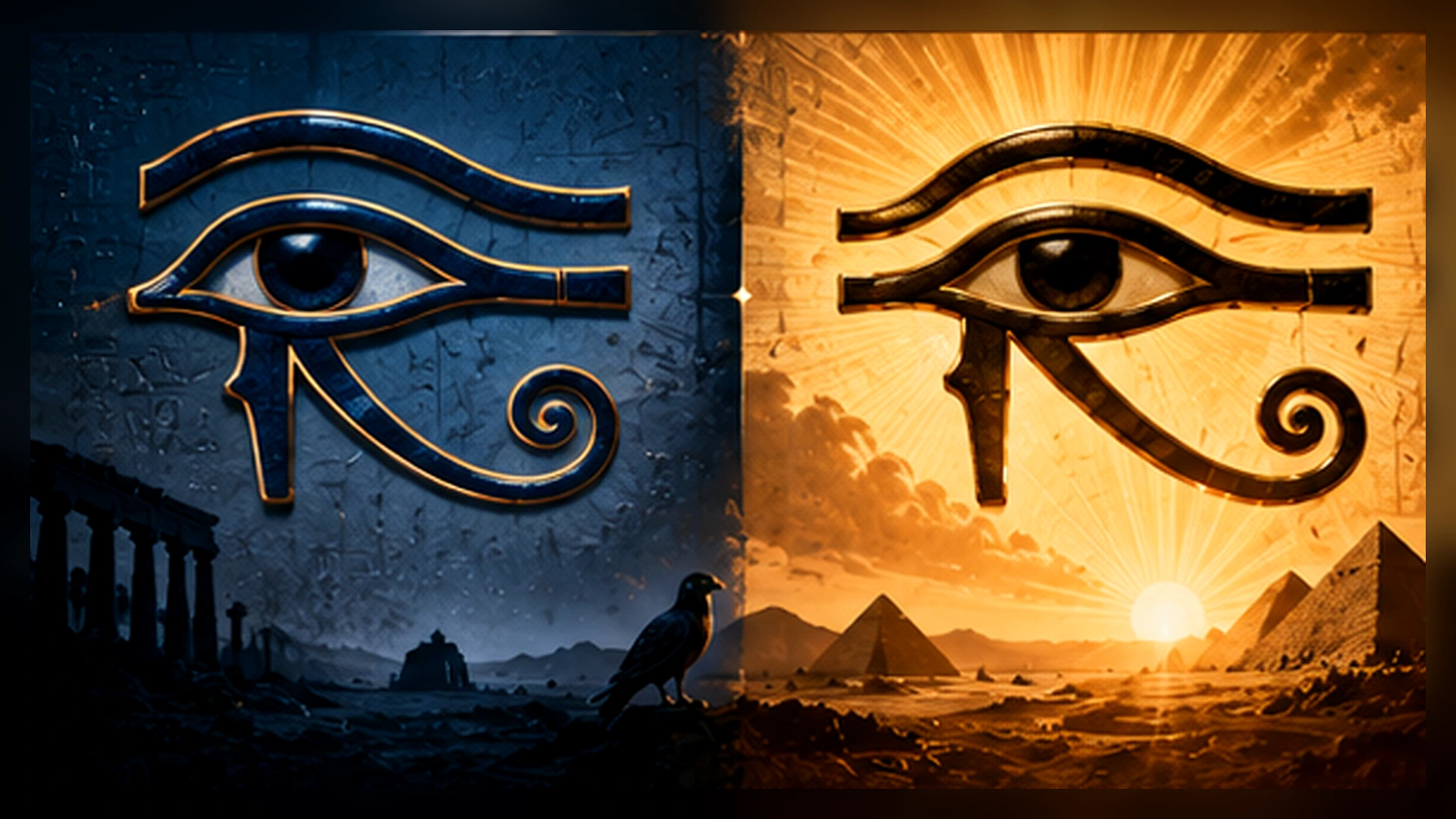
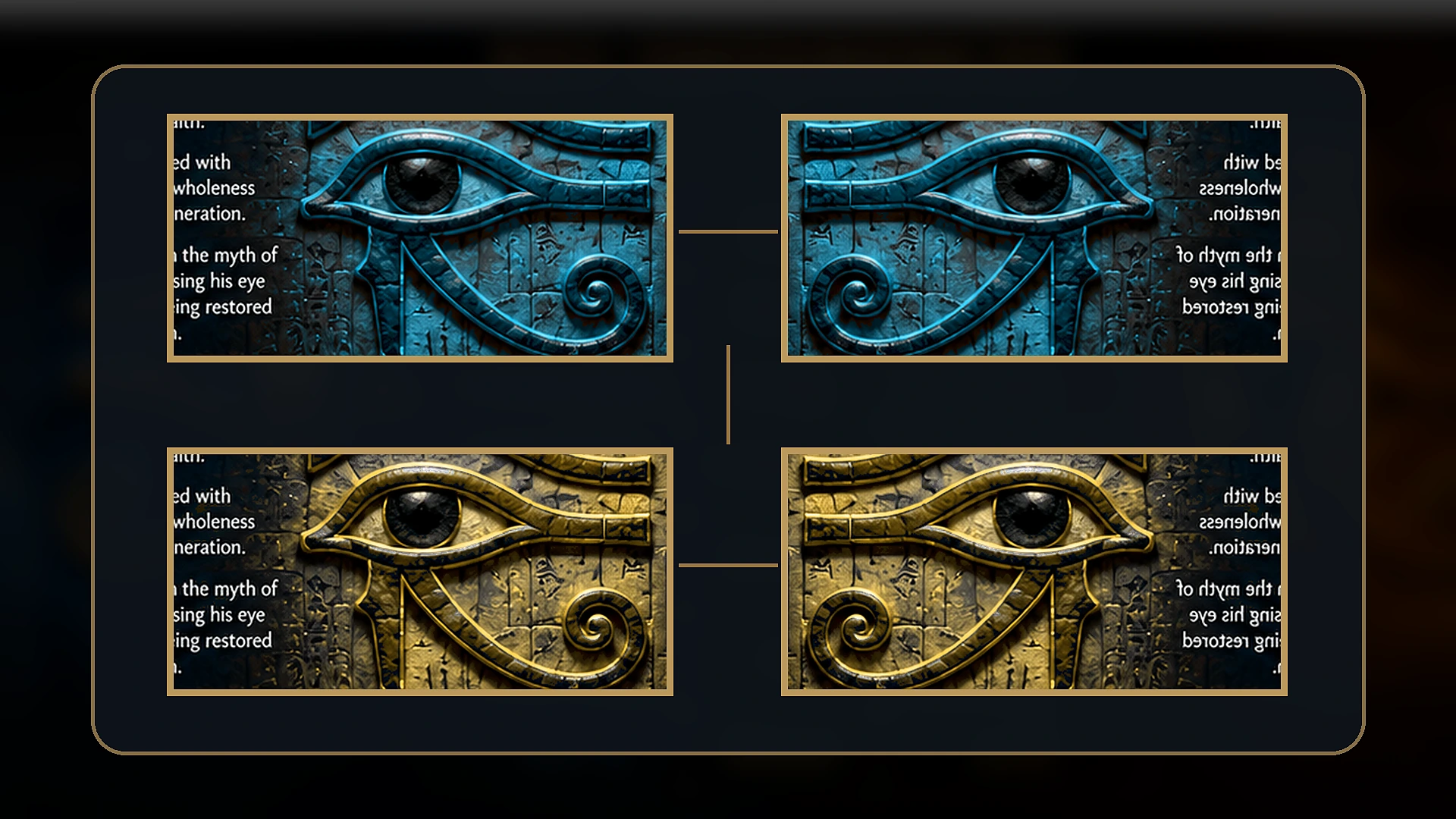
The Eye of Horus and the Eye of Ra are related ancient Egyptian ideas, but they are not simply two names for an identical symbol. The Eye of Horus, commonly called the wedjat or ud...
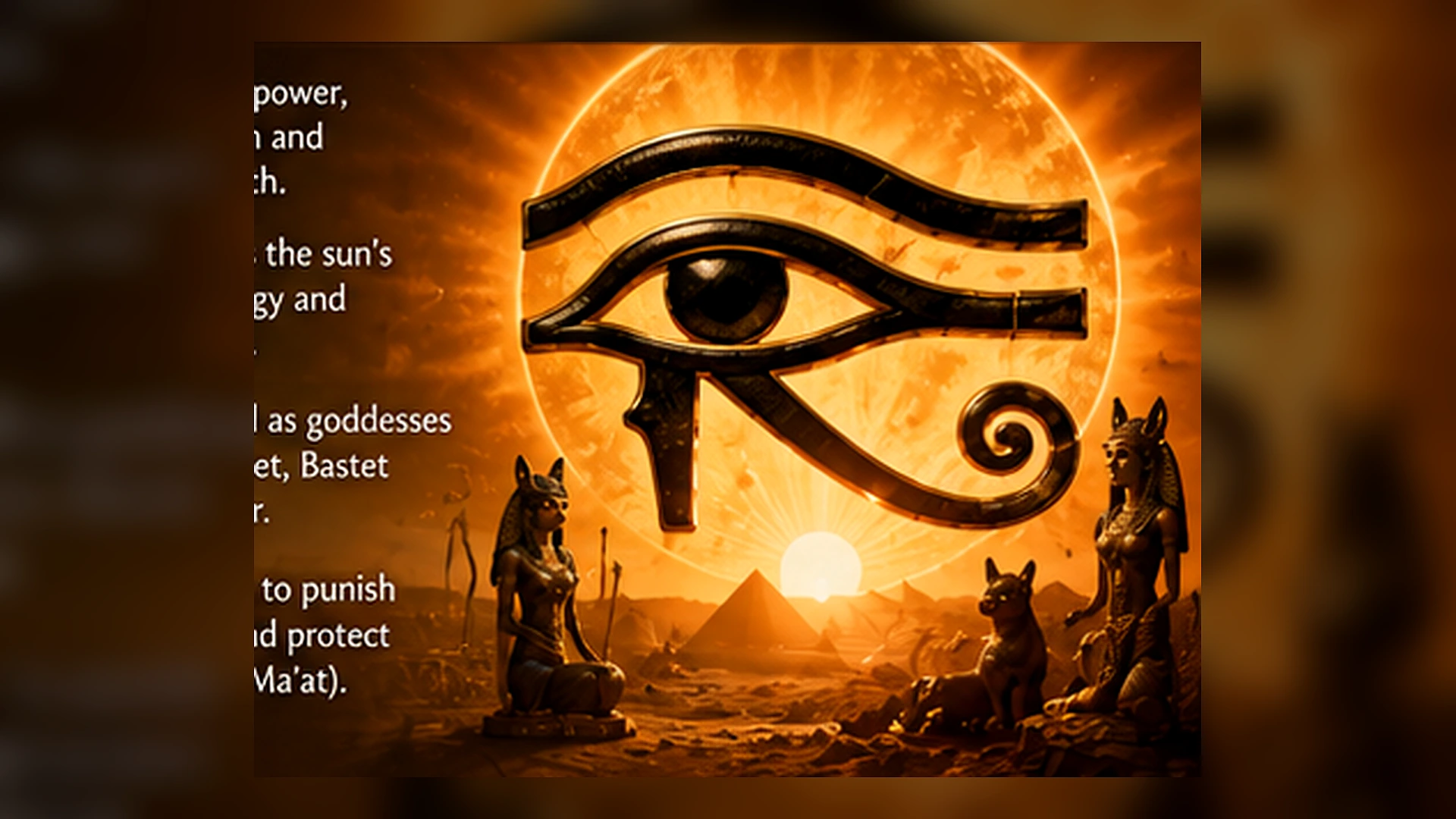
The Eye of Horus and the Eye of Ra are related ancient Egyptian ideas, but they are not simply two names for an identical symbol. The Eye of Horus, commonly called the wedjat or udjat eye, is the injured eye of Horus made sound again. It became one of Egypt's most widespread symbols of restoration, regeneration, well-being and protection. The Eye of Ra is the active power of the sun god Ra or Re. It could defend divine and royal order, punish enemies and take the form of a formidable goddess.
The difference becomes less clear when modern illustrations try to identify them only by direction. A popular rule says Horus is always a left eye and Ra is always a right eye. Ancient objects do not support that as a universal test. Wedjat amulets face both ways, solar and lunar meanings overlap, and the Eye of Ra could be represented through a goddess, a sun disk or a protective cobra rather than a single standardized eye drawing.
This article compares the two traditions through museum objects and Egyptological context. It explains what each Eye meant, the myths behind it, where their protective functions overlap, how ancient Egyptians used the imagery, and how modern readers can avoid misleading claims.
Quick Answer
The Eye of Horus is the restored wedjat eye associated with healing, wholeness, rebirth and protection. The Eye of Ra is an active solar force linked with divine authority, royal defense and powerful goddesses such as Hathor, Sekhmet, Tefnut and Wadjet. Both can be protective, but direction alone does not reliably distinguish them.
| Image number | 1 |
|---|---|
| Purpose | Featured comparison image that distinguishes the two traditions without relying on text labels or fantasy effects. |
| Detailed scene | A museum-style dark stone table holds two separate objects: on the left, a blue-green faience wedjat amulet with accurate human-and-falcon eye features; on the right, a gold rearing uraeus cobra beneath a small solar disk, representing a documented form of solar royal protection. A narrow beam of gallery light separates the objects. |
| Specific culture or historical context | Ancient Egyptian-inspired educational still life using museum-quality reproductions; it must not be presented as a photographed original artifact. |
| People shown | No people. |
| Location | Quiet Egyptology museum study room or conservation table. |
| Clothing | Not applicable. |
| Architecture | Dark stone, archival drawers and softly blurred museum cases. |
| Objects | Faience wedjat eye reproduction, gold uraeus reproduction, neutral display mounts and a small magnifying lens. No readable labels. |
| Lighting | Controlled museum lighting with cooler light on the wedjat and warm solar light on the uraeus. |
| Composition | Wide 16:9 editorial photograph with the two objects balanced across the frame and clear negative space between them. |
| SEO-friendly filename | eye-of-horus-vs-eye-of-ra.webp |
| Image title | Eye of Horus and Eye of Ra Compared |
| Alt text | Museum-style comparison of a blue-green wedjat Eye of Horus amulet and a gold solar uraeus representing the Eye of Ra. |
| Caption | The Eye of Horus centers on restoration, while the Eye of Ra represents an active solar power; ancient contexts are more reliable than direction alone. |
| Recommended placement | Immediately after the introduction and Quick Answer. |
| Article section supported | Main comparison and definition. |
| Important elements to avoid | Embedded text, labels, logos, fantasy beams, random hieroglyphs, modern evil-eye beads, inaccurate cobra anatomy, distorted objects, split-screen borders or claims that the reproductions are ancient originals. |
What Is the Eye of Horus?
The Eye of Horus is best identified by its Egyptian name, commonly transliterated as wedjat, udjat or wedjat-eye. The word is often translated as the sound, intact or restored one. Its design combines a human eye and eyebrow with markings associated with the falcon, the bird closely connected with Horus. The Metropolitan Museum of Art describes the wedjat as the healed eye of Horus and notes that it was one of the most popular amulets in ancient Egypt. [1]
The symbol does not represent an ordinary healthy eye from the beginning. Its power comes from a story of injury and restoration. In mythic traditions concerning the struggle between Horus and Set, Horus loses or suffers damage to an eye. The eye is subsequently restored, often by Thoth, although Egyptian traditions could vary and other divine figures appear in some accounts. Because the eye became sound again, it embodied recovery after damage rather than mere invulnerability.
The Conflict of Horus and Set
Horus and Set were central figures in stories about kingship, succession and order. Horus was associated with legitimate kingship and the sky; Set could represent disruptive power, the desert and opposition, although his religious role was more complex than the modern label of a purely evil god. Their conflict was told in multiple versions rather than one fixed narrative. The damaged eye became one of the most enduring results of that conflict.
In later interpretation, the loss and restoration of the eye could be related to lunar waning and waxing. Museum summaries also connect the recovered eye with the revival of Osiris and with offerings. The Global Egyptian Museum explains that the restored eye became a model for completion, healing, protection and the offering that renews life. [2]
What the Eye of Horus Symbolized
Restoration: something damaged can be made sound again.
Regeneration and rebirth: the renewed eye could transfer life-restoring power.
Protection: the amulet was used to guard living people and the deceased.
Health and well-being: museum records repeatedly connect the wedjat with soundness and recovery.
Completion and wholeness: its Egyptian name emphasizes restored integrity.
Perception and watchfulness: an eye naturally carried associations with seeing and vigilance.
Offering and renewal: the eye could stand for offerings that sustained gods and the dead.
These meanings overlap rather than form a rigid dictionary. A blue faience amulet in a burial, a gold pendant worn in life and a large eye placed on a coffin might emphasize different aspects of the same symbolic network.
How the Eye of Horus Was Used
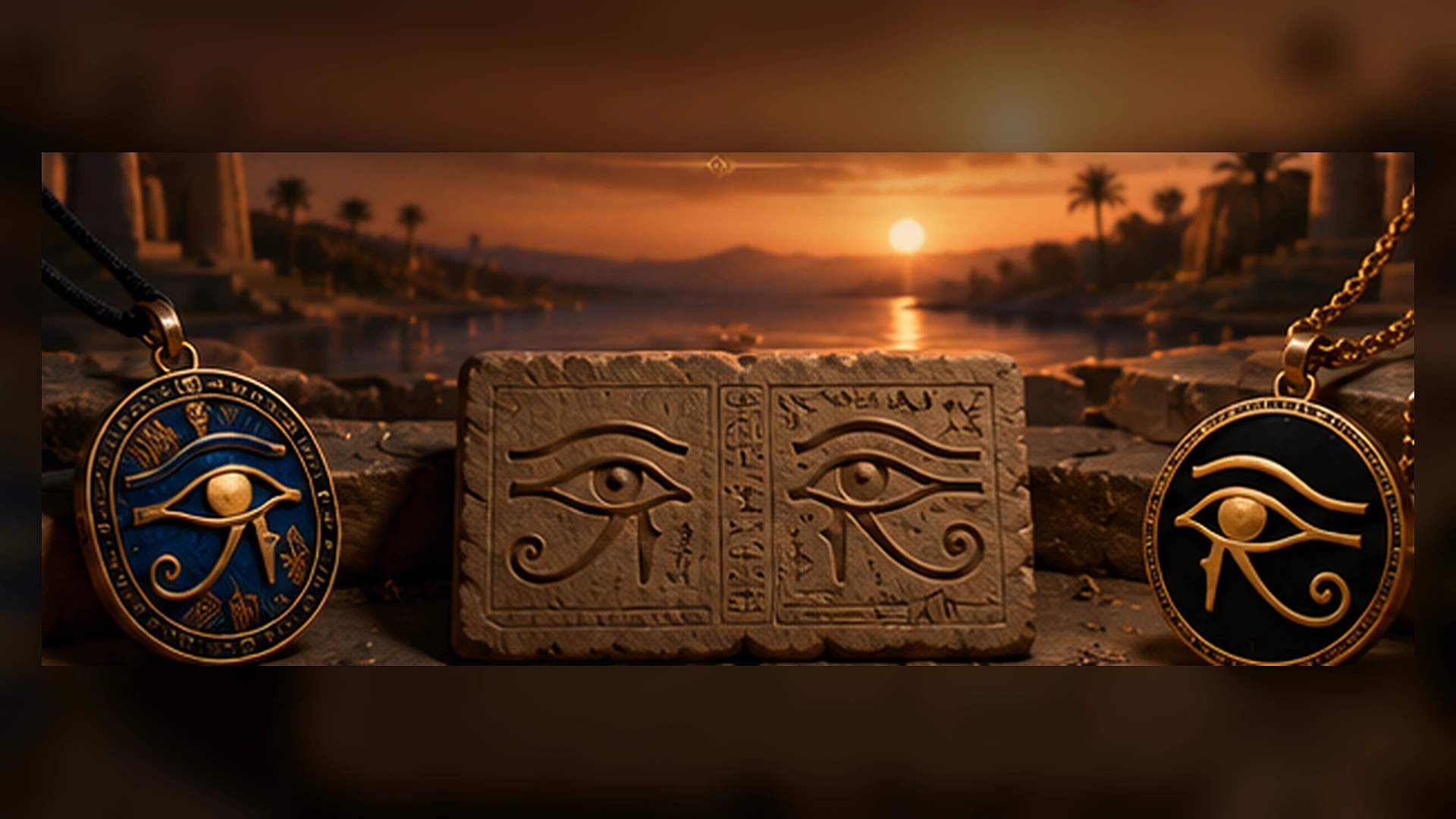
Wedjat amulets were made in faience, stone, glass, precious metals and other materials. Some were simple silhouettes; others combined the eye with wings, arms, falcon features, cobras, papyrus plants or royal names. The British Museum records both straightforward examples and elaborate composite versions. One object combines falcon features, a human eye, a papyrus and a cobra with a sun disk, showing how Egyptian religious imagery could layer protective meanings rather than keep every symbol isolated. [3]
The amulet could be worn by the living, placed among mummy wrappings or attached to funerary equipment. A Smithsonian museum label explains that wedjat amulets were positioned with the dead to provide health and renewed life. [4] The purpose was not only decorative. Shape, material, color and ritual words could all contribute to the object's religious function.
The familiar blue-green color of many examples comes from glazed composition commonly called Egyptian faience. That color could evoke life, vegetation, water and regeneration, but wedjat amulets also occur in gold, carnelian, obsidian, hematite, glass and other materials. No one color is the only authentic form.
| Image number | 2 |
|---|---|
| Purpose | Show the archaeological variety and physical use of wedjat amulets. |
| Detailed scene | A conservation table displays five accurate wedjat reproductions in blue-green faience, carnelian, gold, black stone and glass. One is pierced as a pendant, another rests beside linen mummy bandage fragments, and a third is positioned near a small offering bowl. A conservator's gloved hands examine one object with a magnifying lens. |
| Specific culture or historical context | Educational reconstruction based on ancient Egyptian amulet types from the Middle Kingdom through the Ptolemaic Period; no single group should be falsely presented as one excavated assemblage. |
| People shown | Only the gloved hands of an adult museum conservator. |
| Location | Museum conservation laboratory. |
| Clothing | Neutral conservation gloves and lab sleeve. |
| Architecture | Clean archival workspace with softly blurred specimen drawers. |
| Objects | Five wedjat reproductions, linen, offering bowl, calipers and magnifying lens; no readable catalog labels. |
| Lighting | Bright neutral conservation lighting that shows material textures accurately. |
| Composition | Wide 16:9 overhead editorial photograph with each amulet clearly separated. |
| SEO-friendly filename | eye-of-horus-wedjat-amulets-ancient-egypt.webp |
| Image title | Wedjat Eye of Horus Amulets |
| Alt text | Museum conservation table with blue faience, gold, carnelian, glass and stone wedjat Eye of Horus amulets. |
| Caption | Wedjat amulets appeared in many materials and were used by both the living and the dead. |
| Recommended placement | After the section on ancient uses. |
| Article section supported | Eye of Horus amulets and materials. |
| Important elements to avoid | Fake excavation dirt, readable invented inscriptions, plastic-looking materials, modern jewelry branding, text overlays, logos, distorted hands or mixing unrelated cultures. |
What Is the Eye of Ra?
The Eye of Ra, or Eye of Re, is not best understood as a single standardized amulet that can always be identified by which direction it faces. It is a theological idea: the sun god's power acting in the world. The Eye could search, protect, punish, destroy enemies, defend the king and return with renewed energy. It often behaved as an independent divine personality while remaining connected to Ra.
This active Eye was frequently personified as a goddess. The specific goddess varied by place, period and myth. Hathor, Sekhmet, Tefnut, Wadjet, Bastet, Mut and Isis could all receive the title or function of Eye of Ra in particular contexts. The Metropolitan Museum of Art describes these Eye of Re goddesses as volatile agents and counterparts of the sun god who could become powerful protectors and benefactors when appeased. [5]
The Eye of Ra as a Solar Goddess
The Eye of Ra combines creative, protective and dangerous dimensions. The sun gives light and sustains life, but Egyptian experience also knew its heat, drought and destructive intensity. A lioness goddess such as Sekhmet could express the Eye's burning fury. Hathor could embody both violent and nurturing aspects. Tefnut or another distant goddess could leave Egypt and return, with her homecoming restoring normalcy, fertility and prosperity.
This is why asking which single goddess is the Eye of Ra has no universal answer. Egyptian deities could share titles, merge with one another and express different dimensions of a larger divine power without becoming permanently identical. Context - the temple, text, crown, associated gods and historical period - matters more than a modern one-name chart.
The Destructive and Protective Eye
In the story commonly called the Destruction of Humanity, preserved within the Book of the Heavenly Cow, Ra sends his Eye against rebellious humanity. The Eye is personified through a goddess, often discussed as Hathor-Sekhmet, whose violence becomes so great that it must be stopped. The story is not a simple moral tale about an evil symbol. It dramatizes divine authority, fury, mercy and the need to pacify dangerous power.
The same force that threatens enemies can defend the king, temple and ordered world. This double character is visible in the uraeus, the rearing cobra worn on royal and divine foreheads. The cobra was ready to attack enemies with venom or fire. Museum descriptions identify Wadjet as an ancient royal goddess and explain that uraei, often crowned with a sun disk, created protected royal and sacred spaces. [6][7]
| Image number | 3 |
|---|---|
| Purpose | Explain the Eye of Ra through its goddess and royal-protection forms rather than inventing a standardized eye icon. |
| Detailed scene | A museum-quality reconstruction of a New Kingdom temple relief shows the sun god Ra-Horakhty with a solar disk, while a lioness-headed Sekhmet stands as an active protective goddess. In the foreground, an accurate gold uraeus cobra with a small sun disk is mounted on a neutral display stand. The relief is presented as a modern educational reconstruction, not an original wall. |
| Specific culture or historical context | Ancient Egyptian New Kingdom solar theology and later documented Eye of Re goddess traditions; the scene should not claim to reproduce one exact surviving relief. |
| People shown | No modern people; two ancient Egyptian deities in accurate canonical relief style. |
| Location | Museum reconstruction gallery. |
| Clothing | Historically plausible divine garments and crowns based on Egyptian art. |
| Architecture | Painted stone relief wall and restrained museum display. |
| Objects | Solar disk, uraeus, was-scepter and ankh only where iconographically appropriate. |
| Lighting | Warm directional light suggesting solar power without supernatural glow. |
| Composition | Wide 16:9 view with relief in the background and uraeus artifact reproduction in sharp foreground. |
| SEO-friendly filename | eye-of-ra-sekhmet-solar-uraeus.webp |
| Image title | Eye of Ra as Solar Goddess and Uraeus |
| Alt text | Museum reconstruction of Ra-Horakhty and Sekhmet behind a gold solar uraeus symbolizing the protective Eye of Ra. |
| Caption | The Eye of Ra could act through powerful goddesses and royal solar imagery, not only through a drawn eye. |
| Recommended placement | Within the Eye of Ra origin and goddess section. |
| Article section supported | Eye of Ra personification and protective power. |
| Important elements to avoid | Fantasy armor, Greek clothing, modern occult symbols, inaccurate hieroglyphs, excessive fire, embedded text, watermarks, distorted deity anatomy or presenting the reconstruction as an excavated original. |
Eye of Horus vs Eye of Ra: Main Differences
| Feature | Eye of Horus | Eye of Ra |
|---|---|---|
| Central identity | The damaged and restored eye of Horus, known as the wedjat or sound eye. | The active solar power of Ra or Re, often personified as a goddess. |
| Core mythic pattern | Injury, loss and restoration during the conflict involving Horus and Set. | Departure, action, defense, punishment and return of a solar Eye or goddess. |
| Strongest meanings | Healing, restoration, regeneration, wholeness, well-being and protection. | Solar force, divine authority, royal defense, destructive heat, protection and restoration of order. |
| Typical forms | Human-and-falcon eye motif, often made as a wedjat amulet. | Goddess, uraeus cobra, sun disk, royal crown imagery or other solar contexts; not one fixed amulet form. |
| Major deities | Horus, Set, Thoth, Osiris and sometimes Hathor in restoration traditions. | Ra plus Hathor, Sekhmet, Tefnut, Wadjet, Bastet, Mut, Isis and other goddesses in specific traditions. |
| Celestial emphasis | Often associated with the moon and its recovery, but solar connections also occur. | Primarily solar, expressing the sun's life-giving and dangerous power. |
| Ancient use | Very common personal and funerary amulet; also used on coffins, stelae and offerings. | Theological and royal concept expressed in temple myths, goddess cults, crowns, uraei and protective solar imagery. |
| Reliable visual test | Identify wedjat features and archaeological context; direction alone is insufficient. | Look for solar, royal, goddess or uraeus context; do not assume every right-facing eye is the Eye of Ra. |
Are They Both Protective Symbols?
Yes, but their protection follows different narrative patterns. The Eye of Horus protects because what was injured has been restored and made whole. Its amulet transfers soundness, regeneration and well-being. The Eye of Ra protects as an active extension of solar and royal power. It confronts enemies, guards the king and can create a protected sacred space.
The overlap is not a contradiction. Ancient Egyptian religious thought allowed one symbol to hold several associations and different divine powers to cooperate. The sun and moon could be described as divine eyes; Horus and Ra could merge in forms such as Ra-Horakhty; cobras, falcons, goddesses and eye amulets could share protective functions. Modern comparison tables are useful only when they do not erase this flexibility.
Is the Eye of Horus Left and the Eye of Ra Right?
Not as a universal identification rule. The left-Horus and right-Ra formula is a modern simplification built from real but variable ancient associations. In some traditions, the sky god's right eye was the sun and the left was the moon. Because the restored Eye of Horus was often linked with the moon, people then equated it with the left eye; the solar eye was assigned to Ra and the right side.
Ancient objects are less tidy. British Museum and Global Egyptian Museum records note that wedjat amulets can depict either direction and that solar and lunar meanings became interwoven. One British Museum composite wedjat includes a sun-disk cobra inside the same protective design. [3] The Global Egyptian Museum explains that many amulets show the right eye even though the Horus eye was often interpreted as lunar. [8]
Direction can support an interpretation when combined with an inscription or documented context, but it cannot identify every object by itself. A photograph of an eye pendant without provenance, inscription or associated imagery may simply be a modern design. The responsible answer is sometimes: the object resembles a wedjat eye, but there is not enough context to call it specifically the Eye of Ra.
| Image number | 4 |
|---|---|
| Purpose | Visually correct the simplistic left-eye/right-eye rule through archaeological comparison. |
| Detailed scene | An Egyptologist's study table displays four documented-style wedjat reproductions: two facing left and two facing right, in faience and stone. Beside them are a separate solar uraeus and a small falcon-head reference model. Colored thread connects visual features, but no words or arrows are embedded. |
| Specific culture or historical context | Modern educational comparison based on ancient Egyptian museum collections; the objects are clearly reproductions. |
| People shown | One adult Egyptologist's hands arranging the reproductions. |
| Location | University Egyptology laboratory. |
| Clothing | Neutral professional clothing and clean cotton gloves. |
| Architecture | Wood table, archival drawers and softly blurred reference shelves. |
| Objects | Four wedjat reproductions, solar uraeus, falcon model, calipers and blank catalog cards. |
| Lighting | Neutral daylight-balanced study lighting. |
| Composition | Wide 16:9 overhead composition with left- and right-facing eyes visibly mixed. |
| SEO-friendly filename | eye-of-horus-left-right-eye-myth.webp |
| Image title | Left- and Right-Facing Wedjat Eyes |
| Alt text | Egyptology study table with left- and right-facing wedjat amulets beside a solar uraeus, showing that direction alone is not decisive. |
| Caption | Ancient wedjat amulets could face either direction, so context is more reliable than a left-versus-right rule. |
| Recommended placement | After the orientation discussion. |
| Article section supported | Visual identification and common misconceptions. |
| Important elements to avoid | Readable fake labels, modern infographic arrows, symmetrical cloning, random hieroglyphs, occult diagrams, distorted hands or claims that all objects came from one excavation. |
Origins: Which Symbol Came First?
It is difficult to assign either idea a single invention date. Egyptian religion developed across more than three millennia, and divine eye imagery appears in early royal, celestial and funerary traditions. Horus was an ancient sky and kingship deity whose eyes could be understood as celestial bodies. Ra became a dominant solar god and was combined with other deities in changing theological systems. The Eye concepts grew through texts, temple ritual, kingship, amulets and funerary practice rather than appearing as two logos created at one moment.
The safest historical statement is that both traditions are ancient and overlapping, while the familiar mass-produced wedjat amulet is especially well documented archaeologically. Museum collections preserve examples from the Middle Kingdom, New Kingdom, Third Intermediate Period, Late Period and Ptolemaic Period. [1] The Eye of Ra is often easier to trace through divine titles, goddess myths, solar disks, uraei and temple contexts than through objects cataloged under one universal Eye of Ra shape.
Why the Two Eyes Overlap
Horus Was Also a Celestial and Solar Deity
Horus was not limited to the moon. As a sky deity, his two eyes could represent the sun and moon. The British Museum describes the right and left eyes of celestial Horus as solar and lunar. [3] This means that solar eye symbolism was not owned exclusively by Ra, and lunar symbolism did not erase Horus's solar connections.
Ra and Horus Could Merge
Egyptian gods could combine without losing every separate identity. Ra-Horakhty, Ra-Horus of the Horizons, joined solar Ra with a form of Horus. Such combinations make modern either-or categories unstable. An eye, falcon, sun disk or royal image may participate in more than one theological network.
Protection Was Layered
Ancient Egyptian amulets often layered powers. An elaborate wedjat could include a falcon wing, human eye, papyrus plant, ankh or uraeus. A royal crown could combine the solar disk, cobra and other emblems. These combinations were meaningful accumulations, not design mistakes. The wearer or sacred space benefited from several related forms of protection, renewal and authority.
Common Misunderstandings
“They are identical except for direction.” The Eye of Horus has a standardized wedjat amulet tradition, while the Eye of Ra is a broader active solar concept. Direction alone is not decisive.
“The Eye of Ra is always Sekhmet.” Sekhmet is an important Eye of Ra goddess, but Hathor, Tefnut, Wadjet, Bastet, Mut, Isis and others could hold the role in different settings.
“The Eye of Horus only means protection.” Protection is central, but restoration, regeneration, health, completion, offering and rebirth are equally important.
“The Eye of Ra is evil.” Its destructive force defended divine and royal order. Ancient religious categories cannot be reduced to a modern good-versus-evil label.
“Every Egyptian-looking eye is ancient.” Modern jewelry frequently alters, reverses or combines motifs. Provenance and context determine what an object can responsibly be called.
“The wedjat is the same as every evil-eye symbol.” Protective eye traditions occur across many cultures, but they have different histories. The Egyptian wedjat should not be collapsed into one universal symbol.
“One definition applied throughout Egyptian history.” Meanings changed across regions, temples and periods. Museum dates and associated inscriptions matter.
Can You Wear the Eye of Horus or Eye of Ra Today?
People today wear Egyptian-inspired eye pendants as historical, spiritual, artistic or protective symbols. There is no single modern rule governing all personal use, but accuracy and respect improve the choice. Know whether the design is a wedjat eye, a solar uraeus, a goddess image or a modern hybrid. Avoid advertising guaranteed healing, immunity from harm or supernatural power as fact.
For a tattoo or permanent design, use a reputable image from a museum collection as reference and ask the artist not to invent hieroglyphs. A wedjat tattoo can reasonably be described as inspired by restoration, wholeness and protection. A design centered on the Eye of Ra should explain which solar form is intended - for example Sekhmet, Wadjet or the uraeus - rather than treating a reversed wedjat as historically certain.
Ancient Egypt belongs to the history of Africa and to living Egyptian heritage. Respectful use avoids exotic language, recognizes the symbol's religious and funerary contexts, and does not claim ownership of restricted knowledge. Museum learning, Egyptian scholarship and transparent sourcing are better guides than viral symbol charts.
| Image number | 5 |
|---|---|
| Purpose | Close with responsible modern study and use of ancient Egyptian symbols. |
| Detailed scene | A Black African museum educator and an Egyptian or North African adult researcher examine high-resolution photographs and reproduction amulets at a study table. A blue-green wedjat, a small uraeus and a Sekhmet figurine are separated into individual padded trays. Their notebooks contain no readable text. |
| Specific culture or historical context | Contemporary African-led museum education focused on ancient Egyptian material culture. |
| People shown | Two adult researchers with natural expressions and anatomically correct hands. |
| Location | Modern museum study room in Africa. |
| Clothing | Professional contemporary clothing; cotton gloves used only for objects that require them. |
| Architecture | Bright conservation-friendly room with neutral cases and archival storage. |
| Objects | Wedjat reproduction, uraeus reproduction, Sekhmet figurine, magnifier, tablet showing object photographs and blank notebooks. |
| Lighting | Soft natural daylight with accurate neutral color. |
| Composition | Wide 16:9 documentary photograph, researchers on the right and clearly separated symbols on the left. |
| SEO-friendly filename | studying-eye-of-horus-eye-of-ra-symbols.webp |
| Image title | Responsible Study of Egyptian Eye Symbols |
| Alt text | African museum educators comparing a wedjat Eye of Horus, solar uraeus and Sekhmet figure in a modern study room. |
| Caption | Historical context, museum evidence and Egyptian scholarship provide a stronger foundation than simplified internet charts. |
| Recommended placement | Near the conclusion after responsible modern use. |
| Article section supported | Cultural respect, research and modern interpretation. |
| Important elements to avoid | Tourist-costume styling, fantasy temple backgrounds, readable fake hieroglyphs, exotic poses, handling original artifacts with bare hands, embedded text, logos or inaccurate ethnicity stereotypes. |
Key Takeaways
The Eye of Horus is the restored wedjat eye and is strongly associated with healing, regeneration, wholeness and protection.
The Eye of Ra is an active solar force that could act through several goddesses and protect divine and royal order.
Both traditions are protective, but they reach protection through different mythic patterns: restoration versus active solar defense.
The Eye of Horus has a well-documented amulet form; the Eye of Ra is not limited to one standardized eye-shaped object.
Left-versus-right direction is not a reliable universal identification rule.
Ancient Egyptian religion allowed overlapping deities, shared titles and layered symbols.
Modern use is most respectful when it is historically sourced and does not promise guaranteed supernatural outcomes.
People Also Ask
What is the main difference between the Eye of Horus and Eye of Ra?
The Eye of Horus represents an injured divine eye restored to soundness, making it a symbol of healing, regeneration and protection. The Eye of Ra is the sun god's active power, often embodied by a goddess, and emphasizes solar authority, defense and the destruction of enemies.
Is the Eye of Horus the left eye?
It is often linked with the lunar left eye in modern explanations, but ancient wedjat amulets can face either direction. Context, inscription and associated imagery are more dependable than direction alone.
Is the Eye of Ra the right eye?
The sun could be associated with a divine right eye, but the Eye of Ra was not one universal right-facing symbol. It could appear as a goddess, solar disk, uraeus cobra or other solar form.
Who healed the Eye of Horus?
Thoth is frequently named as the restorer, but ancient Egyptian myth existed in variants and Hathor or other divine assistance may appear in different traditions.
Was the Eye of Ra a goddess?
It could be personified as a goddess while remaining the power of Ra. Hathor, Sekhmet, Tefnut, Wadjet, Bastet, Mut and Isis could embody the Eye in particular contexts.
What did Eye of Horus amulets do?
They were believed to transfer protection, soundness, health and regenerative power. They were worn by living people and placed with the dead.
What is a wedjat eye?
Wedjat, also spelled udjat, is the Egyptian term commonly used for the restored Eye of Horus. It means the sound, intact or restored one.
Are the Eye of Horus and Eye of Ra evil-eye symbols?
They are ancient Egyptian protective eye traditions, but they should not be treated as identical to every later Mediterranean, Middle Eastern or global evil-eye symbol.
Can the Eye of Horus and Eye of Ra look alike?
Yes. Modern designs often use the same wedjat shape for both, and ancient solar and lunar eye associations overlap. Without context, a direction change may not prove which concept is intended.
Can I wear both symbols together?
Modern wearers may combine them, but the combination is a contemporary choice unless based on a documented ancient object. Describe the meanings as inspiration rather than guaranteed protection.
Frequently Asked Questions
Did ancient Egyptians call it the Eye of Ra?
Egyptian texts and scholarship discuss the Eye of Re or Ra as a divine power and title, especially for solar goddesses. Modern English naming can make it sound like a single logo, which is misleading.
What animal features appear in the Eye of Horus?
The wedjat combines a human eye and eyebrow with stylized markings associated with a falcon's eye, reflecting Horus's falcon form.
Why is the uraeus connected with the Eye of Ra?
The rearing cobra represented protective goddesses, especially Wadjet, and could bear the sun disk. On royal and divine crowns it confronted enemies and expressed solar and royal power.
Is the Eye of Horus connected with the moon?
Often, yes. Its injury and restoration could be interpreted through the waning and waxing moon, although the eye also carried solar and broader celestial associations.
Is the Eye of Ra only destructive?
No. Its destructive force defended order, but the Eye could also bring protection, fertility, prosperity and renewed normalcy when pacified or returned.
Which symbol is stronger?
Ancient evidence does not provide a universal power ranking. They served different religious functions, and effectiveness was understood through deity, ritual, material, words and context.
What color should an Eye of Horus be?
Blue-green faience is common, but surviving amulets also use gold, carnelian, obsidian, glass, hematite and other materials. There is no single mandatory color.
Does the Eye of Horus mean one-sixth or mathematical fractions?
Modern diagrams often divide the eye into Egyptian fractions, but popular explanations can overstate a complex scholarly issue. The safest public meaning is restoration and protection unless a specialist source is provided.
Is the Eye of Ra the same as the sun disk?
Not exactly. The solar disk can express Ra's presence and can accompany an Eye goddess or uraeus, but the Eye of Ra is the active divine power, not merely the geometric disk.
Were eye amulets only for pharaohs?
No. Wedjat amulets are found in personal and funerary contexts beyond kingship, although materials and workmanship varied with status and purpose.
Can a modern necklace be called an authentic Eye of Ra?
It can be accurately described as inspired by Eye of Ra symbolism if its intended solar or goddess context is clear. Calling a reversed wedjat an archaeologically certain Eye of Ra may overstate the evidence.
How should a museum object be identified?
Use the museum catalog name, date, material, provenance and curator's notes. Do not replace a documented label with a viral left-eye/right-eye chart.
Conclusion
The clearest difference between the Eye of Horus and the Eye of Ra is not simply the direction of a drawing. The Eye of Horus is the wedjat - the eye made sound after injury - and its enduring power lies in restoration, regeneration and protection. The Eye of Ra is the sun god's force in action, capable of defending order, punishing enemies and appearing through formidable goddesses and solar royal symbols.
Their meanings overlap because ancient Egyptian religion was relational and layered. Horus could be solar as well as lunar; Ra and Horus could combine; a wedjat amulet could include a solar cobra; and several goddesses could embody the Eye of Ra. A careful reader therefore asks about context, date, material, inscription and associated deity before assigning a label.
For modern use, the most responsible approach is to keep the history visible. Use museum objects as references, recognize ancient Egypt as a specific African civilization, avoid guaranteed supernatural claims and describe uncertainty honestly. That produces a more meaningful symbol than any simplified internet rule.
Final Summary
The Eye of Horus symbolizes restored wholeness; the Eye of Ra symbolizes active solar power. Both protect, but they arise from different myths and forms. The wedjat is a recognizable amulet, while the Eye of Ra can be a goddess, uraeus or solar force. Direction helps only when the surrounding evidence agrees.
Research Sources and Further Reading
[1] Wedjat Eye Amulet - The Metropolitan Museum of Art. Collection records explain the human-and-falcon form, the meaning of wedjat as the sound eye, restoration by Thoth, and use for protection and regeneration.
[2] Eye of Horus and Udjat-eye - The Global Egyptian Museum. Glossary entries summarize lunar associations, the conflict with Set, restoration, offerings, healing, completion and protective use.
[3] Glazed composition wedjat eye amulet, EA29222 - British Museum. Object record documents an elaborate composite wedjat combining falcon features, human eye, papyrus and a sun-disk cobra, and discusses solar and lunar eye associations.
[4] Amulet and Horus-Eye Amulets - Smithsonian Institution. Museum labels describe wedjat amulets in mummy wrappings and their intended associations with health, protection and renewed life.
[5] Egypt in the Third Intermediate Period - The Metropolitan Museum of Art. Museum essay identifies Hathor, Mut-Sakhmet-Bastet, Tefnut, Wadjet and Isis as Eye of Re goddesses and explains the Faraway Goddess pattern.
[6] Uraeus - The Metropolitan Museum of Art. Collection record explains Wadjet, the raised cobra and its role as a royal protective symbol.
[7] Uraeus fitting from shrine - The Metropolitan Museum of Art. Collection record explains cobra friezes, sun disks, protection of sacred spaces and the image of uraei attacking enemies.
[8] Udjat-eye - The Global Egyptian Museum. Entry notes that wedjat amulets could depict the right eye despite lunar interpretations, demonstrating that orientation is not a universal rule.
[9] Wedjat Eye Amulet object records - The Metropolitan Museum of Art. Dated examples from the Middle Kingdom through Ptolemaic times document materials, funerary use and persistence of the symbol.
[10] Digital Egypt for Universities - University College London. Higher-education resource for Egyptian chronology, religious material culture, funerary texts and the importance of context in interpreting ancient art.
[11] The Book of the Heavenly Cow - translated and discussed in Egyptological literature. Primary mythic context for the sun god sending his Eye against rebellious humanity; modern retellings should be checked against scholarly translations.
[12] Uraeus and wedjat collection records - British Museum and Metropolitan Museum of Art. Object-level evidence used to distinguish the common wedjat amulet from broader solar, royal and goddess imagery.
Editorial note: Ancient Egyptian religion changed across regions and more than three millennia. The article distinguishes museum evidence, mythic interpretation and modern symbolism. It does not claim that an amulet or tattoo guarantees healing, protection or supernatural results.
Article Information
- Publisher
- Ancestral Temple
- Editor
- Ancestral Temple
- Last updated
- Jul 26, 2026
- Last reviewed
- Jul 26, 2026
- Content version
- f3a1324cb8
This educational article should be read as cultural and spiritual information, not as medical, legal, financial, or emergency advice.
Helpful Related Guidance
Explore This Topic
Related Topic Cluster
Dreams & Symbolism
About the Author
 Ancestral Temple
Spiritual guide and practitioner with decades of experience in ancestral wisdom, rituals, and divine guidance.
Related Posts
View All












Leave a Comment
We'd love to hear your thoughts.