
Eye Symbols and Their Meanings: Protection, Knowledge and Watchfulness
Quick Summary
Eye symbols appear on amulets, drinking vessels, temple architecture, manuscripts, jewelry, flags, government seals, tattoos, and modern warning signs. Because sight is central to...
Eye symbols appear on amulets, drinking vessels, temple architecture, manuscripts, jewelry, flags, government seals, tattoos, and modern warning signs. Because sight is central to how humans recognize danger, communicate attention, and understand other people, the eye easily becomes a symbol of protection, knowledge, divine presence, judgment, or surveillance.
There is no single universal meaning. An ancient Egyptian wedjat amulet, a blue bead used against the evil eye, Shiva’s third eye, the painted eyes of a Nepalese stupa, and the Eye of Providence do not come from one tradition and should not be treated as interchangeable. Each symbol developed within a specific historical, religious, artistic, and social setting.
Quick Answer
Eye symbols commonly represent protection, awareness, knowledge, spiritual insight, divine watchfulness, healing, or the danger of an envious gaze. Their meaning depends on the culture and object. The Eye of Horus emphasizes restored wholeness and protection; evil-eye amulets avert harmful envy; Shiva’s third eye expresses supreme wisdom and transformative power; and the Eye of Providence represents an overseeing divine presence.
What Does an Eye Symbolize?
At the broadest level, an eye symbolizes the power to see and to be seen. Seeing can suggest knowledge, recognition, attention, truth, or spiritual understanding. Being seen can suggest accountability, divine supervision, social pressure, exposure, or danger.
An eye image can therefore work in opposite ways. It may protect a person by “watching” for danger, or it may represent the dangerous gaze itself. It may promise wisdom, but it can also warn that nothing is hidden. It may be a personal ornament, a royal emblem, a sacred image, a healing device, or a political sign.
| Meaning | How the eye communicates it | Examples in this article |
|---|---|---|
| Protection | A watchful image guards against danger or turns harmful attention away | Wedjat amulets, hamsa pendants, Ethiopian healing scrolls |
| Knowledge and wisdom | Sight becomes a metaphor for understanding beyond ordinary perception | Shiva’s third eye, Buddha eyes |
| Divine presence | An eye suggests a deity or sacred power that sees human actions | Eye of Providence |
| Healing and restoration | A damaged or threatened eye is restored and becomes a model of wholeness | Eye of Horus or wedjat |
| Dangerous envy | A hostile or admiring gaze is believed to cause harm | Mediterranean and Middle Eastern evil-eye traditions |
| Watchfulness and accountability | The feeling of being observed can encourage caution or conformity | Religious vigilance, civic emblems, psychological eye-cue research |
| Identity and aesthetics | The eye becomes a modern personal or commercial design | Jewelry, tattoos, fashion, branding |
Why Eyes Become Powerful Symbols
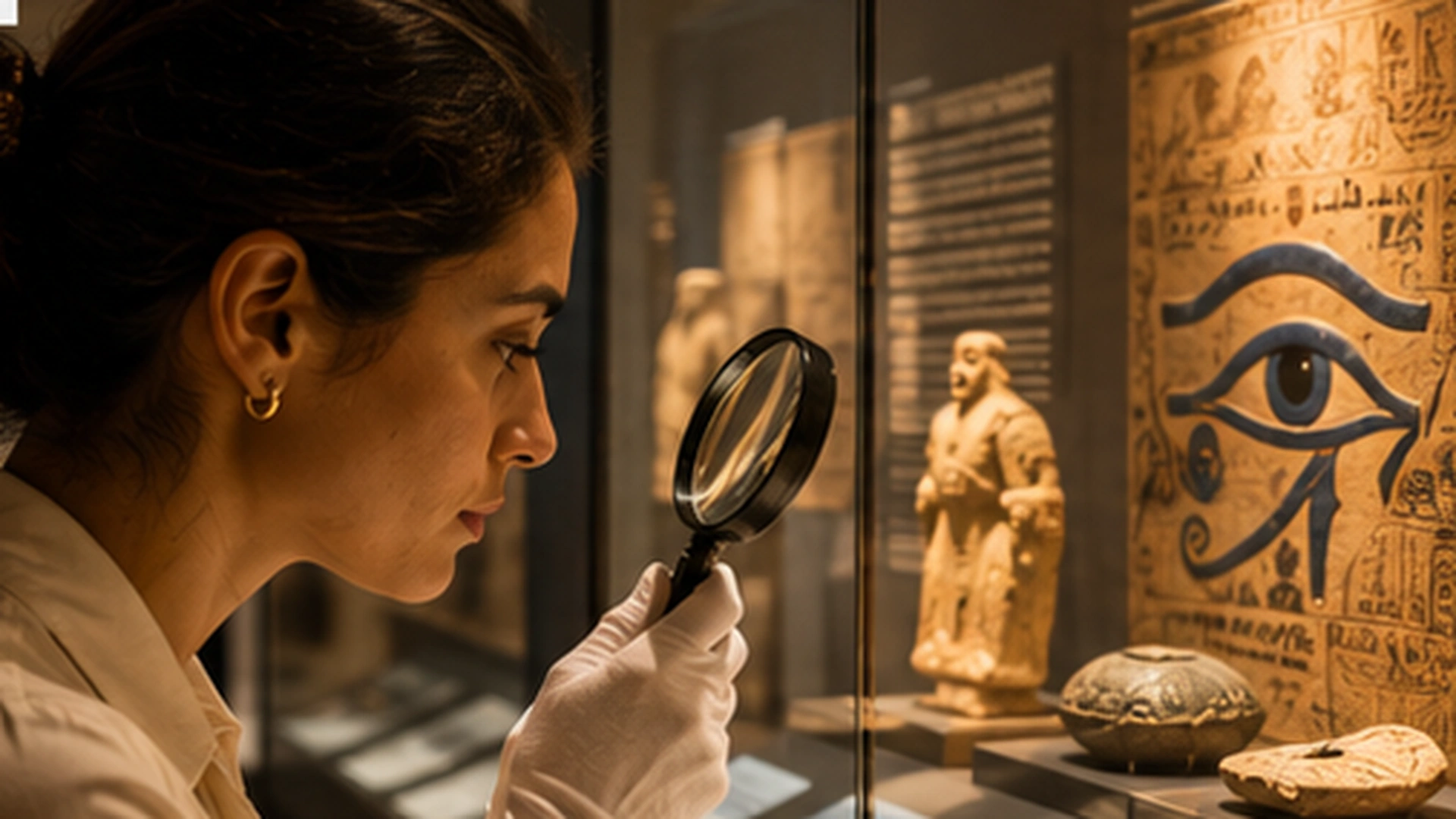
Eyes are visually distinctive and emotionally important. Humans rapidly notice gaze direction because it helps identify attention, threat, affection, status, and intention. Direct gaze can make a person feel recognized, challenged, welcomed, or monitored. These everyday experiences make the eye an unusually flexible cultural image.
The symbol also draws power from vulnerability. Eyes provide sight but can be injured. They reveal emotion but can also conceal intention. They look outward while allowing others to look back. Symbolic systems repeatedly build on these tensions: sight and blindness, knowledge and secrecy, protection and exposure, blessing and envy.
Specific culture or historical context: Contemporary museum research and culturally responsible interpretation; not tied to a single sacred tradition.
People shown: One Black African adult researcher, shown naturally and respectfully.
Location: Quiet museum study gallery or conservation viewing room.
Clothing: Contemporary professional clothing in neutral tones; no ceremonial dress.
Architecture: Modern museum interior with glass cases and subdued walls.
Objects: Notebook, pencil, archival display mounts, softly blurred amulets.
Lighting: Soft side lighting with a clear catchlight in the eye and realistic museum ambience.
Composition: 16:9 cinematic close-up; eye placed off-center with negative space for web cropping; shallow depth of field.
SEO-friendly filename: eye-symbols-meanings-protection-knowledge-watchfulness.webp
Image title: Eye Symbols: Protection, Knowledge, and Watchfulness
Alt text: Close view of a museum researcher’s eye reflected in displays of historic eye symbols
Caption: Across cultures, eye symbols can communicate protection, knowledge, divine presence, danger, or watchfulness.
Recommended placement: After “Why Eyes Become Powerful Symbols.”
Article section supported: Why Eyes Become Powerful Symbols
Important elements to avoid: No collage, no floating Eye of Horus, no hamsa layered over the face, no zodiac graphics, no glowing magical iris, no text, logo, or watermark.
The Eye of Horus: Protection, Healing, and Restored Wholeness
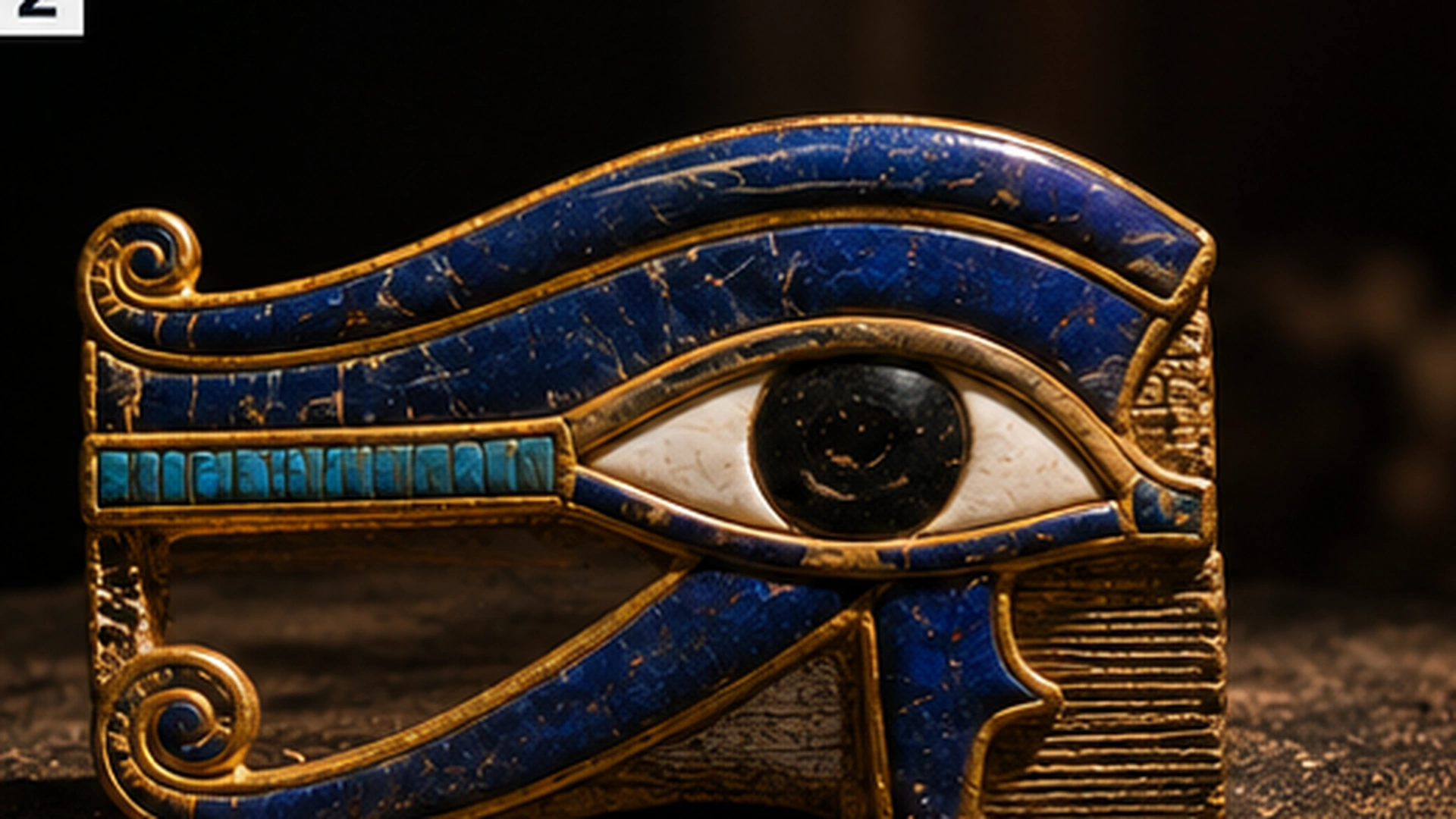
One of the best-known ancient eye symbols is the Egyptian wedjat eye, often called the Eye of Horus. The Metropolitan Museum of Art explains that the design combines a human eye with the markings of a falcon, an animal closely associated with Horus. The name wedjat means “the one that is sound” or restored.[1]
In Egyptian myth, the eye of Horus was injured or taken during conflict with Seth and was restored by Thoth. The healed eye became a sign of recovery, regeneration, and renewed integrity. Wedjat amulets were used by living people and placed with the dead. They were believed to protect the wearer and convey the eye’s restorative power.[1]
The symbol should not be reduced to a generic “Egyptian all-seeing eye.” Its central idea is not simply surveillance. It concerns an eye that has suffered damage and become whole again. Protection emerges from restoration.
Is the Eye of Horus the Same as the Eye of Ra?
No. Modern graphics frequently blur the names, but Egyptian religious traditions contained several overlapping eye concepts. The Eye of Horus is especially associated with the healed wedjat and regeneration. The Eye of Ra can refer to the active, often feminine power of the solar god and may be personified through goddesses. Individual texts and periods vary, so a single chart that assigns “left eye” and “right eye” meanings with absolute certainty is usually oversimplified.
Specific culture or historical context: Ancient Egypt, New Kingdom to Late Period amuletic tradition.
People shown: No people; optional gloved conservator hand at the edge for scale only.
Location: Egyptian art conservation studio or museum collection room.
Clothing: Neutral conservation glove if a hand is shown.
Architecture: Minimal conservation workspace; object dominates.
Objects: Faience wedjat amulet, archival support, scale card without readable text.
Lighting: Raking conservation light revealing glaze, carving, and wear.
Composition: Extreme close-up, three-quarter angle, ample empty background, 16:9.
SEO-friendly filename: eye-of-horus-wedjat-amulet-meaning.webp
Image title: Eye of Horus Wedjat Amulet
Alt text: Ancient Egyptian blue-green wedjat eye amulet on a museum conservation mount
Caption: The wedjat eye represented the restored eye of Horus and was associated with protection, recovery, and regeneration.
Recommended placement: After the Eye of Horus section.
Article section supported: The Eye of Horus: Protection, Healing, and Restored Wholeness
Important elements to avoid: No pyramids as decoration, no gold fantasy glow, no invented hieroglyphs, no human sacrifice, no oversized jewelry recreation.
The Evil Eye: When a Gaze Is Believed to Cause Harm
The “evil eye” is not one object but a widespread family of beliefs about harmful attention. In many Mediterranean, Middle Eastern, North African, Balkan, and South Asian communities, envy or excessive admiration may be understood as a dangerous gaze that can affect health, prosperity, children, animals, homes, or valued possessions.
The belief is not identical everywhere. Different languages, prayers, colors, gestures, materials, and religious explanations are involved. Some people understand the evil eye literally, others as inherited custom, and others as a cultural expression of the social risks surrounding envy and public success.
The Blue Eye Bead or Nazar
Blue-and-white eye beads are strongly associated today with Turkey and neighboring regions, although eye-shaped amulets have much older and wider histories. A British Museum object from Turkey combines an eye bead with other materials and records its use to deter the “evil eye” or “eye of envy.”[2] The bead represents protection against the harmful gaze; it is not itself the evil force.
Popular internet explanations often assign fixed meanings to every bead color. Those modern color charts may reflect commercial or contemporary spiritual use rather than a documented ancient system.
The Hamsa or Khamsa: A Hand Used Against the Eye of Envy
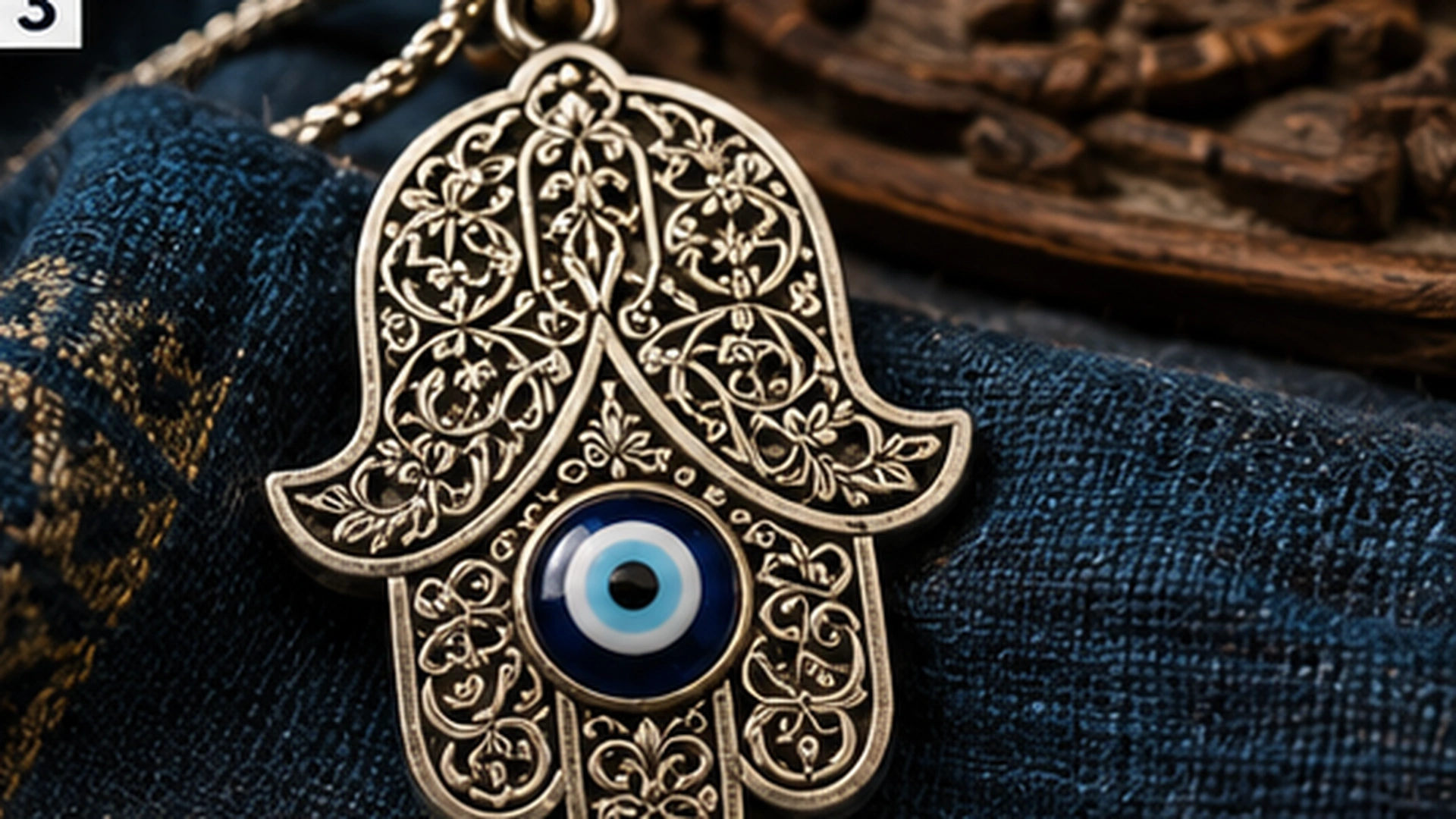
The hamsa, also written khamsa, is a hand-shaped amulet found in Middle Eastern and North African contexts. Khamsa means “five,” referring to the hand’s five digits. Some examples contain an eye; others do not.
British Museum records describe Moroccan and Palestinian hand amulets used against the “eye of envy.” The museum notes that these objects could be used by Muslims or Jews, while other examples and communities include Christian use as well.[3] The name “Hand of Fatima” is common in Muslim contexts, but it should not erase Jewish, Christian, regional, and older hand-amulet traditions.
When an eye appears within the hand, the image combines two protective ideas: the hand as a barrier or blessing and the eye as a vigilant counter-gaze. The precise interpretation depends on the community and object.
Specific culture or historical context: Morocco, North Africa; Islamic-world material culture with broader Jewish, Christian, and Muslim amuletic use in the region.
People shown: No people.
Location: North African or Islamic art museum display.
Clothing: Not applicable.
Architecture: Dark neutral gallery case.
Objects: Silver khamsa, enamel details, glass element, conservation mount.
Lighting: Soft directional light emphasizing silver texture and enamel without theatrical effects.
Composition: Centered still life with the whole pendant visible and enough side space for article layout.
SEO-friendly filename: moroccan-khamsa-eye-protection-amulet.webp
Image title: Moroccan Khamsa Protection Amulet
Alt text: Moroccan silver khamsa hand amulet with enamel and an eye-like glass detail
Caption: Khamsa hand amulets have been used in Middle Eastern and North African communities as protection against the eye of envy.
Recommended placement: After the hamsa section.
Article section supported: The Hamsa or Khamsa: A Hand Used Against the Eye of Envy
Important elements to avoid: No generic belly-dance setting, no mixed Turkish nazar wall, no invented Arabic text, no claim that one religion owns the symbol.
Eye-Cups and Gorgons in Ancient Greek Art
Large painted eyes appeared on Greek drinking cups known as eye-cups from about the sixth century BCE. When a drinker raised the cup, the painted eyes could align with the face, temporarily turning the vessel into a masklike image. Some cups also contained a gorgoneion, or Gorgon face, inside.[4]
Scholars debate the complete significance of eye-cups, and not every example should be assigned a single protective meaning. Their imagery participated in drinking-party performance, humor, identity, myth, and visual transformation. The Gorgon, especially Medusa’s face, is more securely understood as apotropaic in many contexts: a threatening image used to repel threats.[5]
Apotropaic means intended to turn away harm. It does not necessarily mean that the image itself was viewed as gentle or benevolent. A frightening face could protect precisely because it confronted danger with danger.
Ethiopian Healing Scrolls and the Protective Gaze
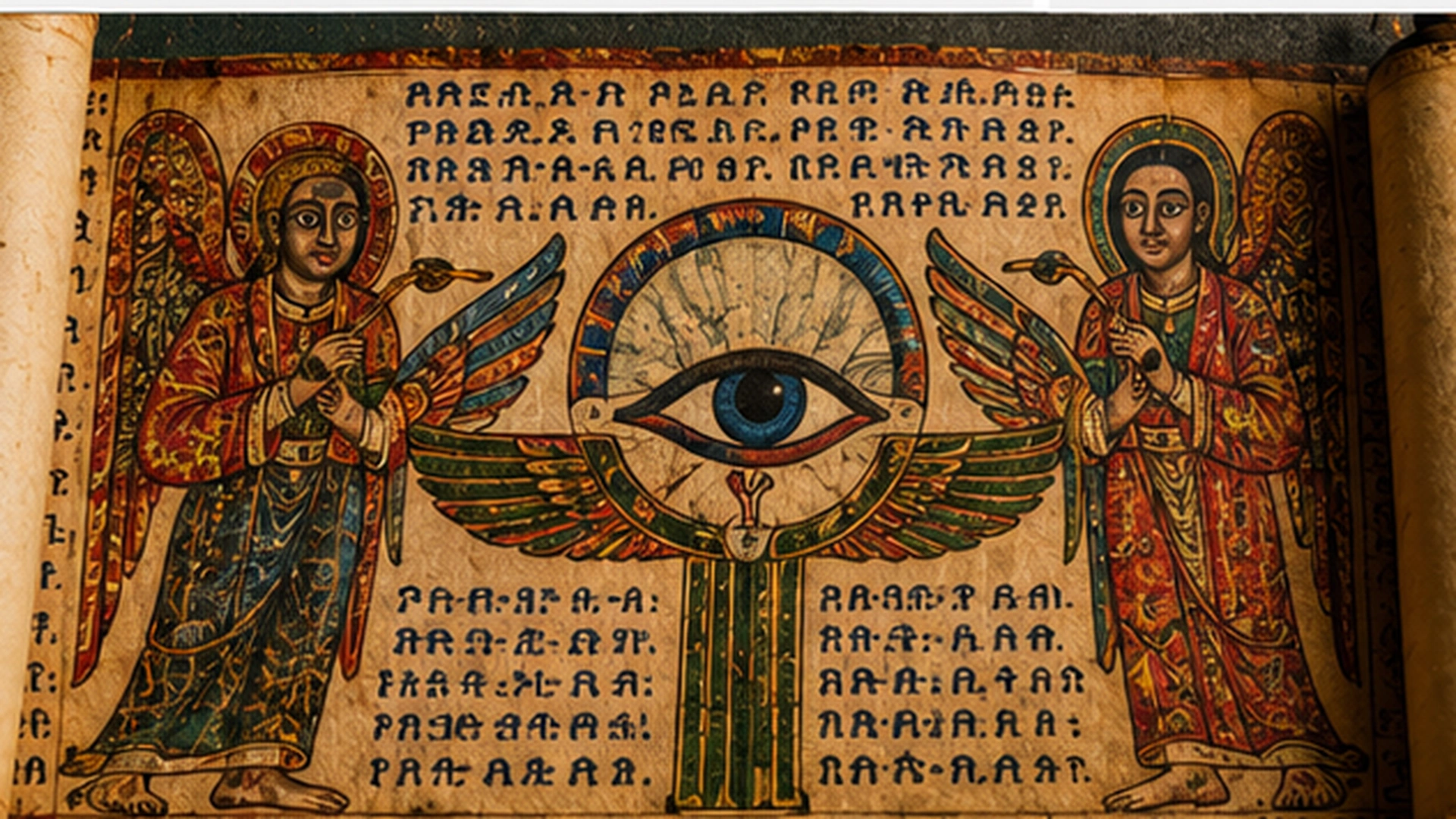
Ethiopian Christian healing scrolls provide a distinct African example of eye symbolism. These hand-produced parchment scrolls could contain prayers, sacred names, protective figures, and large staring eyes. The Metropolitan Museum of Art explains that the gaze is central to the scrolls’ protective and healing logic: the eyes of talismanic figures confront the illness-causing force, and some figures are reduced almost entirely to faces or eyes.[6]
These objects belong to particular Ethiopian Orthodox and local healing histories. They should not be presented as “African tribal magic,” and their religious function should not be detached from the prayers, specialists, clients, materials, and Christian framework surrounding them.
Claims about demons, spiritual attack, or healing outcomes belong to religious belief and practice. They are not equivalent to biomedical evidence. Responsible description can respect the tradition while maintaining that distinction.
Specific culture or historical context: Ethiopian Christian healing-scroll tradition, nineteenth or early twentieth century presentation.
People shown: One Ethiopian conservator represented only by hands and forearms.
Location: Ethiopian heritage institution or manuscript conservation room.
Clothing: Professional conservation clothing and nitrile gloves.
Architecture: Simple archival workspace.
Objects: Parchment healing scroll, weights, archival supports, magnifier.
Lighting: Even, low-UV conservation lighting with warm parchment tones.
Composition: Overhead 16:9 documentary view; scroll runs diagonally across frame.
SEO-friendly filename: ethiopian-healing-scroll-protective-eyes.webp
Image title: Protective Eyes in an Ethiopian Healing Scroll
Alt text: Ethiopian parchment healing scroll with a painted face and large protective eyes
Caption: In Ethiopian healing-scroll traditions, the gaze of talismanic figures could play a protective role within Christian prayer and healing practice.
Recommended placement: After the Ethiopian healing-scroll section.
Article section supported: Ethiopian Healing Scrolls and the Protective Gaze
Important elements to avoid: No staged exorcism, no exposed private client information, no fantasy demon, no “tribal magic” styling, no readable invented Ge’ez text.
Shiva’s Third Eye: Supreme Wisdom and Transformative Power
In Hindu iconography, Shiva is frequently shown with a vertical third eye on the forehead. A seventh-century stone linga in the Metropolitan Museum of Art displays this eye as a sign of “supreme wisdom.”[7] Other texts and images connect it with perception beyond ordinary sight, ascetic power, and the ability to destroy illusion or burn destructive desire.
The third eye is not simply an ancient name for intuition, psychic prediction, or a modern wellness technique. Those interpretations may belong to later yoga, tantric, esoteric, or New Age systems, but they should not be projected backward onto every Hindu image.
Shiva’s third eye also shows why eye symbolism cannot be divided neatly into protection versus danger. The same eye can represent knowledge and a terrible transformative force. Wisdom is not always pictured as gentle; it can expose and destroy falsehood.
Buddha Eyes on Nepalese Stupas
At Swayambhunath and other stupas in Nepal’s Kathmandu Valley, pairs of eyes appear on the four sides of the square structure above the dome. The Metropolitan Museum of Art notes that these eyes look toward the four cardinal directions.[8] Project Himalayan Art explains that they are commonly identified with the Buddha’s compassionate and all-knowing gaze.[9]
The eyes operate within the architecture of the stupa, a Buddhist reliquary monument associated with the Buddha’s presence, teachings, relics, pilgrimage, and circumambulation. They are not merely a decorative “third eye” design. Their meaning is connected to the monument, directional orientation, local Newar and Buddhist histories, and ongoing religious practice.

Specific culture or historical context: Newar and Nepalese Buddhist heritage in the Kathmandu Valley.
People shown: A few distant Nepalese worshippers or caretakers; no posed tourists.
Location: Swayambhunath, Kathmandu, Nepal.
Clothing: Contemporary local clothing appropriate to morning worship; no costume styling.
Architecture: Authentic stupa dome, harmika with eyes, gilded tower, prayer flags in natural condition.
Objects: Butter lamps or prayer wheels may appear only if architecturally accurate and not dominant.
Lighting: Early golden sunlight with cool valley haze.
Composition: Low-angle 16:9 architectural photograph; eyes and structure dominate; people provide scale.
SEO-friendly filename: swayambhunath-buddha-eyes-nepal.webp
Image title: Buddha Eyes at Swayambhunath Stupa
Alt text: Painted Buddha eyes on the Swayambhunath stupa above worshippers in Kathmandu
Caption: The eyes on Nepalese stupas are commonly understood as the Buddha’s compassionate and all-knowing gaze toward the cardinal directions.
Recommended placement: After the Nepalese stupa section.
Article section supported: Buddha Eyes on Nepalese Stupas
Important elements to avoid: No giant supernatural eyes in the sky, no Tibet-Nepal costume mixing, no added mandala, no fantasy levitation, no text, logos, or watermark.
The Eye of Providence and the All-Seeing Eye
The Eye of Providence is usually drawn as an eye within a triangle surrounded by rays. In European and American Christian-influenced art, it represents divine providence, omnipresence, or omniscience. A British Museum record from the early nineteenth century explicitly describes the eye as signifying God’s omnipresence and omniscience.[10]
The symbol also appears on the reverse of the Great Seal of the United States above an unfinished pyramid. The National Archives explains that the eye and the motto Annuit Coeptis communicate divine favor toward the American undertaking.[11]
Is the All-Seeing Eye an Illuminati Symbol?
The eye-in-triangle existed in Christian and political imagery beyond conspiracy theories. The Great Seal’s documented design history belongs to the late eighteenth-century United States. Modern associations with secret societies, surveillance, entertainment, and internet conspiracy culture are later layers of interpretation. A triangle containing an eye does not automatically prove an Illuminati connection.
Protection, Knowledge, and Watchfulness: How the Meanings Differ
Three themes organize many eye symbols, but they do not erase cultural differences.
Protection
Protective eye symbols may guard, heal, avert envy, or confront danger. The wedjat protects through restored wholeness. Evil-eye amulets counter a harmful gaze. Hamsas combine the protective hand with an eye or other motifs. Ethiopian healing-scroll eyes confront spiritual danger within a Christian talismanic practice.
Knowledge
Knowledge symbolism grows from the connection between seeing and understanding. Shiva’s third eye represents wisdom beyond ordinary perception. Buddha eyes communicate an awakened, compassionate gaze. The metaphor “to see” often means “to understand,” but each religious tradition gives that metaphor a different theological form.
Watchfulness
Watchfulness can be comforting or unsettling. A divine eye may reassure believers that the world remains under sacred care. A civic emblem may encourage duty. A surveillance camera icon warns of monitoring. A staring eye in a public place may make people feel accountable—or controlled.
Do Images of Watching Eyes Change Human Behavior?
Psychologists have studied whether eye images act as subtle cues of observation. Some experiments found reduced littering, increased donations, or other prosocial behavior when eyes were displayed.[12] Direct gaze can capture attention and increase self-referential processing—the feeling that another’s attention is directed toward oneself.[13]
The evidence is not perfectly consistent. Reviews have reported failed replications and context-dependent effects, and not every eye image changes behavior.[14] Cultural meaning, setting, the realism of the eyes, existing social norms, and whether people believe they are genuinely observed may all matter.
This research can help explain why eye imagery feels watchful, but it does not prove supernatural protection or divine surveillance. Psychological responses and religious meanings are different kinds of claims.
Modern Eye Symbols in Tattoos, Jewelry, Fashion, and Branding
Modern users often choose eye designs to represent self-awareness, intuition, grief, protection, memory, vigilance, rebellion, or personal transformation. These meanings may be sincere even when they are not historically ancient.
Problems arise when commercial designs combine sacred symbols from unrelated traditions and market the result as “the original universal protection eye.” A wedjat, hamsa, nazar bead, Shiva’s third eye, and Buddha eyes are not interchangeable parts of one spiritual logo.
How to Choose or Interpret an Eye Symbol Responsibly
Identify the exact symbol instead of calling every design an “all-seeing eye.”
Find the community, period, object type, and religious or political context.
Distinguish museum-documented history from modern spiritual interpretation.
Avoid claiming guaranteed protection, healing, fertility, wealth, or psychic power.
Do not copy restricted ritual objects, funerary material, or sacred manuscripts merely for decoration.
Credit the culture and artist when adapting a documented motif.
Use a neutral eye design when the intention is personal and not tied to a particular tradition.
Common Misunderstandings
“Every Eye Symbol Means Protection”
No. Eyes can protect, but they can also represent danger, judgment, wisdom, divine presence, envy, political vigilance, or surveillance.
“The Evil Eye Bead Is the Evil Eye”
Usually, the bead is an amulet intended to avert the evil eye. The harmful eye is the feared gaze; the bead is a protective response.
“The Eye of Horus and the All-Seeing Eye Are the Same”
They are historically different. The wedjat belongs to ancient Egyptian religion and the restoration of Horus’s eye. The Eye of Providence belongs to Christian-influenced European and American imagery of divine oversight.
“The Third Eye Has One Universal Chakra Meaning”
Shiva’s third eye has a specific Hindu iconographic history. Chakra systems also vary across texts and traditions. Modern claims should not be presented as one unchanged ancient teaching.
“All African Eye Symbols Share One Meaning”
Africa is not one culture. Egyptian wedjat amulets and Ethiopian Christian healing scrolls come from different languages, periods, religious systems, and material traditions.
How Materials and Placement Change an Eye Symbol’s Meaning
An eye painted on a wall does not function in the same way as an eye worn on the body. Material, scale, location, and audience help determine what a symbol is expected to do. Small amulets can remain close to the wearer and may be understood as personal protection. Monumental eyes on architecture address communities and landscapes. Eyes printed on civic emblems or uniforms communicate institutional vigilance. Eyes inside manuscripts operate through reading, viewing, prayer, and handling.
Ancient Egyptian wedjat eyes were made in faience, stone, glass, gold, and other materials. Their loops and perforations show that many were designed to be suspended or attached. The material could affect cost, color, durability, and social setting without replacing the symbol’s religious associations. A gold amulet from an elite burial and a small faience amulet used by a less wealthy person could share protective meaning while belonging to different material worlds.
The same principle applies to hamsas and evil-eye objects. A large silver khamsa displayed in a home, a tiny hand bead sewn onto clothing, and a mass-produced plastic eye sticker may all refer to protection, yet their makers, users, economic value, and degree of religious commitment may be very different. Modern manufacture does not automatically make an object meaningless, but it changes the context in which meaning is created and transmitted.
How Eye Symbols Travel Between Cultures
Symbols can move through trade, migration, conquest, pilgrimage, intermarriage, collecting, and mass media. Movement does not mean that every culture received an image unchanged. Communities may preserve a form while altering its name, material, story, or purpose.
Wedjat-eye amulets, for example, have been found beyond Egypt in Phoenician and Cypriot archaeological contexts. A British Museum amulet from Amathus in Cyprus combines Egyptianizing form with a different local history of production, burial, and exchange.[15] The object is evidence of contact and adaptation, not proof that Egyptian and Cypriot religion were identical.
The modern blue eye bead has likewise become internationally recognizable through tourism and global commerce. A person may buy one as a religious amulet, a family custom, a national souvenir, or a decorative object. These uses can coexist, but researchers should avoid assuming the owner’s belief from the object alone.
Historical Evidence, Living Belief, and Modern Interpretation
Eye symbolism is best studied by separating three kinds of evidence. Historical evidence includes excavated objects, dated artworks, inscriptions, texts, and museum records. Living belief includes what present-day practitioners, families, artists, and religious specialists say and do. Modern interpretation includes personal spirituality, tattoo culture, internet symbolism, and commercial design.
These categories can overlap, but they should not be confused. A modern person may interpret the Eye of Horus as intuition or personal empowerment. That interpretation can be meaningful to the person, yet it is not automatically evidence for what Egyptians in the New Kingdom or Ptolemaic period believed. Similarly, the fact that a hamsa appears in contemporary fashion does not erase its protective use in Jewish, Muslim, Christian, and regional family traditions.
Responsible writing identifies which kind of claim is being made. “This amulet was excavated from a burial” is an archaeological statement. “Some believers use this symbol to avert envy” describes a living cultural belief. “The symbol guarantees safety” is a supernatural claim that cannot be established scientifically.
Scientific and Ethical Limits
Science can investigate human vision, attention, gaze perception, social behavior, and the measurable effects of stress or expectation. It can test whether an eye image changes donation, littering, memory, or self-awareness in a particular experiment. It cannot verify that a painted eye contains an invisible protective force, that envy physically travels through a gaze, or that an amulet guarantees healing.
This distinction does not require dismissing religious traditions. Cultural and religious beliefs can shape identity, comfort, conduct, and community relationships even when their supernatural claims are outside scientific testing. Ethical interpretation avoids both extremes: it neither advertises guaranteed spiritual outcomes nor describes practitioners as irrational.
Researchers and content creators should also consider access and privacy. A museum-published amulet is different from a restricted ritual object, a manuscript made for a named client, or a ceremony that communities do not want photographed. Public visibility does not always equal permission for unrestricted commercial reuse.
Key Takeaways
Eye symbols often concern seeing, being seen, protection, knowledge, and accountability.
The Eye of Horus represents restored wholeness, regeneration, and protective power in ancient Egyptian contexts.
Evil-eye traditions concern the danger of envy or harmful attention; nazar beads and hamsas are protective responses.
Shiva’s third eye represents supreme wisdom and transformative force in Hindu iconography.
Buddha eyes on Nepalese stupas express an awakened, compassionate gaze oriented toward the cardinal directions.
The Eye of Providence represents divine oversight and appears in Christian-influenced art and the Great Seal of the United States.
Psychological eye-cue studies suggest that perceived observation can affect behavior, but findings are mixed and do not validate supernatural claims.
Responsible interpretation requires a specific culture, period, object, and source.
People Also Ask
What does an eye symbolize?
An eye can symbolize protection, knowledge, awareness, divine presence, healing, envy, judgment, or watchfulness. The correct meaning depends on the specific cultural tradition and object.
Which eye symbol represents protection?
The Eye of Horus, evil-eye amulets, hamsas, and some Ethiopian talismanic eyes have protective meanings, but they belong to different historical and religious systems.
Is the evil eye good or bad?
The “evil eye” refers to a harmful or envious gaze. An eye bead or related amulet is generally used as protection against that danger.
What does the eye in a hamsa mean?
It commonly strengthens the hand amulet’s protective function by presenting a vigilant counter-gaze against envy or harm. Not every hamsa contains an eye.
What does Shiva’s third eye mean?
It represents supreme wisdom, perception beyond ordinary sight, ascetic power, and transformative force within Hindu iconography.
What do Buddha eyes mean?
On Nepalese stupas, they are commonly understood as the Buddha’s compassionate and all-knowing gaze looking toward the four directions.
What does the Eye of Providence mean?
It represents an overseeing divine presence, providence, omniscience, or omnipresence in Christian-influenced art and civic imagery.
Do eye symbols really protect people?
Protective power is a matter of religious or cultural belief. There is no scientific evidence that an image or amulet guarantees supernatural protection.
Frequently Asked Questions
Can I wear an Eye of Horus or hamsa?
Many people wear these symbols, but responsible use includes learning the history, avoiding false claims, and not treating sacred traditions as generic fashion trends.
What does an eye tattoo mean?
It may represent protection, memory, intuition, vigilance, grief, or self-knowledge. A culturally specific tattoo should be researched more carefully than a neutral eye design.
Why are eye symbols often blue?
Blue is especially common in modern nazar beads and in some amuletic traditions, but eye symbols are not universally blue. Materials, pigments, and color meanings vary by place and period.
Is an eye in a triangle always religious?
No. It may refer to divine providence, government history, Freemasonry, popular culture, surveillance, or a modern graphic design. Context determines the meaning.
Are eye symbols connected to ancestors?
Some traditions connect sacred sight with ancestors, spirits, or the dead, while others do not. The link must be established from the specific community rather than assumed.
Conclusion
Eye symbols endure because the gaze is one of the most powerful experiences in human life. Eyes reveal attention, communicate emotion, identify danger, and make people aware that they are visible to others. Religious and artistic traditions transform those experiences into images of protection, wisdom, restoration, compassion, judgment, and vigilance.
The most accurate interpretation begins with specificity. The Eye of Horus is not the evil eye. The hamsa is not automatically Islamic or Jewish alone. Shiva’s third eye is not simply a universal intuition symbol. Buddha eyes belong to the architecture and practice of Nepalese stupas. The Eye of Providence has a documented Christian and civic history beyond modern conspiracy culture. Respecting those differences makes the symbols more meaningful, not less.
Research Sources and Further Reading
[1] The Metropolitan Museum of Art. Wedjat Eye Amulet. https://www.metmuseum.org/art/collection/search/550998
[2] British Museum. Amulet / pilgrim souvenir with eye bead, Turkey. https://www.britishmuseum.org/collection/object/W_2012-6006-13
[3] British Museum. Hand-shaped khamsa pendants from Morocco and Palestine. https://www.britishmuseum.org/collection/object/W_As1966-01-440
[4] The Metropolitan Museum of Art. Terracotta kylix: eye-cup. https://www.metmuseum.org/art/collection/search/254894
[5] The Metropolitan Museum of Art. Medusa in Ancient Greek Art. https://www.metmuseum.org/essays/medusa-in-ancient-greek-art
[6] The Metropolitan Museum of Art. Ethiopian Healing Scrolls. https://www.metmuseum.org/essays/ethiopian-healing-scrolls
[7] The Metropolitan Museum of Art. Linga with Face of Shiva (Ekamukhalinga). https://www.metmuseum.org/art/collection/search/38250
[8] The Metropolitan Museum of Art. Nepal: Swayambhunath Stupa. https://www.metmuseum.org/perspectives/nepal
[9] Rubin Museum of Himalayan Art, Project Himalayan Art. The Svayambhu Chaitya of Kathmandu. https://rubinmuseum.org/projecthimalayanart/essays/the-svayambhu-chaitya-of-kathmandu/
[10] British Museum. Portrait record explaining the Eye of Providence as omnipresence and omniscience. https://www.britishmuseum.org/collection/object/P_1876-1209-129
[11] National Archives. The Great Seal: Celebrating a National Emblem. https://prologue.blogs.archives.gov/2015/06/20/the-great-seal-celebrating-233-years-of-a-national-emblem/
[12] Bateson et al., PLOS ONE / PubMed. Do images of watching eyes induce more prosocial or normative behavior?. https://pubmed.ncbi.nlm.nih.gov/24339990/
[13] Conty, George, and Hietanen / PubMed. Watching Eyes Effects: When Others Meet the Self. https://pubmed.ncbi.nlm.nih.gov/27639066/
[14] Dear et al., Evolution and Human Behavior. Do Watching Eyes Influence Antisocial Behavior? A Systematic Review and Meta-Analysis. https://www.sciencedirect.com/science/article/pii/S1090513817303264
[15] British Museum. Cypro-Phoenician wedjat-eye amulet from Amathus, Cyprus. https://www.britishmuseum.org/collection/object/G_1894-1101-119
5. Supporting Content and Internal-Link Opportunities
| Supporting article | Topical and SEO purpose |
|---|---|
| Eye of Horus Meaning: History of the Wedjat Amulet | Deepen the Ancient Egypt cluster and target named-symbol queries. |
| The Evil Eye Across the Mediterranean and Middle East | Cover regional differences, terminology, and protective practices in depth. |
| Hamsa Meaning in Jewish, Muslim, and Christian Communities | Clarify shared and distinct uses without assigning exclusive ownership. |
| Ethiopian Healing Scrolls: Art, Prayer, and Protective Images | Build African Christian art and healing-tradition authority. |
| Shiva’s Third Eye: Meaning in Hindu Art and Myth | Target religious iconography and correct generic chakra claims. |
| Buddha Eyes of Nepal: Swayambhunath and Boudhanath | Connect symbols, architecture, pilgrimage, and Newar heritage. |
| The Eye of Providence: History Beyond Conspiracy Theories | Capture high-interest misconception queries. |
| Protective Symbols Across African Traditions | Compare specific communities without presenting Africa as one culture. |
| Eye Tattoo Meanings and Cultural Considerations | Serve modern design intent and link readers back to source traditions. |
Suggested Internal Anchor Text
protective symbols and amulets
African sacred art and healing traditions
meaning of the Eye of Horus
religious symbols of knowledge
the evil eye and hamsa
spiritual symbols used responsibly
ancestral knowledge and sacred vision
Article Information
- Publisher
- Ancestral Temple
- Editor
- Ancestral Temple
- Last updated
- Jul 26, 2026
- Last reviewed
- Jul 26, 2026
- Content version
- d349ec76ae
This educational article should be read as cultural and spiritual information, not as medical, legal, financial, or emergency advice.
Helpful Related Guidance
Explore This Topic
Related Topic Cluster
Dreams & Symbolism
About the Author
 Ancestral Temple
Spiritual guide and practitioner with decades of experience in ancestral wisdom, rituals, and divine guidance.
Related Posts
View All












Leave a Comment
We'd love to hear your thoughts.