
African Symbols of Protection: Meanings and Cultural Context
Quick Summary
African symbols of protection do not belong to one continent-wide system. Across Africa, communities have used visual signs, sacred texts, jewelry, crosses, amulets, sculpted figur...
African symbols of protection do not belong to one continent-wide system. Across Africa, communities have used visual signs, sacred texts, jewelry, crosses, amulets, sculpted figures and ritual objects in very different ways. Some were believed to guard a person from illness or misfortune. Others communicated vigilance, authority, resilience, divine sovereignty or communal order. Their meanings depend on the people who made them, the language surrounding them, the materials used and the religious or social setting in which they were activated.
This distinction matters because online lists often remove symbols from their histories. An Akan Adinkra design may be presented as a universal charm even though Adinkra is primarily a sophisticated visual language linked to proverbs, leadership, mourning and moral ideas. A Kongo nkisi may be copied as decoration even though it was created through the collaboration of an artist and an initiated ritual specialist. An Ethiopian cross may be treated as a generic pattern even though it belongs to a living Christian tradition.
A culturally responsible guide therefore asks more than “What does this symbol mean?” It also asks: Who used it? When? In what form? Was it worn, displayed, read, blessed, stamped, carried or ritually prepared? Was the meaning fixed, or did it vary by region and practitioner?
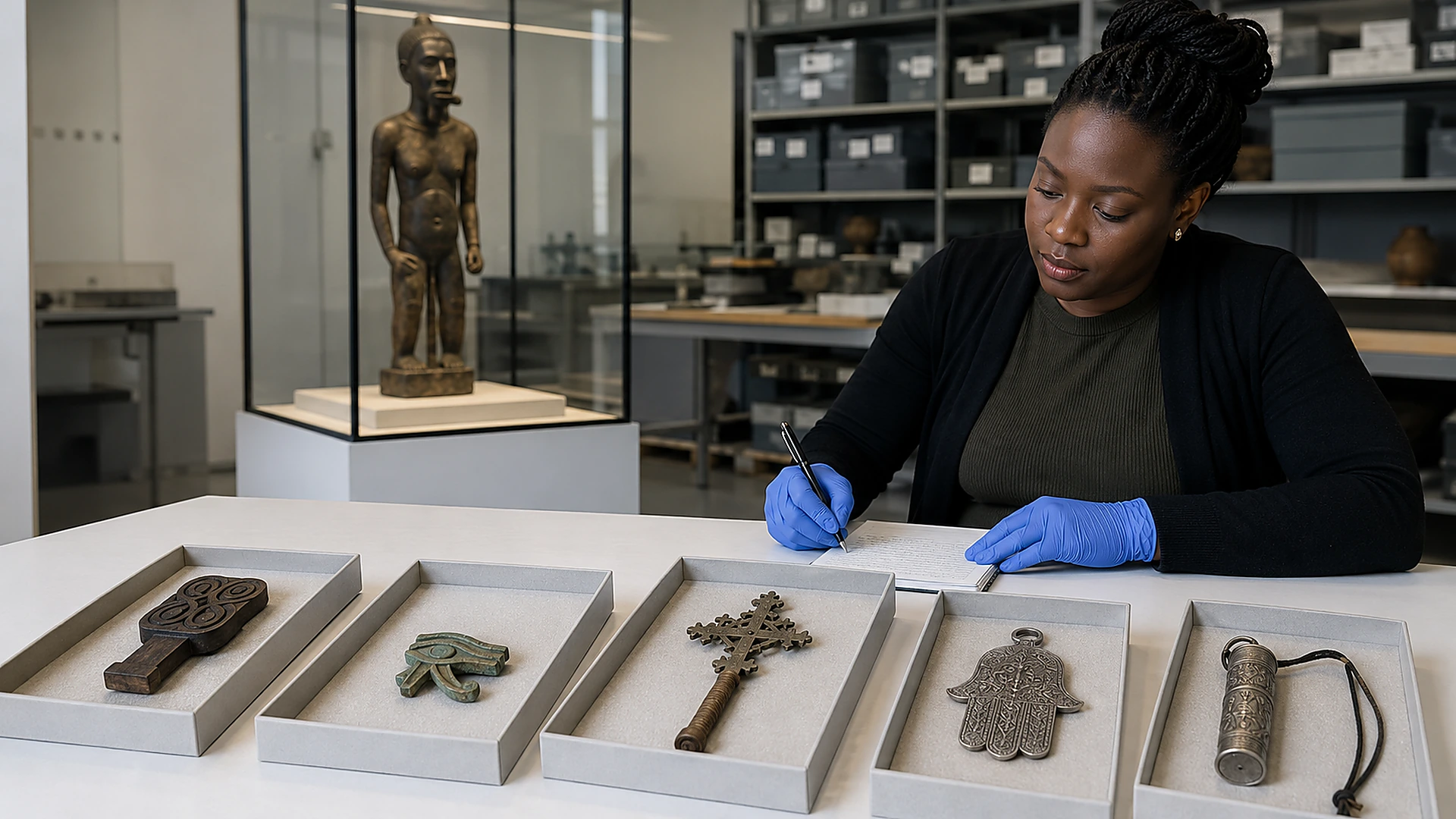
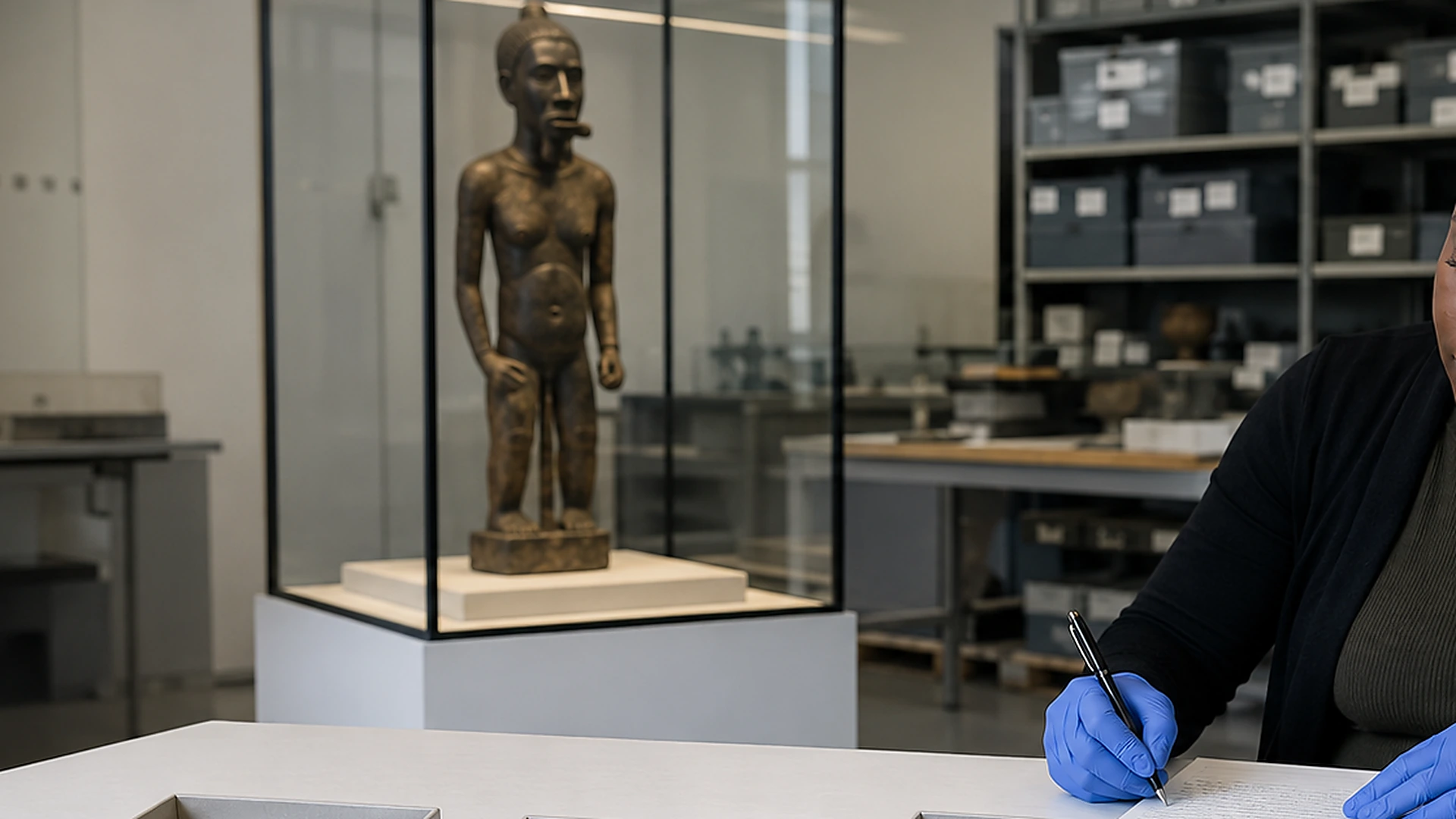
Specific culture or historical context: Contemporary museum research setting that makes clear the objects come from distinct regions and traditions.
People shown: One adult African curator wearing gloves and taking notes.
Location: Modern museum conservation or collections room.
Clothing: Plain professional clothing, nitrile gloves, no ceremonial garments.
Architecture: Neutral study room with archival shelves and glass cases.
Objects: Separate conservation trays, Adinkra stamp, wedjat amulet replica, Ethiopian cross, Moroccan khamsa, Tuareg amulet tube, background Kongo object.
Lighting: Soft neutral museum lighting with accurate metal, clay, wood and textile textures.
Composition: Wide 16:9 editorial photograph; curator on the right third, distinct objects separated across the foreground; generous space on the left for responsive cropping.
SEO-friendly filename: african-symbols-of-protection-cultural-context.webp
Image title: African Protection Symbols in Cultural Context
Alt text: African museum curator studying protective objects from several distinct African traditions
Caption: Protective signs and objects across Africa belong to specific cultures, religions and historical settings.
Recommended placement: After the introduction.
Article section supported: Definition and cultural caution.
Important elements to avoid: No collage panels, labels, embedded text, fantasy glow, mixed ritual ceremony, inaccurate artifact combinations, logos, borders or watermarks.
Quick Answer
African protection symbols include signs and objects associated with safety, healing, vigilance, divine support or defense from misfortune in specific cultures. Examples include ancient Egypt’s wedjat eye, Kongo minkisi, Ethiopian crosses and healing scrolls, North African khamsa amulets, and Qur’anic amulet cases used in several Muslim African communities. Their meanings are not interchangeable.
What Are African Symbols of Protection?
A protection symbol is a visual form, object or inscription understood within a community as helping to guard a person, household, ruler, institution or spiritual relationship. Protection may be physical, social, religious, political or spiritual. In many traditions, the image alone was not the whole source of meaning. Words, prayers, materials, ritual preparation, specialist knowledge and the identity of the owner could be equally important.
The broad phrase “African protection symbols” is useful for searching, but it can be misleading. The continent contains thousands of communities and many religious histories, including indigenous traditions, Christianity, Islam, Judaism and complex combinations of local and transregional practices. A hand-shaped amulet from Morocco, a Kongo cosmogram and an Ethiopian healing scroll should not be treated as parts of one single system.
| Tradition or region | Protective form | Documented meaning or use | Important caution |
|---|---|---|---|
| Akan / Asante, Ghana | Adinkra signs such as Aban, Akoben, Gye Nyame and Dwennimmen | Communicate authority, vigilance, divine sovereignty, strength and moral ideas through proverb-based visual language | Not every Adinkra sign is a magical charm; meanings depend on language and context |
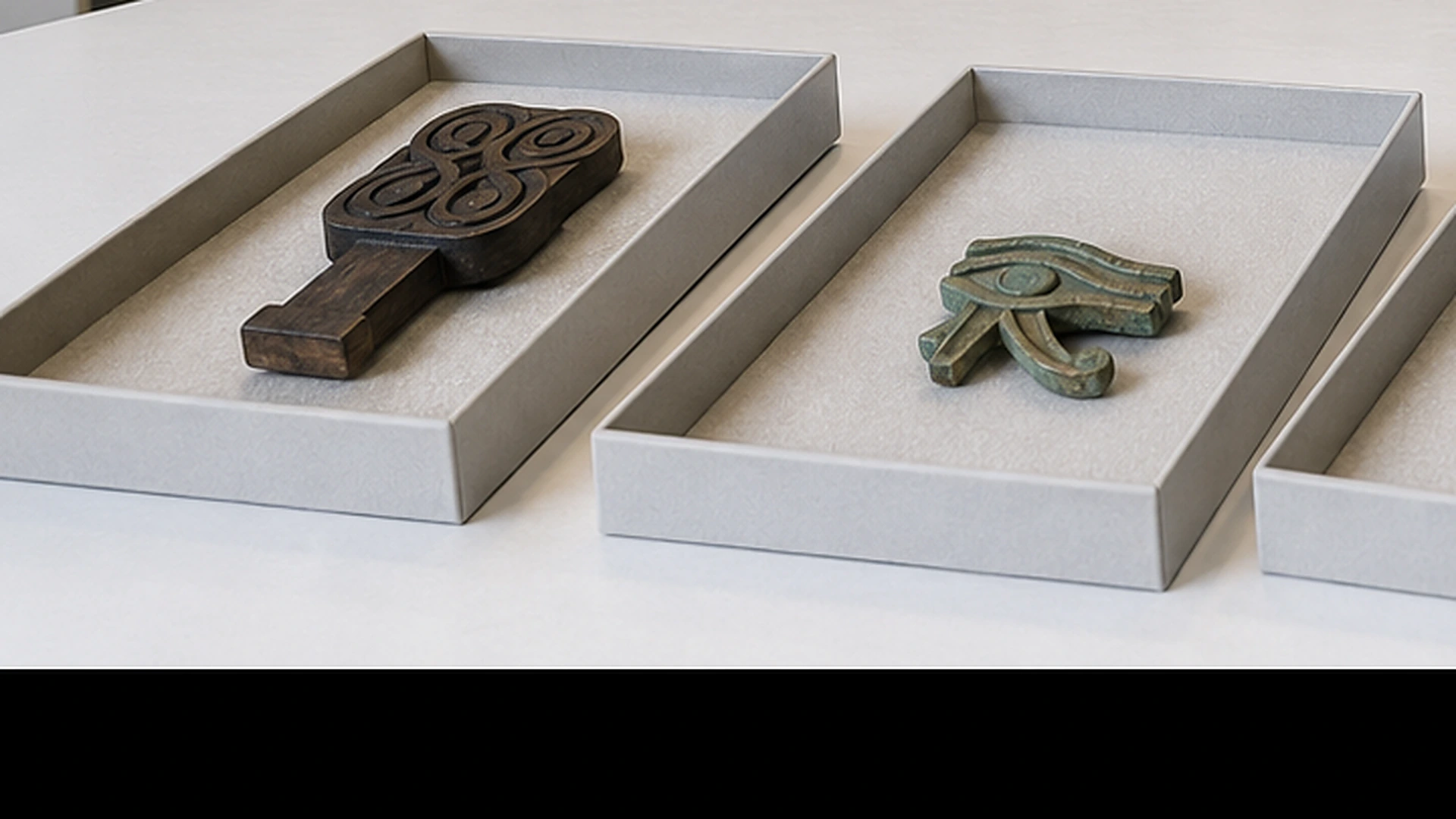
| Ancient Egypt | Wedjat eye amulet | Associated with the restored eye of Horus, regeneration, well-being and protection from harm | Ancient Egyptian religion changed across long periods; modern “evil eye” meanings should not be projected backward automatically |
| Kongo peoples, Central Africa | Nkisi power figures and dikenga cosmogram | Used by specialists for healing, dispute settlement, safeguarding peace and addressing harmful forces | A nkisi is a ritually constituted object, not merely a carved symbol |
| Ethiopian Orthodox and northern Ethiopian traditions | Crosses, pendant icons and healing scrolls | Crosses bless and protect; customized scrolls combine prayers and talismanic images for protection and healing | Church teaching, local practice and specialist healing traditions do not always interpret these objects identically |
| Muslim communities in West, North and East Africa | Qur’anic texts folded into leather or metal cases | Written prayers or verses carried close to the body for well-being and protection | Forms and names vary greatly by community; avoid using “gris-gris” as a universal label |
| Morocco and wider North Africa | Khamsa or hand amulet | Used by Muslims and Jews, among others, to guard against the “eye of envy” | The hand symbol is shared across regions and religions; it is not exclusively African or exclusively Islamic |
| Tuareg communities of the Sahara and Sahel | Silver jewelry and hollow amulet containers | Silver may be associated with clarity, divine blessing and protection; cases may hold Qur’anic writing | Not every cross-shaped Tuareg pendant has one fixed protective meaning |
Protection Is Often More Than a Graphic Sign
Modern design culture encourages people to think of symbols as detachable icons: a shape is copied, named and given a short definition. Many African protective traditions work differently. A mark may be inseparable from a proverb. A pendant may matter because it contains writing. A sculpture may become effective only after medicines or other substances are added by a specialist. A cross may function through prayer and blessing. A scroll may be created for one named person and carried in a case close to the body.
For this reason, the same visible shape can have different meanings, and a similar purpose can be expressed through very different forms. The most accurate interpretation begins with the object’s cultural biography rather than its appearance alone.
Akan Adinkra: Strength, Vigilance and Divine Authority
Adinkra is a graphic communication system associated especially with Akan-speaking communities and Asante history in Ghana. Symbols are stamped onto cloth and also appear on jewelry, brass weights, architecture and other objects. Older signs are commonly linked to proverbs, folktales, songs and moral sayings. Historically, Adinkra cloth was closely associated with royalty and mourning, although its use has expanded widely.
It is common online to see Adinkra reduced to a list of “African spiritual symbols.” That description misses the role of language, social occasion and trained interpretation. The Smithsonian National Museum of African Art emphasizes that understanding the nuances of Adinkra requires knowledge of the names, proverbs and situations associated with particular signs.
Aban: the house or castle
The sign called Aban refers to a two-storied house or castle. In Asante royal contexts, it is associated with the king’s palace, strength and authority. The protective idea is therefore architectural and political: a secure structure stands for organized power and the capacity to endure. It should not automatically be described as a personal magical shield.
Akoben: the war horn
Akoben represents a war horn and is associated with readiness, vigilance and the ability to respond to danger. In a protection-focused article, it is best understood as a symbol of alertness and preparedness rather than as a promise that harm cannot occur.
Gye Nyame: “except God”
Gye Nyame expresses the controlling power and eternal nature of God. Its protective relevance comes through faith in divine sovereignty. The sign is widely used today, but its familiarity should not obscure its Akan linguistic and religious setting.
Dwennimmen: ram’s horns
Dwennimmen represents ram’s horns and communicates humility combined with strength. It can support themes of resilience and disciplined power, but it is more accurately described as a moral symbol than as a dedicated protection amulet.
Specific culture or historical context: Contemporary Akan or Asante Adinkra cloth production in Ghana, connected to historical stamping methods.
People shown: One adult Ghanaian artisan; hands and technique clearly visible.
Location: Open-air or naturally lit textile workshop in Kumasi, Ghana.
Clothing: Practical modern work clothing or locally made textile, no invented ceremonial costume.
Architecture: Simple workshop with wooden table and cloth-drying area.
Objects: Gourd stamps, bark-based dark dye, comb-like grid tool, cotton cloth.
Lighting: Soft daylight with accurate fabric and dye texture.
Composition: Wide documentary photograph with the stamped cloth occupying the foreground and artist on the left third.
SEO-friendly filename: akan-adinkra-symbols-strength-vigilance-protection.webp
Image title: Akan Adinkra Symbols and Protective Themes
Alt text: Akan textile artist stamping Adinkra designs onto cloth in a Ghanaian workshop
Caption: Adinkra signs communicate proverbs, authority and moral ideas; they are not a single system of magical charms.
Recommended placement: After the Adinkra section.
Article section supported: Akan visual language and responsible interpretation.
Important elements to avoid: No random symbols, fake writing, embedded labels, mass-produced tourist shop, fantasy smoke, ritual claims, logos or collage.
The Wedjat Eye in Ancient Egypt
The wedjat eye—often called the Eye of Horus today—is one of the clearest documented examples of a protective amulet from Africa. In ancient Egyptian mythology, the eye of the god Horus was injured and restored. The term wedjat refers to being sound or whole again. Amulets in this form were associated with healing, regeneration and protection from harm.
Wedjat amulets were made in materials such as faience, stone, carnelian, obsidian and gold. They were used by living people and in funerary settings. Their meaning therefore joined protection with restoration and continuing well-being.
The wedjat should be interpreted within ancient Egyptian religion rather than blended indiscriminately with later Mediterranean or Middle Eastern “evil eye” symbols. Similar concerns about harmful gazes appear in many societies, but visual resemblance does not prove identical origin or meaning.
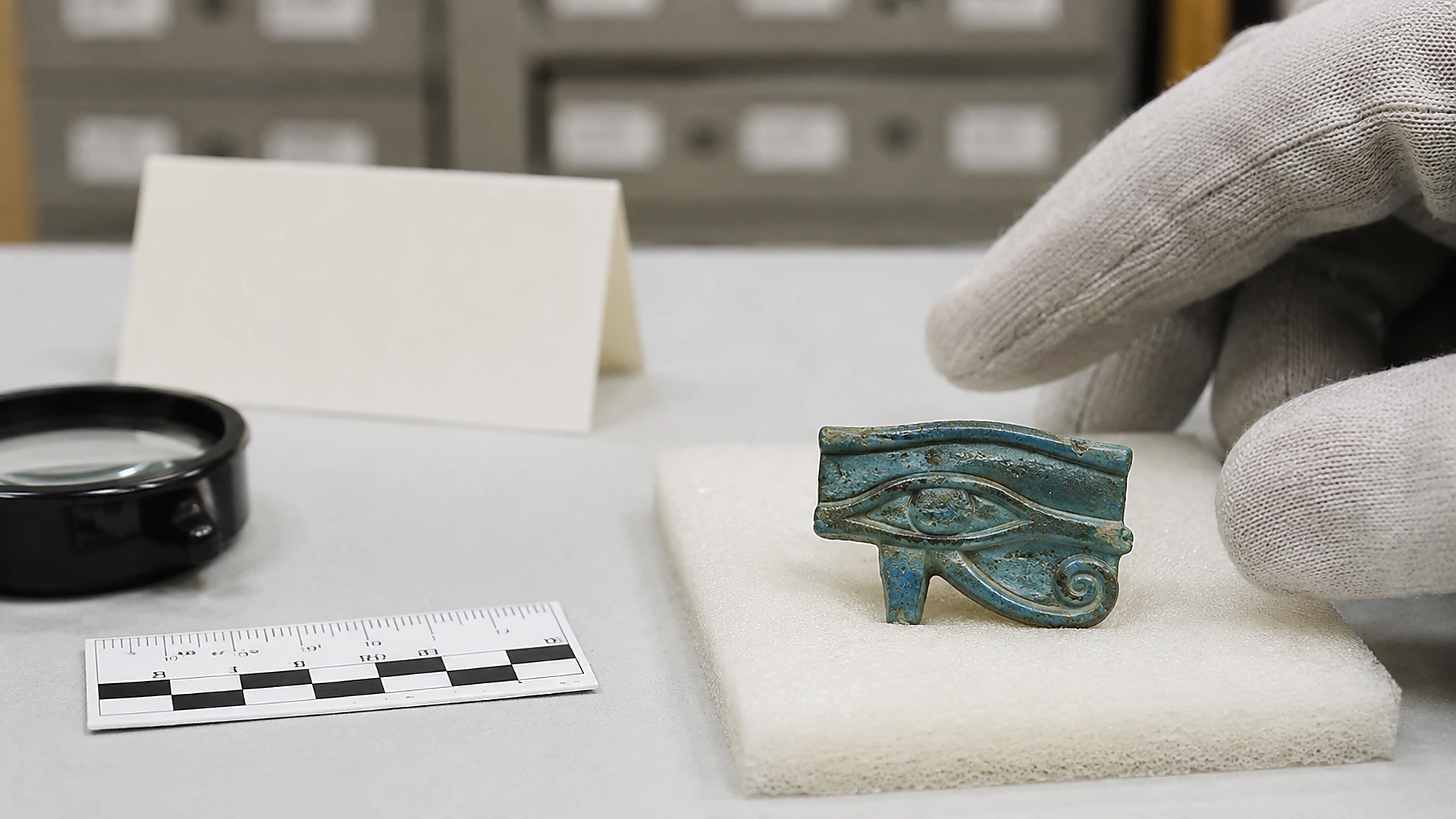
Specific culture or historical context: Ancient Egyptian amulet tradition, shown through a modern museum study setting.
People shown: Only a gloved hand, no full person required.
Location: Egyptian antiquities conservation laboratory or museum study room.
Clothing: Not visible beyond conservation glove.
Architecture: Neutral laboratory surface and softly blurred storage drawers.
Objects: Faience wedjat amulet, archival foam, ruler, magnifier, catalog support.
Lighting: Neutral conservation lighting revealing surface texture and glaze.
Composition: Macro 16:9 photograph with the amulet sharply focused on the right third and negative space to the left.
SEO-friendly filename: ancient-egypt-wedjat-eye-protection-amulet.webp
Image title: Ancient Egyptian Wedjat Eye Protection Amulet
Alt text: Blue-green ancient Egyptian wedjat eye amulet displayed on archival support
Caption: The wedjat eye represented restoration, regeneration and protection in ancient Egyptian religious practice.
Recommended placement: After the wedjat eye section.
Article section supported: Ancient Egyptian protective amulets.
Important elements to avoid: No glowing eye, pyramid fantasy, modern tattoo design, embedded hieroglyphic text, inaccurate scale, logo, border or collage.
Kongo Minkisi and the Dikenga Cosmogram
Among Kongo peoples of Central Africa, a nkisi is not simply a symbol or statue. The term can refer to a spirit as well as the material complex through which a ritual specialist works. A carved figure could be transformed through the addition of medicines, minerals, plant materials, cloth, shells, mirrors, metal and other substances selected for cultural and linguistic significance.
Minkisi—the plural form—could be used for healing illness, settling disputes, safeguarding peace, identifying wrongdoing or responding to forces understood to threaten the community. Their power was connected to the work of the nganga, an initiated specialist, and to the assembled materials and prescribed actions. Copying the silhouette of a nail-studded figure does not reproduce its cultural function.
The dikenga cross within a circle
The dikenga is a Kongo cosmological diagram often described as a cross within a circle. It can represent the sun’s perceived movement in relation to the horizon and, metaphorically, the cycle of birth, life, death, spiritual existence and return. On some minkisi, the sign appears on a medicine pack. Its protective importance comes from a larger understanding of balance between visible and ancestral realms, not from a simple “four directions” definition.
Mirrors, knots and crossroads
Reflective surfaces can refer to seeing into the ancestral realm. Knots and tied bundles may express binding or capturing spiritual forces. Cross forms can mark the meeting of the living and the dead. These elements are meaningful within Kongo cosmology and ritual practice; they should not be rearranged into a new “African protection ritual” without evidence or community authority.
Specific culture or historical context: Kongo peoples of Central Africa, 19th to early 20th century museum presentation.
People shown: One curator and one adult student, naturally posed.
Location: African art museum gallery or study collection.
Clothing: Contemporary professional and student clothing.
Architecture: Minimal gallery with neutral labels blurred beyond readability.
Objects: One nkisi figure with historically plausible materials; no unrelated masks or ritual props.
Lighting: Controlled museum lighting with gentle reflections managed on the case.
Composition: Wide 16:9 documentary photograph; figure centered, people at the edge for scale.
SEO-friendly filename: kongo-nkisi-dikenga-protection-cultural-context.webp
Image title: Kongo Nkisi and Protective Cultural Context
Alt text: Museum display of a Kongo nkisi power figure with curator and student
Caption: A nkisi was constituted through specialist knowledge, materials and ritual use; it was more than a carved symbol.
Recommended placement: After the Kongo section.
Article section supported: Minkisi, dikenga and specialist practice.
Important elements to avoid: No horror styling, glowing eyes, exaggerated nails, invented ceremony, mixed cultures, embedded text, logos or collage.
Ethiopian Crosses and Healing Scrolls
Ethiopia offers two closely related but distinct protective traditions: the central role of the cross in Ethiopian Orthodox Christianity and the personalized use of healing scrolls in parts of the northern highlands. Both involve sacred words and images, but they belong to different forms of religious and healing practice.
Crosses as blessing, triumph and protection
Christianity became established in the Aksumite kingdom in the fourth century. Since then, crosses have appeared in liturgy, processions, personal devotion and everyday life. Ethiopian hand crosses, pendant crosses and processional crosses developed extraordinary regional variety. Museum scholarship describes some processional crosses as apotropaic objects—that is, objects intended to ward off harmful forces—and as emblems of the community.
Within Ethiopian Orthodox theology and devotion, the cross is associated with triumph, resurrection, blessing, healing and protection. Priests use hand crosses to bless the faithful. These forms should not be treated merely as ornamental “tribal patterns,” because they remain active Christian sacred objects.
Healing scrolls and talismanic images
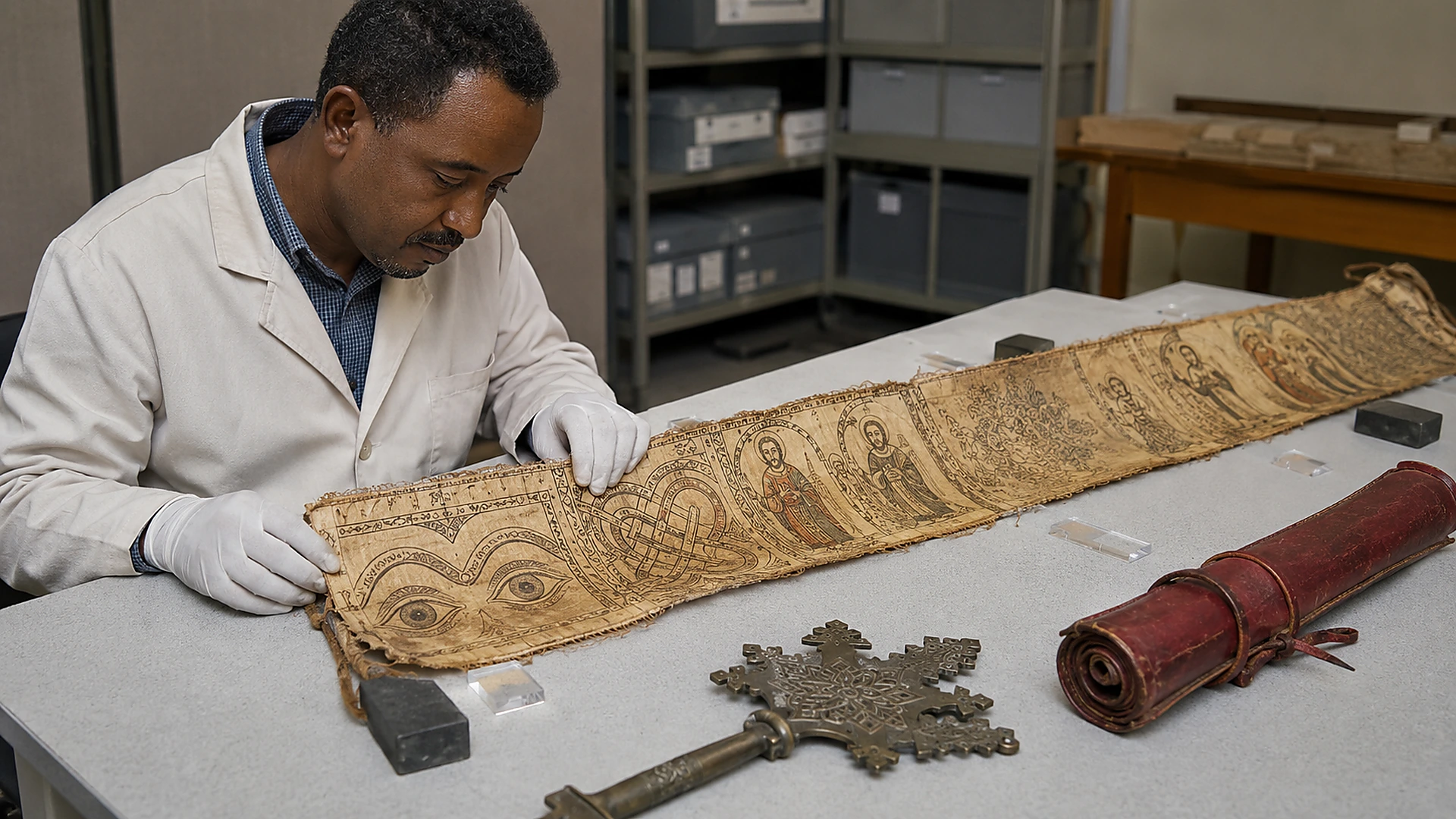
In Amhara- and Tigrinya-speaking regions, customized parchment scrolls have combined prayers with images of saints, angels, eyes, stars and interlaced talismanic forms. A däbtära—an unordained religious scholar who may also practice traditional healing—could prepare a scroll for a named individual. Portable scrolls were rolled into leather cases and worn on the body; larger examples could protect a household.
Meanings were not always fixed. The same eight-pointed form could be interpreted in different ways, and images varied by region and practitioner. The Ethiopian Orthodox Church has not uniformly endorsed all magical interpretations, even though Christian prayers and figures appear on many scrolls. This is an important example of how official doctrine, local devotion and healing practice can overlap without being identical.
Specific culture or historical context: Amhara or Tigrinya healing-scroll tradition and Ethiopian Orthodox cross tradition, shown as related but distinct objects.
People shown: One Ethiopian adult researcher seated at a conservation table.
Location: Museum manuscript study room in Ethiopia or an international collection.
Clothing: Plain professional clothing and conservation gloves.
Architecture: Neutral archive room with manuscript storage boxes.
Objects: Parchment scroll, red leather case, Ethiopian hand cross, archival weights and supports.
Lighting: Soft neutral task lighting with accurate parchment and metal texture.
Composition: Wide 16:9 scene with scroll extending horizontally across the foreground and researcher on the left.
SEO-friendly filename: ethiopian-cross-healing-scroll-protection.webp
Image title: Ethiopian Cross and Healing Scroll Traditions
Alt text: Ethiopian researcher examining a protective healing scroll beside a hand cross
Caption: Ethiopian crosses and healing scrolls express protection through Christian devotion, prayer and specialized healing traditions.
Recommended placement: After the Ethiopian section.
Article section supported: Crosses, healing scrolls and cultural variation.
Important elements to avoid: No fake Ge’ez paragraphs, demonic horror imagery, fantasy rays, ritual sacrifice, mixed foreign artifacts, embedded labels, logos or collage.
Qur’anic Amulets Across West, North and East Africa
In many Muslim African communities, protection has been associated with sacred writing carried close to the body. Specialists may write Qur’anic verses, divine names, prayers or numerical and geometric arrangements on paper, then fold or roll the text into a leather, silver or gold case. The visible container is only part of the object; the written content, the maker and the religious intention can be more important than the outer shape.
The practice is geographically widespread but not uniform. In Akan royal contexts, triangular leather cases containing Qur’anic texts were worn for protection, including during war. Their presence reflects long histories of trade and exchange between Akan courts and Muslim scholars. Among Tuareg communities, hollow silver or leather containers may hold Qur’anic writing. In Somalia, rectangular or cylindrical cases called hersi—literally “protection”—have been worn to promote health and well-being.
Terms such as “gris-gris” are often used loosely in English and French, but local names, materials and religious debates differ. Some Muslim scholars accept certain forms of written prayer while rejecting others as improper. A responsible article therefore describes documented practice without presenting one position as universal.
The Khamsa in Morocco and North Africa
The khamsa—Arabic for “five”—is a hand-shaped amulet found in North Africa and the wider Middle East. In Morocco, silver hand pendants have been worn by Muslims and Jews and associated with protection from the “eye of envy.” The object is also popularly called the Hand of Fatima in Muslim contexts, but that name does not capture all of its users or histories.
Because the hand motif travels across religious and regional boundaries, it should not be advertised as a uniquely African, uniquely Islamic or universally ancient symbol with one unchanging meaning. Its protective use is well documented, but specific forms, inscriptions and interpretations vary.
Tuareg Silver, Amulet Containers and the “Agadez Cross”
Tuareg metalworkers are renowned for silver jewelry. Museum records describe silver as associated with clarity, goodness, happiness and divine blessing, and in some contexts as protective against harmful spirits and illness. Hollow tubes or boxes may contain Qur’anic writing, while bracelets, earrings and pendants also function as wealth, inheritance and social identity.
Cross-shaped Tuareg pendants are frequently marketed under names such as “Agadez cross” and supplied with confident legends about navigation, family lineage or protection. Some of these interpretations are modern, localized or commercially standardized. It is safer to identify the specific pendant type, maker, region and documented use rather than assume every cross-shaped form has one fixed ancient meaning.
Protection Symbols, Sacred Objects and the Problem of Translation
English words such as symbol, charm, talisman, medicine, power and magic can flatten important distinctions. A museum may use “power figure” to translate nkisi, but the Kongo term refers to a wider material and spiritual complex. The word “medicine” may translate substances valued for spiritual, botanical, social and linguistic reasons rather than a modern pharmaceutical product. “Magic” may be the language of older scholarship, local translation or religious criticism, and it can carry misleading stereotypes.
Whenever possible, use the community’s own term—such as nkisi, tälsäm, mäsqäl or hersi—and then explain it carefully. This keeps the reader close to the original cultural framework and reduces the temptation to treat all protective objects as interchangeable occult tools.
Common Misunderstandings
“Africa has one protection symbol”
There is no single symbol recognized by all African peoples. Even widely circulated images such as Gye Nyame, the wedjat eye or the khamsa belong to particular histories and languages.
“Every old-looking pattern is spiritual”
Geometric designs may communicate status, beauty, identity, technique, memory or social belonging. A protective meaning should be supported by evidence rather than assumed from appearance.
“A copied image has the same power as the original object”
In many traditions, meaning depends on prayer, consecration, specialist preparation, contents, ownership and prescribed use. A digital icon or mass-produced necklace may reference a form without reproducing its ritual status.
“Traditional means unchanged”
African communities have long interacted through trade, migration, empire, conversion and artistic exchange. Protective forms have changed, travelled and been reinterpreted. Tradition is historical and living, not frozen.
“Protection beliefs are scientific guarantees”
Religious and cultural beliefs about spiritual safety are not the same as scientifically demonstrated protection from disease, violence, financial loss or other hazards. Protective objects should never replace medical care, legal help, physical safety planning or other evidence-based action.
How to Use African Protection Symbols Respectfully
Identify the specific culture, region, language and religious setting before using or explaining a symbol.
Distinguish between a communicative sign, a sacred object, a written amulet, a ritual instrument and a modern decorative adaptation.
Use museum, academic and community sources rather than relying on anonymous symbol charts or commercial product descriptions.
Avoid combining unrelated symbols into a fictional “African protection” design or ceremony.
Do not expose restricted ritual knowledge or claim to reproduce an initiated practice from a public image.
When using a symbol in a tattoo, logo or product, consider whether the form is sacred, funerary, clerical, royal or connected to a living community.
Credit the community and object type in captions, product descriptions and educational material.
Use belief-language—“was believed,” “is understood,” or “is used within”—instead of promising supernatural results.
Consult cultural custodians, artists, clergy or researchers when the intended use is public, commercial or permanent.
Can Anyone Wear an African Protection Symbol?
There is no single answer. Some forms, such as widely sold Adinkra jewelry or contemporary khamsa pendants, circulate broadly. Others may be clerical, royal, funerary, initiated or personally commissioned. An Ethiopian priest’s hand cross, a customized healing scroll and a Kongo nkisi do not have the same social status as a modern printed design.
A respectful wearer should know what the object is, who made it, whether it was intended for public use and whether its sale supports the community or artist. Learning the name and history is more meaningful than treating the object as an exotic guarantee of luck.
People Also Ask
What is the African symbol for protection?
There is no single pan-African protection symbol. Specific examples include the ancient Egyptian wedjat eye, Ethiopian crosses, Kongo minkisi, North African khamsa amulets and Qur’anic amulet cases used in several Muslim African communities.
Are Adinkra symbols used for protection?
Some Adinkra signs communicate themes linked with security, vigilance, strength or divine authority. Adinkra is primarily a proverb-based visual language, so it is inaccurate to describe every sign as a magical protection charm.
What does the Eye of Horus protect against?
Ancient Egyptian wedjat eye amulets were associated with restoration, regeneration, well-being and protection from harm. Their meanings came from the myth of Horus’s injured and restored eye.
What is a Kongo nkisi?
A nkisi is a Kongo spiritual and material complex that may take the form of a figure, container or bundle activated by a ritual specialist. Minkisi could be used for healing, dispute settlement, peacekeeping and protection.
Why are Ethiopian crosses protective?
In Ethiopian Orthodox Christianity, the cross is associated with Christ’s triumph, resurrection, blessing and healing. Processional and personal crosses may be understood as warding off harmful forces and protecting the community.
What is inside an African amulet?
Depending on the tradition, an amulet may contain Qur’anic verses, prayers, divine names, plant or mineral materials, cloth, personal items or other culturally selected substances. The contents and preparation often matter more than the outer design.
Is the khamsa an African symbol?
The khamsa is used in North Africa, including Morocco, but it also appears across the wider Middle East and Mediterranean. It has been used by Muslims and Jews, among others, especially against the “eye of envy.”
Can African protection symbols guarantee safety?
No symbol or object can be scientifically guaranteed to prevent illness, violence, accidents or financial loss. Their importance is religious, cultural, historical and personal; practical safety measures remain essential.
Frequently Asked Questions
Is Gye Nyame a protection symbol?
Gye Nyame expresses the supremacy and eternal nature of God in Akan thought. People may connect that faith with divine protection, but the sign is more accurately described as a statement of divine sovereignty than as a dedicated magical shield.
What does Akoben mean?
Akoben means “war horn” and is associated with vigilance, readiness and the ability to respond to danger. Its protective theme is alertness and preparedness.
What does Aban mean in Adinkra?
Aban refers to a house or castle and is associated with strength, authority and royal power. Spellings and interpretations can vary, so cultural and linguistic context matters.
Is the Kongo cross the same as a Christian cross?
The dikenga cross-within-a-circle is a Kongo cosmological diagram. Kongo Christianity also developed important cross imagery, and the two histories interacted, but the dikenga should not be reduced to a standard Christian cross.
Were minkisi always aggressive figures covered in nails?
No. Nkisi can refer to many receptacles, including packets, vessels and carved figures. Nails and blades appear on certain nkisi nkondi connected with agreements, disputes and punishment, but they do not define every nkisi.
Are Ethiopian healing scrolls still used?
Their use has declined in many places since the twentieth century, but the tradition remains part of Ethiopian cultural memory and living practice. Interpretation and acceptance vary among clergy, healers, families and regions.
Do all African Muslims use amulets?
No. Practice varies, and Muslim scholars disagree about which forms of amulet use are acceptable. The article describes documented cultural practices rather than a universal Islamic rule.
What is a Somali hersi?
Hersi is a Somali term for a protective amulet container, often made in silver or gold and designed to hold written prayers or Qur’anic verses close to the body.
Does Tuareg silver always mean protection?
Silver can be associated with clarity, blessing and protection in Tuareg contexts, but jewelry also expresses inheritance, wealth, marriage and identity. Meaning depends on the object and setting.
Can I use a protection symbol in a business logo?
First determine whether the form is sacred, royal, funerary, clerical or restricted. A logo may commercialize a living tradition, so consult knowledgeable community members and credit the source rather than using a generic “African” label.
Are African symbols suitable for tattoos?
Some people choose them, but permanent use requires careful research. Verify the name, orientation, cultural meaning and whether the symbol is appropriate for public use. Avoid combining unrelated traditions into one design.
How can I verify a symbol’s meaning?
Compare museum collection records, academic publications, language-based sources and explanations from artists or cultural custodians. Be cautious when many commercial websites repeat the same uncited definition.
Key Takeaways
Africa has no single universal protection-symbol system.
Some forms are visual signs; others are sacred texts, jewelry, crosses, figures or personalized ritual objects.
Adinkra communicates proverbs and social values; it should not be reduced to a list of magical charms.
The wedjat eye is a well-documented ancient Egyptian protective amulet associated with restoration and well-being.
Kongo minkisi depend on specialist knowledge, materials and ritual constitution, not appearance alone.
Ethiopian crosses and healing scrolls belong to distinct but sometimes overlapping Christian and healing traditions.
Qur’anic amulet cases appear in several Muslim African societies, with local names and differing religious interpretations.
Respectful use requires cultural identification, evidence, credit and avoidance of supernatural guarantees.
Conclusion
African symbols of protection reveal the creativity with which communities have connected visible forms to moral order, divine presence, health, memory, authority and spiritual safety. Yet their diversity is more important than any simplified list. A stamped Akan sign, an ancient Egyptian amulet, a Kongo nkisi, an Ethiopian cross and a Somali Qur’anic case do not carry the same history or function.
The most responsible way to study these objects is to keep the culture, language, maker, materials and practice attached to the meaning. This approach does more than avoid error. It shows why these traditions remain intellectually, artistically and spiritually significant to the communities that created and continue to interpret them.
Final Summary
African protective traditions include proverb-based symbols, restored-eye amulets, cosmological diagrams, ritual power objects, Christian crosses, healing scrolls, sacred writing and protective jewelry. Their meanings are culturally specific, historically changing and inseparable from the communities and practices that give them significance.
Research Sources and Further Reading
1. Smithsonian National Museum of African Art — Inscribing Meaning: Writing and Graphic Systems in African Art
2. Smithsonian National Museum of African Art — Asante Adinkra Wrapper
3. Smithsonian National Museum of African Art — Adinkra Stamp: Gye Nyame
4. The Metropolitan Museum of Art — Wedjat Eye Amulet
5. The Metropolitan Museum of Art — Nkisi (Power Figure), Kongo Peoples
6. The Metropolitan Museum of Art — Female Nkisi and the Dikenga
7. The Metropolitan Museum of Art — Ethiopian Processional Cross
8. The Metropolitan Museum of Art — Hand Cross (Mäsqäl)
9. The Metropolitan Museum of Art — Ethiopian Healing Scrolls
10. The Metropolitan Museum of Art — Ethiopian Healing Scroll
11. The Metropolitan Museum of Art — Akan Gold Weight Representing a Qur’anic Amulet
12. Smithsonian National Museum of African Art — Tuareg Silver Amulet
13. Smithsonian National Museum of African Art — Somali Hersi Amulet
14. British Museum — Moroccan Khamsa Hand Amulet
15. British Museum — Ethiopian Amuletic Necklace
Article Information
- Publisher
- Ancestral Temple
- Editor
- Ancestral Temple
- Last updated
- Jul 26, 2026
- Last reviewed
- Jul 26, 2026
- Content version
- b459a0c572
This educational article should be read as cultural and spiritual information, not as medical, legal, financial, or emergency advice.
Helpful Related Guidance
Explore This Topic
Related Topic Cluster
Dreams & Symbolism
About the Author
 Ancestral Temple
Spiritual guide and practitioner with decades of experience in ancestral wisdom, rituals, and divine guidance.
Related Posts
View All










Leave a Comment
We'd love to hear your thoughts.