
Sun, Moon and Rising Signs: What Each Means in Astrology
Quick Summary
What Each Means in Astrology Search focus: sun, moon and rising signs | Intent: informational and practical astrology education 1. SEO Metadata Field Recommendation Recommended SEO...
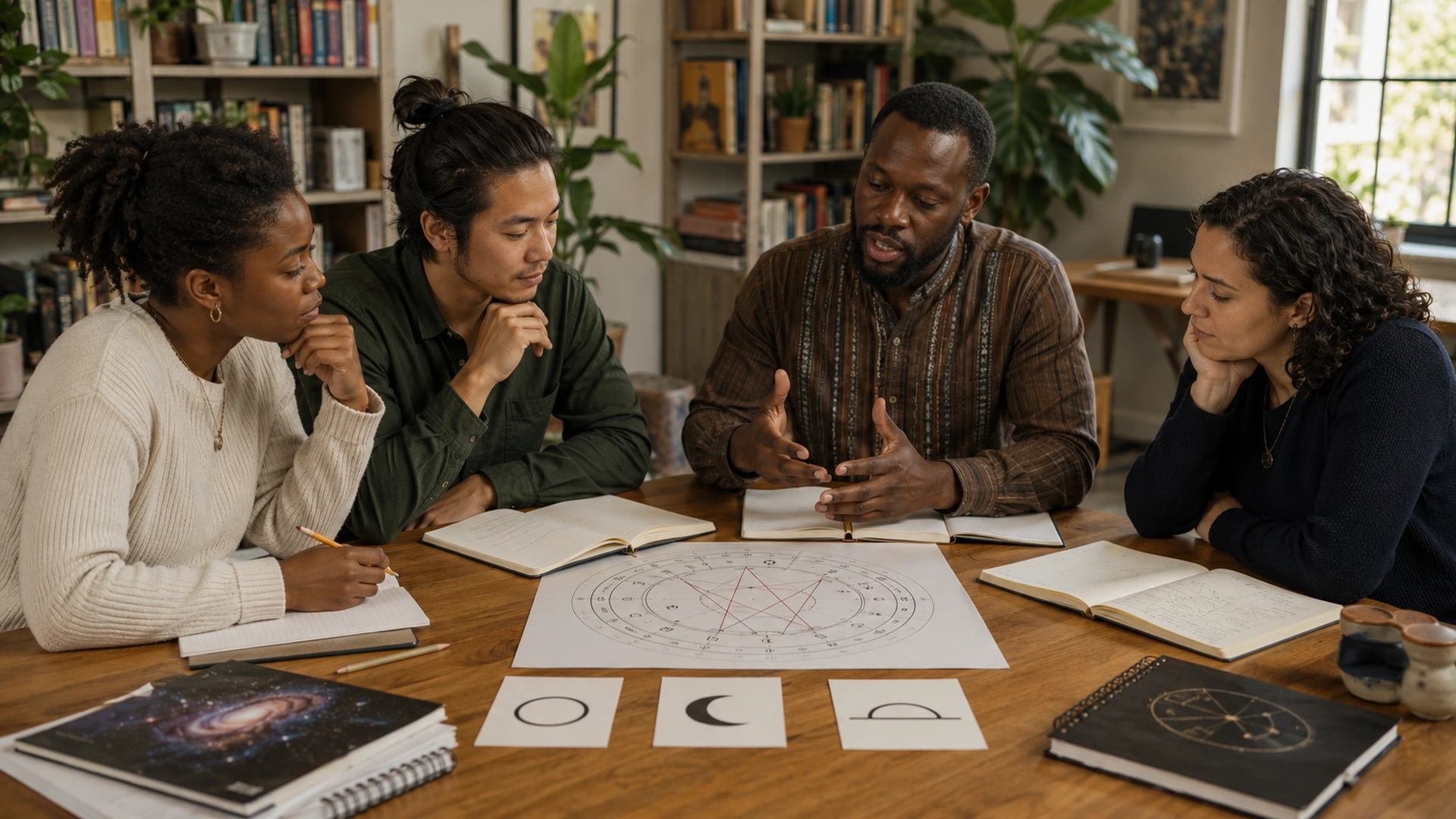
A person can know their zodiac sign and still feel that popular horoscope descriptions do not fit. One reason is that the sign usually discussed in newspapers and social media is only the Sun sign. Modern Western astrologers commonly look at two other chart factors—the Moon sign and the rising sign, or Ascendant—before beginning a fuller interpretation.
Together, the Sun, Moon and rising signs are often called the “Big Three.” The phrase is modern popular shorthand rather than a universal term used by every astrological tradition. Within contemporary Western natal astrology, it offers a simple entry point into three different questions: What am I trying to become? What helps me feel emotionally secure? How do I approach the world and enter new situations? [1][2][3][4][5]
This guide explains those meanings without treating them as scientifically proven personality facts. Astrological interpretations are symbolic traditions. They can be used for cultural study or personal reflection, but they should not be used to diagnose mental health, judge moral character, predict danger or replace medical, legal, financial or psychological advice. [10][11][12][14]
Quick Answer
In modern Western astrology, the Sun sign represents identity, vitality and the qualities a person is thought to develop consciously. The Moon sign represents emotional habits, instinctive reactions and needs for comfort or security. The rising sign is the zodiac sign on the eastern horizon at birth and is associated with approach, self-presentation and the structure of the birth chart. The three are interpreted together, not as fixed scientific facts.
What Are the Sun, Moon and Rising Signs?
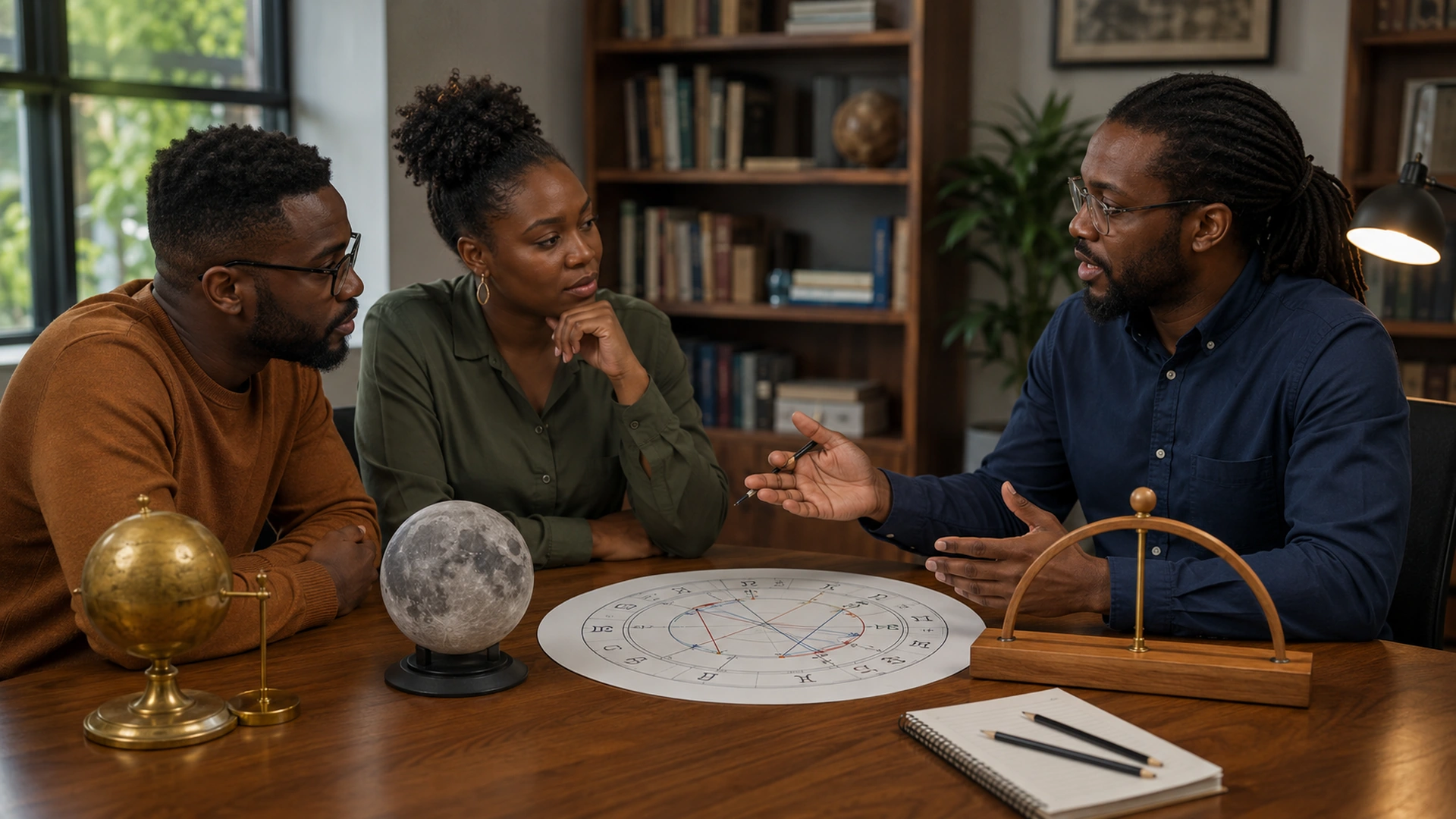
A natal chart is a diagram of the apparent positions of the Sun, Moon, planets and important astronomical points for a particular date, time and location. Astrodienst describes a chart as a map of the heavens for a specific moment and place. It also explains that the sign rising in the east is called the Ascendant or rising sign. [2]
The Big Three come from three different kinds of chart information:
Sun sign: the zodiac sign occupied by the Sun at birth.
Moon sign: the zodiac sign occupied by the Moon at birth.
Rising sign: the zodiac sign intersecting the eastern horizon at the birth time and location.
The Sun and Moon are physical celestial bodies. Astrologers traditionally call them the two luminaries. The Ascendant is different: it is a calculated point created by the intersection of the ecliptic and the local eastern horizon. It changes as Earth rotates, which is why birth time and place matter so strongly. [2][5][7]
Why Are They Called the “Big Three”?
The label reflects their prominence in modern introductory astrology. Practitioner sources often present the Sun, Moon and Ascendant as a “Primal Triad” or the “Big Three,” while also warning that a complete chart contains many more factors. [3][16]
The phrase can be helpful because it moves readers beyond Sun-sign astrology. It can also oversimplify. Traditional astrologers may give substantial attention to the chart ruler, sect, houses, aspects, planetary condition, lots, lunar phase and other techniques. Indian, Chinese and other astrological traditions organize charts through different concepts and should not be forced into the modern Western Big Three framework.
Sun, Moon and Rising Signs at a Glance
| Placement | What is calculated | Common astrological themes | Data needed | Useful reflective question |
|---|---|---|---|---|
| Sun sign | Sun’s zodiac position at birth | Identity, vitality, purpose, conscious self-expression | Birth date; exact time sometimes matters near a sign boundary | “What qualities am I developing and expressing?” |
| Moon sign | Moon’s zodiac position at birth | Emotional habits, instinct, comfort, security, private responses | Date, time and location; time is important near a Moon-sign change | “What helps me feel safe, settled and emotionally understood?” |
| Rising sign | Sign on the eastern horizon | Approach, first response, self-presentation, first house and chart orientation | Exact birth time and location are essential | “How do I meet the world and begin things?” |
What Your Sun Sign Means
The Sun sign is the zodiac sign occupied by the Sun at birth. Because the Sun appears to move through the tropical zodiac over approximately one year, it usually remains in one sign for about a month. This is why a birth date is often enough to identify the Sun sign—except near the date when the Sun changes signs, when the year, time zone and exact birth time can matter.
Within modern Western astrology, the Sun commonly symbolizes identity, vitality, purpose, creative agency and the qualities a person is thought to develop consciously. Astrodienst describes it as a central factor of personality and basic identity, while emphasizing that the Sun is not the basis for an entire chart interpretation. [3]
The Sun Sign as Identity, Not a Complete Personality
A useful way to understand the astrological Sun is as a center of intention. It is less about every behavior a person displays and more about the style through which they seek coherence, recognition and meaningful self-expression. A person may show solar qualities more clearly when making choices, pursuing goals, accepting responsibility or developing confidence.
This is one reason some people relate more strongly to their Sun sign with age. The claim is an astrological interpretation, not a scientifically established developmental law. Real personality develops through biology, upbringing, culture, learning, relationships, opportunity and life experience as well as the stories people use to understand themselves.
What the Sun Sign Does Not Tell You
It does not describe every emotion, habit or social response.
It does not prove a person’s morality, intelligence, compatibility or destiny.
It does not replace the Moon, Ascendant, houses, aspects or other chart factors.
It does not create twelve identical personality types.
It does not scientifically demonstrate that the Sun causes personality traits.
Sun Sign Meanings for All 12 Zodiac Signs
| Sun sign | Common solar theme in modern Western astrology |
|---|---|
| Aries | Developing initiative, courage, directness and independent action. |
| Taurus | Developing steadiness, patience, embodiment, values and sustainable effort. |
| Gemini | Developing curiosity, communication, flexibility and exchange of ideas. |
| Cancer | Developing care, protection, belonging, memory and emotional loyalty. |
| Leo | Developing creativity, visibility, generosity, pride and wholehearted expression. |
| Virgo | Developing skill, discernment, usefulness, refinement and practical competence. |
| Libra | Developing cooperation, proportion, diplomacy, beauty and relational awareness. |
| Scorpio | Developing depth, honesty, resilience, privacy and transformative commitment. |
| Sagittarius | Developing exploration, meaning, faith, perspective and truth-seeking. |
| Capricorn | Developing responsibility, structure, mastery, endurance and long-term purpose. |
| Aquarius | Developing independence of thought, community awareness, innovation and principle. |
| Pisces | Developing imagination, compassion, receptivity, symbolism and connection. |
These descriptions are broad interpretive themes, not diagnoses or guarantees. A planet’s house, aspects and condition can significantly change how an astrologer reads it.
What Your Moon Sign Means
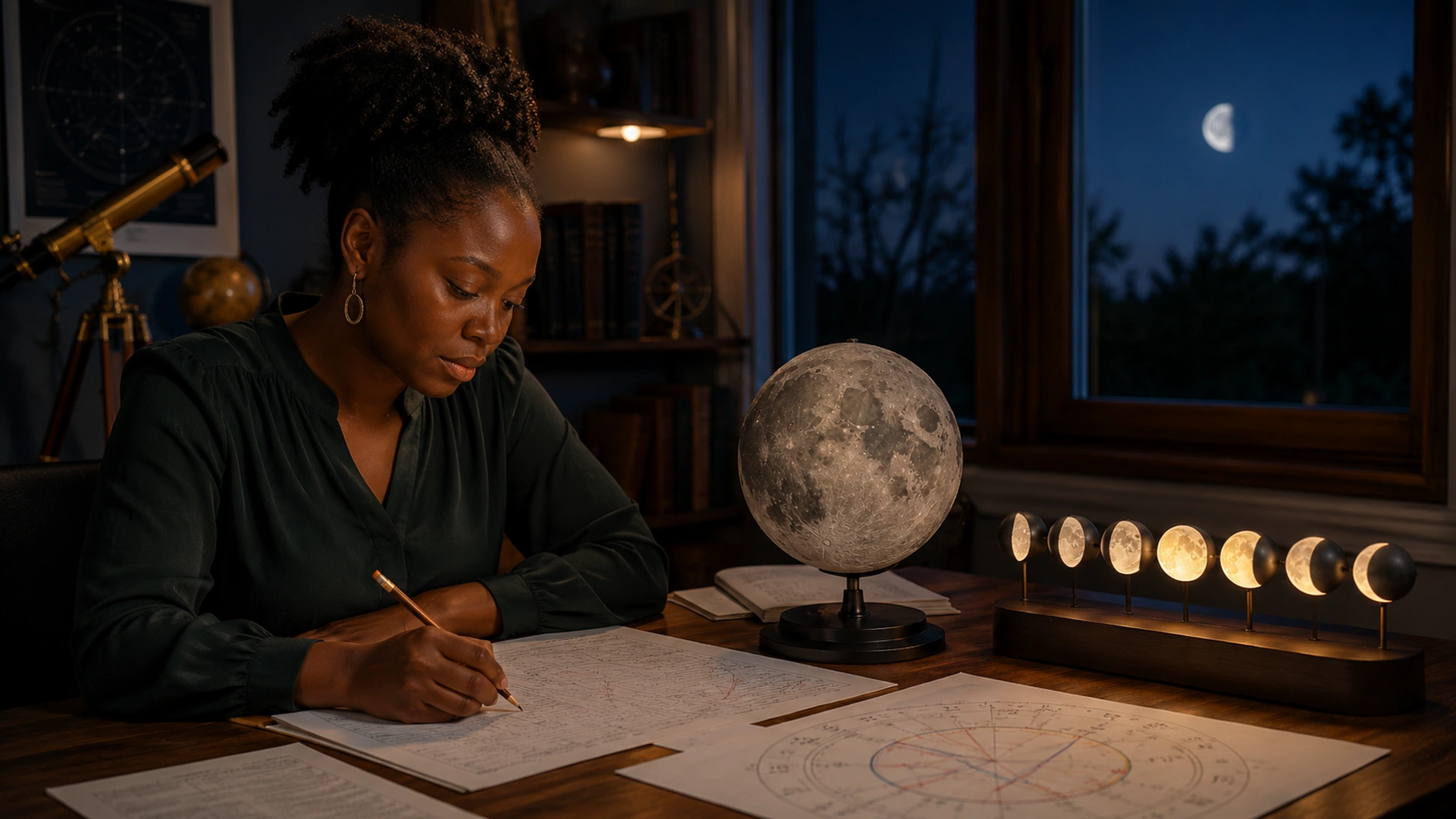
The Moon sign is the zodiac sign occupied by the Moon at birth. The Moon completes an orbit relative to the background stars in about 27.32 days. Dividing that motion across twelve equal zodiac signs gives an average of a little more than two days per sign, although actual timing varies. [6]
Because the Moon moves quickly, two people born several days—or sometimes several hours—apart can have different Moon signs. A date-only calculator may be uncertain when the Moon changed signs on the day of birth. In those cases, the exact time and location are needed.
Within modern Western astrology, the Moon is commonly associated with instinctive responses, emotional rhythms, memory, attachment, comfort, habit and the way a person seeks security. Astrodienst describes the Moon’s sign and house as related to emotional reactions that occur before conscious filtering. [4]
The Moon Sign as Emotional Pattern, Not Emotional Fate
The Moon sign can be used as a reflective question: What conditions help me settle, recover and feel cared for? An astrologer might explore how a person reacts under stress, what feels familiar, how they nurture others and what kind of atmosphere supports rest.
That does not mean a Moon sign controls emotions. Feelings are shaped by nervous-system processes, personal history, relationships, culture, health and current circumstances. Astrology cannot diagnose depression, anxiety, trauma, attachment disorders or any other mental-health condition. A difficult Moon interpretation should never be used to blame a parent, declare someone emotionally damaged or discourage professional care.
Moon Sign Meanings for All 12 Zodiac Signs
| Moon sign | Common lunar theme in modern Western astrology |
|---|---|
| Aries | Often interpreted as needing immediacy, movement, honesty and room to respond directly. |
| Taurus | Often interpreted as needing stability, sensory comfort, consistency and dependable routines. |
| Gemini | Often interpreted as processing feelings through words, questions, variety and mental movement. |
| Cancer | Often interpreted as needing closeness, privacy, continuity, family connection and protective space. |
| Leo | Often interpreted as needing warmth, appreciation, creative expression and heartfelt loyalty. |
| Virgo | Often interpreted as seeking calm through order, usefulness, practical care and manageable details. |
| Libra | Often interpreted as needing fairness, companionship, beauty, conversation and relational balance. |
| Scorpio | Often interpreted as needing trust, depth, privacy, emotional truth and strong boundaries. |
| Sagittarius | Often interpreted as needing freedom, perspective, hope, movement and meaningful experience. |
| Capricorn | Often interpreted as regulating feelings through competence, structure, restraint and responsibility. |
| Aquarius | Often interpreted as needing autonomy, friendship, intellectual space and connection to a wider cause. |
| Pisces | Often interpreted as needing imagination, retreat, compassion, spiritual meaning and gentle boundaries. |
A Moon sign is interpreted with the lunar phase, house, aspects and the rest of the chart. A person with a Capricorn Moon, for example, is not automatically cold; the symbolism may instead be read as careful emotional management, duty or a preference for showing care through practical support.

What Your Rising Sign Means
The rising sign, also called the Ascendant, is the zodiac sign on the eastern horizon at a specific time and location. Astronomically, the Ascendant is the intersection of the local eastern horizon and the ecliptic—the apparent annual path of the Sun. [2][5][7]
As Earth rotates, different zodiac degrees rise. A common beginner’s shortcut says the rising sign changes about every two hours, but the signs do not all take equal time to rise. Latitude, season and the angle between the ecliptic and horizon affect the rate. This is why an accurate calculator needs the birth date, clock time, time zone and location.
What the Ascendant Symbolizes in Astrology
Modern Western astrologers commonly associate the Ascendant with immediate approach, first reactions, self-presentation, physical orientation and the way a person enters unfamiliar situations. It also establishes the first house and helps orient the rest of the house system. [2][5]
The rising sign is often called a “mask,” but that metaphor can be misleading. A mask sounds false or superficial. A better description is interface: the Ascendant symbolizes the style through which a person meets circumstances and makes their inner life visible. It can feel instinctive rather than deliberately performed.
Traditional astrology also pays close attention to the planet ruling the Ascendant sign, often called the chart ruler in modern practice. A Gemini rising chart is therefore connected with Mercury; a Taurus rising chart with Venus; a Capricorn rising chart with Saturn. The condition and placement of that ruler can modify a simple rising-sign description.
Rising Sign Meanings for All 12 Zodiac Signs
| Rising sign | Common Ascendant theme in modern Western astrology |
|---|---|
| Aries | Often presents through speed, initiative, directness and readiness to act. |
| Taurus | Often presents through steadiness, calm pacing, practicality and grounded presence. |
| Gemini | Often presents through curiosity, quick observation, conversation and adaptability. |
| Cancer | Often presents through caution, sensitivity, protectiveness and awareness of atmosphere. |
| Leo | Often presents through warmth, visibility, expressiveness and confident presence. |
| Virgo | Often presents through attentiveness, precision, modesty and practical assessment. |
| Libra | Often presents through diplomacy, social awareness, grace and desire for balance. |
| Scorpio | Often presents through intensity, privacy, perceptiveness and controlled disclosure. |
| Sagittarius | Often presents through openness, humor, movement, enthusiasm and broad perspective. |
| Capricorn | Often presents through seriousness, restraint, competence and goal-conscious behavior. |
| Aquarius | Often presents through independence, originality, distance and group awareness. |
| Pisces | Often presents through receptivity, softness, imagination and sensitivity to surroundings. |
Appearance claims require particular caution. Some astrological traditions connect the Ascendant with body type or facial features, but heredity, ancestry, health, age, environment and individual variation are far more direct influences. A rising sign should never be used to stereotype ethnicity, disability, gender expression or attractiveness.
Sun Sign vs Moon Sign vs Rising Sign: The Key Differences
| Question | Sun | Moon | Rising |
|---|---|---|---|
| Core question | What am I becoming and expressing? | What helps me feel safe and emotionally regulated? | How do I meet situations and make myself visible? |
| Typical focus | Identity, vitality, purpose, agency | Habit, feeling, comfort, instinct, memory | Approach, presentation, first response, chart orientation |
| Rate of change | About one sign per month | About one sign every two to three days | Often changes within roughly two hours, but not evenly |
| Most important data | Date; exact time near boundaries | Date and often time, especially near boundaries | Exact time and place |
| Common oversimplification | “This is your whole personality” | “This controls all emotions” | “This is a fake mask” |
| Better framing | A central symbolic style of conscious development | A symbolic pattern for comfort and reaction | A symbolic interface between person and environment |
How the Same Zodiac Sign Changes by Placement
The sign supplies a style; the placement tells you what function is expressing that style. Aries is not interpreted identically as a Sun, Moon and rising sign. The Sun may emphasize developing initiative, the Moon may describe a need for immediate emotional movement, and the Ascendant may describe a direct way of entering situations.
| Sign | As a Sun sign | As a Moon sign | As a rising sign |
|---|---|---|---|
| Aries | Identity develops through initiative | Needs direct response and movement | Approaches quickly and assertively |
| Taurus | Identity develops through stability and values | Needs consistency and sensory comfort | Approaches steadily and cautiously |
| Gemini | Identity develops through learning and exchange | Needs words, variety and mental stimulation | Approaches curiously and conversationally |
| Cancer | Identity develops through care and belonging | Needs safety, continuity and closeness | Approaches protectively and sensitively |
| Leo | Identity develops through creativity and visibility | Needs warmth, loyalty and appreciation | Approaches expressively and confidently |
| Virgo | Identity develops through skill and refinement | Needs order, usefulness and manageable detail | Approaches analytically and helpfully |
| Libra | Identity develops through relationship and balance | Needs fairness, harmony and companionship | Approaches diplomatically and socially |
| Scorpio | Identity develops through depth and transformation | Needs trust, privacy and emotional truth | Approaches intensely and selectively |
| Sagittarius | Identity develops through meaning and exploration | Needs freedom, hope and perspective | Approaches openly and adventurously |
| Capricorn | Identity develops through mastery and responsibility | Needs structure, competence and reliability | Approaches seriously and strategically |
| Aquarius | Identity develops through principle and originality | Needs autonomy, friendship and mental space | Approaches independently and unconventionally |
| Pisces | Identity develops through imagination and compassion | Needs retreat, gentleness and symbolic meaning | Approaches receptively and intuitively |
How the Big Three Work Together
The Big Three are not three separate personalities. Astrologers interpret them as interacting functions inside one chart. A person may experience them as cooperative, contradictory or context-dependent.
Elements and Modalities
Western astrology groups signs by four elements—fire, earth, air and water—and three modalities—cardinal, fixed and mutable. Repetition can create an easily recognizable pattern. A person with three fire placements may be described as highly expressive or action-oriented. A person with earth, water and air may move among practical, emotional and intellectual modes.
The pattern is not a score. Having no planets in a particular element does not prove that a person lacks that human capacity. It means an astrologer may look elsewhere in the chart for how the theme is represented.
Harmony and Tension
A Sun and Moon in compatible elements may be interpreted as easier coordination between conscious direction and emotional habit. A tense combination may describe a person who wants one thing but feels secure doing another. That tension is not automatically bad; it can create complexity, self-awareness and growth.
The actual angular relationship between the Sun and Moon—the lunar phase—is also important in many traditions. Two people with the same Sun and Moon signs can have different degrees, houses and aspects, producing different chart contexts.
The Chart Ruler and the Rest of the Chart
Because the Ascendant establishes the first house, its ruling planet may connect the Big Three to another part of the chart. A Libra rising person has Venus as the chart ruler. If Venus is in Capricorn in the fourth house, an astrologer may interpret the social Libra approach through themes of restraint, responsibility, home and family. This is why three sign names are only a beginning.
Example Big Three Combinations
The following examples demonstrate how astrologers may combine symbols. They are illustrative, not personality diagnoses.
| Example combination | Possible integrated reading |
|---|---|
| Aries Sun, Cancer Moon, Libra rising | A drive toward initiative may coexist with a strong need for emotional safety, while the person enters social situations diplomatically. The result may be direct goals, private sensitivity and a polished first approach. |
| Taurus Sun, Aquarius Moon, Scorpio rising | A steady value system may combine with emotional independence and an intense, private manner. The person may look guarded while internally needing freedom and externally pursuing long-term stability. |
| Gemini Sun, Virgo Moon, Sagittarius rising | Curiosity and communication may be supported by a need to analyze and improve, while the outward style is broad, candid and exploratory. The combination can alternate between detail and big-picture thinking. |
| Cancer Sun, Capricorn Moon, Leo rising | A caring identity may coexist with emotional restraint and a visible, expressive approach. The person may appear confident while managing feelings carefully and protecting a private inner circle. |
| Leo Sun, Pisces Moon, Virgo rising | Creative self-expression may combine with emotional sensitivity and a precise, modest first impression. The person may seem reserved initially but possess a warm and imaginative inner life. |
| Scorpio Sun, Gemini Moon, Taurus rising | A depth-seeking identity may combine with a mentally active emotional style and a calm outward pace. The person may look steady while privately questioning, researching and changing perspectives. |
How to Find Your Sun, Moon and Rising Signs
To calculate the Big Three accurately, gather three pieces of information:
Date of birth
Exact birth time, including a.m. or p.m.
Birth city and country
A reputable chart calculator converts the birth time to the correct time standard, uses geographic coordinates and calculates the celestial positions and local horizon. The chart should state whether it uses the tropical or sidereal zodiac and identify the house system.
Step 1: Confirm the Birth Time
Use a birth certificate, hospital record, family document or other reliable record if available. Memory can be approximate. Even a difference of several minutes may change the Ascendant degree, and a larger difference can change the rising sign or house positions.
Step 2: Enter the Birth Location Correctly
Choose the actual birth location rather than the place where the family later lived. The Ascendant depends on the local horizon. Two people born at the same clock time on the same date but in different places can have different rising signs. [5]
Step 3: Check Tropical or Sidereal Settings
Tropical astrology anchors the zodiac to the equinoxes and seasons. Sidereal systems use stellar reference corrections. The Sun, Moon and rising signs can therefore differ between calculators using different zodiacs. This is not necessarily a software error; it reflects different astrological frameworks. For more history, link to the site’s Origins of the Zodiac guide. [15]
Step 4: Check Boundary Conditions
If the Sun or Moon is near the beginning or end of a sign, verify the birth time and time zone. Do not rely only on approximate date lists. Rising signs require time and place in every case.
What If You Do Not Know Your Birth Time?
Without a reliable birth time, the rising sign usually cannot be confirmed. The Moon sign may still be known if the Moon remained in one sign for the entire calendar day at the relevant location. If it changed that day, a range of possible times should be shown rather than selecting the preferred interpretation.
Some astrologers offer birth-time rectification, a process that estimates a birth time from life events. It is interpretive and uncertain, not a recovery of objective historical data. A responsible practitioner should disclose the uncertainty and avoid presenting a rectified time as proven fact.

Common Questions and Misconceptions About the Big Three
“I Do Not Feel Like My Sun Sign”
Within astrology, this may be explained by a prominent Moon or Ascendant, a Sun placed in a less visible house, strong aspects or other chart factors. Outside astrology, it may simply reflect the limits of broad sign descriptions. People are more complex than twelve categories, and no one is required to identify with a horoscope label.
“Which One Is the Real Me?”
Astrologers generally treat all three as symbolic parts of one person. The Sun is not the “real” self while the rising sign is fake, and the Moon is not a hidden child controlling every reaction. A useful approach is to ask when each description feels relevant and when it does not.
“Is the Rising Sign Only a First Impression?”
First impressions are one popular interpretation, but the Ascendant has a larger technical role. It marks the eastern horizon, begins the first house and helps establish chart rulership and house orientation. Reducing it to how strangers see you removes much of its traditional importance. [2][5][13]
“Does the Moon Sign Control Mental Health?”
No. A Moon sign is an astrological symbol, not a clinical assessment. It cannot diagnose anxiety, depression, trauma, bipolar disorder, personality disorders, neurodivergence or attachment style. Mental-health questions require evidence-based assessment by qualified professionals.
“Can the Big Three Predict Compatibility?”
No three placements can establish whether a relationship will be safe, respectful or lasting. Astrological compatibility techniques may be used symbolically, but consent, communication, behavior, accountability, shared values and practical circumstances are more important than sign combinations.
“Can My Rising Sign Change?”
The natal Ascendant does not change after birth because it is calculated for the birth moment. Astrologers may use techniques called progressions, directions or relocated charts, but those do not rewrite the original natal rising sign. A different calculator result usually comes from different birth data, time-zone handling or zodiac settings.
“Can the Sun, Moon and Rising Sign Be the Same?”
Yes. This can occur when the Sun and Moon are in the same zodiac sign near a New Moon and that sign is also rising. It is uncommon but possible. Even then, the three factors occupy different degrees or perform different symbolic functions, and the rest of the chart remains important.
Historical and Cultural Context
The modern Big Three concept belongs mainly to contemporary Western natal astrology. It should not be presented as a universal system shared by all cultures.
Babylonian scholars produced some of the earliest known individual horoscopes, including surviving Late Babylonian birth-horoscope tablets. [8] Hellenistic astrologers later developed horoscopic systems that emphasized the rising degree and houses. In medieval European practice, the Ascendant could be more technically central than the simplified Sun sign used in modern newspaper horoscopes. [9][13]
Sun-sign astrology became especially visible through mass media because a reader’s birth date is easy to know. The Moon and Ascendant require more calculation, so digital chart tools helped make the Big Three popular with wider audiences.
Indian jyotiṣa also gives major importance to the Ascendant and Moon, but its technical language, sidereal calculations, lunar mansions and interpretive priorities differ across schools. Chinese systems may use stems, branches, animal cycles, five phases and birth hour through frameworks that are not equivalent to the Western Sun–Moon–Ascendant triad. A comparative cultural article should preserve those differences rather than translating every system into the Big Three.
Are Sun, Moon and Rising Sign Meanings Scientifically Proven?
Controlled research has not established natal astrology as a reliable method for describing personality. Shawn Carlson’s double-blind study in Nature tested whether natal charts could accurately describe participants’ personality traits. Later research comparing computer-generated astrological summaries with a validated personality inventory found that participants could identify their real psychological profiles above chance but could not identify their true astrological summaries. [10][11]
The Barnum effect helps explain why broad personality descriptions can feel uniquely accurate. The American Psychological Association defines it as the tendency to believe that vague predictions or general descriptions have specific personal application. [12]
These findings do not erase astrology’s historical or cultural importance. They do mean that symbolic meaning, personal resonance and scientific evidence are different questions. A reader can study astrology as heritage, narrative or reflection without claiming that the Big Three objectively determine personality.
How to Use the Big Three Responsibly
Treat interpretations as prompts, not verdicts.
Use “may,” “often interpreted as” and “within astrology” rather than presenting symbolism as measured fact.
Do not use signs to diagnose illness, trauma, abuse, criminality or moral character.
Do not make financial, medical, legal or safety decisions from a birth chart.
Respect uncertainty when birth time is missing or disputed.
Keep cultural systems distinct instead of calling every celestial tradition the Big Three.
Compare a description with lived experience and allow disagreement.
Remember that choices, relationships, culture and circumstances shape life.
Key Takeaways
The Sun sign is the zodiac sign occupied by the Sun at birth and is commonly associated with identity, vitality and conscious development.
The Moon sign is the Moon’s zodiac position and is commonly associated with emotional habits, comfort and instinctive response.
The rising sign is the zodiac sign on the eastern horizon and is associated with approach, self-presentation and chart structure.
The Sun changes signs about monthly, the Moon about every two to three days and the Ascendant often within roughly two hours, although rising times vary.
An exact birth time and location are essential for the rising sign.
The same zodiac sign means something different as a Sun, Moon or rising placement.
The Big Three are interpreted with houses, aspects, chart ruler and the rest of the chart.
The term is modern Western shorthand, not a universal cross-cultural framework.
Astrological descriptions are symbolic and have not been scientifically validated as personality measurements.
Responsible astrology avoids fatalism, diagnosis, stereotyping and guarantees.
People Also Ask
What are the Sun, Moon and rising signs?
They are three natal-chart factors used in modern Western astrology. The Sun sign is the Sun’s zodiac position, the Moon sign is the Moon’s position and the rising sign is the sign on the eastern horizon at the birth time and place.
Which is more important: Sun, Moon or rising?
Astrologers commonly treat all three as important but different. The Sun concerns identity and direction, the Moon concerns emotional habits and security, and the Ascendant concerns approach and chart structure. The full chart provides more context than ranking them.
How do I find my Big Three?
Use a reputable birth-chart calculator and enter your birth date, exact time and birth location. Check whether the calculator uses the tropical or sidereal zodiac. Without a reliable birth time, the rising sign usually cannot be confirmed.
Why does my rising sign need an exact birth time?
The Ascendant is calculated from the local eastern horizon, which changes continuously as Earth rotates. Time-zone and location errors can shift the Ascendant degree, house boundaries or rising sign.
What does the Moon sign represent?
Within astrology, the Moon sign is commonly associated with instinctive reactions, comfort, habit, memory, nurturance and emotional security. It is not a scientific measure or mental-health diagnosis.
Can the Big Three all be the same sign?
Yes. It can happen near a New Moon when the Sun and Moon occupy the same sign and that sign is also rising. The rest of the chart still creates substantial differences.
Is a rising sign the same as an Ascendant?
Yes. Rising sign is the common English term for the zodiac sign containing the Ascendant, the point where the ecliptic meets the eastern horizon.
Is the Big Three scientifically proven?
No. Controlled studies have not established that natal charts reliably measure personality. The Big Three can be discussed as astrological symbolism, cultural practice or reflective language rather than scientific diagnosis.
Frequently Asked Questions
1. Can I calculate my Sun sign from my birthday alone?
Usually, but not always. People born near a sign-change date should use the exact year, time and location because the Sun may have entered the next sign at a specific hour.
2. Can I know my Moon sign without a birth time?
Sometimes. If the Moon remained in one sign throughout the relevant local calendar day, the sign can be known. If it changed signs that day, a time range is necessary.
3. How quickly does the rising sign change?
A beginner’s average is roughly one sign every two hours, but actual rising times vary with latitude, season and sign because the ecliptic meets the horizon at different angles.
4. Why do different websites give different results?
Differences may come from incorrect time-zone conversion, daylight-saving settings, rounded coordinates, tropical versus sidereal zodiac selection or different house systems. Check the input data before interpreting.
5. Does the rising sign affect physical appearance?
Some astrologers associate the Ascendant with body and appearance, but such claims are not scientifically established. Genetics, ancestry, health, age and environment are more direct influences and should not be replaced by stereotypes.
6. Is the Moon sign more important in relationships?
Astrologers may use it to discuss emotional needs, but relationship quality depends on behavior, safety, communication and shared values. A Moon-sign match cannot guarantee compatibility.
7. What happens when two Big Three placements conflict?
Astrologers may interpret the contrast as different needs or modes of expression. Conflict does not mean a person is broken; it can simply describe complexity or context-dependent behavior.
8. Should I read horoscopes for my Sun or rising sign?
Some astrologers recommend the rising sign for house-based forecasts and the Sun sign for general themes. Forecasting methods vary, and neither approach is scientifically validated.
9. Is the Big Three used in every type of astrology?
No. The phrase is most common in modern Western astrology. Other traditions may prioritize different points, calendars, houses, lunar mansions, stems, branches or timing systems.
10. Can the Big Three reveal my life purpose?
An astrologer may use the Sun and other chart factors as symbolic prompts about purpose, but a chart cannot objectively assign one destiny. Purpose also develops through values, relationships, opportunities, choices and lived experience.
Research Sources and Further Reading
[1] What Is Astrology? History, Meaning, Charts and Evidence. Ancestral Temple. https://ancestraltemple.com/blog/what-is-astrology Existing site cornerstone used for internal-link and cannibalization planning.
[2] Charts FAQ: General. Astrodienst. https://www.astro.com/faq/fq_fh_natal_e.htm Definition of a chart and the rising sign.
[3] Sun - Astrodienst Astrowiki. Astrodienst. https://www.astro.com/astrowiki/en/Sun Practitioner-source summary of Sun symbolism and whole-chart context.
[4] Moon - Astrodienst Astrowiki. Astrodienst. https://www.astro.com/astrowiki/en/Lunar Practitioner-source summary of Moon symbolism.
[5] Ascendant - Astrodienst Astrowiki. Astrodienst. https://www.astro.com/astrowiki/en/Asc Astronomical definition and practitioner interpretations of the Ascendant.
[6] Eclipses and the Moon’s Orbit. NASA Goddard Space Flight Center. https://eclipse.gsfc.nasa.gov/SEhelp/moonorbit.html Sidereal lunar orbital period and orbital geometry.
[7] What Is the Plane of the Ecliptic?. NASA. https://www.nasa.gov/image-article/plane-of-ecliptic/ Definition of the ecliptic plane and the Sun’s apparent path.
[8] Late Babylonian Horoscope for a New-Born Baby, Museum No. 78089. British Museum. https://www.britishmuseum.org/collection/object/W_1886-0617-5 Material evidence for an individual Babylonian horoscope.
[9] Astrology, Chapter 23 in The Cambridge History of Science. Cambridge University Press. https://www.cambridge.org/core/books/cambridge-history-of-science/astrology/17E3D5BB41AE55616C6B9AB7949FE0F1 Scholarly history of astrology as premodern learned knowledge.
[10] A Double-Blind Test of Astrology. Nature. https://www.nature.com/articles/318419a0 Controlled test of natal-chart personality claims.
[11] Science versus the Stars. PubMed / Journal of General Psychology. https://pubmed.ncbi.nlm.nih.gov/18649494/ Comparison of astrological summaries with a validated personality inventory.
[12] Barnum Effect. American Psychological Association Dictionary of Psychology. https://dictionary.apa.org/barnum-effect Definition of personal validation from vague descriptions.
[13] Chaucer’s Man of Law as Interpreter. Cambridge Core / Traditio. https://www.cambridge.org/core/journals/traditio/article/chaucers-man-of-law-as-interpreter/148CDECF7E2D704DC78CF0CC39166625 Historical note on the technical importance of the Ascendant in medieval astrology.
[14] Common Astrology Myths: Facts, History and Evidence. Ancestral Temple. https://ancestraltemple.com/blog/common-astrology-myths Existing site evidence and misconception guide.
[15] Origins of the Zodiac: From Babylon to Modern Astrology. Ancestral Temple. https://ancestraltemple.com/blog/origins-of-the-zodiac Existing site history of zodiac development and tropical-versus-sidereal context.
[16] Re-Legitimizing Astrology. Astrodienst. https://www.astro.com/astrology/in_po_relegit_astro_e.htm Contemporary practitioner source describing “the big three” as a popular form of astrology.
Article Information
- Publisher
- Ancestral Temple
- Editor
- Ancestral Temple
- Last updated
- Jul 26, 2026
- Last reviewed
- Jul 26, 2026
- Content version
- 1a0d70557c
This educational article should be read as cultural and spiritual information, not as medical, legal, financial, or emergency advice.
Helpful Related Guidance
Explore This Topic
Related Topic Cluster
Dreams & Symbolism
About the Author
 Ancestral Temple
Spiritual guide and practitioner with decades of experience in ancestral wisdom, rituals, and divine guidance.
Related Posts
View All












Leave a Comment
We'd love to hear your thoughts.