
Sun Sign vs Moon Sign: Differences and How to Find Yours
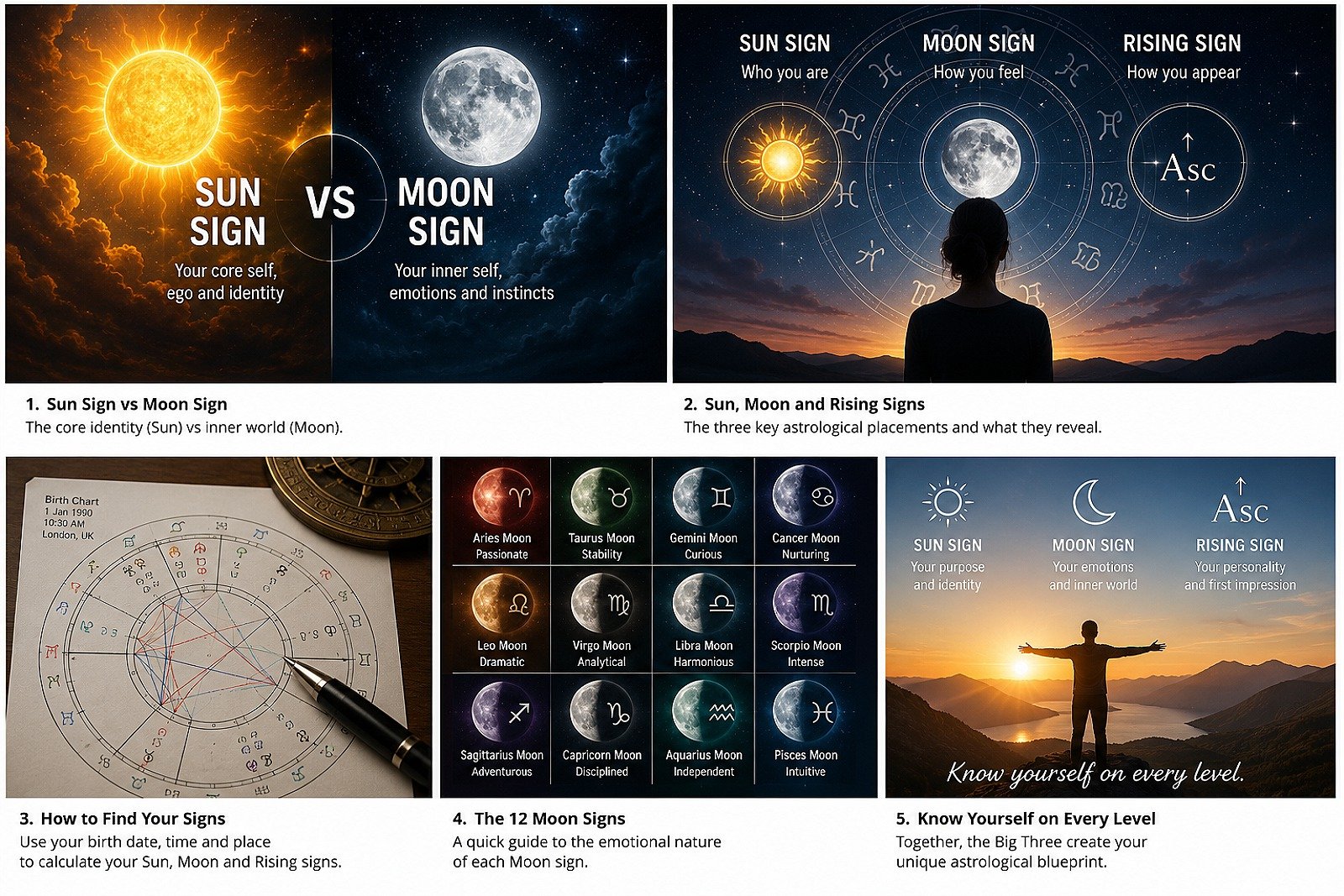
Quick Summary
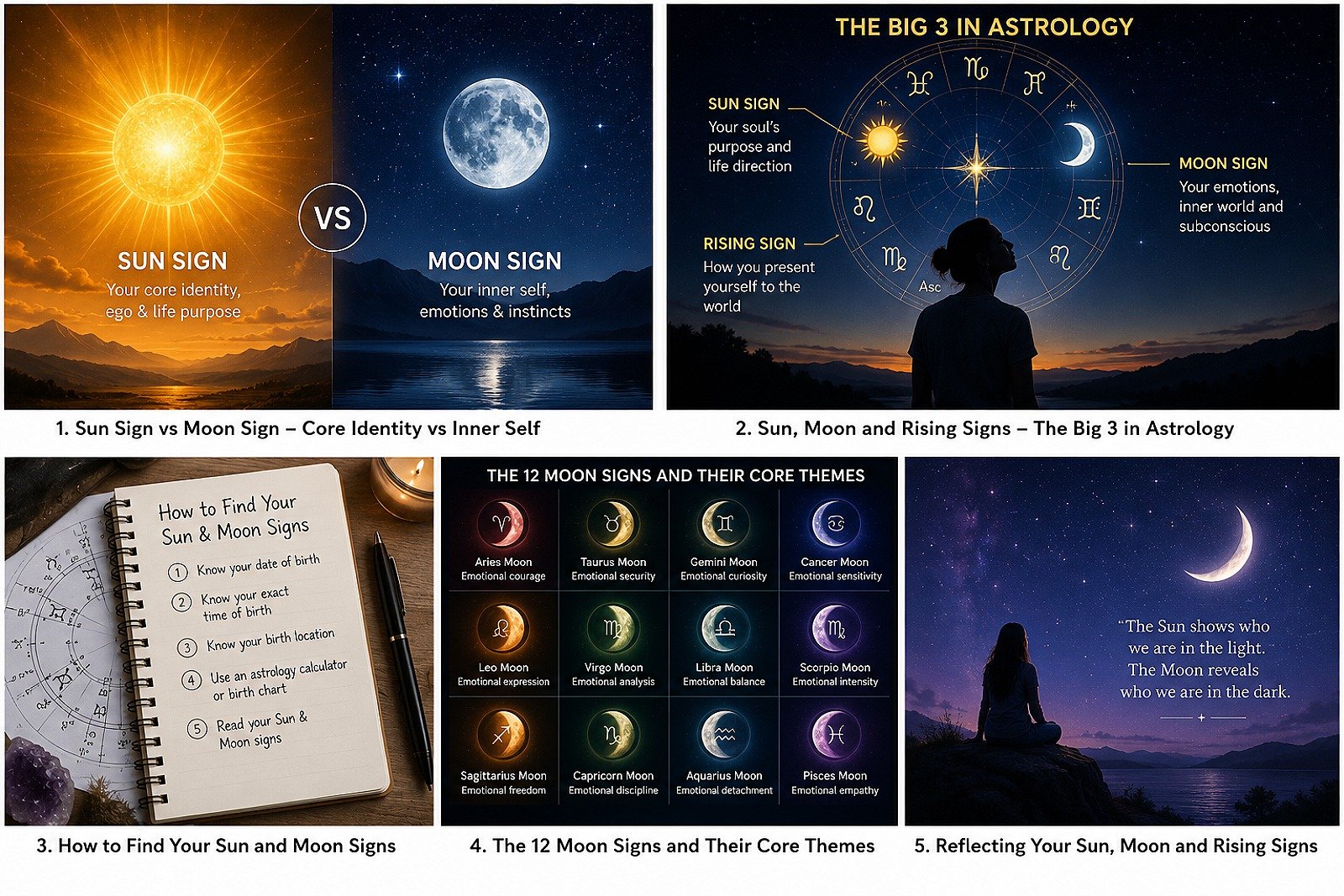
When someone asks, “What is your sign?” they usually mean your Sun sign. That is the zodiac sign assigned to the Sun at the time of your birth. A birth chart, however, also assigns...
When someone asks, “What is your sign?” they usually mean your Sun sign. That is the zodiac sign assigned to the Sun at the time of your birth. A birth chart, however, also assigns a sign to the Moon. In modern Western astrology, these two placements are interpreted differently: the Sun sign is commonly associated with identity, purpose and conscious self-expression, while the Moon sign is associated with emotional needs, instinctive reactions, memory and familiar habits.[1][2]
The difference is not that one sign is your “real” self and the other is a hidden second personality. They are two symbols within a larger astrological system. A full natal chart also includes the Ascendant, planets, houses and angular relationships. Even within astrology, reducing a person to one or two signs is considered an incomplete reading.[1][3]
This guide explains the Sun sign vs Moon sign comparison, shows how to find both placements, clarifies when birth time matters and explains why different calculators can sometimes return different answers. It also separates astrological interpretation from astronomy and scientific evidence.
Quick Answer
In Western astrology, your Sun sign is the zodiac sign occupied by the Sun at your birth and is commonly read as identity, direction and conscious self-expression. Your Moon sign is the sign occupied by the Moon and is commonly read as emotional needs, habits and instinctive responses. A birth date usually finds the Sun sign; the Moon sign may require the exact birth time and place.
| Image number | Image 1 - Featured image |
|---|---|
| Purpose | Introduce the comparison between solar identity symbolism and lunar emotional symbolism without implying a scientifically proven force. |
| Detailed scene | A realistic editorial portrait of one adult standing outdoors at twilight. Warm sunlight touches one side of the scene while cool moonlight colors the other, with a subtle Sun disk low on one horizon and a realistic Moon on the opposite side. The person is centered between the two light sources, suggesting two complementary chart placements. |
| Specific culture or historical context | Contemporary Western astrology explainer; symbolic editorial concept, not an ancient ritual. |
| People shown | One adult of African heritage, shown naturally and respectfully. |
| Location | Open East African highland landscape or clean urban rooftop with a wide sky. |
| Clothing | Simple contemporary clothing in natural fabrics; no ceremonial costume. |
| Architecture | Minimal and unobtrusive. |
| Objects | No crystals, tarot cards, ritual tools or invented sacred symbols. |
| Lighting | Physically plausible warm twilight and cool evening tones; no supernatural glow. |
| Composition | Wide 16:9 image with the person on the center or lower third and generous negative space. |
| SEO-friendly filename | sun-sign-vs-moon-sign-comparison.webp |
| Image title | Sun and Moon in the Birth Chart |
| Alt text | A person between symbolic sunlight and moonlight representing Sun and Moon signs in astrology |
| Caption | Astrology assigns different symbolic roles to the Sun and Moon, even though both placements belong to one birth chart. |
| Recommended placement | After the introduction and Quick Answer. |
| Article section supported | Core comparison and search intent. |
| Important elements to avoid | Split-screen collage, embedded text, zodiac labels, fantasy halos, magical beams, inaccurate Moon phase, watermarks. |
Sun Sign vs Moon Sign at a Glance
The simplest comparison is that the Sun describes how astrology frames the organizing center of a person’s identity, while the Moon describes how it frames emotional regulation, instinct and the need for safety. That summary is useful, but it should not be mistaken for a scientific personality test or a complete chart interpretation.
| Comparison point | Sun sign | Moon sign |
|---|---|---|
| Core astrological idea | Identity, purpose and conscious self-expression | Emotional needs, instinctive reactions and familiar habits |
| Astronomical position used | Zodiac sign occupied by the Sun at birth | Zodiac sign occupied by the Moon at birth |
| How quickly it changes signs | Roughly once a month | Roughly every two to three days |
| Birth data usually needed | Birth date; time and place help near sign boundaries | Birth date, local time and place; time may be decisive |
| Popular use | Newspaper horoscopes and the answer to “What is your sign?” | Deeper birth-chart interpretation and emotional symbolism |
| What it does not provide alone | A complete personality or full chart | A complete emotional profile or full chart |
| Scientific status | Astrological interpretation, not scientifically validated personality measurement | Astrological interpretation, not scientifically validated personality measurement |
What Is a Sun Sign?
A Sun sign is the zodiac sign in which the Sun was located at the time of birth, according to the zodiac system being used. Astrodienst defines the Sun sign as the common term for the sign occupied by the Sun at birth. This is the placement behind statements such as “I am a Leo” or “My sign is Capricorn.”[1]
In modern Western astrology, the Sun is commonly interpreted as the basic sense of identity, vitality, purpose, will and capacity for conscious self-expression. The language varies among astrologers: some emphasize the ego, some emphasize the life force, and others describe the Sun as a developmental direction rather than a finished personality.[2][4]
The Sun sign became the most familiar part of astrology because it is comparatively easy to determine from a birthday and works well for mass-market horoscope columns. The Sun remains in each zodiac sign for about a month, so a newspaper can divide readers into twelve broad groups without knowing exact birth times. Astrologers who use full natal charts generally regard this approach as simplified because it leaves out the Moon, Ascendant, planets, houses and aspects.[1][3]
Astronomically, the Sun is the star at the center of our solar system. Astrology uses the Sun’s apparent position along the zodiac as seen from Earth, while astronomy studies the Sun as a physical star and measures its actual properties and motion.[6]
What the Sun Sign Is Commonly Said to Represent
Within modern Western astrology, the Sun sign is commonly used to discuss:
the qualities a person tries to develop consciously;
a preferred style of self-expression;
confidence, purpose and personal agency;
the way a person seeks recognition or creative fulfillment;
a broad life direction or organizing principle.
These are interpretive themes, not guaranteed traits. Two people with the same Sun sign can differ greatly because of upbringing, culture, temperament, circumstances and the rest of the chart.
What Is a Moon Sign?
A Moon sign is the zodiac sign in which the Moon was located at the time of birth. Because the Moon moves through the zodiac much faster than the Sun, it changes signs roughly every two to three days. This makes the birth date more specific than a Sun-sign date, but on transition days the exact time can determine which sign is assigned.[5]
In modern Western astrology, the Moon is commonly interpreted as emotional needs, instinctive responses, memory, habit, receptivity and the ways a person seeks comfort or belonging. Traditional and modern astrologers do not all use identical language, but the Moon is widely treated as one of the central placements in a natal chart.[4]
The Moon sign is sometimes described as the “inner self,” but that phrase can be misleading. Emotions are not always hidden, and the Sun is not always public. A more careful distinction is that the Moon is used to describe automatic patterns and needs, while the Sun is used to describe identity and conscious direction.
Astronomically, the Moon is Earth’s natural satellite. Its physical orbit and changing position can be measured precisely. The astrological claim that its zodiac sign describes personality or emotional life is a separate cultural interpretation, not an established result of lunar science.[7][10]
What the Moon Sign Is Commonly Said to Represent
Within modern Western astrology, the Moon sign is commonly used to discuss:
emotional comfort and the conditions that feel safe;
reflexive reactions before conscious analysis;
habits, rhythms, memory and familiarity;
caregiving and the experience of being cared for;
private needs and the way feelings are processed.
The Moon sign does not diagnose mental health, attachment style or trauma. Those subjects require appropriate psychological or medical expertise rather than an astrological label.
What Is a Birth Chart?
A birth chart, natal chart or horoscope is an astrological diagram that maps the positions assigned to the Sun, Moon and planets for a particular time and place. It also identifies the zodiac sign rising on the eastern horizon, known as the Ascendant, and divides the chart into houses.[3]
The calculations depend on astronomical position data, time conversion and the chosen astrological framework. The Swiss Ephemeris is one widely used high-precision data system for calculating planetary positions in astrology software.[8] Accurate astronomical calculation does not by itself validate astrological interpretation; it only means that the positions are computed consistently.
Your Sun sign and Moon sign are therefore not two separate horoscopes. They are two placements in one chart. Their signs, houses and relationships with other placements are interpreted together by astrologers.
| Image number | Image 2 |
|---|---|
| Purpose | Show how a birth chart records the zodiac positions of the Sun and Moon at a particular time. |
| Detailed scene | A clean, museum-quality astrological chart wheel on parchment or a modern tablet, with the Sun and Moon glyphs visibly placed in two zodiac sectors. Include a subtle astronomical sky map in the background, but no readable personal data. |
| Specific culture or historical context | Contemporary educational reconstruction of a Western tropical natal chart. |
| People shown | Optional hands of a researcher or astrologer, shown accurately. |
| Location | Quiet study desk or archival reading room. |
| Clothing | If hands or a person are visible, simple modern professional clothing. |
| Architecture | None required. |
| Objects | Chart wheel, ephemeris or astronomy reference book, pencil; no fortune-telling props. |
| Lighting | Soft natural desk light with clear detail. |
| Composition | Wide 16:9 close editorial composition; chart wheel is the visual focus. |
| SEO-friendly filename | birth-chart-sun-and-moon-placements.webp |
| Image title | Sun and Moon Placements in a Natal Chart |
| Alt text | A birth chart wheel showing separate Sun and Moon placements in zodiac signs |
| Caption | A natal chart records the zodiac positions assigned to the Sun, Moon and other bodies for a birth time and place. |
| Recommended placement | After the section explaining what a birth chart is. |
| Article section supported | Definitions of Sun sign, Moon sign and natal chart. |
| Important elements to avoid | Readable private birth data, fake ancient manuscript claims, embedded explanatory text, clutter, glowing occult effects. |
The Main Differences Between Sun and Moon Signs
The two placements differ in symbolism, speed and the information needed to calculate them.
Identity Versus Emotional Regulation
The Sun is often read as the part of the chart connected with deliberate expression: what a person wants to become, create or stand for. The Moon is more often read as the part connected with regulation and response: what feels familiar, what restores security and how emotions are processed.
A person may strongly identify with the Sun-sign description when making choices, taking leadership or pursuing a goal, yet recognize the Moon-sign description more clearly during stress, intimacy, rest or family life.
Conscious Direction Versus Automatic Habit
Astrological writers frequently contrast the Sun’s conscious direction with the Moon’s automatic patterns. This does not mean the Sun is rational and the Moon irrational. It means the Sun is used as a symbol for intentional development, while the Moon is used for patterns that may operate before a person explains them.
For example, an astrologer might interpret a Capricorn Sun as seeking achievement and responsibility, while a Gemini Moon seeks variety and verbal processing. The person could appear disciplined in long-term goals but need conversation, changing interests or mental movement to feel emotionally refreshed. This is an astrological illustration, not a clinical assessment.
Slow-Moving Versus Fast-Moving Placement
The Sun takes about a year to travel through the twelve tropical zodiac signs, remaining in each for roughly a month. The Moon completes the same apparent zodiac circuit in about a month and changes signs every two to three days.[5]
This difference explains why many people share a Sun sign, while the Moon sign narrows the birth window. It also explains why approximate birthday lists are often sufficient for the Sun but less reliable for the Moon.
Popular Astrology Versus Full-Chart Astrology
Sun-sign astrology is the basis of many newspaper and app horoscopes. It offers a simple entry point, but even astrologers describe it as incomplete. The Moon sign is often introduced when people move from generalized horoscopes to a complete birth chart.[1][3][4]
Neither placement is automatically “more important.” Different astrological traditions prioritize different factors. Some Western practitioners emphasize the Sun, Moon and Ascendant together. Many forms of Indian astrology give major interpretive weight to the Moon sign, lunar mansion and Ascendant. The title “your big three” is a modern popular summary, not a universal rule across every historical tradition.
How to Find Your Sun Sign
For most people using the Western tropical zodiac, the birth date is enough to identify the Sun sign. People born near a sign boundary should use a calculator rather than assuming that a fixed date range applies every year.
Step 1: Choose the Astrology System
Decide whether you are using the tropical zodiac, common in modern Western astrology, or a sidereal zodiac, used in Jyotisha and some Western sidereal schools. The same birth can receive different sign labels because the two systems anchor the zodiac differently.
A calculator should state which zodiac it uses. Do not compare results from different systems as though one of them must contain an error.
Step 2: Start with Your Birth Date
Use the approximate tropical Sun-sign dates below as a quick guide. These dates can shift slightly depending on the year and time zone, especially at the beginning or end of a sign.
| Tropical Sun sign | Approximate dates |
|---|---|
| Aries | March 21-April 19 |
| Taurus | April 20-May 20 |
| Gemini | May 21-June 20 |
| Cancer | June 21-July 22 |
| Leo | July 23-August 22 |
| Virgo | August 23-September 22 |
| Libra | September 23-October 22 |
| Scorpio | October 23-November 21 |
| Sagittarius | November 22-December 21 |
| Capricorn | December 22-January 19 |
| Aquarius | January 20-February 18 |
| Pisces | February 19-March 20 |
*These are approximate tropical-zodiac dates. Use exact birth data near a boundary.*
Step 3: Check Boundary Birthdays with Exact Data
If your birthday falls within about a day of a sign change, enter your complete birth date, local birth time and birth place into a reputable natal-chart calculator. The calculator converts local civil time and uses an ephemeris to determine the Sun’s zodiac longitude at that moment.
The popular idea of being “born on a cusp” does not usually mean the Sun occupies two signs at once. In standard chart calculation, the Sun has one zodiac position at a given moment. A person near the boundary may relate to both sign descriptions for many reasons, including other chart placements, broad wording or personal identification, but the calculated Sun is assigned to one sign.
| Image number | Image 3 |
|---|---|
| Purpose | Support the practical steps for finding a Sun sign and explain why boundary dates need exact calculation. |
| Detailed scene | An editorial flat-lay showing a calendar, a simple zodiac date reference, a clock and a clean ephemeris page. One calendar date near a sign boundary is circled, while a calculator or laptop displays an abstract chart interface with no readable personal information. |
| Specific culture or historical context | Modern educational how-to for Western tropical astrology. |
| People shown | No people required; optional accurate hands entering a date. |
| Location | Bright, uncluttered desk. |
| Clothing | Not applicable unless hands are shown. |
| Architecture | None. |
| Objects | Calendar, clock, ephemeris, laptop or tablet, pen. |
| Lighting | Neutral daylight, realistic shadows. |
| Composition | Wide 16:9 top-down or three-quarter editorial view. |
| SEO-friendly filename | how-to-find-your-sun-sign.webp |
| Image title | Finding a Sun Sign Accurately |
| Alt text | Calendar, clock and birth chart calculator used to find a Sun sign |
| Caption | A birth date usually identifies the Sun sign, but exact time and place can matter near a sign boundary. |
| Recommended placement | After the step-by-step Sun-sign calculation section. |
| Article section supported | How to find your Sun sign. |
| Important elements to avoid | Prominent brand logos, readable private data, inaccurate dates, embedded instructions, mystical objects. |
How to Find Your Moon Sign
A Moon-sign calculation is more sensitive to time because the Moon moves about thirteen degrees through the zodiac in a day and changes signs every two to three days.[5] Use a full birth-chart calculator rather than a generic birthday list.
Step 1: Gather Your Birth Details
Collect:
your complete birth date;
the local time of birth, including minutes if available;
the city and country of birth.
The place is needed mainly so the calculator can interpret the local time correctly and apply the relevant time zone and historical daylight-saving rules. It is also required for the Ascendant and houses, although those are not necessary to define the Moon sign itself in a standard geocentric chart.
Step 2: Use a Calculator That Identifies Its Settings
Choose a calculator that shows the zodiac system, time zone and chart settings. Astrodienst and other established chart services use ephemeris data to calculate planetary positions. Enter the information exactly as recorded rather than converting the time yourself unless the tool specifically asks for Universal Time.[3][8]
After the chart is generated, locate the Moon glyph or the line labeled Moon and note the zodiac sign beside it. Also record the degree because a Moon near 0 degrees or 29 degrees may be close to a sign boundary.
Step 3: Verify Transition-Day Results
If one website gives a different Moon sign from another, first check whether the calculators use the same tropical or sidereal zodiac. Then verify the birth time, time zone, daylight-saving setting and date format. A day-month reversal can produce an entirely different chart.
If the Moon changed signs close to the recorded time, even a modest time error may change the result. Compare the displayed degree and the exact transition time rather than choosing the description that feels more flattering.
Can You Find Your Moon Sign Without a Birth Time?
Sometimes. First generate a chart for the earliest possible time on the birth date and another for the latest possible time, using the correct birth place. If the Moon remains in the same sign in both charts, the sign is usually secure even though the exact degree is unknown.
If the Moon is in one sign at the beginning of the day and another at the end, the sign cannot be determined confidently without narrowing the birth time. Family records, a long-form birth certificate, hospital documents, a baby book or a relative’s memory may help. Memories are approximate, so document the uncertainty.[5]
Do not invent a birth time simply to obtain a complete chart. An honest “Moon sign uncertain between Libra and Scorpio” is better than false precision.
| Image number | Image 4 |
|---|---|
| Purpose | Explain why Moon-sign calculation depends on local birth time and can be uncertain when the Moon changed signs that day. |
| Detailed scene | A realistic educational desk scene with a world map, clock, birth record, Moon ephemeris and laptop showing a clean lunar-position chart. Two times on the same date are being compared to determine whether the Moon crossed a zodiac boundary. |
| Specific culture or historical context | Contemporary calculation workflow using astronomical position data in an astrological chart. |
| People shown | One researcher or astrologer of African heritage, seen from the side or over the shoulder. |
| Location | Modern study or library. |
| Clothing | Simple professional clothing. |
| Architecture | Minimal study interior. |
| Objects | World map, analog clock, calendar, ephemeris, laptop, notebook. |
| Lighting | Soft daylight or warm desk lighting; natural and realistic. |
| Composition | Wide 16:9 documentary-style image with the calculation materials clearly visible. |
| SEO-friendly filename | how-to-find-your-moon-sign.webp |
| Image title | Calculating a Moon Sign from Birth Details |
| Alt text | A researcher using birth time, location and an ephemeris to calculate a Moon sign |
| Caption | Because the Moon changes signs every two to three days, birth time may decide the result on a transition date. |
| Recommended placement | After the Moon-sign calculation and unknown-time guidance. |
| Article section supported | How to find your Moon sign and why birth time matters. |
| Important elements to avoid | Readable personal records, inaccurate Moon phases, brand logos, embedded text, astrology-as-science claims. |
Why Different Calculators May Give Different Signs
Disagreement between calculators usually has a technical explanation rather than a mysterious astrological one.
Tropical Versus Sidereal Zodiac
The tropical zodiac is anchored to the seasonal cycle and begins Aries at the March equinox. The sidereal zodiac is aligned more closely with stellar reference points and applies an offset, commonly called an ayanamsha. Because the systems use different zero points, a tropical placement often falls in the previous sign in a sidereal chart, although the exact result depends on degree and ayanamsha.
Neither system is identical to the irregular astronomical constellations. In Western astrology, zodiac signs are twelve equal thirty-degree sectors, while constellations vary in size.[9] When comparing charts, label the system rather than saying only “my real sign.”
Time Zone or Daylight-Saving Errors
A calculator must convert local birth time to a common astronomical time standard. Incorrect historical time-zone data, an accidentally selected daylight-saving option or entering a time as a.m. instead of p.m. can shift the chart by hours. That is enough to alter the Moon’s degree and, on a transition day, its sign.
Different Date Formats
A date written 04/07 can mean April 7 or July 4. Use a calculator that displays the month name or confirm the site’s expected format before submitting the chart.
Geocentric Versus Specialized Settings
Most popular natal charts are geocentric, meaning they calculate zodiac positions from an Earth-centered observational framework. Some specialist software offers topocentric, heliocentric or other options. These settings are not interchangeable. Beginners should use the standard natal-chart defaults and record any nonstandard choice.
| Image number | Image 5 |
|---|---|
| Purpose | Clarify why tropical and sidereal astrology calculators may assign different signs. |
| Detailed scene | A precise conceptual illustration of two transparent zodiac wheels offset from one another around the same ecliptic circle. One wheel is anchored to the seasonal equinox while the other is aligned with a star-field background. Use Sun and Moon markers without written labels. |
| Specific culture or historical context | Educational comparison of tropical and sidereal zodiac frameworks; not a claim that one system is scientifically predictive. |
| People shown | None. |
| Location | Abstract astronomical visualization. |
| Clothing | Not applicable. |
| Architecture | None. |
| Objects | Two offset zodiac wheels, star field, equinox reference line, Sun and Moon markers. |
| Lighting | Clean, restrained scientific-illustration lighting. |
| Composition | Wide 16:9 diagram with strong visual separation and no text. |
| SEO-friendly filename | tropical-vs-sidereal-zodiac.webp |
| Image title | Tropical and Sidereal Zodiac Systems |
| Alt text | Two offset zodiac wheels illustrating tropical and sidereal astrology systems |
| Caption | Different zodiac frameworks can produce different sign labels from the same birth details. |
| Recommended placement | After the section on tropical and sidereal differences. |
| Article section supported | Calculator discrepancies and cultural-system clarification. |
| Important elements to avoid | Embedded labels, national or religious stereotypes, misleading astronomical scale, fantasy effects, watermarks. |
Can Your Sun and Moon Signs Be the Same?
Yes. The Sun and Moon can occupy the same zodiac sign at birth, particularly around a new moon, when their ecliptic longitudes are close. In astrology, a same-sign Sun and Moon is often interpreted as a stronger concentration of that sign’s style or as greater alignment between identity and emotional habit.
That interpretation still depends on degree, house, aspects and the rest of the chart. A same-sign pair does not mean a person is emotionally simple or perfectly consistent. It only means the two placements are assigned to the same thirty-degree zodiac sector.
How to Interpret Your Sun and Moon Together
A useful interpretation begins by keeping the two functions separate, then examining how they cooperate or conflict.
Start with Two Simple Questions
Ask:
What does my Sun sign description say about deliberate expression, purpose or identity?
What does my Moon sign description say about comfort, emotional processing or automatic response?
Then look for overlap. Signs of the same element may be interpreted as operating through similar styles. Signs with different elements or modalities may describe competing needs, but “conflict” does not mean failure. In astrology, contrast can be read as a developmental task.
Use the Elements Carefully
Western astrology groups the signs into fire, earth, air and water. Fire is commonly associated with initiative and inspiration; earth with practicality and stability; air with concepts and social exchange; water with feeling and receptivity.
A Leo Sun with a Pisces Moon, for example, might be interpreted as outwardly expressive yet inwardly sensitive to atmosphere. A Virgo Sun with an Aries Moon might be interpreted as consciously methodical but emotionally impatient. These are symbolic readings, not evidence-based predictions of behavior.
Consider the Relationship Between the Placements
Astrologers also consider the angular distance, or aspect, between the Sun and Moon. A conjunction occurs when they are close together, an opposition when they are roughly 180 degrees apart, and squares when they are about 90 degrees apart. These relationships correspond to the lunar phase at birth and add another layer to the interpretation.
A sign-only comparison cannot show the exact aspect because degrees matter. Two people with the same Sun and Moon signs may have different degrees, houses and surrounding placements.
Do Not Use the Pair as a Verdict
Sun-Moon combinations are best treated as prompts for reflection within the astrological tradition. They should not be used to decide whether someone is trustworthy, suitable for employment, compatible for marriage or likely to develop a health condition. Serious decisions require evidence, conversation and qualified advice.
Brief Moon Sign Meanings
The summaries below reflect common modern Western astrological language. They are broad interpretive themes, not universal descriptions or scientific findings.
| Moon sign | Common modern Western interpretation |
|---|---|
| Aries Moon | Often interpreted as emotionally direct, quick to react and restored by action or independence. |
| Taurus Moon | Often interpreted as seeking steadiness, sensory comfort, routine and tangible security. |
| Gemini Moon | Often interpreted as processing feelings through words, information, movement and conversation. |
| Cancer Moon | Often interpreted as protective, memory-oriented and strongly connected with home or belonging. |
| Leo Moon | Often interpreted as needing warmth, appreciation, creative expression and heartfelt loyalty. |
| Virgo Moon | Often interpreted as finding emotional steadiness through usefulness, order and practical care. |
| Libra Moon | Often interpreted as seeking harmony, reciprocity and a calm relational atmosphere. |
| Scorpio Moon | Often interpreted as emotionally private, intense and concerned with trust or transformation. |
| Sagittarius Moon | Often interpreted as needing space, meaning, honesty, learning and a sense of possibility. |
| Capricorn Moon | Often interpreted as emotionally self-controlled, responsible and reassured by competence. |
| Aquarius Moon | Often interpreted as independent, observant and restored by perspective, friendship or ideals. |
| Pisces Moon | Often interpreted as receptive, imaginative and sensitive to atmosphere, symbolism and compassion. |
Is the Moon Sign the Same as the Moon Phase?
No. The Moon sign describes the Moon’s position within the zodiac. The Moon phase describes the changing angle between the Sun, Moon and Earth, which determines how much of the Moon’s sunlit half is visible from Earth.
A person can have a Taurus Moon at a new moon, first quarter, full moon or another phase depending on the Sun’s position. The sign and phase answer different questions. Astrology may interpret both, but astronomy defines the phase through geometry and illumination.[7]
Western Astrology Is Not the Only Astrology
The Sun-sign versus Moon-sign framework is most familiar through modern Western popular astrology. Astrology has a long and diverse history, with systems developing through Mesopotamian, Hellenistic, Persian, Indian, Islamic, European and other intellectual settings. Academic histories describe astrology as a changing set of practices concerned with supposed relationships or correspondences between celestial and earthly events, not one uniform tradition.[11][12]
Jyotisha commonly uses a sidereal zodiac and may place strong emphasis on the Moon sign, lunar mansion or nakshatra, Ascendant and planetary periods. Chinese astrology organizes time through different calendrical and cosmological structures. These systems should not be compressed into Western Sun-sign language.
When publishing or discussing a chart, name the tradition and calculation system. Avoid calling modern generalized meanings “what every ancient culture believed.”
What Science Says About Sun and Moon Signs
Astronomy can calculate the positions of the Sun and Moon with high precision. That does not establish that zodiac placements cause or reliably predict personality, emotion, compatibility or life events.
Modern astrology is not accepted as a scientific personality system. Reviews and controlled tests have not produced dependable evidence that natal charts predict traits or outcomes beyond chance, and current scientific criticism classifies astrology as a pseudoscience or superstition.[10]
People may still value astrology as a cultural tradition, symbolic language, spiritual practice or reflective framework. The responsible boundary is to present those uses as interpretation and belief, not as scientifically verified diagnosis or prediction.
Common Mistakes to Avoid
Assuming a fixed birthday list is always accurate for someone born at a sign boundary.
Entering a guessed noon birth time and treating the Moon or Ascendant as certain.
Comparing a tropical result with a sidereal result without noticing the system change.
Confusing a Moon sign with a Moon phase.
Treating the Sun sign as a complete personality profile.
Describing astrology as proven astronomy because both use celestial position calculations.
Using sign labels to make medical, legal, financial or relationship decisions for another person.
Presenting modern Western meanings as universal ancient beliefs.
Key Takeaways
The Sun sign is the zodiac sign assigned to the Sun at birth and is commonly interpreted as identity, purpose and conscious expression.
The Moon sign is the sign assigned to the Moon and is commonly interpreted as emotional needs, habits and instinctive responses.
A birth date usually identifies the Sun sign, except near boundaries. The Moon sign may require exact birth time and place because the Moon changes signs every two to three days.
Different calculators may disagree because they use tropical versus sidereal zodiacs, different time settings or incorrect date formats.
Sun and Moon signs can be the same, and neither placement should be interpreted in isolation from the rest of a chart.
Astrology is a cultural and symbolic system, not a scientifically validated method of measuring personality or predicting events.
People Also Ask
What is the difference between a Sun sign and a Moon sign?
In Western astrology, the Sun sign is commonly associated with identity, purpose and conscious self-expression. The Moon sign is associated with emotional needs, habits and instinctive responses. Both are positions in the same natal chart.
How do I find my Moon sign?
Use a natal-chart calculator and enter your birth date, local birth time and birth place. Locate the Moon in the result and note its zodiac sign. If your birth time is unknown, compare the Moon’s position at the beginning and end of the day.
Do I need my birth time to know my Moon sign?
Not always. If the Moon remained in one sign throughout the birth date, the sign can usually be identified without an exact time. If it changed signs that day, the time may be necessary.
Which is more important, the Sun sign or Moon sign?
Astrology does not have one universal ranking. Modern Western astrology often treats both as central, while different schools and traditions emphasize different placements. A full chart provides more context than either sign alone.
Can my Sun and Moon signs be the same?
Yes. This can happen when the Sun and Moon occupy the same zodiac sign, often near a new moon. Astrologers may interpret it as concentration or alignment of solar and lunar themes.
Frequently Asked Questions
Why does my Moon sign feel more accurate than my Sun sign?
Astrologically, people may identify more strongly with the placement that describes familiar emotional patterns. Psychologically, broad descriptions, personal expectations and selective attention can also shape what feels accurate. A feeling of recognition is not scientific validation.
Can I have two Sun signs?
In standard chart calculation, the Sun occupies one zodiac degree and one sign at a given moment. Boundary birthdays require exact calculation, but they do not normally produce two simultaneous Sun signs.
Does the Moon sign affect compatibility?
Astrologers may compare Moon signs when discussing emotional compatibility, but sign matching alone cannot establish whether a relationship will be healthy or successful. Communication, values, safety and behavior are more reliable guides.
What if I do not know my birthplace?
For the Sun sign, the date may still be enough unless the birth occurred near a boundary. For the Moon sign, a country and approximate region may help with time-zone conversion, but uncertainty should be recorded. The Ascendant and houses are much more sensitive to location and time.
Is the zodiac sign the same as the constellation?
Not exactly. In Western tropical astrology, signs are twelve equal thirty-degree sectors anchored to the seasonal cycle. Astronomical constellations are irregularly shaped star regions and do not occupy equal portions of the ecliptic.[9]
Conclusion
The difference between a Sun sign and Moon sign is a difference of astrological function. The Sun is commonly used to describe identity, purpose and deliberate self-expression. The Moon is commonly used to describe emotional needs, instinctive responses and familiar patterns. Neither sign replaces the rest of the natal chart, and neither is a scientifically validated personality measurement.
To find your Sun sign, begin with your birth date and verify boundary birthdays with exact data. To find your Moon sign, use your birth date, local time and place, then check the zodiac system and time-zone settings. When the birth time is unknown, test the Moon’s position across the entire day and preserve uncertainty if it crossed a sign boundary.
Used carefully, the Sun-Moon comparison can serve as a clear introduction to natal astrology while respecting the difference between symbolic interpretation, historical tradition and astronomical fact.
Research Sources and Further Reading
[1] Astrodienst Astrowiki. “Sun Sign.” Astrodienst AG. https://www.astro.com/astrowiki/en/Sun_Sign
[2] Astrodienst Astrowiki. “Sun.” Astrodienst AG. https://www.astro.com/astrowiki/en/Sun
[3] Astrodienst. “Charts: General.” Frequently Asked Questions. https://www.astro.com/faq/fq_fh_natal_e.htm
[4] Brennan, Chris, and Israel Ajose. “The Moon in Astrology: Meanings and Uses.” The Astrology Podcast, episode 294, 2021. https://theastrologypodcast.com/transcripts/tap-ep-294-transcript-the-moon-in-astrology-meanings-and-uses/
[5] Brennan, Chris, and Leisa Schaim. “How to Read a Natal Chart With No Birth Time.” The Astrology Podcast, 2020. https://theastrologypodcast.com/2020/09/08/how-to-read-a-natal-chart-with-no-birth-time/
[6] NASA Science. “Sun.” https://science.nasa.gov/sun/
[7] NASA Science. “Lunar Discovery and Exploration” and “Moon Phases.” https://science.nasa.gov/lunar-science/ and https://science.nasa.gov/moon/moon-phases/
[8] Astrodienst. “Swiss Ephemeris.” https://www.astro.com/swisseph/
[9] Astrodienst Astrowiki. “Zodiac.” https://www.astro.com/astrowiki/en/Zodiac
[10] Orsi, Carlos. What Science Says About Astrology. Columbia University Press, 2026. https://cup.columbia.edu/book/what-science-says-about-astrology/9780231221399/
[11] von Stuckrad, Kocku. “Astrology.” In The Cambridge Handbook of Western Mysticism and Esotericism. Cambridge University Press, 2016. https://doi.org/10.1017/CBO9781139027649.032
[12] Rutkin, H. Darrel. “Astrology.” In The Cambridge History of Science, Volume 3. Cambridge University Press, 2006.
Article Information
- Publisher
- Ancestral Temple
- Editor
- Ancestral Temple
- Last updated
- Jul 26, 2026
- Last reviewed
- Jul 26, 2026
- Content version
- 21de9cf4a6
This educational article should be read as cultural and spiritual information, not as medical, legal, financial, or emergency advice.
Helpful Related Guidance
Explore This Topic
Related Topic Cluster
Dreams & Symbolism
About the Author
 Ancestral Temple
Spiritual guide and practitioner with decades of experience in ancestral wisdom, rituals, and divine guidance.
Related Posts
View All












Leave a Comment
We'd love to hear your thoughts.