
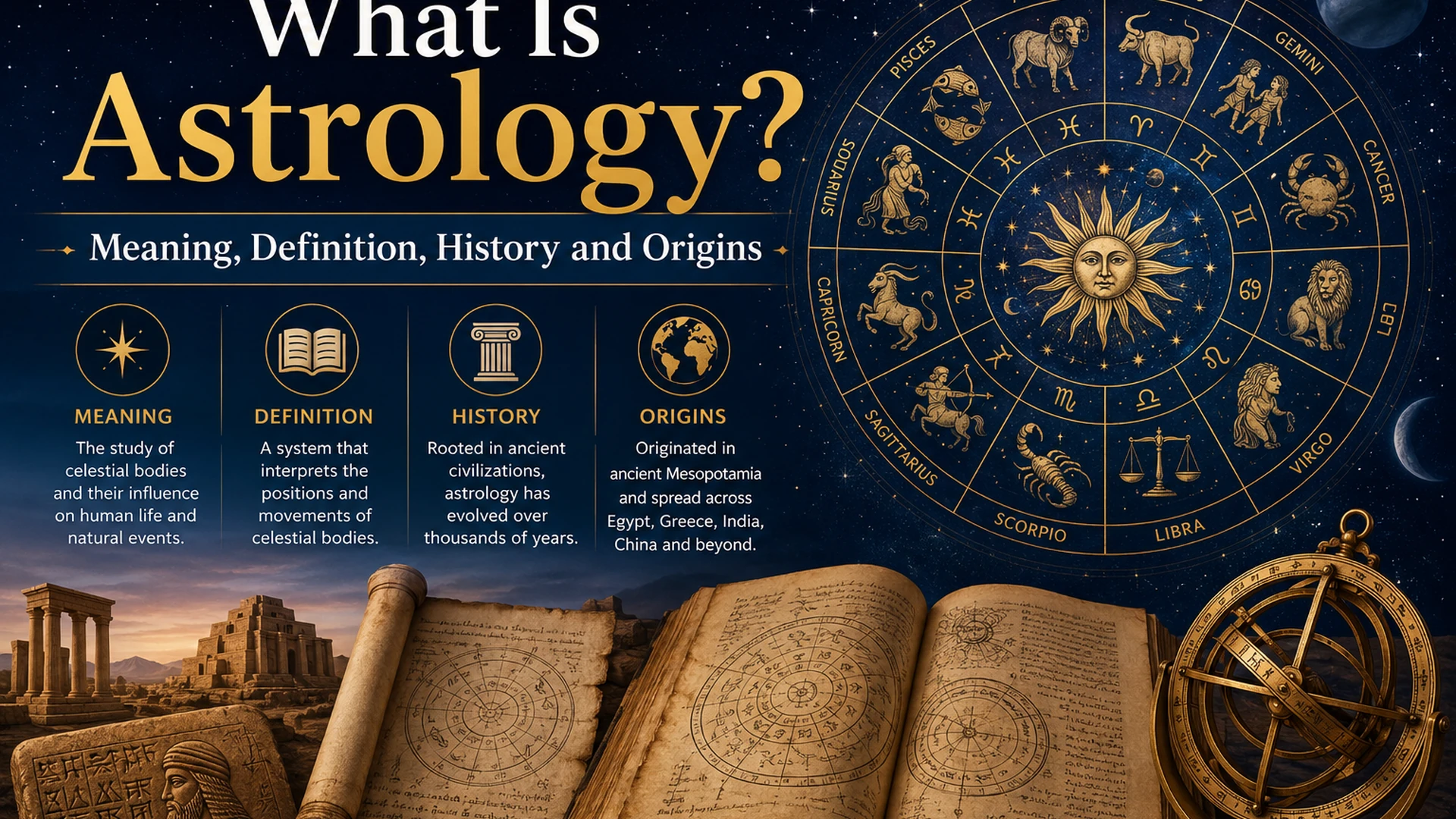
What Is Astrology? Meaning, Definition, History and Origins
Quick Summary
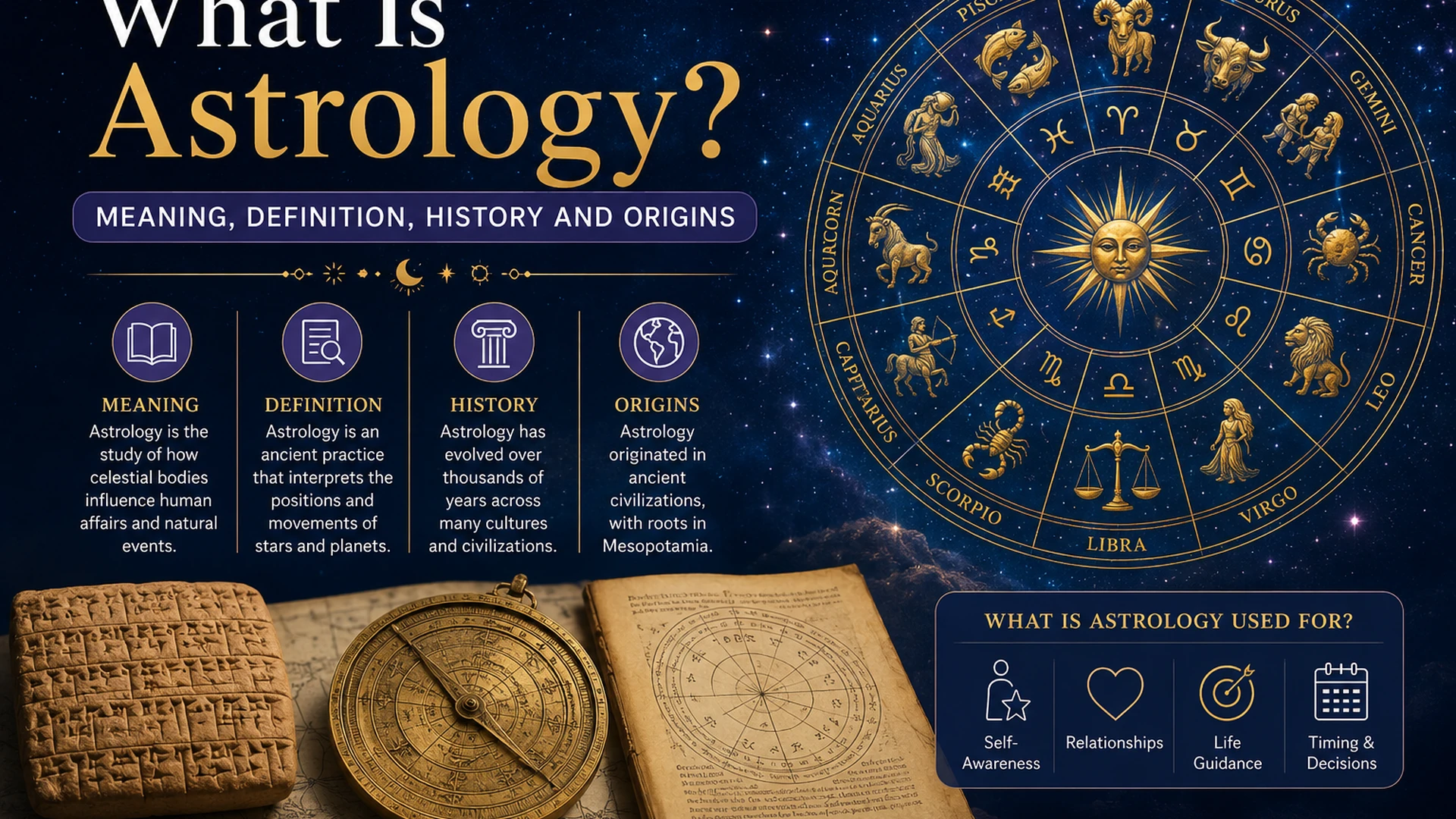
Astrology is a historical system of celestial interpretation. It studies the apparent positions and relationships of the Sun, Moon, planets and zodiacal signs, then assigns symboli...
Astrology is a historical system of celestial interpretation. It studies the apparent positions and relationships of the Sun, Moon, planets and zodiacal signs, then assigns symbolic meaning to those patterns in relation to human character, earthly events or the timing of activities.
Modern dictionaries usually define astrology as a form of divination based on the supposed influence or significance of celestial bodies.
Astrology has never been a single, unchanged tradition. Mesopotamian omen texts, Hellenistic birth-chart techniques, Indian jyotisha, Chinese astral systems, medieval Arabic scholarship and modern newspaper horoscopes belong to different historical and cultural settings.
Some traditions describe celestial bodies as causes. Others treat them as signs, symbols, correspondences or indicators of cosmic order.
Understanding astrology therefore requires two perspectives at once. Historically, it is an influential body of ideas that shaped calendars, medicine, politics, philosophy, art and the development of observational astronomy. Scientifically, its predictive claims have not gained reliable empirical support, and astronomy is now a separate evidence-based science.
Quick Answer
Astrology is a divinatory and symbolic tradition that interprets the positions of celestial bodies as meaningful for human life and events on Earth. Its best-documented early foundations developed in ancient Mesopotamia, while the familiar birth-chart system was shaped further in the Hellenistic Mediterranean. Astrology remains culturally influential, but its predictive claims are not established by modern science.
A practical definition of astrology is: a system that interprets celestial positions and cycles as signs or symbols connected with earthly life.
Astrologers may examine where the Sun, Moon and planets appear in the zodiac, their angular relationships and their placement within a chart calculated for a particular time and location.
The word can describe both the wider tradition and the act of interpretation. An astrologer is a person who studies or practices astrology. Astrological is the adjective: an astrological chart, astrological tradition or astrological interpretation.
Astrological does not mean astronomical. Astronomical refers to the scientific study or physical measurement of celestial objects.
Astrology in simple words
In simple words, astrology is the belief or interpretive practice that patterns in the sky can reveal meaning about life on Earth.
A birth chart is treated as a symbolic map of the sky at the time and place of a person’s birth. An astrologer reads that map according to the rules of a particular tradition.
This simple definition should not be mistaken for a complete description. Different schools disagree about which zodiac to use, how to divide the chart, which celestial bodies matter and whether the chart indicates fixed destiny, tendencies, timing, character or spiritual symbolism.
What Does the Word Astrology Mean?
The English word astrology came through Middle English and French from Latin astrologia, which in turn came from Greek astrologia. The Greek components broadly refer to stars or celestial bodies and discourse, study or account.
Historically, the words translated as astrology and astronomy were not always separated as sharply as they are today.
That older overlap matters. Ancient and medieval scholars often needed careful observations and calculations to produce calendars, track planets, predict eclipses or construct astrological tables.
The same person might study celestial motion for mathematical, calendrical, political and divinatory purposes. The modern distinction—astronomy as science and astrology as divination—became clearer gradually.
Astrological definition and astrological meaning
Astrological means “related to astrology.” For example:
How Does Astrology Work According to Astrologers?
Astrology works as an interpretive framework rather than as one universally agreed method.
Most chart-based traditions begin with astronomical data: a date, an exact or approximate time, a location and calculated positions of celestial bodies. The chart then translates those positions into a symbolic system.
A typical natal chart records planetary positions against a zodiac and divides the sky into chart sectors commonly called houses.
The Internet Encyclopedia of Philosophy describes a horoscopic chart as a representation of planetary positions against zodiac signs, organized with reference to the horizon and a specific time and place.
The main chart components
Planets and luminaries: In astrology, the Sun and Moon are commonly grouped with planets for interpretive convenience. Each is assigned themes or qualities. These meanings are traditional symbols, not descriptions of scientifically demonstrated forces.
Zodiac signs: The zodiac is a belt of sky associated with the apparent path of the Sun. Many Western systems divide it into twelve equal signs. The signs are interpreted as styles, qualities or modes of expression.
Houses: Houses divide a chart into sectors connected with areas of life. House systems vary, and different calculation methods can place house boundaries differently.
Aspects: Aspects are angular relationships between planets, such as conjunctions, oppositions and trines. Astrologers interpret them as patterns of interaction.
Timing techniques: Transits, progressions, planetary periods and other techniques compare a natal chart with later cycles. Different traditions use different methods.
Calculation is not the same as validation
A chart can be calculated with mathematical precision while its interpretation remains symbolic.
Accurate planetary positions show where celestial bodies appeared from a chosen viewpoint. They do not by themselves prove that those positions determine personality or predict personal events.
This distinction is essential when explaining how astrology works.
What Is Astrology Used For?
Astrology has been used for different purposes in different societies.
Ancient celestial divination often focused on rulers, kingdoms, warfare, weather, harvests, epidemics and public events rather than the short personality descriptions familiar today.
British Museum tablets include eclipse omens from the Old Babylonian period and later reports relating celestial observations to public affairs.
Common historical and modern uses include:
1. Interpreting public events
Mundane astrology concerns states, leaders, wars, weather, economies or collective events.
In Mesopotamian court settings, celestial reports could be prepared for rulers, and omens were understood within religious and political systems.
2. Interpreting birth charts
Natal astrology studies a chart for a person’s birth.
The earliest surviving individual horoscope commonly cited by historians dates to 410 BCE in Babylon, although celestial omen traditions are much older. Hellenistic scholars later developed more elaborate birth-chart doctrines.
3. Choosing a time for an activity
Electional astrology selects a time considered symbolically favorable for an action, such as a journey, ceremony or political undertaking.
The criteria vary greatly by tradition.
4. Answering a specific question
Horary astrology constructs a chart for the time a question is asked or understood by the astrologer.
It became especially developed in medieval and early modern traditions.
5. Calendars, ritual timing and social customs
Astrological and astronomical calculations historically overlapped with calendar-making, religious observance, agriculture, court ceremony and medicine.
The exact role depends on the society and period. It is inaccurate to treat every celestial calendar as astrology.
6. Modern reflection and entertainment
Today, some people use astrology for self-reflection, identity language, relationship discussion or spiritual practice.
Others read horoscopes purely for entertainment.
These modern uses should not be confused with clinical diagnosis, legal evidence or scientifically validated forecasting.
Where Did Astrology Originate?
The clearest documentary foundations of the astrology that later influenced the Mediterranean world developed in ancient Mesopotamia, particularly Babylonia.
This does not mean that Mesopotamia was the only civilization to connect sky patterns with earthly life. Many societies independently created celestial calendars, omen systems and cosmologies.
The more precise claim is that Mesopotamian astral divination and zodiacal scholarship were major ancestors of later Western and Near Eastern astrology.
Early Mesopotamian celestial omens
People in Mesopotamia observed the Moon, planets, eclipses, stars and atmospheric events over long periods.
Surviving Old Babylonian eclipse-omen tablets date broadly to the early second millennium BCE. Later scholarly traditions organized extensive omen series, including material associated with Enuma Anu Enlil.
These early systems were not identical to modern Sun-sign astrology.
They were often concerned with what celestial events might signify for the king, the land, enemies, crops or weather. The sky was treated as a field of signs that trained specialists could read.
The development of the zodiac
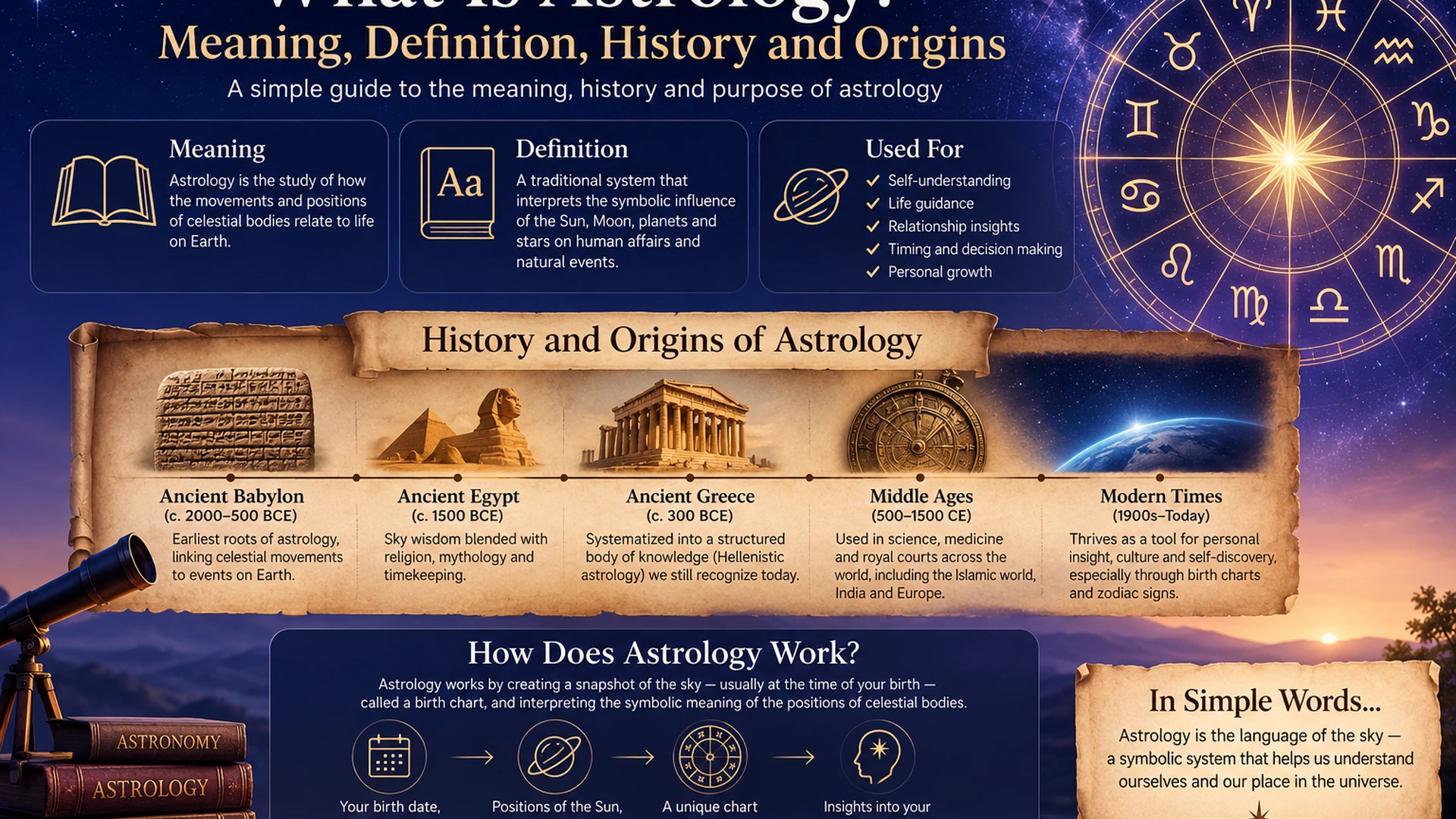
The twelve-sign zodiac developed gradually rather than appearing fully formed at one moment.
A British Museum tablet dated to about 500 BCE lists months with associated zodiacal signs and represents an important stage in the development of the familiar system.
The museum notes that the twelve-part zodiac derives from ancient Mesopotamian ideas and that the system was established through a long process.
Late Babylonian scholars also produced sophisticated mathematical astronomy.
Cambridge scholarship places the establishment of a fixed zodiac of twelve thirty-degree signs around 400 BCE and connects calculated planetary data with later natal omens.
From omens to individual horoscopes
An important historical shift occurred when celestial interpretation became increasingly focused on the circumstances of individual births.
Surviving Babylonian horoscope tablets are limited in number, so historians caution against reconstructing a complete system from fragmentary evidence.
Nevertheless, they demonstrate that personal horoscopy was practiced before the mature Hellenistic systems.
How Astrology Developed in the Hellenistic World
After the conquests of Alexander the Great, ideas circulated across Mesopotamia, Egypt and the Greek-speaking Mediterranean.
Hellenistic astrology combined Babylonian celestial traditions with Egyptian calendrical material and Greek philosophical, geometrical and cosmological concepts.
Alexandria in Egypt is widely regarded as an important center in this process, although surviving evidence does not permit historians to attribute every technique to one city or inventor.
Hellenistic practitioners developed the recognizable architecture of horoscopic astrology: zodiac signs, planets, houses, aspects, lots and techniques for interpreting individual lives.
Their writings also debated fate, providence, character and free will.
Claudius Ptolemy and the Tetrabiblos
Claudius Ptolemy, active in the second century CE, wrote the Tetrabiblos, one of the most influential surviving astrological works of antiquity.
Ptolemy attempted to present astrology in a systematic natural-philosophical framework while rejecting some doctrines he considered poorly reasoned.
His influence continued through Arabic, Latin and later European scholarship.
Astrology Across Regions and Intellectual Traditions
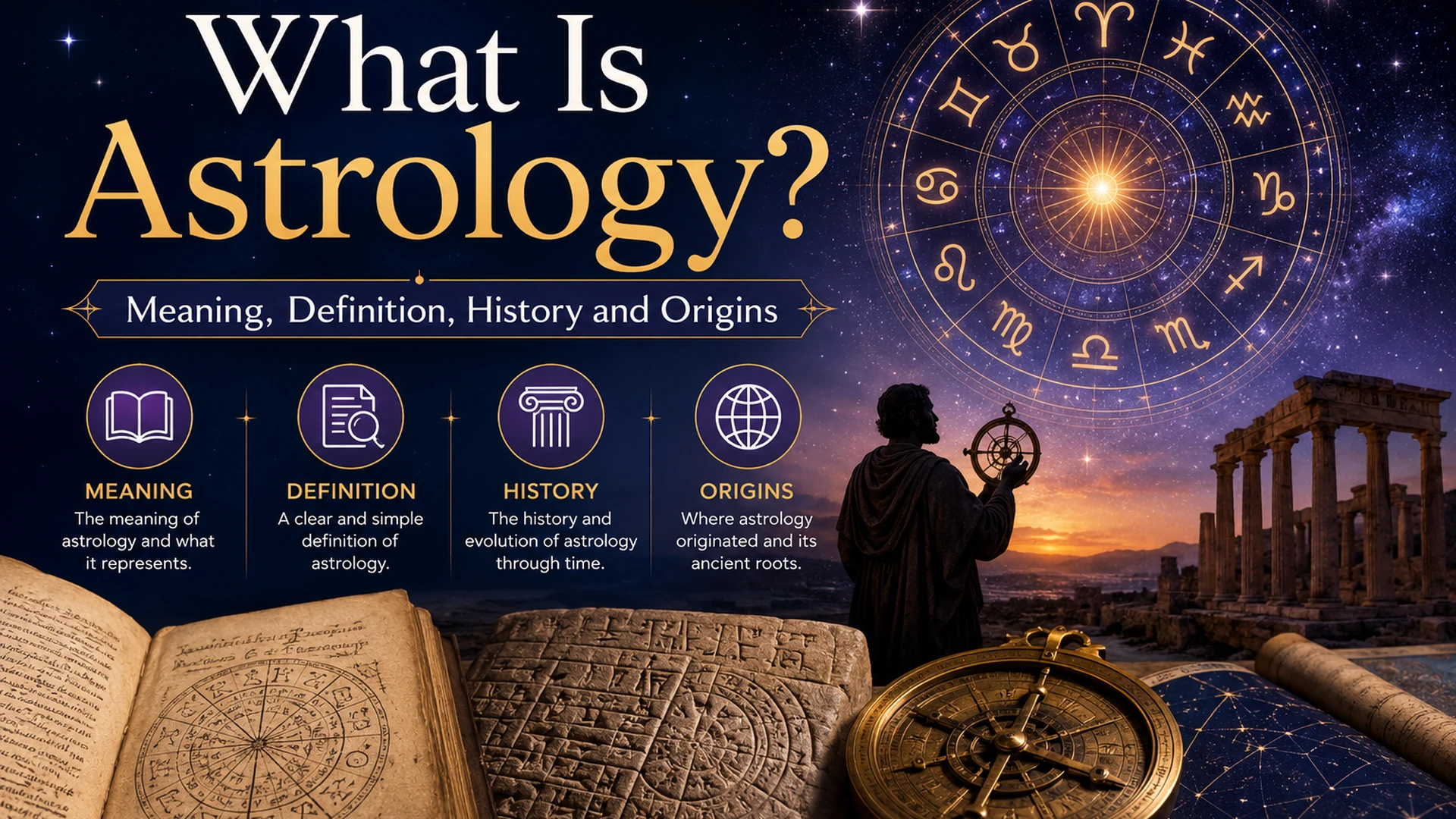
It is misleading to describe all astrology as one line running unchanged from Babylonia to the present.
Celestial interpretation developed through multiple traditions, translations and local innovations.
Indian jyotisha
In South Asia, jyotisha is a broad learned tradition connected with celestial calculation, calendars, ritual timing and forms of astrology.
Indian traditions developed their own texts, techniques and philosophical settings while also participating in long periods of exchange with Hellenistic, Persian and Islamic scholarship.
“Vedic astrology” is a common modern label, but it can flatten a long and internally diverse history.
Chinese astral traditions
Chinese court astronomers and astrologers developed systems centered on imperial governance, calendars, celestial omens, lunar mansions and distinctive constellational maps.
The familiar twelve-animal cycle is only one part of a much larger set of calendrical and cosmological traditions.
Chinese astrology should not be treated as a simple translation of the twelve Western zodiac signs.
The Islamic world
From the eighth century onward, scholars working in Arabic and Persian translated, criticized and extended Greek, Persian and Indian astral sciences.
Baghdad, Isfahan, Maragha, Samarqand, al-Andalus and other centers contributed to mathematical astronomy, tables, instruments and astrological literature.
Cambridge scholarship emphasizes that Islamic astronomers were not merely passive transmitters. They made important mathematical and observational contributions that later shaped European astronomy.
Medieval and Renaissance Europe
Arabic and Greek works entered Latin scholarly networks through translation.
Astrology became connected with court practice, medicine, university learning and calendar production.
Figures now remembered for astronomy sometimes also worked within astrological settings because the modern disciplinary boundary had not yet fully formed.
During the Scientific Revolution, astronomy increasingly developed around mathematical models, telescopic observation, physical laws and testable predictions.
Astrology continued as a separate interpretive tradition, but it lost its earlier place within mainstream natural philosophy.
Astrology and Astronomy: What Is the Difference?
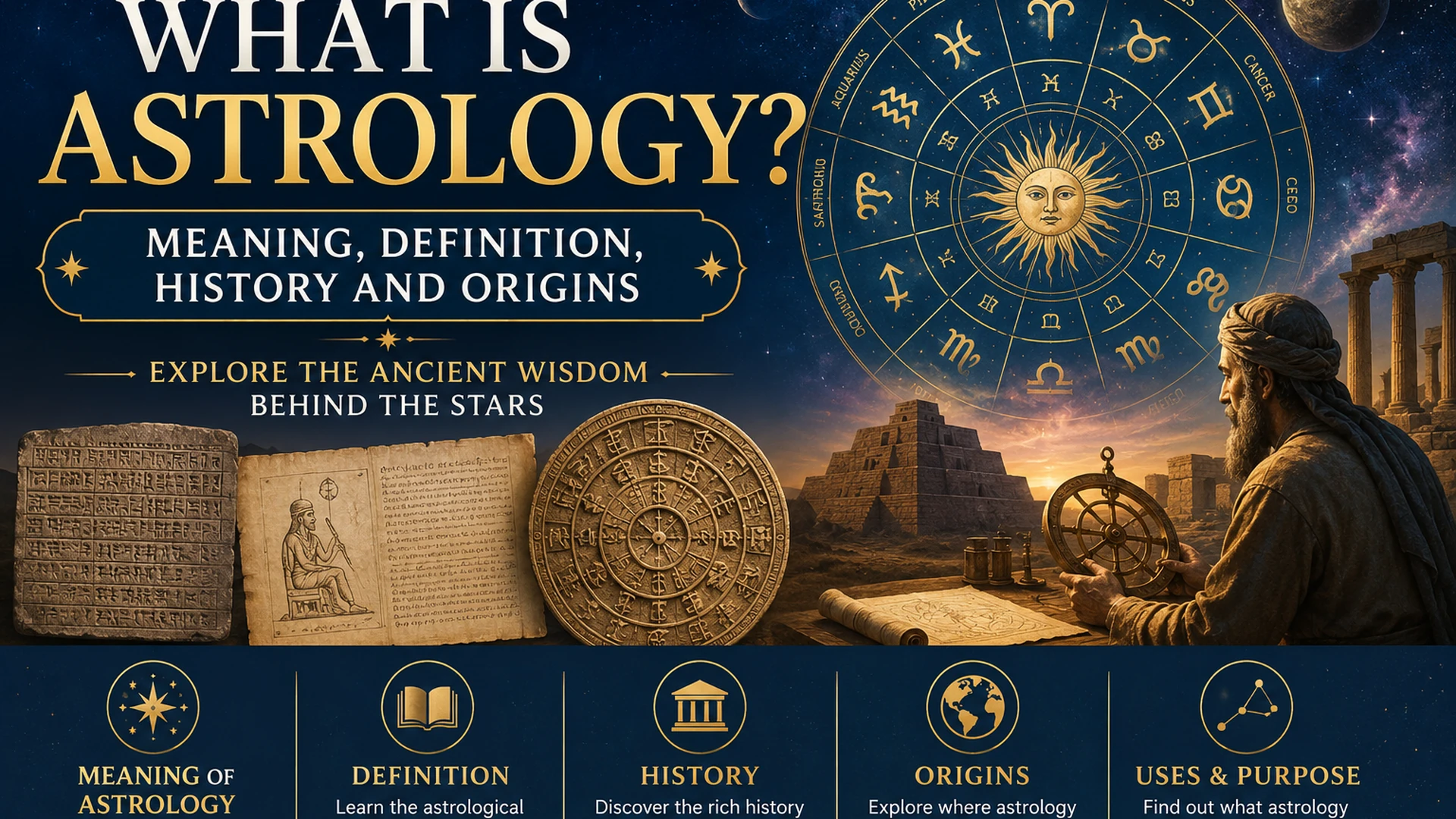
Astrology and astronomy share historical roots in sky observation, but today they are different fields.
| Astrology | Astronomy |
|---|---|
| Interprets celestial positions as symbolically meaningful for human life or earthly events | Studies celestial objects, space and the physical universe |
| Uses inherited symbolic rules and interpretive traditions | Uses observation, mathematics, physics, instruments and testable models |
| Includes birth charts, horoscopes and electional timing | Includes planetary science, stellar evolution, cosmology and astrophysics |
| Does not have established scientific validation for personal prediction | Is a modern scientific discipline whose claims are tested against evidence |
NASA explains that astronomy follows scientific processes involving evidence and data, whereas astrology is based on the belief that celestial positions can describe personality or predict events.
The distinction does not require dismissing astrology’s historical importance.
Astrology helped motivate generations of sky observation, table-making and instrument use. At the same time, historical contribution does not establish the truth of every astrological claim.
The Zodiac, Constellations and Precession
A zodiac sign is not exactly the same thing as a modern astronomical constellation.
Many astrological systems use twelve equal thirty-degree signs, while astronomical constellations are irregularly shaped regions of the sky.
Earth’s rotational axis also changes direction slowly through precession. NASA describes an approximately 26,000-year precession cycle, which changes celestial reference coordinates over long periods.
Western tropical astrology usually anchors its zodiac to the seasonal equinoxes rather than to the current boundaries of constellations.
Many sidereal systems instead use reference points intended to remain aligned more closely with stellar positions. This is why two astrologers using different zodiacs can assign different signs to the same planet.
Precession is a real astronomical phenomenon. It does not by itself prove or disprove astrological interpretation. It explains why systems must define how their zodiac relates to seasons and stars.
Is Astrology a Science?
In modern academic and scientific usage, astrology is not classified as a science.
Scientific disciplines require methods that generate testable claims, allow independent checking, respond to contrary evidence and produce reliable results beyond chance.
One influential double-blind study published in Nature tested whether astrologers could match natal-chart interpretations with personality profiles under controlled conditions.
The study did not support the tested claim that natal charts could accurately describe personality at the expected level.
Philosophers of science continue to debate the best general criteria for distinguishing science from pseudoscience.
Astrology is frequently discussed as a central example because its methods have not produced a dependable progressive research program comparable with astronomy, physics or psychology.
What science can and cannot conclude
Science can test specific claims—for example, whether chart readings match personality profiles better than chance, or whether a defined astrological factor predicts a measurable outcome.
Negative results weaken those specific predictive claims.
Science does not decide whether a person may find a story, symbol or reflective exercise personally meaningful.
Personal meaning and empirical prediction are different questions. Problems arise when symbolic interpretation is presented as a guaranteed medical, financial, legal or psychological diagnosis.
Why Does Astrology Remain Popular?
Astrology offers an organized language for discussing identity, uncertainty, relationships, change and time.
It can provide narrative structure when events feel confusing. Shared zodiac language also creates social conversation and community.
Psychology provides several possible explanations for why generalized readings can feel accurate.
People may notice statements that fit and overlook those that do not, interpret broad descriptions personally or remember striking coincidences more strongly than misses.
These tendencies do not imply that every astrology user is irrational. They show why careful testing requires blinding, control groups and predefined outcomes.
Astrology also survives because it is adaptable.
It has moved from royal courts and manuscript cultures into almanacs, newspapers, radio, websites, apps and social media.
Modern astrology often emphasizes personality and self-development more than the statecraft and omen interpretation found in many ancient sources.
Common Misunderstandings About Astrology
“Astrology is only Sun signs”
Popular horoscopes often classify people by the Sun’s sign, but traditional chart interpretation considers many placements, angles and timing methods.
“All astrology comes from one civilization”
Mesopotamian traditions were foundational for later Hellenistic and Western astrology, but South Asian, Chinese and other celestial traditions have distinct histories.
Cultural exchange occurred, but difference should not be erased.
“Ancient people believed exactly what modern astrologers believe”
Ancient astrology often focused on rulers and public omens.
Modern psychological astrology developed in a different social and intellectual environment.
“A mathematically accurate chart is scientifically proven”
Mathematical calculation can accurately represent celestial positions.
The interpretive meanings assigned to those positions require separate evidence.
“Astrology and astronomy are interchangeable”
They were historically entangled, but modern astronomy is an empirical science and astrology is a symbolic or divinatory tradition.
“Astrology always teaches fixed fate”
Some systems have been strongly deterministic. Others emphasize tendencies, cycles, choices or symbolic reflection.
There is no single universal astrological philosophy.
Cultural Cautions and Ethical Boundaries
Astrology should be discussed with both respect and precision. A responsible approach includes the following principles:
How to Study Astrology Responsibly
Begin by deciding what you want to study: history, cultural symbolism, a living religious tradition, chart techniques or scientific evaluation.
These are related but not interchangeable.
For historical research, prioritize translated primary texts, museum collections, university publications and specialist historians.
Check dates and distinguish between the age of a manuscript and the age of the ideas it contains.
For cultural study, learn the tradition’s own terminology and regional context.
Avoid assuming that a social-media summary accurately represents Indian, Chinese, Arabic, African, European or Indigenous celestial knowledge.
For practical chart study, compare more than one school and state which system you are using.
Record interpretations before outcomes are known when evaluating accuracy. This reduces the temptation to reinterpret every result after the event.
For important decisions, use qualified medical, legal, financial or psychological professionals.
Astrology may be treated as reflection or cultural practice, but it should not replace evidence-based care.
Key Takeaways
People Also Ask
What is astrology in simple terms?
Astrology is a symbolic or divinatory system that interprets the positions of the Sun, Moon, planets and zodiac signs as meaningful for human life and events on Earth.
What does astrology mean literally?
The word comes through Latin from Greek roots associated with stars and discourse or study.
Historically, the term could include celestial study more broadly, but modern usage distinguishes astrology from astronomy.
Where did astrology originate?
The strongest documented foundations of the astrology that influenced the Mediterranean and later Western world developed in ancient Mesopotamia, especially Babylonia.
Other civilizations also created distinct celestial and calendrical traditions.
What is astrology used for?
Historically, astrology was used to interpret omens concerning rulers, weather, war, harvests and public affairs.
Later traditions also developed birth charts, question charts and methods for choosing times.
Today, it is often used for self-reflection, spirituality or entertainment.
How does astrology work?
Astrologers calculate celestial positions for a time and place, organize them into a chart and interpret planets, signs, houses and aspects according to a particular tradition.
Accurate calculation does not itself prove the meanings assigned to the chart.
Is astrology scientifically proven?
No reliable scientific evidence has established astrology as a dependable method for predicting personality or events.
Controlled studies have not validated major tested claims.
Who invented astrology?
No single person invented astrology.
It developed gradually through generations of observers, scribes and scholars. Mesopotamian celestial omen traditions were especially influential, and Hellenistic scholars later systematized horoscopic astrology.
Is a zodiac sign the same as a constellation?
No.
Astrological signs are usually equal divisions of a zodiac, while astronomical constellations are irregular regions of the sky.
Different astrological systems also define their zodiac reference points differently.
Frequently Asked Questions
Is astrology a religion?
Astrology is not one religion.
It has been practiced within religious, philosophical, courtly, medical and secular settings.
Some people integrate it into spiritual belief. Others treat it as a technique, cultural language or entertainment.
Is astrology the same everywhere?
No.
Western tropical astrology, Indian jyotisha, Chinese astral traditions and other systems use different calendars, zodiacs, symbols and interpretive methods.
What is a horoscope?
A horoscope can mean a chart showing celestial positions for a particular time and place.
In popular media, the word also refers to a short forecast written for a zodiac sign.
What is a natal chart?
A natal or birth chart is a chart calculated for the time and place of birth.
Astrologers interpret it according to the rules of their chosen tradition.
Why are there twelve zodiac signs?
The twelve-part zodiac was shaped gradually in Mesopotamian scholarship and linked with the year’s twelve-month structure.
A Late Babylonian tablet dated to about 500 BCE associates months with zodiacal signs.
Did astrology help astronomy develop?
Astrological, calendrical and political demand encouraged observation, calculation and table-making in several historical societies.
Astronomy later emerged as a separate scientific discipline, so historical contribution should not be confused with proof of astrological prediction.
Can astrology predict health or fertility?
Astrology should not be used to diagnose disease, assess fertility or replace qualified medical care.
No chart guarantees a medical or reproductive outcome.
Can astrology guarantee money, protection or relationships?
No.
Claims that astrology guarantees wealth, legal victory, protection, marriage or reconciliation are unsupported and can be exploitative.
Conclusion
Astrology is best understood as a family of historical and living traditions that assign meaning to celestial patterns.
Its documentary history reaches deep into ancient Mesopotamian omen scholarship, while the familiar language of planets, zodiac signs, houses and birth charts was developed through Hellenistic and later intellectual worlds.
Its influence is undeniable.
Astrology shaped art, manuscripts, political advice, medical theories, calendars and the history of celestial observation.
Yet historical importance and scientific reliability are not the same.
Modern astronomy studies the physical universe through evidence and testable models, while astrology remains an interpretive, divinatory or symbolic practice.
A careful study of astrology therefore avoids two extremes: presenting every claim as proven or dismissing centuries of cultural history as meaningless.
The most responsible approach recognizes its historical depth, respects distinct traditions and states clearly where evidence ends and belief or interpretation begins.
Final Summary
Astrology means interpreting the sky as meaningful for human and earthly affairs. Its strongest documented early roots lie in Mesopotamian celestial divination; its horoscopic form was developed further in the Hellenistic world and transformed across South Asian, East Asian, Islamic and European settings. It remains culturally influential, but modern science has not validated its personal predictive claims.
Research Sources and Further Reading
5. Internal Linking Plan
| Suggested anchor text | Target article or slug | Recommended placement |
|---|---|---|
| origins of astrology | /origins-of-astrology/ | Mesopotamian origins section |
| how to read a birth chart | /what-is-a-birth-chart/ | How astrology works |
| twelve zodiac signs | /twelve-zodiac-signs-meaning/ | Chart components |
| elements in astrology | /four-elements-in-astrology/ | Supporting chart concepts |
| planetary meanings in astrology | /planetary-meanings-in-astrology/ | Planets and luminaries |
| Moon sign versus Sun sign | /moon-sign-vs-sun-sign/ | Popular astrology context |
| what a rising sign means | /rising-sign-meaning/ | Birth-chart explanation |
| astrology in ancient civilizations | /astrology-in-ancient-civilizations/ | Historical development |
| common myths about astrology | /common-astrology-myths/ | Misunderstandings section |
| lunar calendars through history | /lunar-calendars-through-history/ | Calendars and timing |
Implementation note: Verify the live slug for each existing article before publishing. Use descriptive anchors once where contextually relevant rather than repeating exact-match anchors throughout the page.
6. Glossary
| Term | Definition |
|---|---|
| Aspect | An angular relationship between celestial bodies in an astrological chart. |
| Astrology | A symbolic or divinatory tradition that interprets celestial positions as meaningful for human or earthly affairs. |
| Astronomy | The scientific study of celestial objects, space and the physical universe. |
| Birth chart | A chart representing celestial positions for a person’s time and place of birth. |
| Celestial divination | Interpreting events or patterns in the sky as signs concerning earthly matters. |
| Electional astrology | Selecting a time considered symbolically favorable for an activity. |
| Ephemeris | A table or dataset giving calculated positions of celestial bodies over time. |
| Horoscope | A chart for a particular moment, or a popular forecast associated with a zodiac sign. |
| Horary astrology | A method that interprets a chart for the time a specific question is posed. |
| House | One of the chart sectors associated by astrologers with areas of life. |
| Jyotisha | A diverse South Asian learned tradition involving celestial calculation, calendars and astrology. |
| Mundane astrology | Astrology concerned with states, rulers, public events or collective conditions. |
| Natal astrology | Astrological interpretation based on a person’s birth chart. |
| Precession | The slow change in the direction of Earth’s rotational axis. |
| Sidereal zodiac | A zodiac defined with reference to stellar positions, using a chosen correction or reference point. |
| Tropical zodiac | A zodiac anchored to the seasonal equinoxes and solstices. |
| Zodiac | A belt of sky along the ecliptic, divided into signs in many astrological systems. |
7. Related Article Recommendations
Article Information
- Publisher
- Ancestral Temple
- Editor
- Ancestral Temple
- Last updated
- Jul 26, 2026
- Last reviewed
- Jul 26, 2026
- Content version
- ff54541626
This educational article should be read as cultural and spiritual information, not as medical, legal, financial, or emergency advice.
Helpful Related Guidance
Explore This Topic
Related Topic Cluster
Astrology and zodiac
Complete Guide The 12 Zodiac Signs in Order: Dates, Meanings and OriginsAbout the Author
 Ancestral Temple
Spiritual guide and practitioner with decades of experience in ancestral wisdom, rituals, and divine guidance.
Related Posts
View All












Leave a Comment
We'd love to hear your thoughts.