
Planetary Influence Meaning: How Planets Are Interpreted in Astrology
Quick Summary
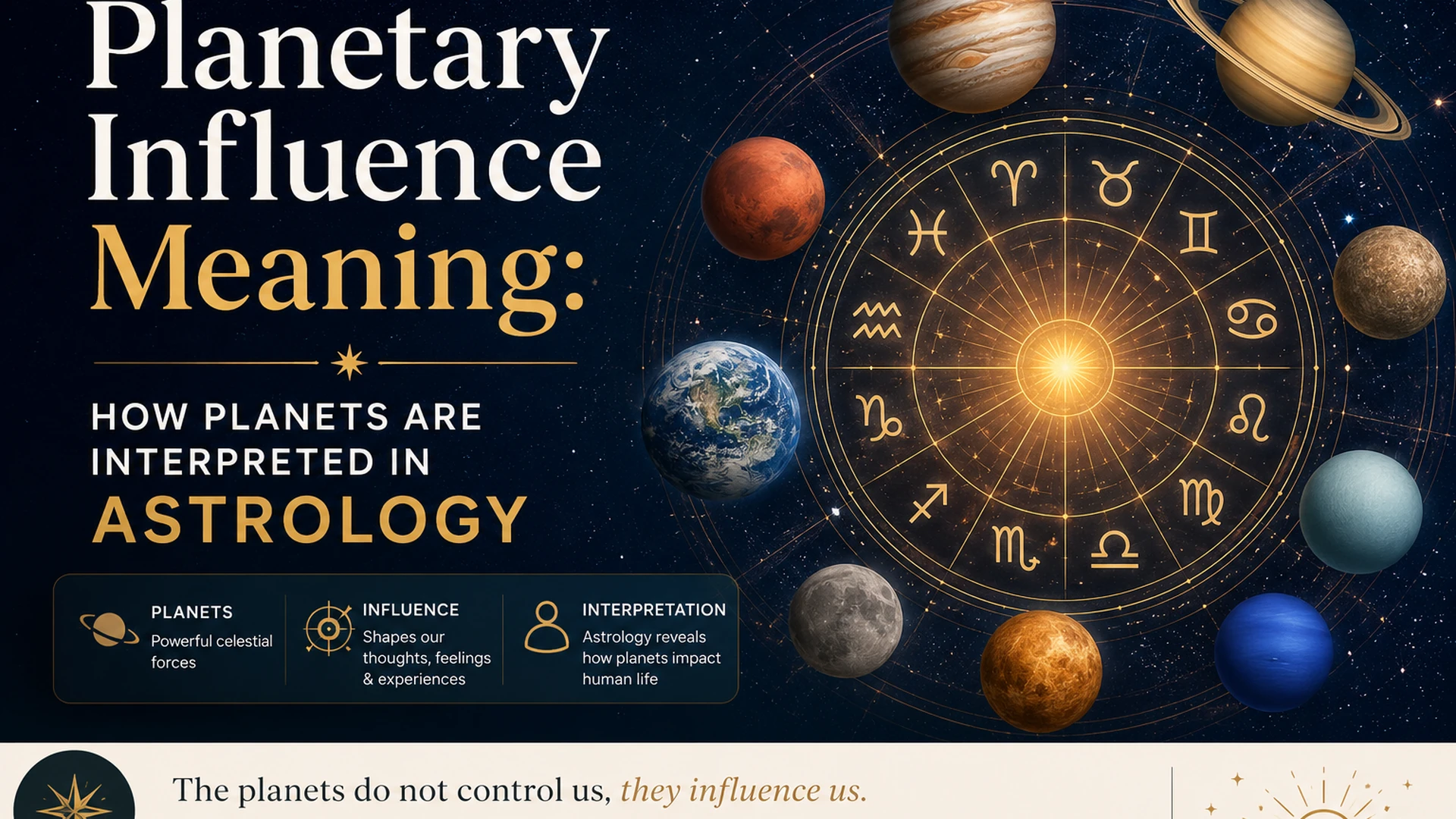
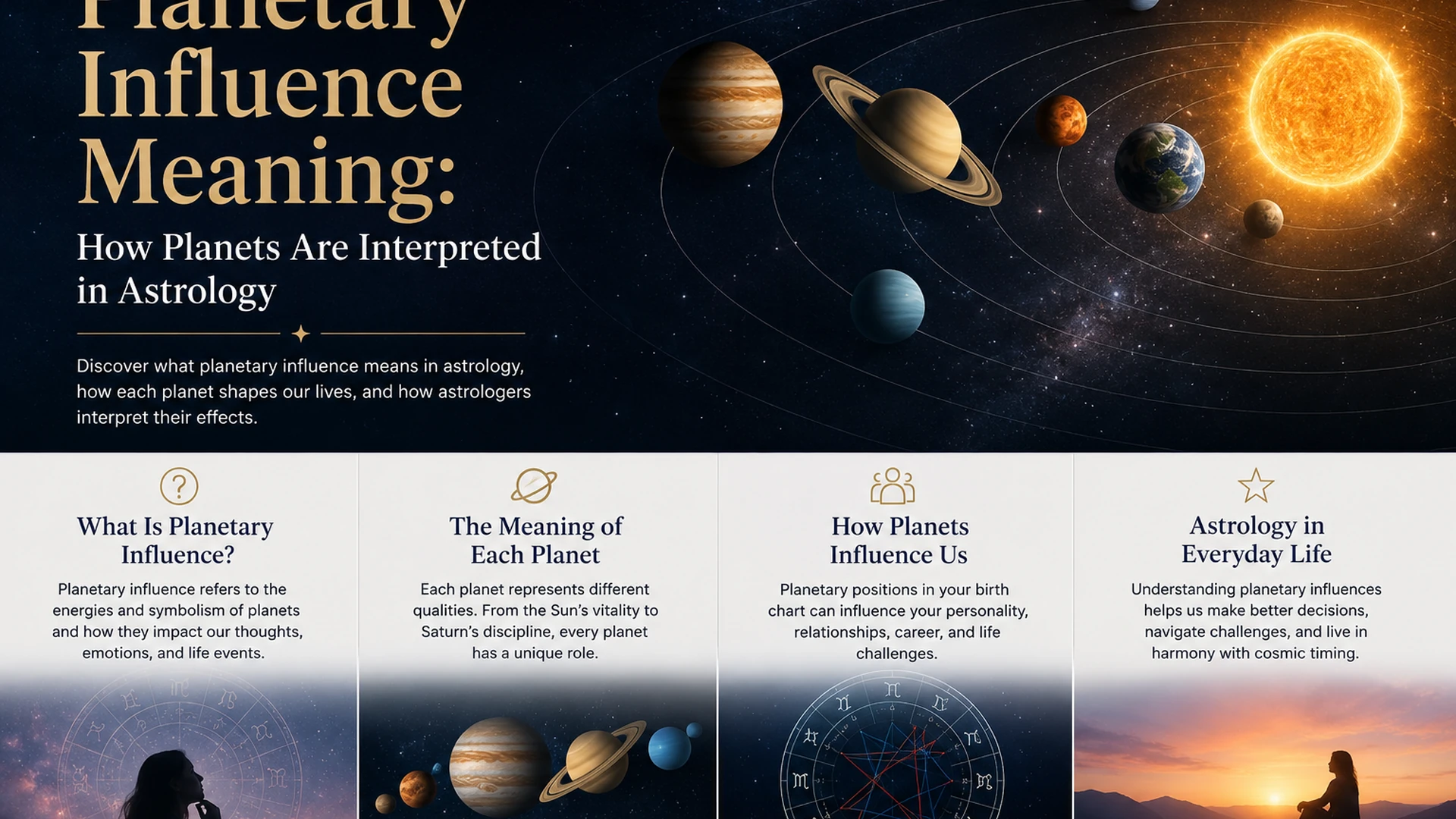
Planetary influence meaning in astrology refers to the symbolic roles astrologers assign to the Sun, Moon, and planets when interpreting a birth chart, event chart, or period of ti...
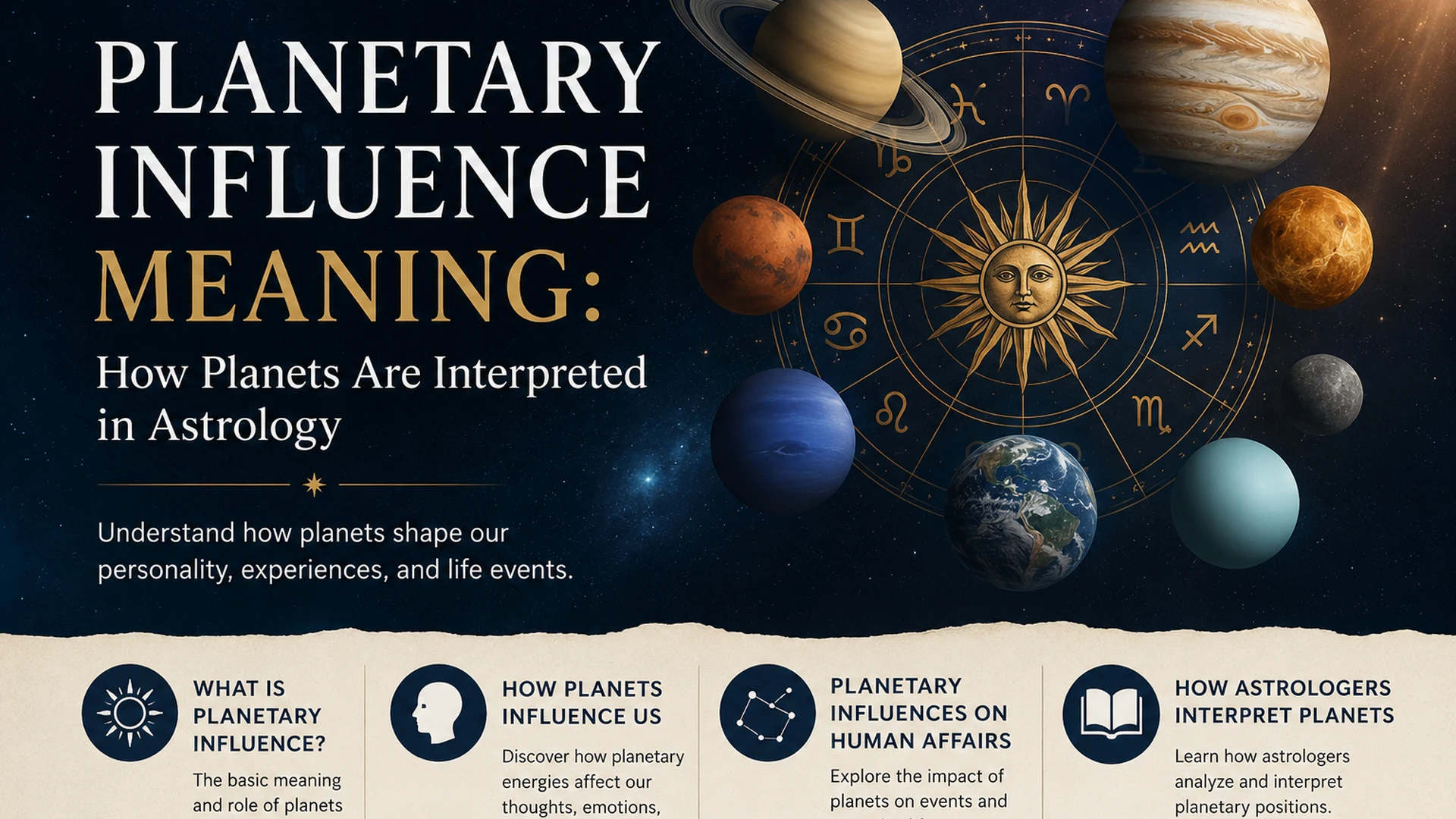
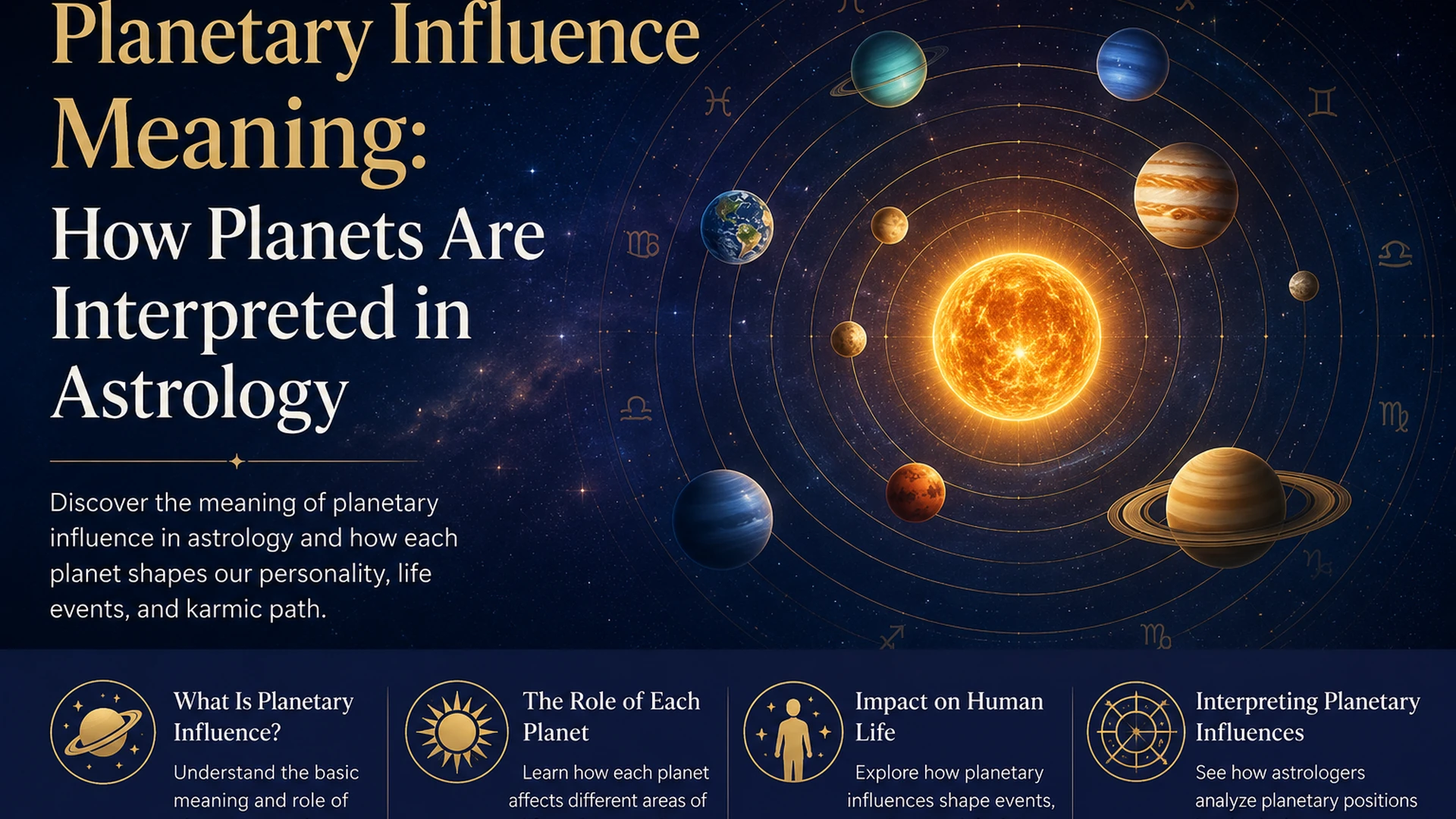
Planetary influence meaning in astrology refers to the symbolic roles astrologers assign to the Sun, Moon, and planets when interpreting a birth chart, event chart, or period of time. A planet is not read alone. Its meaning is modified by the zodiac sign it occupies, the astrological house where it appears, its angular relationships with other planets, and whether the astrologer is examining a birth moment, a current transit, or a public event.
The phrase can sound as though astrology has discovered a measurable force flowing from planets into human personality. That is not what every astrologer means, and it is not scientifically established. Some astrological traditions describe celestial bodies as causes; others treat them as signs, symbols, correspondences, divine indicators, archetypes, or timing markers. A careful explanation must therefore separate what astrology teaches, what historical cultures believed, and what scientific research has demonstrated.
Quick Answer
In astrology, planetary influence means the symbolic function assigned to a celestial body in a chart. The planet describes what kind of theme is active, the zodiac sign describes how it is expressed, the house describes where it appears in life, and aspects describe how it interacts with other planetary themes. These interpretations are traditional beliefs, not scientifically proven forces.
What Does “Planetary Influence” Mean?
In ordinary language, an influence is something that helps shape an outcome. In astrology, however, the word has several possible meanings.
A literal or causal interpretation says that celestial bodies somehow produce effects on earthly life. Ancient writers sometimes explained such effects through qualities such as heat, cold, moisture, dryness, rays, divine intention, or cosmic sympathy. Ptolemy’s Tetrabiblos, one of the most influential texts in Western astrological history, discussed planets through physical qualities accepted in the natural philosophy of his period. [4]
A symbolic interpretation treats the planets as a language of meaning. The Sun may symbolize identity, Mercury communication, Venus attraction, and Saturn boundaries. The chart is read as an organized symbolic picture rather than a map of measurable radiation causing personality.
A correspondence-based interpretation proposes that celestial and earthly patterns reflect one another. In this view, planets may indicate a quality of time without mechanically producing every event associated with that time.
A divinatory interpretation treats the sky as a source of signs. This approach is historically important because Mesopotamian celestial omen texts connected observations of the Moon, planets, eclipses, and stars with possible consequences for rulers, harvests, warfare, weather, and public affairs. British Museum tablets preserve zodiac lists, planetary observations, and omen reports involving Venus, Mars, Jupiter, and the Moon. [2][3]
A psychological or archetypal interpretation, common in some modern Western astrology, uses planetary symbols to discuss motives, emotions, conflict, attachment, responsibility, imagination, and transformation. This form often presents astrology as a reflective framework rather than a physical science.
These approaches overlap, but they are not identical. Two astrologers can use the same birth chart while disagreeing about whether the chart describes causes, signs, possibilities, tendencies, spiritual meaning, or a language for self-reflection.
The Basic Formula: Planet, Sign, House, Aspect and Timing
A beginner can understand much of Western chart interpretation through five questions:
| Chart factor | Main question | Simple explanation |
|---|---|---|
| Planet | What is acting? | The function, drive, topic, or symbolic character being interpreted |
| Zodiac sign | How does it act? | The style, qualities, or manner of expression |
| House | Where does it act? | The area of life in which the theme is placed |
| Aspect | How does it relate? | The angular relationship between planetary functions |
| Transit or timing method | When is it emphasized? | The period when a current planet forms a relationship with a chart placement |
For example, an astrologer does not interpret Mars only as “action.” Mars in one sign may be described as direct, while Mars in another may be described as cautious or emotionally motivated. A house position may connect the symbolism with work, relationships, family, finances, education, or another chart area. An aspect to Saturn may be interpreted as restraint or discipline, while an aspect to Jupiter may be interpreted as expansion or confidence.
This layered method explains why simple online lists can be misleading. The planet supplies a core vocabulary, but the full interpretation comes from relationships within the chart.
Why Astrology Calls the Sun and Moon “Planets”
Astronomy classifies the Sun as a star and the Moon as Earth’s natural satellite. The solar system has eight planets, while Pluto is classified as a dwarf planet. [1]
Astrology uses older observational language. The Greek root behind “planet” is connected with a wanderer—an object that appears to move against the background of fixed stars. Ancient sky watchers recognized seven prominent moving lights: the Sun, Moon, Mercury, Venus, Mars, Jupiter, and Saturn. These became the seven classical planets of astrology.
The Sun and Moon are also called the luminaries or lights. Modern astrologers commonly retain the convenient word “planet” for chart factors that function like planets in the interpretive system, even when their astronomical classifications differ.
This is also why Pluto remains important in many modern astrological systems despite its astronomical reclassification. Astrology’s vocabulary is organized by historical and symbolic practice, not by the International Astronomical Union’s current taxonomy.
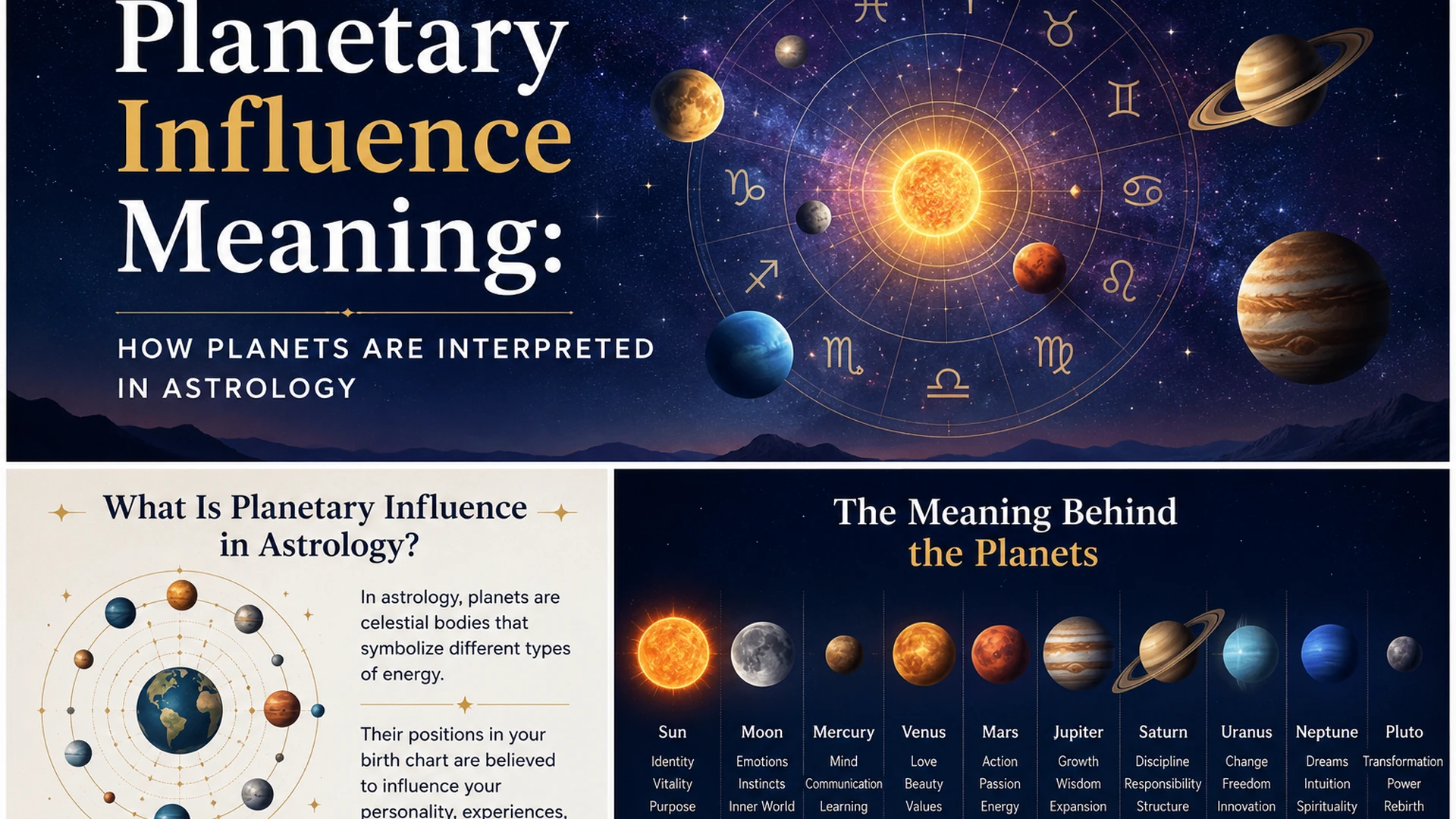
The Ten Common Planetary Meanings in Modern Western Astrology
The table below summarizes widely used associations. These are astrological conventions, not scientifically verified personality mechanisms. Meanings also vary by school, period, and practitioner.
| Astrological body | Common symbolic themes | Constructive expressions | Difficult or excessive expressions |
|---|---|---|---|
| Sun | Identity, vitality, purpose, visibility, authority | Confidence, creativity, direction | Pride, domination, self-absorption |
| Moon | Emotion, instinct, memory, habits, security | Care, responsiveness, belonging | Moodiness, dependency, reactivity |
| Mercury | Thinking, language, learning, exchange, movement | Curiosity, analysis, communication | Restlessness, confusion, manipulation |
| Venus | Affection, attraction, values, beauty, pleasure | Cooperation, appreciation, connection | Indulgence, avoidance, possessiveness |
| Mars | Action, desire, courage, conflict, assertion | Initiative, bravery, decisive effort | Aggression, impatience, destructiveness |
| Jupiter | Growth, belief, opportunity, law, meaning | Generosity, learning, perspective | Excess, overconfidence, exaggeration |
| Saturn | Limits, structure, duty, time, consequence | Discipline, endurance, maturity | Fear, rigidity, restriction, pessimism |
| Uranus | Change, independence, invention, disruption | Originality, reform, liberation | Instability, rebellion without direction |
| Neptune | Imagination, ideals, spirituality, ambiguity | Compassion, artistry, vision | Confusion, escapism, deception |
| Pluto | Power, depth, crisis, elimination, transformation | Renewal, honesty, resilience | Obsession, coercion, destructive control |
The Sun: Identity, Vitality and Direction
In modern Western astrology, the Sun is usually associated with conscious identity, vitality, purpose, visibility, and the desire to become a distinct person. It is the basis of the familiar Sun sign used in newspaper and online horoscopes.
A full chart reading does not treat the Sun sign as the whole personality. The Sun’s house, aspects, dignity, relationship to the Ascendant, and the astrologer’s tradition all affect interpretation. Traditional astrology may also connect the Sun with rulers, authority, honor, fathers, status, and life-giving heat.
The Moon: Emotion, Habit and Security
Astrologers commonly associate the Moon with emotional responses, bodily rhythms, memory, habit, care, family, belonging, and the need for security. Because the Moon moves quickly through the zodiac, its position changes more rapidly than those of the planets.
Historically, the Moon was important not only in natal astrology but also in calendars, omen literature, agriculture, religious observance, and electional timing. Its real astronomical phases and tidal relationship with Earth should not be confused with every astrological claim made about mood or fate.
Mercury: Thought, Language and Exchange
Mercury usually symbolizes perception, speech, writing, learning, calculation, trade, travel, messages, and the exchange of information. Its interpretation may describe how a person organizes ideas or communicates, but it does not scientifically diagnose intelligence or guarantee communication problems during retrograde periods.
In a chart, Mercury’s aspects can substantially change the reading. A Mercury-Saturn contact may be described as careful or restrained; a Mercury-Jupiter contact may be described as broad, confident, or expansive. These are interpretive patterns within astrology, not laboratory-established personality laws.
Venus: Affection, Value and Attraction
Venus is commonly connected with affection, attraction, relationships, beauty, pleasure, diplomacy, art, and personal values. In older Mesopotamian traditions, the planet Venus was associated with Inana or Ishtar, a deity whose meanings included sexuality, political power, warfare, and transitions. This history shows that planetary symbolism has never been completely fixed or limited to modern ideas of romance. [3]
Modern readings may ask what a person appreciates, how they seek harmony, and how they relate to pleasure or attachment. Ethical interpretation should avoid claiming that one Venus placement proves loyalty, compatibility, wealth, or moral character.
Mars: Action, Desire and Conflict
Mars generally represents action, assertion, courage, competition, anger, desire, and the capacity to confront obstacles. Ancient omen texts also connected Mars with public events, danger, war, and political consequences.
A balanced interpretation includes both constructive and difficult possibilities. Mars can symbolize decisive effort and protection as well as impatience and aggression. A chart placement should never be used to label someone violent, abusive, or dangerous without real-world evidence.
Jupiter: Growth, Belief and Meaning
Jupiter is commonly interpreted through themes of growth, confidence, generosity, opportunity, religion, philosophy, law, education, travel, and broad perspective. It is often called beneficial, but “Jupiter is always lucky” is an oversimplification.
Expansion can be constructive or excessive. An astrologer may describe Jupiter as increasing whatever it touches, which could mean learning and generosity or overconfidence and waste. Traditional methods also consider condition, house placement, rulership, sect, and aspects rather than assuming that every Jupiter placement produces good fortune.
Saturn: Structure, Limits and Time
Saturn commonly symbolizes structure, time, responsibility, scarcity, boundaries, discipline, authority, endurance, fear, aging, and consequence. Traditional texts often treated Saturn as difficult because of its slow motion and ancient associations with coldness, distance, limitation, and deprivation. [4]
Modern psychological astrology frequently reframes Saturn as a teacher of maturity. That interpretation can be useful as symbolism, but it should not romanticize suffering or tell people that abuse, illness, or poverty is a deserved “lesson.”
Uranus: Independence, Innovation and Disruption
Uranus was discovered in 1781, the first planet identified with the aid of a telescope. Astrologers gradually developed meanings involving independence, rebellion, invention, sudden change, reform, electricity, and disruption. [6]
Its symbolism illustrates how astrology changes over time. Ancient astrologers did not interpret Uranus because it was not part of their working planetary system. Modern associations were built after discovery through analogy, mythology, historical observation, and astrological practice rather than inherited unchanged from antiquity.
Neptune: Imagination, Ideals and Uncertainty
Neptune was discovered in 1846. Modern astrologers often connect it with imagination, spirituality, compassion, dreams, art, idealization, uncertainty, dissolution, escapism, and deception. [6]
Because Neptune moves slowly, many people born within the same period share its zodiac sign. Astrologers therefore tend to rely more heavily on its house position and aspects in individual charts. Broad generational interpretation should not be mistaken for a precise personal diagnosis.
Pluto: Power, Crisis and Transformation
Pluto was discovered in 1930 and reclassified as a dwarf planet in 2006. Many modern astrologers continue to use it as a major chart factor, associating it with power, hidden material, compulsion, destruction, elimination, survival, death-and-rebirth symbolism, and deep transformation. [1][6]
Pluto’s history again shows that astrological and astronomical categories serve different purposes. Its continued astrological use does not make it an astronomical planet, and its astronomical reclassification does not automatically remove it from a symbolic tradition.
How Planetary Interpretation Developed Historically
Mesopotamian Celestial Omens
The earliest background of Western planetary astrology lies partly in ancient Mesopotamian systems of celestial observation and divination. Scholars tracked the Moon, eclipses, weather, stars, and visible planets. Omen statements commonly followed a conditional structure: if a particular celestial event occurred, a corresponding earthly event might follow.
These interpretations were often concerned with kingdoms, rulers, warfare, crops, disease, and collective affairs rather than modern personality descriptions. British Museum collections include tablets concerning the zodiac, Mercury’s stationary points, Venus forecasts, and Mars in relation to the Moon, stars, and Jupiter. [2][3]
Babylonian mathematical astronomy later provided increasingly precise methods for predicting and describing celestial positions. Astronomy and divination were not separated in the same way that modern science separates astronomy from astrology. [2]
Hellenistic Horoscopic Astrology
During the Hellenistic and Roman periods, earlier Mesopotamian celestial knowledge interacted with Greek mathematical, philosophical, and geometrical ideas in Egypt and the wider eastern Mediterranean. Astrologers developed systematic birth-chart methods using zodiac signs, houses or places, planetary rulerships, aspects, lots, and timing techniques.
Ptolemy’s Tetrabiblos presented an influential attempt to organize astrological doctrine within the natural philosophy of the second century CE. Vettius Valens preserved extensive practical material about planetary effects and combinations. Modern scholarly analysis of Valens shows that planetary combinations followed an internal interpretive logic rather than being merely random lists. [4][5]
Medieval, Indian, Islamic and European Transformations
Astrological knowledge moved through translation, criticism, adaptation, and debate. Greek texts were translated into Syriac, Persian, Arabic, Latin, and other languages. Indian astrology developed through complex interactions among local astral traditions, mathematical astronomy, calendrical systems, and imported horoscopic techniques. Islamic scholars preserved and expanded astronomical calculation while also debating the religious and philosophical status of astrology.
European medieval and Renaissance astrology later used planetary doctrine in medicine, agriculture, politics, weather prediction, and natal interpretation. These practices changed across regions and periods. There has never been one timeless, globally identical astrology.
Modern Psychological and Popular Astrology
Modern Western astrology increasingly emphasizes personality, self-understanding, relationships, and inner development. The discovery of Uranus, Neptune, and Pluto expanded the working planetary vocabulary. Twentieth-century psychological approaches often described planets as archetypal functions within the personality.
Popular Sun-sign columns simplified this larger system by focusing on the Sun’s zodiac sign. A complete modern natal reading may include all ten commonly used bodies, houses, the Ascendant, aspects, nodes, asteroids, and multiple timing methods.
What Are “Planetary Influences on Human Affairs”?
The phrase planetary influences on human affairs usually refers to the astrological belief that celestial configurations correspond with events in personal or collective life.
In natal astrology, the “human affairs” may include personality, family, work, relationships, values, conflict, beliefs, and life transitions. In mundane astrology, they may include rulers, governments, wars, economic conditions, weather, public health, or social change. Ancient Mesopotamian celestial omens were often directed toward collective and royal affairs, while later horoscopic astrology placed greater emphasis on individual births. [3]
Astrologers may interpret these connections in different ways:
A responsible article should not collapse these positions into the claim that all astrologers believe planets emit a scientifically measurable personality force.
How Signs Change a Planet’s Meaning
Astrologers usually describe the planet as the basic function and the sign as its style of expression.
For example, Mars remains connected with action or assertion, but its sign is said to describe how that action operates. Mercury remains connected with thinking and communication, but its sign is said to shape the tone, speed, emotional quality, or practical focus of expression.
Traditional astrologers may also judge whether a planet is in a sign it rules, a sign of exaltation, detriment, or fall. Modern astrologers may focus more on psychological style. These methods can produce different interpretations from the same placement.
How Houses Change a Planet’s Meaning
Astrological houses divide a chart into areas of life. Although house systems and meanings vary, astrologers commonly connect them with topics such as identity, possessions, communication, home, creativity, health, partnership, shared resources, belief, career, community, and retreat.
A planet’s house answers the question “Where is this theme emphasized?” Venus in a relationship house may be interpreted differently from Venus in a career house. Saturn in a home-related house may be discussed through family duty or boundaries, while Saturn in an education-related house may be discussed through disciplined study or restrictive beliefs.
The house does not replace the planet’s core symbolism. It gives that symbolism a field of application.
How Aspects Combine Planetary Influences
Aspects are angular relationships between planets or chart points. Common Western aspects include:
The aspect tells the astrologer how two planetary functions are said to interact. Venus and Saturn might be read through affection and restraint; Mars and Jupiter through action and expansion; Mercury and Neptune through communication and imagination or confusion.
The same aspect can be expressed in multiple ways. Ethical interpretation presents possibilities rather than declaring a fixed fate.
Natal Planets Versus Planetary Transits
A natal planet is the position of a planet in a chart calculated for a birth time and location. Astrologers treat it as part of the chart’s lasting structure.
A transit is the current or future position of a moving planet compared with the natal chart or another event chart. Astrologers use transits to discuss timing, emphasis, periods of change, or the activation of natal patterns.
For example, natal Saturn is interpreted as part of the birth chart’s symbolism. Transiting Saturn forming an aspect to natal Mercury may be interpreted as a temporary period involving serious thought, responsibility, delays, concentration, or communication boundaries.
A transit does not have one guaranteed outcome. Interpretation depends on the natal chart, the astrologer’s methods, and the person’s circumstances. Claims that a transit guarantees divorce, illness, wealth, pregnancy, or death are irresponsible and unsupported.
Personal, Social and Outer Planets
Modern Western astrologers often group planets by apparent speed and interpretive scope.
Personal planets
The Sun, Moon, Mercury, Venus, and Mars are commonly called personal planets or personal bodies. Because they move relatively quickly through the zodiac, their signs vary more among individuals born close in time.
Social planets
Jupiter and Saturn are sometimes called social planets. Their cycles are slower and are interpreted through a person’s relationship with education, law, belief, opportunity, structure, institutions, and social responsibility.
Outer or generational planets
Uranus, Neptune, and Pluto move slowly. Entire age groups may share the same sign placement, so astrologers often give greater attention to houses and aspects when making individual interpretations. Their sign positions are also used for broad generational narratives.
These categories are modern conveniences rather than universal rules across all astrological traditions.
Do All Astrological Traditions Interpret the Same Planets?
No. Planetary doctrines vary.
Traditional Western and Hellenistic astrology focus on the seven visible planets. Many modern Western astrologers add Uranus, Neptune, and Pluto. Indian Jyotisha commonly emphasizes the Sun, Moon, Mercury, Venus, Mars, Jupiter, Saturn, and the lunar nodes Rahu and Ketu, with techniques and philosophical frameworks that differ from Western practice. Chinese systems include important planetary and calendrical correspondences but should not be reduced to a Western birth chart translated into different symbols.
African celestial traditions are also diverse. Communities have used the sky for calendars, navigation, farming, ritual timing, political authority, storytelling, and environmental knowledge. Not every African system of sky observation is astrology, and it is inaccurate to invent one universal “African planetary astrology” for the entire continent.
Respectful comparison identifies the specific culture, period, language, and practice instead of merging unrelated systems.
Are Planetary Influences Scientifically Proven?
Astrology has major cultural and historical importance, but controlled scientific testing has not established that natal planetary positions reliably predict personality or life outcomes.
In a well-known double-blind study published in Nature in 1985, Shawn Carlson tested whether astrologers could match natal charts with personality profiles under controlled conditions. The reported results did not support the tested astrological claim. [7]
Astronomy does confirm real physical relationships involving celestial bodies. The Sun supplies Earth with light and heat. The Moon contributes to ocean tides. Planetary gravity affects orbital motion. These established effects do not demonstrate that the zodiac positions of distant planets encode personality, compatibility, career, or fate.
Astrological interpretations can still feel personally meaningful. Meaningfulness, however, is not the same as experimental validation. Broad statements, selective memory, confirmation bias, flexible symbolism, and the Barnum or Forer effect can all contribute to the feeling that a reading is uniquely accurate.
The most accurate conclusion is therefore:
Common Misunderstandings About Planetary Influence
“A planet has one fixed meaning”
Planet meanings change with historical period, school, sign, house, aspect, and context. Venus did not always mean only romance, and Saturn does not always mean punishment.
“One difficult planet makes someone a bad person”
Astrological placements do not establish moral character. A Mars, Saturn, or Pluto placement cannot prove violence, cruelty, criminality, or abuse.
“A beneficial planet guarantees success”
Jupiter or Venus placements do not guarantee money, marriage, status, or protection. Even within astrology, interpretation depends on the whole chart.
“Retrograde planets move backward through space”
Retrograde motion is an apparent change in movement against the background stars caused by the relative positions and motions of Earth and another body. Astrologers assign symbolic meanings to the appearance, but the planet does not physically reverse its orbit.
“Pluto’s reclassification disproves or proves astrology”
Pluto’s astronomical classification and its astrological use are different questions. Reclassification concerns scientific definitions; astrological use concerns a symbolic tradition.
“Planetary influence is the same in every culture”
It is not. Different cultures and schools use different celestial bodies, calendars, zodiacs, houses, interpretive principles, and religious frameworks.
Ethical and Responsible Use
Astrology is safest when used as optional cultural study, spiritual reflection, storytelling, or a prompt for self-examination. It becomes harmful when presented as unquestionable authority.
Do not use planetary interpretations as the sole basis for decisions involving:
A chart cannot provide informed consent, verify evidence, diagnose disease, calculate financial risk, or replace qualified professional advice.
Astrologers and readers should also avoid fatalistic language. “This placement guarantees suffering” can create fear and dependency. More responsible wording describes themes, questions, or possible interpretations while leaving room for context, choice, uncertainty, and real-world evidence.
How to Read a Planetary Interpretation Critically
When reading an astrology article or receiving a chart reading, ask:
These questions allow readers to appreciate astrology’s history and symbolism without treating every claim as fact.
Key Takeaways
People Also Ask
What is the meaning of planetary influence?
In astrology, planetary influence means the symbolic theme assigned to a celestial body and the way that theme is interpreted through its zodiac sign, house, aspects, and timing. It does not necessarily mean a scientifically measured physical force.
What do planets represent in astrology?
Astrologers commonly interpret planets as functions: the Sun as identity, Moon as emotion, Mercury as communication, Venus as values and attraction, Mars as action, Jupiter as growth, Saturn as structure, Uranus as change, Neptune as imagination, and Pluto as transformation.
How are planets interpreted in a birth chart?
An astrologer combines the planet’s core symbolism with its zodiac sign, astrological house, aspects to other planets, rulerships, condition, and the wider chart. Different schools may emphasize different factors.
Do planets influence human behavior?
Astrology proposes symbolic or causal relationships between celestial patterns and human life, but controlled scientific research has not established that planetary positions in a natal chart reliably determine behavior or personality.
What is the strongest planet in astrology?
There is no universally strongest planet. Astrologers may judge prominence through angularity, rulership, dignity, aspects, house placement, sect, or closeness to important chart points. The method depends on the tradition.
What is the difference between a planet, sign, and house?
The planet represents what function is active, the sign describes how it expresses itself, and the house describes where in life the theme is interpreted. Aspects describe how planets interact.
Why are the Sun and Moon called planets in astrology?
Astrology preserves an older observational category of moving celestial lights. The Sun and Moon are technically a star and natural satellite, but they function as major chart bodies and are often grouped with the planets.
Is planetary influence scientifically proven?
No reliable scientific evidence has established astrological planetary influence as a method for predicting personality or life events. Astrology is better understood as a historical, cultural, symbolic, spiritual, or divinatory system.
Frequently Asked Questions
1. Are planetary meanings the same in traditional and modern astrology?
No. Traditional astrology emphasizes the seven visible planets, rulership, dignity, sect, benefic and malefic classification, houses, and concrete topics. Modern psychological astrology often adds the outer planets and emphasizes inner development, archetypes, and self-reflection.
2. Why is Earth not normally interpreted as a planet in a geocentric birth chart?
A standard horoscope maps the sky as viewed from Earth, so Earth is the observational center rather than a plotted wandering body. Some specialized modern systems use Earth-related points, but they are not part of the standard traditional planetary set.
3. Does a planet rule a zodiac sign?
In many Western systems, planets are assigned rulerships over zodiac signs. For example, Mercury traditionally rules Gemini and Virgo, while Saturn rules Capricorn and Aquarius. Modern astrologers sometimes assign Uranus to Aquarius, Neptune to Pisces, and Pluto to Scorpio, but traditional rulership schemes remain widely used.
4. Can a planet be good or bad?
Traditional astrology sometimes classifies Jupiter and Venus as benefics and Mars and Saturn as malefics, but interpretation is more complex than good versus bad. Every planet can have constructive and difficult expressions, and condition within the chart matters.
5. What is a dominant planet?
A dominant planet is one an astrologer considers especially prominent because of placement, rulership, angularity, repeated aspects, or connection to the Ascendant or Midheaven. There is no single calculation accepted by every school.
6. Do outer planets affect individuals or generations?
Modern astrologers often use them for both. Because Uranus, Neptune, and Pluto move slowly, their sign placements are shared by large groups, while their houses and aspects are used for more individual interpretation.
7. Can planetary influence predict exact events?
Astrologers may use transits and other timing techniques to discuss periods or themes, but exact-event guarantees are unreliable. A responsible interpretation does not promise specific deaths, marriages, pregnancies, fortunes, or disasters.
8. Can astrology be meaningful without being scientifically proven?
Yes, people can find cultural, spiritual, artistic, narrative, or reflective meaning in astrology. That meaning should be distinguished from claims of scientific prediction or physical causation.
Conclusion
Planetary influence in astrology is best understood as an interpretive system. Planets supply symbolic themes, but those themes are shaped by signs, houses, aspects, timing methods, and the tradition being used. The system developed through long histories of Mesopotamian celestial omens, Hellenistic horoscopes, Indian and Islamic scholarship, European transmission, and modern psychological reinterpretation.
That history deserves careful study. It also requires clear boundaries. Astronomy measures the physical nature and motion of celestial bodies. Astrology assigns meaning to their apparent positions. People may value those meanings as culture, spirituality, divination, or self-reflection, but they should not present them as scientifically guaranteed causes of personality, destiny, health, wealth, or human affairs.
Final Summary
Planetary influence meaning is the astrological idea that the Sun, Moon, and planets symbolize different functions or themes in human life. Astrologers interpret those themes through signs, houses, aspects, and transits. Meanings vary across traditions and have changed throughout history. They can be culturally or personally meaningful, but scientific research has not validated natal planetary positions as reliable predictors of personality or events.
Research Sources and Further Reading
Article Information
- Publisher
- Ancestral Temple
- Editor
- Ancestral Temple
- Last updated
- Jul 26, 2026
- Last reviewed
- Jul 26, 2026
- Content version
- e07081be1f
This educational article should be read as cultural and spiritual information, not as medical, legal, financial, or emergency advice.
Helpful Related Guidance
Explore This Topic
Related Topic Cluster
Dreams & Symbolism
About the Author
 Ancestral Temple
Spiritual guide and practitioner with decades of experience in ancestral wisdom, rituals, and divine guidance.
Related Posts
View All












Leave a Comment
We'd love to hear your thoughts.