
Amavasya Meaning in English: Cultural and Spiritual Significance
Quick Summary
Amavasya means the new-moon day or dark-moon day in many Hindu calendar traditions, with meanings tied to tithi, ancestors, prayer, Diwali and regional practice.
Amavasya means the new-moon day or dark-moon day in many Hindu calendar traditions. In simple English, it is the lunar date connected with the Moon's conjunction with the Sun, when the Moon is usually not visible from Earth. Culturally, Amavasya can be a time for remembrance, fasting, prayer, household observance, temple visits, charity, or festival preparation, depending on region, family, language, and religious tradition.
The word should not be reduced to "a scary moonless night" or treated as one universal ritual day. Amavasya has astronomical, calendar, devotional, ancestral, and regional meanings. Some communities treat particular Amavasya dates as solemn. Others connect specific Amavasya dates with major festivals such as Diwali. A responsible explanation has to say which tradition is being discussed instead of claiming that every Hindu family observes Amavasya in the same way.
Quick Answer
In English, Amavasya is usually translated as "new moon," "new-moon day," or "dark-moon day." It is a tithi, or lunar date, in the Hindu calendar. Astronomically, it is associated with the Sun and Moon being in the same direction from Earth, so the Moon's illuminated side faces away from us and the near side is dark. Culturally, Amavasya may be used for ancestor remembrance, prayer, fasting, charity, reflection, temple observance, or festival rituals, but practices differ widely.
What Does Amavasya Mean?
Amavasya is the name given to the new-moon tithi in many Indian lunar calendar systems. A tithi is not exactly the same as a modern civil day. It is based on the angular relationship between the Sun and Moon. Because the Moon's motion is not perfectly even, a tithi can begin or end at different times of the civil day.
Older English-language calendar scholarship describes Amavasya as the point of new moon when the longitudes of the Sun and Moon are equal. The same source defines a tithi as the time during which the Moon increases its distance from the Sun by twelve degrees, with thirty tithis in one lunation.
That technical definition helps explain why Amavasya dates in panchang calendars can vary by location and calculation method. A printed or online calendar may show Amavasya beginning on one evening and ending the next day, rather than neatly matching midnight-to-midnight time.
Simple English Meaning
For everyday readers, the simplest meaning is:
Amavasya is the new-moon day in the Hindu lunar calendar.
More complete English translations include:
- New-moon day.
- Dark-moon day.
- The lunar date of the new moon.
- The tithi that ends at the new moon.
- A day of religious or family observance in some Hindu traditions.
The word "dark" in "dark-moon day" refers to the Moon's appearance, not to a single moral meaning. The Moon has not disappeared, and it is not being blocked by Earth. During the astronomical new Moon, the Moon is near the Sun in the sky from our viewpoint, and the side facing Earth is mostly unlit.
Amavasya and the New Moon
NASA explains that the new Moon is the invisible phase of the Moon. The illuminated side faces the Sun, while the night side faces Earth. NASA also lists the lunar cycle as new Moon, waxing crescent, first quarter, waxing gibbous, full Moon, waning gibbous, third quarter, and waning crescent, repeating roughly every 29.5 days.
This scientific explanation is useful, but Amavasya is not only an astronomy term. In Hindu calendar use, it is also a date marker within religious, family, festival, and regional systems of time.
The same physical Moon can carry different meanings in different calendars. An astronomer may describe conjunction. A Hindu panchang may describe a tithi. A family may remember ancestors. A festival calendar may identify a particular Amavasya as part of a larger celebration. These uses can overlap without being identical.
Is Amavasya the Same Everywhere?
No. Amavasya is widely recognized, but its observance is not identical everywhere.
The Hindu calendar is traditionally lunisolar. Oxford Bibliographies in Hinduism describes the Hindu calendar, or Panchangam, as important for vows, feasts, rituals, initiation, and marriage. It also notes that months are defined by Moon cycles while the year is adjusted to the solar year. This helps explain why lunar dates matter for festivals and observances.
However, India and the wider Hindu world have many calendars, languages, regional traditions, sectarian practices, family customs, and diaspora adaptations. One Amavasya may be interpreted differently in Maharashtra, Tamil Nadu, Uttar Pradesh, Nepal, Bali, Mauritius, Trinidad, South Africa, the United Kingdom, Uganda, or the United States.
Even the structure of the lunar month can differ. Cambridge University Press notes that in one system the month is measured from full moon to full moon, while the amanta system followed in Maharashtra and much of South India measures the month from Amavasya to Amavasya.
Common Cultural Themes
Many Amavasya observances include one or more of these themes:
- Remembering ancestors.
- Offering prayers.
- Fasting or dietary discipline.
- Visiting temples.
- Giving charity.
- Lighting lamps.
- Reflecting quietly.
- Beginning or ending a lunar month.
- Preparing for a festival.
- Avoiding certain activities according to family or regional custom.
These themes should be described carefully. Saying "Amavasya is only for ancestors" is too narrow. Saying "Amavasya is always unlucky" is also too narrow. Some traditions emphasize restraint, remembrance, or caution. Others connect particular Amavasya dates with powerful festival celebration.
Ancestor Remembrance and Pitra Practices
Some Hindu families connect Amavasya with remembrance of ancestors, often described in English as Pitru or Pitra observances. Depending on tradition, a family may offer water, food, prayer, charity, or remembrance for departed relatives.
This should not be described as a guaranteed way to solve family problems or receive material results. It is better explained as a devotional and family practice of memory, duty, gratitude, and continuity. Details differ by lineage, region, priestly guidance, and household custom.
Readers should also be careful with online instructions. Public cultural education can explain the general meaning, but it should not replace the guidance of a family elder, priest, temple authority, or community teacher for specific rites.
Amavasya and Diwali
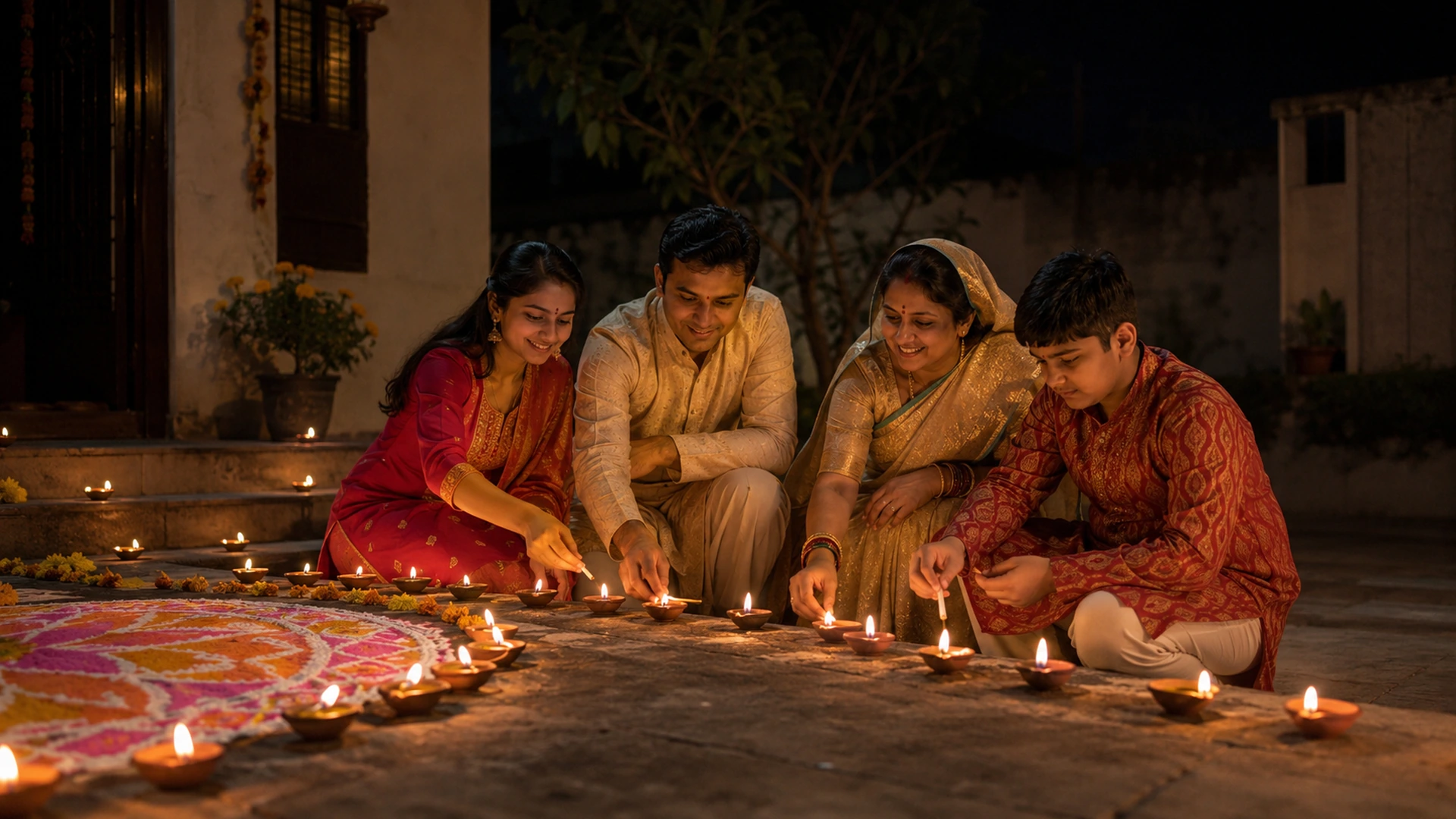
Diwali, also known as Deepavali, is one of the best-known examples of a major festival connected with Amavasya in many Hindu calendars. In several North Indian traditions, the main night of Diwali falls on the Amavasya of the month of Kartika.
This is one reason Amavasya cannot be explained only as negative or inauspicious. A moonless night can also become a night of lamps, prayer, family gathering, worship, hospitality, renewal, and celebration.
Diwali itself has different meanings among Hindu, Jain, Sikh, Buddhist, regional, and diaspora communities. Some households emphasize Lakshmi worship. Others emphasize Rama's return, Krishna traditions, Kali worship, new business ledgers, family visits, sweets, lamps, or local stories. Amavasya is part of the calendar setting, but the festival meaning depends on the tradition.
Spiritual Meaning Without Exaggeration
In spiritual writing, Amavasya is often associated with inwardness, stillness, endings, beginnings, hidden potential, ancestral memory, or clearing old burdens. These interpretations can be meaningful as symbolic language, but they should not be presented as universal ancient doctrine unless a specific tradition supports them.
Responsible wording would say:
- "Some families observe Amavasya as a time for remembrance."
- "In some traditions, the dark Moon invites reflection."
- "Particular Amavasya dates are important in specific regional calendars."
Irresponsible wording would say:
- "Amavasya always brings bad luck."
- "Every ritual on Amavasya guarantees wealth."
- "All Hindus must avoid the same activities."
- "The Moon is dark because Earth blocks it."
- "One online ritual applies to every family."
Difference Between Amavasya and Purnima
Amavasya and Purnima are opposite points in the lunar cycle.
Amavasya is the new-moon tithi, associated with conjunction, when the Moon is near the Sun from Earth and usually invisible. Purnima is the full-moon tithi, associated with opposition, when the Moon's fully illuminated near side is visible.
Both dates can be religiously significant. Some festivals and vows are associated with Purnima. Others are associated with Amavasya. The meaning depends on the deity, region, month, lineage, and festival calendar.
Why Amavasya Dates Can Vary
People sometimes become confused when one website lists Amavasya on one date and another lists a slightly different date or time. This can happen because:
- A tithi can begin or end during a civil day.
- Calendars may use different locations.
- Sunrise rules may affect religious observance.
- Regional calendars may follow different conventions.
- Some sites calculate by local time zone.
- Family or temple practice may follow a particular panchang.
For this reason, anyone planning a religious observance should check a trusted local panchang, temple calendar, or family authority for their location.
Safety, Ethics, and Respect
Amavasya content online often attracts exaggerated claims. Readers should be cautious when someone promises guaranteed love, fertility, money, revenge, healing, or protection through a ritual. Cultural and spiritual observance should not be used to pressure people into unsafe choices.
Amavasya observance should never replace:
- Medical care.
- Mental-health support.
- Legal advice.
- Financial planning.
- Emergency services.
- Safe family boundaries.
- Protection from abuse.
It is also respectful to avoid copying private rituals from families or communities that have not made those practices public. A cultural article can explain meaning without turning restricted tradition into a public checklist.
How to Use the Word in a Sentence
Here are natural English examples:
- "Amavasya is the new-moon day in the Hindu lunar calendar."
- "Some families observe Amavasya with prayers for ancestors."
- "The main night of Diwali falls on Amavasya in many Hindu calendars."
- "Amavasya timings depend on the tithi and local calendar calculation."
- "Not every community observes Amavasya in the same way."
Key Takeaways
- Amavasya means the new-moon day or dark-moon day.
- It is a tithi in Hindu lunar calendar systems.
- The Moon is usually invisible because its illuminated side faces away from Earth.
- It is not caused by Earth blocking the Moon.
- Amavasya can be connected with ancestor remembrance, prayer, fasting, charity, or festival observance.
- Diwali falls on Amavasya in many Hindu calendars.
- Regional and family customs differ.
- The date and timing can vary by location and calendar rules.
- Spiritual meanings should be explained without guaranteed-result claims.
- Specific observances should follow trusted family, temple, or community guidance.
People Also Ask
What is Amavasya in English?
Amavasya in English means new-moon day, dark-moon day, or the lunar date of the new moon in the Hindu calendar.
Is Amavasya the same as the new Moon?
It is closely connected with the new Moon, but it is also a Hindu calendar tithi. The astronomical new Moon describes the Moon's position, while Amavasya describes a lunar date used in cultural and religious calendars.
Is Amavasya good or bad?
It depends on the tradition and the specific Amavasya. Some observances are solemn, some emphasize ancestors or restraint, and some are connected with major festivals such as Diwali. It should not be described as universally good or universally bad.
Why is the Moon not visible on Amavasya?
At the new Moon, the illuminated side of the Moon faces mostly away from Earth and the Moon is near the Sun's direction in the sky, so the near side appears dark and is usually hidden by daylight.
What do people do on Amavasya?
Depending on tradition, people may pray, fast, remember ancestors, give charity, visit temples, light lamps, reflect quietly, or follow family-specific observances.
Frequently Asked Questions
1. What does Amavasya literally mean?
Older Sanskrit-based explanations connect Amavasya with the Sun and Moon dwelling together, referring to the conjunction associated with the new Moon. In everyday English, "new-moon day" is the clearest translation.
2. Is Amavasya only a Hindu idea?
The word Amavasya belongs to South Asian lunar calendar and Sanskritic religious vocabulary, especially Hindu usage. Other religions and cultures have their own new-moon terms and calendars.
3. Can Amavasya happen during the daytime?
Yes. A tithi can begin or end during the daytime according to calendar calculation. The religious observance may depend on local rules, sunrise, or a trusted panchang.
4. Does Amavasya mean there is an eclipse?
No. Solar eclipses can only happen near new Moon, but most new Moons and Amavasya dates are not eclipses because the Moon's orbit is tilted relative to Earth's orbit around the Sun.
5. Should everyone perform the same Amavasya ritual?
No. Practices differ by family, region, lineage, temple, language, and tradition. Specific observances should be learned from trusted community sources, not copied from generic online instructions.
Sources
- NASA Science. "Moon Phases." https://science.nasa.gov/moon/moon-phases/
- NASA Astronomy Picture of the Day. "Moon Pairs and the Synodic Month." https://apod.nasa.gov/apod/ap200926.html
- Oxford Bibliographies in Hinduism. "Calendar." Oxford Academic. https://academic.oup.com/reference/62357/reference-article-abstract/554509004
- Robert Sewell and Sankara Balkrishna Dikshit. The Indian Calendar (1896), "The tithi, amavasya, purnima." Wikisource scan. https://en.wikisource.org/wiki/Page:Sewell_Dikshit_The_Indian_Calendar_(1896)_proc.djvu/19
- John M. Stanley. "Special Time, Special Power: The Fluidity of Power in a Popular Hindu Festival." The Journal of Asian Studies 37, no. 1 (1977): 27-43. Cambridge Core. https://doi.org/10.2307/2053326
Frequently Asked Questions
What is Amavasya in English?
Amavasya in English means new-moon day, dark-moon day, or the lunar date of the new moon in the Hindu calendar.
Is Amavasya the same as the new Moon?
It is closely connected with the astronomical new Moon, but Amavasya is also a Hindu calendar tithi used in cultural and religious timing.
Is Amavasya good or bad?
It depends on the tradition and the specific Amavasya. Some observances are solemn, while others connect with major festivals such as Diwali.
Why is the Moon not visible on Amavasya?
At the new Moon, the Moon is near the Sun from Earth and the side facing Earth is mostly unlit, so it is usually hidden by daylight.
Does Amavasya mean there is an eclipse?
No. Solar eclipses can happen only near new Moon, but most Amavasya dates are not eclipses because the Moon orbit is tilted.
Article Information
- Publisher
- Ancestral Temple
- Editor
- Ancestral Temple
- Last updated
- Jul 26, 2026
- Last reviewed
- Jul 26, 2026
- Content version
- f805b93297
This educational article should be read as cultural and spiritual information, not as medical, legal, financial, or emergency advice.
Helpful Related Guidance
Explore This Topic
Related Topic Cluster
Moon, Sun and seasons
Complete Guide New Moon Spiritual Meaning: Symbolism, Traditions and Cultural BeliefsAbout the Author
 Ancestral Temple
Spiritual guide and practitioner with decades of experience in ancestral wisdom, rituals, and divine guidance.
Related Posts
View All







Leave a Comment
We'd love to hear your thoughts.