
The 8 Phases of the Moon in Order: Names, Meanings and Symbolism
Quick Summary
The eight phases of the Moon describe the repeating ways the Moon appears from Earth as it travels around our planet. In the correct order, they are new Moon, waxing crescent, firs...
The eight phases of the Moon describe the repeating ways the Moon appears from Earth as it travels around our planet. In the correct order, they are new Moon, waxing crescent, first quarter, waxing gibbous, full Moon, waning gibbous, third quarter or last quarter, and waning crescent. The pattern then begins again.
These phases are not caused by Earth’s shadow covering the Moon. They occur because sunlight always illuminates half of the Moon, while the Moon’s changing position lets us see different portions of that illuminated half. A complete new-Moon-to-new-Moon cycle lasts about 29.5 days. [1][2]
People have also attached meanings to the Moon’s changing appearance for thousands of years. Those meanings vary by culture, religion, place and historical period. In modern symbolic frameworks, waxing phases are often associated with growth, full Moon with culmination, and waning phases with release. These are interpretations, not physical powers established by astronomy.
Quick Answer
The 8 phases of the Moon in order are: 1) new Moon, 2) waxing crescent, 3) first quarter, 4) waxing gibbous, 5) full Moon, 6) waning gibbous, 7) third or last quarter, and 8) waning crescent. They repeat roughly every 29.5 days as the Moon orbits Earth and we see changing portions of its sunlit half. [1][3]
Specific culture or historical context: Contemporary astronomy; no ritual or cultural symbolism.
People shown: None.
Location: Space above Earth, with a subtle star field that does not distract from the lunar cycle.
Clothing: Not applicable.
Architecture: None.
Objects: Earth, eight realistic Moon positions, subtle sunlight direction and natural shadows.
Lighting: Physically plausible sunlight with clear contrast between illuminated and unilluminated lunar surfaces.
Composition: Wide 16:9 landscape; Earth slightly below center; the orbital sequence arranged in a clean ellipse with enough negative space for website cropping. It must read as one coherent scientific visualization, not a split-screen collage.
SEO-friendly filename: 8-phases-of-the-moon-in-order.webp
Image title: The Complete Eight-Phase Lunar Cycle
Alt text: Eight phases of the Moon arranged in order around Earth from new Moon to waning crescent
Caption: The Moon’s eight named phases repeat as our viewing angle of its sunlit half changes during the lunar cycle.
Recommended placement: Immediately after the Quick Answer.
Article section supported: Quick Answer and phase order.
Important elements to avoid: Embedded labels, arrows, text, fantasy glow, duplicated Moons, incorrect illumination, eclipse imagery, watermarks, logos, borders and collage panels.
All 8 Phases of the Moon in Order
The table below gives the standard sequence, a simple definition and the approximate place of each phase within the 29.5-day cycle. The days are estimates because the Moon changes continuously; the named phases are reference points and broad intervals rather than eight perfectly equal blocks.
| Order | Moon phase | Simple definition | Approximate cycle position | Common symbolic association* |
|---|---|---|---|---|
| 1 | New Moon | The Moon’s near side is mostly unlit from Earth’s viewpoint, so it is usually invisible | Day 0 | Beginnings, potential, inward reflection |
| 2 | Waxing Crescent | A thin illuminated crescent grows larger each day | Days 1–6 | Intention, emergence, hope |
| 3 | First Quarter | Half of the visible disk appears illuminated; the Moon is one-quarter through its orbit | Around day 7 | Decision, effort, action |
| 4 | Waxing Gibbous | More than half is illuminated and the bright portion is increasing | Days 8–13 | Refinement, patience, preparation |
| 5 | Full Moon | Nearly the entire Earth-facing disk is illuminated | Around day 14–15 | Culmination, visibility, completion |
| 6 | Waning Gibbous | More than half remains illuminated, but the bright portion is decreasing | Days 16–21 | Gratitude, sharing, integration |
| 7 | Third or Last Quarter | Half of the visible disk appears illuminated; the Moon is three-quarters through its orbit | Around day 22 | Review, correction, release |
| 8 | Waning Crescent | A shrinking crescent remains before the next new Moon | Days 23–29 | Rest, closure, renewal preparation |
*The symbolic associations are common modern interpretations, not universal cultural definitions or scientifically demonstrated effects.
What Is a Moon Phase?
A Moon phase is the apparent shape of the Moon’s illuminated portion as seen from Earth. The Moon does not produce its own visible light. What we call moonlight is sunlight reflected from the lunar surface. At every point in the cycle, except during the brief geometry of a lunar eclipse, the Sun illuminates roughly half of the Moon. What changes is how much of that bright half faces us. [1]
The Moon takes about 27.3 days to complete one orbit relative to the distant stars. However, Earth is also moving around the Sun. The Moon must travel a little farther to return to the same Sun-Earth-Moon alignment, so the phase cycle from one new Moon to the next lasts about 29.5 days. Astronomers call this interval the synodic month. [2]
What Do Waxing and Waning Mean?
Waxing means that the visible illuminated portion is increasing from night to night. The Moon waxes from new Moon through crescent, first quarter and gibbous phases until it reaches full Moon.
Waning means that the visible illuminated portion is decreasing. The Moon wanes after full Moon through gibbous, last quarter and crescent phases until the next new Moon. [1]
What Do Crescent and Gibbous Mean?
A crescent Moon appears less than half illuminated. A gibbous Moon appears more than half illuminated but not completely full. Waxing or waning tells you whether that visible illuminated area is growing or shrinking. [1]
Why Does a Quarter Moon Look Half Full?
“First quarter” and “third quarter” describe where the Moon is in its orbital cycle, not how much of the visible disk appears bright. At first quarter, the Moon is approximately one-quarter of the way around Earth from the new-Moon position. From Earth, we see half of the Moon’s disk illuminated. The same geometry appears on the opposite side at third quarter. [1]
Why the Moon Has Eight Named Phases
The Moon’s appearance changes continuously, so nature does not pause at exactly eight shapes. The eight-phase system is a practical way to divide a smooth cycle into recognizable stages. The four principal phases are new Moon, first quarter, full Moon and third quarter. The four intermediate phases are waxing crescent, waxing gibbous, waning gibbous and waning crescent.
This naming system helps people describe observations, create calendars, plan night-sky viewing and discuss the relationship between the Moon, Sun and Earth. It also gives cultural and symbolic systems a familiar sequence, although the meanings assigned to that sequence are not the same everywhere.
1. New Moon
Scientific Definition
A new Moon occurs when the Moon is in approximately the same direction as the Sun from Earth. The illuminated lunar hemisphere faces mostly away from us, while the near side faces Earth in darkness. The Moon rises and sets close to the Sun, so it is normally hidden by daylight glare even when a very small amount of its near side is faintly illuminated by reflected light from Earth. [1]
A new Moon does not automatically produce a solar eclipse. The Moon’s orbit is tilted by about five degrees relative to Earth’s orbital plane. Most months, the Moon passes above or below the Sun from our viewpoint. A solar eclipse occurs only when the alignment is close enough during an eclipse season. [4]
What It Looks Like and When to Observe It
The new Moon itself is usually not visible. One or two evenings later, a thin waxing crescent may appear low in the western sky after sunset. Experienced observers may notice earthshine, a soft glow across the Moon’s darker portion caused by sunlight reflected from Earth toward the Moon and back again. [1]
Common Symbolic Meaning
In modern symbolic writing, the new Moon is often treated as a point of beginning, quiet potential or inward attention. The dark appearance can suggest a pause before visible growth. Some people use it as a reminder to set intentions or begin a planning cycle.
That meaning should not be described as universal. A particular community may begin a month with the first visible crescent rather than the astronomical new Moon, and religious calendars use their own rules and authorities. Symbolic reflection can be personally meaningful, but a new Moon does not scientifically guarantee a fresh start, success, fertility or protection.
2. Waxing Crescent
Scientific Definition
The waxing crescent follows the new Moon. A thin portion of the Moon’s sunlit half becomes visible and grows each day. From many northern-latitude viewpoints, the bright crescent often appears on the right side; from many southern-latitude viewpoints, it often appears on the left. Near the equator, the orientation can look more upright or like a tilted “smile,” depending on season, time and viewing direction. The phase itself is the same; the apparent rotation differs with the observer’s orientation. NASA therefore publishes separate northern- and southern-hemisphere visualizations. [5]
What It Looks Like and When to Observe It
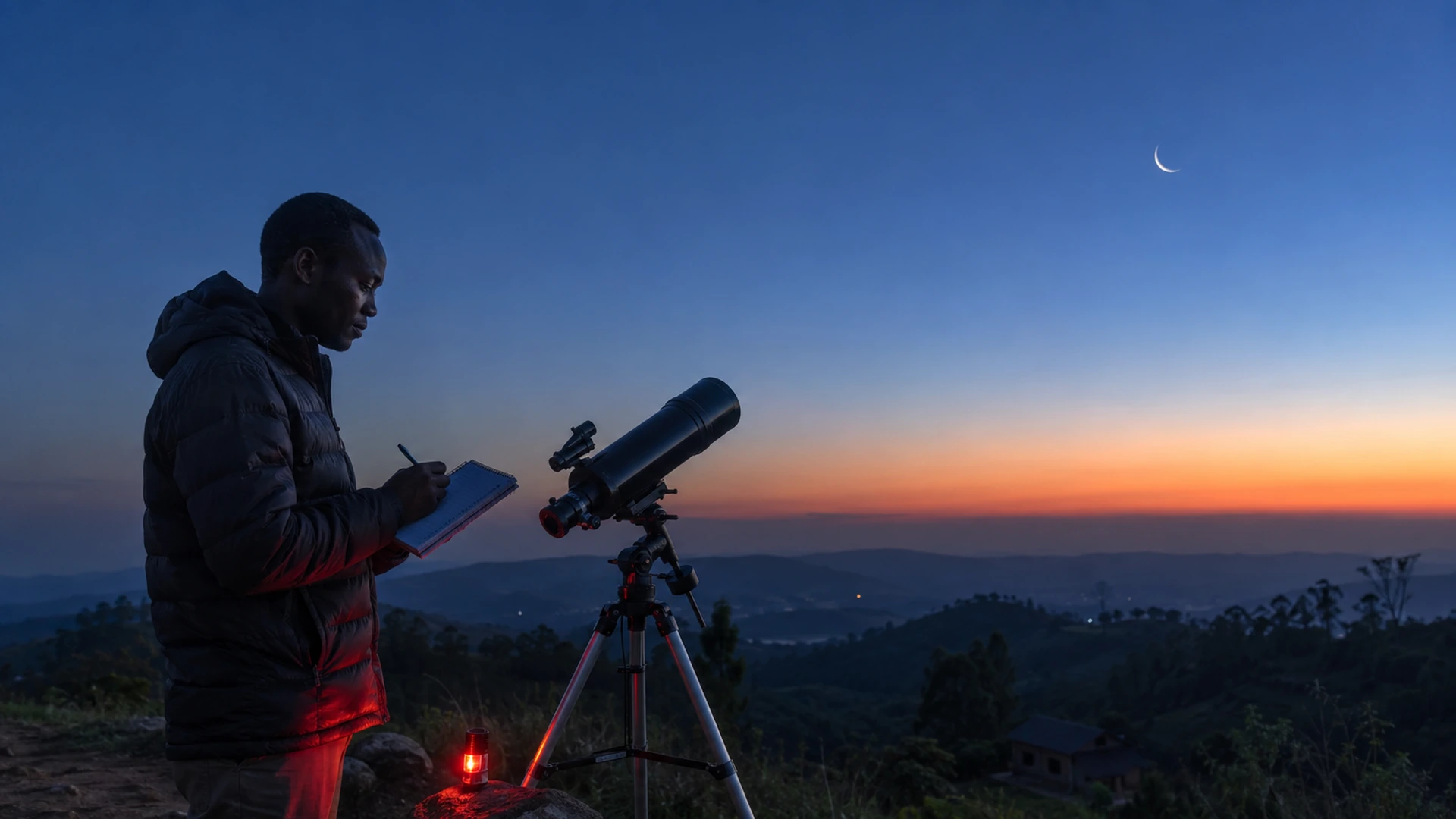
A waxing crescent is visible in the west after sunset. Early in the phase it sets soon after the Sun. As the crescent grows, it remains in the sky later each evening. The dark portion may show earthshine, making the full circular outline easier to recognize. [1]
Specific culture or historical context: Contemporary East African sky observation; educational and non-ritual context.
People shown: One adult Black African observer, naturally posed, with accurate hands holding a pencil and notebook.
Location: Open elevated landscape in Uganda or the East African highlands, with distant vegetation and a clear western horizon.
Clothing: Practical modern casual clothing suitable for an evening outdoors; no invented ceremonial dress.
Architecture: At most a distant ordinary rural building; no fantasy temple.
Objects: Telescope, notebook, pencil, small red-light torch and waxing crescent Moon.
Lighting: Natural blue-hour light with warm sunset remaining near the horizon; subtle red torch glow.
Composition: Observer placed on one third of the frame, crescent on the opposite upper third, open sky providing visual clarity.
SEO-friendly filename: observing-waxing-crescent-moon-africa.webp
Image title: Observing the Waxing Crescent Moon
Alt text: Black African observer recording a waxing crescent Moon above an East African landscape at twilight
Caption: The waxing crescent becomes visible in the western sky after sunset and remains visible longer each evening.
Recommended placement: After the waxing crescent observation explanation.
Article section supported: Waxing crescent visibility and Moon observation.
Important elements to avoid: Ritual fire, occult symbols, inaccurate crescent orientation, oversized Moon, embedded text, fantasy clothing, distorted telescope, extra fingers, logos and watermarks.
Common Symbolic Meaning
Because the illuminated portion is visibly increasing, the waxing crescent is commonly associated with emergence, hope, intention and early effort. A responsible interpretation is to use the phase as a visual metaphor: a small beginning can become more visible through consistent action.
The phase does not cause a plan to succeed. It can serve as a calendar marker or reflective symbol, while practical preparation, evidence-based decisions and sustained work remain responsible foundations for real-world outcomes.
3. First Quarter
Scientific Definition
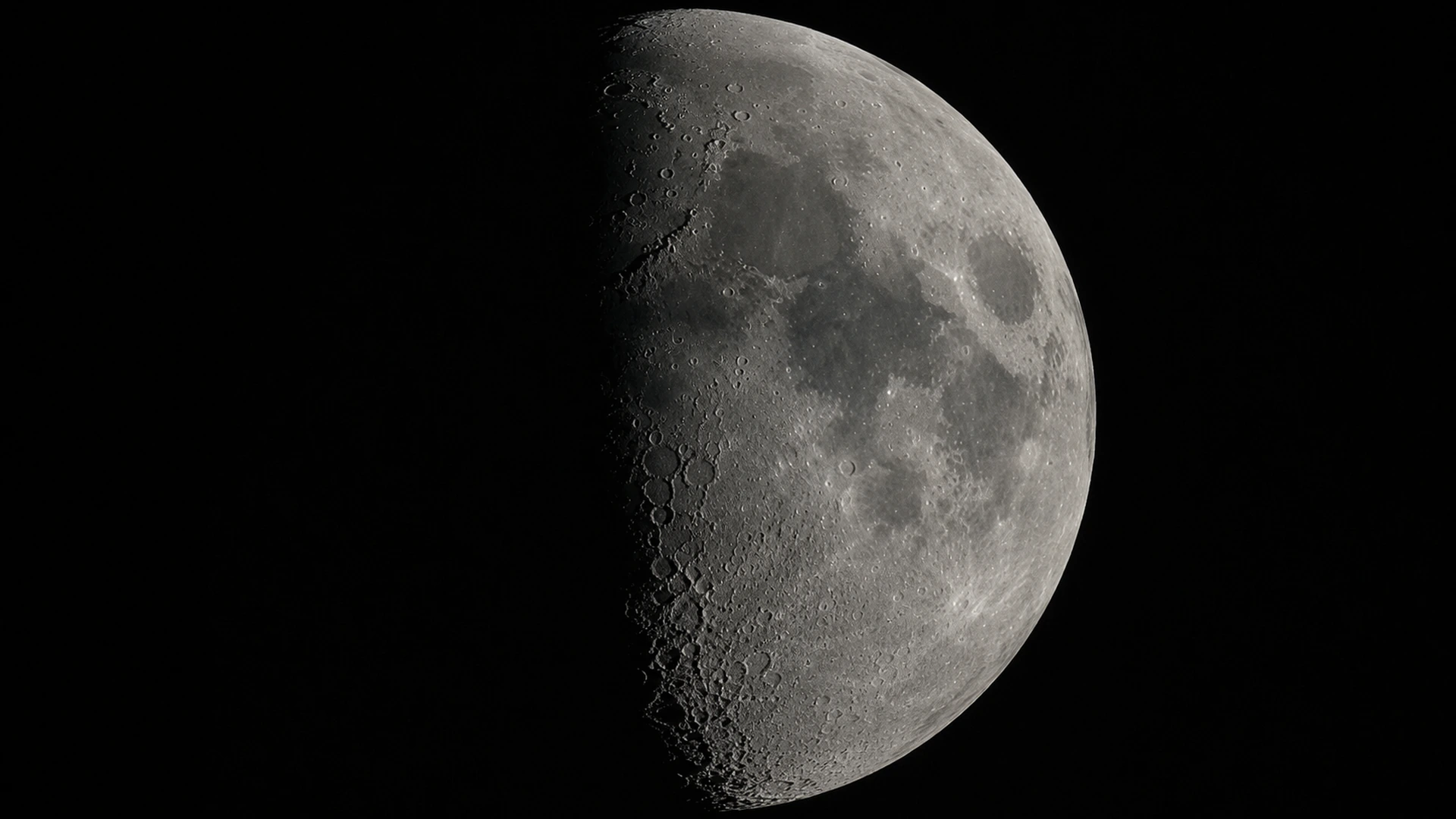
At first quarter, the Moon has traveled approximately one-quarter of the way through its phase cycle from new Moon. From Earth, half of the visible lunar disk appears illuminated. The Sun, Earth and Moon form roughly a right angle. A first-quarter Moon rises around midday, is high in the sky around sunset and sets around midnight. [1]
What It Looks Like and When to Observe It
First quarter is excellent for telescope or binocular observation. The boundary between lunar day and night is called the terminator. Near this line, low-angle sunlight casts long shadows from mountains and crater walls, making surface relief especially dramatic. The Moon is often easy to find in the afternoon or evening sky.
Specific culture or historical context: Contemporary observational astronomy.
People shown: None.
Location: Deep black sky; lunar surface fills most of the frame.
Clothing: Not applicable.
Architecture: None.
Objects: First-quarter Moon with accurately rendered craters, maria and terminator shadows.
Lighting: Realistic grazing sunlight along the terminator; no artificial colored glow.
Composition: Lunar disk positioned slightly off center, leaving modest negative space; visible half illumination and crisp terrain.
SEO-friendly filename: first-quarter-moon-terminator-craters.webp
Image title: First-Quarter Moon and the Lunar Terminator
Alt text: First-quarter Moon showing detailed craters and long shadows along the lunar terminator
Caption: Low-angle sunlight near the terminator makes lunar craters and mountains easier to see during first quarter.
Recommended placement: In the first-quarter section after the observation paragraph.
Article section supported: First quarter, terminology and telescope observation.
Important elements to avoid: Full-Moon lighting, impossible crater formations, labels, arrows, colored nebulae, stars visible through the dark lunar disk, exaggerated glow, text and watermarks.
Common Symbolic Meaning
The first quarter is often interpreted as a stage of decision, action or productive tension. The half-lit appearance can symbolize a point at which an intention encounters obstacles and requires commitment.
This symbolism is best presented as a reflective framework rather than a prediction. It may encourage someone to identify the next concrete step, review a challenge or make a decision, but the Moon phase does not determine the outcome.
4. Waxing Gibbous
Scientific Definition
During the waxing gibbous phase, more than half of the visible disk is illuminated and the bright portion continues to increase. The phase lies between first quarter and full Moon. It rises during the afternoon, is prominent during the evening and usually sets after midnight. [1]
What It Looks Like and When to Observe It
A waxing gibbous Moon is bright and easy to see, sometimes before sunset. Surface features remain visible, although the shadows near the center of the disk become shorter as full Moon approaches. The terminator still provides useful contrast along the shrinking dark edge.
Common Symbolic Meaning
The waxing gibbous phase is often associated with refinement, adjustment, patience and preparation. Its nearly full appearance can represent work that is advanced but not complete. In a practical reflection exercise, it may prompt questions such as: What needs correction? What detail has been overlooked? What can be improved before a deadline?
The symbolism is not an instruction to delay necessary action until a particular phase. It is a metaphor that some readers may find useful for organizing thought.
5. Full Moon
Scientific Definition
A full Moon occurs when the Moon is approximately opposite the Sun in Earth’s sky. The lunar hemisphere facing Earth is then almost entirely illuminated by sunlight. A full Moon rises around sunset, reaches its highest point around midnight and sets around sunrise. It can appear full for more than one night because the change in illuminated fraction is gradual. [1]
A lunar eclipse is possible only near full Moon, when Earth passes closely enough between the Sun and Moon for Earth’s shadow to fall on the lunar surface. It does not happen every full Moon because the Moon’s orbit is tilted. [4]
What It Looks Like and When to Observe It
The full Moon is the brightest phase and illuminates the night landscape strongly. It is excellent for naked-eye appreciation of broad dark plains called maria and bright ray systems around some craters. It is not always the best phase for detailed crater relief because the near-frontal sunlight creates fewer long shadows across most of the visible disk.
Common Symbolic Meaning
The full Moon is widely used as an image of completion, visibility, culmination or heightened awareness. The circular disk can symbolize wholeness, abundance or a moment when something becomes clear. These associations appear in many modern spiritual and creative practices, but cultures do not interpret the Moon in one uniform way.
The full Moon’s scientifically measurable effects include its contribution, together with the Sun, to the geometry of spring tides. Claims that every full Moon reliably causes aggression, “madness,” financial events or supernatural results are not supported as universal facts. Research on human sleep and behavior has produced mixed and context-dependent findings; individual studies should not be turned into guaranteed claims. [6][11][12]
6. Waning Gibbous
Scientific Definition
The waning gibbous phase begins after full Moon. More than half of the visible disk remains illuminated, but the bright portion becomes smaller each day. The Moon rises later in the evening and remains visible into the morning. [1]
What It Looks Like and When to Observe It
A waning gibbous Moon may be seen after sunset, late at night and in the morning sky after sunrise. Its morning visibility surprises people who assume the Moon appears only at night. As the phase advances, the terminator moves across the lunar surface from the opposite direction compared with waxing phases.
Common Symbolic Meaning
Modern symbolic systems often associate waning gibbous with gratitude, sharing, teaching or integration. After the “culmination” metaphor of full Moon, this phase may represent considering what has been learned and what can be passed to others.
This interpretation is not a historical rule for every culture. It is safer to describe it as one contemporary framework and to identify any specific traditional interpretation by its community, period and source.
7. Third Quarter or Last Quarter
Scientific Definition
Third quarter and last quarter are two names for the same principal phase. The Moon is approximately three-quarters of the way through its cycle from new Moon, and half of the visible disk appears illuminated. It rises around midnight, is high near sunrise and sets around midday. [1]
NASA commonly uses both “third quarter” and “last quarter.” The word “third” emphasizes orbital progress, while “last” identifies the final principal quarter phase before the cycle returns to new Moon.
What It Looks Like and When to Observe It
The last-quarter Moon is best seen from late night through morning. Its terminator again produces strong crater shadows, but on the opposite side from first quarter. It can remain visible in a bright daytime sky during the morning.
Common Symbolic Meaning
The last quarter is often associated with review, correction, release or a deliberate change of direction. The balanced half-lit disk may be used as a visual prompt to decide what remains useful and what can be left behind.
“Release” should not be turned into advice to abandon medical treatment, legal responsibilities, financial obligations or important relationships without careful reasoning and appropriate professional support. Symbolic language should remain subordinate to real-world evidence and responsibilities.
8. Waning Crescent
Scientific Definition
The waning crescent is the final named phase before new Moon. Less than half of the visible disk is illuminated, and the crescent becomes thinner each day. It rises in the early morning before sunrise and is often visible low in the eastern sky at dawn. Later, it sets during the afternoon. [1]
What It Looks Like and When to Observe It
To observe a waning crescent, look toward a clear eastern horizon before sunrise. The Moon will appear close to the Sun’s direction, so the observing window can be short. Never use binoculars or a telescope near the rising Sun unless you are trained and can guarantee the instrument cannot point at the Sun. Accidental solar viewing can permanently damage eyesight.
Common Symbolic Meaning
The waning crescent is frequently associated with rest, closure, surrender, contemplation and preparation for renewal. Its narrowing light can serve as a metaphor for completing a cycle and making space before beginning again.
The symbolism does not mean that a person must become inactive. Rest and reflection can be scheduled whenever they are needed. The lunar phase can be a memorable prompt, not a compulsory timetable.
Scientific Meaning and Symbolic Meaning Are Different
The word meaning can cause confusion because it is used in two ways.
The scientific meaning of a Moon phase describes observable geometry: where the Moon is relative to the Sun and Earth, how much of the sunlit hemisphere is visible, and when the Moon is likely to rise and set.
A symbolic meaning is a cultural, religious, artistic or personal interpretation. It may connect the Moon with renewal, time, fertility, authority, protection, death, rebirth, devotion or seasonal activity. Such interpretations can be historically important without being physical laws.
| Question | Scientific answer | Symbolic or cultural answer |
|---|---|---|
| Why does the Moon appear as a crescent? | We see only a small portion of the Moon’s sunlit half | A crescent may symbolize beginnings, a deity, devotion, identity or another idea in a specific tradition |
| Why does the Moon become full? | The Earth-facing hemisphere is nearly fully illuminated from our viewpoint | Fullness may be interpreted as completion, abundance, revelation or a festival marker |
| Does a phase cause an event in someone’s life? | Astronomy does not establish phases as guaranteed causes of personal outcomes | A person or community may use phases as calendar markers, metaphors or ritual times |
| Is one symbolic definition universal? | No scientific phase carries a universal spiritual definition | Meanings vary across communities, historical periods and modern practices |
Moon Symbolism Across Cultures: Specific Examples
Moon symbolism is ancient and widespread, but it must be discussed specifically. “African Moon symbolism,” for example, is too broad to be one belief system. Africa contains thousands of communities, languages and religious histories. The same caution applies to Asia, Europe, the Americas and Oceania.
Ancient Egypt: Lunar Change and Regeneration
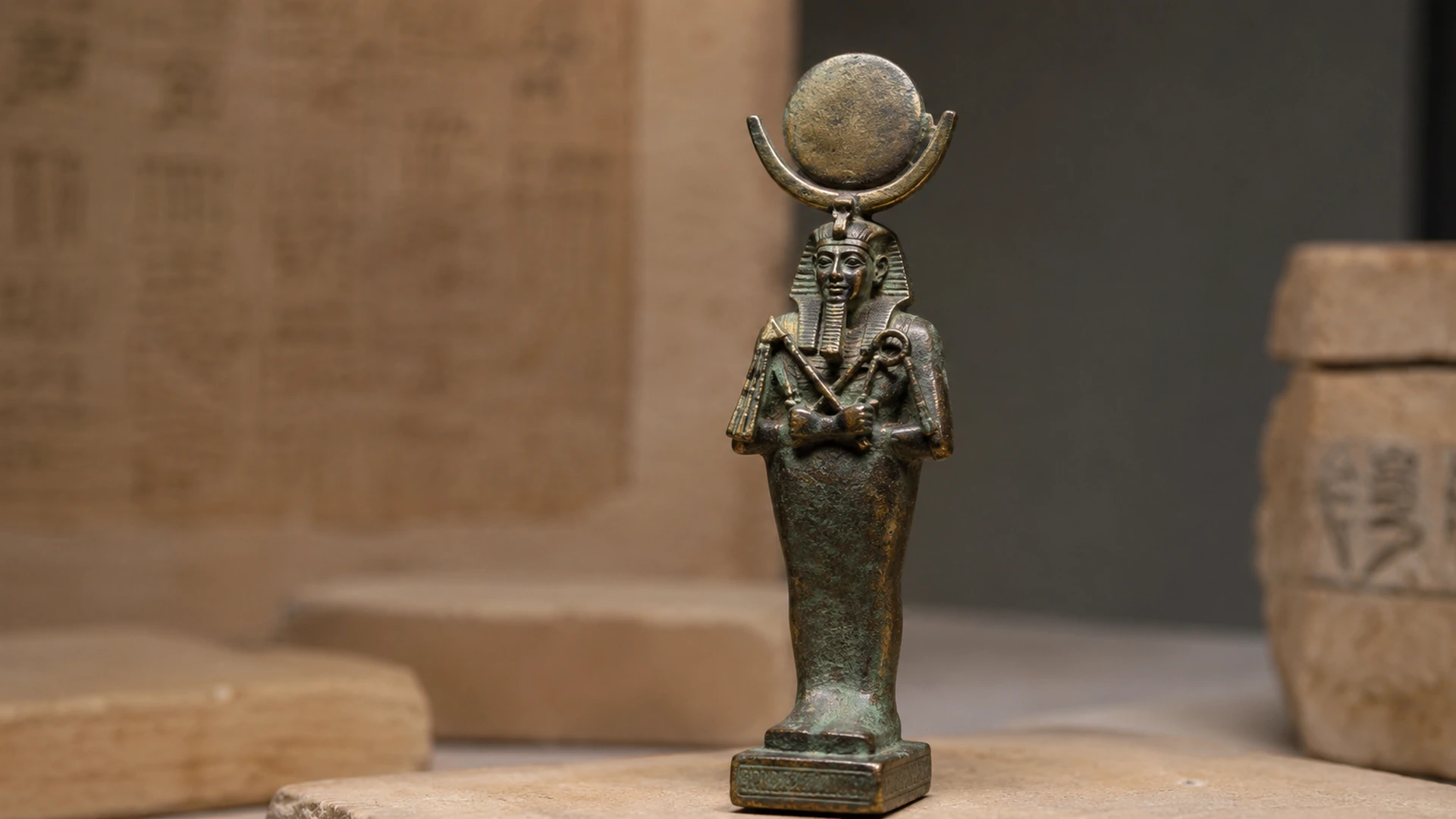
A Late Period Egyptian form of Osiris known as Osiris-Iah was explicitly connected with the Moon. Museum records describe a crown combining the lunar disk and crescent, encompassing the phases. The waxing movement from crescent toward fullness was associated with Osiris’s regeneration and rebirth. This is a documented ancient Egyptian association, not a definition that should be applied to all African communities or all phases. [7]
Specific culture or historical context: Ancient Egypt, Late Period to Ptolemaic era; representation of Osiris-Iah linked with lunar regeneration.
People shown: No living people; one historically informed deity statuette.
Location: Museum conservation or gallery setting, not an invented active ritual.
Clothing: Historically appropriate sculpted garment on the statuette, following known Osiris-Iah iconography.
Architecture: Minimal museum interior; no pyramids placed inaccurately indoors.
Objects: Small metal statuette, lunar disk-and-crescent crown, neutral display support.
Lighting: Soft professional museum lighting that reveals metal texture without supernatural glow.
Composition: Close editorial still life, object centered slightly off-axis, shallow depth of field, ample negative space.
SEO-friendly filename: osiris-iah-ancient-egypt-moon-symbolism.webp
Image title: Osiris-Iah and Lunar Regeneration in Ancient Egypt
Alt text: Museum-style reconstruction of an ancient Egyptian Osiris-Iah statuette wearing a crescent and lunar disk crown
Caption: In ancient Egyptian art, Osiris-Iah’s lunar crown connected the Moon’s changing phases with regeneration and rebirth.
Recommended placement: After the ancient Egypt symbolism subsection.
Article section supported: Moon symbolism across cultures.
Important elements to avoid: Invented ceremony, living priest, hieroglyphic gibberish, fantasy beams, oversized crown, mixed Greek or West African dress, embedded text, watermarks and claims of magical effects.
Mesopotamia: The Crescent as a Divine Emblem
In ancient Mesopotamian art, the moon god Sin could be represented by the crescent. Museum collections show that celestial symbols functioned as recognizable divine emblems alongside other symbols for deities. The crescent’s meaning here belongs to a particular religious and artistic system; it should not be reduced to the modern keyword “manifestation.” [8]
Lamu and Indian Ocean Connections
A twentieth-century crescent-moon necklace collected in Lamu, Kenya, illustrates the movement of artistic forms across East Africa, the Arabian Peninsula and South Asia. The Metropolitan Museum of Art describes the crescent as a widely used motif in Islamic-world silver jewelry and emphasizes long histories of trade and artistic exchange. This example shows why symbols may travel, change and acquire layered meanings rather than belonging to only one location. [9]
Living Astronomical Knowledge
UNESCO’s record of Suri Jagek, a Kalasha knowledge system in the Hindu Kush, documents observation of the Sun, Moon, stars, shadows and local topography as a form of traditional meteorological and astronomical knowledge. It demonstrates that engagement with the Moon can involve practical environmental observation as well as ceremony or belief. [10]
These examples should remain distinct. Ancient Egyptian regeneration imagery, Mesopotamian divine emblems, Islamic jewelry from Lamu and Kalasha astronomical practice are not parts of one combined ritual system.
How Moon Phases Relate to Tides
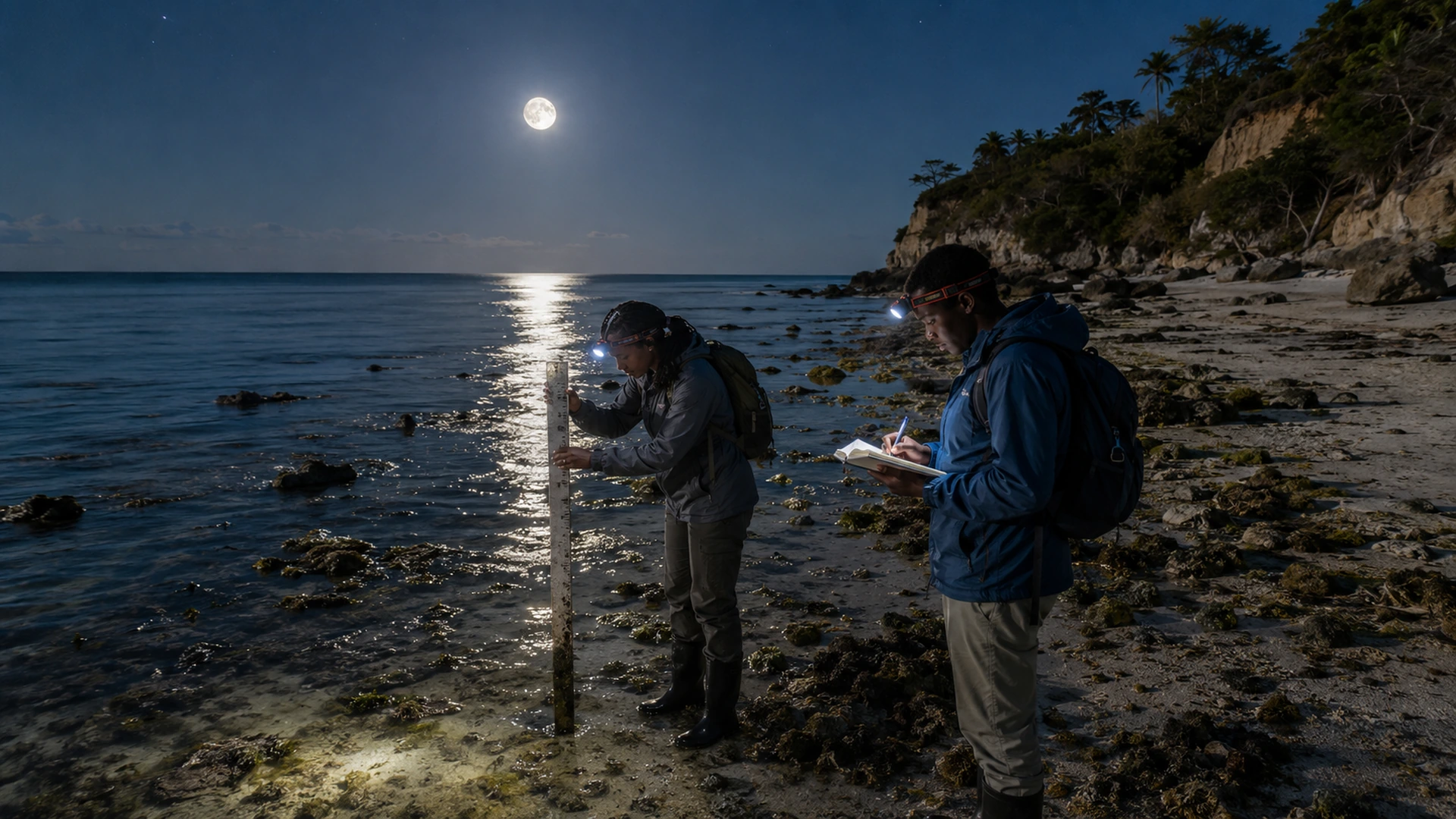
The Moon’s gravity is a major influence on ocean tides, while the Sun also contributes. During new Moon and full Moon, the Sun, Earth and Moon are approximately aligned. Their tidal effects combine to produce spring tides, which generally have a larger difference between high and low water. During first and third quarter, the Sun and Moon are approximately at right angles from Earth, producing neap tides, which generally have a more moderate tidal range. [6]
“Spring tide” does not refer to the season. It comes from the idea of the water “springing forth.” Local tide height also depends on coastline shape, water depth, weather, atmospheric pressure and other conditions, so a Moon-phase label alone is not a complete local tide forecast.
Specific culture or historical context: Contemporary coastal science on the East African or western Indian Ocean coast.
People shown: Two Black African coastal researchers, one reading a tide staff and one recording data; accurate anatomy and practical teamwork.
Location: East African rocky-sandy coastline with mangrove or coral-limestone elements appropriate to the region.
Clothing: Modern field clothing, reflective safety details if appropriate, boots and simple equipment.
Architecture: None or a distant modest research shelter.
Objects: Tide staff, notebook, headlamps, calm water, exposed shore and realistic full Moon.
Lighting: Natural moonlight supplemented by subtle headlamp light; no storm or supernatural illumination.
Composition: Wide shoreline leading line toward the Moon; researchers in the foreground; enough sky and coastline to explain context.
SEO-friendly filename: full-moon-spring-tide-east-africa.webp
Image title: Full Moon and Spring-Tide Observation
Alt text: Black African coastal researchers measuring the shoreline under a full Moon during a spring-tide period
Caption: New and full Moon alignments contribute to larger average tidal ranges called spring tides.
Recommended placement: After the Moon-phases-and-tides explanation.
Article section supported: Scientific effects and tides.
Important elements to avoid: Tsunami imagery, giant Moon, dangerous flooding, ritual activity, glowing water, false instruments, embedded diagrams, text, logos and watermarks.
Do Moon Phases Look the Same Everywhere?
At a given moment, observers around Earth are viewing the same geometric lunar phase, but they may not see it at the same local time or with the same apparent orientation. The Moon can look rotated when viewed from different latitudes and hemispheres. A crescent that appears bright on one side in a northern-hemisphere diagram may appear reversed in a southern-hemisphere view. Near the equator, including Uganda, the crescent may sometimes appear more horizontal or tilted than standard classroom diagrams suggest. [5]
Clouds, terrain, buildings, atmospheric haze and the Moon’s rise or set time also affect whether it can be seen. A diagram is therefore a guide to illumination, not a promise that the Moon will appear at the same angle from every location.
Common Misunderstandings About the Eight Lunar Phases
Misunderstanding 1: Earth’s Shadow Causes the Ordinary Phases
Earth’s shadow causes a lunar eclipse, not the normal monthly phases. Ordinary phases result from our changing view of the Moon’s sunlit half. [1][4]
Misunderstanding 2: The Dark Side of the Moon Never Receives Sunlight
The far side of the Moon receives sunlight. “Far side” means the hemisphere that usually faces away from Earth. Because the Moon rotates once during each orbit, it keeps nearly the same hemisphere facing us, but both hemispheres experience day and night. [1]
Misunderstanding 3: A Quarter Moon Is Only One-Quarter Illuminated
A quarter Moon appears half illuminated from Earth. “Quarter” refers to its position in the orbital cycle. [1]
Misunderstanding 4: The Eight Phases Last Exactly the Same Number of Days
The Moon changes continuously, and its orbital speed varies. The eight names are useful categories, not eight equal time boxes. Calendar dates for principal phases are calculated for precise moments, while crescent and gibbous labels describe the intervals between them.
Misunderstanding 5: A New Moon Always Produces a Solar Eclipse
Most new Moons pass above or below the Sun from Earth’s viewpoint because the lunar orbit is tilted. Only suitable alignment near an orbital node produces an eclipse. [4]
Misunderstanding 6: Moon-Phase Symbolism Is the Same in Every Tradition
A crescent, full disk or lunar cycle can have different meanings in different societies. Some traditions use lunar observation for calendars, festivals, agricultural timing, navigation, art or religious devotion. Others may not assign the modern eight-stage personal-development meanings found online. Cultural claims should be sourced and identified specifically.
Misunderstanding 7: The Full Moon Scientifically Guarantees Changes in Human Behavior
The Moon has clear gravitational relationships with tides, but broad claims about crime, aggression, health or personal destiny are not established as universal effects. Some studies have reported limited associations with specific outcomes, while others find no significant relationship, and methods differ. The responsible conclusion is that evidence is mixed and does not justify guaranteed claims. [6][11][12]
How to Observe the Full Lunar Cycle
The best way to understand the eight phases is to observe them over a month.
1. Choose a location with an open view of the eastern and western horizons.
2. Record the date, local time, weather and direction you are facing.
3. Sketch or photograph the Moon’s illuminated shape.
4. Note whether it is visible in the afternoon, evening, late night or morning.
5. Compare your observation with an authoritative phase calendar.
6. Continue for at least one 29.5-day cycle.
Do not expect to observe the Moon at the same time every day. The Moon generally rises later from one day to the next, and the useful viewing period shifts with the phase. A full Moon is visible through most of the night, while a waxing crescent appears mainly after sunset and a waning crescent mainly before sunrise. [1]
Safe Viewing
The Moon is normally safe to view with the unaided eye, binoculars or a telescope. The serious risk comes from accidentally pointing optical equipment toward the Sun, especially when searching for a thin crescent near sunrise or sunset. Never look directly at the Sun through binoculars, a telescope or a camera viewfinder without properly certified solar equipment and expert procedures.
People Also Ask
What are the eight phases of the Moon in the correct order?
New Moon, waxing crescent, first quarter, waxing gibbous, full Moon, waning gibbous, third or last quarter, and waning crescent. The cycle then returns to new Moon. [1]
What are simple definitions of the eight Moon phases?
New Moon is usually invisible; waxing crescent is a growing sliver; first quarter looks half lit; waxing gibbous is more than half and growing; full Moon is nearly fully lit; waning gibbous is more than half and shrinking; last quarter looks half lit; waning crescent is a shrinking sliver.
How many days does each Moon phase last?
There is no fixed equal duration for each named phase. The entire cycle lasts about 29.5 days, while the Moon’s appearance changes continuously. The principal phases are precise moments, and the crescent or gibbous phases describe the intervals between them. [2][3]
What phase comes after the full Moon?
The waning gibbous phase comes after full Moon. The visible illuminated portion remains more than half but decreases each day.
Is third quarter the same as last quarter?
Yes. Both names describe the same half-illuminated principal phase after waning gibbous and before waning crescent.
Why can the Moon be seen during the day?
The Moon is above the horizon during daytime for portions of most phase cycles. Whether it is visible depends on its position, brightness, sky conditions and distance from the Sun’s glare. First quarter is often visible in the afternoon, and last quarter commonly remains visible in the morning. [1]
Which Moon phases produce spring tides?
New Moon and full Moon produce the approximate Sun-Earth-Moon alignment associated with larger average tidal ranges called spring tides. First and third quarter are associated with neap tides. [6]
What does a waxing Moon symbolize?
In many modern symbolic systems, waxing phases represent growth, development, intention or building momentum. This is an interpretive metaphor, not a universal cultural rule or scientifically proven influence.
What does a waning Moon symbolize?
Modern symbolic frameworks often connect waning phases with reflection, completion, release or rest. Specific traditions may understand the Moon differently, so cultural claims should be identified and sourced.
Why are there eight Moon phases instead of four?
The four principal phases describe major geometric positions: new, first quarter, full and third quarter. Four intermediate crescent and gibbous stages provide a clearer description of the continuously changing appearance between them.
Frequently Asked Questions
Does the lunar cycle begin with the new Moon?
Astronomy diagrams and calendars commonly begin the named cycle with new Moon because it marks a clear Sun-Moon alignment and the start of increasing visible illumination. A cycle has no absolute beginning in nature, however, so the choice is a useful convention.
Is the Moon completely unlit during new Moon?
No. The Sun still illuminates half of the Moon. During new Moon, the illuminated hemisphere faces mostly away from Earth. The near side may also receive faint earthshine, but the Moon is usually lost in daylight glare. [1]
Is a crescent Moon always on the same side?
No. The illuminated side’s apparent orientation depends on whether the Moon is waxing or waning and on the observer’s hemisphere, latitude, time and orientation. Northern-hemisphere emoji-style diagrams should not be treated as universal sky views. [5]
Can the Moon phase be different in another country?
The underlying phase is the same worldwide at the same moment, but local date, visibility time and apparent rotation can differ. People separated by time zones may describe observations on different calendar dates.
Why does the Moon rise later each day?
As the Moon travels eastward in its orbit, Earth must rotate a little farther for the Moon to return to the same position in the local sky. This shifts typical moonrise and moonset times through the phase cycle.
What is earthshine?
Earthshine is the faint illumination sometimes visible on the Moon’s dark-looking portion, especially during a thin crescent. Sunlight reflects from Earth to the Moon and then back toward an observer. [1]
What is the lunar terminator?
The terminator is the boundary between lunar day and night. Sunlight strikes the surface at a low angle near this line, producing long shadows that reveal crater rims, mountains and valleys clearly.
Is a full Moon larger than other phases?
Not because it is full. The Moon’s apparent size changes slightly because its orbit is not a perfect circle. A full Moon can occur when the Moon is nearer or farther from Earth, but phase and distance are separate properties.
Do the Moon phases control ocean tides?
The Moon and Sun gravitationally influence tides. Phase indicates the alignment associated with spring or neap tidal ranges, but local tides also depend on geography, water depth, weather and other factors. [6]
Can Moon phases predict pregnancy, fertility or childbirth?
Moon phases should not be used as a guaranteed medical or fertility predictor. Anyone making decisions about pregnancy, fertility or childbirth should rely on qualified healthcare professionals and evidence-based guidance.
Can a particular phase guarantee financial or relationship success?
No. A phase may be used as a personal reminder or cultural symbol, but it cannot guarantee money, business results, reconciliation or another person’s choices.
Are lunar calendars based on the eight named phases?
Lunar calendars are based on repeated lunar cycles, but their month-start rules and religious or civil calculations differ. Some emphasize astronomical conjunction, some visible crescent observation and some calculated criteria. The modern eight-phase diagram is an educational subdivision, not a universal calendar rule.
Key Takeaways
The correct order is new Moon, waxing crescent, first quarter, waxing gibbous, full Moon, waning gibbous, third or last quarter, and waning crescent.
The phase cycle lasts about 29.5 days.
Moon phases are caused by changing Sun-Earth-Moon geometry, not by Earth’s shadow.
Waxing means increasing illumination; waning means decreasing illumination.
Crescent means less than half illuminated; gibbous means more than half.
Quarter phases appear half lit because “quarter” refers to orbital position.
Symbolic meanings are cultural or personal interpretations, not universal scientific effects.
Specific cultural examples should be kept distinct and attributed accurately.
New and full Moon alignments contribute to spring tides; quarter phases contribute to neap tides.
Observing the Moon over a complete month is the clearest way to understand the sequence.
Conclusion
The eight phases of the Moon provide a simple vocabulary for one continuous astronomical cycle. Beginning with new Moon, the illuminated portion visible from Earth grows through the waxing crescent, first quarter and waxing gibbous phases, reaches full Moon, and then decreases through waning gibbous, last quarter and waning crescent.
Their scientific definitions come from light, motion and viewing geometry. Their symbolic meanings come from people: from particular religions, works of art, calendars, oral traditions, modern spiritual practices and individual reflection. Both can be studied respectfully when they are not confused. Astronomy explains what the Moon is doing; cultural history explains some of the many ways communities have understood what they see.
Final Summary
The 8 Moon phases in order are new Moon, waxing crescent, first quarter, waxing gibbous, full Moon, waning gibbous, third or last quarter, and waning crescent. The sequence repeats about every 29.5 days. The names describe how much of the Moon’s sunlit half is visible from Earth and whether that visible portion is increasing or decreasing. Symbolic associations can add personal or cultural meaning, but they should not be presented as universal or scientifically guaranteed outcomes.
Research Sources and Further Reading
1. NASA Science — Moon Phases. Authoritative overview of all eight phases, reflected sunlight, visibility, moonrise and moonset patterns.
2. NASA Space Place — What Are the Moon’s Phases? Explanation of the 27.3-day orbit and approximately 29.5-day phase cycle.
3. NASA Jet Propulsion Laboratory Education — Make a Moon Phases Calendar and Calculator. Ordered phase sequence and phase-cycle geometry.
4. NASA Science — Why Do Eclipses Happen? Explanation of the Moon’s tilted orbit and why eclipses do not occur every month.
5. NASA Scientific Visualization Studio — Moon Phase and Libration, 2026. Northern- and southern-hemisphere lunar views and libration.
6. NOAA National Ocean Service — What Are Spring and Neap Tides? Relationship between lunar alignment and tidal range.
7. The Metropolitan Museum of Art — Osiris-Iah. Ancient Egyptian lunar crown and association with regeneration.
8. The Metropolitan Museum of Art — Mesopotamian Deities. The crescent as an emblem of the moon god Sin.
9. The Metropolitan Museum of Art — Crescent-Moon Necklace. Indian Ocean artistic connections and crescent symbolism in jewelry from Lamu, Kenya.
10. UNESCO Intangible Cultural Heritage — Suri Jagek. Kalasha astronomical and meteorological knowledge based on observing the Sun, Moon, stars and local topography.
11. Núñez and colleagues — Moon Cycles and Violent Behaviours: Myth or Fact? Study reporting no statistically significant association in the examined data.
12. Cajochen and colleagues — Evidence That the Lunar Cycle Influences Human Sleep. A controlled study reporting an association with sleep measures, illustrating why the broader evidence should be described carefully rather than as settled universal causation.
Article Information
- Publisher
- Ancestral Temple
- Editor
- Ancestral Temple
- Last updated
- Jul 26, 2026
- Last reviewed
- Jul 26, 2026
- Content version
- f03e95fa4e
This educational article should be read as cultural and spiritual information, not as medical, legal, financial, or emergency advice.
Helpful Related Guidance
Explore This Topic
Related Topic Cluster
Dreams & Symbolism
About the Author
 Ancestral Temple
Spiritual guide and practitioner with decades of experience in ancestral wisdom, rituals, and divine guidance.
Related Posts
View All












Leave a Comment
We'd love to hear your thoughts.