
Rising Signs Explained: Meaning, Calculation and Why They Change Every Two Hours
Quick Summary
A rising sign—also called the ascendant—is the zodiac sign occupying the eastern horizon for a particular time and geographic location. In astrology, it is traditionally interprete...
A rising sign—also called the ascendant—is the zodiac sign occupying the eastern horizon for a particular time and geographic location. In astrology, it is traditionally interpreted as the way a person meets the world, approaches unfamiliar situations and is first perceived by others. Astronomically, however, the ascendant is simply a calculated intersection: the point where the ecliptic, the Sun’s apparent yearly path, crosses the eastern half of the local horizon. [1][3]
The phrase “rising signs change every two hours” is useful only as an average. Twelve zodiac signs pass through the ascendant during roughly one day, but they do not divide the day into twelve equal two-hour blocks at most latitudes. Earth’s rotation drives the apparent motion, while geographic latitude and the tilt between the celestial equator and ecliptic make some signs rise faster and others more slowly. [2][3]
This distinction matters because a rising sign is far more sensitive to birth time and place than a sun sign. A date may be enough to estimate the Sun’s zodiac sign in ordinary horoscope systems, but an ascendant calculation normally requires the birth date, an accurate clock time, the correct time zone and daylight-saving status, and the birthplace coordinates. A small error can change the ascendant degree and, near a sign boundary, may change the rising sign itself.
Quick Answer
| A rising sign is the zodiac sign at the eastern horizon at a specific time and place. It changes roughly every two hours because Earth rotates once in about a day, but the rate is not equal: latitude and the ecliptic’s tilt make some signs rise in less than two hours and others in more. |
|---|
| Image number | 1 — Featured image |
|---|---|
| Purpose | Introduce the rising sign as a real horizon-based calculation rather than a floating zodiac label. |
| Detailed scene | Realistic pre-dawn editorial photograph of a Black African woman standing on an open East African highland viewpoint, looking east as the first light appears. A subtle, physically plausible arc of zodiac constellations follows the ecliptic above the horizon; one constellation is just emerging at the eastern edge. No mystical beams or supernatural effects. |
| Specific culture or historical context | Contemporary East African sky observation; universal astronomy presented through an African editorial setting. |
| People shown | One adult Black African woman, viewed three-quarter from behind, natural posture and anatomy. |
| Location | Open highland landscape near Kampala or the Lake Victoria region, without identifiable private property. |
| Clothing | Modern modest outdoor clothing suitable for cool pre-dawn weather; no invented ceremonial costume. |
| Architecture | None, or a distant unobtrusive city silhouette. |
| Objects | Small notebook, red-light flashlight and simple star wheel held naturally. |
| Lighting | Natural blue-hour and dawn light; realistic stars fading toward sunrise. |
| Composition | 16:9 landscape; subject on left third, eastern horizon on right; clear negative space for website cropping, but no embedded text. |
| SEO-friendly filename | rising-sign-eastern-horizon-explained.webp |
| Image title | The Rising Sign at the Eastern Horizon |
| Alt text | African woman observing the eastern horizon beneath a realistic zodiac arc illustrating the rising sign |
| Caption | The ascendant is the zodiac point rising at the eastern horizon for a specific time and place. |
| Recommended placement | Immediately after the Quick Answer. |
| Article section supported | Quick Answer and definition. |
| Important elements to avoid | Fantasy aura, glowing symbols, visible labels, inaccurate constellations, distorted hands, excessive stars, logos, watermarks or stereotyped “tribal” clothing. |
What Is a Rising Sign in Astrology?
In ordinary English, “ascendant” can mean rising in influence. In astrology, it has a much more precise spatial meaning: the point on the ecliptic that intersects the eastern horizon at a selected moment and location. The zodiac sign containing that degree is called the rising sign. [1]
The eastern horizon is not the same everywhere. Two people born at the same universal moment but in distant locations may have different horizons, different local sidereal times and therefore different ascendants. This is why a chart cannot be relocated without changing its angles and houses, even when the planets remain at nearly the same zodiacal degrees.
Astrologers often use “ascendant” in two related ways. Strictly, the ascendant is an exact degree—for example, 14 degrees of Libra. In casual conversation, “Libra rising” refers to the whole zodiac sign that contains that degree. A complete chart interpretation may consider the exact degree, planets near the ascendant, the ruler of the rising sign and the house system, but the rising sign itself is only one component of a natal chart.
What Does “Rising” Mean?
“Rising” describes apparent motion at the eastern horizon. As Earth turns, stars and zodiacal points seem to move from east to west across the sky. They are not physically circling Earth once each day; the daily motion is mainly the visual consequence of Earth rotating on its axis. The U.S. Naval Observatory gives the mean sidereal day as about 23 hours, 56 minutes and 4 seconds—the interval relevant to the daily return of the star background. [2]
The ascendant does not necessarily mark a visible star or constellation rising exactly where an observer can identify it. Astrological charts normally use the mathematical zodiac along the ecliptic. The ascendant is a geometric point on that zodiac, calculated from time and place.
Rising Sign Meaning in Astrological Tradition
Within modern Western astrology, the rising sign is commonly interpreted as the style through which a person enters situations: first reactions, outward manner, social approach, personal presentation and the “lens” through which the rest of the chart is expressed. Some astrologers also connect it with physical vitality or appearance. These are traditional and interpretive claims, not scientifically established personality measurements. [10][11]
A useful way to read a rising sign is as a symbolic starting point rather than a fixed label. The ascendant begins the chart’s cycle of houses in many commonly used systems, so astrologers use it to orient the rest of the horoscope. Yet different schools vary in how much weight they give the sign, its planetary ruler, planets near the ascendant and the exact house system.
Sun Sign, Moon Sign and Rising Sign
| Factor | What is calculated | Traditional interpretation | Data sensitivity |
|---|---|---|---|
| Sun sign | The Sun’s zodiac position on the birth date | Identity, purpose, vitality and conscious self-expression | Birth date; exact time may matter near a sign change |
| Moon sign | The Moon’s zodiac position at birth | Emotional needs, habits, memory and instinctive responses | Date and preferably accurate time because the Moon moves quickly |
| Rising sign | The zodiac degree at the eastern horizon | Approach, presentation, first response and chart orientation | Accurate date, time, time zone and birthplace |
None of these three placements stands alone in a full astrological reading. They are often called the “big three” in popular astrology, but that phrase is modern shorthand rather than a universal rule across all astrological traditions.
A Brief History of the Ascendant
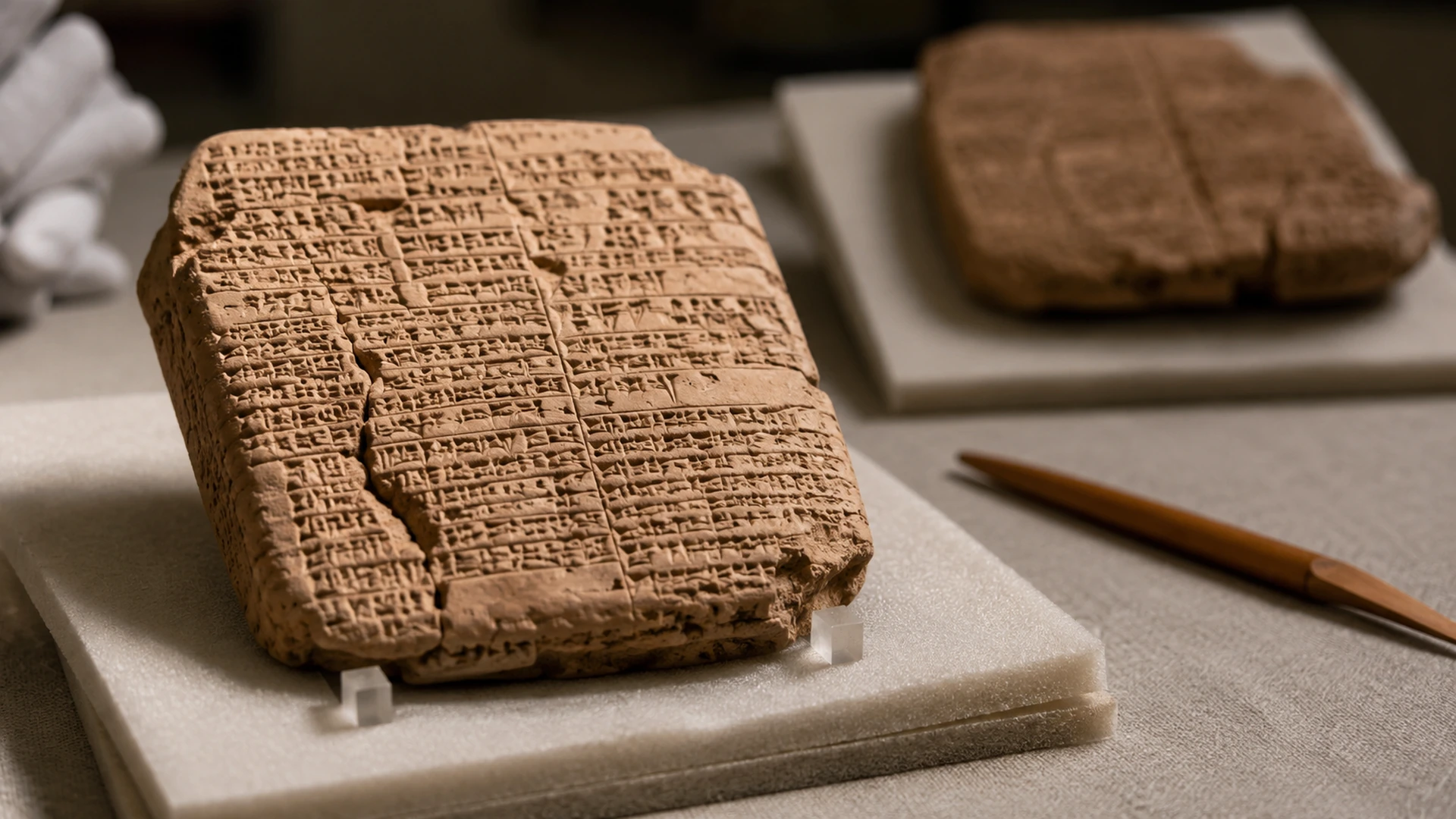
The twelve-part zodiac has deep roots in ancient Mesopotamia. A Late Babylonian tablet held by the British Museum links months with zodiac signs and illustrates the gradual formation of the twelve-sign system by the end of the first millennium BCE. Other surviving Babylonian tablets preserve horoscopes and birth notes from the Seleucid era. [6][7]
Natal astrology developed further in the Hellenistic world, where Babylonian astronomical knowledge interacted with Greek and Egyptian intellectual traditions. Claudius Ptolemy’s second-century Tetrabiblos became one of the most influential surviving texts in the later history of astrology. Its long transmission through Greek, Arabic and Latin scholarship helped shape medieval and early modern astrological practice. [12]
The ascendant remained central because it tied a horoscope to a specific local moment rather than only to a calendar date. A Cambridge scholarly discussion of medieval astrological language notes that the sign ascending in the east during the daily motion of the heavens was a crucial feature of horoscopes and elections, and that a sign is ascendant for roughly two hours each day as a generalization. [8]
Historical continuity does not make astrological claims scientific. It does show why the ascendant became culturally important: it was the technical device that localized a chart to a particular horizon, hour and place.

| Image number | 2 |
|---|---|
| Purpose | Show the documented historical development of zodiacal and horoscopic practice. |
| Detailed scene | Museum-quality still life featuring a historically plausible Late Babylonian clay horoscope tablet on a conservation support, with a second blurred tablet and a simple reconstructed wooden writing stylus nearby. The cuneiform should be artifact-like but not copied as readable modern text. |
| Specific culture or historical context | Late Babylonian or Seleucid-era Mesopotamia, approximately first millennium BCE; educational archaeological presentation. |
| People shown | No people in the main frame; optional gloved conservator hands at the edge only. |
| Location | Professional museum conservation or study room. |
| Clothing | If hands appear, neutral museum conservation gloves and sleeve. |
| Architecture | Minimal modern museum setting, softly out of focus. |
| Objects | Clay tablet, padded support, scale-free archival tray, wooden stylus replica. |
| Lighting | Soft raking museum light revealing the clay texture and incisions. |
| Composition | Close editorial still life, tablet dominant, shallow depth of field, no labels or captions inside the image. |
| SEO-friendly filename | babylonian-horoscope-zodiac-history.webp |
| Image title | Babylonian Horoscopes and the History of the Zodiac |
| Alt text | Museum-style photograph of a Late Babylonian clay horoscope tablet showing the historical roots of zodiacal practice |
| Caption | Surviving Babylonian tablets document early zodiac lists, horoscopes and birth notes. |
| Recommended placement | After “A Brief History of the Ascendant.” |
| Article section supported | History and origins. |
| Important elements to avoid | Invented readable inscriptions, Egyptian motifs, mixed cultures, fantasy glow, modern astrology charts, logos, labels or damaged-looking fake artifacts. |
How Is a Rising Sign Calculated?
A reliable rising-sign calculation is not based on guessing from a two-hour timetable. It converts a recorded civil birth time into an astronomical time reference, determines the orientation of the sky for the birthplace, and finds the eastern intersection of the horizon with the ecliptic.
Information Required
Birth date, including the correct calendar date at the birthplace.
Birth time, preferably from a contemporaneous record rather than memory.
Time zone in force on that date, including historical daylight-saving or wartime changes.
Birthplace latitude and longitude.
Chosen zodiac framework, usually tropical or a specified sidereal ayanamsha.
Calculation settings, especially if comparing chart software or house systems.
Calculation Process in Plain Language
Convert the recorded local time to Universal Time. This step must account for the historical time zone and any daylight-saving rule that actually applied.
Convert the date and Universal Time to a continuous astronomical date value, commonly a Julian day number.
Calculate Greenwich sidereal time, which tracks Earth’s rotation relative to the equinox and star background rather than the civil solar day.
Adjust for the birthplace longitude to obtain local sidereal time—the orientation of the celestial sphere relative to the local meridian.
Use the birthplace latitude, local sidereal time and the obliquity of the ecliptic to calculate where the local horizon intersects the ecliptic in the east.
Express that ecliptic longitude as a zodiac degree and identify the sign containing it.
Professional ephemeris software performs these operations with standardized astronomical models. The Swiss Ephemeris, for example, documents functions for sidereal time, geographic latitude and longitude, house cusps and the ascendant. Its current algorithms incorporate modern precession and nutation models for relevant date ranges. [4]
Why Exact Birth Time Matters
The ascendant continually moves through zodiacal degrees as the horizon changes relative to the ecliptic. A time error does not translate into one universal number of zodiac degrees because the ascendant’s speed varies by sign, latitude and moment. Near a sign boundary, a difference of several minutes may be enough to produce a different rising sign. Farther from a boundary, the sign may remain the same while the degree changes substantially.
High latitudes can make the situation more sensitive. Astrodienst’s technical discussion of polar-region charts notes that the ascendant can move unusually fast or behave in ways that challenge traditional house calculations near and beyond the polar circles. [5]
Why Birthplace Matters
Clock time alone does not define the ascendant. Longitude changes local sidereal time, and latitude changes the angle at which the ecliptic meets the horizon. Therefore, two births recorded at the same civil time in different cities can produce different rising signs. Even a chart for the same instant changes its angles when calculated for another location.

| Image number | 3 |
|---|---|
| Purpose | Explain the practical data and geometry behind a rising-sign calculation. |
| Detailed scene | Realistic editorial workspace with a Black African astronomy educator calculating a chart. On the desk are a globe tilted correctly, an analog clock, a printed map with latitude/longitude grid, a circular blank birth-chart wheel with no readable labels, and a laptop showing a clean unlabeled horizon-and-ecliptic visualization. |
| Specific culture or historical context | Contemporary educational setting in Africa; astronomy-informed calculation, not ritual. |
| People shown | One Black African adult educator, focused and naturally posed, accurate hands. |
| Location | University outreach room, observatory classroom or well-organized study. |
| Clothing | Contemporary professional-casual clothing. |
| Architecture | Modern classroom or observatory interior, neutral and credible. |
| Objects | Globe, clock, map, ruler, notebook, laptop, circular chart paper. |
| Lighting | Natural window light with a warm desk lamp; realistic screen brightness. |
| Composition | Over-the-shoulder 16:9 view that clearly connects time, place and sky geometry; no readable text. |
| SEO-friendly filename | how-rising-sign-is-calculated.webp |
| Image title | How a Rising Sign Is Calculated |
| Alt text | African astronomy educator using time, location and sky geometry to calculate a rising sign |
| Caption | Accurate ascendant calculation combines birth time, time zone, longitude, latitude and the ecliptic. |
| Recommended placement | After “Why Birthplace Matters.” |
| Article section supported | Calculation and required birth data. |
| Important elements to avoid | Mystical props, crystal balls, random zodiac symbols, incorrect globe tilt, readable personal data, distorted screens, extra fingers, logos or stock-photo posing. |
Why Do Rising Signs Change About Every Two Hours?
The simple explanation begins with division: the zodiac contains twelve signs, and the full zodiac passes around the horizon during approximately one daily rotation. Twenty-four hours divided by twelve gives an average of two hours per sign. This is why many introductory astrology sources say the rising sign changes every two hours.
But the average hides the actual geometry. Earth’s mean sidereal day is about 23 hours, 56 minutes and 4 seconds, not exactly 24 solar hours. More importantly, the ecliptic is tilted relative to the celestial equator. The horizon cuts that tilted circle at different angles through the day, and geographic latitude changes the angle further. [2][3]
The Signs Do Not All Rise for Equal Lengths of Time
At or near the equator, the twelve signs have relatively similar rising times, although they are not perfectly identical. At mid-latitudes the differences become obvious. Astrodienst gives Paris as an example: Pisces and Aries can cross the eastern horizon in about one hour, while Virgo and Libra can take about two hours and forty-five minutes. In the Southern Hemisphere, the long- and short-ascension pattern is reversed. [3]
This phenomenon is traditionally called long and short ascension. In Northern Hemisphere astrology, Cancer through Sagittarius are generally signs of long ascension, while Capricorn through Gemini are signs of short ascension. The reverse applies in the Southern Hemisphere. These labels describe rising duration, not personality quality.
What Controls the Rate?
| Factor | Effect on rising-sign timing |
|---|---|
| Earth’s rotation | Drives the apparent daily movement of the celestial sphere and the zodiac across the horizon. |
| Obliquity of the ecliptic | The ecliptic is tilted about 23.4 degrees to the celestial equator, so equal zodiac arcs do not rise in equal clock times. |
| Geographic latitude | Changes the angle between the local horizon and the ecliptic; differences grow toward high latitudes. |
| Hemisphere | Reverses which signs have long and short ascension. |
| Exact zodiac degree | A sign boundary occurs at a particular moment; the ascendant is continuous rather than jumping in preset two-hour blocks. |
| Polar-region geometry | Can create extremely rapid movement, limited possible ascendants or technical problems for some house systems. |
So How Often Does the Rising Sign Change?
For a general beginner answer: roughly every two hours. For an accurate answer: whenever the ascendant crosses from one 30-degree zodiac sign into the next, which may happen in substantially less or more than two hours depending on location and sign. There is no universal local timetable such as “Aries from 6:00 to 8:00, Taurus from 8:00 to 10:00.”
That is also why online lists that assign rising signs by broad birth-time windows without using a birthplace are unreliable. A proper calculation needs both time and place.

| Image number | 4 |
|---|---|
| Purpose | Visualize why the two-hour rule is an average and why latitude changes rising speed. |
| Detailed scene | Museum-quality scientific visualization rendered as a realistic physical teaching model: a globe with a tilted translucent ecliptic ring and a horizontal local-horizon disk. The eastern intersection is highlighted by natural reflected light, while unequal arc lengths of the zodiac approach the horizon. No text, numbers or labels. |
| Specific culture or historical context | Contemporary astronomy education; universal celestial geometry. |
| People shown | Optional Black African lecturer’s hand pointing to the eastern intersection; no full person required. |
| Location | Observatory classroom or science museum demonstration table. |
| Clothing | If a hand is shown, neutral professional sleeve. |
| Architecture | Softly blurred modern educational interior. |
| Objects | Accurate Earth globe, tilted ecliptic ring, local horizon disk, subtle compass orientation without letters. |
| Lighting | Directional studio light that clarifies the intersecting planes without fantasy glow. |
| Composition | Wide 16:9 close-up, model centered slightly right, generous clear background; no split-screen or infographic panels. |
| SEO-friendly filename | why-rising-signs-change-two-hours.webp |
| Image title | Why Rising Signs Change at Unequal Rates |
| Alt text | Physical globe model showing the tilted ecliptic crossing a local horizon at the rising-sign point |
| Caption | The two-hour estimate comes from a daily average, but the tilted ecliptic and latitude create unequal rising times. |
| Recommended placement | After “So How Often Does the Rising Sign Change?” |
| Article section supported | Two-hour timing and long/short ascension. |
| Important elements to avoid | Flat labeled infographic, embedded text, incorrect celestial geometry, multiple panels, floating symbols, fantasy space background, distorted hand or logos. |
Can Your Rising Sign Change?
Your natal rising sign does not change after birth when the same chart system and birth data are used. It represents the ascendant for that recorded moment and place. What can change is the result produced by a calculator if the input or method changes.
A corrected birth time can move the ascendant degree or sign.
A corrected birthplace or time-zone rule can alter the result.
A tropical chart and a sidereal chart may place the ascendant in different signs.
Different sidereal ayanamshas can shift the sign near a boundary.
Relocation charts intentionally recalculate angles for another place, but they do not replace the natal chart.
An uncertain or rounded birth time can produce several plausible ascendants.
Tropical and Sidereal Rising Signs
Most popular Western astrology calculators use the tropical zodiac, which anchors 0 degrees Aries to the March equinox. Many Indian and some Western sidereal systems use a zodiac offset intended to align signs more closely with a stellar reference. That offset is called an ayanamsha, and several versions exist.
The astronomical horizon calculation is still needed in both cases, but the zodiac framework used to label the resulting longitude differs. Swiss Ephemeris documentation describes multiple sidereal modes and notes that different reference choices can yield different sidereal positions. [4]
Therefore, a person may see one rising sign in a tropical calculator and another in a sidereal calculator without either site necessarily having made a time-zone error. The first question should be: Which zodiac and ayanamsha did the calculator use?
The Twelve Rising Signs: Traditional Meanings
The following summaries reflect common themes in modern Western astrology. They should be read as symbolic vocabulary, not verified personality diagnosis. A full interpretation also considers the ascendant degree, its ruler, planets near the ascendant and the rest of the chart.
| Rising sign | Common modern Western astrological themes |
|---|---|
| Aries rising | Direct, quick to engage, initiating and visibly energetic. May approach new situations through action before reflection. |
| Taurus rising | Steady, measured, comfort-aware and persistent. Often described as presenting calmness or practicality. |
| Gemini rising | Curious, conversational, adaptable and mentally alert. May meet the world by asking, comparing and connecting. |
| Cancer rising | Protective, receptive, cautious and sensitive to atmosphere. Often described as reading emotional safety first. |
| Leo rising | Expressive, warm, noticeable and creative. May approach life through confidence, performance or personal presence. |
| Virgo rising | Observant, precise, helpful and improvement-oriented. Often described as noticing details before acting. |
| Libra rising | Relational, diplomatic, aesthetic and balance-seeking. May approach situations by considering other viewpoints. |
| Scorpio rising | Private, intense, strategic and perceptive. Often described as testing depth, trust and motive. |
| Sagittarius rising | Open, exploratory, candid and future-oriented. May meet life through movement, learning or broad perspective. |
| Capricorn rising | Reserved, structured, responsible and goal-conscious. Often described as assessing demands and long-term consequences. |
| Aquarius rising | Independent, conceptual, unconventional and group-aware. May approach experience by stepping back to see patterns. |
| Pisces rising | Imaginative, receptive, compassionate and porous to atmosphere. Often described as responding intuitively or symbolically. |
How to Interpret a Rising Sign Responsibly
Treat a rising-sign description as an interpretive prompt, not a verdict. Broad sign language can encourage reflection, but it can also invite the Barnum effect—the tendency to recognize oneself in statements that are general enough to fit many people. A responsible reading compares symbols with lived experience and does not use a chart to overrule evidence, consent or personal agency.
Use the rising sign to ask questions, not to declare fixed traits.
Consider the whole chart rather than isolating one placement.
Do not diagnose health, mental illness, fertility or danger from an ascendant.
Do not make financial, legal or medical decisions because of a rising-sign description.
Avoid stereotyping appearance, ethnicity, gender or morality by zodiac sign.
Be transparent about uncertain birth times and calculation settings.
Common Misunderstandings
“My Rising Sign Is the Constellation I Saw in the East”
Not necessarily. The astrological ascendant is the ecliptic degree on the eastern horizon. The visible constellation may be difficult to identify, obscured by daylight or atmospheric conditions, and it does not map perfectly onto a thirty-degree astrological sign.
“Everyone Has One Rising Sign for a Two-Hour Birth Window”
No. A two-hour window is only a rough average, and the same clock window does not apply everywhere. Latitude, longitude, date and time-zone rules all matter.
“The Ascendant and First House Are Always Identical”
The ascendant is an exact horizon point. In many widely used house systems it serves as the first-house cusp, but not every house system defines the first cusp in exactly the same way. The Swiss Ephemeris documentation explicitly notes systems in which the ascendant can differ from the first-house cusp. [4]
“A Birth Time Rounded to the Hour Is Accurate Enough”
Sometimes it preserves the sign; sometimes it does not. The only responsible approach is to calculate the range produced by the earliest and latest plausible times and state the uncertainty.
“A Different Calculator Proves One Website Is Wrong”
Different results may come from time-zone databases, tropical versus sidereal settings, ayanamsha choice or incorrect user input. Compare the settings before assuming a calculation error.
Scientific and Historical Limitations
The ascendant’s astronomical geometry is calculable: time, Earth rotation, geographic coordinates, the horizon and ecliptic can be modeled precisely. The astrological claim that the ascendant predicts personality, appearance or life outcomes is a separate claim and does not follow automatically from the accuracy of the geometry.
Astrology is generally classified outside modern science because its interpretive claims have not developed reliable predictive support under controlled testing. A well-known double-blind study published in Nature tested whether natal charts could accurately describe participants’ personalities and did not support the tested astrological claim. [9]
This does not erase astrology’s historical, religious, artistic or personal significance. It means that articles should distinguish measurable celestial calculations from symbolic interpretation. Readers may engage astrology as cultural history, spiritual practice or self-reflection without presenting it as a scientifically validated diagnostic system.

| Image number | 5 |
|---|---|
| Purpose | Model an ethical, reflective use of astrology that avoids deterministic or guaranteed claims. |
| Detailed scene | Respectful contemporary consultation between two Black African adults seated at a wooden table. One person calmly explains a circular birth chart while the other listens and takes notes. The mood is educational and reflective, not theatrical. Chart markings are abstract and unreadable. |
| Specific culture or historical context | Contemporary African spiritual-literacy or cultural-education setting; no claim of representing a specific ethnic ritual. |
| People shown | Two Black African adults of different genders or gender-neutral presentation, natural expressions, accurate hands. |
| Location | Bright private study, community library or cultural education room. |
| Clothing | Modern everyday professional clothing; optional subtle African textile accents without inventing ceremonial meaning. |
| Architecture | Contemporary interior with books and a window; no shrine unless culturally documented. |
| Objects | Notebook, pen, printed chart wheel, astronomy book and cup of tea. |
| Lighting | Soft natural daylight, warm and credible. |
| Composition | 16:9 medium shot, chart visible but not readable, equal and non-authoritarian body language. |
| SEO-friendly filename | responsible-rising-sign-interpretation.webp |
| Image title | Responsible Interpretation of a Rising Sign |
| Alt text | Two African adults discussing a birth chart as a reflective tool in a respectful educational setting |
| Caption | Rising-sign interpretations are best treated as symbolic prompts, not fixed diagnoses or guaranteed predictions. |
| Recommended placement | After “Scientific and Historical Limitations.” |
| Article section supported | Ethical interpretation and scientific limitations. |
| Important elements to avoid | Fortune-teller stereotype, crystal ball, dramatic prophecy, guaranteed outcomes, hierarchy or coercion, occult horror imagery, embedded text, logos, distorted hands or mixed ceremonial symbols. |
How to Find Your Rising Sign Accurately
1. Locate the most reliable birth record available, such as a hospital record, civil certificate or contemporaneous family record.
2. Confirm whether the recorded time is exact, estimated or rounded.
3. Use a calculator with a reputable astronomical ephemeris and historical time-zone database.
4. Enter the birthplace rather than your current residence.
5. Check whether the calculator uses the tropical zodiac or a sidereal zodiac and which ayanamsha it applies.
6. If the ascendant lies near 0 degrees or 29 degrees of a sign, test a plausible time range and treat the result cautiously.
7. For historical dates, unusual time-zone histories or high-latitude births, compare more than one reputable calculation source.
People Also Ask
What is a rising sign in astrology?
A rising sign is the zodiac sign containing the ascendant, the ecliptic degree crossing the eastern horizon at a particular time and place. Astrologers traditionally associate it with outward approach, first impressions and the orientation of the birth chart.
How often does the rising sign change?
It changes signs roughly every two hours on average, but not at a fixed rate. Geographic latitude and the ecliptic’s tilt make some signs rise faster and others slower.
How do I calculate my rising sign?
Use your birth date, exact local birth time, historical time zone and birthplace coordinates in a calculator based on a reputable ephemeris. The calculation converts time to local sidereal time and finds the eastern horizon’s intersection with the ecliptic.
Why is birth time important?
The ascendant moves continuously through zodiacal degrees during the day. An inaccurate time can change its degree and, near a boundary, its sign.
Can two people born on the same day have different rising signs?
Yes. The ascendant depends on time and place, not date alone. People born hours apart—or at the same instant in distant locations—can have different rising signs.
Is the rising sign scientifically proven to shape personality?
No. The horizon calculation is astronomical, but the personality meanings assigned to the rising sign are astrological interpretations and have not been established as reliable scientific predictions.
Frequently Asked Questions
What if I do not know my birth time?
Do not assume noon, midnight or a convenient two-hour slot gives a trustworthy ascendant. Search records, ask relatives whether the time was documented, and calculate a range if only a window is known. Birth-time rectification is an astrological estimation method, not an independently verified way to recover an exact clock time.
Can the rising sign change within minutes?
The ascendant degree changes continuously. The sign changes at the exact moment the degree crosses a sign boundary. If a birth occurred close to that boundary, a difference of minutes can change the sign; otherwise, it may only change the degree.
Does daylight saving time affect the result?
Yes. A one-hour time-zone error can substantially shift the ascendant. Historical daylight-saving rules must be checked for the specific location and date.
Why does my sidereal rising sign differ from my tropical rising sign?
The systems label ecliptic longitude from different reference frameworks. The tropical zodiac begins at the equinox, while sidereal systems apply an ayanamsha. Near many degrees, that offset changes the named sign.
Is the rising sign the same as the ascendant?
In everyday astrology, yes. More precisely, the ascendant is the exact zodiac degree at the eastern horizon, while the rising sign is the sign that contains that degree.
Why can signs rise faster in one hemisphere?
The ecliptic meets the horizon at different angles depending on latitude and hemisphere. This reverses the traditional pattern of long and short ascension between the Northern and Southern Hemispheres.
Does everyone at the same birthplace get each sign for two hours?
No. The average across a full day is close to two hours per sign, but individual signs may occupy the ascendant for shorter or longer periods. The pattern also changes by latitude and season of sidereal orientation.
Key Takeaways
The rising sign is the zodiac sign at the eastern horizon for a specific time and place.
The exact ascendant is a degree; the rising sign is the sign containing that degree.
Accurate calculation needs birth date, birth time, historical time zone and birthplace coordinates.
“Every two hours” is an average, not a universal schedule.
Latitude and the tilt of the ecliptic create long and short ascension.
Tropical and sidereal calculators can legitimately return different sign labels.
Astronomical calculation does not scientifically validate astrological personality meanings.
Use rising-sign interpretations as symbolic or cultural tools, not as diagnoses or guaranteed predictions.
Conclusion
Rising signs are best understood by keeping two layers distinct. The first is celestial geometry: Earth rotates, the local horizon changes, and a calculable point of the ecliptic rises in the east. That point moves through the zodiac over the course of a day, producing the useful—but simplified—average of one new rising sign every two hours.
The second layer is astrological interpretation. Across historical and modern traditions, astrologers have treated the ascendant as a major symbol of approach, embodiment and first response. Those meanings may be culturally or personally significant, but they are not established scientific personality facts.
A careful answer to “how often does the rising sign change?” is therefore: roughly every two hours, but sometimes considerably faster or slower. The most reliable way to find a rising sign is not a generic timetable. It is a calculation using accurate birth time, correct historical time-zone information, geographic coordinates and a clearly identified zodiac system.
Final Summary
| A rising sign is the zodiac sign at the eastern horizon at birth. It is calculated from time, time zone, longitude and latitude. It changes about every two hours only as a daily average; unequal rising times mean the real interval varies. Astrological meanings are traditional interpretations, while the calculation itself rests on measurable celestial geometry. |
|---|
Research Sources and Further Reading
1. “Ascendant,” The Oxford Pocket Dictionary of Current English via Encyclopedia.com. Definition of the astrological ascendant as the ecliptic’s intersection with the eastern horizon. Source
2. U.S. Naval Observatory, “Astronomical Applications Department Glossary” and “Sidereal Time.” Mean sidereal day and definition of local/Greenwich sidereal time. Source
3. Astrodienst Astrowiki, “Ascendant.” Horizon/ecliptic definition, rough two-hour cycle, and long/short ascension examples by latitude. Source
4. Astrodienst, Swiss Ephemeris Documentation and Programming Interface. Sidereal-time, geographic-coordinate, ascendant and house calculations; tropical/sidereal modes. Source
5. Dieter Koch, Astrodienst, “Astrology in Polar Regions and on the Southern Hemisphere.” High-latitude ascendant behavior and technical limitations. Source
6. British Museum, Late Babylonian zodiac-list tablet, museum no. 77824. Historical development of the twelve-part zodiac. Source
7. British Museum, Seleucid-era horoscope tablets, including museum no. 38104 and birth notes for three children, museum no. 34567. Source
8. “Chaucer’s Man of Law as Interpreter,” Traditio, Cambridge University Press. Scholarly discussion of the ascendant’s role and approximate daily duration in medieval astrology. Source
9. Shawn Carlson, “A Double-Blind Test of Astrology,” Nature 318, 419–425 (1985), DOI 10.1038/318419a0. Source
10. Cambridge Dictionary, “Astrology.” Definition emphasizing belief that celestial positions affect character and lives. Source
11. Liz Greene, Astrodienst, “First Steps in Astrology: Cycle of the Sun.” Representative modern astrological interpretation of the ascendant. Source
12. Claudius Ptolemy, Tetrabiblos, Frank Egleston Robbins translation, LacusCurtius/University of Chicago hosting. Primary historical text and editorial introduction. Source
Post-Publication Optimization
After indexing, monitor the supplied query group as one intent cluster rather than judging each spelling independently.
If impressions rise but CTR remains low, test the first alternative title emphasizing the direct question “What Is a Rising Sign?”
If the timing-source queries rank between positions 8 and 20, expand the cited two-hour section with a small latitude comparison example rather than publishing a competing article.
Add internal links from existing zodiac, birth-chart, divination-history and astronomy-versus-astrology pages using varied natural anchor text.
Create the supporting tropical-vs-sidereal article only when enough distinct query evidence appears; link it from the present section.
Validate structured FAQ markup against current search-engine eligibility rules before deployment; do not assume visual FAQ results are guaranteed.
Review comments and on-site search logs for confusion about unknown birth time, then strengthen that FAQ if needed.
Keep the publication date and reviewed date visible because time-zone databases and calculation software can be updated even though the core geometry is stable.
Article Information
- Publisher
- Ancestral Temple
- Editor
- Ancestral Temple
- Last updated
- Jul 26, 2026
- Last reviewed
- Jul 26, 2026
- Content version
- bf16547ba5
This educational article should be read as cultural and spiritual information, not as medical, legal, financial, or emergency advice.
Helpful Related Guidance
Explore This Topic
Related Topic Cluster
Dreams & Symbolism
About the Author
 Ancestral Temple
Spiritual guide and practitioner with decades of experience in ancestral wisdom, rituals, and divine guidance.
Related Posts
View All












Leave a Comment
We'd love to hear your thoughts.