
Planetary Influence Meaning: How Planets Are Interpreted in Astrology
Pillar Article
Quick Summary
Planetary influence in astrology means the symbolic importance assigned to the Sun, Moon and planets when astrologers interpret a birth chart, event chart or current transit. The p...
Planetary influence in astrology means the symbolic importance assigned to the Sun, Moon and planets when astrologers interpret a birth chart, event chart or current transit. The phrase can sound as though planets send a scientifically measured force that determines personality or destiny. In practice, astrologers have explained “influence” in several different ways: as physical qualities, divine signs, cosmic correspondence, inherited symbolism, psychological archetypes or meaningful timing. These explanations belong to particular astrological traditions and are not established conclusions of astronomy.
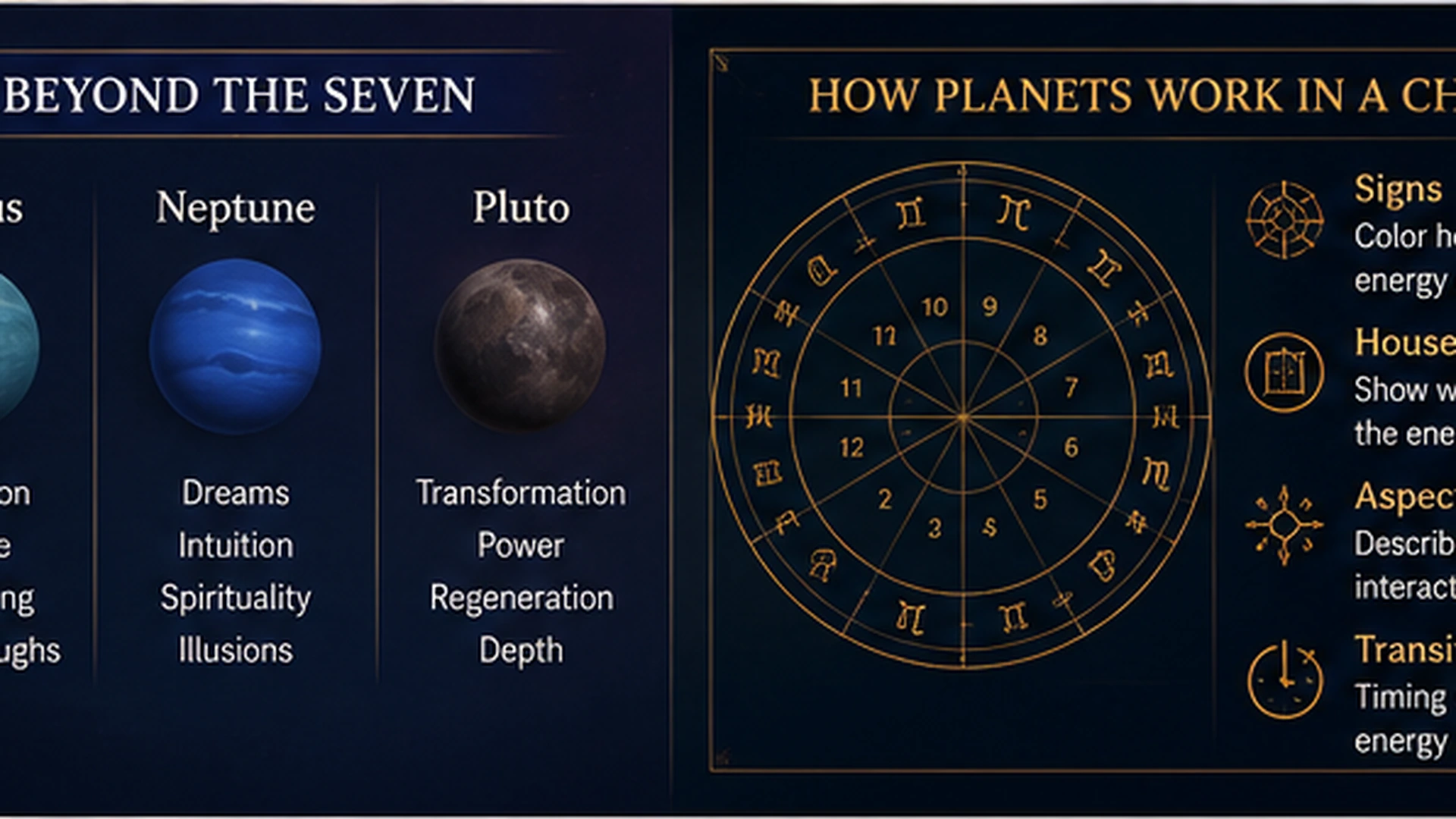
In a Western birth chart, a planet is often treated as the part of the sentence that answers “what function is being expressed?” The zodiac sign describes how that function is expressed, the house describes where it appears in life, and aspects describe how it relates to other chart factors. For example, Venus may symbolize affection and values, but an astrologer will not interpret Venus from its name alone. Its sign, house, aspects, speed, visibility and condition can change the reading.
This guide explains the traditional seven planets, the modern outer planets, chart interpretation, retrogrades, rulership, historical development and major differences among Western, Indian and Chinese systems. It also separates cultural and symbolic meaning from scientific evidence so readers can study astrology without confusing it with astronomy.
Quick Answer
| Planetary influence in astrology is the symbolic role assigned to a celestial body in a chart. A planet represents a function such as identity, emotion, communication, desire, growth or responsibility. Its interpretation is modified by its zodiac sign, house, aspects, motion and the astrological tradition being used. These meanings are cultural interpretations, not scientifically proven planetary effects. |
|---|
Planetary Influence at a Glance
| Astrological body | Common symbolic themes | Important context |
|---|---|---|
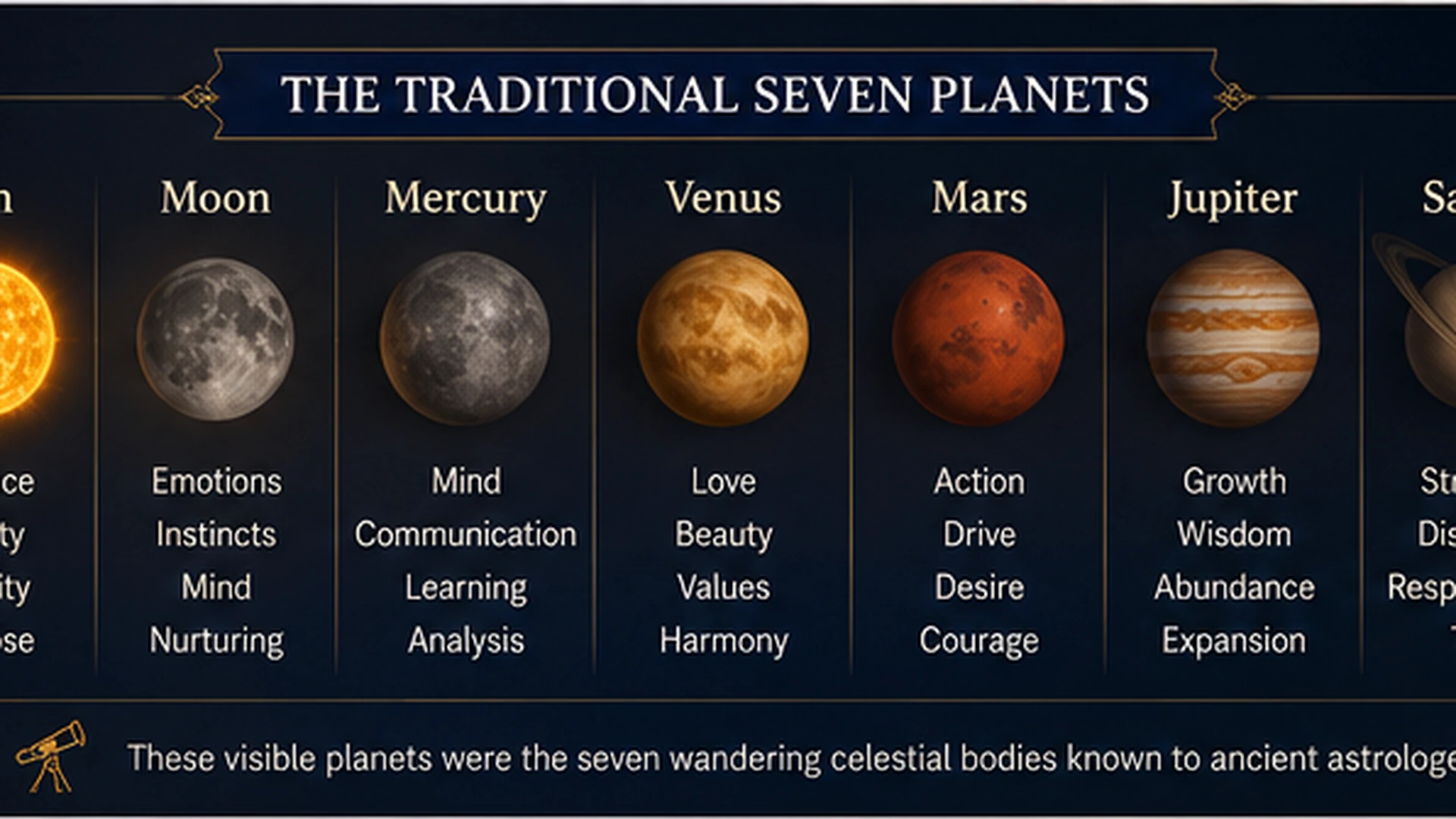
| Sun | Identity, vitality, purpose, visibility | Luminary; traditionally counted among the planets |
| Moon | Emotion, habit, security, body rhythms | Luminary; moves fastest through the zodiac |
| Mercury | Thinking, communication, learning, exchange | Traditional visible planet |
| Venus | Affection, attraction, values, pleasure, harmony | Traditional benefic in many Western systems |
| Mars | Action, desire, conflict, courage, severing | Traditional malefic in many Western systems |
| Jupiter | Growth, belief, law, generosity, opportunity | Traditional greater benefic |
| Saturn | Limits, structure, time, duty, endurance | Traditional greater malefic |
| Uranus | Disruption, independence, innovation, awakening | Modern Western astrology; discovered 1781 |
| Neptune | Imagination, ideals, dissolution, uncertainty | Modern Western astrology; discovered 1846 |
| Pluto | Power, compulsion, depth, transformation | Modern Western astrology; discovered 1930; dwarf planet astronomically |
What Does “Planetary Influence” Mean?
The word influence has never had only one astrological definition. In ancient and medieval sources, astrologers might describe planets through qualities such as hot, cold, moist and dry; through divine or mythological identities; through visibility, speed and position; or as signs of events permitted within a larger religious order. Some writers argued for natural effects. Others understood the heavens as signs rather than independent causes. Modern astrologers may speak instead of symbolism, archetypes, synchronicity, psychological patterns or cycles of time.
Because these theories differ, it is misleading to say “astrology teaches that planets control people” as though every school holds one doctrine. Fatalistic language exists in astrological history, but so do traditions that emphasize character, probability, timing, divine providence, free will or ethical response. A careful reader should ask what a particular astrologer means by influence: physical cause, spiritual sign, predictive technique or reflective metaphor.
Astronomy uses the term influence differently. Planets physically influence one another through gravity and other measurable interactions. Scientists calculate those forces to understand orbits, tides, spacecraft trajectories and planetary systems. That measurable astronomical influence is not the same claim as saying a distant planet determines personality, romantic compatibility or future events.
Why Astrology Calls the Sun and Moon “Planets”
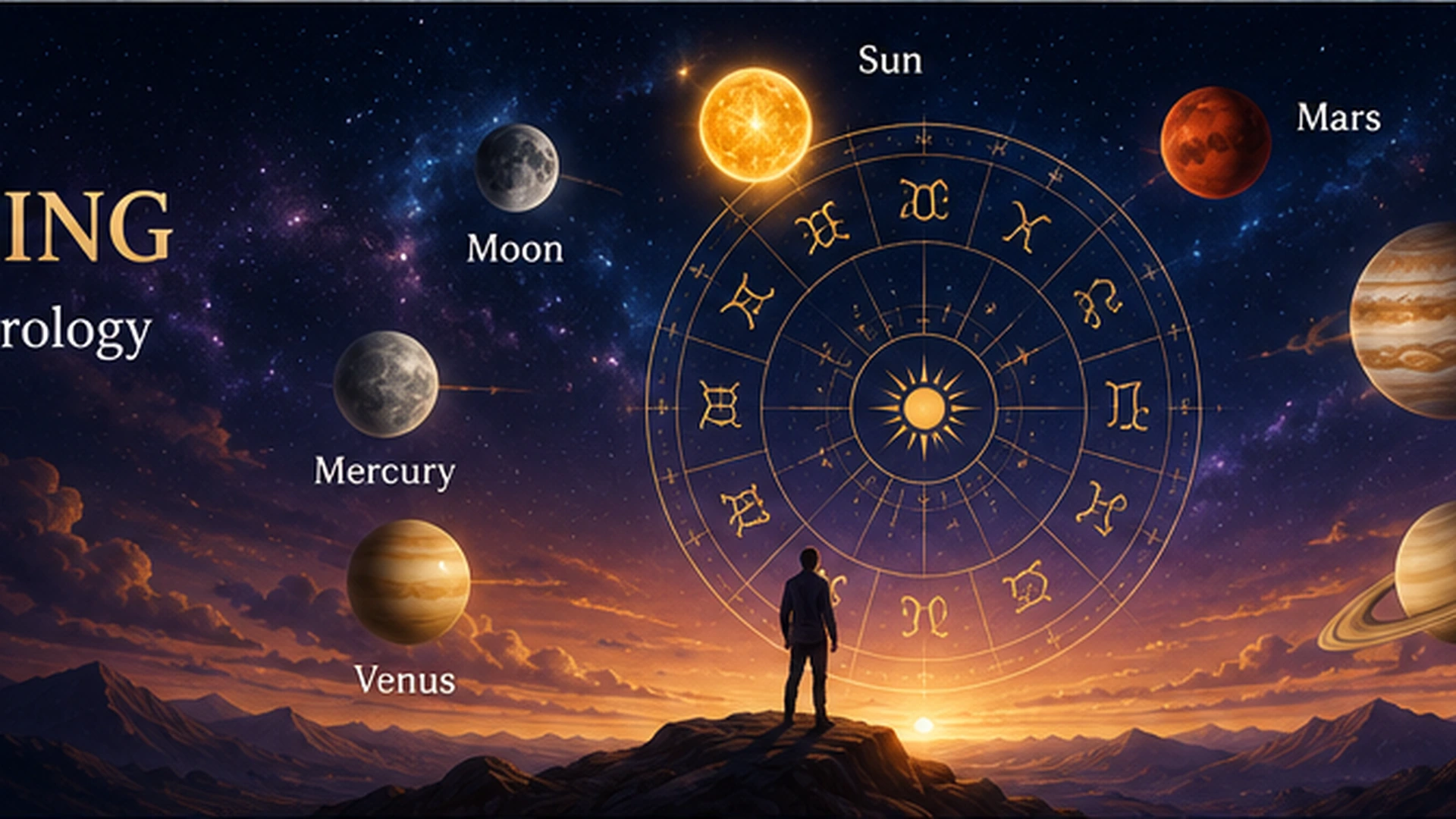
Modern astronomy classifies the Sun as a star, the Moon as Earth’s natural satellite and the solar system as eight planets plus recognized dwarf planets and smaller bodies. Astrology inherited an older Earth-centered observational vocabulary. To a sky watcher, the Sun, Moon, Mercury, Venus, Mars, Jupiter and Saturn move against the comparatively stable background of stars. The Greek root behind “planet” meant wanderer. [2]
Traditional Western astrology therefore speaks of seven planets even though two are not planets in the modern astronomical sense. Astrologers often call the Sun and Moon the luminaries to acknowledge their distinctive role. Museum objects from medieval Islamic and Renaissance Europe likewise show the Sun, Moon and five visible planets as a seven-part celestial order. [4][5]
How Astrologers Interpret a Planet in a Chart
A planet’s basic meaning is only the beginning. A common teaching formula is:
| Planet = what | Sign = how | House = where | Aspect = relationship | Condition = capacity and context |
|---|
This formula is useful for beginners, but established traditions add more layers. A traditional astrologer may consider whether a planet is in its own sign, visible before or after sunrise, moving quickly or slowly, direct or retrograde, close to the Sun, angular, supported by benefics, pressured by malefics or operating within a day or night chart. A modern psychological astrologer may focus more on motivation, inner conflict and personal development.
| Chart factor | What astrologers commonly examine |
|---|---|
| Planet | The function or actor: communication, desire, growth, limits and so on. |
| Zodiac sign | The style, quality or manner in which the function is interpreted. |
| House | The life area where the function is said to appear, such as home, work or partnership. |
| Aspect | The angular relationship linking planets, often read as cooperation, tension, emphasis or adjustment. |
| Rulership | A traditional relationship between a planet and one or more zodiac signs. |
| Dignity and condition | Traditional assessments of how comfortably or effectively a planet is placed. |
| Motion | Direct, stationary or retrograde appearance; speed may also be interpreted. |
| Timing | Transits, progressions, planetary periods and other techniques used to describe changing cycles. |
The Traditional Seven Planets
The Sun: Identity, Purpose and Visibility
In many forms of modern Western astrology, the Sun represents identity, vitality, purpose, creative authority and the wish to be recognized as a distinct person. Traditional texts also associated the Sun with rulers, honors, leadership, illumination, the father or authority figures, depending on the chart and question. The Sun sign is popular because it is easy to calculate from the birth date, but traditional chart reading never treated it as the entire personality.
A strong Sun does not scientifically prove confidence or leadership, and a difficult Sun placement does not make someone weak. Astrologers interpret the Sun differently according to its sign, house, aspects, time of day and relationship with other planets.
The Moon: Emotion, Habit and Embodied Life
The Moon is commonly linked with emotional needs, memory, habit, care, security, family life and bodily rhythms. Because it moves quickly, its zodiac position changes every two to three days and is considered more personal than the slower planets. Traditional astrology also associated the Moon with the public, travel, change, fertility, food, mothers and the flow of events, depending on context.
Moon symbolism is culturally powerful, but it should not be used to diagnose mental health, fertility or medical conditions. The physical Moon measurably affects Earth’s tides; that fact does not establish all astrological claims about mood or personality.
Mercury: Thinking, Language and Exchange
Mercury commonly symbolizes communication, language, reasoning, learning, trade, calculation, messages and movement. Its meaning can be morally neutral: the same skill with words may support teaching, negotiation, humor, persuasion, confusion or deception. Traditional astrologers often described Mercury as adaptable because it changes character according to the planets around it.
The internet phrase “Mercury retrograde causes every device to fail” is a modern exaggeration. Retrograde motion is an apparent reversal produced by relative orbital motion. Astrologers may use it as a symbol of review or complication, but technology fails during direct periods too. [3]
Venus: Affection, Value and Harmony
Venus is commonly associated with affection, attraction, pleasure, beauty, art, agreement, social ease and personal values. In relationship readings, Venus may be used to discuss what a person enjoys or how they receive affection. It cannot determine consent, fidelity, compatibility or whether a relationship is safe.
Traditional Western astrology classified Venus as a benefic, meaning its significations were generally considered supportive or life-giving. That did not mean Venus was always “good.” Excess, indulgence, passivity, jealousy or costly pleasure could appear when other chart factors changed the interpretation.
Mars: Action, Desire and Conflict
Mars commonly represents action, assertion, desire, courage, competition, anger, cutting, heat and conflict. In constructive interpretations it can describe initiative, boundaries, physical effort or the capacity to confront danger. In difficult contexts it can symbolize injury, aggression, rupture or impulsive action.
A Mars placement does not prove that a person is violent or dangerous. Ethical interpretation avoids using astrological symbolism as character evidence, criminal prediction or justification for abuse.
Jupiter: Growth, Belief and Opportunity
Jupiter is associated with expansion, generosity, learning, law, religion, philosophy, opportunity, confidence and social recognition. Traditional Western astrology called it the greater benefic. Modern popular astrology sometimes reduces Jupiter to “luck,” but growth can also mean excess, overconfidence, inflation, waste or taking on more than can be sustained.
A responsible Jupiter reading asks not only where opportunity may appear, but what wisdom, ethics and proportion are required to use it well.
Saturn: Limits, Time and Responsibility
Saturn symbolizes limits, structure, duty, scarcity, delay, age, endurance, institutions and the consequences of time. Traditional astrology called it the greater malefic because it was associated with coldness, restriction, loss and difficulty. Modern astrologers often reinterpret Saturn as discipline, boundaries, maturity and long-term construction.
Neither “always bad” nor “secretly always good” is accurate to the history. Saturn can symbolize real hardship in astrological language, while the same symbolism can be used reflectively to discuss patience, accountability and the structures that make achievement possible.
The Modern Outer Planets
Uranus, Neptune and Pluto were unknown to ancient naked-eye astrology. Their inclusion demonstrates that astrology is not a frozen system. Modern Western astrologers gradually developed meanings for newly discovered bodies by combining astronomical events, mythology, social history, observed cycles and earlier symbolic patterns. Traditional astrologers may use them as secondary factors or not at all.
Uranus: Disruption, Independence and Innovation
Uranus was discovered in 1781. Modern astrology links it with independence, sudden change, rebellion, originality, technology, awakening and disruption. Because it takes about eighty-four years to orbit the Sun, an entire generation shares its zodiac sign. Personal interpretation therefore depends heavily on house placement and aspects to faster chart factors.
Neptune: Imagination, Ideals and Dissolution
Neptune was discovered in 1846. Modern astrologers associate it with imagination, dreams, spirituality, compassion, idealization, uncertainty, boundaries, art and escape. Its symbolism can describe inspiration or confusion depending on context. It should not be used to diagnose psychosis, addiction or deception.
Pluto: Power, Depth and Transformation
Pluto was discovered in 1930 and reclassified by astronomers as a dwarf planet in 2006. Many modern astrologers continue using it because astronomical classification and astrological symbolism are separate systems. Pluto is associated with power, compulsion, hidden processes, destruction, regeneration, taboo and transformation.
Because Pluto moves slowly, its zodiac sign is generational. Claims that one Pluto placement proves trauma, abuse, criminality or spiritual destiny are not responsible interpretations.
Planetary Rulership, Dignity and Condition
Rulership is a traditional system that links planets with zodiac signs. The Sun is associated with Leo and the Moon with Cancer. Mercury rules Gemini and Virgo; Venus rules Taurus and Libra; Mars traditionally rules Aries and Scorpio; Jupiter rules Sagittarius and Pisces; Saturn rules Capricorn and Aquarius. Modern astrologers often assign Scorpio to Pluto, Aquarius to Uranus and Pisces to Neptune, while many traditional practitioners retain the classical scheme.
Dignity describes a planet’s condition according to its sign and other factors. Terms such as domicile, exaltation, detriment and fall are technical categories, not moral judgments about a person. A planet in detriment does not make someone defective, and an exalted planet does not guarantee virtue or success.
Historical explanations linked rulership and exaltation with the structure of the geocentric cosmos, seasonal qualities and relationships among planets. Recent scholarship shows that these doctrines were embedded in particular Mediterranean climatic and philosophical assumptions; they should not be presented as culturally universal laws. [7]
| Traditional planet | Signs of domicile | Broad traditional theme |
|---|---|---|
| Sun | Leo | Vitality and central authority |
| Moon | Cancer | Care, change and embodied life |
| Mercury | Gemini and Virgo | Communication and analysis |
| Venus | Taurus and Libra | Attraction and harmony |
| Mars | Aries and Scorpio | Action and severing |
| Jupiter | Sagittarius and Pisces | Growth and meaning |
| Saturn | Capricorn and Aquarius | Structure and limits |
Aspects: How Planets Relate to One Another
Aspects are angular relationships between planets or chart points. A conjunction brings two factors together. An opposition places them across the chart. A square is traditionally tense, while a trine is often considered flowing. A sextile is usually treated as cooperative but requiring participation. Exact definitions and allowable distance vary by school.
An aspect does not erase the planets involved. A Venus-Saturn aspect, for example, can be interpreted through affection and value meeting structure, fear, duty or endurance. The astrologer then examines signs, houses, sect, condition and the person’s real circumstances. Historical analysis of Vettius Valens suggests that ancient astrologers used a consistent combinatorial logic rather than reading each planet as an isolated keyword. [6]
| Aspect | Approximate angle | Common interpretive language |
|---|---|---|
| Conjunction | 0 degrees | Fusion, concentration or intensified combination |
| Sextile | 60 degrees | Opportunity, exchange or workable support |
| Square | 90 degrees | Friction, conflict, pressure or development through challenge |
| Trine | 120 degrees | Flow, ease, reinforcement or unexamined habit |
| Opposition | 180 degrees | Polarity, awareness, projection or negotiation |
Retrogrades, Transits and Planetary Timing
Retrograde Motion
A planet appears retrograde when its movement against the background stars seems to reverse because Earth and the other planet are moving at different speeds and distances. The planet does not physically reverse its orbit. Astrology interprets the apparent cycle symbolically. Modern descriptions may include review, delay, internalization, repetition or unconventional expression, but meanings differ across techniques and traditions.
Natal Placements and Transits
A natal placement refers to a planet’s calculated position at birth. A transit is a current planetary position compared with the natal chart or another chart. Astrologers use transits to describe timing, but a transit is not a scientifically validated guarantee that a specific event will occur. Two people can experience the same astronomical transit under entirely different social, economic, medical and personal conditions.
Planetary Returns
A planetary return occurs when a planet reaches approximately the zodiac position it held in the natal chart. The solar return happens yearly; the Jupiter return roughly every twelve years; the Saturn return roughly every twenty-nine years. Astrologers use these cycles as interpretive milestones. The astronomical cycles are measurable; the proposed life meanings are astrological interpretations.
Benefics, Malefics and the Problem of “Good” and “Bad” Planets
Traditional Western astrology often classifies Venus and Jupiter as benefics and Mars and Saturn as malefics. The Moon’s condition can increase or reduce support, while Mercury changes according to context. These categories describe inherited judgments about planetary action; they are not labels for good and evil people.
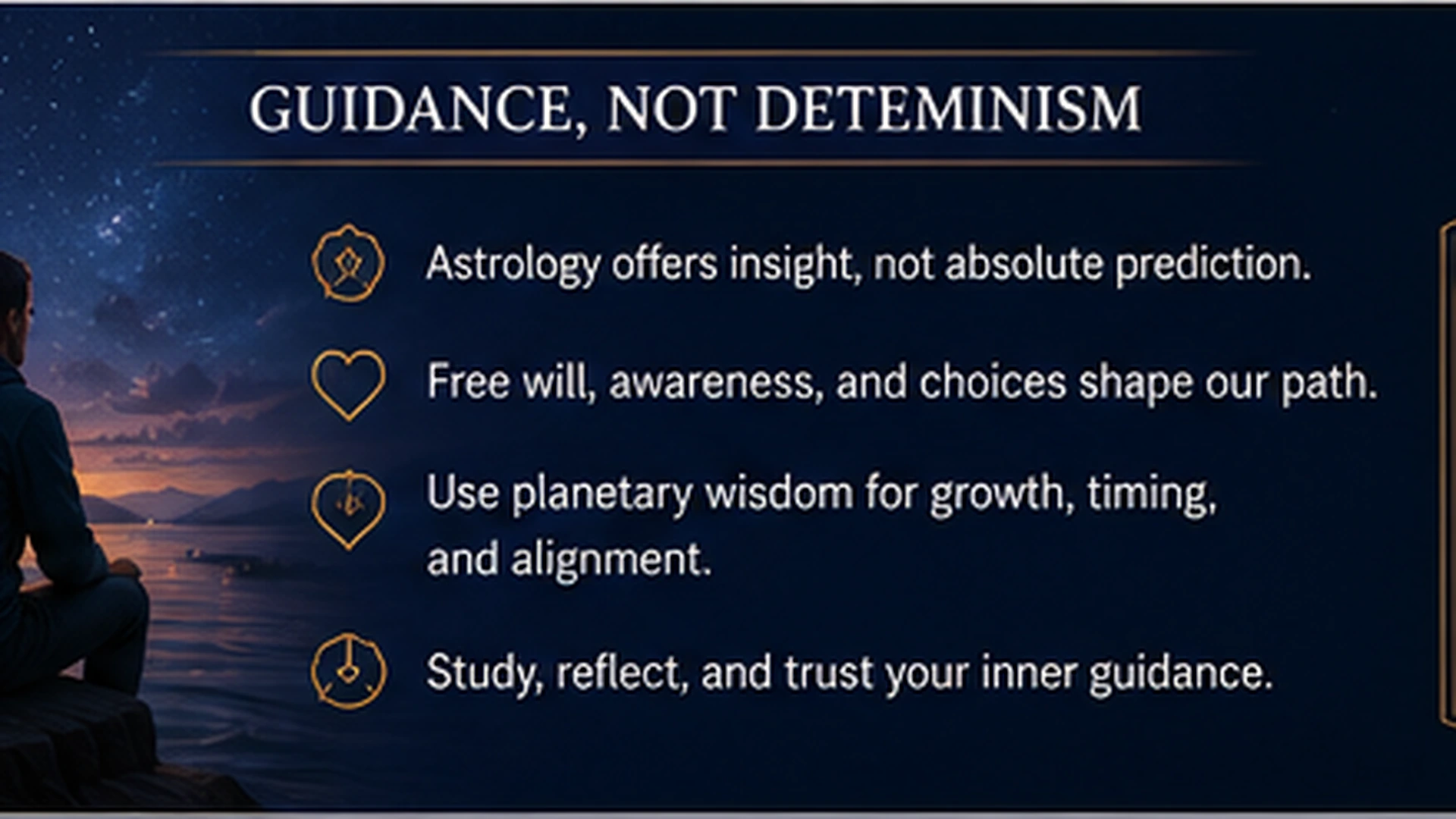
A benefic can signify excess, complacency or pleasure with consequences. A malefic can signify necessary separation, discipline, defense or endurance. Traditional astrologers still take harm seriously, but responsible modern communication avoids frightening clients with claims that a planet proves doom, curses, infertility, abuse or unavoidable tragedy.
A Brief History of Planetary Interpretation
Mesopotamian Observation and Celestial Omens
Western horoscopic astrology has important roots in Mesopotamian celestial omen traditions. Scholars recorded the appearances of the Moon, planets, eclipses and unusual sky events, then interpreted them in relation to rulers, harvests, warfare, disease and public order. Over time, mathematical techniques and individual horoscopes developed. Planetary meanings were connected with divine identities, color, brightness, direction, speed and observed cycles.
Hellenistic Astrology and the Birth Chart
In the Hellenistic Mediterranean, Babylonian zodiacal calculation interacted with Greek geometry, Egyptian settings of scholarship and broader philosophical traditions. Texts associated with Ptolemy and Vettius Valens show systematic planetary meanings, houses, aspects, lots and timing techniques. Valens’ surviving work illustrates how practitioners combined planet meanings rather than treating them as isolated dictionary entries. [6]
The Medieval Islamic World
Scholars working in Arabic and Persian translated, criticized and expanded Greek, Persian and Indian astronomy and astrology. Accurate planetary tables, instruments and mathematical methods supported both scientific observation and astrological calculation. Astrological art personified the seven planets on metalwork, manuscripts and ceramics. Religious and philosophical debate continued over causation, free will and whether celestial signs could be interpreted without limiting divine authority. [4][5]
Renaissance Europe and the Seven Planets
European artists produced series showing Saturn, Jupiter, Mars, the Sun, Venus, Mercury and the Moon with mythological figures, occupations and zodiac signs. These images demonstrate how planetary symbolism extended into medicine, calendars, politics, craft, alchemy and social classification. They also reflect the prejudices and hierarchies of their period and should not be copied uncritically.
Modern Psychological and Popular Astrology
Modern astrology increasingly describes planets as parts of the psyche: the Sun as identity, the Moon as emotional need, Mercury as thought, Venus as relating and Mars as assertion. Uranus, Neptune and Pluto were added to many Western systems. Newspaper horoscopes simplified astrology further by focusing on the Sun sign. Digital applications now calculate complex charts instantly, but fast calculation does not guarantee historically accurate or ethically responsible interpretation.
Are Planetary Meanings the Same Across Cultures?
No. Shared celestial bodies do not produce one universal dictionary. Traditions may observe the same Sun, Moon and visible planets while organizing them through different calendars, deities, elements, ritual systems, philosophical categories and techniques. Similarities can result from cultural exchange, independent observation or later comparison. They should not be treated as proof that every system secretly teaches the same thing.
Indian Jyotisha and the Navagraha
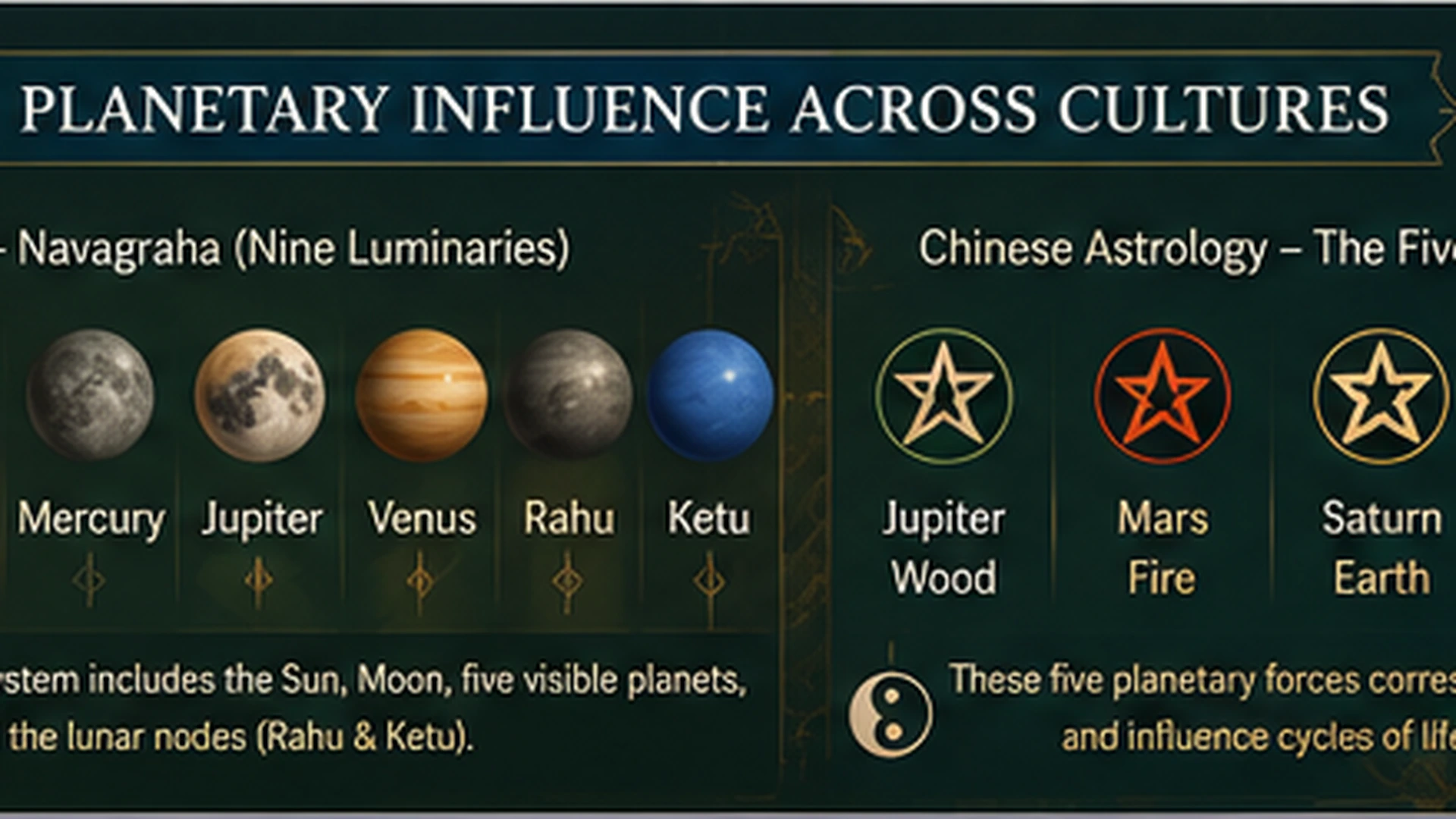
Many Indian astrological traditions work with the Navagraha: the Sun, Moon, Mars, Mercury, Jupiter, Venus, Saturn, Rahu and Ketu. Rahu and Ketu are lunar nodes, not physical planets, and are important for eclipse symbolism and chart interpretation. Jyotisha also uses nakshatras, planetary periods and other methods that do not map neatly onto modern Western sun-sign astrology.
The Nine Luminaries traveled through Buddhist and East Asian religious networks. A twelfth-century Japanese handscroll in The Metropolitan Museum of Art depicts the Sun, Moon, five visible planets and the ascending and descending lunar nodes as an iconographic reference for monks. [8] Public museum evidence supports discussion of transmission, but it does not authorize outsiders to invent rituals or promise that remedies will alter scientifically measurable planetary effects.
Chinese Five Planets and the Five Phases
Chinese cosmological traditions associated the five visible planets with the Five Phases: Jupiter with wood, Mars with fire, Saturn with earth, Venus with metal and Mercury with water. A Ming-period handscroll in The Met depicts the deities of the Five Planets with the twenty-eight constellations. [9] These associations are not equivalent to the Western idea that Venus means romantic style or Saturn means personal boundaries.
Chinese calendrical and political astrology developed through court observation, omen interpretation, stems and branches, directional systems and other cosmological frameworks. The familiar twelve animal cycle is also different from the twelve signs of the Western zodiac.
Islamic, Persian and Mediterranean Traditions
Medieval Islamic astrology inherited and transformed Hellenistic, Persian and Indian materials while developing sophisticated astronomy. Planetary personifications could appear in art as symbols of cosmic order, rulership or talismanic belief. Muslim scholars disagreed sharply about astrology: some practiced or defended limited techniques, while others rejected divination or claims that planets independently govern human destiny.
Does Science Support Astrological Planetary Influence?
Astronomy can measure planetary mass, composition, gravity, magnetic fields, radiation, orbit and interactions with other bodies. NASA describes a planet through physical criteria and studies planetary systems using observation, mathematics and testable models. [2] Astrology makes a different claim when it links celestial positions with personality, relationship outcomes or future events.
NASA distinguishes astronomy from astrology and states that astrological claims about personality and prediction are not based on scientific evidence. [3] A widely discussed double-blind experiment published in Nature tested whether astrologers could accurately match natal charts with standardized personality profiles under agreed conditions; the tested claim was not supported beyond chance. [10]
This does not erase astrology’s importance in cultural history, art, religion, identity or personal reflection. It does mean that symbolic usefulness should not be presented as demonstrated physical causation. A meaningful story is not automatically a reliable diagnostic or predictive instrument.
| Type of statement | Responsible distinction |
|---|---|
| Astronomical claim | Planets have measurable mass, gravity, orbits, atmospheres and physical interactions. |
| Astrological claim | Planetary positions symbolize or predict personality, events, relationships or timing. |
| Evidence status | Astronomical claims are tested through observation and models; central astrological predictive claims have not been reliably established. |
| Responsible wording | “Astrologers interpret Saturn as…” rather than “Saturn scientifically causes…” |
Can Planetary Symbolism Be Used for Self-Reflection?
A person may use planetary symbolism as a structured set of questions without treating the chart as objective proof. Saturn can prompt reflection on responsibility; Venus on values and relationships; Mars on boundaries and action; Jupiter on growth and excess. The value comes from the quality of reflection and behavior, not from assuming the planet has issued an unquestionable command.
Helpful questions include:
What real behavior or evidence supports this interpretation?
Does the reading increase responsibility or encourage fatalism?
Could the same description apply to many people?
Am I using astrology to avoid a difficult conversation or professional advice?
Does the interpretation respect consent, privacy and cultural context?
Would I make the same medical, legal or financial decision without the chart?
When Planetary Interpretation Becomes Harmful
Astrology can become harmful when a practitioner uses fear, certainty or authority to replace evidence. No planetary placement can prove that a person is cursed, infertile, mentally ill, unfaithful, criminal, abusive or destined for tragedy. A transit cannot guarantee investment returns, legal victory, pregnancy, healing or protection.
Readers should be cautious when someone claims that payment is required to “remove” Saturn, repair a retrograde planet, neutralize a birth chart or prevent disaster. Religious remedies belong to specific living traditions and should be explained as beliefs or devotional practices, not as scientifically guaranteed services.
Common Misunderstandings About Planetary Influence
| Claim | Responsible answer |
|---|---|
| “Planets control personality.” | Astrology interprets planets symbolically; scientific evidence has not established deterministic personality effects. |
| “The Sun and Moon are planets.” | They are treated as planets in traditional astrological vocabulary, but astronomy classifies them as a star and a natural satellite. |
| “Jupiter is always lucky.” | Astrologers may connect Jupiter with growth, which can include opportunity or excess. |
| “Saturn is always a punishment.” | Historical astrology treated Saturn as difficult, while modern readings may also discuss discipline, limits and endurance. |
| “Retrograde planets move backward.” | Retrograde motion is an apparent reversal caused by relative orbital motion. |
| “Outer planets were always part of astrology.” | Uranus, Neptune and Pluto entered Western astrology after their discoveries. |
| “All cultures give planets the same meanings.” | Western, Indian, Chinese, Islamic and other traditions differ in structure and doctrine. |
| “A strong planet guarantees success.” | Astrological condition is an interpretive category, not scientific proof of outcomes or moral quality. |
Related Reading on AncestralTemple.com
| Internal link | Purpose |
|---|---|
| What Is Astrology? History, Meaning, Charts and Evidence | Use as the cornerstone definition page and link near the introduction. |
| Origins of the Zodiac: From Babylon to Modern Astrology | Link from the history section for the development of signs and horoscopic technique. |
| Common Astrology Myths: Facts, History and Evidence | Link from retrogrades, benefics/malefics and science limitations. |
| Understanding the Eight Moon Phases | Link from the Moon section for a focused lunar-cycle explainer. |
| December 12 Zodiac Sign: Sagittarius Traits, Meaning and Compatibility | Link as an example of how one Sun sign is only part of a larger chart. |
People Also Ask
What does planetary influence mean in astrology?
It means the symbolic role assigned to the Sun, Moon or a planet in a chart. The meaning is modified by sign, house, aspects, motion and tradition.
What do the planets represent in a birth chart?
They represent functions such as identity, emotion, communication, attraction, action, growth and responsibility. These are astrological associations, not scientifically proven effects.
Why are the Sun and Moon called planets in astrology?
Astrology preserves an older observational system that counted seven wandering lights: the Sun, Moon, Mercury, Venus, Mars, Jupiter and Saturn.
What is the most important planet in astrology?
There is no universal answer. The Sun and Moon are prominent, while chart rulers, angular planets and strongly aspected planets may receive special attention depending on the tradition.
Do retrograde planets have stronger influence?
Astrologers disagree. Some interpret retrogrades as internalized, revised or unconventional expression. Astronomy describes retrograde as apparent motion, not a planet reversing orbit.
Do planets physically affect personality?
Scientific research has not established that planetary positions at birth reliably determine personality. Astrology is better described as symbolic, cultural or divinatory interpretation.
Frequently Asked Questions
1. What is a planetary sign placement?
It is the zodiac sign occupied by a planet in a chart. Astrologers use the sign to describe how the planet’s function is expressed.
2. What is a planetary house placement?
It is the astrological house containing a planet. The house is interpreted as the area of life where the planet’s themes are emphasized.
3. What is a ruling planet?
A ruling planet is linked with a zodiac sign through an inherited system of rulership. Astrologers may also call the ruler of the Ascendant the chart ruler.
4. Are Uranus, Neptune and Pluto used in traditional astrology?
No. They were unknown to ancient and medieval astrologers. Modern Western astrology commonly uses them; traditional practitioners may not.
5. Is Pluto still used after being classified as a dwarf planet?
Yes, by many astrologers. Astronomical classification and astrological practice are separate systems.
6. What are benefic and malefic planets?
Traditional Western astrology generally classifies Venus and Jupiter as benefics and Mars and Saturn as malefics. These are technical categories, not moral labels for people.
7. Is Navagraha the same as the Western planets?
No. Navagraha traditions include the Sun, Moon, five visible planets and two lunar nodes within Indian religious and astrological frameworks.
8. Can a planet predict marriage, money or health?
Astrologers may interpret such topics, but planetary placements cannot scientifically guarantee outcomes or replace medical, legal, financial or relationship evidence.
Key Takeaways
Planetary influence in astrology means symbolic interpretation, not one universally agreed physical mechanism.
A planet represents a function; its sign, house, aspects, motion and condition modify the reading.
Traditional Western astrology uses seven planets: Sun, Moon, Mercury, Venus, Mars, Jupiter and Saturn.
Uranus, Neptune and Pluto were added to many modern Western systems after their discoveries.
Rulership, dignity, benefic and malefic are technical historical categories, not moral judgments about a person.
Retrograde motion is astronomically apparent motion; its personal meaning is an astrological interpretation.
Indian Navagraha and Chinese Five-Planet traditions are culturally distinct from Western planetary symbolism.
Scientific testing has not established natal planetary positions as reliable predictors of personality or life events.
Astrology can be used as optional reflection, but it should not replace evidence, professional care, consent or safety.
Conclusion and Final Summary
Planetary influence is the interpretive heart of many astrological systems, but the phrase needs careful definition. In a chart, planets are not read as isolated objects. Their symbolic roles are shaped by signs, houses, aspects, motion, visibility, rulership and the methods of a particular tradition. The Sun may symbolize identity, Venus affection and Saturn limits, yet no single keyword can describe a complete person or guarantee an event.
The history is equally important. The seven visible celestial bodies were interpreted through Mesopotamian omens, Hellenistic horoscopes, medieval Islamic scholarship, Indian Navagraha traditions, Chinese five-planet cosmology and later European and modern systems. These histories interacted, but they are not interchangeable.
A responsible approach can value astrology as cultural history, art, religion or personal symbolism while keeping scientific claims accurate. Astronomy measures what planets physically are and how they move. Astrology asks what their positions might mean within inherited interpretive frameworks. Understanding that boundary makes the subject more honest, more culturally respectful and more useful.
Article Information
- Publisher
- Ancestral Temple
- Editor
- Ancestral Temple
- Last updated
- Jul 30, 2026
- Last reviewed
- Jul 30, 2026
- Content version
- 42979ed90a
This educational article should be read as cultural and spiritual information, not as medical, legal, financial, or emergency advice.
Helpful Related Guidance
About the Author
 Ancestral Temple
Spiritual guide and practitioner with decades of experience in ancestral wisdom, rituals, and divine guidance.
Related Posts
View All











Comments
We'd love to hear your thoughts.