
Ancient Protection Symbols: Egyptian and African Symbols Explained
Quick Summary
Ancient protection symbols were not a single visual language shared by every civilization. In ancient Egypt, signs such as the sa hieroglyph, wedjat eye, tyet knot and djed pillar...
Ancient protection symbols were not a single visual language shared by every civilization. In ancient Egypt, signs such as the sa hieroglyph, wedjat eye, tyet knot and djed pillar could be worn as amulets, placed on bodies, incorporated into objects or combined with spoken and written ritual formulas. Elsewhere in Africa, protection could be communicated through stamped textile symbols, Christian crosses, talismanic manuscripts, carved power objects, prescribed jewelry or containers holding spiritually significant materials.
The most accurate way to understand these traditions is to ask four questions: Who used the symbol? In which place and period? What did it mean in that community? Was it only an image, or was it part of a larger object and practice? Those questions prevent a common mistake: treating all African religious symbols as interchangeable decorations.
This guide explains the best-documented ancient Egyptian symbols of protection and then compares them with selected traditions from Ghana, Ethiopia, Central Africa and Madagascar. It describes historical beliefs respectfully but does not present supernatural protection as a scientifically demonstrated outcome.
Quick Answer
The clearest ancient Egyptian symbol for protection is the sa sign, whose hieroglyphic meaning is “protection.” The wedjat or Eye of Horus represented restoration, well-being and protection; the tyet invoked Isis in funerary protection; the djed conveyed stability; and scarabs represented renewal. Africa has no single universal protection symbol: meanings belong to specific peoples, regions, religions and historical settings. [1–5]
| Field | Specification |
|---|---|
| Image number | 1 (featured image) |
| Purpose | Introduce the article as a careful, museum-based comparison rather than a fantasy ritual scene. |
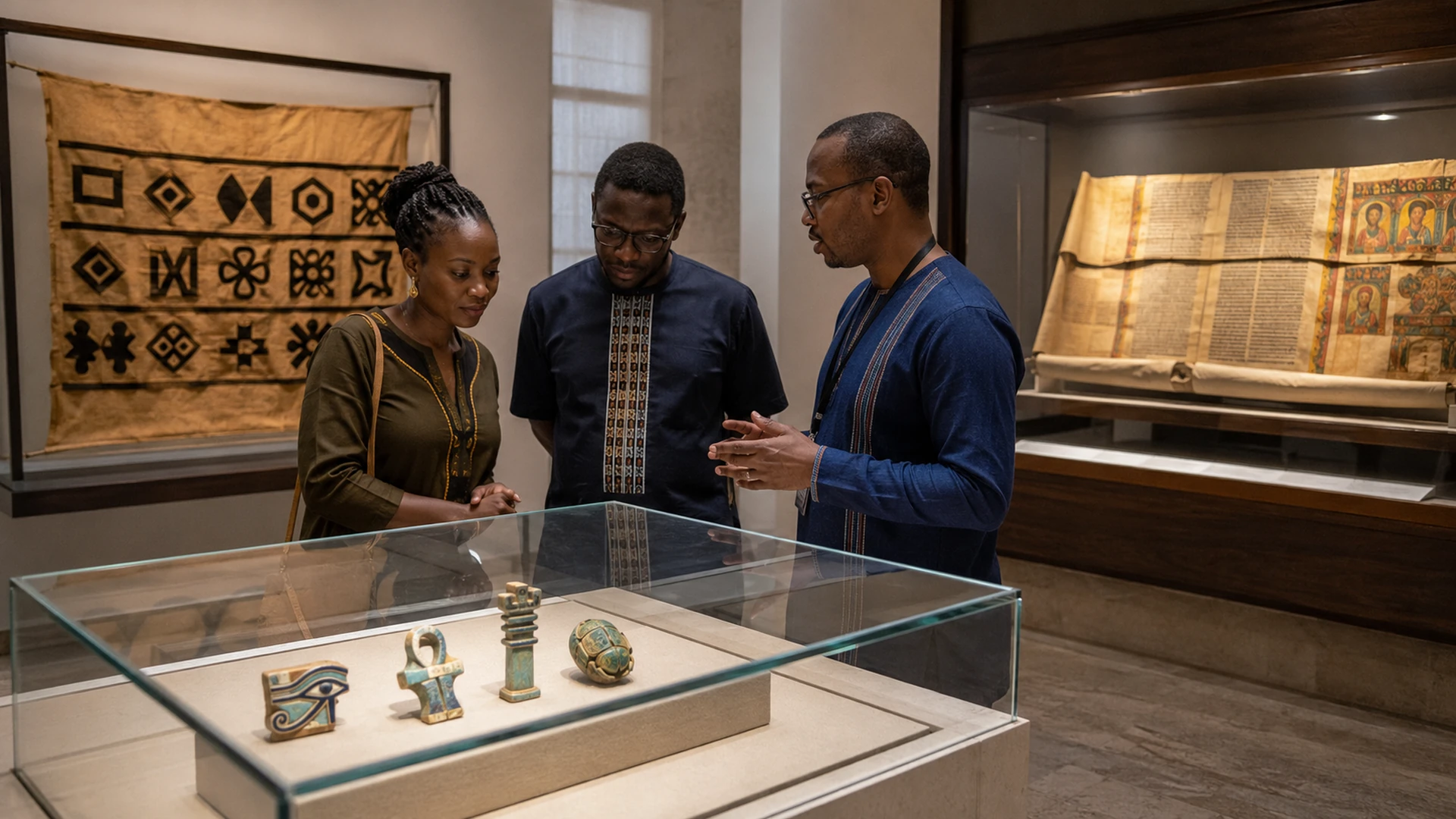
| Detailed scene | A realistic African heritage museum gallery with three clearly separate display areas: a foreground glass case containing small ancient Egyptian faience amulets such as a wedjat eye, sa sign, djed and scarab; a distant wall display of an Asante Adinkra cloth; and a separate manuscript case containing an Ethiopian parchment scroll. Two Black African adult visitors study the Egyptian case while a curator stands nearby. |
| Specific culture or historical context | Modern educational museum presentation of distinct ancient Egyptian, Akan/Asante and Ethiopian objects; each tradition remains visually separated. |
| People shown | Two Black African adult visitors and one Black African museum curator; natural expressions, respectful posture. |
| Location | Contemporary African museum gallery with controlled lighting. |
| Clothing | Modern smart-casual African clothing with subtle woven details; no costumes. |
| Architecture | Clean museum interior, neutral stone and dark wood, professional display cases. |
| Objects | Museum-quality replicas of a sa amulet, wedjat eye, djed pillar, scarab, Adinkra cloth and Ethiopian scroll, each in a separate display context. |
| Lighting | Soft museum spotlights, balanced natural-looking exposure, no dramatic supernatural glow. |
| Composition | 16:9 landscape; Egyptian amulet case in sharp foreground, visitors at center, other traditions visible but separated in the background; ample negative space for website cropping. |
| SEO-friendly filename | ancient-protection-symbols-egyptian-african.webp |
| Image title | Ancient Egyptian and African Protection Symbols in Context |
| Alt text | Museum-style display presenting Egyptian protection amulets with separate African textile and manuscript traditions in distinct cases |
| Caption | Protection symbols are best understood through the specific objects, communities and historical settings in which they were used. |
| Recommended placement | Immediately after the Quick Answer. |
| Article section supported | Introduction and Quick Answer. |
| Important elements to avoid | No embedded text, labels, logos, watermarks, fantasy magic, mixed ritual performance, pharaoh costume clichés, collages, split screens or unrelated symbols merged into one invented design. |
What Is a Protection Symbol?
A protection symbol is a visual form associated with guarding a person, household, community, ruler, body, journey or transition. Its power may be understood religiously, socially, politically or psychologically. A symbol can appear alone, but it often works as part of a larger system involving material, color, inscription, placement, prayer, ritual action or community authority.
In ancient Egypt, an amulet was not valued only because it looked like a sign. The Metropolitan Museum of Art notes that an amulet’s perceived efficacy could depend on its shape, material, color, inscription and words or actions performed over it. Amulets could be worn by living people or placed among mummy wrappings. [1]
The word “symbol” is therefore useful for search, but it can be too broad. A flat graphic sign, a deity image, a carved figure and a scroll containing prayers may all relate to protection while functioning in very different ways.
| Type | What it is | Example |
|---|---|---|
| Symbol | A sign that communicates an idea | The Egyptian sa sign writes “protection”; Eban represents a secure fence/home. |
| Amulet | A portable object worn or placed for a desired benefit | A wedjat-eye pendant, scarab or Malagasy ody. |
| Protective deity image | An image invoking the responsibilities of a deity | Bes guarding households; Taweret protecting pregnancy and childbirth. |
| Talismanic text or manuscript | Written prayers, names and images used within a protective practice | Ethiopian healing or protective scrolls. |
| Power object | A prepared object whose significance depends on specialist knowledge and materials | A Kongo nkisi or nkisi nkondi. |
| Political or social emblem | A sign of authority, vigilance or responsibility | Adinkra motifs connected with leadership, wariness or the duty to protect. |
Why “African Protection Symbol” Is Not One Category
Africa contains thousands of communities, languages and changing religious histories. UNESCO describes the continent’s culture as diverse and vibrant, encompassing both tangible and intangible heritage. A symbol from an Akan textile tradition in Ghana should not be presented as though it automatically belongs to Kongo religion, Ethiopian Christianity, Malagasy amulet practices or ancient Egypt. [10]
The phrase “African spiritual symbols” can still be useful when it introduces a carefully organized comparison. It becomes misleading when it suggests that one sign represents the entire continent or when unrelated motifs are combined into a fictional “African protection seal.”
The article therefore uses “African” geographically while naming the specific people, country, medium and period whenever possible.
Ancient Egyptian Protection Symbols and Their Meanings
1. The Sa Sign: The Most Literal Egyptian Symbol of Protection
For readers asking which Egyptian symbol actually means protection, the sa sign is the strongest direct answer. A Middle Kingdom silver and electrum amulet in the Metropolitan Museum represents the hieroglyph used to write sa, “protection.” The museum explains that the amulet was intended to extend protection to its wearer in life or death. [2]
The sign is usually shown as a narrow looped form with a horizontal base or tie-like ending. It can be confused with the shen ring, a different sign associated with encircling or enclosing. Some scarabs carry one or more sa signs on their undersides, combining the beetle’s associations with renewal and a written wish for protection. [2]
The sa sign also appears beside protective deities. Taweret is frequently represented resting her forepaws on it, visually linking her guardian role with the written concept of protection.
2. The Wedjat Eye or Eye of Horus
The wedjat eye is among the most famous Egyptian protection symbols. It represents the healed eye of Horus after it was injured and restored in myth. The ancient name wedjat means “the one that is sound” or “sound again.” As an amulet, it conveyed restoration, regeneration, well-being and protection from harm. It was used for both the living and the dead. [3]
Its shape combines a human eye with stylized falcon markings because Horus was associated with the falcon. Ancient examples vary by period and material, including faience, carnelian, gold, obsidian and other stones. The meaning was not simply “an eye watching enemies.” It was tied to the story of injury made whole, which helps explain its strong association with recovery and renewed integrity.
Modern sellers often use “Eye of Horus,” “Eye of Ra” and generic evil-eye imagery interchangeably. Historically, those are not automatically the same symbol. A responsible article or product description should identify the exact form and avoid merging different traditions.
3. The Tyet or Tit Knot of Isis
The tyet, also spelled tit and often called the knot or girdle of Isis, resembles a knotted strip of cloth. Its earliest meaning is uncertain, but by the New Kingdom it was strongly associated with Isis. The Book of the Dead specified a red version placed at the deceased’s neck, and the sign was considered a potent form of protection in the afterlife. [4]
The tyet illustrates why color and placement mattered. Red could represent dangerous force, blood, vitality and protective potency. The symbol’s use cannot be reduced to a modern decorative loop; it belonged to funerary belief, written ritual instructions and the protective identity of Isis.
4. The Djed Pillar: Stability, Permanence and Continuity
The djed pillar primarily signified stability or permanence. Over time it became closely associated with Osiris and was interpreted as his backbone. Funerary djed amulets were intended to help ensure permanence for the deceased and connect the wearer with Osiris’s restoration after death. [5]
The djed is therefore related to protection through endurance, continuity and secure existence rather than through a literal word meaning “guard.” It is better described as a stabilizing and regenerative symbol than as a simple all-purpose shield.
5. The Scarab: Becoming, Renewal and Protective Rebirth
Scarab amulets take the form of the dung beetle. Ancient Egyptian wordplay connected the beetle with kheper, “to become” or “come into being,” while the insect’s rolling behavior was associated with the sun’s daily movement and rebirth at dawn. Scarabs became powerful amulets for rejuvenation in life and regeneration after death. [6]
Some scarabs functioned as seals; inscriptions on their bases could add names, divine images or positive signs. A scarab was not always a generic protection sign by itself, but its associations with renewed life made it protective in many contexts, especially when combined with inscriptions or placed on the body. Winged scarabs attached to mummy wrappings were intended to support the deceased’s rebirth.
6. Bes: A Guardian of the Household
Bes and related “Bes-image” deities were represented with a frontal face, leonine features and a compact body. Unlike many Egyptian figures shown in profile, the direct gaze contributes to the figure’s confronting presence. Bes-images guarded the household, protected women and children, and were associated with music, knives and the sa sign as means of driving away danger. [7]
Bes is a protective divine figure rather than a single abstract hieroglyph. His image appeared on amulets and domestic objects, making him relevant to the query “symbol of a protector.” The protector in this case is represented as an active guardian personality.
7. Taweret: Protection in Pregnancy and Childbirth
Taweret is a composite goddess combining human, hippopotamus, lion and crocodile features. Those dangerous animals were brought together to create a formidable guardian. Her principal responsibility was protecting women during pregnancy and childbirth; she could also appear in funerary settings connected with rebirth. [8]
Taweret is commonly shown standing upright with a swollen belly and resting on the sa sign. Her image should not be described as a monster in the modern fantasy sense. The hybrid form communicated protective strength within Egyptian religious thought.
8. The Ankh: Life, Not a Literal Word for Protection
The ankh is one of the most recognizable ancient Egyptian symbols, but its core meaning is life. It was used as a hieroglyph for “live,” “alive” or “life,” and divine figures often present it to rulers as a gift of life. [9]
Because life, health and continued existence can overlap with protective wishes, the ankh may appear in protective combinations. That does not make it the clearest Egyptian word-symbol for protection. When someone asks for the Egyptian protection symbol, the sa sign and wedjat eye are more precise answers; the ankh should be described first as a symbol of life.
| Field | Specification |
|---|---|
| Image number | 2 |
| Purpose | Show how protection symbols existed as crafted objects whose materials and scale mattered. |
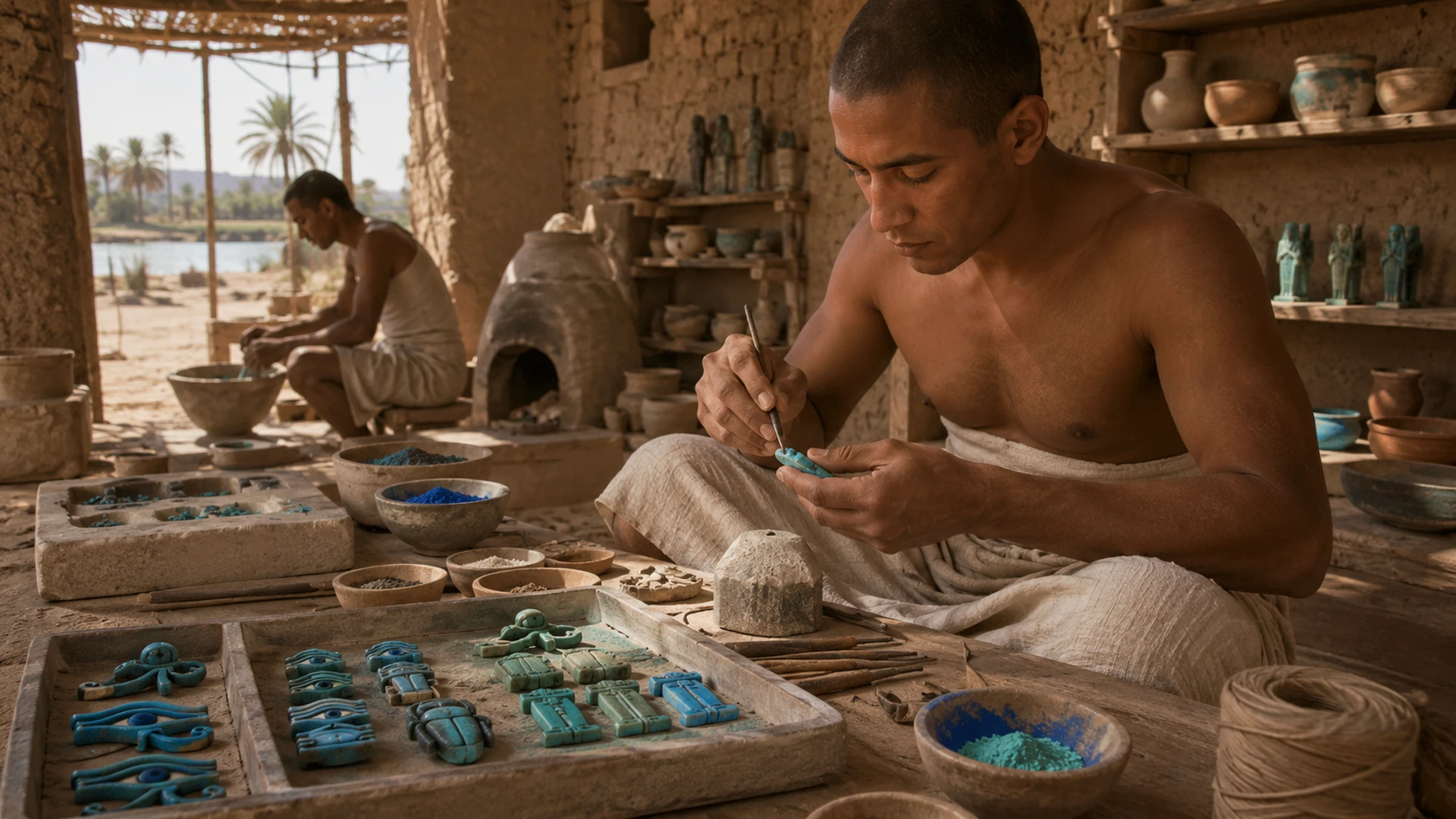
| Detailed scene | Museum-quality historical reconstruction of a New Kingdom Egyptian artisan workshop. An adult Egyptian craftsperson sits at a low workbench shaping small blue-green faience amulets: a wedjat eye, djed pillar, sa sign and scarab. Finished pieces rest in separate shallow trays beside mineral pigments, small tools and a ceramic kiln area. |
| Specific culture or historical context | Ancient Egypt, New Kingdom artisan environment, approximately 1550–1070 BCE; educational reconstruction rather than a ritual scene. |
| People shown | One adult Egyptian artisan with accurate anatomy and hands; one assistant in the background preparing materials. |
| Location | Mud-brick workshop near a Nile Valley settlement. |
| Clothing | Simple linen garments appropriate to ancient Egypt; no royal regalia. |
| Architecture | Mud-brick walls, reed shade, wooden shelves, compact kiln and open courtyard light. |
| Objects | Small faience amulets, stone molds, mineral pigments, linen cord, ceramic bowls and period-appropriate hand tools. |
| Lighting | Natural morning light with warm reflected tones and realistic shadows. |
| Composition | 16:9 landscape, close editorial view of hands and amulets with workshop context behind; no text or labels. |
| SEO-friendly filename | ancient-egyptian-protection-amulets-workshop.webp |
| Image title | Ancient Egyptian Protection Amulets in an Artisan Workshop |
| Alt text | Historical reconstruction of an ancient Egyptian artisan making faience Eye of Horus, sa, djed and scarab amulets |
| Caption | Egyptian amulets derived meaning from form, material, color, inscription, placement and ritual context. |
| Recommended placement | After the ancient Egyptian symbol profiles. |
| Article section supported | Ancient Egyptian Protection Symbols and Their Meanings. |
| Important elements to avoid | No pyramids inside the workshop, no fantasy glow, no modern jewelry tools, no hieroglyphic text floating in the air, no pharaoh, no embedded words, logos or watermarks. |
Ancient Egyptian Protection Symbols at a Glance
| Symbol or image | Primary meaning | Why linked with protection | Typical context |
|---|---|---|---|
| Sa sign | Protection | Direct written sign for protection; worn in life or death. | Living and funerary amulets |
| Wedjat eye | Restoration, soundness, regeneration, protection | Represents the healed eye of Horus. | Living and funerary use |
| Tyet/Tit | Protection associated with Isis | Red knot-like funerary amulet. | Especially afterlife protection |
| Djed pillar | Stability and permanence | Associated with Osiris and enduring existence. | Strong funerary role |
| Scarab | Becoming, renewal and rebirth | Beetle linked with the rising sun and regeneration. | Seals, jewelry and funerary amulets |
| Bes image | Household guardianship | Protective deity guarding women, children and homes. | Domestic and personal use |
| Taweret image | Pregnancy, childbirth and rebirth protection | Formidable composite guardian often shown with sa sign. | Domestic, temple and funerary contexts |
| Ankh | Life | May support protective wishes, but does not literally mean protection. | Royal, divine, ritual and funerary imagery |
Selected African Protection Symbols and Protective Traditions
The examples below do not form one continental system. They demonstrate different ways communities have represented security, vigilance, blessing, healing, moral order and defense. Several are living or relatively recent traditions rather than “ancient” in the archaeological sense.
This distinction matters for SEO accuracy. A reader searching “African traditional religion symbols” should receive specific, sourced examples, not a chart that invents one religion for the entire continent.
Akan and Asante Adinkra: Eban, Akoben and Protective Responsibility
Adinkra is a graphic tradition associated especially with Akan and Asante peoples in Ghana and with related histories in Côte d’Ivoire. Symbols are stamped onto cloth and also appear on jewelry, architecture and other media. The Smithsonian explains that older Adinkra signs are closely connected with proverbs, folktales, songs and sayings; understanding their nuances traditionally requires cultural knowledge. [11]
Eban means “fence” and is widely interpreted as safety, security and the protection of home and family. Akoben, the war horn, represents vigilance or wariness: the readiness to hear warning and respond. Tuo ne Akofena, showing a gun and state sword, has been described by the Smithsonian as a reminder of power, authority, military prowess and the national responsibility to protect. [12–13]
These meanings show that a protector symbol may represent more than supernatural defense. It can communicate secure domestic space, alert leadership, courage or the duty of a state. Adinkra meanings also depend on proverb, use and arrangement, so a symbol should not be detached from Akan language and history.
Gye Nyame is often marketed online as a general protection symbol. Its documented primary meaning is the supremacy, controlling power and eternal nature of God. A wearer may personally connect that belief with divine protection, but the symbol should first be explained according to its established meaning rather than relabeled for sales. [11]
| Field | Specification |
|---|---|
| Image number | 3 |
| Purpose | Present Adinkra as a living Akan/Asante graphic and textile tradition, not a generic pan-African code. |
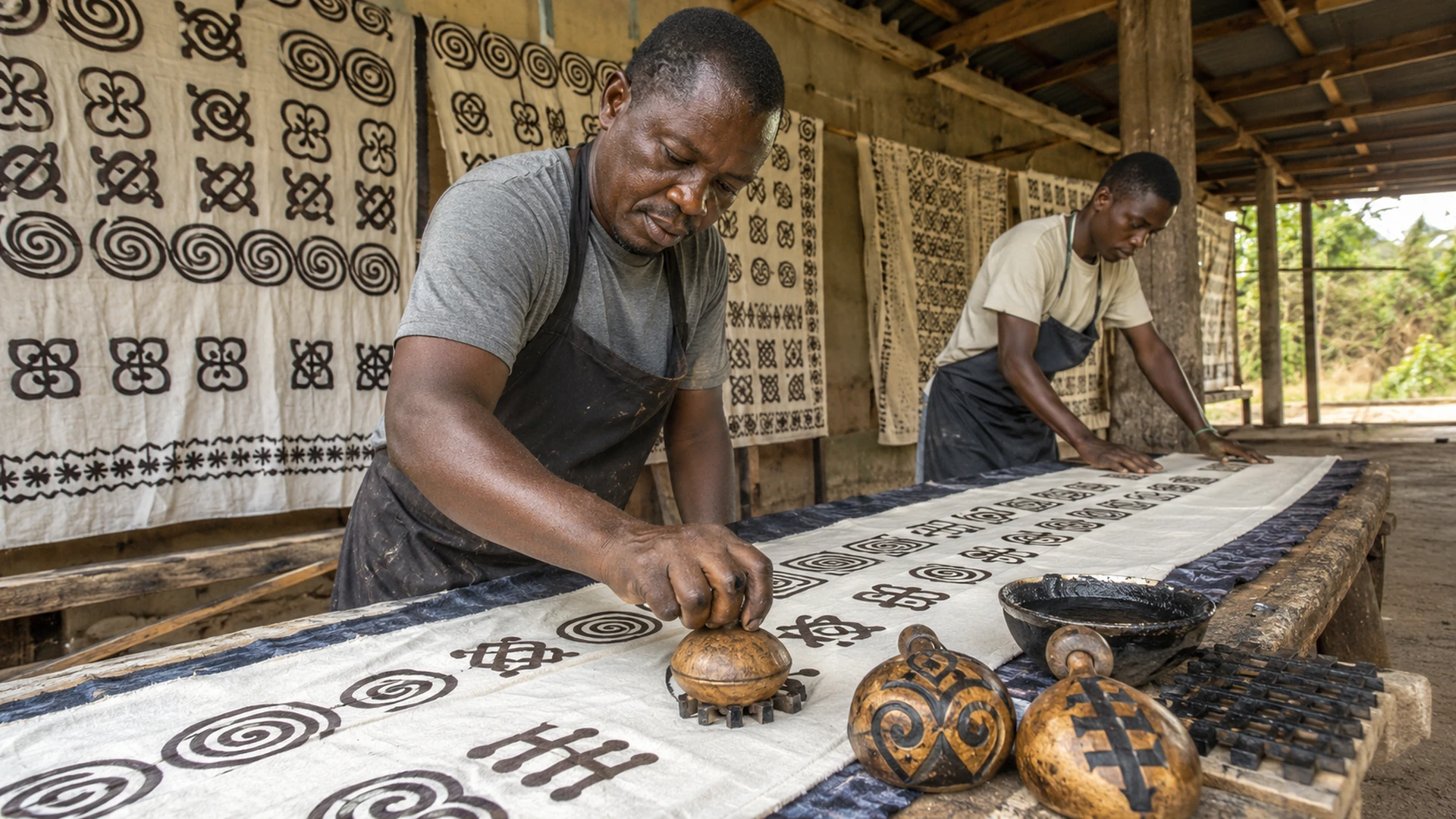
| Detailed scene | Realistic documentary photograph of an Akan Adinkra cloth artisan in Ntonso, Ghana, stamping dark symbols onto a long cotton cloth laid on a padded work surface. Several carved gourd stamps are arranged nearby, including Eban and Akoben forms, while completed patterned cloth hangs in the background. |
| Specific culture or historical context | Contemporary Akan/Asante Adinkra production in Ghana, connected to a historic textile tradition. |
| People shown | One Black Ghanaian adult artisan and one younger adult assistant, both focused on the work. |
| Location | Open-sided textile workshop in the Ashanti Region of Ghana. |
| Clothing | Everyday Ghanaian work clothing with practical aprons; no invented ceremonial costume. |
| Architecture | Simple workshop with timber posts, shaded roof and earthen or concrete floor. |
| Objects | Carved gourd stamps, dark Adinkra dye, comb-like grid tool, cotton cloth and drying textiles. |
| Lighting | Soft daylight, documentary realism, accurate fabric texture. |
| Composition | 16:9 landscape; artisan and stamping action in foreground, hanging cloth patterns behind; one continuous scene, not a collage. |
| SEO-friendly filename | akan-adinkra-protection-symbols-ghana.webp |
| Image title | Akan Adinkra Symbols for Security and Vigilance |
| Alt text | Ghanaian Adinkra artisan stamping symbolic patterns onto cloth in an Akan workshop |
| Caption | Adinkra symbols communicate Akan and Asante proverbs, values and social ideas through stamped cloth and other media. |
| Recommended placement | After the Adinkra subsection. |
| Article section supported | Akan and Asante Adinkra. |
| Important elements to avoid | No Egyptian symbols, no invented “tribal” costume, no embedded labels, no mixing with unrelated African rituals, no fantasy effects, logos or watermarks. |
Ethiopian Talismanic Scrolls and Protective Eyes
In the northern Ethiopian highlands, parchment healing scrolls were commissioned within traditions associated with Amhara and Tigrinya communities. The scrolls combined written prayers with talismanic images. The Metropolitan Museum describes the practice as historically spanning Christian, Jewish and Muslim settings in the region, while also having distinctive connections with Ethiopian religious scholarship. [14]
Large eyes, faces, angelic figures, geometric nets and other images were understood within the tradition as confronting harmful spiritual forces. Scrolls could be made to correspond to the owner’s height, worn in a leather case, hung in a house or retained for future danger. These are not merely isolated “eye symbols”; the written words, manuscript format, religious specialist, prayer and viewing practice formed an integrated whole. [14]
Ethiopian crosses provide another important example. The Smithsonian notes that the cross is among Ethiopia’s most pervasive symbolic artifacts, and priests use hand crosses to bless and receive salutations from believers. A cross in Ethiopian Orthodox life is part of a Christian religious tradition with regional forms, not a generic substitute for every African protection emblem. [15]
| Field | Specification |
|---|---|
| Image number | 4 |
| Purpose | Show Ethiopian protective manuscript art in a precise historical and material context. |
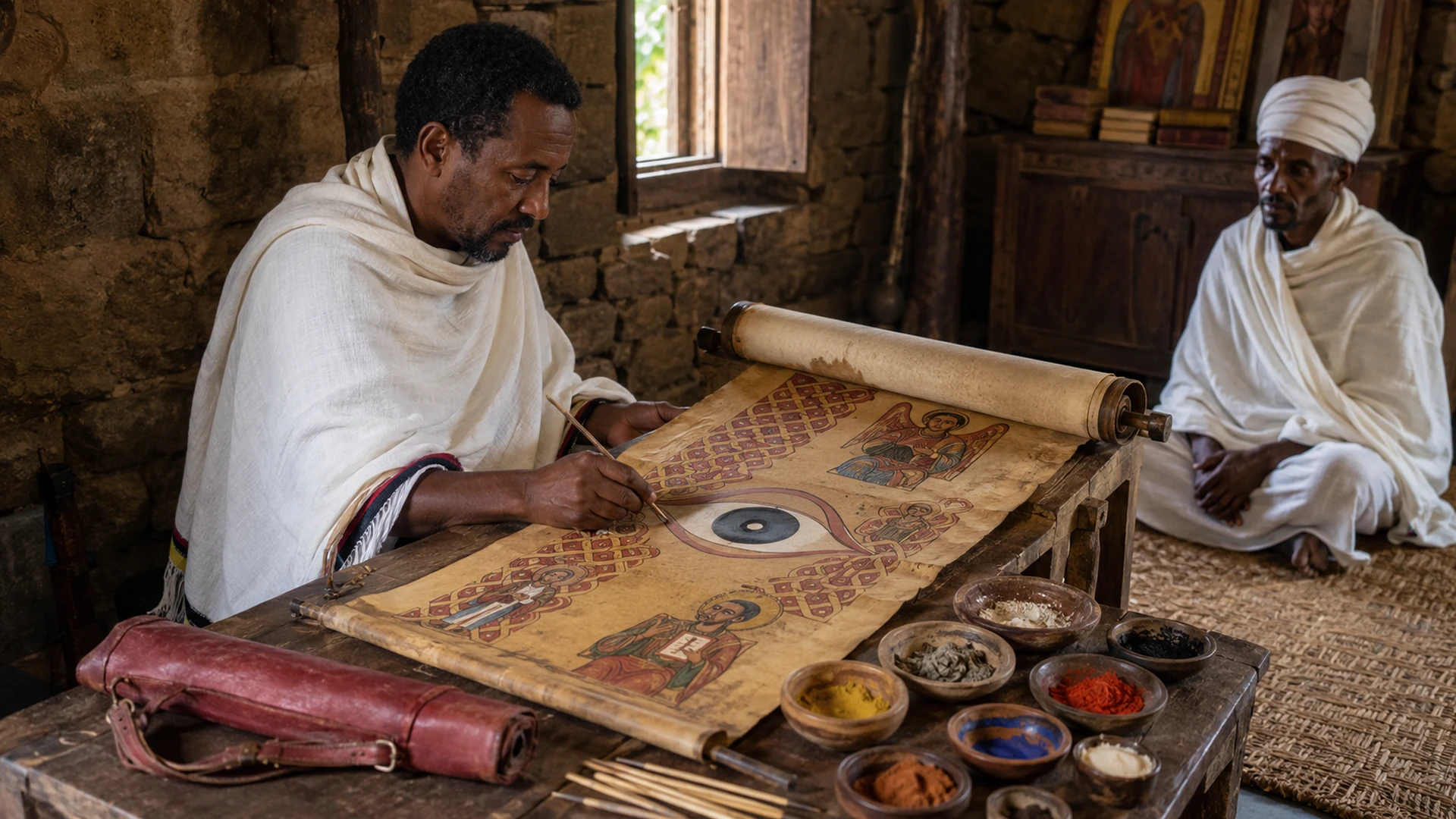
| Detailed scene | Respectful museum-quality reconstruction of a nineteenth-century northern Ethiopian manuscript workspace. A learned adult Ethiopian manuscript maker sits beside a long parchment scroll painted with a large protective eye, geometric net patterns and small Christian figures. The scroll is partially rolled, with pigments, reed pens and a red leather carrying case on the table. |
| Specific culture or historical context | Amhara or Tigrinya peoples, northern Ethiopian highlands, nineteenth century; manuscript and talismanic art tradition. |
| People shown | One Black Ethiopian adult religious scholar/manuscript maker; optional adult patron seated at a respectful distance. |
| Location | Stone-and-timber highland interior with a small window and woven mat. |
| Clothing | Historically plausible white woven Ethiopian garments and shawl; simple, dignified and regionally appropriate. |
| Architecture | Northern Ethiopian stone wall, timber beams and modest manuscript workspace. |
| Objects | Parchment scroll, reed pens, mineral and plant pigments, small bowls, red leather scroll case and hand cross placed separately. |
| Lighting | Soft window light, warm interior tones, legible manuscript imagery without supernatural effects. |
| Composition | 16:9 landscape; scroll and maker dominate foreground, full manuscript length suggested through diagonal composition. |
| SEO-friendly filename | ethiopian-protective-healing-scroll-symbols.webp |
| Image title | Ethiopian Talismanic Scroll and Protective Eye Imagery |
| Alt text | Ethiopian manuscript maker painting protective eye and geometric imagery on a parchment healing scroll |
| Caption | Ethiopian protective scrolls combined manuscript text, images, prayer and specialist knowledge within regional religious traditions. |
| Recommended placement | After the Ethiopian talismanic scroll subsection. |
| Article section supported | Ethiopian Talismanic Scrolls and Protective Eyes. |
| Important elements to avoid | No demonic spectacle, no medical cure claim, no fantasy magic, no Arabic-Egyptian mixing, no embedded English text, logos, watermarks or distorted manuscript script. |
Kongo Minkisi: Protection as an Activated Power Object
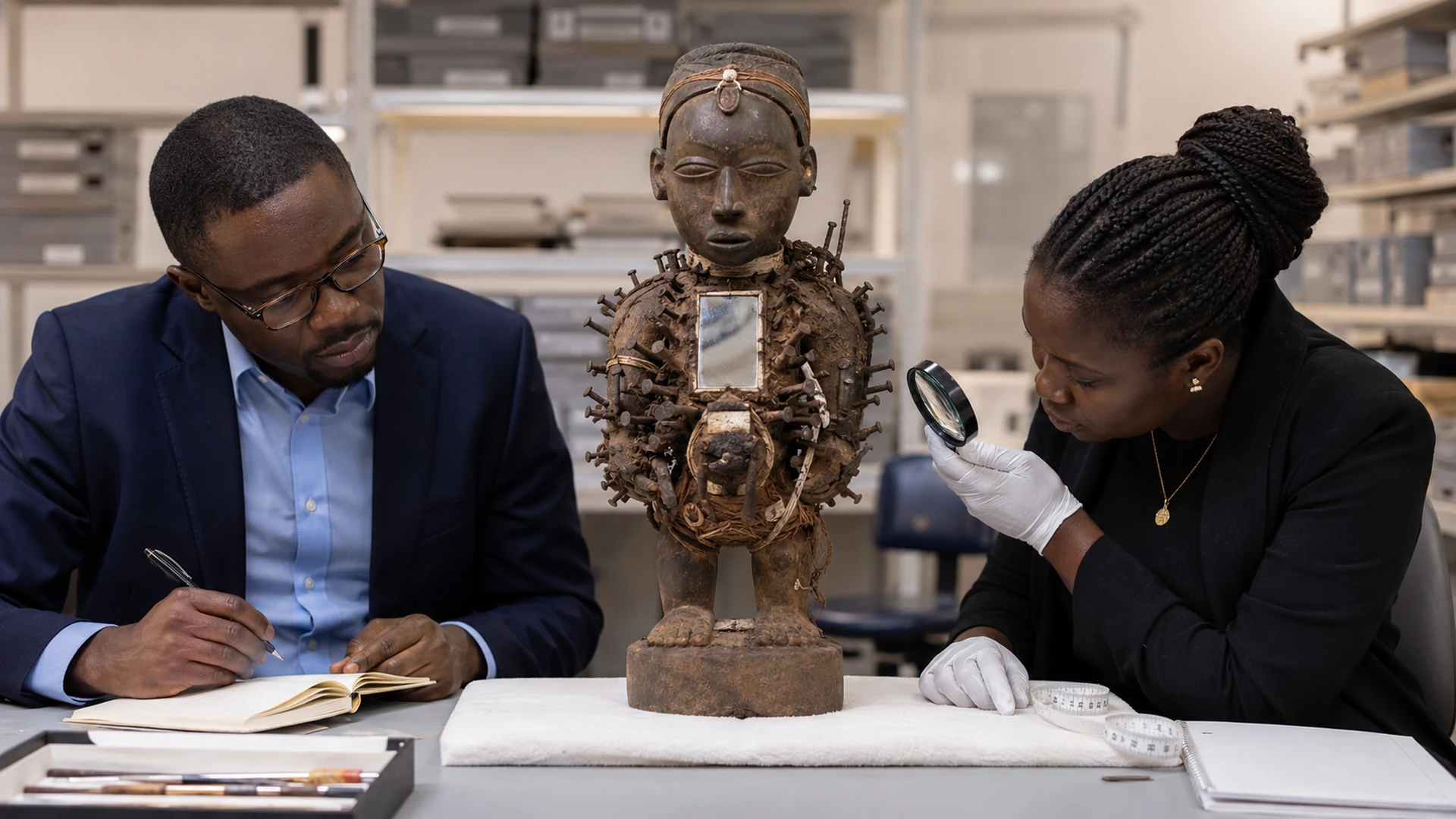
Among Kongo peoples of Central Africa, the term nkisi can refer to a range of prepared receptacles, including packets, vessels and carved figures. A nkisi nkondi was made through collaboration between an artist and an initiated ritual specialist, or nganga. Museum records describe such objects as addressing healing, disputes, peacekeeping and punishment of wrongdoing. [16]
A nkisi is not simply a logo. Its meaning depended on materials placed within it, specialist knowledge, social agreements and repeated use. Mirrors, medicines, earths, plant matter, shells, cloth, metal and other substances could be incorporated. Nails or blades on certain nkondi figures record invocations, agreements or actions; they should not be reduced to the sensational label “voodoo doll.”
These works are often nineteenth- or early twentieth-century objects in museum collections. They belong in an article about African protection traditions, but calling every nkisi “ancient” would be inaccurate.
Protective Amulets in Madagascar and Prescribed Jewelry in West Africa
In Madagascar, amulets called ody have been used by different peoples for protection, safety and good fortune. Their significance may depend on substances selected by a diviner or healer and placed inside a container worn on the body. A Merina example in the Metropolitan Museum uses an alert face and a filled interior, while Sakalava mohara ody could be made from zebu horn for particular clients and circumstances. [17]
Among Senufo communities in West Africa, diviners may prescribe ornaments called yawiige—pendants, rings, bracelets or anklets intended to address a client’s specific concern and offer protection. The form alone does not necessarily reveal the private reason for which an object was prescribed.
These examples reinforce a key lesson: in many African traditions, protection is not contained in a universally readable icon. It may depend on a relationship among the owner, a specialist, particular materials, spoken knowledge and community belief.
| Field | Specification |
|---|---|
| Image number | 5 |
| Purpose | Explain that some African protective traditions center on prepared power objects rather than graphic symbols. |
| Detailed scene | Professional museum conservation studio with a nineteenth-century Kongo nkisi nkondi power figure standing securely on a padded examination table. A Black Central African curator and a Black conservator study the object with soft measuring tools and archival notes; medicine cavity, mirror and metal elements are visible but treated respectfully. |
| Specific culture or historical context | Kongo peoples, Democratic Republic of the Congo or Republic of the Congo, nineteenth century object viewed in a modern conservation setting. |
| People shown | Two Black African museum professionals, adults, wearing conservation gloves only when appropriate for handling. |
| Location | Museum conservation laboratory with neutral background and controlled equipment. |
| Clothing | Modern professional museum attire. |
| Architecture | Clean conservation studio, archival shelves and diffuse light panels. |
| Objects | One Kongo nkisi nkondi figure, padded support, magnifier, measuring scale and archival materials; no ritual reenactment. |
| Lighting | Even conservation lighting with realistic wood, metal, mirror and fiber textures. |
| Composition | 16:9 landscape; nkisi at center, professionals on either side with respectful distance; no dramatic horror framing. |
| SEO-friendly filename | kongo-nkisi-protective-power-object.webp |
| Image title | Kongo Nkisi Protective Power Object in Museum Context |
| Alt text | African museum professionals studying a historic Kongo nkisi nkondi power figure in a conservation studio |
| Caption | Kongo minkisi were prepared objects whose meanings depended on materials, specialist practice and social purpose, not on appearance alone. |
| Recommended placement | After the Kongo and protective-object discussion. |
| Article section supported | Kongo Minkisi and African protective amulets. |
| Important elements to avoid | No horror styling, glowing eyes, violence, fictional ceremony, “voodoo doll” clichés, mixed cultures, embedded text, logos or watermarks. |
What Can Be a Symbol of a Protector?
A “symbol of a protector” can represent the protector directly or express the qualities expected of protection. Ancient Egyptian examples include Bes as a household guardian and Taweret as a defender of mothers and children. The sa sign represents protection as a concept, while the wedjat eye represents restoration after injury. In Akan Adinkra, Eban communicates a secure home, and Akoben communicates vigilance.
A protector symbol may therefore emphasize one of several ideas:
A guarding person or deity, such as Bes or Taweret.
A protected boundary, such as the fence represented by Eban.
Alertness and warning, as communicated by Akoben.
Recovery and wholeness, as represented by the wedjat eye.
Stability and endurance, as represented by the djed.
Written protection, as represented by the sa sign.
Moral or legal enforcement, as associated with some nkisi nkondi contexts.
Blessing and religious intercession, as expressed through Ethiopian crosses and manuscripts.
How Protection Symbols Were Used
Protection symbols were rarely limited to wall decoration. Their use depended on body, place and moment. Ancient Egyptian amulets could be worn on necklaces, rings or cords; sewn into mummy wrappings; placed at specific body locations; carved on seals; painted on coffins; or integrated into household objects. A symbol might also be combined with divine names and ritual texts.
Adinkra symbols were arranged on cloth in meaningful combinations and worn in social contexts, especially historically in mourning and royal settings. Ethiopian scrolls could be worn in cases, displayed during recitation or hung in houses. Minkisi and ody were prepared objects whose materials and specialist activation mattered. The visible form was only one part of their function.
This means that copying an outline without its language, material, placement or cultural authority may preserve appearance while losing much of the original meaning.
Materials, Colors and Placement in Ancient Egypt
Egyptian amulets were made from faience, stone, metal, wood, bone, shell and other materials. Blue and green faience evoked water, vegetation, life and regeneration. Red could be dangerous and protective at the same time, which helps explain the prescribed red material of the tyet. Gold suggested durability and divine brilliance, while silver had lunar and purity associations. [1]
Placement could be equally important. A funerary text might direct that an amulet be set at the throat, chest or another body area. Multiple amulets could work together: a djed for permanence, a scarab for renewal, a wedjat for restoration and a divine figure for personal guardianship.
Modern icon charts often remove these material relationships. A historically careful explanation should restore them.
Common Misunderstandings
| Misunderstanding | More accurate explanation |
|---|---|
| “The ankh is the Egyptian word for protection.” | The ankh primarily means life. The sa sign more literally writes protection. |
| “The Eye of Horus is just an evil-eye symbol.” | The wedjat has its own Egyptian mythology of injury, restoration, regeneration and protection. |
| “All African symbols come from one religion.” | African religious and symbolic traditions are highly diverse and must be identified by community and region. |
| “Every Adinkra symbol is ancient.” | Adinkra is a historic and living tradition; surviving objects and documented meanings belong to specific periods and uses. |
| “A nkisi is a symbol anyone can copy.” | A nkisi is a prepared power object whose meaning depends on specialist practice, materials and social context. |
| “A protective object proves supernatural results.” | Historical sources document beliefs and practices, not scientific guarantees of protection or healing. |
| “Any online meaning can be used for a tattoo or logo.” | Meanings may be oversimplified or commercially relabeled. Cultural and religious research should come before permanent use. |
Cultural and Ethical Guidelines for Using These Symbols
Name the specific culture and period. Write “Akan Eban Adinkra symbol” rather than only “African symbol.”
Do not combine unrelated symbols into an invented ritual seal unless it is clearly presented as modern artwork rather than historical tradition.
Distinguish documented meaning from personal interpretation. A person may connect Gye Nyame with protection, but its established meaning should still be stated accurately.
Avoid restricted or private ritual knowledge. Museum and academic sources usually describe public objects without disclosing every specialist practice.
Do not promise medical, fertility, financial or physical safety from wearing a symbol.
Check whether sacred imagery is appropriate for commercial branding, tattoos, jewelry or entertainment.
Credit living communities and recognize that meanings can change across region, family, specialist and historical period.
Historical Belief and Scientific Limits
Museums and historians can document that people made, wore, displayed and interpreted protective symbols. Archaeology can identify materials, dates, locations and patterns of use. Texts can record prayers, myths and ritual instructions. These forms of evidence show what communities believed and practiced.
They do not scientifically establish that a symbol prevents accidents, cures illness, guarantees fertility, defeats enemies or produces financial success. The responsible approach is to treat protection symbolism as religious, cultural, historical and artistic evidence. Personal faith may give the symbol additional meaning for a believer, but that claim should not be presented as a universal scientific fact.
Key Takeaways
The sa sign is the most direct ancient Egyptian written symbol for protection.
The wedjat or Eye of Horus represents restored wholeness, regeneration, well-being and protection.
The tyet invokes Isis and was especially important in funerary protection.
The djed means stability or permanence, and the scarab represents becoming and renewal.
Bes and Taweret are protective deity images rather than abstract signs.
The ankh primarily means life, not protection.
There is no single universal African protection symbol.
Akan Adinkra, Ethiopian scrolls, Kongo minkisi and Malagasy ody belong to distinct cultural systems.
The meaning of a protective object may depend on material, inscription, placement, specialist knowledge and social use.
Historical significance should be explained without promising supernatural results.
People Also Ask
What is the ancient Egyptian symbol for protection?
The sa sign is the most literal answer because it writes the word “protection.” The wedjat eye is also one of the best-known Egyptian protective amulets, associated with restoration and well-being.
Is the Eye of Horus a protection symbol?
Yes. The wedjat or Eye of Horus represented the healed eye of Horus and conveyed regeneration, restored soundness and protection from harm.
Does the ankh mean protection?
The ankh primarily means life. It may appear in combinations expressing well-being or continued existence, but it is not the Egyptian word for protection.
Which African symbol represents safety?
In Akan Adinkra, Eban, meaning “fence,” represents safety, security and the protected home. It should be identified as an Akan symbol rather than a symbol for all Africa.
What is a symbol of a protector?
A protector may be symbolized by a guardian figure such as Bes or Taweret, a boundary such as Eban, a warning sign such as Akoben, or a written concept such as the Egyptian sa sign.
Are African traditional religion symbols the same everywhere?
No. African religions and symbolic systems vary greatly by people, language, region and history. Comparisons should preserve those distinctions.
Frequently Asked Questions
What are the main ancient Egyptian protection symbols?
The sa sign, wedjat eye, tyet knot, djed pillar, scarab, Bes image and Taweret image are among the strongest examples. Each protects in a different sense: direct guarding, restoration, stability, renewal, household safety or childbirth.
Which Egyptian symbol is best for a historically accurate protection article?
Use the sa sign for the literal concept of protection and the wedjat eye for the most recognizable protective amulet. Explain the difference rather than naming only one.
Was the Eye of Horus used by living people?
Yes. Museum evidence shows that wedjat amulets were used by both living people and the dead.
Why were scarabs protective?
Their connection with the rising sun, becoming and rebirth made them symbols of renewed life. Inscriptions on the base could add further protective or beneficial meanings.
What did the djed protect against?
The djed did not represent a specific enemy. It embodied stability, permanence and continued existence, especially in funerary contexts connected with Osiris.
Is Gye Nyame a protection symbol?
Its established primary meaning concerns the supremacy and eternal power of God. Some modern users connect divine authority with protection, but the symbol should not be reduced to a generic protection label.
What is the Eban symbol?
Eban is an Akan Adinkra symbol whose name means fence. It represents safety, security, love and the protected home.
Are Ethiopian healing scrolls the same as ancient Egyptian papyri?
No. They come from different periods, languages and religious histories. Ethiopian scrolls are associated with northern highland manuscript and healing traditions, while ancient Egyptian papyri belong to much earlier Egyptian religious systems.
Are Kongo minkisi evil objects?
That description is inaccurate and sensationalized. Minkisi served varied social and religious purposes, including healing, dispute resolution, safeguarding peace and enforcing agreements.
Can protection symbols be used as tattoos?
People can make personal choices, but permanent use deserves careful research. Confirm the symbol, community, religious significance and whether commercial or bodily use may be disrespectful.
Do protection symbols guarantee safety?
No scientific evidence shows that wearing a symbol guarantees physical, medical, financial or spiritual outcomes. Their significance is cultural, historical, artistic and religious.
What should an educational image of these symbols avoid?
It should avoid fantasy rituals, mixed cultures, invented symbols, inaccurate clothing, horror stereotypes, embedded text and scenes that claim supernatural effects as fact.
Conclusion
Ancient protection symbols become more meaningful when they are restored to their original settings. The Egyptian sa sign directly names protection. The wedjat eye tells a story of damage repaired and wholeness regained. The tyet invokes Isis, the djed promises stability, the scarab expresses renewed becoming, and the images of Bes and Taweret give protection a guardian form. The ankh remains vital to the discussion, but its first meaning is life.
Across other African regions, protection is expressed differently. Akan Adinkra symbols can communicate secure boundaries and vigilance. Ethiopian scrolls combine text, image and prayer. Kongo minkisi and Malagasy ody demonstrate that a protective object may depend on materials, specialists and social purpose rather than a universally readable icon.
The central lesson is not that one symbol is stronger than every other. It is that symbols carry the histories of the communities that made and used them. Accurate naming, cultural specificity and honest limits create a more respectful and useful understanding of ancient Egyptian and African protection traditions.
Final Summary
For the clearest answer, identify the Egyptian sa sign as the literal sign for protection and the wedjat eye as the best-known protective amulet. Then explain related symbols according to their own meanings. When discussing African spiritual or religious symbols, never present one sign as universal: name the specific community, place, period, object and practice.
Research Sources and Further Reading
[1] Ancient Egyptian Amulets. The Metropolitan Museum of Art. Overview of amulet forms, materials, chronology and uses.
[2] Sa Amulet, Middle Kingdom. The Metropolitan Museum of Art. Museum record identifying sa as the word for protection.
[3] Wedjat Eye Amulet. The Metropolitan Museum of Art. Museum explanation of the healed Eye of Horus, regeneration and protection.
[4] Tit Amulet, New Kingdom. The Metropolitan Museum of Art. Museum record on the Isis-associated protective knot.
[5] Djed Pillar Amulet. The Metropolitan Museum of Art. Museum record on permanence, Osiris and funerary use.
[6] Scarab, Middle Kingdom–Second Intermediate Period. The Metropolitan Museum of Art. Museum record on becoming and rebirth.
[7] Bes-Image Amulet. The Metropolitan Museum of Art. Museum record on household, women and children.
[8] Taweret Amulet. The Metropolitan Museum of Art. Museum record on pregnancy, childbirth and rebirth protection.
[9] Model Ankh. The Metropolitan Museum of Art. Museum record defining the ankh as life.
[10] Culture and Africa. UNESCO. Overview emphasizing Africa’s cultural diversity and heritage.
[11] Inscribing Meaning: Writing and Graphic Systems in African Art. Smithsonian National Museum of African Art. Curatorial discussion of Adinkra, its media and proverbial meanings.
[12] Adinkra Stamp: Tuo ne Akofena. Smithsonian National Museum of African Art. Museum record on authority, military prowess and responsibility to protect.
[13] Adinkra Symbols and Meanings. Ghanaian Museum. Ghana-based overview including Eban and Akoben.
[14] Ethiopian Healing Scrolls. The Metropolitan Museum of Art. Historical overview of parchment scrolls, talismanic imagery and practice.
[15] Hand Cross. Smithsonian Institution / National Museum of African Art. Museum record on the symbolic and liturgical role of Ethiopian hand crosses.
[16] Power Figure: Male (Nkisi Nkondi). The Metropolitan Museum of Art. Museum record on healing, disputes, peace and wrongdoing.
[17] Protective Amulet (Ody). The Metropolitan Museum of Art. Museum record on Merina protective amulets and prepared materials.
Post-Publication Optimization Plan
Publish with the recommended title and meta description, then request indexing in Google Search Console.
Add Article, BreadcrumbList and FAQPage structured data only when the visible page contains the same information.
Link from existing pages about African spiritual traditions, protection rituals, amulets, sacred art and cultural symbolism using varied natural anchor text.
Create supporting articles only where the intent is distinct; do not create separate pages for the Egyptian word-order variants in the query map.
After 28–42 days, review impressions, clicks, CTR and average position for all supplied queries. Test an alternative SEO title if impressions rise but CTR remains weak.
Expand the section that corresponds to any query reaching positions 8–20, using additional sourced examples rather than repeating keywords.
Compress the five WebP images, preserve 1920 × 1080 dimensions, add the specified alt text and use descriptive filenames.
Update the article when better African institutional sources become available, especially for individual Adinkra symbol meanings.
Add editorial review dates and author credentials related to cultural research and SEO.
Avoid adding transactional promises or claims that a symbol guarantees protection; this would weaken trust and create factual and policy risk.
Article Information
- Publisher
- Ancestral Temple
- Editor
- Ancestral Temple
- Last updated
- Jul 26, 2026
- Last reviewed
- Jul 26, 2026
- Content version
- cb3c552f86
This educational article should be read as cultural and spiritual information, not as medical, legal, financial, or emergency advice.
Helpful Related Guidance
Explore This Topic
Related Topic Cluster
Dreams & Symbolism
About the Author
 Ancestral Temple
Spiritual guide and practitioner with decades of experience in ancestral wisdom, rituals, and divine guidance.
Related Posts
View All










Leave a Comment
We'd love to hear your thoughts.