
lunar-calendars-through-history
Pillar Article
Quick Summary
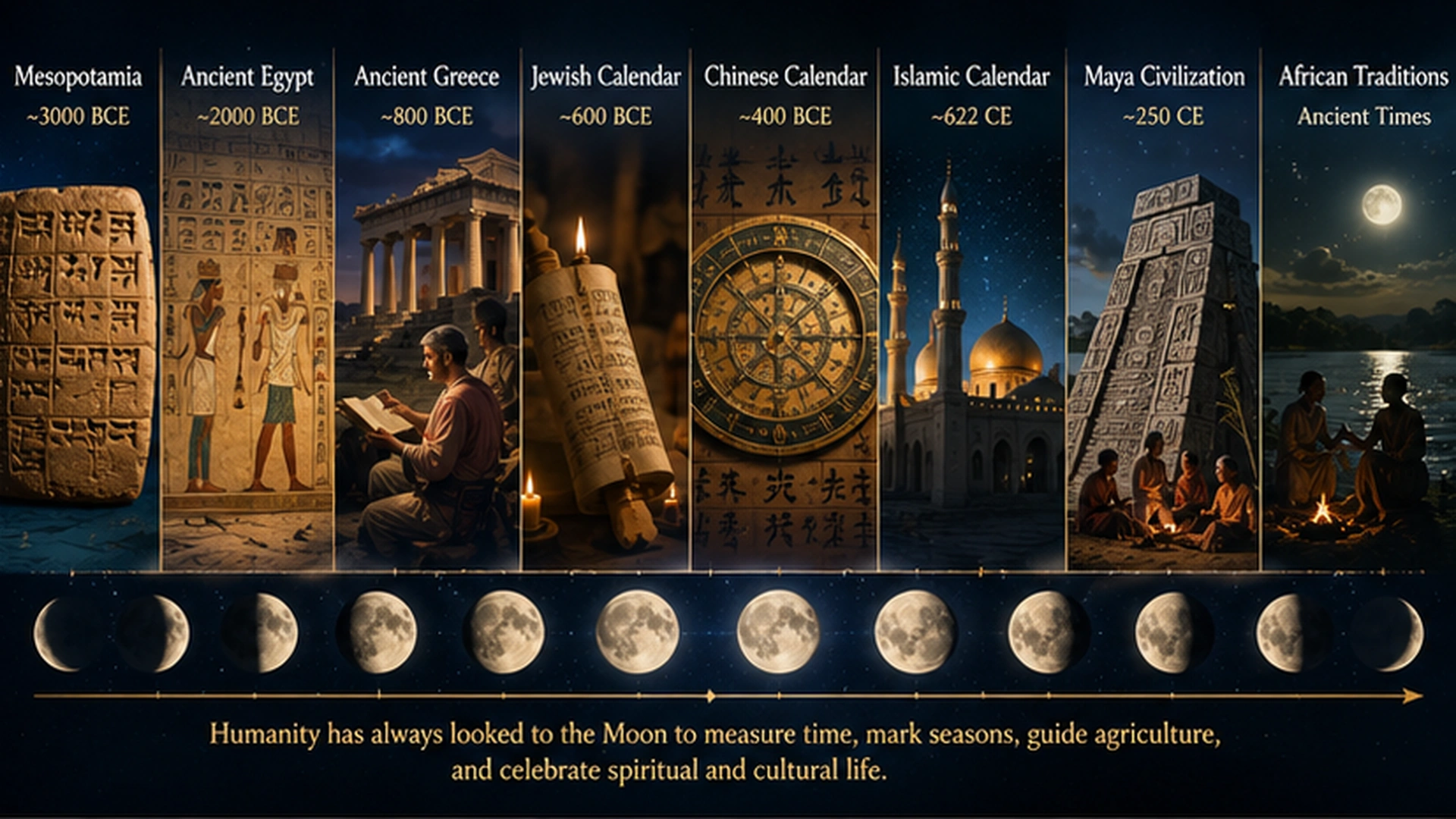
Lunar calendars through history reveal how communities transformed repeated observations of the Moon into systems for organizing worship, agriculture, taxation, political authority...
Lunar calendars through history reveal how communities transformed repeated observations of the Moon into systems for organizing worship, agriculture, taxation, political authority, family life, and collective memory.
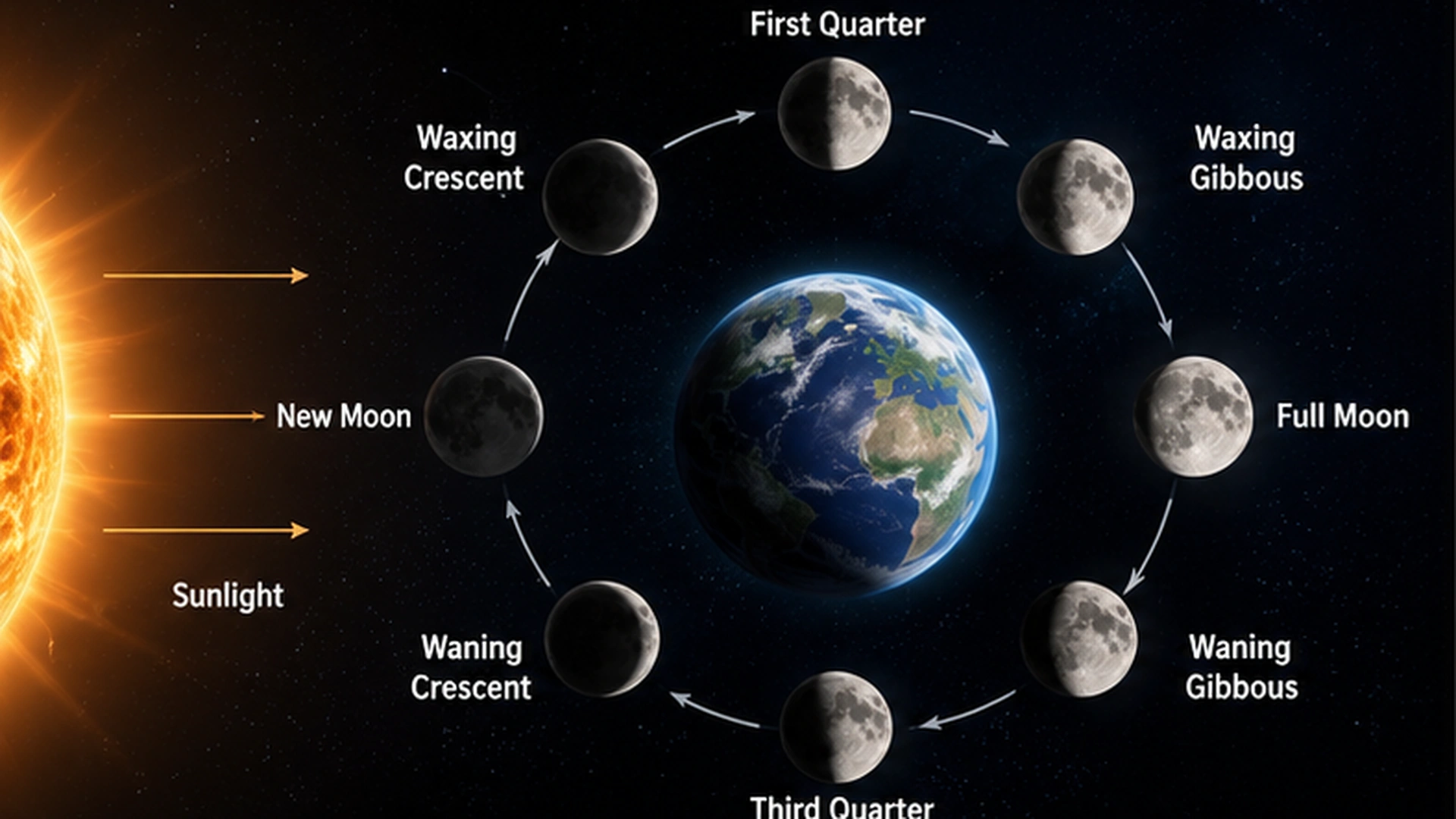
The Moon is a natural timekeeper because its visible phases follow a recognizable cycle. From one new Moon to the next, the average synodic month lasts approximately 29.53 days. A calendar month must contain a whole number of days, so lunar months commonly alternate between 29 and 30 days. [1]
Twelve lunar months total about 354 days. That is roughly 11 days shorter than the solar year that governs the seasons.
This mismatch produced two major solutions:
Pure lunar calendars keep months aligned with the Moon and allow the year to move through the seasons.
Lunisolar calendars keep lunar months but occasionally insert an additional month so that festivals and agricultural seasons remain approximately aligned with the solar year.
The Islamic Hijri calendar is a major surviving example of a purely lunar system. The Jewish, Chinese, and many Hindu calendars are lunisolar. Ancient Mesopotamian, Greek, and several African systems also combined lunar months with seasonal adjustment.
There has never been one universal lunar calendar.
Different societies chose different answers to questions such as:
Does the month begin at astronomical conjunction or first crescent visibility?
Who is authorized to confirm the new month?
Does the day begin at sunset, sunrise, or midnight?
How is a cloudy horizon handled?
When is a leap month inserted?
Which festival must remain in a particular season?
Does calculation replace observation?
The history of lunar calendars is therefore not only a history of astronomy. It is also a history of law, religion, farming, government, language, and community authority.
A lunar month follows the Moon’s approximately 29.53-day phase cycle.
Twelve lunar months are about 10 to 11 days shorter than a solar year.
A purely lunar calendar moves through the seasons.
A lunisolar calendar inserts leap months to stay seasonally aligned.
Ancient Mesopotamian calendars strongly influenced later Near Eastern calendar systems.
Ancient Egypt used a stable civil solar calendar while also maintaining lunar and festival timekeeping.
Jewish calendars use a 19-year cycle containing seven leap years.
The Chinese Agricultural Calendar combines lunar months with solar terms.
Hindu calendars are diverse and often lunisolar rather than one single national system.
Islamic months traditionally begin through sighting the first crescent after conjunction.
Maya and Zapotec inscriptions show sophisticated lunar reckoning, although Mesoamerican civil calendars were not simply lunar calendars.
Precolonial Setswana farming societies used lunisolar calendars tied to seasonal observation.
Indigenous lunar calendars remain living systems of language, ecology, and cultural identity.
What Is a Lunar Calendar?
Clear Definition
A lunar calendar is a system in which each month follows one complete cycle of the Moon’s phases.
Plain-Language Meaning
A lunar calendar counts time from one repeated lunar phase to the next, commonly from one new Moon or first visible crescent to the next.
The mean synodic month is approximately:
29 days, 12 hours, 44 minutes, and 3 seconds. [1]
Because civil calendar days cannot normally be divided into fractions, lunar months use 29 or 30 days.
Lunar, Lunisolar, and Solar Calendars
Calendar type
What months follow
What the year follows
Seasonal behavior
Lunar
Moon phase cycle
Twelve lunar months
Moves through the seasons
Lunisolar
Moon phase cycle
Adjusted to solar year
Remains approximately seasonal
Solar
Solar year
Earth’s seasonal orbit
Months do not stay aligned with Moon phases
The modern Gregorian calendar is solar. Its months no longer correspond consistently with lunar phases.
The Islamic calendar is lunar. Its months remain linked with the Moon but shift approximately 10 or 11 days earlier each Gregorian year.
The Jewish and Chinese calendars are lunisolar. Their months remain lunar while leap months prevent major festivals from drifting permanently away from their intended seasons. [1]
Why Twelve Lunar Months Do Not Make a Solar Year
The average lunar year contains:
12 × 29.53059 days = approximately 354.37 days
The tropical solar year contains approximately 365.24 days.
The difference is approximately 10.87 days.
Without adjustment, a lunar date moves earlier through the solar seasons each year. After roughly 33 solar years, a purely lunar calendar has moved through an entire seasonal cycle.
This is why Ramadan can occur in hot or cool seasons depending on the year, while Passover and the Chinese New Year remain seasonally constrained through lunisolar adjustment.
What Is Intercalation?
Intercalation means inserting an additional day or month to bring a calendar back into alignment with an astronomical or seasonal cycle.
In lunisolar calendars, an extra month is added during selected years.
A common mathematical solution is the 19-year cycle. Nineteen solar years are close in length to 235 lunar months. In systems using this relationship, seven years within the cycle receive a thirteenth month.
Intercalation can be determined by:
A fixed mathematical rule
Seasonal agricultural observation
The position of the Sun
The visibility of stars
Political or priestly decision
A combination of calculation and observation
Did Prehistoric People Use Lunar Calendars?
Archaeologists have proposed that some prehistoric notched bones, engraved stones, and repeated marks recorded lunar phases or night counts.
These interpretations are possible but often debated.
A sequence of 29 marks does not automatically prove the existence of a calendar. The markings may have counted animals, events, days, ritual actions, or something no longer recoverable.
Recent archaeological scholarship emphasizes that early calendars should be identified through combined evidence such as repetition, astronomical fit, context, cultural continuity, and demonstrable use—not through visual resemblance alone. [2]
For that reason, claims about “the world’s oldest lunar calendar” should be treated cautiously.
1. Lunar Timekeeping in Ancient Mesopotamia
Ancient Mesopotamia provides some of the clearest early written evidence for organized lunar months, intercalation, and astronomical recordkeeping.
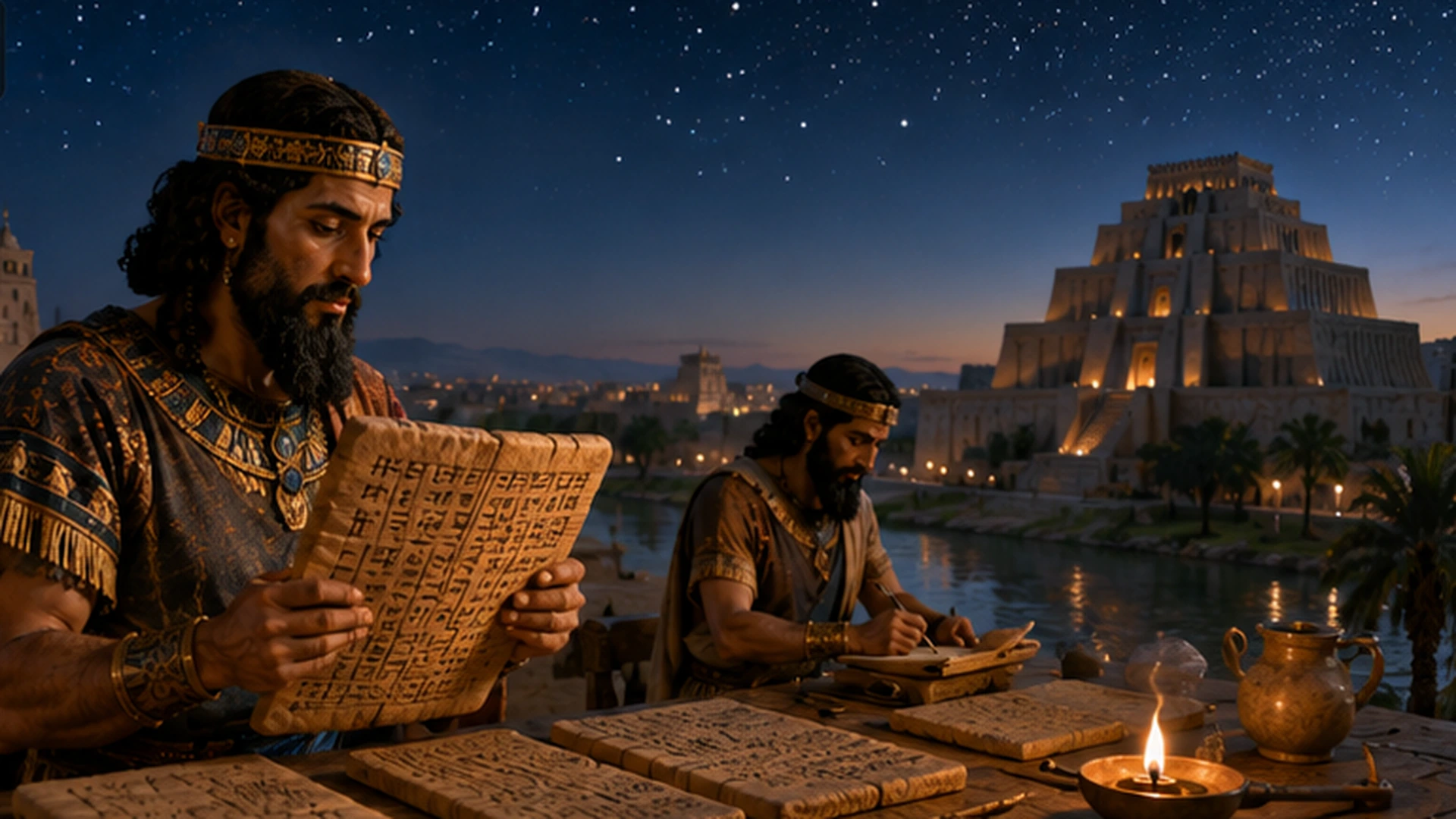
Babylonian months generally began with observation of the first crescent. Months contained 29 or 30 days, and additional months were inserted when necessary to keep the calendar connected with the agricultural and ritual year.
Mesopotamian scribes recorded:
Crescent visibility
Lunar and solar eclipses
Planetary positions
Weather
River conditions
Market prices
Political events
Religious omens
Late Babylonian tablets preserve month lists, zodiac associations, astronomical diaries, and calculations of lunar visibility. A British Museum tablet dated to approximately 500 BCE lists Babylonian months with zodiacal signs, while other tablets preserve systematic lunar and planetary observations. [3]
Why Mesopotamian Calendars Mattered
The calendar regulated:
Temple festivals
Offerings
Taxation
Administration
Agriculture
Royal ceremonies
Legal dates
The authority to name or adjust a month could therefore carry political and religious significance.
Observation Became Calculation
Early lunar months depended strongly on observation. Over time, Babylonian astronomers developed increasingly sophisticated mathematical techniques for predicting lunar phenomena.
This transition from direct observation to calculation influenced later Jewish, Greek, Islamic, and scientific astronomy.
2. Ancient Egypt: Solar Civil Time and Lunar Ritual Time
Ancient Egypt is frequently described as having a solar calendar—and this is correct for the civil calendar.
The civil year contained:
12 months of 30 days
Three seasons of four months each
Five additional days
The seasons were connected with flooding, growth, and harvest. [4]
However, Egyptians also used lunar reckoning in religious and festival contexts.
Temple observances could be scheduled by lunar days, and some festivals were linked with new or full Moon timing. UCL’s Digital Egypt records, for example, describe Theban festivals whose dates were associated with new Moon observance. [5]
Why Egypt Used More Than One Calendar
Different calendars served different purposes:
The civil calendar supported administration.
Lunar calendars helped organize ritual cycles.
Agricultural activity followed Nile conditions and seasons.
Priestly astronomy supported temple timekeeping.
This demonstrates an important principle: a society may use several calendars at the same time.
Frequently Asked Questions
What should readers know first about uncategorized?
Uncategorized: Lunar calendars through history reveal how communities transformed repeated observations of the Moon into systems for organizing worship, agric
What should readers know first about lunar-calendars-through-history?
Explore lunar calendars through history, from Mesopotamia and ancient Egypt to Jewish, Chinese, Hindu, Islamic, African, and Indigenous systems.
What causes lunar-calendars-through-history?
Explore lunar calendars through history, from Mesopotamia and ancient Egypt to Jewish, Chinese, Hindu, Islamic, African, and Indigenous systems. The safest next step is to compare the signs, prepare clear details, and request private guidance when the matter f
How does lunar-calendars-through-history work?
Explore lunar calendars through history, from Mesopotamia and ancient Egypt to Jewish, Chinese, Hindu, Islamic, African, and Indigenous systems. The safest next step is to compare the signs, prepare clear details, and request private guidance when the matter f
Is it possible to get private guidance for lunar-calendars-through-history?
Explore lunar calendars through history, from Mesopotamia and ancient Egypt to Jewish, Chinese, Hindu, Islamic, African, and Indigenous systems. The safest next step is to compare the signs, prepare clear details, and request private guidance when the matter f
How long does lunar-calendars-through-history take to understand?
Explore lunar calendars through history, from Mesopotamia and ancient Egypt to Jewish, Chinese, Hindu, Islamic, African, and Indigenous systems. The safest next step is to compare the signs, prepare clear details, and request private guidance when the matter f
Can lunar-calendars-through-history affect relationships, family, work, or personal peace?
Explore lunar calendars through history, from Mesopotamia and ancient Egypt to Jewish, Chinese, Hindu, Islamic, African, and Indigenous systems. The safest next step is to compare the signs, prepare clear details, and request private guidance when the matter f
Why do people seek spiritual guidance for lunar-calendars-through-history?
Explore lunar calendars through history, from Mesopotamia and ancient Egypt to Jewish, Chinese, Hindu, Islamic, African, and Indigenous systems. The safest next step is to compare the signs, prepare clear details, and request private guidance when the matter f
What signs should someone notice before asking about lunar-calendars-through-history?
Explore lunar calendars through history, from Mesopotamia and ancient Egypt to Jewish, Chinese, Hindu, Islamic, African, and Indigenous systems. The safest next step is to compare the signs, prepare clear details, and request private guidance when the matter f
When should someone contact a private spiritual guide?
Explore lunar calendars through history, from Mesopotamia and ancient Egypt to Jewish, Chinese, Hindu, Islamic, African, and Indigenous systems. The safest next step is to compare the signs, prepare clear details, and request private guidance when the matter f
Article Information
- Publisher
- Ancestral Temple
- Editor
- Ancestral Temple
- Last updated
- Jul 26, 2026
- Last reviewed
- Jul 13, 2026
- Content version
- fd9705ebbd
This educational article should be read as cultural and spiritual information, not as medical, legal, financial, or emergency advice.
Helpful Related Guidance
Explore This Topic
New Moon Symbolism · Uncategorized
Related Topic Cluster
Uncategorized
Complete Guide Full Moon Traditions Around the WorldAbout the Author
 Ancestral Temple
Spiritual guide and practitioner with decades of experience in ancestral wisdom, rituals, and divine guidance.
Related Posts
View All

Leave a Comment
We'd love to hear your thoughts.
This was comprehensive without claiming that one lunar calendar is more authentic than all others.
Ruth E.
Are there recommended museum databases for viewing ancient calendar artifacts online?
Nathan C.
The article showed why one date can differ between communities without either side being careless.
Sophia D.
A future article about ancient calendar tablets and manuscripts would be interesting.
Emmanuel R.
I liked the reminder that Indigenous Moon names belong to specific languages and ecosystems.
Alice M.
Strong overview connecting astronomy with agriculture, religion, politics, and cultural identity.
Brian W.
The misconceptions section corrected several claims I have seen online.
Patricia N.
The article remained neutral while explaining disagreements about crescent sighting.
Omar S.
The explanation of why seven-day weeks do not fit lunar months was simple and memorable.
Janet R.
I appreciated that the Setswana example was not used to generalize the whole continent.
Kofi A.
More information about women who preserved calendar knowledge would be useful.
Evelyn P.
The Maya Lunar Series deserves its own full article.
Thomas D.
The main lesson was that calendars reflect authority as well as astronomy.
Mariam F.
The article respected religious calendars without making supernatural claims.
Victor L.
I liked the explanation that a lunar calendar can survive within a community even when civil dates are Gregorian.
Hannah O.
The section about colonialism and calendar change was important.
George E.
Could you write next about Indigenous African month names and their environmental meanings?
Rose B.
The short paragraphs worked well on mobile.
Abdul J.
The numbered historical sections made the long article easy to navigate.
Linda C.
This is useful for students of astronomy, history, religion, and anthropology.
Paul K.
Thank you for explaining that apps may not match local religious calendar rules.
Rebecca M.
I did not know Greek cities could have different local month names and New Year dates.
Henry A.
The article clearly showed that a calendar can carry religious and political authority.
Naomi T.
A visual timeline of the major calendar systems would make a helpful companion resource.
Christopher S.
The glossary made synodic month, lunation, and conjunction easy to distinguish.
Zainab R.
The Easter computus section was completely new to me.
David N.
I liked the reminder that one society may use several calendars for different purposes.
Esther G.
The tithi explanation helped me understand why Hindu festival dates can begin during the day.
Andrew H.
This was detailed without making the astronomy difficult.
Josephine E.
The Roman calendar reform section explained why our modern months no longer match Moon phases.
Michael P.
I would like a detailed article about how Jewish leap months are calculated.
Beatrice L.
I appreciated that Muslim communities were not presented as following one identical sighting method.
Ibrahim C.
The table comparing lunar, lunisolar, and solar calendars was useful.
Sarah W.
The Chinese solar-term system was more complex than I expected.
Moses K.
Thank you for distinguishing the invisible new Moon from the visible Islamic crescent.
Fatima D.
I now understand why Ramadan moves through different seasons.
James R.
The explanation of observational and calculated calendars was balanced.
Nadia S.
A separate article about Setswana seasonal month names would be very interesting.
Peter O.
I had assumed ancient Egypt used only one solar calendar.
Maria J.
I liked that African calendar traditions were treated as community-specific rather than universal.
Kwame B.
The Babylonian section showed how advanced ancient recordkeeping could be.
Lydia A.
I appreciated the caution about calling prehistoric markings proven lunar calendars.
Samuel T.
The intercalation section explained why some calendars need a thirteenth month.
Grace N.
I did not realize that twelve lunar months are almost eleven days shorter than a solar year.
Daniel M.
The distinction between lunar and lunisolar calendars finally made the topic clear to me.
Amina K.