
The Moon in African Calendars
Pillar Article
Quick Summary
The Moon in African Calendars History • Astronomy • Agriculture • Living Heritage The Moon in African calendars has served as a visible clock, a marker of months, a guide for cerem...
The Moon in African Calendars
History • Astronomy • Agriculture • Living Heritage
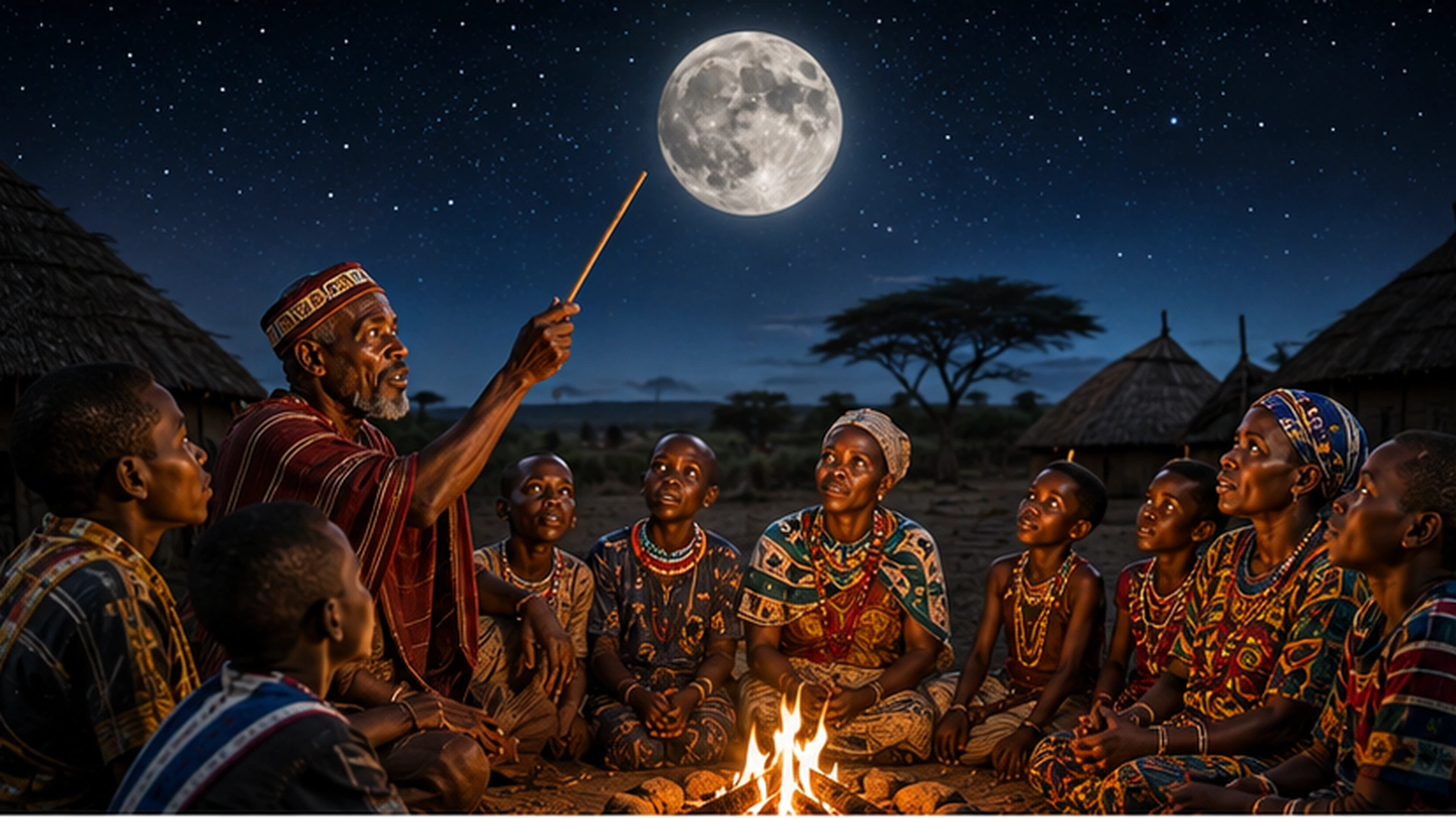
The Moon in African calendars has served as a visible clock, a marker of months, a guide for ceremonies, and one part of broader systems for understanding seasons, rainfall, farming, livestock, and community life.
There was never one universal African lunar calendar.
Africa contains thousands of communities with different languages, environments, religions, political histories, and methods of timekeeping. Some calendars were strongly lunar. Others combined the Moon with stars, rainfall, plant growth, animal behavior, and agricultural seasons. Some were lunisolar, inserting an additional month or otherwise adjusting the count so that named months remained connected with the seasons. Other influential African calendars were mainly solar or followed non-lunar cycles.
The average lunar phase cycle—from one new Moon to the next—lasts approximately 29.53 days. Twelve such cycles total about 354 days, roughly 11 days shorter than the solar year. A community using lunar months therefore had to choose whether to let the calendar move through the seasons or periodically correct it. [1]
African solutions to this problem were diverse.
Ancient Egyptians used lunar calendars for religious purposes alongside a civil calendar. Borana Oromo calendar specialists coordinated the Moon with named stars and ritual day cycles. The Lango calendar of northern Uganda connected thirteen named lunar months with rainfall, agriculture, food availability, and social life. Ngas observers in Nigeria watched for the first crescent to establish months and the New Year. Precolonial Setswana communities used a lunisolar system that required seasonal correction. Muslim communities throughout Africa continue to use the Hijri lunar calendar for religious observances.
These systems should be studied as complete cultural institutions rather than reduced to claims such as “Africans planted by the full Moon.”
Key Points
The Moon has been used in African calendars to:
Begin or count months
Mark the first visible crescent
Schedule ceremonies and festivals
Coordinate agricultural work
Identify periods of scarcity and abundance
Organize livestock movement
Support weather and seasonal interpretation
Regulate marriage, initiation, funerary, and naming practices
Connect community life with stars and environmental signs
Determine Islamic religious months
Transmit knowledge through elders and specialist observers
Important examples include:
Ancient Egyptian lunar religious calendars
The Borana lunar-stellar calendar of southern Ethiopia and northern Kenya
Dwete a Lango in northern Uganda
The Ngas lunar calendar in Nigeria
The traditional Setswana lunisolar calendar
Lunar observance among African Muslim communities
Not all African calendars were lunar. The Akan adaduanan, for example, is described in historical scholarship as a non-lunar cycle, demonstrating why the continent must not be treated as one calendrical system. [7]
What Is an African Lunar Calendar?
Clear Definition
An African lunar calendar is a community-specific system that uses the Moon’s phases or visibility to organize months, ceremonies, agriculture, social responsibilities, or seasonal knowledge.
Plain-Language Meaning
It is a way of counting and understanding time by watching the Moon—often together with stars, rain, plants, animals, and community traditions.
The Difference Between a Lunar Month and a Calendar Month
A lunar month follows the Moon’s phase cycle.
The average synodic month lasts approximately 29.53 days. Because a civil calendar normally counts whole days, observational lunar months commonly contain 29 or 30 days. [1]
A traditional month may also carry an ecological meaning, such as:
The time of land preparation
The beginning of rainfall
A hunger period before crops mature
The first harvest
Livestock movement
A festival or initiation season
The name of a month may therefore express more than astronomy.
Lunar, Lunisolar, and Ecological Calendars
Calendar type
Main basis
Relationship with seasons
Lunar
Moon phases or crescent visibility
Moves through seasons unless corrected
Lunisolar
Lunar months plus seasonal correction
Remains approximately aligned with seasons
Ecological or seasonal
Rain, plants, animals, farming, stars, and community events
Closely tied to local environment
Solar
Solar year or seasonal cycle
Remains aligned with annual seasons
Many Indigenous African systems combined several of these features.
A calendar could be lunar in its months, stellar in its observations, ecological in its meanings, and ritual in its authority.
Why the Moon Was a Useful Timekeeper
The Moon is:
Visible without specialized equipment
Recognizable through repeating phases
Shared across a wide landscape
Useful for counting nights
Connected with changes in nighttime illumination
Relevant to ocean tides in coastal communities
Easy to incorporate into oral teaching
A community could say that an event would occur after the first crescent, during a named Moon, or on a particular lunar day even without printed calendars.
African Calendars Were Not Based on the Moon Alone
Traditional calendar knowledge often included:
Stars and constellations
Rainfall
Cloud patterns
Wind
Plant flowering
Grass conditions
Animal behavior
River and lake levels
Crop maturity
Pasture and water availability
Cultural astronomy research repeatedly emphasizes Africa’s enormous diversity and warns that examples from one region should not be treated as representatives of the entire continent. [2]
1. Lunar Calendars in Ancient Egypt
Ancient Egypt used more than one calendar.
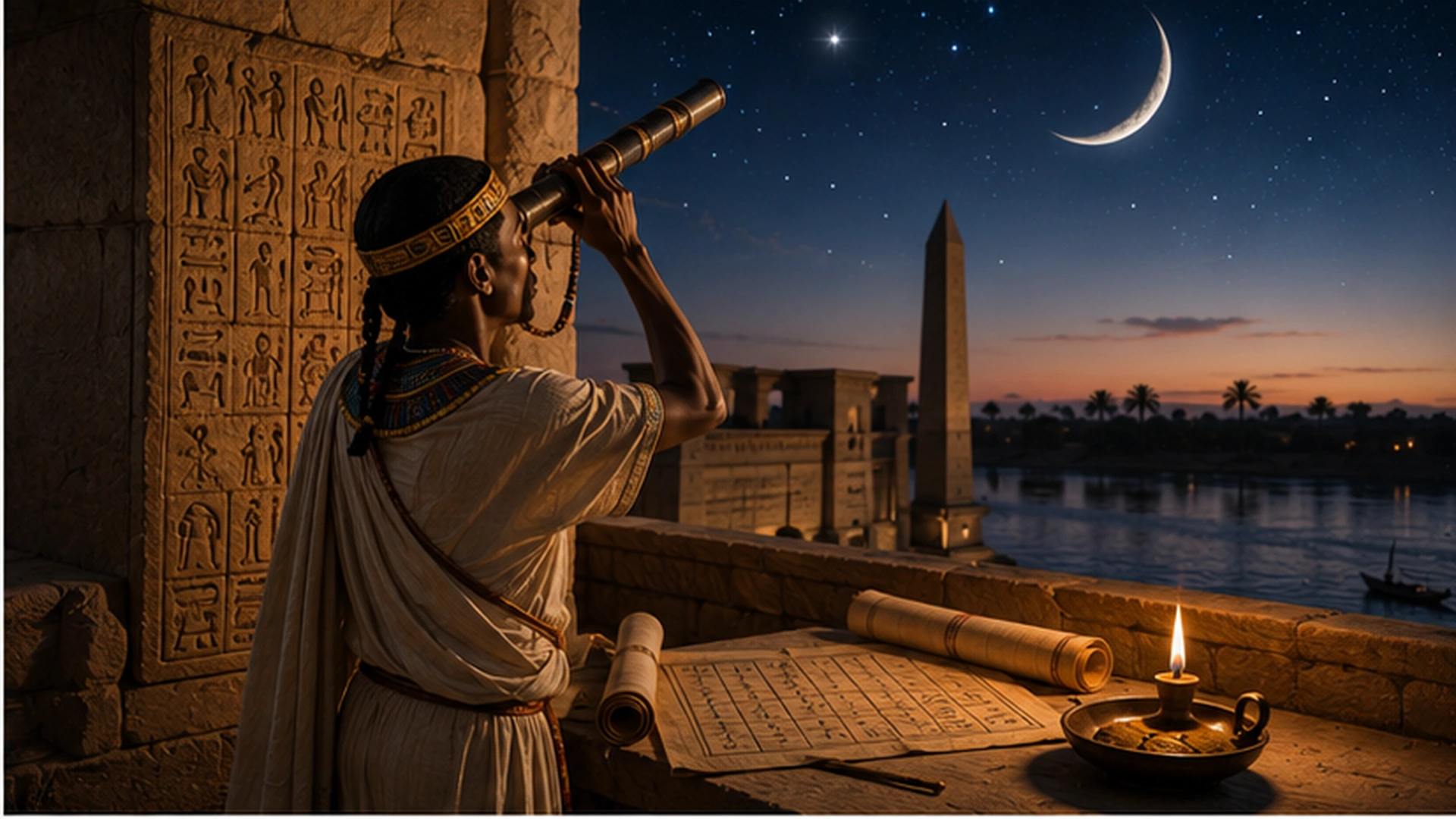
The civil calendar was a stable 365-day system used for administration. Alongside it, lunar calendars helped regulate religious observances and temple festivals. A major University of Chicago study concluded that ancient Egyptians maintained two lunar religious calendars in addition to the civil calendar. [3]
How the Lunar Month Was Identified
The precise historical rules changed over long periods, but Egyptian lunar reckoning involved observation of the Moon’s visibility and the counting of lunar days.
Lunar dates could help organize:
Temple services
Offerings
Processions
Festival cycles
Priesthood duties
Religious texts
Why Several Calendars Coexisted
One calendar could serve government, while another served religion.
Ancient Egyptian farmers also followed the Nile and the agricultural seasons of inundation, growth, and harvest. The presence of a lunar calendar does not mean every area of Egyptian life was scheduled only by Moon phase.
The Moon Was Part of a Larger Sky System
Egyptian timekeeping also involved:
The Sun
Stars
The heliacal rising of Sirius
Nile conditions
Civil administration
The Moon was important, but it was one element within a complex civilization.
2. The Borana Lunar-Stellar Calendar
The Borana Oromo live across parts of southern Ethiopia and northern Kenya.
Their traditional calendrical system is commonly described as lunar-stellar because it coordinates lunar months and named day cycles with observations of stars or constellations.
Anthropologist Marco Bassi’s field report describes specialist calendar experts known as ayantu, who possessed detailed knowledge of sky observation and were consulted about ritual dates, weather forecasting, and other matters. [4]
Month Beginning
In Bassi’s account, a Borana month began when the new crescent became visible after astronomical conjunction. The month could therefore contain 29 or 30 days. [4]
Calendar Specialists
Ayantu were not simply people who looked at a printed phase chart.
Their knowledge involved:
Lunar visibility
Star positions
Named days
Ritual requirements
Oral calculation
Intergenerational teaching
The specialist character of the system means that it should not be reconstructed casually from short online lists.
Ritual Rather Than a Simple Farming Almanac
Bassi reported that the Borana calendar was used especially for ritual timing and that its month sequence did not simply mirror the agricultural cycle. This is an important correction to the common assumption that every Indigenous African calendar was mainly a planting calendar. [4]
At the same time, recent research among Borana Oromo pastoralists documents the broader use of astronomical and environmental observations in seasonal weather forecasting. The calendar and forecasting knowledge should be distinguished while recognizing that both belong to a larger system of observing the sky and landscape. [5]
The Namoratunga Debate
Popular accounts sometimes claim that the Namoratunga stone site in Kenya proves an ancient Borana calendar extending back to a precise date.
Archaeological interpretations of the site and its relationship with the modern Borana system remain debated. The safest approach is to describe the living and historically documented calendar without presenting disputed archaeological claims as settled fact.
Frequently Asked Questions
What should readers know first about uncategorized?
Uncategorized: The Moon in African Calendars History • Astronomy • Agriculture • Living Heritage The Moon in African calendars has served as a visible clock,
What should readers know first about The Moon in African Calendars?
Explore how African communities used the Moon in calendars, including Ancient Egyptian, Borana, Lango, Ngas, Setswana, and Islamic traditions.
What causes The Moon in African Calendars?
Explore how African communities used the Moon in calendars, including Ancient Egyptian, Borana, Lango, Ngas, Setswana, and Islamic traditions. The safest next step is to compare the signs, prepare clear details, and request private guidance when the matter fee
How does The Moon in African Calendars work?
Explore how African communities used the Moon in calendars, including Ancient Egyptian, Borana, Lango, Ngas, Setswana, and Islamic traditions. The safest next step is to compare the signs, prepare clear details, and request private guidance when the matter fee
Is it possible to get private guidance for The Moon in African Calendars?
Explore how African communities used the Moon in calendars, including Ancient Egyptian, Borana, Lango, Ngas, Setswana, and Islamic traditions. The safest next step is to compare the signs, prepare clear details, and request private guidance when the matter fee
How long does The Moon in African Calendars take to understand?
Explore how African communities used the Moon in calendars, including Ancient Egyptian, Borana, Lango, Ngas, Setswana, and Islamic traditions. The safest next step is to compare the signs, prepare clear details, and request private guidance when the matter fee
Can The Moon in African Calendars affect relationships, family, work, or personal peace?
Explore how African communities used the Moon in calendars, including Ancient Egyptian, Borana, Lango, Ngas, Setswana, and Islamic traditions. The safest next step is to compare the signs, prepare clear details, and request private guidance when the matter fee
Why do people seek spiritual guidance for The Moon in African Calendars?
Explore how African communities used the Moon in calendars, including Ancient Egyptian, Borana, Lango, Ngas, Setswana, and Islamic traditions. The safest next step is to compare the signs, prepare clear details, and request private guidance when the matter fee
What signs should someone notice before asking about The Moon in African Calendars?
Explore how African communities used the Moon in calendars, including Ancient Egyptian, Borana, Lango, Ngas, Setswana, and Islamic traditions. The safest next step is to compare the signs, prepare clear details, and request private guidance when the matter fee
When should someone contact a private spiritual guide?
Explore how African communities used the Moon in calendars, including Ancient Egyptian, Borana, Lango, Ngas, Setswana, and Islamic traditions. The safest next step is to compare the signs, prepare clear details, and request private guidance when the matter fee
Article Information
- Publisher
- Ancestral Temple
- Editor
- Ancestral Temple
- Last updated
- Jul 26, 2026
- Last reviewed
- Jul 13, 2026
- Content version
- 615f696b4b
This educational article should be read as cultural and spiritual information, not as medical, legal, financial, or emergency advice.
Helpful Related Guidance
Explore This Topic
New Moon Symbolism · Uncategorized
Related Topic Cluster
Uncategorized
Complete Guide Understanding African Spiritual Traditions: A Historical IntroductionAbout the Author
 Ancestral Temple
Spiritual guide and practitioner with decades of experience in ancestral wisdom, rituals, and divine guidance.
Related Posts
View All

Leave a Comment
We'd love to hear your thoughts.
This was comprehensive without presenting one calendar as more authentic than all others.
Ruth E.
Are there community museums or digital archives where African traditional calendars can be studied?
Nathan C.
The preservation section showed why Indigenous knowledge should not simply be collected by outsiders.
Sophia D.
A future article about African observation sites and horizon astronomy would be interesting.
Emmanuel R.
I liked the reminder that a calendar is a social agreement as well as an astronomical system.
Alice M.
Strong overview connecting the Moon with ritual, farming, rainfall, social authority, and cultural memory.
Brian W.
The misconceptions section corrected several claims I have seen shared online.
Patricia N.
The Islamic-calendar section remained neutral while acknowledging different sighting methods.
Omar S.
The article made the relationship between language, ecology, and calendars easy to understand.
Janet R.
I appreciated the use of an Akan example to challenge continent-wide generalizations.
Kofi A.
More research about women who transmitted lunar and seasonal knowledge would be valuable.
Evelyn P.
The Namoratunga debate deserves its own careful archaeological article.
Thomas D.
The strongest lesson was to ask which community and which purpose before describing a calendar.
Mariam F.
The tone respected cultural beliefs while separating documented history from disputed claims.
Victor L.
I liked that agriculture was included without claiming Moon phases directly control every crop.
Hannah O.
The discussion of oral transmission corrected the assumption that written calendars are always more sophisticated.
George E.
Could you write next about the Moon and traditional calendars in Uganda specifically?
Rose B.
The short paragraphs and clear headings worked well on mobile.
Abdul J.
The community-by-community structure made the long article easy to follow.
Linda C.
This is useful for students of African history, astronomy, agriculture, and cultural heritage.
Paul K.
Thank you for emphasizing community control over digital preservation.
Rebecca M.
The climate-change section explained why old seasonal predictions may no longer match perfectly.
Henry A.
I appreciated the warning against translating every traditional month directly into a Gregorian month.
Naomi T.
A visual comparison of Borana, Lango, Ngas, and Setswana calendars would be interesting.
Christopher S.
The glossary helped me understand the difference between a lunation and a lunar-stellar calendar.
Zainab R.
The section on multiple calendars in one household was realistic.
David N.
I liked the point that month names can preserve memories of hunger, rain, and harvest.
Esther G.
The recent northern Uganda research made the article feel especially relevant.
Andrew H.
This was respectful of Indigenous knowledge without exaggerating every claim.
Josephine E.
The article showed how calendars can regulate ceremonies, farming, and family life at the same time.
Michael P.
I would like a detailed article about the traditional Setswana calendar and leap months.
Beatrice L.
The explanation of why lunar years need seasonal correction was helpful.
Ibrahim C.
I liked the reminder that traditional weather interpretations should not be presented as universal scientific laws.
Sarah W.
The Ngas observation-place example showed that astronomy can include both knowledge and physical heritage.
Moses K.
Thank you for explaining that Islamic crescent sighting is not Moon worship.
Fatima D.
I had not heard of ayantu calendar specialists before reading this.
James R.
The article explained first-crescent observation without confusing it with the exact new Moon.
Nadia S.
A downloadable chart of the Lango lunar months would be a useful future resource.
Peter O.
Dwete a Lango deserves a full article because the month meanings are closely connected with food and rainfall.
Maria J.
The Akan counterexample was important because not every African calendar was lunar.
Kwame B.
I liked the explanation that the Borana calendar was not simply an agricultural almanac.
Lydia A.
The Borana section showed how specialist sky knowledge can be more complex than a simple month list.
Samuel T.
I did not know ancient Egypt used lunar religious calendars alongside the civil calendar.
Grace N.
The distinction between lunar, lunisolar, and ecological calendars was very clear.
Daniel M.
I appreciated that the article did not describe Africa as having one universal Moon calendar.
Amina K.