
Astrology Across Cultures: History, Beliefs and Cultural Interpretations
Quick Summary
Astrology across cultures is the history of many different ways people have interpreted celestial patterns as meaningful for life on Earth. It is not one universal belief system th...
Astrology across cultures is the history of many different ways people have interpreted celestial patterns as meaningful for life on Earth. It is not one universal belief system that appeared fully formed in a single civilization. Mesopotamian omen scholars, Egyptian timekeepers, Hellenistic horoscope writers, Indian jyotiṣa specialists, Chinese court astronomers, Muslim mathematicians and astrologers, European physicians, and Maya calendar keepers worked within different languages, institutions, religious traditions and ideas about time.
Those differences matter. A Babylonian report about an eclipse and the welfare of a king is not the same practice as a modern newspaper horoscope. The Chinese twelve-animal cycle is not a translation of Aries through Pisces. The Maya ceremonial calendar should not be treated as a disguised Western birth chart. Even the word astrology can be misleading when it is used to label every cultural tradition involving stars, seasons, calendars or divination.
This article therefore approaches astrology as cultural history. It compares what societies observed, what meanings they assigned to celestial events, who was authorized to interpret them, and how those interpretations affected politics, ritual, agriculture, medicine, identity and personal decision-making. It also separates historical importance and living belief from scientific evidence. Astrology has influenced civilizations for millennia, but cultural influence does not by itself demonstrate that planets determine personality or predict individual events.
Quick Answer
Astrology developed differently across cultures. Mesopotamian scholars read celestial events as omens for rulers and states; Hellenistic practitioners developed horoscopes; Indian jyotiṣa joined astronomy, calendars and divination; Chinese systems linked heavenly patterns with political order; Islamic scholars translated, calculated and debated astrology; and Maya traditions connected sky cycles with calendars, agriculture and ceremony. These systems share an interest in cosmic meaning but are not interchangeable.
What Does “Astrology Across Cultures” Mean?
“Astrology across cultures” refers to the comparative study of traditions that connect celestial phenomena with earthly meaning. The category can include omen interpretation, horoscopes, election of favorable times, calendrical divination, political forecasting and symbolic readings of the Sun, Moon, planets or stars.
However, the category must be used carefully. Some societies did not divide knowledge into the modern Western categories of astronomy, astrology, religion and science. In ancient Mesopotamia, precise observation and omen interpretation could belong to the same scholarly activity. In early and imperial China, the category *tianwen*, often translated today as astronomy, included the observation and interpretation of “heavenly patterns.” In India, *jyotiṣa* can refer broadly to astral sciences that include calendrical calculation, astronomy and astrology.
The modern distinction is clearer. Astronomy studies celestial objects and physical processes using observation, mathematics and testable explanations. Astrology assigns symbolic, predictive or divinatory meaning to celestial configurations. NASA describes astronomy as a science and explicitly distinguishes it from astrology. [13]
A comparative article should therefore ask two questions before calling a practice astrology:
Did practitioners interpret celestial positions or events as signs concerning human or earthly affairs?
Is “astrology” the most accurate translation, or does a term such as calendrical science, omenology, cultural astronomy or ritual timekeeping better preserve the tradition’s own categories?
Why Did So Many Societies Connect the Sky With Human Life?
The sky provided some of the most regular patterns available to early societies. Sunrise and sunset structured the day. Lunar phases shaped month-like cycles. Seasonal star appearances helped communities anticipate changes in weather, migration, planting and harvest. Planetary movements and eclipses were visually striking and, before modern astrophysics, difficult to explain.
These patterns made the heavens useful in several ways. They could organize calendars, coordinate ritual, support navigation and demonstrate mathematical knowledge. They could also become politically meaningful. A ruler who controlled the calendar, sponsored an observatory or employed specialists to interpret eclipses could present the state as aligned with cosmic order.
Astrology also addressed uncertainty. War, illness, marriage, succession, travel and harvests involved risks that people could not fully control. Celestial interpretation offered structured ways to discuss timing, danger and possibility. The value of those systems was therefore not only predictive. They could provide social authority, shared symbolism and a language for making decisions.
At the same time, similar human concerns did not produce identical systems. Celestial knowledge was shaped by geography, inherited calendars, religious institutions, writing systems, political organization and contact with neighboring cultures.
A Brief Global Timeline of Astrology and Astral Interpretation
| Period | Region | Major development |
|---|---|---|
| Second and first millennia BCE | Mesopotamia | Systematic celestial omen traditions connected eclipses, planets and stars with kings, kingdoms and public affairs. |
| New Kingdom and later | Ancient Egypt | Decans and stellar observations supported timekeeping and religious cosmology; zodiac imagery became prominent in the Ptolemaic and Roman periods. |
| Late first millennium BCE onward | Hellenistic Mediterranean | Babylonian zodiacal knowledge, Egyptian traditions and Greek mathematical philosophy contributed to horoscopic astrology centered on individual births. |
| Late ancient and medieval periods | South Asia | Indian astral sciences developed calendrical, astronomical and horoscopic systems involving planets, lunar mansions and auspicious timing. |
| Early imperial through late imperial periods | China | Court institutions combined observation, calendars, omen interpretation and political cosmology; separate cyclical systems also shaped popular birth-time interpretation. |
| Eighth century onward | Islamic world | Arabic scholarship translated Greek, Persian and Indian works, improved astronomical calculation and preserved extensive astrological literature amid theological debate. |
| Medieval and Renaissance periods | Europe | Astrology appeared in courts, medicine, universities and almanacs before losing academic authority as astronomy became a modern physical science. |
| Ancient to contemporary periods | Maya regions of Mesoamerica | Astronomical observations and interlocking calendars structured agriculture, ceremony, historical records and living traditions of time. |
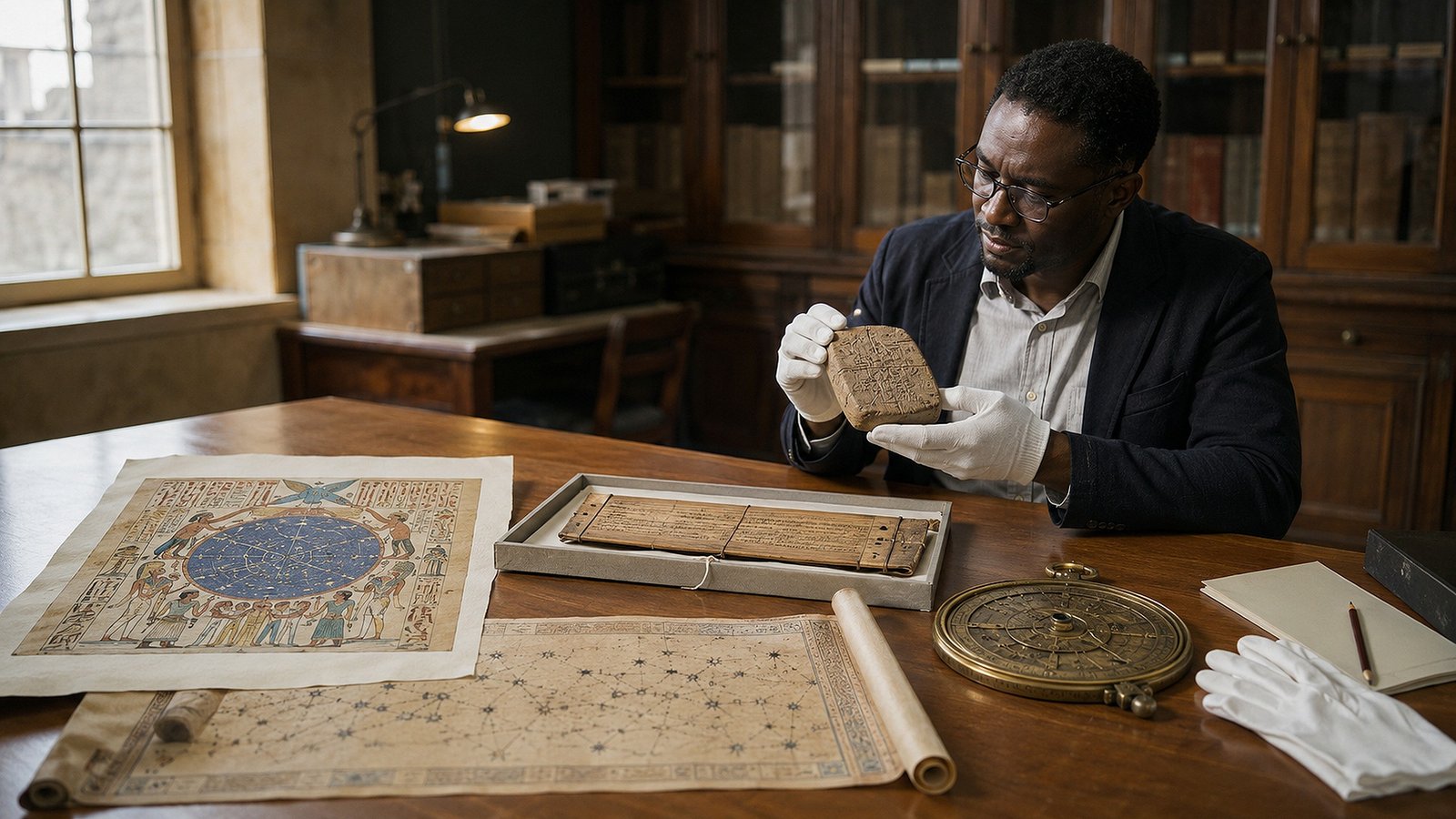
Specific culture or historical context: Modern scholarly comparison of Mesopotamian, Egyptian, South Asian, Chinese and medieval Islamic astral traditions.
People shown: One Black African adult researcher, attentive and professional.
Location: Museum study room or university special-collections room.
Clothing: Contemporary neutral professional clothing; no ceremonial costume.
Architecture: Modern heritage-research interior with wooden tables, archival cabinets and soft museum lighting.
Objects: Replica clay tablet, manuscript folios, star map, astrolabe, pencils and cotton gloves.
Lighting: Warm directional window light with subtle archival task lighting.
Composition: 16:9 editorial composition, researcher on the right third, objects clearly separated across the foreground, generous negative space for website cropping.
SEO-friendly filename: astrology-across-cultures-history-beliefs.webp
Image title: Astrology Across Cultures and Historical Traditions
Alt text: African cultural historian comparing Mesopotamian, Egyptian, Indian, Chinese and Islamic astronomical materials in a museum study room
Caption: Astrological traditions developed through different cultural, political and religious histories rather than from one universal system.
Recommended placement: After the comparative timeline near the beginning of the article.
Article section supported: What astrology across cultures means and the global timeline.
Important elements to avoid: No glowing symbols, magical energy, mixed ceremonial clothing, fake writing, text overlays, zodiac wheel floating in the air, collage panels or stereotypical “mystic” décor.
Mesopotamia: Celestial Omens, Statecraft and the Zodiac
The strongest documented roots of the tradition that later became Western horoscopic astrology lie in ancient Mesopotamia. Clay tablets from Babylonia and Assyria preserve observations and interpretations of eclipses, planets, stars, weather and other phenomena. British Museum tablets from the Library of Ashurbanipal include astrological forecasts based on stars and reports to the king concerning the Sun, Moon and public affairs. [1][2]
Early Mesopotamian astrology was largely mundane, meaning it addressed collective and political matters rather than an ordinary person’s psychological profile. An eclipse might be interpreted in relation to a ruler, a city, warfare, crops or disease. Specialists worked in scholarly and courtly settings where observing the sky, copying omen series and advising political authorities were connected activities.
This does not mean every prediction was accepted without question. Scholars compared observations, consulted established texts and sometimes offered protective or alternative interpretations. Astrology functioned within a technical scribal culture rather than as casual fortune-telling.
From omen lists to a mathematical zodiac
Mesopotamian astronomy became increasingly systematic. By the late first millennium BCE, scholars used a zodiac divided into twelve equal sections of thirty degrees. A scholarly study of a Late Babylonian astrological compendium dates it to after the invention of the zodiac in the late fifth century BCE and shows that the text combined calendrical, medical, geographical and other astrological associations. [3]
The mathematical zodiac allowed celestial positions to be recorded more consistently. It was related to constellations, but its equal signs were not identical to irregular constellations in the visible sky. This distinction remains important: modern astrological signs are symbolic divisions, while astronomical constellations are unequal star regions.
From kings to individual births
Mesopotamian texts eventually included horoscopes associated with particular births. This was a major conceptual shift. Instead of asking only what an eclipse meant for the kingdom, a practitioner could calculate the sky at a person’s birth and interpret possible features of that individual’s life.
Later Hellenistic astrology expanded natal interpretation, but Mesopotamian observation, omen literature and zodiacal calculation supplied essential foundations. The history is therefore best understood as transmission and transformation, not as a simple claim that “Babylon invented every form of astrology.”
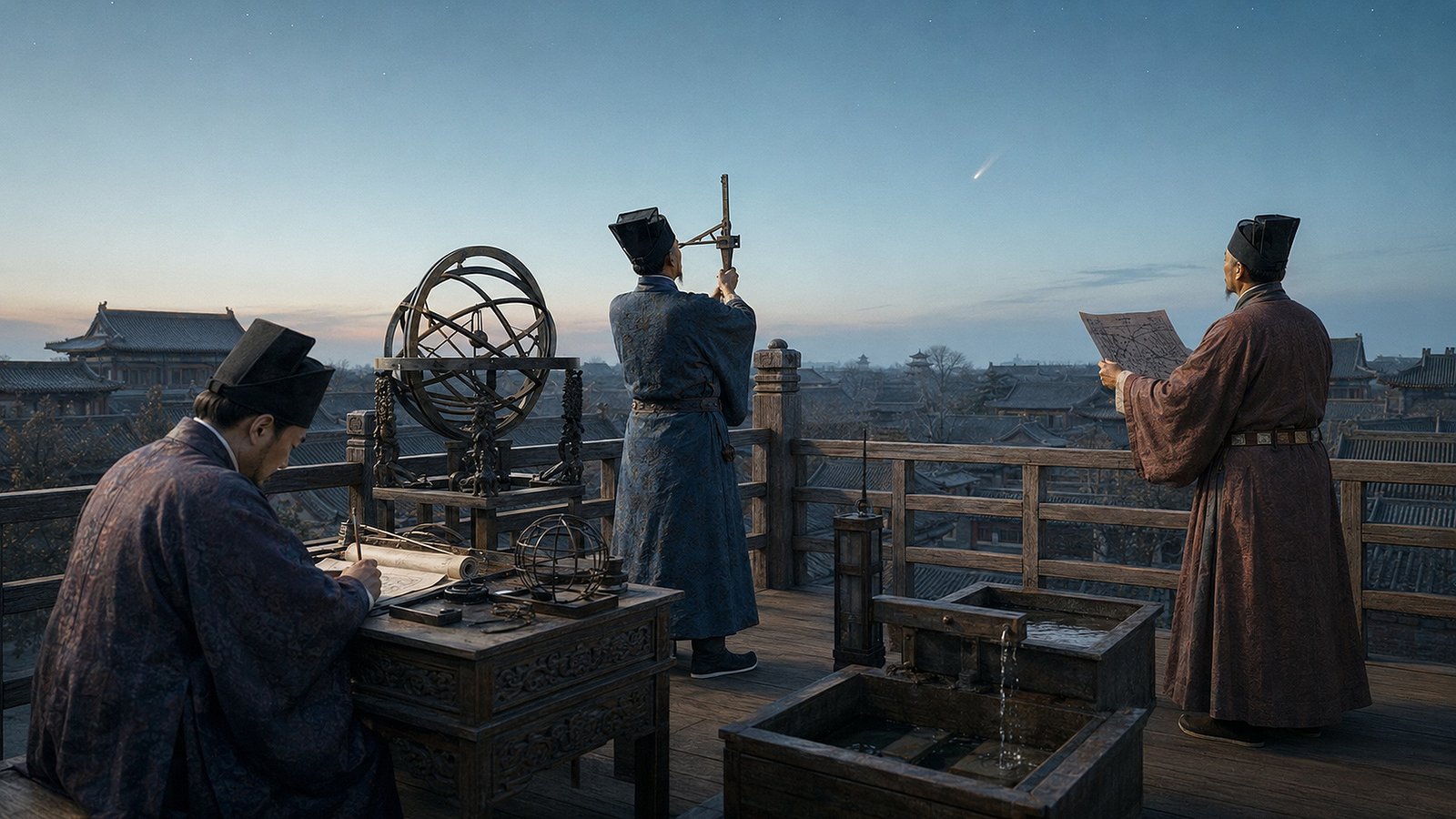
Specific culture or historical context: Neo-Assyrian court scholarship, seventh century BCE, associated with the intellectual world of Ashurbanipal’s library.
People shown: Two adult Mesopotamian male scribes; no king or invented priestly ceremony.
Location: Palace rooftop in ancient Nineveh, northern Mesopotamia.
Clothing: Historically plausible Assyrian linen and wool garments with simple fringed shawls.
Architecture: Mudbrick and stone palace roofline with crenellated walls; distant city roofs.
Objects: Clay tablets, reed stylus, oil lamp, low writing board and tablet basket.
Lighting: Natural twilight transitioning to night, with a visible Moon and a few bright planets or stars.
Composition: Wide documentary reconstruction, scribes in the lower left, open sky dominating the upper frame.
SEO-friendly filename: mesopotamian-astrology-celestial-omens.webp
Image title: Mesopotamian Scholars Recording Celestial Omens
Alt text: Neo-Assyrian scribes recording the Moon and planets on clay tablets from a palace rooftop in ancient Nineveh
Caption: Mesopotamian scholars connected careful celestial observation with omen interpretation concerning rulers, cities and public affairs.
Recommended placement: After the Mesopotamia section.
Article section supported: Mesopotamia: celestial omens, statecraft and the zodiac.
Important elements to avoid: No telescope, modern star charts, fantasy robes, Egyptian motifs, glowing runes, oversized planets, invented rituals or inaccurate ziggurat clichés.
Ancient Egypt and the Hellenistic Mediterranean
Ancient Egypt developed sophisticated astronomical and calendrical traditions long before the twelve-sign zodiac appeared in Egyptian monuments. Egyptians used stellar groups known as decans in systems connected with night hours, calendars and religious imagery. A reconstruction of the astronomical ceiling from the tomb of Senenmut lists planets and decans and displays a structured map of the night sky. [4]
Egyptian celestial knowledge was deeply connected with sacred order, timekeeping, temple life and ideas about the journey of the dead. Yet it is inaccurate to project the complete modern Western zodiac backward into the earliest dynastic periods.
The Dendera zodiac and cultural exchange
The famous circular zodiac from the Temple of Hathor at Dendera dates to the Ptolemaic period, around the first century BCE. The Louvre identifies zodiac signs, decans and constellations in the relief. [5] Its imagery reflects a period when Egyptian, Greek and Near Eastern traditions interacted intensely.
Hellenistic Egypt became a crucial setting for the development of horoscopic astrology. Practitioners combined several bodies of knowledge:
Babylonian planetary records and zodiacal divisions
Egyptian decans, calendars and sacred cosmology
Greek geometry, philosophy and models of the cosmos
Techniques for calculating the Ascendant, houses and planetary relationships
This synthesis produced systems that could interpret a chart for an individual birth. Greek-language astrological texts circulated around the Mediterranean and later influenced Roman, Indian, Islamic and European traditions.
Astrology, fate and social power
In Greek and Roman societies, astrology raised questions about fate and free will. If celestial configurations determined events, what room remained for moral choice? Philosophers, religious authorities and political leaders answered differently.
Astrologers could be respected advisers, especially at courts, but they could also be restricted when predictions threatened rulers. Astrology’s political value and political danger came from the same source: it claimed to interpret signs beyond ordinary human control.
The Hellenistic tradition became one major ancestor of modern Western astrology, but it was never culturally isolated. Its formation depended on movement among Africa, West Asia and the Mediterranean.
India: Jyotiṣa, Lunar Mansions and Auspicious Time
Indian astral sciences developed through a long and internally diverse history. The Sanskrit term jyotiṣa is often translated as astrology, but it can include astronomy, calendrical calculation and the study of celestial cycles. Treating it as a direct synonym for modern Western astrology hides that wider intellectual context.
Early Indian astronomical traditions were concerned with the determination of time for ritual and social purposes. Scholarly histories describe the *Vedāṅga Jyotiṣa* as an early calendrical work and note that later Sanskrit astronomy developed more advanced planetary theories. [7] Indian astral sciences were connected with mathematics, calendars, worship, politics, agriculture and daily decisions.
Nakshatras and the lunar framework
A distinctive feature of many Indian systems is the use of nakshatras, usually translated as lunar mansions. These divide the Moon’s path into named sectors associated with stars or asterisms. Nakshatras have been used in calendrical organization, ritual timing and astrological interpretation.
Many Indian astrological schools also use a sidereal zodiac, which is anchored to stellar reference points through a chosen correction called an *ayanāṃśa*. Western tropical astrology instead anchors its zodiac to the seasonal equinoxes. This difference means that a planet may appear in different zodiac signs under tropical and sidereal calculations.
Horoscopy, timing and social life
Indian horoscopic traditions interpret planetary placements, houses, lunar mansions and calculated periods. Depending on region and school, jyotiṣa may be consulted for:
Birth-chart interpretation
Marriage matching
Naming and life-cycle ceremonies
Choosing times for travel, building or business
Calendrical festivals and religious observance
Political or household decisions
C. A. Bayly describes Hindu and Jain astral sciences as disciplines in which observation helped determine timing for worship, war, politics, agriculture and daily transactions. [6]
These practices have changed over time and are not uniform across India, Nepal, Sri Lanka or South Asian diasporas. Caste, language, sect, region, colonial history and modern technology all affect how jyotiṣa is practiced and understood.
Cultural care when describing Indian astrology
Several common simplifications should be avoided. “Vedic astrology” is widely used in modern English, but not every contemporary technique can be traced unchanged to the earliest Vedic texts. Indian astrology also should not be reduced to karma-based prediction or marriage matching. It includes multiple textual lineages, mathematical methods and living professional traditions.
Historical exchange is equally important. Indian and Hellenistic astral sciences influenced one another through translation and adaptation. Recognizing exchange does not erase Indian intellectual agency; it shows how scholars transformed imported ideas within established South Asian frameworks.
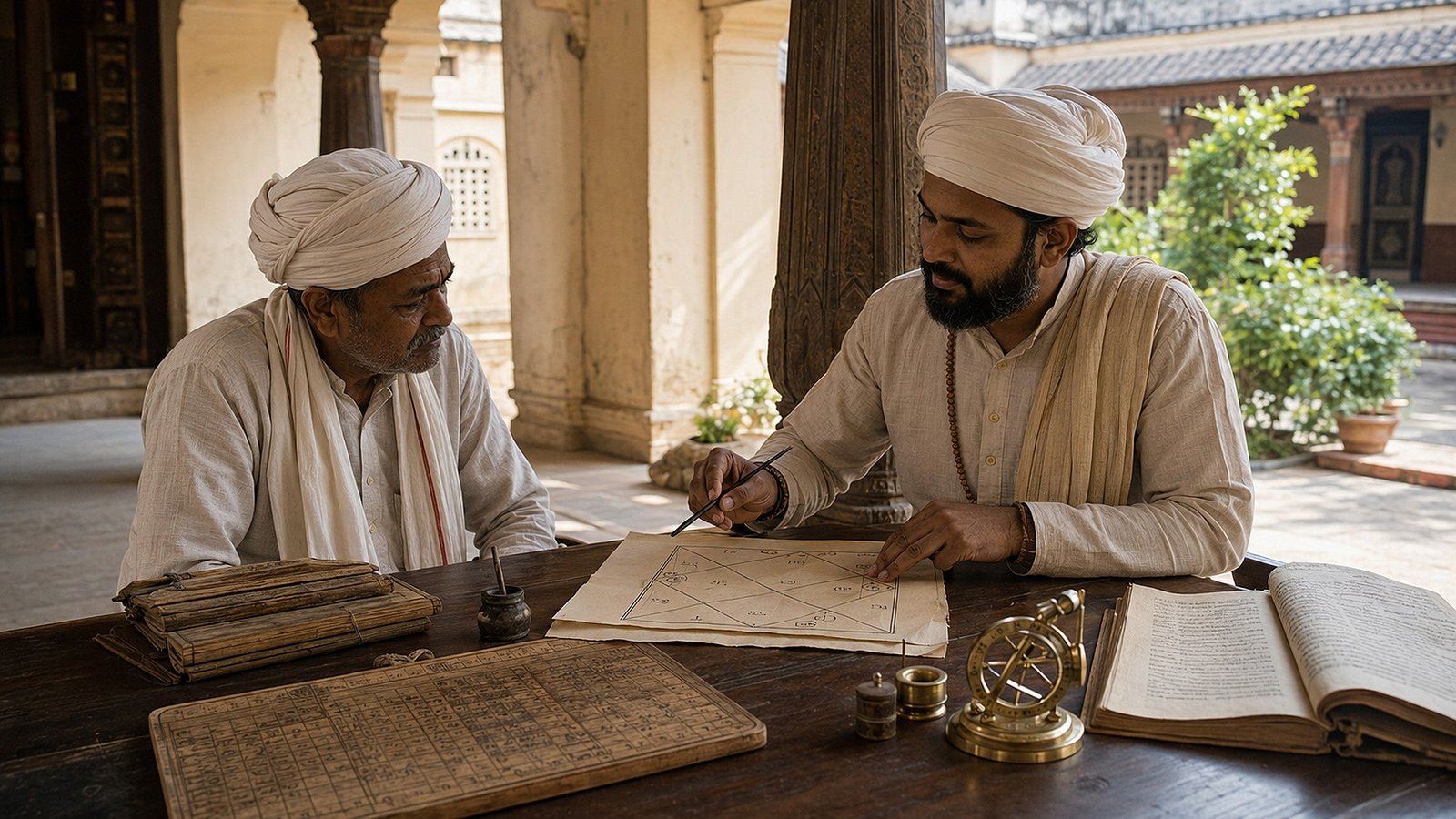
Specific culture or historical context: Early modern North Indian scholarly context, approximately seventeenth to eighteenth century, representing jyotiṣa as an astral science connected with calendars, timing and horoscopy.
People shown: One adult South Asian scholar and one adult family elder.
Location: Scholarly courtyard attached to a household or learning center in North India.
Clothing: Historically plausible cotton garments and turbans appropriate to the region and period; restrained colors.
Architecture: Plastered courtyard walls, carved wooden doorway, shaded veranda.
Objects: Paper horoscope diagram without readable text, manuscript folios, ink, reed pens, calendar board and brass instrument.
Lighting: Soft morning light filtered through the veranda.
Composition: Medium-wide scene focused on hands, calculations and conversation; no exaggerated ritual pose.
SEO-friendly filename: indian-jyotisha-history-cultural-practice.webp
Image title: Indian Jyotisha as Calendar and Horoscopic Scholarship
Alt text: South Asian jyotisha scholar discussing a horoscope diagram and calendar calculations with a family elder in a historical courtyard
Caption: Jyotiṣa developed within South Asian calendrical, mathematical, ritual and horoscopic traditions, with substantial regional and historical variation.
Recommended placement: After the India section.
Article section supported: India: jyotiṣa, lunar mansions and auspicious timing.
Important elements to avoid: No generic guru stereotype, no fire ritual, no modern zodiac app, no Devanagari gibberish, no guarantees of fate, no Western-only zodiac wheel.
China: Heavenly Patterns, Political Order and Cyclical Time
Chinese celestial traditions developed through categories that do not map neatly onto the modern Western opposition between astronomy and astrology. David Pankenier’s study of early China emphasizes that astral phenomena shaped art, architecture, calendrical science, myth and political decisions, and that there was no positive ancient distinction equivalent to today’s astronomy-versus-astrology divide. [8]
One important term is tianwen, literally “heavenly patterns.” Historically, it included observation and interpretation of celestial and atmospheric phenomena. Another field, often associated with calendrical calculation, focused on mathematical prediction and timekeeping. These activities could be institutionally distinct yet closely related.
The sky and imperial legitimacy
In imperial contexts, unusual celestial events could be interpreted as signs concerning the ruler and state. Comets, eclipses, planetary groupings or unfamiliar lights might be recorded, classified and connected with political change.
This did not make interpretation open to everyone. A study of the Yuan dynasty Bureau of Astronomy shows that the institution included sections for omen astrology, mathematical astronomy, divination, observation and timekeeping. It also describes restrictions on who was authorized to interpret celestial phenomena. [9]
The authority to read the sky was therefore also authority over political meaning. Calendrical accuracy demonstrated orderly government, while ominous events could be used in debates about imperial conduct.
The Chinese zodiac is not the Western zodiac
The familiar Chinese zodiac organizes years through a cycle of twelve animals associated with the Earthly Branches. In many forms it also interacts with the Heavenly Stems, yin and yang, and five phases—wood, fire, earth, metal and water.
This system is not based on twelve equal divisions of the Sun’s apparent path in the same way as the Western zodiac. Calling both systems “zodiacs” is convenient in English, but the shared label can create a false equivalence.
Chinese birth-time systems can consider year, month, day and hour. They may interpret cyclical relationships rather than simply assigning personality from one animal year. Regional traditions across China and East Asia have also adapted the twelve-animal cycle differently.
Observation, omenology and historical evidence
Chinese astronomical records are important to modern historians because they preserve observations of comets, novae, eclipses and other events. Yet extracting scientific data from them requires understanding the original omenological and political context. A historical record was not necessarily written as a neutral modern observation log.
This is a useful lesson for all cross-cultural research: ancient evidence should not be stripped of its original categories simply because one part of it can be used by modern astronomy.

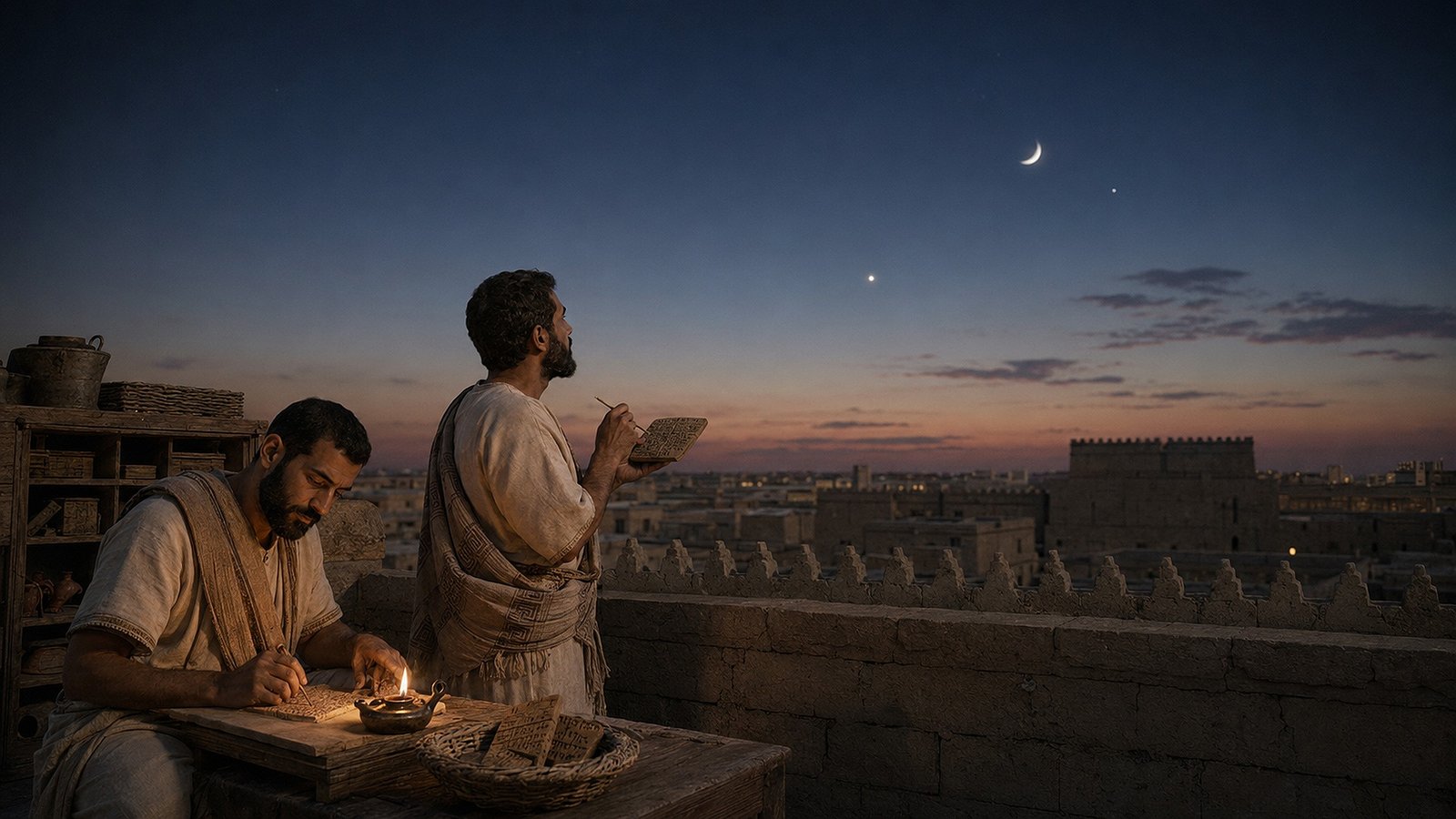
Specific culture or historical context: Yuan dynasty China, late thirteenth century, imperial Bureau of Astronomy.
People shown: Three adult Chinese court astronomers or officials.
Location: Imperial astronomical bureau in or near the capital.
Clothing: Historically plausible Yuan official robes and caps, without mixing later Qing styles.
Architecture: Timber observatory platform with tiled roofs visible in the distance.
Objects: Armillary-style instrument, water clock details, star map, writing desk and brushes.
Lighting: Cold predawn light with a clear sky and one subtle unusual celestial object.
Composition: Wide architectural view with officials arranged at different tasks; instruments prominent but not oversized.
SEO-friendly filename: chinese-astrology-tianwen-imperial-bureau.webp
Image title: Chinese Tianwen and the Imperial Astronomy Bureau
Alt text: Yuan dynasty Chinese astronomy officials observing the sky and consulting a star map at an imperial bureau
Caption: In imperial China, celestial observation, calendrical calculation and omen interpretation were organized through institutions whose categories do not map neatly onto the modern astrology–astronomy divide.
Recommended placement: After the China section.
Article section supported: China: heavenly patterns, political order and calendrical cycles.
Important elements to avoid: No dragon zodiac wheel, no Japanese architecture, no Qing queues, no fantasy celestial beams, no modern telescope or inaccurate costumes.
Astrology in the Medieval Islamic World
From the eighth century onward, scholars working in Arabic and other languages translated, compared and extended Greek, Persian and Indian knowledge. Baghdad became a major center, while research also flourished in Cairo, Rayy, Isfahan, Damascus, Córdoba, North Africa and other regions.
The Metropolitan Museum of Art explains that medieval Islamic scholars improved methods for observing and calculating celestial movements. Astronomical knowledge supported prayer times, the direction of Mecca, lunar months and calendars. The same intellectual world also produced astrological texts, horoscopes and richly decorated objects. [10]
Calculation and interpretation
Astrological work required accurate positions. Practitioners used tools such as:
Astrolabes for measuring celestial altitude and time
Ephemerides listing planetary positions
Mathematical tables
Manuscripts explaining planetary characteristics and zodiacal meanings
Important figures such as Abu Ma‘shar al-Balkhi wrote influential astrological works that later circulated in Latin Europe. Al-Biruni discussed astronomy, calendars and astrology with unusual comparative breadth. Al-Sufi revised knowledge of fixed stars through new observation.
Religious and philosophical disagreement
Astrology was never universally accepted in Muslim societies. Theologians, jurists and philosophers debated whether celestial bodies could cause earthly events, whether astrologers merely read signs created by God, and whether prediction challenged divine authority or human responsibility.
Some critics rejected natal and political prediction while accepting astronomy and practical calendar calculation. Others allowed limited ideas about natural influence but opposed deterministic claims. The existence of extensive anti-astrology writing is evidence of astrology’s influence and controversy, not proof of a single Islamic position.
Art, power and talismanic meaning
Zodiac and planetary figures appeared on metalwork, ceramics and manuscripts. In some settings these images symbolized royal power or were understood as talismanic. Their forms often drew on Greek constellation imagery while developing new planetary personifications in Arabic and Persian visual culture.
The medieval Islamic world was therefore not merely a bridge that “preserved Greek astrology” for Europe. Its scholars translated multiple traditions, produced new calculations, criticized earlier models and developed their own intellectual and artistic frameworks.
Medieval and Renaissance Europe
European astrology inherited materials through Greek and Latin texts and through translations from Arabic. During the medieval and Renaissance periods, astrology could be found in royal courts, universities, medical practice, almanacs and agricultural forecasting.
Physicians sometimes considered celestial timing when discussing treatment or surgery. Political astrologers interpreted conjunctions and eclipses. Almanacs provided calendars, weather expectations and astrological advice to broad audiences.
Acceptance varied. Christian thinkers debated whether celestial bodies influenced the physical world without determining the rational soul. Some forms of natural astrology were tolerated, while deterministic prediction could be condemned as a threat to providence and free will.
Astrology’s academic position weakened as astronomy developed physical explanations based on planetary motion, gravity and improved observation. The change was gradual. Early modern astronomers and mathematicians could still cast horoscopes or earn income from astrological calendars even while contributing to the science that would eventually separate astronomy from astrology.
Modern Western astrology later emphasized natal charts, personality and psychological symbolism. Newspaper sun-sign columns simplified a much larger tradition by focusing on the zodiac sign associated with the Sun.
Maya Calendars, Astronomy and Ceremonial Time
The ancient Maya developed exceptionally detailed systems for observing celestial cycles and organizing time. The Smithsonian National Museum of the American Indian describes Maya knowledge of the Sun, Moon, Venus and interlocking calendars, and emphasizes that these traditions remain connected with contemporary Maya communities. [11]
It is common online to call this “Maya astrology,” but the label can be misleading. Maya calendars should first be understood through Maya concepts of time, land, agriculture, ceremony and community rather than forced into Western horoscope categories.
Interlocking calendars
The best-known Maya calendar systems include:
The 365-day Haab calendar
The 260-day Tzolk’in or related regional sacred calendars
The Calendar Round created by the interaction of cycles
The Long Count used to place events within extended historical and mythic time
Maya astronomers observed cycles of the Sun, Moon and Venus and produced tables related to eclipses. Calendar dates appeared in inscriptions recording rulers, dedications, warfare and ritual events.
Sky, corn and living time
Maya timekeeping was not only abstract calculation. The Smithsonian’s “Sun, Corn, and the Calendar” materials explain how solar patterns and the agricultural cycle of corn are interconnected in Maya cultural understanding. [12]
Contemporary K’iche’, Yucatec, Tzeltal and other Maya communities are not one identical culture. Calendar practices, languages and ceremonies vary. Public educational sources can describe living traditions, but private or restricted knowledge should not be reconstructed from generalized internet claims.
Avoiding the 2012 myth
The end of a Long Count cycle on December 21, 2012 was widely misrepresented as a Maya prophecy of global destruction. Maya scholars and community voices repeatedly rejected that sensational interpretation. The episode shows how easily Indigenous calendrical knowledge can be commercialized and detached from its cultural context.
Specific culture or historical context: Contemporary K’iche’ Maya community in the Guatemalan highlands; public educational context inspired by documented living calendar traditions.
People shown: One adult K’iche’ Maya day keeper and two younger adult community members.
Location: Guatemalan highland landscape near cultivated corn fields.
Clothing: Regionally plausible contemporary K’iche’ clothing, represented respectfully and without costume exaggeration.
Architecture: Minimal rural context; distant homes or hills only.
Objects: Simple calendar teaching board, woven cloth and corn plants; no sacred objects presented as props.
Lighting: Natural golden sunrise with soft mist over the hills.
Composition: Environmental portrait with people in the left third, corn and rising Sun establishing the relationship between land and sky.
SEO-friendly filename: maya-calendar-living-cultural-astronomy.webp
Image title: Living Maya Calendar Knowledge and Cultural Time
Alt text: K’iche’ Maya day keeper explaining calendar cycles to younger community members beside a corn field at sunrise in Guatemala
Caption: Maya calendrical knowledge connects astronomical observation with agricultural and ceremonial cycles and remains part of living cultural traditions.
Recommended placement: After the Maya and Mesoamerica section.
Article section supported: Maya calendars, astronomy and ceremonial time.
Important elements to avoid: No invented ritual, no human sacrifice imagery, no pyramid fantasy scene, no pan-Indigenous costume mixing, no doomsday symbolism, no Western zodiac signs or embedded text.
African Contexts: Egypt, North African Scholarship and Diverse Sky Traditions
Africa cannot be described as having one astrological system. The continent contains thousands of communities with different languages, histories, religions and environmental knowledge. Some traditions connect stars or lunar cycles with seasons, initiation, leadership or divination. Others use celestial observation mainly for agriculture, navigation or calendars. Those practices should be named according to the evidence available for the specific community.
Ancient Egypt is an African civilization and an important part of the history of celestial knowledge. Egyptian decans, calendars, temple imagery and later participation in Hellenistic astrology belong within African history as well as Mediterranean history.
North African cities and courts also participated in Arabic-language astronomy and astrology. Scholars, instrument makers and manuscript networks connected regions of present-day Egypt, Tunisia, Algeria, Morocco and the Sahara with wider intellectual centers.
West African manuscript collections, including those associated with Timbuktu, preserve astronomical, calendrical and sometimes astrological learning within Islamic scholarly traditions. This evidence is important, but it should not be used to claim that every West African spiritual practice used the same astrology.
A responsible phrase is African celestial traditions when discussing broad patterns. The word astrology should be reserved for documented systems that interpret celestial phenomena in relation to human or earthly affairs. Future articles should focus on named communities, regions, languages and historical periods rather than inventing a pan-African zodiac.
How Major Astrology and Astral Traditions Compare
| Tradition or context | Primary celestial framework | Common historical uses | Key cultural emphasis | Important caution |
|---|---|---|---|---|
| Mesopotamian | Eclipses, planets, stars, lunar and solar phenomena; later a twelve-sign mathematical zodiac | Royal omens, state affairs, weather, harvests and eventually individual horoscopes | The sky as a field of signs relevant to king and kingdom | Early practice was not mainly personality-based sun-sign astrology. |
| Hellenistic Mediterranean | Twelve-sign zodiac, planets, houses, aspects and birth-time calculations | Natal horoscopes, political forecasting, medicine and election of times | Synthesis of Babylonian, Egyptian and Greek knowledge | The familiar Western system was cross-cultural, not the invention of one nation. |
| Indian jyotiṣa | Planets, sidereal zodiac in many schools, nakshatras, calendars and calculated periods | Ritual timing, marriage, natal interpretation, travel, political and household decisions | Linking celestial calculation with time, duty and auspiciousness | Jyotiṣa includes astronomy and calendrics as well as astrology; schools vary. |
| Chinese tianwen and related systems | Asterisms, planets, comets, eclipses, stems and branches, five phases and calendrical cycles | Imperial omens, political legitimacy, calendar regulation and birth-time interpretation | Correspondence between celestial patterns and social or political order | The Chinese animal zodiac is not equivalent to the Western ecliptic zodiac. |
| Medieval Islamic world | Greek, Persian and Indian astronomical tables, zodiac, planetary positions and instruments | Court advice, horoscopes, city foundations, medicine and timing | Translation, calculation and debate about divine authority and causation | Astrology was influential but contested among Muslim theologians and philosophers. |
| Maya calendrical traditions | Solar, lunar, Venus and interlocking calendar cycles | Agriculture, ceremony, historical dating and community timekeeping | Reciprocal relationships among sky, land, corn and sacred time | “Maya astrology” can be misleading when it forces Western categories onto Maya knowledge. |
The comparison shows why a list of “zodiac signs around the world” is often inadequate. The systems differ in their basic units, calculations and social purposes. Some focus on the ecliptic and planets; others emphasize lunar mansions, cyclical stems and branches, omen catalogues or interlocking calendars.
They also differ in authority. A Mesopotamian court scholar, a Chinese imperial official, an Indian household astrologer and a Maya day keeper occupied different social roles. Their knowledge was transmitted through different institutions, including palaces, temples, households, manuscripts, apprenticeships and community practice.
Shared Themes Across Cultures
Despite their differences, several recurring themes appear in the history of astral interpretation.
Celestial order as a model for earthly order
Many societies treated the sky as evidence of order, rhythm and hierarchy. Political systems often used that order symbolically. A ruler could claim legitimacy by maintaining a correct calendar or responding appropriately to an omen.
Timing as a form of knowledge
Astrology and calendrical divination often asked when, not only what. The proper time for a journey, ritual, marriage, military campaign or planting season could be treated as crucial. This concern encouraged careful observation and calculation even when the later interpretation was not scientific by modern standards.
The relationship between individual and cosmos
Horoscopic traditions linked a person’s birth to a larger celestial pattern. This could provide identity, social expectations or a narrative of fate. Different cultures defined the individual differently, however. Some emphasized household, lineage, duty or political status more than modern psychological personality.
Managing uncertainty
Celestial interpretation offered a structured response to uncertainty. It could help rulers explain crisis, households plan ceremonies or individuals discuss difficult choices. The interpretation might not reliably predict events, but the system could still influence behavior and social relationships.
Knowledge, authority and restriction
Not everyone was permitted to interpret celestial signs. Courts, priesthoods, scholarly lineages and professional communities could control texts and training. Modern popular astrology often obscures these histories by presenting all techniques as freely interchangeable consumer choices.
Important Differences That Should Not Be Erased
Shared themes do not justify combining unrelated traditions.
First, the Western and Chinese zodiacs are structurally different. One divides the ecliptic into signs; the other commonly organizes years through animals and cyclical relationships.
Second, Indian jyotiṣa is not simply Western astrology with sidereal signs. Lunar mansions, planetary periods, calendars, ritual timing and regional textual traditions create a wider system.
Third, Maya calendrical knowledge is not a twelve-sign personality system. It is rooted in Mesoamerican cycles of time, astronomy, agriculture and ceremony.
Fourth, Mesopotamian omen astrology was initially political and collective. Modern personality astrology represents a later emphasis.
Fifth, African celestial knowledge must be culturally specific. Star lore, lunar calendars, Islamic astrology and divination are not one interchangeable category.
Modern Astrology in a Globalized World
Modern astrology travels rapidly through books, apps, social media and online consultations. Western tropical astrology has become globally visible, but Indian, Chinese and other traditions also circulate far beyond their historical regions.
This movement creates new hybrid practices. Some people combine Western birth charts with Chinese zodiac animals, numerology, tarot or modern psychological language. Such combinations may be personally meaningful, but they should not be described as ancient traditions unless historical evidence supports that claim.
Globalization can also flatten culture. Commercial content often reduces Chinese astrology to one animal stereotype, Indian astrology to marriage compatibility, Maya calendars to “signs,” and African spirituality to invented symbols. Responsible publishing should identify modern adaptations as modern.
Astrology also functions differently for different people. It may be approached as religious belief, divination, entertainment, identity language, cultural heritage or self-reflection. A person can value astrology symbolically without claiming it is a physical science.
Is Astrology Scientifically Proven?
Astrology is historically and culturally important, but its core predictive claims are not established by reliable scientific evidence.
A widely discussed double-blind study published in *Nature* tested whether astrologers could match natal charts with personality profiles under controlled conditions. The results did not support the tested claims. [15] No accepted physical mechanism has shown that planetary positions at birth determine personality or reliably predict specific life events.
Astronomy, by contrast, explains celestial motion through measurable physical processes. Earth’s axis slowly precesses over roughly 26,000 years, changing the relationship between seasonal reference points and background constellations. NASA documents this axial motion. [14] Astrology traditions respond to this in different ways: tropical systems remain tied to seasons, while sidereal systems use stellar reference corrections.
Scientific criticism does not mean the cultural history is worthless. Historians can study astrology’s role in politics, art, medicine and religion without endorsing its predictions. Anthropologists can document living belief without treating it as laboratory evidence. The correct distinction is between what people believe or practice and what controlled evidence demonstrates.
Astrology should not replace medical care, mental-health treatment, legal advice, financial planning or evidence-based risk assessment. It should not be used to declare that someone is dangerous, infertile, cursed or destined to suffer.
Common Misunderstandings
“All astrology comes from one ancient civilization”
The Western horoscopic tradition has strong Mesopotamian foundations and developed through Hellenistic synthesis, but Indian, Chinese and Maya astral traditions have their own histories. Cultural exchange was important, yet not every system is a branch of one original tree.
“Ancient Egyptians invented the modern zodiac”
Egypt had major astronomical and religious traditions, including decans. The twelve-sign zodiac became prominent in Egypt during the Ptolemaic and Roman periods through interaction with Babylonian and Greek knowledge.
“The Chinese zodiac is another version of Aries through Pisces”
The twelve animal cycle is calendrical and cyclical, not a translation of twelve ecliptic signs. The systems may both use the number twelve, but their structures and histories differ.
“Every Indigenous calendar is astrology”
Calendars can track seasons, ceremonies and agriculture without making natal or predictive claims. Researchers should use community-specific terms whenever possible.
“Historical importance proves astrology works scientifically”
A belief can shape civilizations without being scientifically validated. Historical influence and empirical accuracy are different questions.
“Scientific criticism makes respectful cultural study impossible”
Respect does not require accepting every claim as fact. Responsible study can represent beliefs accurately, acknowledge uncertainty and avoid ridicule while maintaining scientific standards.
How to Study Astrology Across Cultures Responsibly
Begin with the culture’s own vocabulary. Ask whether a translated word means astrology, astronomy, omenology, calendar knowledge or something broader.
Identify the exact community, region and period. “Chinese astrology,” “Indian astrology” and “African astrology” are broad labels covering major internal differences.
Use primary objects, manuscripts and community-based sources when possible. Museum records, peer-reviewed history of science, heritage institutions and publications by scholars from the relevant regions should be prioritized over commercial horoscope websites.
Separate description from endorsement. Phrases such as “practitioners traditionally interpret” or “the belief associates” make the status of a claim clear.
Avoid exposing restricted knowledge. Some ceremonial practices are not intended for public reconstruction. A general educational article should not invent ritual instructions or treat sacred objects as decorative props.
Recognize historical change. Living traditions adapt to colonization, migration, religious change, print culture and digital media. They are not frozen survivals from antiquity.
Finally, avoid fatalism. Cultural astrology can be discussed as symbolism or heritage without telling readers that a chart removes their freedom, guarantees an outcome or replaces professional help.
Key Takeaways
Astrology is a family of culturally different traditions, not one universal system.
Mesopotamian astrology began largely with celestial omens concerning rulers and states.
Hellenistic astrology combined Babylonian, Egyptian and Greek knowledge into influential horoscopic systems.
Indian jyotiṣa includes calendrical, astronomical and astrological disciplines with many schools and regional forms.
Chinese *tianwen* connected celestial observation with omen interpretation and political order, while the animal zodiac belongs to a different framework from Western signs.
Medieval Islamic scholars translated and transformed Greek, Persian and Indian astral knowledge while debating astrology’s religious and philosophical legitimacy.
Maya calendars connect astronomical cycles with agriculture, ceremony, history and living community knowledge; they should not be reduced to Western-style “Maya astrology.”
African celestial traditions must be described through specific communities and historical settings.
Astrology is culturally significant, but controlled scientific evidence has not established its predictive claims.
People Also Ask
How did astrology develop in different cultures?
Astrology developed through local observation, calendars, political institutions, religion and cultural exchange. Mesopotamia emphasized celestial omens; Hellenistic societies developed horoscopes; India created diverse jyotiṣa systems; China linked heavenly patterns with imperial order; and other cultures organized celestial knowledge through different calendars and ritual frameworks.
Which culture invented astrology?
No single culture invented every form of astrology. Ancient Mesopotamia provided major foundations for the Western zodiac and omen tradition, while Hellenistic scholars developed horoscopic astrology. Indian, Chinese and Mesoamerican systems also have distinct histories and should not be treated as copies of one source.
Is Chinese astrology the same as Western astrology?
No. Western astrology commonly uses twelve ecliptic signs, planets, houses and aspects. Chinese systems may use animal years, Heavenly Stems, Earthly Branches, five phases, yin and yang, and birth year, month, day and hour. The shared number twelve does not make the systems equivalent.
How is Indian astrology different from Western astrology?
Many Indian systems use a sidereal zodiac, lunar mansions called nakshatras and calculated planetary periods. Jyotiṣa is also closely connected with calendars and auspicious timing. Western tropical astrology anchors zodiac signs to seasonal equinoxes and has different historical techniques and interpretive schools.
What did ancient Egyptians believe about the stars?
Ancient Egyptian celestial knowledge connected stars with calendars, night hours, gods, sacred order and the afterlife. Decans helped organize the night sky. The twelve-sign zodiac appeared prominently in Egypt later, especially during Ptolemaic and Roman cultural exchange.
What role did astrology play in the Islamic world?
Astrology was practiced at courts, in horoscopy, medicine and election of times. Muslim scholars also improved astronomy and instruments needed for calculation. The practice was controversial, and theologians and philosophers debated whether astrological prediction conflicted with divine authority and free will.
Did the Maya practice astrology?
The Maya developed advanced astronomy and interlocking calendars used for agriculture, ceremony and historical dating. Some modern writers call parts of this “Maya astrology,” but the label can impose Western categories. Maya calendrical knowledge should be described through Maya concepts and community sources.
Is astrology scientifically proven?
No reliable scientific evidence has established that natal charts determine personality or accurately predict individual life events. Astrology remains culturally and historically important, but it is distinct from astronomy and should not replace evidence-based professional advice.
Frequently Asked Questions
1. Why do so many cultures use twelve-part systems?
Twelve is useful in calendars because a solar year contains roughly twelve lunar cycles. However, cultures use twelve in different ways. The Western zodiac’s twelve equal signs are not structurally the same as the Chinese twelve-animal cycle.
2. Are zodiac constellations and zodiac signs the same?
No. Constellations are irregular star regions defined by astronomy. Astrological signs are equal symbolic divisions. Tropical signs remain tied to seasons, while sidereal systems use stellar reference corrections.
3. Was astrology once considered a science?
In many historical societies, celestial observation, calculation and interpretation belonged to one learned field. The modern category of science developed later. Astrology is not accepted as a modern natural science because its predictive claims have not met standards of controlled, reproducible evidence.
4. Did astrology contribute to astronomy?
The desire to calculate calendars, omens and horoscopes helped motivate observations, tables and instruments. Historical astrology and astronomy were often intertwined. That historical contribution does not validate astrological prediction today.
5. Is it respectful to compare astrology traditions?
Yes, when comparison preserves differences, uses reputable sources and avoids claiming that unrelated cultures practiced the same rituals. Comparison becomes disrespectful when it turns living traditions into stereotypes or invents a universal mystical system.
6. Can astrology be used for self-reflection?
Some people use astrology as symbolic language for reflection. It can be approached that way as long as interpretations are not treated as guaranteed facts and do not replace medical, legal, financial or mental-health support.
7. What is the safest way to write about African astrology?
Name the specific community, region, language, religion and period. Distinguish Islamic manuscript astrology, ancient Egyptian astral traditions, Indigenous calendars, star lore and divination rather than merging them into one pan-African system.
8. Why is astrology still popular?
Astrology offers narratives about identity, timing and uncertainty. It also has strong visual symbols, extensive cultural history and easy digital distribution. Popularity reflects social and psychological usefulness for some readers, not scientific proof.
Conclusion
The history of astrology across cultures is not a story of one doctrine spreading unchanged around the world. It is a history of observation, interpretation, translation and reinvention. Mesopotamian scholars read the sky for kings; Egyptian traditions mapped sacred time; Hellenistic writers created influential horoscopes; Indian jyotiṣa joined celestial calculation with ritual and social timing; Chinese institutions interpreted heavenly patterns within political cosmology; Muslim scholars refined astronomy while debating astrology; Europeans used it in courts and medicine; and Maya communities built complex calendars linking sky, land and ceremony.
Studying these traditions carefully reveals both human similarities and cultural differences. People repeatedly looked upward for order and meaning, but they did not ask the same questions or organize knowledge in the same way.
Readers who want a general introduction to chart structure, houses, planets and the distinction between astrology and astronomy can continue with What Is Astrology? History, Meaning, Charts and Evidence. Readers interested specifically in the twelve-sign zodiac can explore Origins of the Zodiac: From Babylon to Modern Astrology. Keeping these topics distinct makes each guide easier to use and avoids repeating the same material.
Final Summary
Astrology is best understood as a diverse set of historical and living traditions that interpret celestial patterns through particular cultural frameworks. Its legacy belongs to the history of religion, politics, mathematics, art and human attempts to manage uncertainty. That legacy deserves respectful study, but cultural respect also requires accuracy: not every sky tradition is astrology, not every culture uses a zodiac, and historical influence is not scientific proof.
Research Sources and Further Reading
[1] British Museum. “Tablet Rm.103: Astrological Omens.”
[2] British Museum. “Tablet 1883,0118.47: Astrological Report to the King.”
[3] Steele, J. M. “A Late Babylonian Compendium of Calendrical and Stellar Astrology.” Journal of Cuneiform Studies 67 (2015).
[4] The Metropolitan Museum of Art. “Astronomical Ceiling,” after the tomb of Senenmut.
[5] Musée du Louvre. “Zodiaque de Dendéra.”
[6] Bayly, C. A. “Colonial Controversies: Astronomers and Physicians.” In Empire and Information. Cambridge University Press.
[7] Sen, S. N. “Planetary Theories in Sanskrit Astronomical Texts.” International Astronomical Union Colloquium.
[8] Pankenier, David W. Astrology and Cosmology in Early China. Cambridge University Press.
[9] Yang, Qiao. “Becoming an Astronomer in Late Medieval China.” Journal of Chinese History (2025).
[10] The Metropolitan Museum of Art. “Astronomy and Astrology in the Medieval Islamic World.”
[11] Smithsonian National Museum of the American Indian. “Living Maya Time.”
[12] Smithsonian National Museum of the American Indian. “Sun, Corn, and the Calendar.”
[13] NASA. “What Are Constellations? Astrology and Astronomy.”
[14] NASA Goddard Space Flight Center. “Nutation and Precession.”
[15] Carlson, Shawn. “A Double-Blind Test of Astrology.” Nature 318 (1985): 419–425.
[16] Ancestral Temple. “What Is Astrology? History, Meaning, Charts and Evidence.”
[17] Ancestral Temple. “Origins of the Zodiac: From Babylon to Modern Astrology.”
Editor’s Publishing Notes
Use the exact H1 supplied by the user, but use the shorter recommended SEO title in the HTML title element.
Keep only one Quick Answer block. The current site template has shown duplicated summary blocks on some pages; remove any automatically generated duplicate before publishing.
Add Article and Breadcrumb structured data if supported. Use FAQ markup only if the visible FAQ content and current Google eligibility rules justify it.
When actual Search Console queries become available, replace the inferred query map and revise the title, introduction, headings and FAQs around the strongest relevant wording.
Do not publish generated images until each image has been checked for cultural accuracy, anatomy, objects, clothing and architecture.
Article Information
- Publisher
- Ancestral Temple
- Editor
- Ancestral Temple
- Last updated
- Jul 26, 2026
- Last reviewed
- Jul 26, 2026
- Content version
- ca28d00a3b
This educational article should be read as cultural and spiritual information, not as medical, legal, financial, or emergency advice.
Helpful Related Guidance
Explore This Topic
Related Topic Cluster
Dreams & Symbolism
About the Author
 Ancestral Temple
Spiritual guide and practitioner with decades of experience in ancestral wisdom, rituals, and divine guidance.
Related Posts
View All












Leave a Comment
We'd love to hear your thoughts.