
Ancestral Shrines: Meaning, Purpose and Their Role in Traditional Communities
Quick Summary
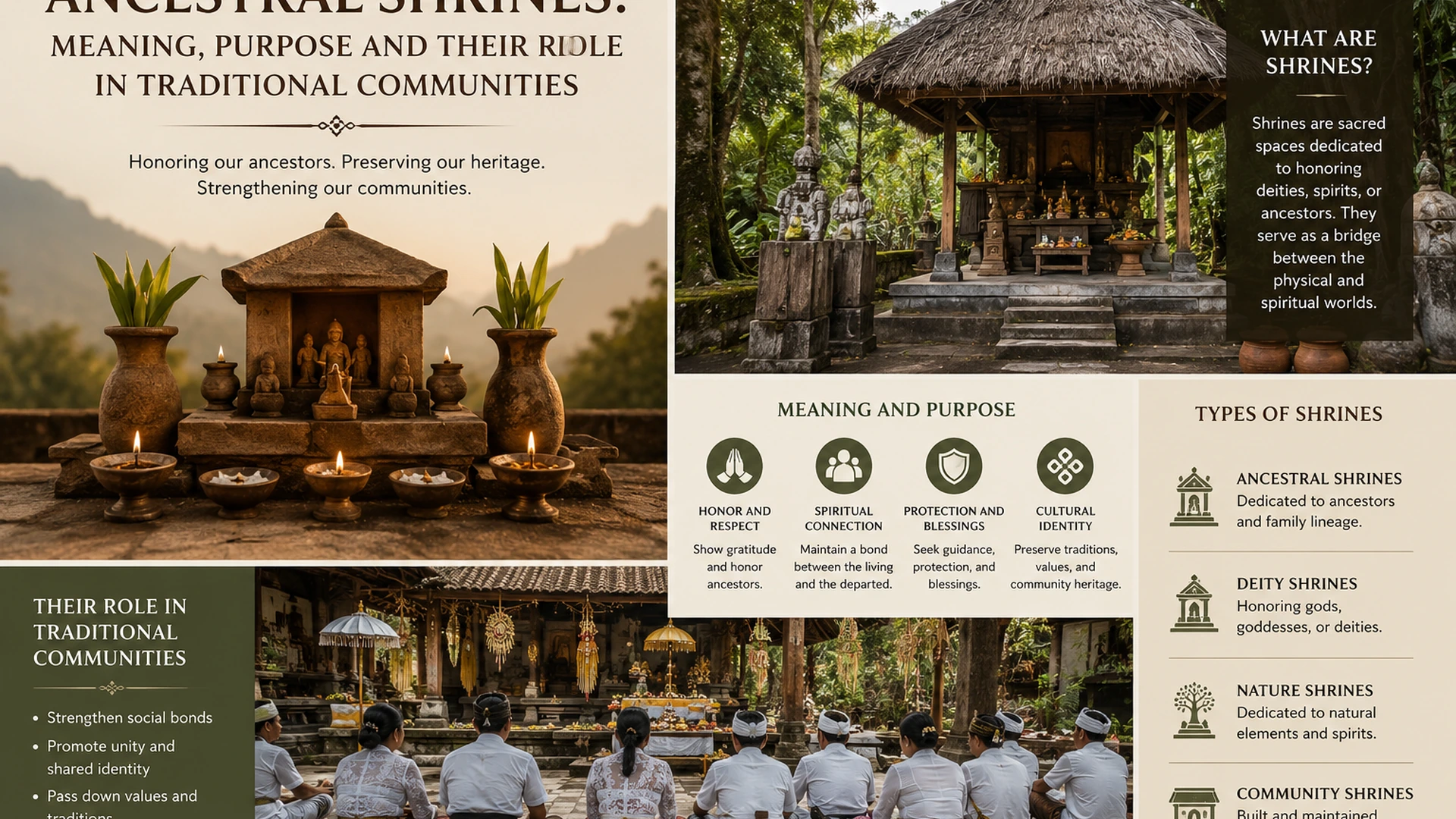
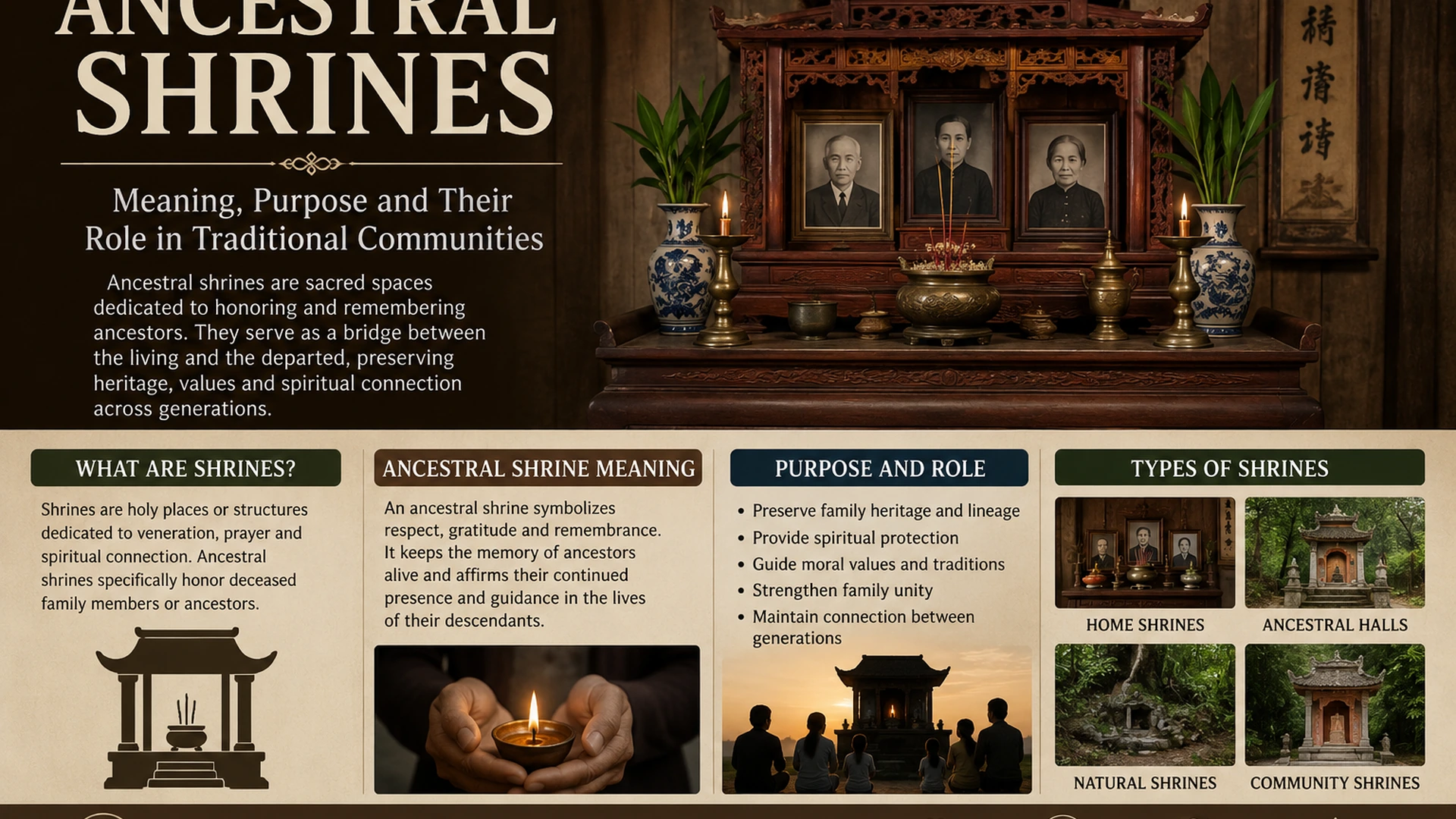
Shrines are culturally recognized places where people direct remembrance, prayer, offerings, vows or other forms of devotion. A shrine may be a small household space, a memorial st...
Shrines are culturally recognized places where people direct remembrance, prayer, offerings, vows or other forms of devotion. A shrine may be a small household space, a memorial structure, a room within a larger building, a royal burial complex, a sacred tree, a cave, a grove or an entire ritual landscape. What makes it a shrine is not its size but the religious or cultural meaning assigned to it and the practices maintained there.[1]
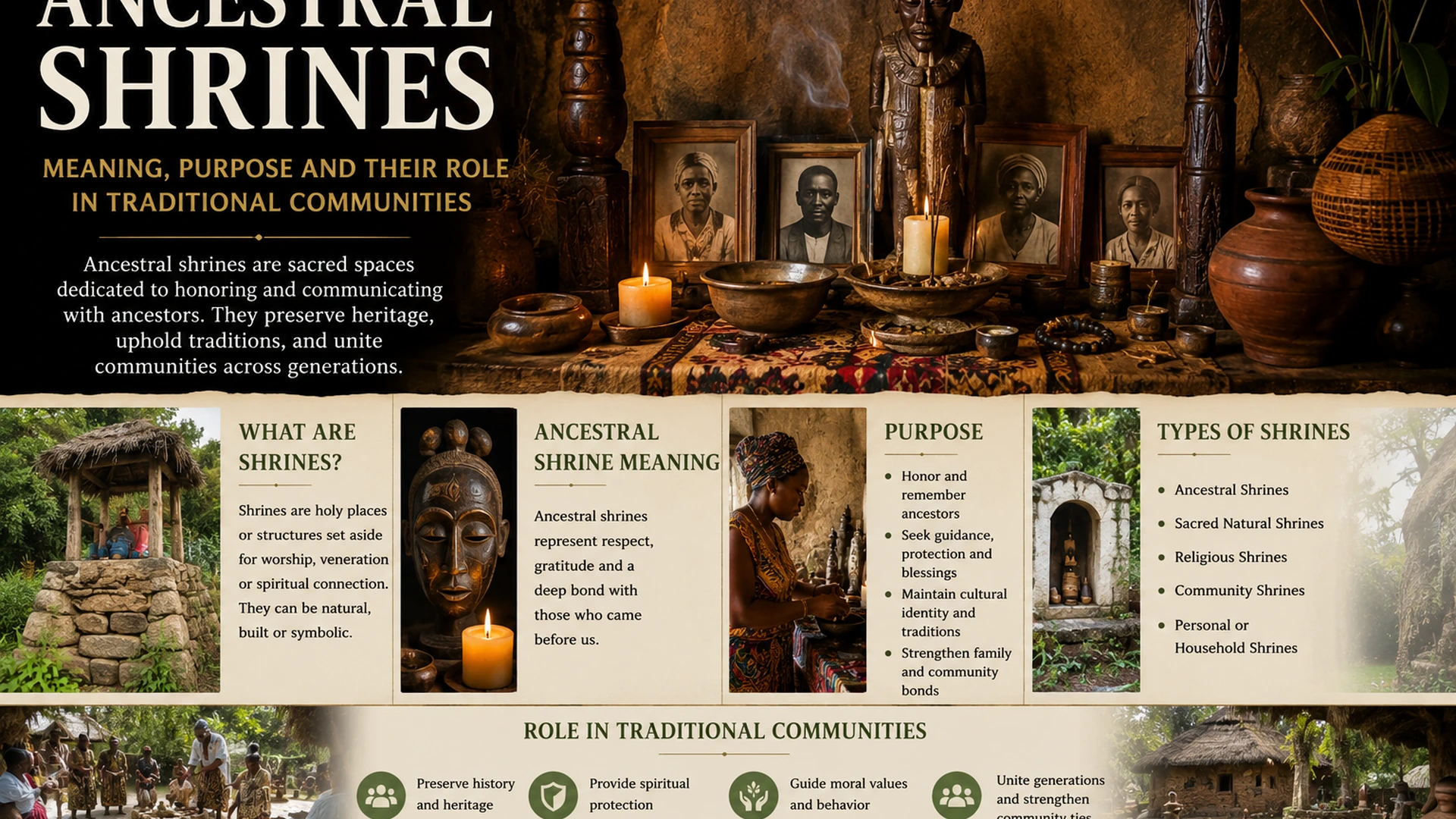
An ancestral shrine is specifically connected with deceased family members, lineage founders, former rulers or other forebears recognized by a community. It can preserve their memory, affirm descent, provide a setting for family gatherings and, within living religious belief, serve as a place where descendants address or honor ancestral presence.
There is no universal ancestral shrine design. In one community it may be an ancestor-rest house near a family compound. In another it may be a royal altar with commemorative artworks. Elsewhere it can be a tomb complex, a sacred hill, a tower-house understood as a temple of the ancestors or a hall holding spirit tablets. Each example must be understood through its own language, history, authority and rules.
Quick Answer
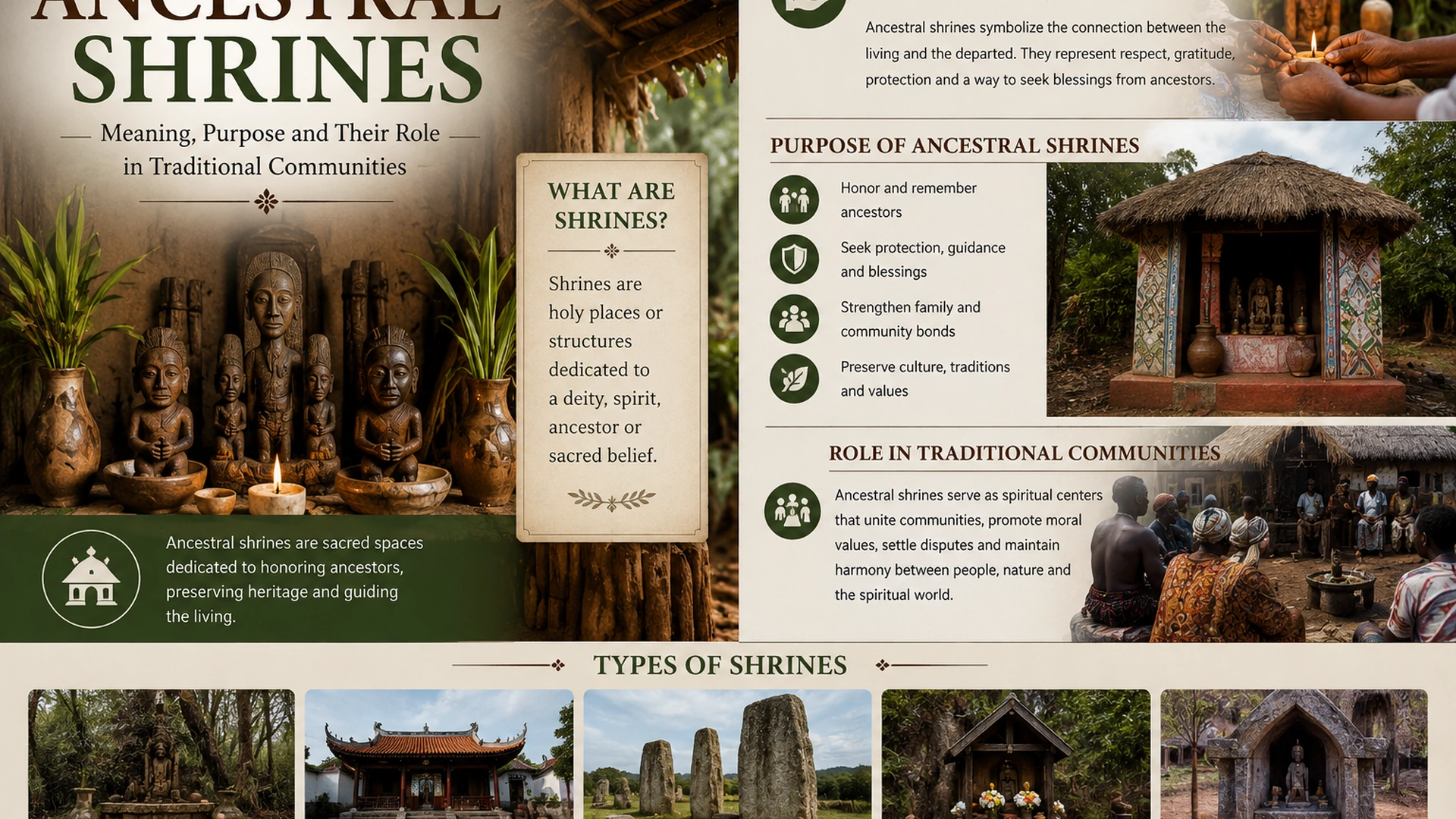
An ancestral shrine is a culturally designated place where a family, lineage, court or community remembers and relates to deceased forebears. It may contain memorial objects, graves, tablets, artworks or offerings, but no object is universal. Ancestral shrines can support remembrance, identity, ritual communication, moral authority and community continuity. Their meaning and permitted use differ by tradition.
What Are Shrines?
A shrine is a place set apart because people associate it with a sacred presence, person, event, object or relationship. Shrines may be dedicated to ancestors, deities, spirits, saints, rulers, natural forces or remembered events. Therefore, not every shrine is ancestral.
The word can describe both a complete structure and a focused sacred area within another place. A household shelf with memorial objects may function as a shrine. So may a small building in a family compound, an enclosed altar in a palace, a royal tomb or a landscape containing ritual paths, pools and forests.
Three features usually help identify a shrine:
A place may look ordinary to an outsider but remain sacred to those who inherit its meaning. Conversely, an old structure decorated with religious imagery is not automatically an active shrine if its original community no longer uses it that way.
What Is the Meaning of an Ancestral Shrine?
The meaning of an ancestral shrine comes from continuing relationships between descendants, social groups and remembered forebears. Scholars of African religions emphasize that ancestral traditions vary greatly, but deceased forebears may be understood as active moral or spiritual agents within particular cosmologies. It is more accurate to identify the community's own concepts than to assume a single African theology.[2]
The expression ancestor veneration is often preferable to “ancestor worship” when participants understand their actions as respect, remembrance or relationship rather than worship in the same sense offered to a supreme deity. Even this distinction varies by language and tradition. Archaeologists and historians also warn that labels such as “ancestor cult” can become empty categories when applied without strong contextual evidence.[13]
An ancestor is not always simply any deceased relative. Some communities recognize particular elders, founders, rulers or morally respected people as ancestors, while others use different criteria. The qualification may depend on age, descendants, social standing, manner of death, burial, ritual installation or family judgment. These rules should never be guessed from outside.
Shrine, Altar, Temple, Tomb or Memorial: What Is the Difference?
| Term | Basic meaning | How it may relate to ancestors |
|---|---|---|
| Shrine | A sacred or commemorative place focused on a presence, person, object or event | May be dedicated to an ancestor, lineage founder or deceased ruler |
| Altar | A surface or structure where offerings, ritual objects or prayers are presented | Can stand inside an ancestral shrine or form its main ritual focus |
| Temple | A larger building or complex dedicated to organized religious activity | May contain one or more shrines but is not necessarily ancestral |
| Tomb | A place containing or marking human remains | Can become an ancestral shrine when continuing rites and sacred meaning are attached to it |
| Memorial | A structure or object created to remember a person or event | May remain commemorative without being a ritual shrine |
| Sacred landscape | A wider natural and built environment understood through spiritual history and practice | May include several shrines, graves, rivers, forests, paths and ceremonial spaces |
These categories overlap. The Tombs of Buganda Kings at Kasubi are royal burial grounds, a major spiritual centre and a place of continuing ritual responsibility. The Batammariba's tower-houses in Koutammakou are dwellings, architectural symbols and temples dedicated to ancestors. The form alone does not decide the category; community meaning does.[6][10]
Major Types of Shrines
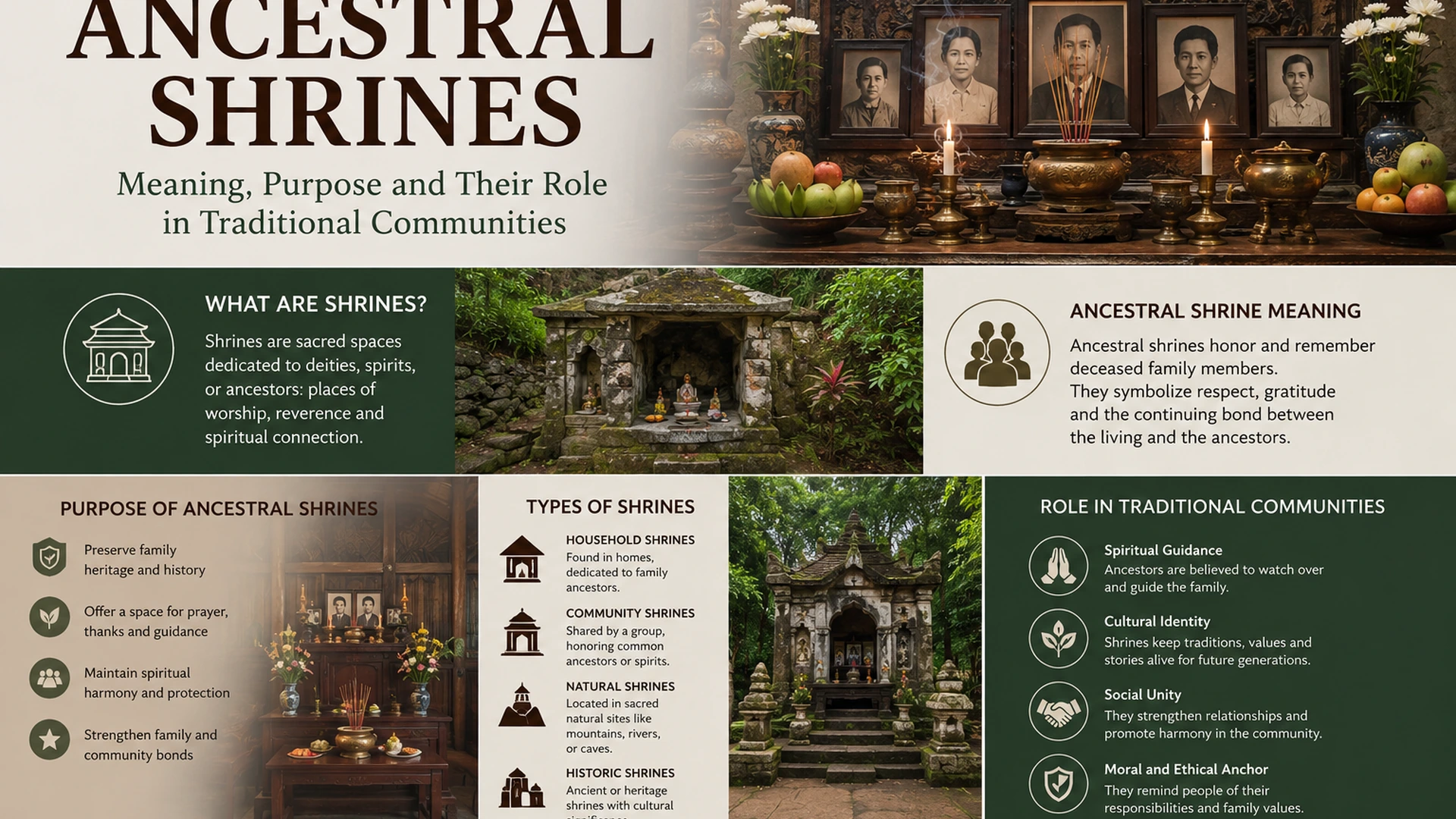
1. Household shrines
A household shrine is maintained within or beside a home. It may be dedicated to ancestors, a deity or another sacred relationship. Household shrines often connect religious practice with daily family life. Their scale may be small, but their authority can be significant.
Smithsonian documentation from Edo-speaking communities in Nigeria records household and village shrines connected with Olokun, demonstrating that household shrines are not necessarily ancestral. This is an important correction to the assumption that every traditional shrine honors the dead.[16]
2. Family or lineage ancestral shrines
A lineage shrine belongs to a descent group or extended family. It may preserve the memory of a founder and provide a meeting place for elders. Smithsonian field documentation from Afikpo in southeastern Nigeria describes a Mma obu, translated as an ancestor-rest house, located near a compound entrance. The documented shrine was associated with the lineage founder, male ancestors, meetings and feasts.[3]
3. Royal ancestral shrines
Royal shrines connect deceased rulers with dynastic continuity, political legitimacy and the welfare of a kingdom. In the Kingdom of Benin, each new oba commissioned a commemorative brass head for his predecessor and placed it on an ancestral altar in the palace. These altars included artworks and ritual objects through which the court maintained relations with royal ancestors.[4]
4. Deity or spirit shrines
Many shrines are dedicated not to human ancestors but to deities, spirits or forces associated with water, land, fertility, healing, rain or protection. The Asante Traditional Buildings near Kumasi include ten surviving shrine houses. They preserve distinctive earthen architecture and symbolic wall reliefs associated with Asante religious history.[7]
5. Sacred landscape shrines
A shrine may be inseparable from hills, forests, rivers, pools, rocks or paths. Malawi's Khulubvi and associated Mbona rain shrines form a network of ritual huts and natural sites linked to Mbona, understood as an ancestral spirit and rainmaker among Mang'anja communities. The landscape also carries histories of ecological knowledge, authority and collective responses to drought and crisis. The property was placed on Malawi's World Heritage Tentative List in 2025; tentative status is not the same as full World Heritage inscription.[9]
6. Funerary and tomb shrines
Some tombs become active shrines because descendants continue to visit, maintain rites and recognize a sacred presence. Other graves remain burial places or memorials without functioning as shrines. The distinction depends on continuing practice.
7. Pilgrimage and regional shrines
Certain shrines draw visitors from beyond one household or ethnic group. The Tonna'ab ancestral shrine in Ghana's Tong Hills has historically attracted pilgrims from neighboring populations. UNESCO's tentative-list description also records its importance during colonial resistance and the repeated reactivation of the shrine after British attempts to suppress it.[8]
8. Ancient or archaeological shrines
An ancient shrine is known through surviving architecture, inscriptions, artifacts, offering deposits or the spatial arrangement of a site. Archaeologists must infer practice from material evidence, and those interpretations can change. At Amarna in ancient Egypt, evidence indicates that statues and stelae were used in household shrines to honor and invoke important ancestors and other figures. This evidence supports the existence of household devotion but does not justify reconstructing every spoken prayer or private belief.[12][13]
Why Traditional Communities Build and Maintain Ancestral Shrines
Preserving family and lineage memory
An ancestral shrine can act as a physical archive. Names, sculptures, stools, photographs, tablets, graves, staffs or other memorial forms may connect living people with a known genealogy. The shrine helps place personal identity within a longer story.
Among Fon communities, memorial sculptures called asen can refer to an individual's occupation, religious relationships and family heritage through visual imagery. Smithsonian curators compare their personal references to the information communicated by an obituary or gravestone, while noting that the imagery often depends on names, proverbs and family knowledge.[15]
Affirming belonging
Shrines may help define who belongs to a household, lineage, court or community. Participation can confirm obligations between generations. In this sense, a shrine is not merely about the dead; it helps organize relationships among the living.
The Mma obu documented at Afikpo served as an ancestor-rest house as well as a meeting and feasting place for lineage elders. Its social and sacred functions were therefore intertwined.[3]
Maintaining ritual relationships
Within communities that understand ancestors as continuing participants in family or political life, a shrine can provide a recognized place for prayer, offerings, thanksgiving, petition or commemoration. These are religious beliefs and social practices, not scientifically testable proof that a spirit physically inhabits an object or building.
Benin palace altars illustrate this relationship at a royal level. Commemorative heads, carved tusks, bells and tableaux were not arranged as decoration alone. Museum records explain that they formed part of a system through which the reigning court honored previous rulers and incorporated their continuing influence into the kingdom's affairs.[4][5]
Supporting moral authority and responsibility
Ancestors may be remembered as moral elders whose lives establish examples, obligations or warnings. A shrine can become a setting where disputes, vows or family decisions are placed within the authority of previous generations.
This does not mean every decision is controlled by a shrine or that all community members interpret ancestral authority in the same way. Age, gender, religious affiliation, migration and education can shape different attitudes within the same family.
Connecting leadership with continuity
Royal ancestral shrines often make political succession visible. The Benin royal altar linked each new oba to his predecessor. Korea's Jongmyo Shrine houses spirit tablets of Joseon kings and queens and supported state ancestral rites tied to royal legitimacy and the welfare of the people. The comparison shows a shared concern with dynastic memory, but the architecture, ritual language and theology are distinct.[4][11]
Marking relationships with land
Shrines can connect a community's history to particular hills, rivers, forests, stones or settlement areas. Scholarship on African shrines emphasizes that they may express group cohesion, knowledge of landscape and claims of belonging as well as religious devotion.[14]
At Tenzug, shrines to the earth and ancestors form part of the Tallensi sacred landscape of the Tong Hills. At Khulubvi, ritual huts cannot be separated from the rivers, pools, forests and oral histories associated with Mbona. Such sites challenge the assumption that a shrine must be a small building.[8][9]
Organizing collective action
Regional shrines can become centres for festivals, conflict mediation, rain ceremonies, healing consultation or responses to social crisis. The Khulubvi nomination describes shrine custodianship and ritual diplomacy as historically important in mobilizing communities during drought, disease and other stresses.[9]
These historical and cultural roles should not be converted into guaranteed claims that rituals control weather or cure disease. The documented fact is that communities used shrine institutions to organize interpretation, responsibility and action in uncertain conditions.
Preserving artistic and architectural knowledge
Shrines can preserve building techniques, sculpture, metalwork, textile traditions, oral histories and ceremonial music. The surviving Asante shrine houses use timber, bamboo and mud plaster, with wall reliefs carrying symbolic motifs. Their conservation depends on maintaining both material knowledge and the living relationships that give the buildings meaning.[7]
African Examples of Ancestral and Sacred Shrines
Mma obu in Afikpo, Nigeria
The Mma obu is a documented ancestral shrine house associated with a lineage founder in an Afikpo compound. Smithsonian field notes describe it as a place where ancestral spirits were said to reside and as a meeting and rest space for lineage elders. Its location near the compound entrance connected memory, authority and community assembly.[3]
Royal ancestral altars in Benin, Nigeria
Benin royal altars were established for deceased obas and queen mothers. Commemorative heads, ivory tusks, bells and brass tableaus recalled the rank and achievements of the deceased while facilitating ritual communication in court belief. The altars also reinforced political continuity between a reigning oba and his predecessors.[4][5]
Kasubi Tombs in Uganda
The Kasubi site began as a palace built in 1882 and became royal burial grounds in 1884. It contains the tombs of four Kabakas and remains a major spiritual centre for the Baganda. Its importance rests not only in monumental architecture but also in belief, continuity, identity and the responsibilities of traditional custodians.[6]
Asante shrine houses in Ghana
The Asante Traditional Buildings are ten surviving shrine houses near Kumasi. Their earthen construction and bas-relief decoration preserve a distinctive architectural tradition. They are sacred buildings, but they should not automatically be described as ancestral shrines because particular houses may be associated with deities or spiritual powers rather than lineage ancestors.[7]
Tallensi shrines at Tenzug, Ghana
The Tong Hills contain shrines to the earth and ancestors, including Tonna'ab. The landscape demonstrates how a shrine can become a regional religious centre, a place of pilgrimage, a symbol of resistance and a focus of relationships between people and land.[8]
Khulubvi and Mbona rain shrines in Malawi
Khulubvi is associated with Mbona, an ancestral spirit and rainmaker in Mang'anja tradition. Its shrines, forests, rivers and pools form one cultural landscape. The site illustrates how spiritual governance, environmental knowledge and communal responses to drought can be organized through a network rather than one altar.[9]
Batammariba tower-houses in Togo and Benin
In Koutammakou, Batammariba tower-houses are more than domestic structures. UNESCO describes the takienta as a temple dedicated to ancestor worship, embedded within a cultural landscape that also includes sacred woods, rocks, springs and ritual paths. The example shows how home, architecture and ancestral relationship can form one system.[10]
What May Be Found at an Ancestral Shrine?
No universal list exists. Depending on the tradition, a shrine may include:
Objects must be interpreted through their original context. A brass head from Benin, an iron asen from Ouidah and a Korean spirit tablet do not express the same religious idea simply because each can appear at an ancestral site.[4][11][15]
Museum collections also require historical care. Many African sacred and royal objects entered European and North American collections through colonial violence, military expeditions, unequal exchange or poorly documented collecting. Their current display should not erase the shrines, communities and historical relationships from which they came.
Who Maintains an Ancestral Shrine?
Custodianship may belong to:
The office may be inherited, selected, initiated or rotated. Authority cannot be assumed from age or public visibility alone. A researcher, tourist, family member who lives abroad or government official may not have permission to enter restricted areas or handle sacred objects.
What Happens at an Ancestral Shrine?
Publicly documented activities may include cleaning, prayer, spoken remembrance, presentation of offerings, libation, music, annual commemoration, installation of memorial objects, family meetings or consultation with custodians. Not every shrine uses all of these practices.
This article intentionally does not provide a step-by-step ancestral ritual. Copying isolated actions can remove them from community authority and may expose restricted knowledge. Educational writing should explain public meaning without manufacturing a ceremony for readers to imitate.
Ancient Shrines and Archaeological Evidence
The phrase ancient shrine refers to a sacred place known primarily through archaeological or historical evidence rather than an uninterrupted living tradition. Archaeologists examine architecture, object placement, inscriptions, remains of offerings, repeated burning, wear patterns and relationships with graves or houses.
At Amarna, evidence of stelae and statues in domestic settings suggests household invocation and honoring of important ancestors and community figures. Ancient Egyptian tomb complexes also contained offering places connected with the deceased. These findings demonstrate ritual attention to the dead, but scholars must avoid projecting one modern model of ancestor worship onto every ancient object.[12][13]
Archaeological interpretation has limitations:
A responsible article therefore distinguishes between excavated evidence, scholarly interpretation and living community testimony.
Are Ancestral Shrines Still Used Today?
Yes, many ancestral and sacred shrines remain active, but their use changes. Families may combine inherited practices with Christianity, Islam, Buddhism, civil memorial customs or modern heritage management. Urbanization can move household shrines into new forms, while migration may lead relatives abroad to participate through visits, remittances or digital communication.
Continuity does not require every detail to remain unchanged. The reconstruction of the Kasubi Tombs after the 2010 fire, for example, required cooperation among the Buganda Kingdom, Ugandan authorities, UNESCO and practitioners so that both architecture and living cultural values could be safeguarded. The restored site was removed from the List of World Heritage in Danger in 2023.[6]
Some shrines decline when custodians die, land is lost, religious affiliation changes or younger generations are not taught the relevant language and responsibilities. Others are revived as expressions of identity, political authority, tourism or heritage. Revival can strengthen a tradition, but it may also create disputes over ownership, access and authenticity.
Common Misunderstandings About Shrines
“All shrines are ancestral”
False. Shrines may be dedicated to deities, spirits, saints, natural forces, rulers, events or sacred objects. An ancestral shrine is one type.
“A shrine is always a building”
False. It may be a shelf, altar, grave, tree, rock, pool, grove, cave, hill or network of places.
“Shrine and altar mean the same thing”
Not exactly. An altar is often the surface where ritual actions occur, while a shrine is the wider sacred focus or place. An altar can stand within a shrine.
“Every dead relative becomes an ancestor”
Not in every tradition. Communities may have specific qualifications for ancestral status.
“Ancestor veneration means worshipping ancestors as gods”
Sometimes outsiders use that wording, but participants may understand the relationship as respect, remembrance, moral kinship or mediation. Use the community's own terms whenever possible.[2][13]
“Ancient shrines reveal every detail of ancient belief”
No. Archaeology provides material evidence that requires interpretation. Private speech, emotion and restricted knowledge rarely survive intact.
“Sacred objects have universal meanings”
No. Colours, foods, bells, statues, trees and vessels can have different meanings in different traditions.
“Anyone may photograph or enter a shrine”
No. Access may be restricted by kinship, initiation, gender, office, season or community decision.
Cultural Cautions and Ethical Boundaries
Identify the specific community
Avoid phrases such as “Africans believe” or “tribal shrines.” Name the Baganda, Edo, Afikpo, Asante, Tallensi, Mang'anja or Batammariba where evidence supports that identification.
Do not invent a combined ritual
Objects from Benin, clothing from Ghana, architecture from Uganda and symbols from another region should not be assembled into a fictional “African ancestral shrine.” Such mixing misinforms readers and may disrespect living traditions.
Protect restricted knowledge
Do not publish private names, medicinal preparations, initiation procedures, sacred songs or interior photographs merely because they might attract traffic. Community permission matters more than online novelty.
Separate belief from proof
A community may believe that ancestors protect, advise, discipline or bless descendants. State this as cultural or religious belief. Do not promise supernatural, medical, legal or financial outcomes.
Respect human remains and funerary spaces
Royal tombs and family graves are not ordinary tourist props. Avoid intrusive photography, touching objects, loud behavior or commercial staging.
Acknowledge colonial disruption
Shrines have sometimes been destroyed, prohibited, looted or reclassified by colonial governments and missionaries. Museum objects may be separated from the sites and relationships that made them meaningful. Historical context should accompany visual appreciation.
Let custodians define respectful access
Visitors should follow local guidance about clothing, photography, offerings, speech and entry. Rules may change, and public access to one part of a site does not imply access to every room or ceremony.
How Shrines Support Traditional Communities
Ancestral and sacred shrines can support communities in several connected ways:
These functions are not present everywhere, and a shrine can also become a site of disagreement. Families may debate legitimacy, gender roles, expense, land rights or the relationship between inherited traditions and newer religions.
How to Study Ancestral Shrines Responsibly
Begin with the local name for the shrine and ask who has authority to explain it. Use community-based research, African scholars, museums, universities and official heritage bodies. Compare historical accounts with present-day testimony because traditions and terminology change.
When examining an old photograph or museum object, ask:
A shrine should not be treated as a collection of exotic objects. Its deepest significance often lies in relationships, memory, authority and place.
Key Takeaways
People Also Ask
What is an ancestral shrine?
An ancestral shrine is a culturally designated place where descendants remember, honor or relate to deceased forebears. It may be a household space, lineage house, altar, tomb, royal complex or sacred landscape. Its objects and practices vary by community.
What are shrines?
Shrines are places set apart for sacred attention, remembrance or devotion. They may honor ancestors, deities, saints, spirits, rulers, events or natural features. A shrine can be small or form an entire landscape.
What is the purpose of a shrine?
A shrine can focus prayer, remembrance, offerings, identity, pilgrimage or community gatherings. An ancestral shrine may also preserve genealogy, affirm lineage and connect leadership with earlier generations.
What are the main types of shrines?
Common categories include household shrines, lineage shrines, royal ancestral shrines, deity shrines, tomb shrines, sacred-landscape shrines, pilgrimage shrines and archaeological shrines. These categories may overlap.
What is the difference between a shrine and an altar?
An altar is usually a surface or structure used for presenting offerings or ritual objects. A shrine is the wider sacred place or focus. An ancestral shrine may contain an altar.
What is an ancient shrine?
An ancient shrine is a sacred place identified through historical or archaeological evidence. Scholars use architecture, inscriptions, artifacts and offering deposits to interpret it, but some details of belief may remain unknown.
Are all sacred shrines ancestral?
No. Sacred shrines may be dedicated to deities, spirits, saints, natural forces, events or ancestors. The shrine's dedication must be established from reliable cultural or historical evidence.
Frequently Asked Questions
What is another name for an ancestral shrine?
Depending on the tradition, it may be called an ancestor shrine, lineage shrine, memorial altar, ancestor house, spirit-tablet hall or royal tomb shrine. Local names are more accurate than a universal English label.
What is kept on an ancestor shrine?
Possible items include memorial images, tablets, stools, bells, vessels, cloth, genealogical records, food or drink offerings. No item is universal, and some shrines contain no portable objects.
Who is allowed to use an ancestral shrine?
Rules vary. Access may belong to family members, lineage elders, custodians, priests, rulers or initiated participants. Visitors should ask permission rather than assume public access.
Can a tomb be an ancestral shrine?
Yes, when continuing sacred meaning and ritual practice are attached to it. Not every tomb functions as a shrine.
Are ancestral shrines only found in Africa?
No. Ancestor shrines occur in many regions. Jongmyo in Korea is a major royal ancestral shrine, while ancient Mediterranean and Asian societies also maintained household or state forms of ancestor devotion.[11]
Are ancestral shrines still relevant in cities?
Yes. Families may maintain adapted household spaces, visit rural or royal sites, support custodians or combine inherited traditions with other religions. Urban practice varies considerably.
Can an ancestral shrine guarantee protection or prosperity?
No outcome can be scientifically guaranteed. A shrine may provide religious meaning, family solidarity or cultural continuity, but claims of guaranteed protection, wealth, fertility or healing should not be presented as fact.
Is it respectful to create an ancestral shrine from another culture?
Copying another community's restricted objects or rites without authority may be disrespectful. A person can create a personal memorial space for their own relatives without falsely claiming it is an inherited ritual from a culture they do not belong to.
Conclusion
Ancestral shrines are places where memory becomes material, social and, within living belief, spiritual. They can be as small as a household focus or as extensive as a royal tomb complex and sacred landscape. Their purpose may include remembrance, kinship, moral reflection, political continuity, ritual communication, environmental custodianship and community assembly.
The most important lesson is that a shrine cannot be understood from appearance alone. A brass head, an earthen house, a royal tomb, a spirit tablet and a sacred hill belong to different histories. Their meaning comes from the communities that name, maintain and interpret them.
Final Summary
A shrine is a sacred or commemorative place, while an ancestral shrine specifically relates to forebears recognized by a family, lineage, court or community. There are household, lineage, royal, tomb, landscape and ancient archaeological forms. Responsible study identifies the exact culture, distinguishes belief from proof, respects restricted access and recognizes that living shrine traditions continue to change.
Research Sources and Further Reading
5. Suggested Internal Links
| Suggested anchor text | Suggested internal destination | Purpose |
|---|---|---|
| ancient shrines in African history | /blog/ancient-shrines-african-history | Support the archaeological and historical cluster |
| ancestor reverence in African traditions | /blog/ancestor-reverence-african-traditions | Explain relationships with forebears without duplicating the shrine page |
| sacred places in African traditions | /blog/sacred-places-african-traditions | Connect buildings, landscapes and ritual geography |
| sacred forests in African traditions | /blog/sacred-forests-african-traditions | Expand sacred-landscape conservation |
| rivers in African spiritual heritage | /blog/rivers-african-spiritual-heritage | Support Khulubvi's water and landscape context |
| mountains with cultural significance | /blog/mountains-cultural-significance | Connect Tenzug and sacred hills |
| sacred caves through history | /blog/sacred-caves-through-history | Extend the types-of-shrines cluster |
| the role of elders in African traditions | /blog/role-of-elders-african-traditions | Expand custodianship and authority |
| how communities remember ancestors | /blog/how-communities-remember-ancestors | Support memory and genealogy themes |
| protective symbols in traditional cultures | /blog/protective-symbols-traditional-cultures | Link carefully from shrine objects and symbolism |
| libation ceremonies and their meaning | /blog/libation-ceremonies-meaning | Explain one possible public practice without implying universality |
| preserving indigenous knowledge | /blog/preserving-indigenous-knowledge | Support heritage conservation and ethical documentation |
6. Glossary
| Term | Definition |
|---|---|
| Shrine | A culturally recognized sacred or commemorative place focused on a presence, person, object, event or relationship |
| Ancestral shrine | A shrine associated with deceased forebears recognized by a family, lineage, court or community |
| Ancestor veneration | Ceremonial respect, remembrance or relationship directed toward deceased forebears; meanings vary by tradition |
| Altar | A surface or structure where offerings or ritual objects are presented |
| Temple | A building or complex dedicated to organized religious practice, often containing several sacred areas |
| Lineage | A descent group tracing relationships through a recognized ancestral line |
| Kinship | Social relationships formed through descent, marriage, adoption or other culturally recognized ties |
| Custodian | A person or group responsible for care, access and ritual or heritage rules at a sacred site |
| Sacred landscape | A natural and built environment whose places are connected through religious history and practice |
| Libation | The ceremonial pouring of liquid; meaning and permission vary by culture |
| Offering | Food, drink, objects or actions presented within a religious relationship |
| Spirit tablet | A tablet representing or naming a deceased person in some East Asian ancestral traditions |
| Royal ancestral shrine | A shrine dedicated to deceased rulers or royal family members |
| Tomb shrine | A burial place that also functions as a continuing sacred or ritual site |
| Mma obu | An Afikpo term documented as an ancestor-rest house associated with a lineage founder and elders' meetings |
| Asen | A Fon memorial altar or sculpture whose imagery may refer to a specific ancestor's life and family history |
| Oba | The title of the ruler of the Kingdom of Benin |
| Kabaka | The title of the king of Buganda |
| Takienta | A Batammariba tower-house understood as both a dwelling and a temple connected with ancestors |
| Archaeological interpretation | A scholarly explanation based on material evidence, distinguished from direct testimony or proven ritual detail |
7. Related Article Recommendations
Article Information
- Publisher
- Ancestral Temple
- Editor
- Ancestral Temple
- Last updated
- Jul 26, 2026
- Last reviewed
- Jul 26, 2026
- Content version
- 0b29f6aa21
This educational article should be read as cultural and spiritual information, not as medical, legal, financial, or emergency advice.
Helpful Related Guidance
Explore This Topic
Related Topic Cluster
Dreams & Symbolism
About the Author
 Ancestral Temple
Spiritual guide and practitioner with decades of experience in ancestral wisdom, rituals, and divine guidance.
Related Posts
View All






Leave a Comment
We'd love to hear your thoughts.