
Where Does Frankincense Come From? Trees, Regions and Ancient Trade
Quick Summary
Frankincense comes from the dried aromatic resin of several trees and shrubs in the genus Boswellia. These plants are native mainly to dry landscapes in the southern Arabian Penins...
Frankincense comes from the dried aromatic resin of several trees and shrubs in the genus Boswellia. These plants are native mainly to dry landscapes in the southern Arabian Peninsula, the Horn of Africa, parts of northeastern and East Africa, and the Indian subcontinent. The best-known source species include Boswellia sacra in Oman, Yemen and northern Somalia; Boswellia frereana in northern and northeastern Somalia; Boswellia papyrifera across a broad belt of seasonally dry African woodland; and Boswellia serrata in India. The resin is also called olibanum.
This origin is botanical, geographic and human at the same time. A piece of frankincense begins as a defensive secretion inside a living tree. It becomes a trade product only after skilled collectors make controlled cuts, allow the exudate to harden, gather the “tears,” sort them and move them through local and international markets. For thousands of years, producers, port communities, caravan workers, merchants, priests, perfumers and healers have given the resin different meanings and uses.
No single country can claim every form of frankincense, and no single species represents the entire tradition. Dhofar in southern Oman is famous because its Boswellia sacra groves and archaeological ports preserve an unusually visible record of production and trade. Somalia and Somaliland contain major natural populations and distinctive resins, while Ethiopia, Eritrea, Sudan and neighbouring drylands have long supplied frankincense from Boswellia papyrifera and related species. India has its own frankincense tradition centred on Boswellia serrata. Understanding these distinctions prevents cultural and botanical oversimplification. [1–5]
Specific culture or historical context: Contemporary Dhofari frankincense harvesting in southern Oman, presented as agricultural and cultural heritage.
People shown: One adult Omani frankincense harvester in practical, locally appropriate clothing; natural pose and accurate hands.
Location: Wadi Dawkah or a comparable Dhofar wadi with rocky alluvial ground, scattered Boswellia sacra trees and arid mountains.
Clothing: Modest contemporary Omani field clothing; no fantasy robes or theatrical costume.
Architecture: None required; distant dryland landscape only.
Objects: Small traditional tapping tool, woven collection bag and a few natural resin tears; no altar, crystals or random ritual props.
Lighting: Warm early-morning or late-afternoon natural light with realistic shadows and pale limestone tones.
Composition: Wide 16:9 documentary frame with the tree as the main subject, harvester to one side and negative space for website cropping.
SEO-friendly filename: frankincense-origin-boswellia-trees-dhofar.webp
Image title: Frankincense Origins in the Boswellia Drylands
Alt text: Omani frankincense harvester beside a Boswellia sacra tree in the dry landscape of Dhofar
Caption: Frankincense begins as aromatic oleo-gum-resin produced by Boswellia trees adapted to dry landscapes in Arabia, Africa and India.
Recommended placement: After the introduction and before the Quick Answer.
Article section supported: Introduction and direct origin answer.
Important elements to avoid: Embedded text, labels, logos, watermarks, fantasy smoke, glowing resin, invented ritual, excessive wounds, damaged tree, distorted hands or generic desert stereotypes.
Quick Answer
Frankincense is an aromatic oleo-gum-resin obtained from several Boswellia species. Its best-known source regions are southern Oman and Yemen, northern Somalia and Somaliland, Ethiopia, Eritrea, Sudan and neighbouring African drylands, plus India. Collectors tap the bark, let the resin harden into “tears,” and then sort and trade it. There is no single universal frankincense tree or country of origin.
What Is Frankincense?
Frankincense is the hardened aromatic exudate of Boswellia trees and shrubs in the Burseraceae family. Botanists describe it as an oleo-gum-resin because it contains volatile aromatic oil, resin-soluble compounds and water-soluble gum. When the bark is wounded naturally or deliberately, the tree releases a pale emulsion from a network of resin canals in the inner bark. Exposure to air gradually turns the sticky material into firm drops or irregular pieces commonly called tears. [12–13]
The word olibanum is widely used as another name for frankincense. In different languages and markets, local names may identify a species, a producing district, a quality grade or a customary product. Commercial labels are therefore not always reliable botanical names. Two sacks sold under the same broad word “frankincense” may come from different species and landscapes, have different aromas, and serve different local purposes.
Frankincense is not the same as an essential oil. The resin is the solid harvested material. Frankincense essential oil is a later product distilled from that resin. Incense mixtures, perfumes, extracts and cosmetic products may contain the resin, its oil or additional ingredients. Readers should check the product description rather than assuming every item labelled frankincense is raw Boswellia resin.
What Tree Does Frankincense Come From?
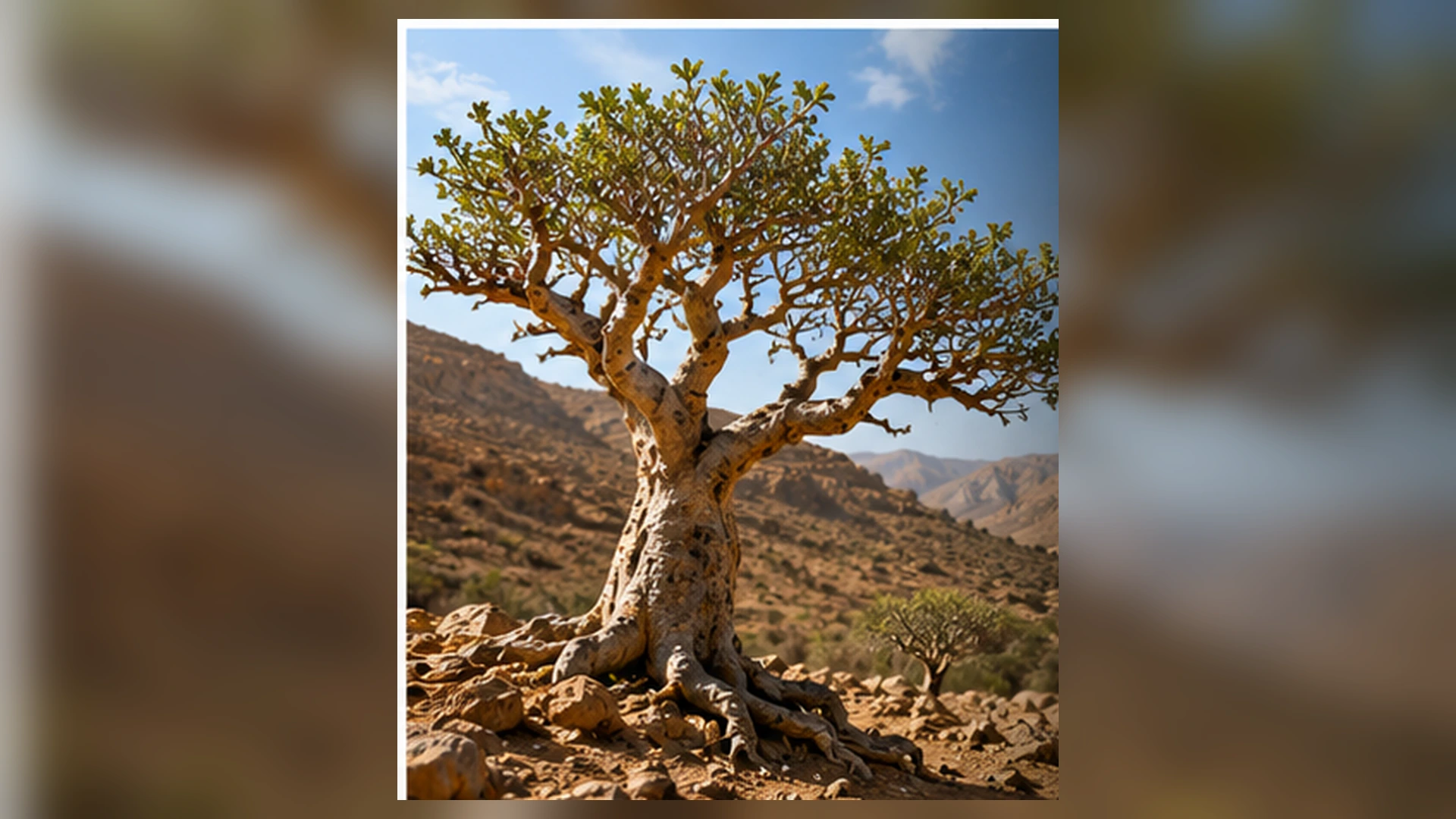
Frankincense comes from the genus Boswellia, not from a single species. Kew’s current botanical database places the genus across tropical Africa, Madagascar, the Arabian Peninsula and India. Many Boswellia species produce aromatic gum-resins, but only a smaller group has supplied major regional or international trade. [1]
| Species | Native range | Typical biome | Why it matters |
|---|---|---|---|
| Boswellia sacra | Northern and northeastern Somalia; southern Yemen; southwestern Oman | Desert and dry shrubland | Strongly associated with Dhofar and internationally traded Arabian/Somali frankincense |
| Boswellia frereana | Northern and northeastern Somalia | Rocky drylands and escarpments | Produces the resin commonly known locally as maydi/maidi; important in Somali trade and chewing traditions |
| Boswellia papyrifera | From northeastern Nigeria across parts of central and northeastern Africa to Eritrea and northeastern Uganda | Seasonally dry tropical woodland | Major African frankincense source, especially associated with Ethiopia, Eritrea and Sudanese trade |
| Boswellia serrata | Indian subcontinent, including India and the western Himalaya/Assam range recorded by Kew | Seasonally dry tropical forest | Indian frankincense, often called salai or Indian olibanum |
| Boswellia neglecta and related East African species | Parts of Ethiopia, Kenya, Somalia, Tanzania and Uganda | Desert or dry shrubland | Regional resin sources; names and market uses vary |
Species names matter because chemistry, aroma, colour, harvesting custom and ecological risk can differ. However, species identity is only one part of quality. Climate, soil, tree condition, season, wound management, storage and sorting also affect the final resin. Claims that one origin is always “the best” often reflect a particular market preference rather than a universal scientific standard.
Specific culture or historical context: Contemporary Somali frankincense landscape associated with Boswellia frereana and local maydi trade.
People shown: One Black Somali adult collector, presented respectfully as a skilled land-based worker.
Location: Northern or northeastern Somalia/Somaliland limestone escarpment or dry mountain slope.
Clothing: Practical modest Somali field clothing suitable for heat and rocky terrain.
Architecture: No invented village or shrine; distant simple settlement may appear only if contextually accurate.
Objects: Woven resin basket, small tapping tool and natural resin pieces.
Lighting: Clear morning light with realistic dryland haze and textured rock.
Composition: Wide landscape with the tree and collector in the foreground and escarpment scale visible behind.
SEO-friendly filename: somali-frankincense-boswellia-frereana-cliffs.webp
Image title: Somali Frankincense and Boswellia frereana
Alt text: Somali frankincense collector inspecting a Boswellia frereana tree on a rocky dryland escarpment
Caption: Northern Somalia and Somaliland contain important native Boswellia populations, including Boswellia frereana, a source of the resin known as maydi.
Recommended placement: After the species comparison and before the regional sections.
Article section supported: Frankincense tree species and Horn of Africa origins.
Important elements to avoid: Piracy stereotypes, weapons, poverty staging, ritual smoke, generic tribal costume, over-tapped bark, incorrect lush forest, embedded text, logos or distorted anatomy.
The Main Frankincense-Producing Regions
The natural distribution of Boswellia is wider than the best-known commercial labels. The regions below are important because they combine suitable dryland ecology with generations of harvesting, sorting, local use and trade. Boundaries shown on modern maps do not erase older cultural and ecological connections across the Gulf of Aden, Red Sea and inland African drylands.
Dhofar in southern Oman
Dhofar is one of the world’s most recognizable frankincense landscapes. Boswellia sacra grows in wadis, limestone slopes and dry coastal-mountain environments shaped by extreme heat and seasonal moisture. UNESCO’s Land of Frankincense property links the living trees of Wadi Dawkah with the caravan oasis of Shisr and the ports of Khor Rori and Al-Baleed. Together, these places show that production, storage, transport and maritime exchange were parts of one system. [2,6]
Dhofar’s fame does not mean that all frankincense originates in Oman. It means that Oman preserves an unusually complete and publicly documented cultural landscape around one major source species. The region’s resins are often graded by appearance, aroma and producing zone, but market terms should not be confused with formal botanical categories.
Southern and eastern Yemen
Boswellia sacra is also native to southern Yemen, including drylands connected historically with Hadramawt and Mahrah. Ancient South Arabian kingdoms occupied strategic positions between producing landscapes, inland caravan routes and ports facing the Red Sea and Indian Ocean. Political instability and limited access can make present-day supply chains difficult to document, so responsible writing should not treat “Yemeni frankincense” as a single uniform product.
Northern Somalia and Somaliland
Northern and northeastern Somalia are within the native range of Boswellia sacra and the exclusive native range recorded by Kew for Boswellia frereana. Trees grow on harsh slopes and escarpments where harvesting requires detailed local knowledge. Somali resins have long moved through ports facing the Gulf of Aden and into Arabian, African and wider international markets. [2,4]
Boswellia frereana is associated with the local resin name maydi or maidi. Some of it is chewed rather than burned, demonstrating why frankincense should not be described only as church incense or perfume material. Local categories, tastes and practices deserve attention alongside export markets.
Ethiopia, Eritrea, Sudan and the wider Boswellia papyrifera belt
Boswellia papyrifera occupies a broad seasonally dry African range extending from northeastern Nigeria toward Eritrea and northeastern Uganda. Commercial production has been particularly important in the dry woodlands of Ethiopia, Eritrea and Sudan. These landscapes support rural livelihoods, livestock, bees, soil protection and other ecological functions in addition to resin production. [3,12]
Because the species occurs across many countries and communities, there is no single “African frankincense tradition.” Harvest schedules, tools, labour roles, grading systems, land tenure and religious uses differ. In some northern Ethiopian production systems, men have traditionally carried out much of the tapping and collection while women have participated strongly in cleaning, sorting and grading. Such patterns may change by place and over time and should not be generalized to every community.
India and Boswellia serrata
India has an independent frankincense tradition centred on Boswellia serrata, often known as Indian olibanum or salai. Kew records the species as native to the Indian subcontinent, while forestry sources document tapping of the bark for gum oleo-resin. Indian material is used in incense and in commercial extracts, but product claims about health effects require separate scientific evaluation and should not be inferred from ancient or religious use. [5]
Why Boswellia Trees Thrive in Dry Landscapes
Boswellia trees are adapted to environments that can look inhospitable: rocky slopes, shallow soils, seasonal drought, high temperatures and irregular rainfall. Some species develop swollen trunk bases, peeling bark and deciduous leaves that reduce water loss during dry periods. Their roots can anchor in cracks and unstable ground where many larger trees struggle.
These adaptations do not make the trees indestructible. Seedlings remain vulnerable to grazing, fire and trampling. Mature trees can be weakened by repeated wounds, insect attack and loss of surrounding woodland. A resin-producing tree may survive in a dry place for decades while its population quietly ages because too few young trees are replacing it.
How Frankincense Is Harvested
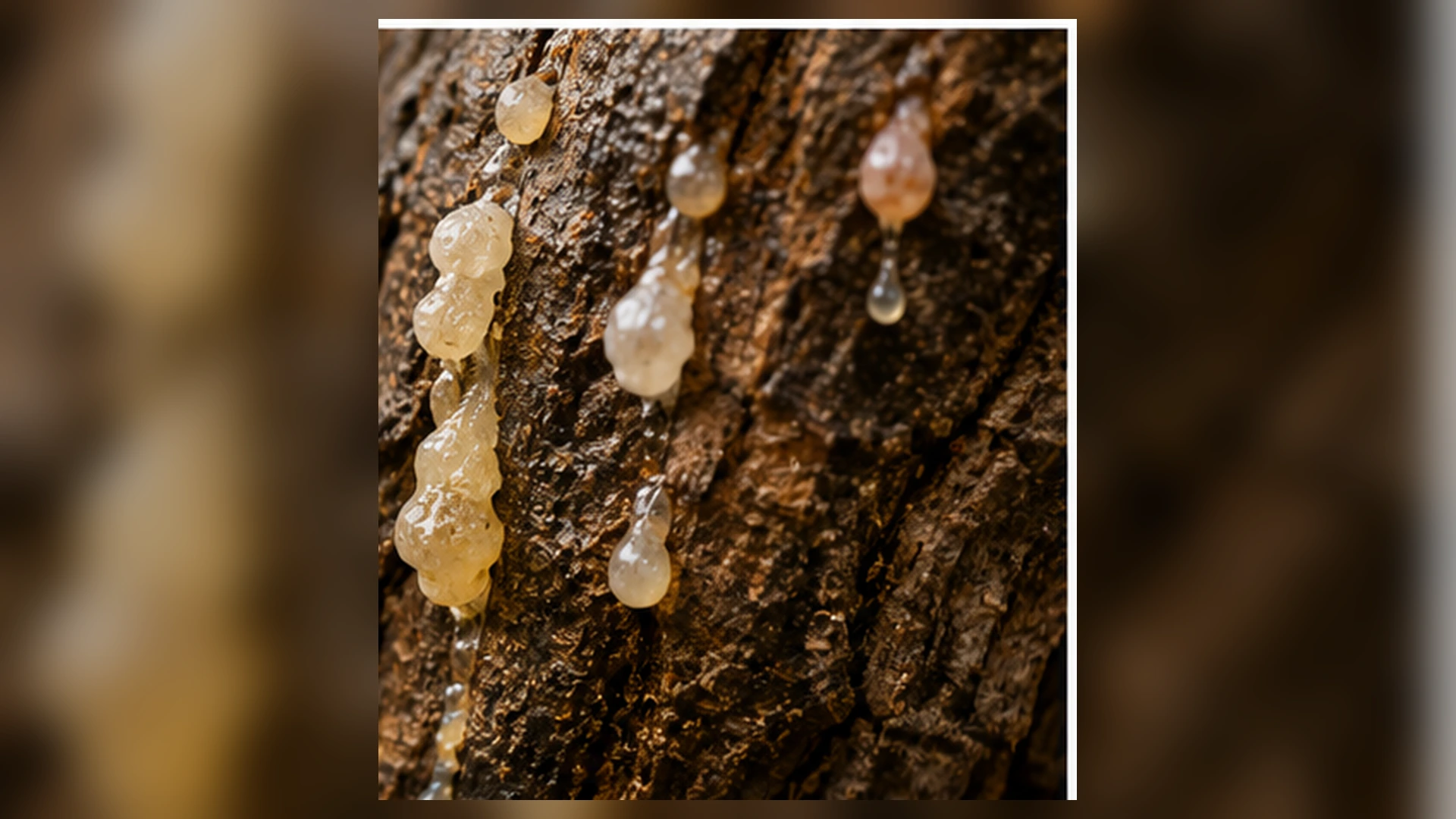
Frankincense is usually harvested by tapping: a collector removes or cuts a small area of outer bark to reach resin-bearing tissue. A milky or translucent exudate appears and begins to dry. On a later visit, the hardened resin may be collected and the wound reopened or enlarged. This cycle can be repeated several times during a dry-season harvest. The exact tool, timing, number of wounds and resting schedule vary by species and region. [12–13]
The first exudate is not automatically the finest product. Collectors and traders may distinguish later flows by colour, cleanliness, size, hardness and aroma. Dust, bark fragments and dark material are removed during sorting. In Ethiopia, documented systems have separated grades by granule size, colour and purity, but grading terminology is not universal across the global trade. [12]
Tapping is a wound-management practice, not simply “taking sap.” Resin is part of the tree’s defensive system. Research on Boswellia papyrifera shows that resin canals form a network in the inner bark and that poorly designed cuts can damage productive tissue. More wounds do not produce unlimited long-term yield; excessive tapping can reduce tree health and reproduction. [13,15]
Specific culture or historical context: Contemporary frankincense production in northern Ethiopia or Eritrea, based on documented Boswellia papyrifera harvesting and grading.
People shown: Three to five Black African adults participating in tapping, collection and sorting; equal dignity and realistic work roles.
Location: Seasonally dry Boswellia woodland with rocky soil and sparse grasses.
Clothing: Practical contemporary regional work clothing; head coverings where appropriate, without costume stereotypes.
Architecture: Simple shaded work shelter only if needed; no invented temple.
Objects: Traditional small tapping tool, woven trays, cloth sacks and natural resin tears.
Lighting: Soft early-morning dry-season light with warm earth tones and realistic tree bark.
Composition: Wide 16:9 documentary frame linking the tapped tree in the foreground with sorting work in the middle ground.
SEO-friendly filename: ethiopian-frankincense-boswellia-papyrifera-harvest.webp
Image title: Harvesting Boswellia papyrifera Frankincense
Alt text: Ethiopian workers carefully tapping a Boswellia papyrifera tree and sorting dried frankincense resin
Caption: Frankincense harvesting involves controlled bark tapping, repeated collection and careful sorting rather than simply gathering resin from the ground.
Recommended placement: After the harvesting section.
Article section supported: Tapping, resin tears, grading and rural labour.
Important elements to avoid: Deep cuts, dozens of wounds, unsafe tools, staged poverty, forced ceremonial imagery, smoke, embedded text, logos, plastic-looking resin or inaccurate tree leaves.
What Are Frankincense “Tears”?
The word tears describes the drops and irregular nodules formed when the exuded resin hardens. It is a visual trade term, not evidence that the tree experiences human emotion. Resin colour may range from pale cream and yellow-green to amber, brown or dark pieces, depending on species, origin, harvest stage, oxidation, contamination and sorting.
Large pale tears often command high prices in some markets, but appearance alone cannot prove species, ethical production or chemical composition. Bright colour may be valued for ceremonial burning or display, while a different resin may be preferred for chewing, perfume, extraction or a local religious practice. “Best” therefore depends on intended use and community standard.
Frankincense and Myrrh Are Different Resins
Frankincense and myrrh are frequently paired because both were luxury aromatics of ancient northeast African and Arabian trade. Botanically, however, frankincense comes from Boswellia species, while true myrrh is associated mainly with Commiphora species such as Commiphora myrrha. Both genera belong to the Burseraceae family, but their trees, resins, aromas and customary uses differ. [1,11]
| Question | Frankincense | Myrrh |
|---|---|---|
| Source genus | Boswellia | Commiphora |
| Common material | Frankincense / olibanum | Myrrh |
| Typical aroma when burned | Often bright, citrus, pine, balsamic or mineral notes depending on origin | Often deeper, bitter, earthy, smoky or medicinal notes depending on origin |
| Historic uses | Incense, perfume, ritual, household fragrance and medicinal traditions | Perfume, anointing, medicine, funerary use and incense mixtures |
| Important caution | Not all Boswellia resins are identical | Not all Commiphora resins are true myrrh |
How Ancient Frankincense Trade Developed
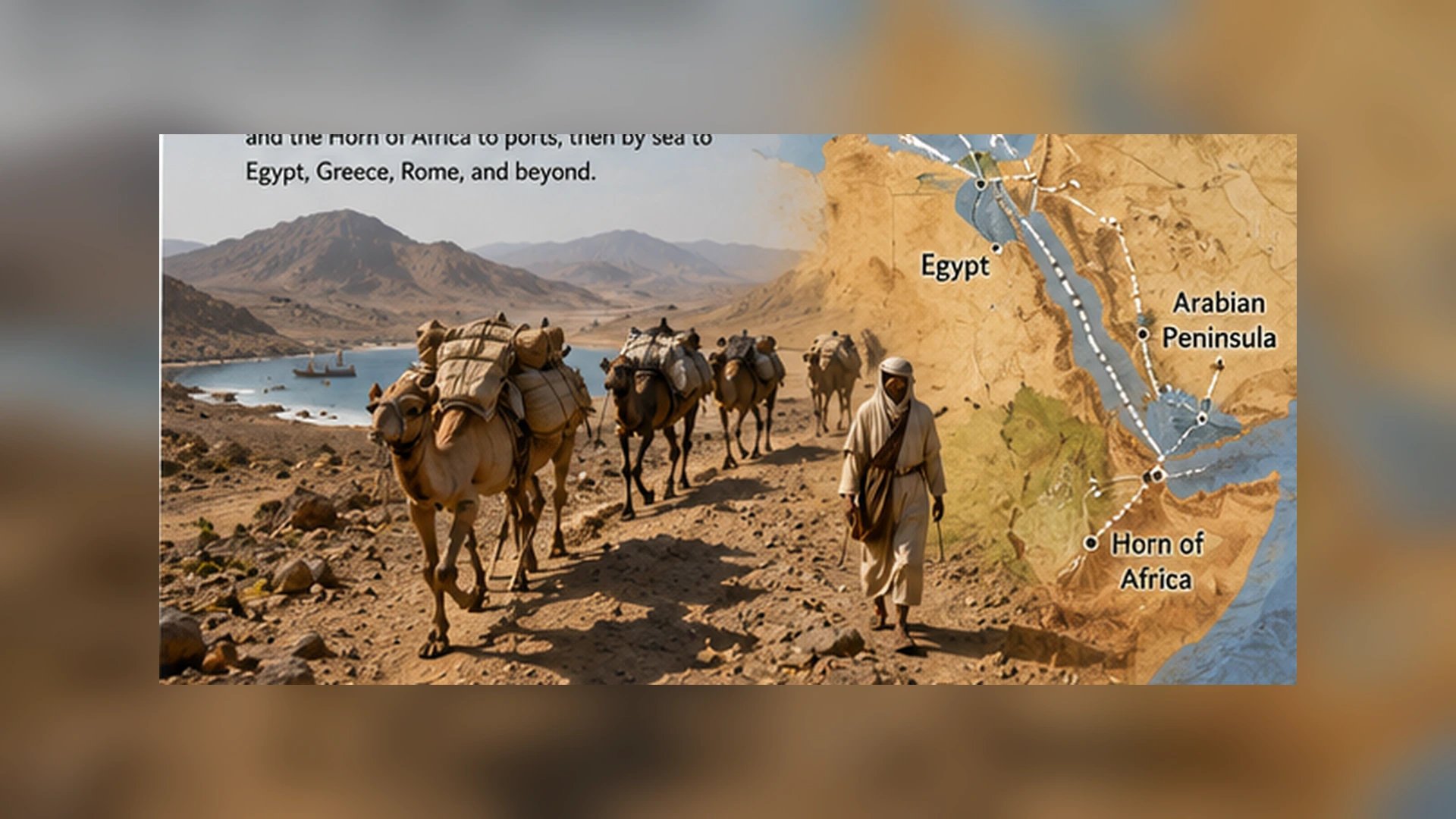
Frankincense became valuable because high demand was separated from the trees by difficult geography. Producing zones lay in southern Arabia and eastern Africa, while major consumers lived in Egypt, Mesopotamia, the Levant, Greece, Rome and elsewhere. Moving resin required local collectors, pack animals, wells, fortified stops, taxes, brokers, ports and ships. The “Incense Route” was therefore a changing network rather than one uninterrupted road owned by one people.
Archaeology and historical texts show that aromatic trade was active by the first millennium BCE and had older roots. Caution is necessary: an ancient burner or residue may prove incense use without identifying the exact plant species. Chemical work has sometimes identified archaeological frankincense, but many early references use broad aromatic categories. Responsible history distinguishes evidence for incense in general from evidence for Boswellia resin specifically. [17]
South Arabian kingdoms and caravan wealth
From roughly the first millennium BCE into late antiquity, kingdoms including Qataban, Saba and Himyar benefited from controlling routes, markets and producing districts in southern Arabia. Smithsonian research describes more than a thousand years in which these kingdoms grew wealthy through international trade in frankincense and myrrh. Their cities developed monumental architecture, inscriptions, sculpture and metalwork while maintaining contacts with northeastern Africa, the eastern Mediterranean, Iran, India and other parts of Asia. [10]
Frankincense did not travel alone. Caravans and ships also carried myrrh, spices, textiles, ivory, pearls, precious stones and other goods. Trade moved artistic forms, technologies, languages and religious ideas along with commodities. This wider exchange is one reason the incense trade matters beyond the history of fragrance.
Dhofar’s ports and inland stations
UNESCO’s Land of Frankincense brings together four components of the Omani system. Wadi Dawkah represents the producing landscape. Shisr functioned as an inland oasis and caravan station. Khor Rori and Al-Baleed were fortified ports connected to maritime distribution. These sites cover different historical periods, showing how trade adapted over centuries rather than remaining fixed. [6]
Khor Rori, also known as Sumhuram, occupied a natural harbour east of modern Salalah and became a hub for Dhofar incense. Al-Baleed later connected the coast to wider Indian Ocean commerce. Imported objects at such ports demonstrate that frankincense moved within multidirectional trade networks, not only north toward Rome.
The overland route toward the Mediterranean
One famous branch ran north through western Arabia and the Nabataean sphere toward Petra, the Negev and Mediterranean ports. UNESCO describes a network extending more than 2,000 kilometres from Yemen and Oman to the Mediterranean. The Negev towns, forts and caravanserais preserve evidence for the profitable trade that flourished especially from the third century BCE to the second century CE. [7]
The Nabataeans did not grow all the resin they traded. Their importance came from controlling northern routes, water, security, taxation and access to markets. Petra’s position connected Arabian goods with the Levant and Mediterranean world. From ports such as Gaza, cargoes could continue by sea.
Red Sea and Indian Ocean routes
Maritime routes were equally important. Ships carried aromatics from southern Arabian and Horn of Africa ports toward Egypt’s Red Sea coast, the Persian Gulf, India and other Indian Ocean destinations. Smithsonian and museum sources note that sea transport became increasingly prominent in the early centuries of the Common Era. [8–10]
The Horn of Africa was both a producing region and a participant in maritime exchange. Frankincense from Somali and other African landscapes could cross the Gulf of Aden or travel through Red Sea networks. It is misleading to imagine Africa only as a distant supplier while Arabia alone handled trade; roles changed by period, port, political power and product.
| Network zone | Examples | Main role |
|---|---|---|
| Producing landscapes | Dhofar, southern Yemen, northern Somalia, Ethiopian/Eritrean/Sudanese drylands and other Boswellia regions | Resin collection, local grading and first-stage exchange |
| South Arabian centres | Shabwa, Timna, Marib and related kingdoms/markets | Caravan organization, taxation, storage and redistribution |
| Dhofar nodes | Wadi Dawkah, Shisr, Khor Rori and Al-Baleed | Production landscape, oasis station and maritime ports |
| Northern caravan network | Arabian oases, Petra and Negev towns | Movement toward Levantine and Mediterranean markets |
| Maritime network | Gulf of Aden, Red Sea, Persian Gulf and Indian Ocean ports | Trade with Egypt, eastern Mediterranean, Iran, India and beyond |
Specific culture or historical context: Ancient South Arabian port in Dhofar connected to the Hadramawt kingdom and international incense trade.
People shown: Diverse South Arabian, northeast African and visiting merchants or sailors, dressed according to the period without theatrical stereotypes.
Location: Khor Rori natural harbour, Dhofar, with accurate dry coastal mountains and stone fortification.
Clothing: Historically plausible first-century BCE to early centuries CE garments based on museum reconstruction; modest and practical.
Architecture: Contextually accurate dressed-stone fortified port structures; no pyramids, domes from later periods or fantasy palace.
Objects: Pack animals, woven sacks, ceramic storage jars, ropes, scales and a period-appropriate coastal vessel.
Lighting: Clear golden morning light with realistic sea haze.
Composition: Wide 16:9 scene with loading activity in the foreground, port architecture mid-frame and vessel/water in the background.
SEO-friendly filename: ancient-frankincense-trade-khor-rori-caravan-port.webp
Image title: Ancient Frankincense Trade at Khor Rori
Alt text: Historical reconstruction of merchants loading frankincense at the ancient port of Khor Rori in Oman
Caption: Ancient frankincense trade depended on linked producing areas, caravan stations, fortified towns and maritime ports such as Khor Rori.
Recommended placement: After the ancient trade-route sections.
Article section supported: South Arabian kingdoms, Incense Route and maritime exchange.
Important elements to avoid: Orientalist fantasy, giant camel train, modern shipping containers, inaccurate ships, mixed Egyptian/Roman costume, readable signs, logos, watermarks or dramatic battle scene.
Why Frankincense Was So Valuable
Frankincense was valued because it concentrated fragrance into a portable material with many uses. A few grains placed on hot charcoal could transform the smell and atmosphere of a room, temple or burial space. The resin could be stored and moved more easily than fresh aromatic plants, yet it came from limited dryland regions and required labour-intensive transport.
Religious demand was especially important. Incense accompanied offerings, prayer, purification, funerary rites and public ceremonies in multiple societies, but its meaning was never identical everywhere. It also entered domestic fragrance, perfumery, medicine and elite gift exchange. The same resin could be sacred in one context, commercial in another and ordinary household material in a third.
High value encouraged myths about hidden forests, guarded trees and dangerous source lands. Ancient writers sometimes repeated stories supplied by merchants or shaped by distant imagination. Such accounts reveal how scarcity was perceived, but they should not replace botanical and archaeological evidence.
Frankincense in Religious and Cultural Traditions
Frankincense has been used in Jewish, Christian, Islamic, Ethiopian, Eritrean, South Arabian, Somali, Indian and other cultural settings, as well as in older Egyptian, Mesopotamian, Greek and Roman practices. It may accompany prayer, mark sacred time, perfume clothing or rooms, welcome guests, honour the dead or form part of customary medicine. These uses should be named specifically rather than blended into a fictional universal ritual.
In Christian traditions, frankincense is widely known from the Gospel account of gifts presented to Jesus and from continuing liturgical incense use. Ethiopian and Eritrean Orthodox Christian life has long included aromatic resins in worship and domestic hospitality. In Oman and Yemen, luban belongs to local heritage, markets, household fragrance and hospitality as well as international trade. Somali frankincense traditions include both burning and chewing particular resins.
Historical use does not prove that smoke, resin or essential oil has guaranteed supernatural or medical effects. Religious meaning is real within a tradition, but it is not the same category as laboratory evidence. Medical claims require appropriate clinical research, dosage information and safety evaluation.
How the Modern Frankincense Supply Chain Works
Modern frankincense may pass through several hands before reaching a consumer: landholders or customary custodians, tappers, collectors, local brokers, sorting workers, exporters, distillers, wholesalers and brands. Resin from different villages or even species may be combined. Documentation can be lost or simplified as the product moves farther from its source.
A label such as “Omani,” “Somali,” “Ethiopian” or “Indian” can be useful, but country alone does not reveal the species, district, harvesting method or benefit received by producers. Essential-oil labels may list a Latin name, yet spelling and taxonomy are not always consistent. Boswellia carteri appears frequently in commerce, while current Kew taxonomy accepts Boswellia sacra and treats Boswellia carteri as a synonym. Buyers should interpret names with care rather than assuming a label resolves every question. [2]
Traceable supply chains record at least the species or best-supported identification, country and region, harvest season, collection method and exporter or producer group. Stronger systems also describe tree-resting practices, fire and grazing management, worker conditions and how revenue returns to source communities.
Conservation Challenges
The phrase “frankincense trees are endangered” is too broad because Boswellia contains many species and populations with different assessments. Nevertheless, major producing populations face serious pressures. Threats include conversion of dry woodland to farms, uncontrolled grazing, fire, insect damage, low seedling survival, conflict, weak land tenure and tapping that is too frequent or severe.
A large multi-country study of Boswellia papyrifera reported that more than three quarters of the surveyed populations lacked small trees and projected that production in those studied populations could be halved within twenty years without intervention. The result applies to the studied B. papyrifera populations, not automatically to every Boswellia tree worldwide. The recommended responses included livestock exclosures, fire management, planting and more careful tapping. [14]
Separate research in northern Ethiopia found that continuous tapping without adequate rest increased vulnerability to longhorn beetle damage. Trees given resting years suffered less damage, and excessive wound numbers increased risk. This research demonstrates why a resin can be “natural” and still be harvested unsustainably. [15]
In Oman, researchers have also warned that aggressive tapping can cause lasting damage and that poor regeneration is a concern. Sustainable production requires matching wound size, intensity and timing to tree condition rather than maximizing the current season’s yield. [16]
Specific culture or historical context: Contemporary community-based Boswellia woodland conservation in the Horn of Africa.
People shown: Black African adults of different ages, including local land users and a forestry technician, working collaboratively.
Location: Seasonally dry woodland with rocky soil, mature Boswellia trees and a managed nursery or regeneration plot.
Clothing: Practical field clothing and locally appropriate fabrics; no ceremonial costume.
Architecture: Small shade nursery or field shelter only; no corporate plantation complex.
Objects: Seedling guards, watering can, field notebook, measuring tape and simple tools.
Lighting: Bright but soft morning light after seasonal rain, showing new growth without turning the landscape unrealistically lush.
Composition: Wide 16:9 editorial frame with people checking seedlings in the foreground and mature woodland extending behind.
SEO-friendly filename: sustainable-frankincense-boswellia-restoration.webp
Image title: Sustainable Frankincense and Boswellia Restoration
Alt text: African community members and forestry researchers protecting young Boswellia trees in a dryland restoration area
Caption: Long-term frankincense supply depends on careful tapping, fire and grazing management, seedling protection and fair community benefit.
Recommended placement: After the conservation section and before the responsible-sourcing checklist.
Article section supported: Conservation, sustainable harvest and ethical purchasing.
Important elements to avoid: Corporate greenwashing, rows of identical plantation trees, plastic-heavy scene, saviour imagery, dead wildlife, ritual objects, embedded text, logos, watermarks or unrealistic rainforest vegetation.
How to Choose Frankincense Responsibly
Consumers cannot solve dryland conservation through shopping alone, but purchasing questions can reward better documentation and discourage vague extraction. A responsible seller should be willing to explain what they know and acknowledge what they do not know.
| Question to check | What a useful answer includes |
|---|---|
| Species or botanical identification | Look for a credible Latin name, while recognizing that mixed lots and old trade synonyms occur. |
| Country and producing region | A district or landscape is more informative than a broad “African” or “Arabian” label. |
| Harvest method | Ask whether trees receive rest, whether wound numbers are controlled and whether young trees are protected. |
| Traceability | Look for named producer groups, cooperatives, exporters or documented long-term partnerships. |
| Community benefit | Fair purchasing should return meaningful value to harvesters and source communities, not only downstream brands. |
| Conservation practice | Evidence may include grazing controls, firebreaks, regeneration plots, planting or monitoring. |
| Product form | Distinguish raw resin, incense blend, extract and essential oil; they are not interchangeable. |
| Claims | Avoid sellers promising guaranteed healing, fertility, protection, wealth or supernatural outcomes. |
Terms such as “wild,” “pure,” “sacred,” “premium” and “organic” do not by themselves prove sustainability or fairness. A wild product can be overharvested. A pale resin can come from a damaged woodland. An organic certificate may address certain chemicals while saying little about regeneration or worker income.
Common Misunderstandings About Frankincense Origins
| Misunderstanding | More accurate explanation |
|---|---|
| “All frankincense comes from Oman.” | Dhofar is famous, but Boswellia resins also come from Somalia/Somaliland, Ethiopia, Eritrea, Sudan, India and other dryland regions. |
| “Frankincense is one tree species.” | Frankincense is produced by multiple Boswellia species with different natural ranges and resin traditions. |
| “The biggest, palest tears are always the best.” | Appearance affects some grades, but intended use, species, aroma, cleanliness, storage and cultural preference also matter. |
| “Ancient incense finds are always frankincense.” | Archaeological burners or texts may indicate incense without identifying the exact botanical material. |
| “Natural harvesting cannot hurt trees.” | Repeated or deep wounds, absent rest, grazing and fire can reduce health and regeneration. |
| “Arabia alone created the frankincense trade.” | South Arabian kingdoms were central, but African producers, Red Sea ports, Nabataean routes, Mediterranean markets and Indian Ocean networks also shaped exchange. |
| “Traditional use proves a medical cure.” | Cultural history and personal testimony are not substitutes for controlled clinical evidence. |
Scientific and Health Boundaries
Frankincense contains biologically active compounds, and Boswellia extracts are studied for several possible applications. However, raw resin, smoke, essential oil and standardized extracts are chemically different products. Results from a laboratory extract cannot automatically be applied to burning resin in a room, swallowing unmeasured material or placing essential oil on skin.
Incense smoke contains particles and combustion products. People with asthma, respiratory sensitivity, infants, older adults and pets may be affected by poor ventilation or heavy exposure. Use small amounts in a ventilated space, keep burning material away from fabrics and children, and follow local fire-safety guidance. Do not ingest resin or use concentrated oil medically without qualified advice.
This article explains origin, heritage and trade. It does not establish that frankincense can guarantee spiritual protection, cure disease, improve fertility, create wealth or replace medical treatment.
How to Identify Genuine Frankincense
A consumer can check whether a product is plausible, but visual inspection cannot confirm species or geographic origin with certainty. Genuine raw frankincense is usually irregular resin rather than perfectly identical beads. It may soften slightly with warmth, release a complex aromatic scent when heated and leave some gum or char depending on composition. Colour varies widely and should not be used as the only test.
Be cautious when a seller provides no botanical or geographic information, uses images of a different plant, promises impossible outcomes or claims every dark piece is fake. Laboratory methods such as chromatography can compare chemical profiles, but even chemistry may be influenced by season, storage and mixed lots. Traceable records remain essential.
People Also Ask
Where does frankincense originally come from?
Frankincense originates from Boswellia trees native to dry regions of southern Arabia, the Horn and northeastern parts of Africa, and India. Famous producing areas include Dhofar in Oman, southern Yemen, northern Somalia/Somaliland, Ethiopia, Eritrea and Sudan.
What tree produces frankincense?
Several Boswellia species produce frankincense. Important examples are Boswellia sacra, B. frereana, B. papyrifera and B. serrata. Frankincense is therefore a family of related resins rather than the product of one universal tree.
Is frankincense from Africa or Arabia?
It is from both, and also from India. Boswellia sacra grows naturally in Oman, Yemen and northern Somalia. Other major species occur across African drylands and the Indian subcontinent. Ancient trade connected these regions across the Gulf of Aden, Red Sea and Indian Ocean.
How is frankincense taken from a tree?
Collectors make controlled shallow wounds in the bark. Resin exudes, dries in the air and hardens into tears. The material is collected during later visits and sorted. Sustainable tapping limits wound size and number and allows trees adequate recovery.
Why was frankincense so expensive in ancient times?
The trees grew in limited, remote drylands while demand came from distant temples, courts, households and perfumers. Long transport, water needs, taxes, security risks and merchant networks added cost before the resin reached Mediterranean or Asian markets.
What was the Incense Route?
The Incense Route was a network of caravan roads, oases, towns and ports that moved frankincense, myrrh and other goods from southern Arabia and connected regions toward Petra, the Negev and Mediterranean. Maritime branches also crossed the Red Sea and Indian Ocean.
Frequently Asked Questions
Is olibanum the same as frankincense?
Yes. Olibanum is a widely used name for frankincense resin, although product labels may use it differently in specific markets.
Does frankincense come from sap?
It is more accurately described as an oleo-gum-resin exuded from resin canals after the bark is wounded. “Sap” is a broad everyday word but does not describe the material precisely.
What are frankincense tears?
They are hardened drops or irregular pieces of resin formed after the exudate dries in air.
Is Boswellia sacra the only true frankincense?
No. Boswellia sacra is a major source species, but several other Boswellia species produce recognized frankincense resins.
What is Somali maydi frankincense?
Maydi or maidi is a local name associated especially with resin from Boswellia frereana in northern Somalia. It may be chewed as well as traded for fragrance.
What is Ethiopian frankincense?
Much Ethiopian commercial frankincense comes from Boswellia papyrifera in seasonally dry woodlands, although Ethiopia contains other Boswellia species and regional products.
What is Indian frankincense?
Indian frankincense generally refers to resin from Boswellia serrata, also known in trade as salai or Indian olibanum.
Why do frankincense trees grow on rocks?
Boswellia species are adapted to dry, shallow and rocky soils. Their roots and seasonal growth strategies allow survival where many other trees struggle.
Can a frankincense tree be harvested every year?
Practices differ, but research shows that continuous intensive tapping can weaken trees. Resting schedules and controlled wound numbers are important for long-term health.
Are all frankincense trees threatened?
No single statement fits every species and population. However, several important producing populations face regeneration failure, overgrazing, fire, land conversion and damaging tapping.
Did the Nabataeans produce frankincense?
They were especially important as northern traders and route controllers. Much of the resin they handled originated farther south in Arabia and in connected producing regions.
Did frankincense travel only by camel caravan?
No. Overland caravans were important, but ships also moved resin through the Red Sea, Gulf of Aden, Persian Gulf and Indian Ocean.
Was frankincense used only for religion?
No. It also served in perfume, household fragrance, medicine traditions, diplomacy, funerary practice, chewing and trade, depending on place and period.
Can colour prove where frankincense came from?
No. Colour may reflect species, grade, season, age and handling, but it cannot securely identify origin without records or analysis.
Is essential oil the same as burning frankincense resin?
No. Essential oil is distilled from resin and has a different composition and exposure route. Safety and evidence cannot be transferred automatically between them.
What should I ask a frankincense seller?
Ask for species, country and region, harvest method, producer or exporter traceability, conservation practices and whether the product is raw resin, a blend, an extract or an essential oil.
Key Takeaways
Frankincense is aromatic oleo-gum-resin from multiple Boswellia species, not one universal tree.
Major origins include Oman, Yemen, Somalia/Somaliland, Ethiopia, Eritrea, Sudan and India, with additional regional sources across Boswellia drylands.
Boswellia sacra, B. frereana, B. papyrifera and B. serrata represent different species, landscapes and trade traditions.
Harvesters tap bark, collect hardened resin tears and sort them by locally defined qualities.
Ancient trade combined producing landscapes, caravan routes, oases, fortified towns and maritime ports.
South Arabian kingdoms and Nabataean networks were important, but African producers and Red Sea/Indian Ocean connections were also central.
Natural resin can still be overharvested; regeneration, grazing, fire and wound management determine sustainability.
Historical or religious use does not prove guaranteed medical or supernatural outcomes.
Conclusion
Frankincense comes from a chain of relationships: between resin canals and bark, trees and dryland climate, harvesters and woodland, inland stations and ports, merchants and worshippers, ancient demand and modern markets. The resin’s story cannot be reduced to one country, one tree or one religion.
Dhofar deserves its title as the Land of Frankincense because living Boswellia sacra groves and archaeological sites preserve a remarkable production-and-trade landscape. Yet northern Somalia, the wider Horn and northeastern African drylands, southern Yemen and India are equally necessary to a complete answer. Each region contributes different species, knowledge, terminology and history.
The future of frankincense depends on whether these living landscapes can regenerate. Respect for heritage therefore requires more than admiring ancient caravans or buying fragrant resin. It requires accurate species and origin information, careful tapping, protection from destructive fire and grazing, fair producer benefit and honest limits on health or spiritual claims.
Final Summary
Frankincense is dried oleo-gum-resin from Boswellia trees native mainly to dry parts of the Arabian Peninsula, Africa and India. Its best-known source species include Boswellia sacra, B. frereana, B. papyrifera and B. serrata. Ancient caravans and ships carried the resin through South Arabian ports, Red Sea and Indian Ocean networks, Petra, the Negev and Mediterranean markets. Today, responsible sourcing must protect both producer livelihoods and the regeneration of Boswellia woodlands.
Research Sources and Further Reading
[1] Boswellia Roxb. ex Colebr. Plants of the World Online, Royal Botanic Gardens, Kew. Current genus distribution, taxonomy and accepted species.
[2] Boswellia sacra Flück. Plants of the World Online, Royal Botanic Gardens, Kew. Accepted native range, morphology, names, uses and conservation notes.
[3] Boswellia papyrifera (Caill.) Hochst. Plants of the World Online, Royal Botanic Gardens, Kew. Accepted African range and dryland ecology.
[4] Boswellia frereana Birdw. Plants of the World Online, Royal Botanic Gardens, Kew. Somali range, morphology and local resin names.
[5] Boswellia serrata Roxb. Plants of the World Online, Royal Botanic Gardens, Kew. Indian range and accepted taxonomy.
[6] Land of Frankincense. UNESCO World Heritage Centre. Wadi Dawkah, Shisr, Khor Rori, Al-Baleed and the historical production and distribution system in Oman.
[7] Incense Route – Desert Cities in the Negev. UNESCO World Heritage Centre. Caravan routes linking South Arabian aromatics to Mediterranean markets.
[8] Trade between Arabia and the Empires of Rome and Asia. The Metropolitan Museum of Art. Overview of Arabian caravan and maritime trade.
[9] Ancient Incense Trade. Smithsonian National Museum of Asian Art. Caravans, Red Sea connections and ancient demand for aromatic resins.
[10] Caravan Kingdoms: Yemen and the Ancient Incense Trade. Smithsonian National Museum of Asian Art. Qataban, Saba, Himyar and overland/maritime exchange.
[11] South Arabian Incense Burner. British Museum collection record. Evidence for incense trade, offerings and aromatic terminology in ancient South Arabia.
[12] Introducing Boswellia papyrifera and Its Non-Timber Forest Product, Frankincense. Food and Agriculture Organization of the United Nations. Harvesting, grading, livelihoods and ecological concerns.
[13] Resin Secretory Structures of Boswellia papyrifera and Implications for Frankincense Yield. Annals of Botany. Bark anatomy, resin canals and tapping implications.
[14] Frankincense in Peril. Nature Sustainability. Multi-population demographic evidence and projected decline in Boswellia papyrifera production.
[15] Continuous Resin Tapping for Frankincense Harvest Increases Susceptibility of Boswellia papyrifera Trees to Longhorn Beetle Damage. Peer-reviewed open-access research from northern Ethiopia.
[16] Roles of Ethylene, Jasmonic Acid and Salicylic Acid in Frankincense Resin Production in Boswellia sacra. Scientific Reports. Resin response, Dhofar production and risks from aggressive tapping.
[17] Archaeological Frankincense. Nature. Chemical identification and the limits of assigning ancient incense residues.
Supporting Article Recommendations
Boswellia Trees Explained: Species, Resin and Dryland Ecology — Build the botanical cluster without repeating the main origin query.
The Land of Frankincense in Oman — Target Dhofar, Wadi Dawkah, Khor Rori, Al-Baleed and Shisr with heritage-focused detail.
Somali Frankincense: Boswellia sacra, Boswellia frereana and Maydi — Create a Horn of Africa article that centres Somali landscapes and terminology.
Ethiopian and Eritrean Frankincense — Cover Boswellia papyrifera, sorting, livelihoods, regeneration and conservation research.
Frankincense vs Myrrh — Answer the comparison intent with a clear botanical and historical structure.
The Ancient Incense Route Explained — Develop a route-focused article with archaeology, towns, ports and a carefully sourced map.
How Frankincense Is Harvested — Expand tapping anatomy, seasonal work, grading and sustainable-management practices.
How to Buy Incense Responsibly — Create a practical ethical-sourcing guide for resins, woods and aromatic plants.
Suggested Internal Links
Plants Used for Spiritual Protection: Cultural Meanings and Traditions — Link from the discussion of plant materials and responsible sourcing.
Understanding African Spiritual Traditions: A Historical Introduction — Link when distinguishing regional traditions and avoiding a single “African” system.
Cleansing and Blessing Rituals: Meaning and Cultural Context — Link when explaining incense use without universalizing ritual meaning.
Sacred Trees in African Traditions — Link from the Boswellia ecology and custodianship sections once published.
Incense and Smoke in Religious Traditions — Link from the cultural-use and health-boundaries sections.
Spiritual Practices and Scientific Evidence — Link from the medical and supernatural-claims caution.
Ancient African Trade Routes and Cultural Exchange — Link from Red Sea and Horn of Africa trade discussion.
Post-Publication Optimization Plan
Publish with the recommended title and concise excerpt, then request indexing in Google Search Console.
Add Article and BreadcrumbList structured data. Add FAQPage markup only if the visible FAQs and current search-engine guidance justify it.
After 28–42 days, review impressions, clicks, CTR and average position for origin, tree, region, harvesting and trade-route queries.
If impressions grow but CTR remains weak, test Alternative SEO Title 1 before changing the page’s topic or slug.
Add real Search Console queries to the query map and strengthen sections ranking between positions 8 and 20.
Link to the page from the protective-plants article, incense-related pages and any relevant educational shop category without making guaranteed spiritual claims.
Create the Oman or Incense Route supporting article only after identifying clear query separation and internal-linking opportunities.
Review botanical ranges and conservation evidence annually because taxonomy, assessments and population research can change.
Compress the five WebP images, preserve descriptive alt text and avoid embedding text inside images.
Seek citations or backlinks from cultural-history, botanical, heritage or ethical-sourcing resources rather than low-quality directory links.
Article Information
- Publisher
- Ancestral Temple
- Editor
- Ancestral Temple
- Last updated
- Jul 26, 2026
- Last reviewed
- Jul 26, 2026
- Content version
- 797f8b58e1
This educational article should be read as cultural and spiritual information, not as medical, legal, financial, or emergency advice.
Helpful Related Guidance
Explore This Topic
Related Topic Cluster
Ancestors
About the Author
 Ancestral Temple
Spiritual guide and practitioner with decades of experience in ancestral wisdom, rituals, and divine guidance.
Related Posts
View All






Leave a Comment
We'd love to hear your thoughts.