
Myrrh Meaning: History, Symbolism and Traditional Uses
Quick Summary
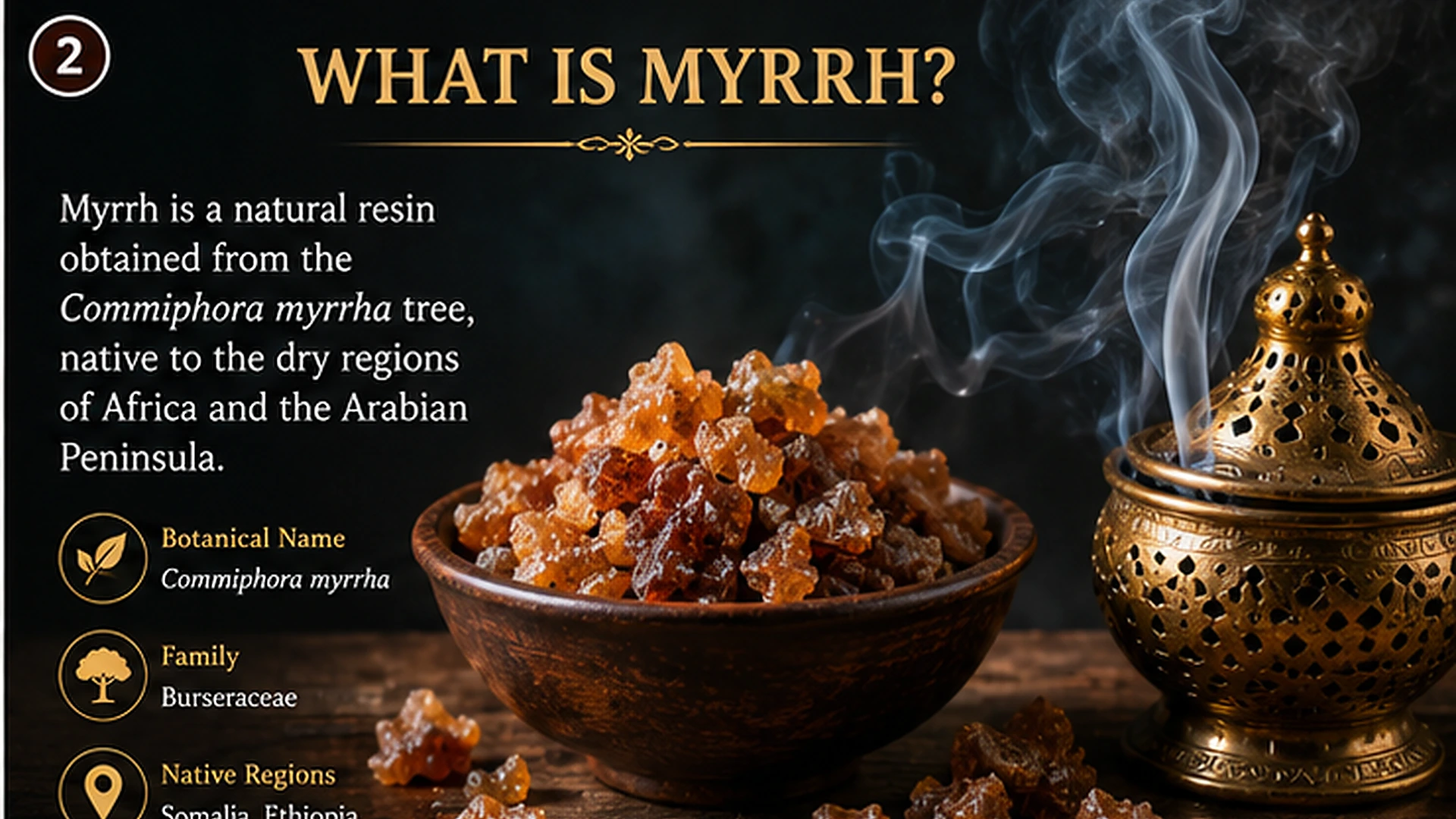
Myrrh is a fragrant but distinctly bitter gum-resin obtained from several small trees and shrubs in the genus Commiphora. The best-known source of true myrrh is Commiphora myrrha,...
Myrrh is a fragrant but distinctly bitter gum-resin obtained from several small trees and shrubs in the genus Commiphora. The best-known source of true myrrh is Commiphora myrrha, a species native to dry regions extending from eastern and southeastern Ethiopia to northeastern Kenya and across parts of the southern Arabian Peninsula. For thousands of years, pieces of the hardened resin were burned as incense, blended into perfumes and ointments, traded across deserts and seas, used in funerary preparation, and incorporated into several systems of traditional medicine. [1]
The meaning of myrrh is therefore not one fixed spiritual definition. In different settings it has represented sacred offering, costly honor, bitter suffering, fragrance, preservation, mourning, purification, healing or restoration. Some of these meanings come directly from historical uses; others are later religious interpretations. A responsible explanation must identify the culture, text, period and type of object being discussed.
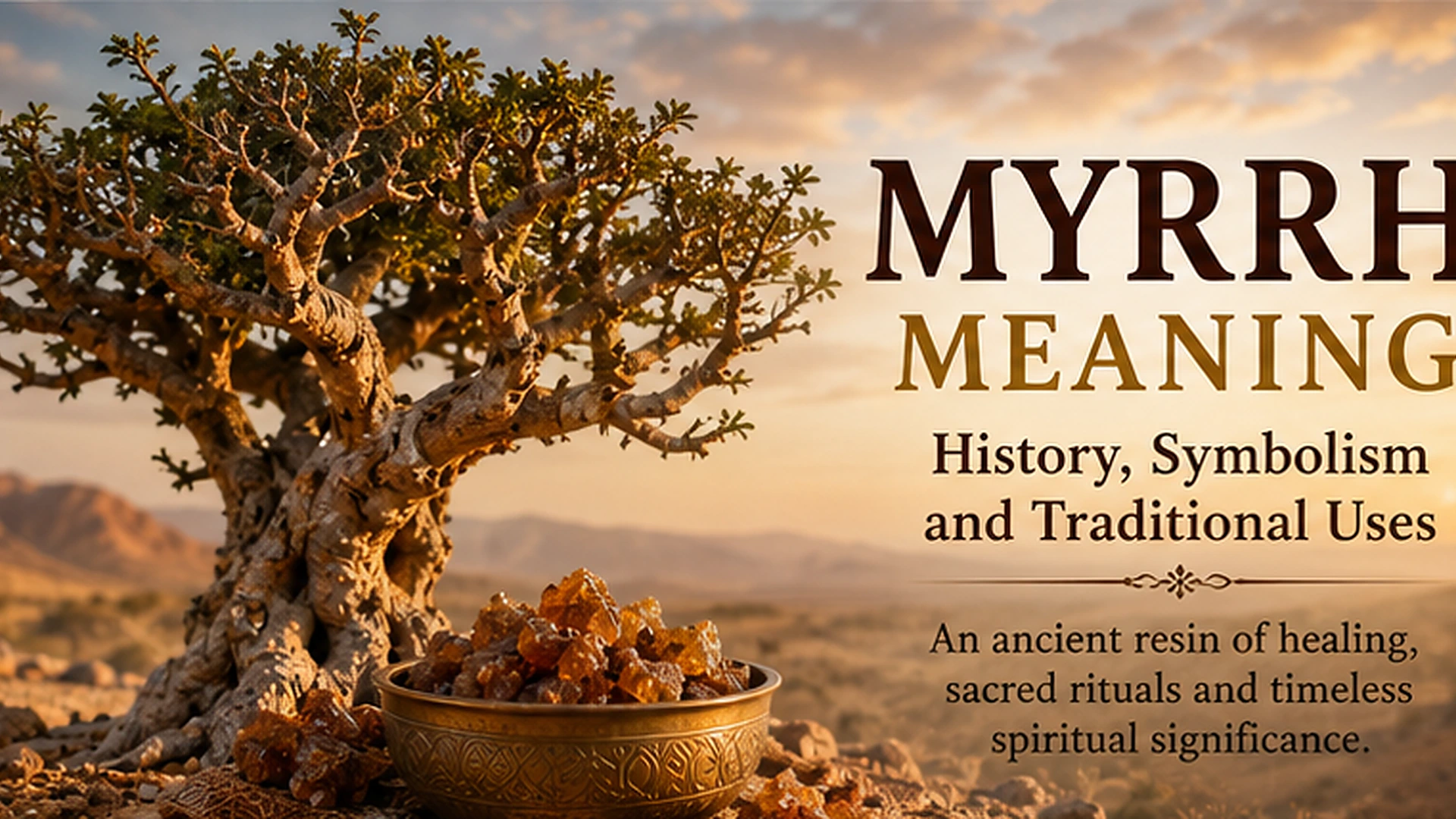
Specific culture or historical context: Contemporary botanical editorial scene based on the native habitat of true myrrh; not a ritual reconstruction.
People shown: No person required.
Location: Arid bushland in the Horn of Africa or northeastern Kenya, with sparse acacia vegetation and limestone soil.
Clothing: Not applicable.
Architecture: No architecture; only natural landscape.
Objects: Commiphora shrub, resin tears, natural stone, dry grasses and shallow rocky soil.
Lighting: Warm dawn light with realistic shadows and accurate resin translucency.
Composition: Wide 16:9 composition; tree on the right third, resin sharply focused in the lower foreground, open landscape to the left for responsive cropping.
SEO-friendly filename: myrrh-meaning-history-symbolism-traditional-uses.webp
Image title: Myrrh Resin and Commiphora Tree
Alt text: Natural myrrh resin beside a Commiphora tree in an arid East African landscape
Caption: Myrrh is an aromatic gum-resin produced by several Commiphora species native to northeastern Africa and southern Arabia.
Recommended placement: After the introduction and before the Quick Answer.
Article section supported: Definition, plant origin and featured-image identity.
Important elements to avoid: No glowing resin, fantasy smoke, text, labels, logos, watermarks, decorative zodiac or occult symbols, lush rainforest vegetation, or an anatomically inaccurate tree.
Quick Answer
Myrrh is a bitter aromatic gum-resin from Commiphora trees native mainly to northeastern Africa and southern Arabia. Historically it was valued as incense, perfume, anointing material, medicine and funerary substance. Its symbolism varies: it can suggest sacred offering, costly honor, preservation, healing, bitterness, suffering or mortality. These meanings are cultural interpretations—not scientifically proven spiritual properties.
What Is Myrrh?
Myrrh is neither an herb leaf nor a conventional essential oil in its natural form. It is an oleo-gum-resin: a plant exudate containing resinous compounds, water-soluble gum and volatile aromatic components. When the bark of a suitable Commiphora tree is naturally damaged or deliberately cut, a sticky liquid emerges. It gradually thickens and hardens into irregular yellow, reddish-brown or dark brown pieces often called resin tears.
Royal Botanic Gardens, Kew accepts Commiphora myrrha as the scientific name of the principal true-myrrh species. Kew places its native range from eastern and southeastern Ethiopia through northeastern Kenya and in the southwestern and southern Arabian Peninsula. The plant is a thorny shrub or small tree adapted to desert and dry-shrubland environments. Its pale bark can peel in papery flakes, and the exudate hardens into translucent gum-resin. [1]
The market name “myrrh” can also cover resins from other Commiphora species. Scented myrrh, often called opopanax or bisabol, is frequently associated with Commiphora guidottii from Ethiopia and Somalia. Botanical identification matters because different species may vary in scent, chemistry, traditional use and commercial quality. [2]
Why Is Myrrh Associated With Bitterness?
The English word myrrh came through Greek and Latin forms from a Semitic word family associated with bitterness, including Arabic murr. The name fits the resin’s sharply bitter taste. This bitterness later became symbolically useful: writers and preachers could connect myrrh with sorrow, suffering, mortality or difficult truth. However, the etymology itself does not prove that every ancient user understood myrrh through the same symbolic lens.
How Myrrh Is Harvested
Myrrh is produced when the bark releases resin in response to injury. Harvesters may make small incisions in the trunk or branches, allowing the exudate to appear and harden before collection. Similar tapping methods are used for frankincense, although the trees, resins and fragrance profiles differ. Sustainable harvesting requires restraint because repeated deep cuts, overharvesting, grazing pressure, charcoal production and habitat change can damage wild trees and the dryland ecosystems that support them.
Quality resin is commonly assessed by botanical source, aroma, color, cleanliness and the proportion of gum, resin and volatile compounds. The raw pieces may be burned directly, ground for incense mixtures, extracted in alcohol, distilled into essential oil, or incorporated into perfumes and traditional preparations. Those forms are not interchangeable: smoke, tincture and essential oil create different exposures and safety concerns.
Specific culture or historical context: Contemporary livelihood and botanical-harvesting context in the Horn of Africa; ordinary work, not a ritual performance.
People shown: One adult harvester with natural anatomy and focused expression.
Location: Dry Commiphora-acacia bushland in Somalia, Ethiopia or northeastern Kenya.
Clothing: Practical modern work clothing in neutral colors, head covering suitable for sun protection, no invented ceremonial costume.
Architecture: No buildings, or a distant simple shade shelter only.
Objects: Small harvesting knife, woven tray, hardened resin tears and mature tree with realistic bark.
Lighting: Soft early-morning light to avoid harsh heat; accurate dryland tones.
Composition: Wide environmental photograph with the tree and harvesting technique clearly visible; person on left third and landscape depth on the right.
SEO-friendly filename: traditional-myrrh-resin-harvesting-horn-of-africa.webp
Image title: Traditional Myrrh Resin Harvesting
Alt text: Harvester collecting hardened myrrh resin from a Commiphora tree in the Horn of Africa
Caption: Myrrh is collected after aromatic resin exudes from carefully cut or naturally damaged bark and hardens into tears.
Recommended placement: After the harvesting section.
Article section supported: Botanical production and cultural geography.
Important elements to avoid: No excessive cutting, bleeding-tree effect, fantasy glow, child labor, staged poverty, labels, logos, smoke, ritual sacrifice or mixed cultural dress.
A Brief History of Myrrh
Origins in northeastern Africa and southern Arabia
The plants that yield true and scented myrrh grow naturally in some of the world’s driest landscapes. Communities in the Horn of Africa and southern Arabia developed detailed knowledge of where the trees grew, when resin could be collected, how it should be sorted and how it could be used or exchanged. Myrrh’s ancient fame depended on this local ecological knowledge long before the resin reached royal courts, temples and pharmacies elsewhere.
Because “myrrh” became a broad trade name, historical texts do not always allow researchers to identify the precise species. A shipment described as myrrh may have included resin from C. myrrha, C. guidottii or another Commiphora. Good historical writing should therefore avoid pretending that every ancient reference can be assigned to one modern botanical species with certainty.
Ancient Egypt: temple fragrance, body care and funerary preparation
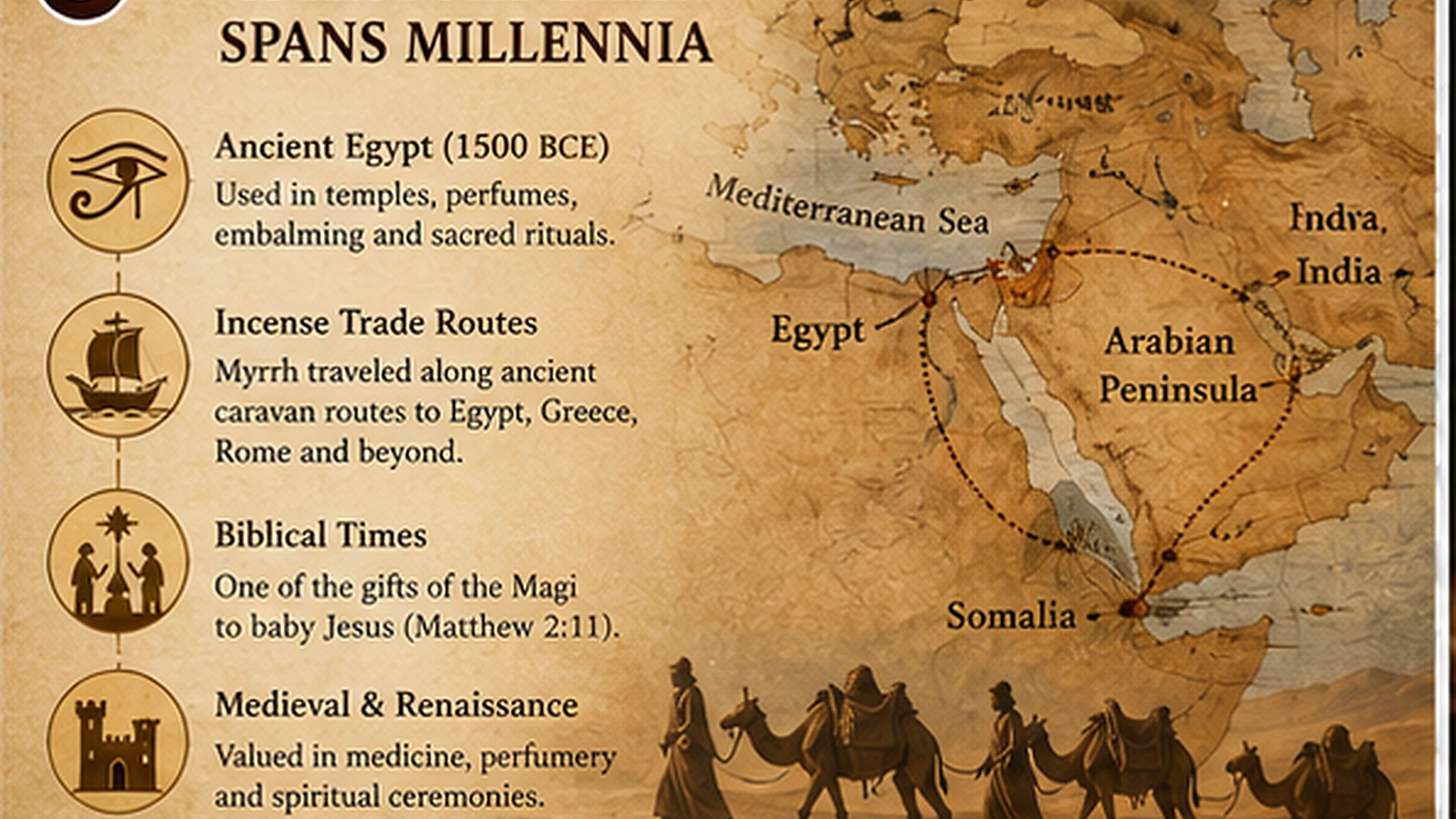
Ancient Egyptian demand helped make aromatic resins prestigious commodities. Museum and historical summaries describe myrrh as a temple offering and an ingredient used in embalming. It also appeared in perfumed oils and body preparations. Fragrance could mark cleanliness, sacred space, status and the maintenance of the body, while resinous materials helped mask odors and contributed to preservation practices. [3]
Myrrh’s later association with death and preservation partly grows from this funerary history, but it should not erase its other Egyptian uses. A substance employed in burial could also be burned for the gods, blended into ointments or valued for scent. “Funerary” and “life-affirming” meanings were not necessarily opposites in a culture concerned with renewal and continued existence after death.
The incense routes and long-distance trade
Myrrh became one of the luxury aromatics moved through ports, caravan routes and market cities connecting the Horn of Africa and southern Arabia with Egypt, the Levant, Mesopotamia and the Mediterranean. UNESCO’s description of the Incense Route in the Negev identifies a network of more than 2,000 kilometers that carried frankincense and myrrh from Yemen and Oman toward Mediterranean markets. Nabataean towns, forts and caravanserais prospered through this trade, particularly from the third century BCE into the early centuries CE. [4]
The trade moved more than fragrant material. Routes carried languages, religious practices, artistic ideas, technologies and political relationships. Myrrh’s symbolism therefore developed through contact: a resin harvested in one ecological and cultural setting could acquire new meanings when it entered an Egyptian temple, a Judean anointing formula, a Greek perfume workshop or a Roman funeral.
Specific culture or historical context: Educational reconstruction of ancient incense trade linking the Horn of Africa, southern Arabia and Mediterranean markets; objects are presented as study materials, not claimed originals.
People shown: One adult researcher wearing conservation gloves.
Location: Modern archaeological laboratory or museum study room.
Clothing: Plain professional clothing, no historical costume.
Architecture: Neutral shelves and archival storage; no fantasy palace.
Objects: Resin fragments, ceramic vessel, balance weights, linen pouch, archival supports and magnifier.
Lighting: Neutral museum task lighting with accurate resin and ceramic texture.
Composition: Wide 16:9 documentary composition; resin and trade objects across foreground, researcher on right third.
SEO-friendly filename: ancient-myrrh-incense-trade-history.webp
Image title: Ancient Myrrh Trade and Material History
Alt text: Researcher examining myrrh resin and ancient trade objects in a museum study room
Caption: Myrrh moved through long-distance trade networks linking northeastern Africa and southern Arabia with Mediterranean societies.
Recommended placement: After the ancient trade section.
Article section supported: Incense routes, archaeology and historical exchange.
Important elements to avoid: No readable fake map text, pyramids mixed with Nabataean architecture, fantasy caravan, glowing resin, modern packaging, labels, logos, borders or collage.
Greek and Roman perfume, incense and medicine
Greek and Roman writers knew myrrh as a costly aromatic used in incense, perfumes, unguents and medicine. The resin also entered mythology. In Ovid’s later literary telling, Myrrha is transformed into a tree and gives birth to Adonis from its trunk. This myth explains the name and resin through a Greco-Roman narrative, but it is not the historical origin of myrrh harvesting in Africa or Arabia.
Roman demand for aromatics helped sustain the incense trade, and myrrh could signal luxury because it required long-distance transport. Its bitter warmth and lingering fragrance made it suitable for perfumery, while its preservative reputation supported medicinal and funerary uses. The same resin could therefore move between domestic, commercial, medical and religious settings.
Myrrh in Jewish texts and ritual
In the Hebrew Bible, myrrh appears in several contexts. Exodus 30:23–25 includes liquid myrrh in the formula for sacred anointing oil. The Song of Songs uses myrrh within an intensely fragrant language of love, beauty and desire. Other passages associate it with perfume, royal settings and costly preparation. These texts show that biblical myrrh was not only a symbol of death; it could signify holiness, intimacy, luxury and embodied fragrance.
Historical identification remains complex because ancient plant names and traded aromatics do not always map perfectly onto modern taxonomy. Still, the repeated biblical references demonstrate that myrrh was culturally recognizable, valuable and sensorially powerful enough to communicate sacredness and desire to ancient audiences.
Myrrh in Christian texts and later symbolism
The Gospel of Matthew states that visitors from the East presented the child Jesus with gold, frankincense and myrrh. The text names the gifts but does not explain a symbolic code for each one. Later Christian interpretation commonly connected gold with kingship, frankincense with divinity or prayer, and myrrh with suffering, mortality and burial. That reading is meaningful within Christian tradition, but it should be described as interpretation rather than an explicit explanation given in Matthew.
Myrrh also appears near the crucifixion and burial narratives. Mark describes wine mixed with myrrh being offered to Jesus, while John describes Nicodemus bringing a large mixture of myrrh and aloes for burial preparation. These passages strengthened later associations with suffering, death and the human body. In church incense and scented holy oils, however, myrrh can also participate in meanings of consecration, prayer, holiness and sacred fragrance. [3]
Medieval Arabic, Chinese and South Asian medicine
Myrrh continued to circulate through medical scholarship and trade after antiquity. Medieval Arabic physicians included aromatic resins in compound remedies, while imported myrrh entered Chinese materia medica by the Tang period. In traditional Chinese medicine it is often paired with frankincense in formulas described as moving blood, reducing swelling and easing pain after trauma. Those diagnostic concepts belong to Chinese medical theory and should not be casually translated as confirmed biomedical mechanisms.
Reviews of the Commiphora genus also document uses in Ayurvedic and other South Asian medical traditions, especially for inflammatory conditions, wounds and pain. Different products, plant species and formulas are involved, so “myrrh medicine” is not one standardized treatment. Historical use is important evidence of cultural practice, but it does not automatically prove clinical effectiveness or safety. [5]
What Does Myrrh Symbolize?
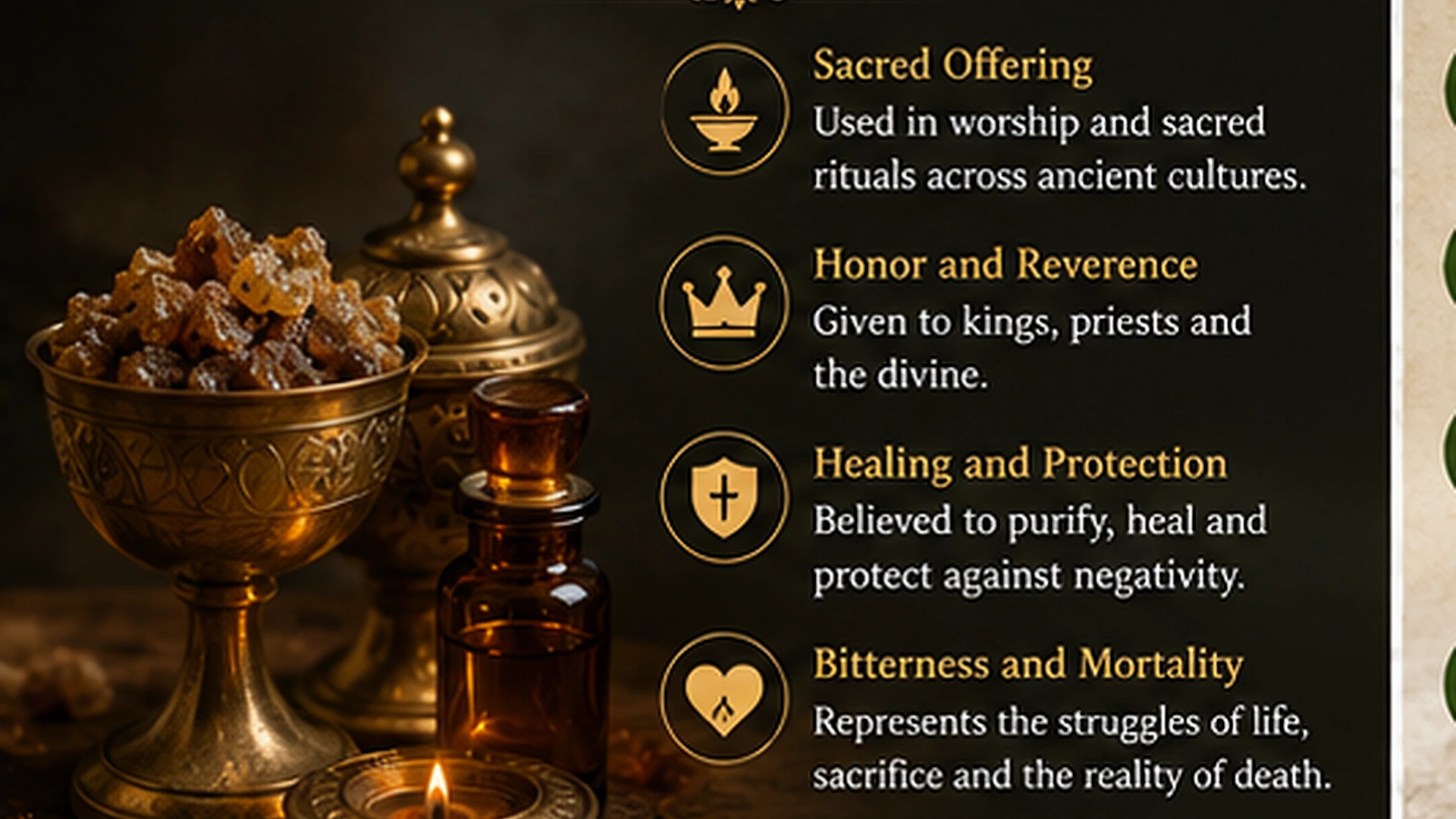
Myrrh’s symbolic meanings grew from its sensory qualities, price, uses and religious settings. The resin is bitter yet fragrant, comes from a wounded tree, hardens into preservable tears, burns into aromatic smoke and traveled as a valuable commodity. These characteristics make it especially open to metaphor. The following meanings are recurring interpretations, not a universal code shared by all cultures.
Sacred offering and costly honor
Because myrrh was difficult to obtain in many regions and moved through long trade networks, giving it could demonstrate honor, devotion or wealth. Temple offerings and the gifts of the Magi both place a valuable aromatic within an act of reverence. The symbolism comes partly from economic reality: a rare imported resin was an appropriate material for gods, rulers and sacred occasions.
Bitterness, sorrow and difficult truth
The bitter taste of myrrh encouraged associations with grief, suffering and hardship. Christian readings of the Magi’s gift often connect this bitterness with the future Passion of Jesus. Modern spiritual writers may extend the image to emotional honesty or endurance. Such interpretations can be meaningful, but they should not be presented as the only ancient meaning of the resin.
Preservation, mortality and remembrance
The use of aromatic substances in embalming and burial linked myrrh with the care of the dead, preservation of the body and remembrance. In Christian tradition, John’s burial account reinforced this connection. The meaning is not merely “death”: funerary care can communicate dignity, love, continuity and hope. Myrrh therefore sits at the boundary between decay and preservation, loss and memory.
Purification, consecration and sacred fragrance
Burning aromatic resin changes the atmosphere of a space. Smoke rises, scent lingers and ordinary surroundings feel marked off from daily life. In Jewish and Christian contexts, myrrh in anointing oils or incense blends can support ideas of consecration and prayer. The Met notes that incense smoke in Roman Catholic and Eastern Orthodox practice is interpreted as the prayers of the faithful rising toward heaven. [3]
Healing and restoration
Traditional topical and oral-care uses contributed to a symbolism of healing, soothing and restoration. Yet “healing symbolism” must not be confused with a guarantee that burning resin or applying oil will cure illness. The responsible distinction is simple: communities may understand a substance as healing within ritual or traditional medicine, while modern clinical evidence may remain limited.
Protection and boundary-making
Some modern users associate myrrh smoke or oil with spiritual protection, cleansing or the setting of boundaries. Historical incense could indeed mark sacred space, mask unpleasant odors and accompany prayers for safety. However, there is no single documented pan-African or universal “myrrh protection ritual.” Any specific claim should be tied to a named community, text or religious practice rather than invented from the resin’s general reputation.
Specific culture or historical context: Educational material-culture presentation showing incense, anointing/perfume and funerary associations as distinct uses.
People shown: No people, or only a conservator’s gloved hand at the edge.
Location: Museum study room or heritage interpretation space.
Clothing: Not applicable beyond a glove if shown.
Architecture: Neutral interior; no church, synagogue and Egyptian tomb combined in one scene.
Objects: Myrrh resin, unlit censer, small oil vessel, linen and archival supports.
Lighting: Soft directional light with visible texture and no dramatic supernatural effect.
Composition: Wide 16:9 still life; each object clearly separated, resin central, ample negative space.
SEO-friendly filename: myrrh-symbolism-incense-anointing-burial.webp
Image title: Myrrh Symbolism in Incense, Anointing and Burial
Alt text: Myrrh resin displayed with a censer, oil vessel and funerary linen in a museum study setting
Caption: Myrrh acquired different meanings through incense, sacred oils, perfume and funerary preparation.
Recommended placement: After the symbolism section.
Article section supported: Religious symbolism and cultural distinctions.
Important elements to avoid: No active blended worship, crosses beside Egyptian gods, fake Hebrew or Arabic writing, flames, magical aura, labels, logos, borders, collage or embedded quotations.
Traditional Uses of Myrrh
Incense and ceremonial fragrance
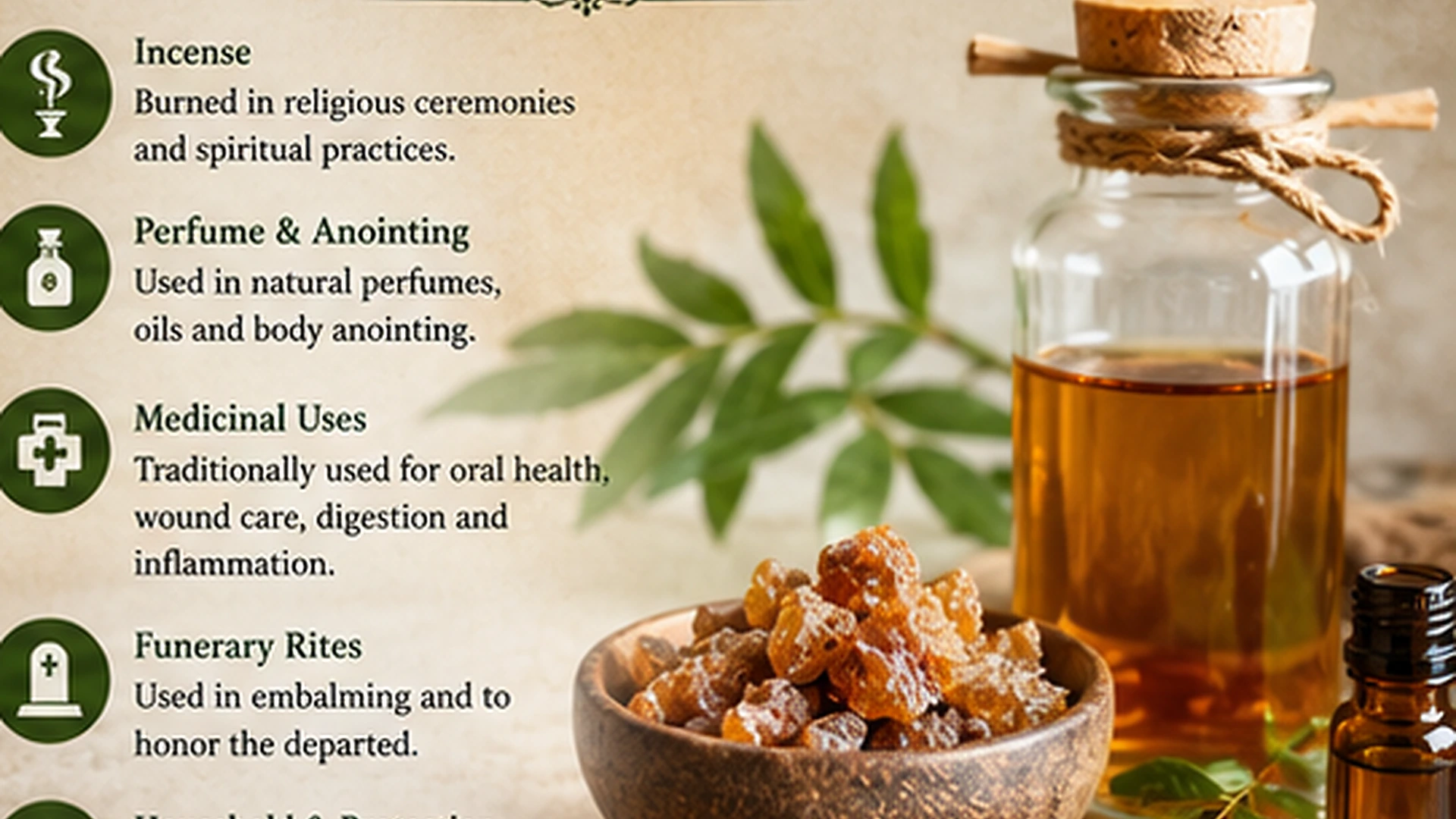
One of myrrh’s longest-lasting uses is fragrance. Small resin pieces can smolder on charcoal or heated surfaces, releasing a warm, earthy, medicinal and slightly smoky aroma. It has been burned alone and blended with frankincense or other aromatics. The exact ingredients and religious meanings vary, and smoke exposure should be considered in enclosed spaces.
Perfume, ointments and body care
Myrrh has been infused into oils, incorporated into ointments and used as a fixative note in perfumery. Its deep scent helps anchor more volatile aromas. Ancient and modern formulas may use raw resin, tincture, resinoid or essential oil, each of which behaves differently. Historical cosmetic use does not mean that concentrated essential oil is safe to apply undiluted.
Funerary preparation and preservation
Ancient Egyptian and later Mediterranean funerary practices used aromatic materials to scent, dry or preserve the body and wrappings. Myrrh’s antibacterial activity in laboratory studies may help explain part of its practical reputation, but ancient embalmers worked with complex mixtures and procedures. It is misleading to suggest that myrrh alone “mummified” bodies.
Mouth care and minor skin applications
The European Medicines Agency’s herbal committee recognizes certain liquid myrrh extracts for traditional use in minor mouth ulcers and inflammation, and for minor wounds and small boils. The basis is long-standing use rather than strong clinical-trial evidence. The EMA limits the assessed preparations to external application on skin or the lining of the mouth, generally for adults and adolescents over 12, and advises professional review if symptoms worsen or persist beyond one week. [6]
This is a useful example of an evidence ladder. Traditional use can make a preparation plausible and suitable for limited self-care, while still falling short of proof from high-quality clinical trials. Laboratory findings of antibacterial, local-anesthetic and anti-inflammatory activity are not the same as demonstrated effectiveness for every product or disease.
Traditional Chinese medicine
In Chinese medicine, myrrh—often combined with frankincense—appears in formulas for trauma, pain, swelling and conditions described through blood-stasis theory. These are practitioner-guided uses within a complete diagnostic system. Self-prescribing raw resin or essential oil based on a translated list of indications can be unsafe and may ignore dose, preparation, interactions and contraindications.
Ayurvedic and other traditional medical systems
Reviews describe Commiphora resins in Ayurvedic, Arabic and other traditional systems for wounds, pain, inflammatory complaints, digestive disorders and gynecological conditions. The genus includes multiple species, and some South Asian products called guggul come chiefly from Commiphora wightii or related species rather than true myrrh. Articles and product labels should not collapse every Commiphora resin into C. myrrha.
Horn of Africa and household uses
In Somalia and Ethiopia, local Commiphora resins have been used in perfumery, incense, household scenting and traditional remedies. Kew records scented myrrh from C. guidottii as an important Somali export and reports local uses involving wounds and stomach complaints. Such records document practice, not a recommendation to reproduce every remedy—especially uses involving pregnancy, childbirth or internal dosing. [2]
Modern perfumery and aromatherapy
Today, myrrh appears in perfumes, soaps, mouth-care products, incense blends and aromatherapy oils. Commercial “myrrh oil” is usually a steam-distilled essential oil, whereas tinctures are solvent extracts and resinoids are concentrated perfumery materials. Buyers should check the botanical name, extraction method and intended use instead of assuming all products are equivalent.
Specific culture or historical context: Contemporary evidence-based ethnobotany and quality-control setting connecting traditional knowledge with careful product identification.
People shown: One adult researcher wearing appropriate laboratory clothing and gloves.
Location: University pharmacognosy laboratory in East Africa or an international botanical research center.
Clothing: Lab coat over professional clothing, safety glasses available, nitrile gloves.
Architecture: Modern laboratory benches and storage shelves softly out of focus.
Objects: Raw resin, amber bottles, glass pipette, scent strip, mortar, botanical specimen and notebook.
Lighting: Bright neutral laboratory lighting with realistic glass reflections.
Composition: Wide 16:9 editorial photograph; researcher on left, samples and resin across foreground, uncluttered composition.
SEO-friendly filename: myrrh-traditional-uses-modern-research-safety.webp
Image title: Myrrh Traditional Uses and Modern Research
Alt text: Researcher comparing raw myrrh resin, tincture and perfumery samples in a laboratory
Caption: Modern research distinguishes raw resin, extracts and essential oil while evaluating traditional uses and safety.
Recommended placement: After the traditional uses section.
Article section supported: Evidence, product forms and responsible modern use.
Important elements to avoid: No miracle-cure label, pills presented as proven treatment, mystical smoke, unsafe bare-hand handling, readable brand names, logos, medical guarantees or collage.
Myrrh and Frankincense: What Is the Difference?
| Feature | Myrrh | Frankincense |
|---|---|---|
| Principal source | Commiphora species, especially C. myrrha | Boswellia species, including B. sacra and related trees |
| Native center | Northeastern Africa and southern Arabia | Horn of Africa, Arabian Peninsula and parts of South Asia, depending on species |
| Taste and scent | Distinctly bitter; warm, earthy, medicinal, smoky | Usually brighter, pine-like, citrusy or balsamic |
| Historical roles | Incense, perfume, ointment, medicine and funerary preparation | Incense, perfume, medicine and temple/church fragrance |
| Common symbolism | Bitterness, honor, mortality, preservation, healing | Prayer, sanctity, divine presence, purification |
| Modern forms | Raw resin, tincture, resinoid, essential oil | Raw resin, hydrodistillate, extract, essential oil |
| Important caution | Species and extracts vary; concentrated products can irritate | Smoke and concentrated oil can also irritate; species and quality vary |
The two resins are frequently paired because they traveled along overlapping routes and complement one another aromatically. They are not the same substance, and their biblical or spiritual meanings should not be reduced to a fixed universal formula.
What Does Modern Science Support?
Laboratory and animal research has identified terpenoids and other compounds in Commiphora resins and has reported antimicrobial, anti-inflammatory, analgesic and antioxidant activity. Reviews also discuss many additional potential effects. These findings help explain why myrrh has attracted medical interest, but most do not establish that a retail oil, incense or supplement treats disease in humans. [5]
The strongest cautious regulatory statement in the sources used for this article comes from the European Medicines Agency: certain liquid extracts can be recognized for traditional external use in minor mouth inflammation and minor skin problems, while the supporting clinical-trial evidence remains insufficient. This is far narrower than claims that myrrh cures infections, cancer, diabetes, infertility or chronic inflammatory disease. [6]
Product quality is another limitation. A 2024 review of Commiphora research emphasized problems with species identification, extract standardization and reproducibility. Studies on different Commiphora species or chemically different extracts cannot automatically be treated as evidence for every product sold as “myrrh.” [7]
Safety and Responsible Use
Do not ingest raw resin or essential oil simply because a historical source lists internal use. Dose, species, extraction method and medical context matter.
Undiluted essential oil can irritate skin and mucous membranes. Use only products formulated for their stated purpose and follow professional or manufacturer guidance.
The EMA reports allergic skin reactions with myrrh medicines and notes that alcohol-based extracts may briefly sting or irritate the mouth or skin. [6]
Avoid self-treatment during pregnancy or breastfeeding and avoid using myrrh to influence menstruation, labor or postpartum processes without qualified medical care.
Seek professional advice when taking prescription medicines, when treating children, or when symptoms are persistent, severe, infected or unexplained.
Incense smoke contains fine particles and combustion products. Ventilate spaces and avoid smoke exposure for people with asthma, respiratory sensitivity, infants and animals.
Spiritual use should never replace medical evaluation, emergency care, legal protection or practical safety measures.
How to Buy and Identify Myrrh Responsibly
1. Check the botanical name. True myrrh is commonly sold as Commiphora myrrha; scented myrrh or opopanax may come from C. guidottii or other species.
2. Check the form. Raw resin, tincture, resinoid and essential oil are different materials with different uses and concentrations.
3. Choose transparent sourcing. Reputable sellers should disclose country of origin, harvest or processing information and intended use.
4. Avoid exaggerated claims. A product advertised as guaranteed to heal disease, remove curses, force love or create wealth is not supported by the historical or scientific evidence presented here.
5. Respect living source communities and ecosystems. Myrrh is not merely a biblical prop; it remains part of dryland livelihoods, regional trade and cultural knowledge in northeastern Africa and Arabia.
Common Misunderstandings About Myrrh
| Misunderstanding | More accurate explanation |
|---|---|
| Myrrh has one universal spiritual meaning. | Meanings vary by culture, text and historical use; modern personal interpretations should be labeled as such. |
| The Bible says myrrh represented Jesus’s death. | Matthew names the gift but does not explain its symbolism. The burial meaning developed through later interpretation and other Gospel passages. |
| All myrrh comes from one tree. | Several Commiphora species produce resins sold under myrrh-related names. |
| Ancient use proves modern medical effectiveness. | Traditional use is historical evidence, not the same as strong clinical-trial evidence. |
| Myrrh and frankincense are interchangeable. | They come from different plant genera and have different scent profiles, chemistry and histories. |
| Natural myrrh oil is safe at any concentration. | Concentrated extracts can irritate and may not be suitable for ingestion or undiluted skin use. |
Responsible Cultural and Spiritual Interpretation
People may use myrrh today in prayer, meditation, remembrance, home fragrance or personal symbolism. Responsible practice starts with honesty about origin. A Christian devotional use should not be described as an ancient Egyptian ritual. A modern intention-setting exercise should not be marketed as a universal African tradition. A perfume blend should not be promoted as clinically healing merely because myrrh had medicinal uses in the past.
The most respectful approach is to name the level of interpretation: documented ancient use, scriptural reference, later religious symbolism, traditional medical practice, contemporary spiritual meaning or personal association. This preserves both cultural depth and factual clarity.
Key Takeaways
Myrrh is a bitter aromatic gum-resin, principally associated with Commiphora myrrha and related species.
Its botanical center lies in northeastern Africa and southern Arabia, where local ecological knowledge underpinned its harvest and trade.
It became valuable through incense, perfume, anointing, medicine, long-distance trade and funerary preparation.
Its symbolism can include sacred offering, costly honor, bitterness, suffering, preservation, remembrance, healing and consecration.
Biblical texts use myrrh in several ways; the familiar “gift predicting burial” explanation is a later Christian interpretation, not a direct statement in Matthew.
Modern evidence is limited and product-specific. Traditional use should not be converted into broad medical claims.
Species identification, form, concentration, sourcing and safety all matter.
People Also Ask
What is myrrh?
Myrrh is an aromatic gum-resin produced by several Commiphora trees and shrubs. True myrrh usually refers to resin from Commiphora myrrha, native to dry areas of northeastern Africa and southern Arabia.
What does myrrh symbolize?
Depending on the tradition, myrrh may symbolize sacred offering, honor, bitterness, suffering, healing, preservation, mourning, remembrance or consecration. There is no single universal meaning.
Why did the Magi give myrrh?
Matthew records myrrh as one of the gifts but does not explain why. Later Christian interpretation commonly sees it as a sign of Jesus’s human mortality and future burial because myrrh was used in funerary preparation.
What was myrrh used for in ancient Egypt?
Historical summaries describe myrrh in temple offerings, perfumed preparations and embalming. It was one aromatic among several used in complex religious, cosmetic and funerary practices.
Is myrrh the same as frankincense?
No. Myrrh comes from Commiphora species, while frankincense comes from Boswellia species. They have different aromas and chemistry, although they were traded and burned together.
Can myrrh be used medicinally?
Certain regulated liquid extracts are recognized in Europe for traditional external use in minor mouth inflammation and minor skin problems. Evidence is limited, and concentrated products should be used only as directed.
What does myrrh smell like?
Myrrh is commonly described as warm, earthy, woody, balsamic, smoky and medicinal, with a bitter undertone. Its exact aroma varies by species and grade.
Where does myrrh come from?
The principal true-myrrh species is native from eastern and southeastern Ethiopia to northeastern Kenya and parts of the southern Arabian Peninsula.
How is myrrh harvested?
Resin exudes after the bark is naturally damaged or carefully incised. It hardens on the tree into tears that are later collected, cleaned and sorted.
Is myrrh safe to burn?
Burning any incense creates smoke and fine particles. Use ventilation, avoid heavy exposure and consider respiratory sensitivities, children and animals.
Frequently Asked Questions
Is myrrh a tree or a resin?
The word usually refers to the resin. It is produced by small trees and shrubs in the genus Commiphora.
What color is natural myrrh?
Raw resin can range from yellowish or amber to reddish-brown and dark brown. Color varies with species, age, oxidation and quality.
Why is myrrh called bitter?
Its name is connected with a Semitic word family for bitterness, and the resin has a strongly bitter taste.
Was myrrh more valuable than gold?
Myrrh was a costly luxury in some periods, but broad claims that it was always worth more than gold oversimplify changing markets, grades and historical contexts.
Is myrrh an African spiritual herb?
It is a resin from trees native partly to northeastern Africa, and it has African cultural histories. It is not one pan-African spiritual substance with a single ritual meaning.
Can myrrh remove negative energy?
That is a modern spiritual belief, not a scientifically testable or historically universal fact. People may use scent symbolically, but it should not be presented as guaranteed protection.
Can myrrh heal wounds?
Traditional topical uses exist, and certain extracts are recognized for minor skin problems on the basis of long-standing use. Serious, infected or slow-healing wounds need medical care.
Can myrrh be swallowed?
Do not swallow raw resin, tincture or essential oil unless a qualified clinician or a properly authorized product specifically directs that use.
Is myrrh safe during pregnancy?
Pregnant people should avoid self-medicating with myrrh because internal traditional uses include effects related to menstruation and childbirth, and safety evidence is inadequate.
What is opopanax?
Opopanax or scented myrrh commonly refers to fragrant resin from Commiphora guidottii and sometimes other sources. Trade names can be inconsistent.
Does myrrh appear in Islam?
Myrrh circulated widely in Arabic medicine and perfumery. Specific religious claims should be tied to authoritative Islamic texts or named regional traditions rather than assumed from general Middle Eastern use.
Why are frankincense and myrrh often paired?
They traveled along overlapping trade networks, complement each other aromatically and both became important in incense, perfumery, medicine and religious history.
Is myrrh essential oil the same as resin?
No. Essential oil is a concentrated volatile fraction distilled from resin. It does not contain every component of the raw gum-resin and requires different safety precautions.
Can I burn myrrh resin without charcoal?
Some electric resin warmers can heat it without direct charcoal. Follow the appliance instructions and maintain ventilation.
How should myrrh resin be stored?
Keep it sealed, dry, cool and away from direct sunlight. Strong aromas can transfer to nearby materials.
Is myrrh endangered?
Kew’s current prediction for Commiphora myrrha does not classify it as threatened, but local populations and other Commiphora species can face habitat degradation and overharvesting. Responsible sourcing still matters.
Conclusion
Myrrh became meaningful because it was both material and metaphor: a bitter resin from a wounded dryland tree, an aroma that crossed enormous distances, a costly offering, a medicine, a perfume and a substance used to care for the dead. Each use added another layer of interpretation. Its history belongs not to one civilization but to networks linking northeastern Africa, Arabia, Egypt, the Levant, the Mediterranean, South Asia and China.
The most accurate answer to “What does myrrh mean?” is therefore contextual. In one text it marks holiness; in another, desire; in another, burial; in another, pain relief or wound care. Modern readers can value those meanings while still separating belief from evidence, later symbolism from original texts, and personal spiritual practice from the traditions of specific communities.
Final Summary
Myrrh is a historically important Commiphora resin associated with sacred fragrance, luxury, medicine, preservation and long-distance trade. Its best-known symbols—honor, bitterness, suffering, healing and mortality—arise from particular uses and interpretations. Responsible study identifies the plant, culture, period and preparation, and avoids promising spiritual or medical results that the evidence cannot support.
Research Sources and Further Reading
1. Royal Botanic Gardens, Kew — Plants of the World Online: Commiphora myrrha
2. Royal Botanic Gardens, Kew — Plants of the World Online: Commiphora guidottii
3. The Metropolitan Museum of Art — Offering Incense
4. UNESCO World Heritage Centre — Incense Route: Desert Cities in the Negev
5. Shen, Li, Wang & Lou — The genus Commiphora: traditional uses, phytochemistry and pharmacology, Journal of Ethnopharmacology
6. European Medicines Agency — Myrrha herbal medicinal product summary
7. Yang et al. — The Genus Commiphora: traditional uses, phytochemistry, pharmacology and quality control
8. Ghebremeskel et al. — Commiphora myrrh: a phytochemical and pharmacological update
9. The Metropolitan Museum of Art — Reliquary of the Journey and Adoration of the Magi
10. UNESCO World Heritage Centre — Old Incense Trade Routes, Yemen Tentative List
5. Internal Linking Plan
| Anchor text | Suggested destination | Placement |
|---|---|---|
| frankincense meaning and traditional uses | /blog/frankincense-meaning-history-symbolism-traditional-uses | Myrrh-versus-frankincense section |
| African sacred herbs and resins | /blog/african-sacred-herbs-resins-cultural-context | Introduction or responsible interpretation |
| ancient incense trade routes | /blog/ancient-incense-route-africa-arabia-mediterranean | Historical trade section |
| ancient Egyptian spiritual traditions | /blog/ancient-egyptian-spiritual-traditions | Ancient Egypt section |
| incense safety and responsible use | /blog/incense-safety-smoke-essential-oils | Safety section |
| African symbols of protection | /blog/african-symbols-of-protection-cultural-context | Protection symbolism caution |
| traditional African spiritual practices | /blog/understanding-african-spiritual-traditions | Cultural context note |
6. Supporting Article Recommendations
| Priority | Supporting article | Purpose / cannibalization guidance |
|---|---|---|
| 1 | Frankincense Meaning: History, Symbolism and Traditional Uses | Parallel resin page with distinct Boswellia focus. |
| 2 | Myrrh vs Frankincense: Origins, Scent and Symbolism | Comparison intent; link back to both pillar pages. |
| 3 | The Ancient Incense Route Between Africa and Arabia | Historical trade cluster; avoid repeating general myrrh definition. |
| 4 | How Myrrh and Frankincense Are Harvested | Process and sustainability visual explainer. |
| 5 | Incense in Ancient Egypt: Temples, Perfume and Burial | Deep historical context; link to myrrh section. |
| 6 | Sacred Anointing Oils in Biblical History | Scripture and material-culture focus. |
| 7 | Incense Smoke and Essential Oil Safety | Health-information support page with current medical sourcing. |
| 8 | Commiphora Trees of the Horn of Africa | Botanical and regional authority page; avoid medical claims. |
Article Information
- Publisher
- Ancestral Temple
- Editor
- Ancestral Temple
- Last updated
- Jul 26, 2026
- Last reviewed
- Jul 26, 2026
- Content version
- fbcd8a80e2
This educational article should be read as cultural and spiritual information, not as medical, legal, financial, or emergency advice.
Helpful Related Guidance
Explore This Topic
Related Topic Cluster
Dreams & Symbolism
About the Author
 Ancestral Temple
Spiritual guide and practitioner with decades of experience in ancestral wisdom, rituals, and divine guidance.
Related Posts
View All












Leave a Comment
We'd love to hear your thoughts.