
The History of Shrines: From Household Altars to Sacred Sites
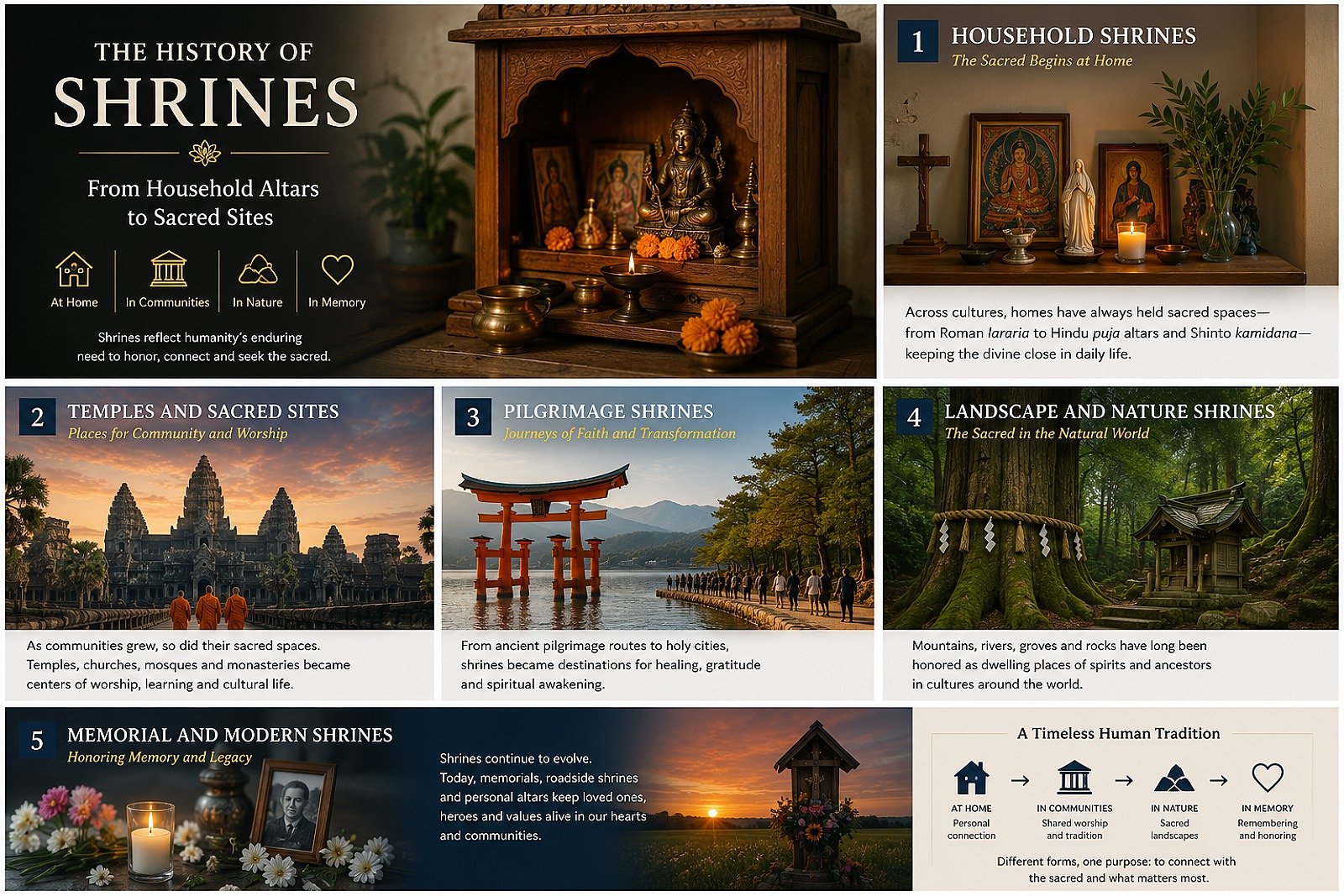
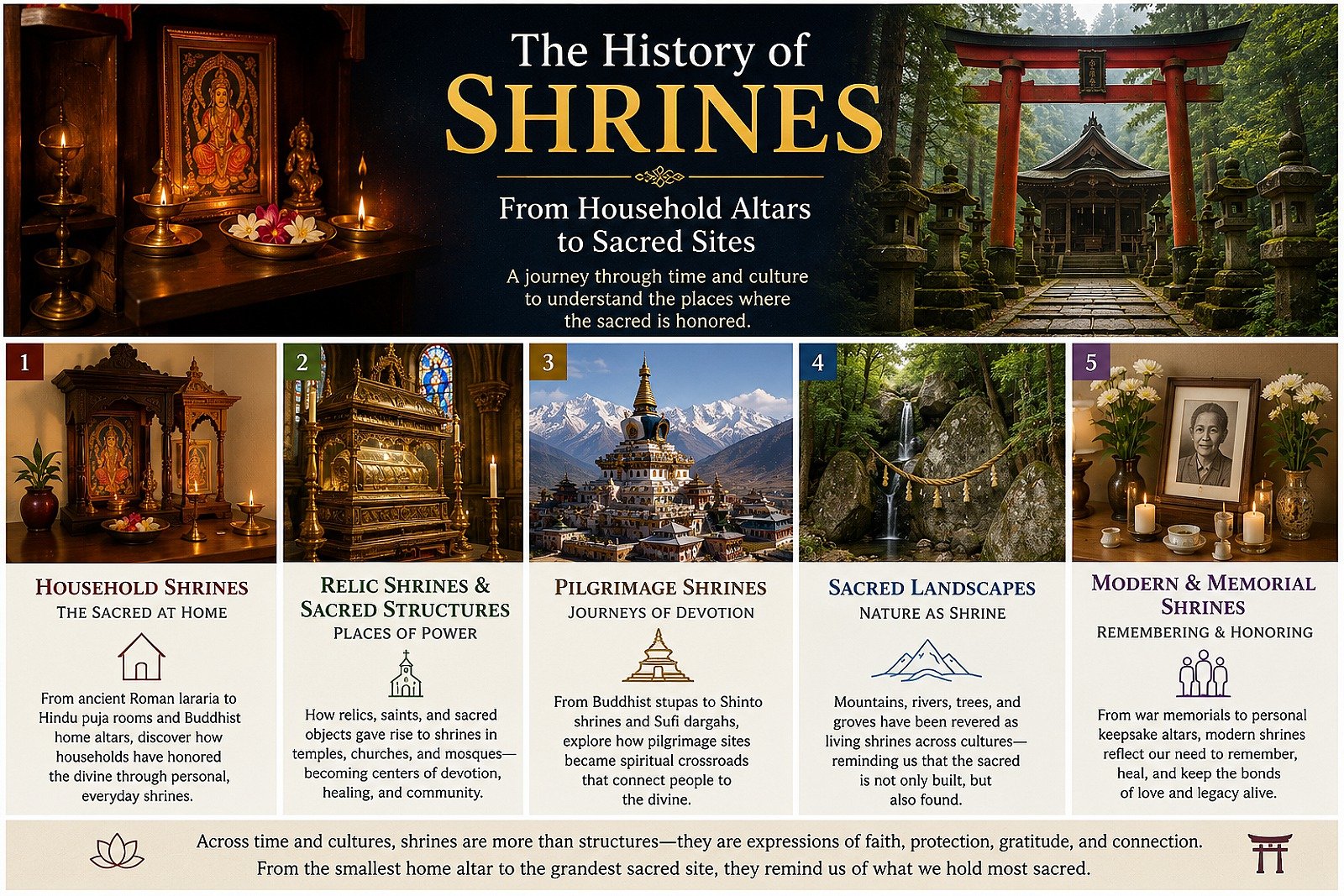
Quick Summary
A shrine can be a shelf in a home, a niche beside a road, a tomb visited by pilgrims, a reliquary inside a church or an entire mountain landscape. These places differ enormously in...
A shrine can be a shelf in a home, a niche beside a road, a tomb visited by pilgrims, a reliquary inside a church or an entire mountain landscape. These places differ enormously in size and theology, yet they share a basic feature: a community treats a particular location or container as a focused point of sacred presence, memory, protection, communication or devotion.
The history of shrines is therefore not a single story in which a small household altar gradually evolved into a monumental sacred site. Domestic shrines, graves, natural landmarks, temples, relic sites and pilgrimage routes developed through different local histories. Many existed side by side. A Roman family could maintain a lararium at home while participating in public cult; a medieval Christian could pray before a domestic image and also travel to a saint’s tomb; a Japanese household might keep a kamidana while visiting a regional jinja.
Understanding shrine history requires attention to scale, material and community. Who or what is enshrined? What offerings are made? Who controls access? Is the site archaeological, reconstructed, privately maintained or still used by a living religious community? These questions reveal more than a universal definition ever could.
Quick Answer
Shrines developed independently in homes, at graves, around divine images and relics, beside roads and within sacred landscapes. Some are small containers or shelves; others are buildings or pilgrimage complexes. An altar is usually a surface for offerings, while a shrine is the focused place or structure that houses, marks or gives access to a sacred presence. There is no single global origin story.
| Image number | Image 1 - Featured image |
|---|---|
| Purpose | Introduce the article as a history of multiple shrine traditions and scales without blending them into one invented sacred practice. |
| Detailed scene | A refined museum gallery with five physically separate illuminated displays: a Roman household lararium reconstruction, a Japanese kamidana, a medieval Christian reliquary, an African ancestor memorial object and a scale model of a mountain pilgrimage complex. Each display is separated by architecture and contains no readable labels. |
| Specific culture or historical context | Contemporary educational museum presentation of historically distinct shrine traditions. |
| People shown | Optional diverse adult visitors viewed from behind, observing quietly. |
| Location | Modern museum gallery with conservation-quality vitrines and open circulation space. |
| Clothing | Contemporary visitor clothing; no ceremonial dress. |
| Architecture | Minimal gallery architecture that keeps every tradition in a separate display zone. |
| Objects | Lararium niche and statuettes, kamidana shelf, reliquary, ancestor memorial object and sacred-landscape model. |
| Lighting | Controlled museum lighting with realistic shadows and warm highlights. |
| Composition | Wide 16:9 editorial photograph with a clear left-to-right movement from domestic scale to landscape scale. |
| SEO-friendly filename | history-of-shrines-household-altars-sacred-sites.webp |
| Image title | Many Scales of Sacred Space |
| Alt text | Museum gallery presenting household, funerary and pilgrimage shrine traditions in separate displays |
| Caption | Shrines have developed in homes, at graves, around relics and across sacred landscapes rather than through one universal sequence. |
| Recommended placement | After the introduction and Quick Answer. |
| Article section supported | Overview and definition of shrine history. |
| Important elements to avoid | Collage layout, readable text, mixing sacred objects in one altar, fantasy lighting, invented hybrid symbols, active restricted rituals. |
What Is a Shrine?
In ordinary English, a shrine is a focused sacred place associated with a deity, ancestor, saint, relic, event, image, landscape feature or memory. It may be freestanding or located inside a house, temple, church, tomb or natural setting. The word can describe both the container and the place around it.
That broad definition is useful, but it can also hide cultural differences. A Roman lararium, a Hindu household puja space, a Shinto jinja, a Buddhist stupa and a Christian reliquary are not interchangeable. Each belongs to a particular religious vocabulary and social history. “Shrine” is often an English umbrella term applied to several types of sacred focus.
Shrine, Altar, Temple and Sanctuary: What Is the Difference?
An altar is generally a table, block, shelf or prepared surface where offerings, lamps, incense, food, sacrifice or ritual objects are placed. A shrine may contain an altar, but it can also be a niche, tomb, image house, reliquary or marked natural place.
A temple, church, mosque or other house of worship is a larger institutional building or complex. A shrine may stand inside it, beside it or independently. A sanctuary is a protected sacred precinct; in ancient Greek religion, for example, a sanctuary could include an enclosure, temple, outdoor altar, statues, votive offerings, trees and springs.[6]
A reliquary is a container for relics. When that container becomes an architectural focus of devotion, it may be called a reliquary shrine. These terms overlap, so the most accurate description usually combines the local name with a brief explanation.
| Shrine type | Main function | Typical focus | Examples |
|---|---|---|---|
| Household shrine | A sacred focus inside a home | Images, amulets, ancestor tablets, lamps, offerings | Roman lararia; Hindu home shrines; Tibetan Buddhist shrines; kamidana |
| Funerary or ancestral shrine | Maintains memory or relationship with the dead | Tomb, portrait, relic, memorial sculpture, offerings | Greek heroa; Fon asen; Kasubi Tombs |
| Temple- or church-associated shrine | A focused sacred place inside a larger religious complex | Cult image, relic, saintly tomb, divine emblem | Egyptian god shrines; medieval reliquaries; side chapels |
| Pilgrimage shrine | Draws visitors to a person, event, relic or sacred manifestation | Tomb, footprint, relic, image, spring or commemorated event | Lumbini; Abu Mena; saintly shrines |
| Landscape shrine or sacred site | A natural feature and ritual setting treated as sacred | Mountain, grove, spring, cave, path, boundary marker | Kii Mountains; Mount Fuji; sacred groves |
| Wayside or memorial shrine | Marks protection, gratitude, loss or local memory in public space | Cross, niche, flowers, candles, photographs, votive gifts | Polish wayside shrines; roadside memorials; spontaneous shrines |
Why Shrines Do Not Have One Universal Origin
Humans have marked significant places for far longer than written history, but archaeology cannot always tell us whether an arrangement of stones, a grave deposit or a special building functioned as a “shrine” in the later religious sense. Objects survive more readily than prayers, gestures and oral teachings.
Different societies created sacred focuses for different reasons. A household might maintain relations with protective beings or ancestors. A ruler might establish a tomb cult. A community might recognize a spring, tree, cave or mountain as powerful. A religious movement might gather around the remains of a teacher or martyr. A state might sponsor monumental sacred architecture to organize ritual and authority.
Because these possibilities are not stages in one ladder, “the first shrine” is an unhelpful global question. It is better to ask when a particular community began marking a particular kind of sacred presence and what evidence survives.
Household Shrines: Sacred Practice in Daily Space
Household shrines place religious practice inside the rhythms of cooking, sleeping, work, family memory and seasonal observance. Their scale can be modest, but their importance is not necessarily minor. A home shrine may receive daily attention more regularly than a distant monumental site.
Domestic shrines also show why size does not determine sacred value. Some occupy a separate room; others are a high shelf, wall niche, cabinet, row of images or temporary arrangement prepared for a festival.
Roman Lararia and the Protection of the Household
In Roman homes, the lararium was a shrine associated with household deities and protective powers. The Metropolitan Museum of Art describes the lar familiaris as a household deity concerned with the family’s health and prosperity. From the Augustan period onward, lararia commonly included paired Lares carrying a drinking vessel and offering dish.[1]
Archaeological examples from Pompeii range from painted wall niches to elaborate miniature architectural settings. They could stand in atria, courtyards, kitchens or service areas. Offerings connected divine protection with the ordinary life of the household rather than separating religion into a building visited only on special occasions.
The lararium did not replace public religion. Roman households participated in civic festivals and temple cults while maintaining domestic sacred practices. This coexistence is a recurring pattern in shrine history.
| Image number | Image 2 |
|---|---|
| Purpose | Show how a household shrine functioned within Roman domestic life. |
| Detailed scene | A historically informed Pompeian domestic interior with a painted lararium niche on a courtyard wall. Two small bronze Lares stand beside a central protective figure, with a modest offering dish and lamp placed below. No modern people are present. |
| Specific culture or historical context | Roman Italy, first century CE, based on archaeological lararia from Pompeian houses. |
| People shown | None, or one household member at a distance performing an ordinary offering without theatrical gesture. |
| Location | Atrium or service courtyard of a Roman house in Pompeii. |
| Clothing | If a person appears, historically plausible simple Roman domestic clothing. |
| Architecture | Plastered walls, painted niche, masonry altar shelf and realistic Roman courtyard details. |
| Objects | Small Lares statuettes, offering dish, lamp and painted serpent or garden motif only where archaeologically appropriate. |
| Lighting | Natural Mediterranean daylight entering the courtyard. |
| Composition | Wide 16:9 documentary reconstruction with the lararium as the focal point and domestic space visible around it. |
| SEO-friendly filename | roman-household-lararium-pompeii.webp |
| Image title | A Roman Household Lararium |
| Alt text | Reconstructed Roman household lararium in a Pompeian courtyard |
| Caption | Roman lararia brought protective household deities into the daily spaces of family life. |
| Recommended placement | After the Roman lararia subsection. |
| Article section supported | Household shrines in ancient Mediterranean religion. |
| Important elements to avoid | Modern candles, Egyptian objects, Christian crosses, fantasy statues, lavish palace setting, readable modern labels. |
Hindu Household Shrines and Direct Devotion
The Smithsonian’s educational materials on Hindu puja describe the household shrine as the sacred center of the home. It may be an entire room, an architectural cabinet, a small niche or even a row of religious prints. Home worship allows direct contact between devotee and deity, while temple practice may involve priests and larger communal structures.[2]
The form of a home shrine varies by region, family, lineage and available space. Images of deities, lamps, flowers, water, incense and food may be arranged for puja, but there is no single object list that represents every Hindu home. The shrine is maintained through repeated acts rather than through architecture alone.
Tibetan Buddhist Domestic Shrines
Tibetan Buddhist households may maintain a simple altar or an entire dedicated shrine room. The Smithsonian National Museum of Asian Art notes that these spaces can hold images of buddhas, bodhisattvas, teachers, protective beings, texts and ritual implements. Daily practice may include prayers, water-bowl offerings, lamps and incense.[3]
A museum reconstruction can display the material density of such a shrine room, but it is not identical to a living household space. Objects in use have personal, sectarian and teacher-student relationships that a gallery label can only partly communicate.
The Kamidana in Japanese Homes
A kamidana is a household Shinto altar or “kami shelf” where amulets or apportioned sacred presence may be enshrined. Kokugakuin University’s Encyclopedia of Shinto emphasizes that the institution is not timeless. Household Buddhist altars developed around ancestral tablets, while the spread of Ise and other cults helped establish kamidana. Special Ise altars became widespread through networks of religious specialists, and kamidana spread broadly from around the mid-Edo period.[4]
This history matters because household practices are often described as ancient and unchanged. In reality, they grow through travel, trade, institutional outreach, political change and new domestic arrangements. A tradition may be deeply established today while still having a traceable historical expansion.
| Image number | Image 3 |
|---|---|
| Purpose | Represent the development of a household Shinto altar as a specific Japanese practice rather than a universal home shrine. |
| Detailed scene | A historically informed mid-Edo-period Japanese merchant household with a small kamidana mounted high on a clean wooden wall. An ofuda is enshrined inside, with simple rice, salt and water offerings arranged below. The room remains practical and lived-in. |
| Specific culture or historical context | Japan, mid-to-late Edo period, when kamidana spread widely through households. |
| People shown | One Japanese adult shown from the side or back making a brief respectful bow; no staged ceremony. |
| Location | Merchant or artisan home in an Edo-period town. |
| Clothing | Historically plausible everyday kimono appropriate to a merchant household. |
| Architecture | Wooden interior, tatami or plank floor, paper screens and a high wall shelf. |
| Objects | Kamidana, ofuda and modest offerings; no Buddhist statues mixed into the same altar. |
| Lighting | Soft morning daylight with warm interior tones. |
| Composition | Wide 16:9 editorial reconstruction; shrine in upper third, daily household environment visible below. |
| SEO-friendly filename | edo-period-kamidana-household-shrine.webp |
| Image title | Kamidana in an Edo-Period Home |
| Alt text | Japanese household with a kamidana mounted high on the wall during the Edo period |
| Caption | The household kamidana became widespread in Japan through particular medieval and early modern religious networks. |
| Recommended placement | After the household shrines across cultures section. |
| Article section supported | Japanese household shrine history and daily devotion. |
| Important elements to avoid | Torii gate indoors, mixed Buddhist and Shinto objects without context, geisha costume, fantasy architecture, oversized shrine, readable text. |
Portability, Migration and Adaptation
Shrines can travel. Miniature devotional objects, folding icons and pocket shrines allow sacred images to accompany people away from established institutions. Migration may also require worshippers to build with available materials.
A striking example is a Buddhist butsudan made from scrap lumber at the Jerome Relocation Center in Arkansas during the imprisonment of Japanese Americans in the Second World War. The Smithsonian records that Buddhism was practiced privately in the barracks even though it lacked a formally recognized house of worship there.[16] The object shows how a shrine can preserve religious identity under coercive conditions and material scarcity.
From Domestic Focus to Communal Sacred Precinct
Public shrines do not simply represent enlarged household altars. Communal sacred spaces organize larger groups, formal offices, festivals, processions, land, wealth and political authority. They may still share basic actions with domestic practice - offerings, prayer, care of images and remembrance - but their social scale changes what the shrine does.
Ancient Greek Sanctuaries and Hero Shrines
Ancient Greek worship took place in sanctuaries set apart as sacred precincts. These could contain temples, outdoor altars, cult images, statues, votive offerings and natural features such as springs or trees.[6] The temple building was therefore only one part of the sacred environment.
Greek hero cults also centered on graves. A deceased hero was believed capable of beneficial or harmful power, and the grave could become a marked precinct called a heroon. The Met’s description of a fourth-century BCE votive relief explains that worship included offerings, libations and a feast shared in honor of the dead hero.[7]
Here, burial, memory and local identity created a shrine without following a domestic-to-monumental sequence. The grave itself anchored sacred presence.
African Shrine Houses and Ancestral Memorials
African shrine traditions are highly diverse and should not be reduced to a single model of “ancestor worship.” In Asante contexts in Ghana, a shrine house or obosomfie could be organized around a courtyard with spaces for drummers, singers and ceremonial food preparation. Smithsonian archival documentation describes a shrine house near Besease as a complex in which architecture supported collective ritual roles.[14]
Among Fon artists in present-day Benin, iron memorial sculptures called asen could refer to a particular ancestor’s occupation, religious commitments and family history. The Smithsonian compares their imagery to the identifying function of an obituary or tombstone inscription.[15] These are not generic decorations: their forms locate a person within family and religious memory.
At the Kasubi Tombs in Kampala, the burial place of four Buganda kings is also a major spiritual center. UNESCO describes the site as a place where royal rituals and relationships with the spiritual world are maintained. Its sequence of gatehouse, courtyard and large thatched burial structure joins architecture, kingship, memory and living practice.[13]
| Image number | Image 5 |
|---|---|
| Purpose | Represent an African royal burial site as living sacred heritage maintained by community custodians. |
| Detailed scene | A documentary exterior view of the Kasubi Tombs complex in Kampala, showing the broad courtyard, traditional thatched architecture and several Baganda custodians or guides welcoming a small group of respectful visitors. No private ritual is shown. |
| Specific culture or historical context | Contemporary Buganda cultural and spiritual heritage at the Kasubi Tombs, Uganda. |
| People shown | Black Ugandan Baganda custodians and a small mixed-age visitor group, represented with dignity. |
| Location | Kasubi hillside, Kampala, within the recognized royal burial and spiritual complex. |
| Clothing | Contemporary Ugandan clothing; optional bark-cloth elements only if appropriate and verified for the setting. |
| Architecture | Regionally accurate large thatched royal building, gatehouse and courtyard organization. |
| Objects | Minimal visitor items; no invented ritual objects or museum-style display cases. |
| Lighting | Natural late-afternoon daylight with realistic tropical atmosphere. |
| Composition | Wide 16:9 documentary photograph emphasizing architecture, courtyard sequence and living custodianship. |
| SEO-friendly filename | kasubi-tombs-living-sacred-site-uganda.webp |
| Image title | Kasubi Tombs as Living Sacred Heritage |
| Alt text | Baganda custodians and visitors in the courtyard of the Kasubi Tombs in Kampala |
| Caption | The Kasubi Tombs combine royal burial, spiritual practice, architecture and community custodianship. |
| Recommended placement | After the African shrines and royal burial sites subsection. |
| Article section supported | African shrine traditions, tombs and living heritage. |
| Important elements to avoid | Restricted ceremonies, invented regalia, safari imagery, generic “tribal” styling, damaged-site sensationalism, readable signage. |
Temporary Structures and Permanent Buildings in Shinto History
The history of Japanese jinja provides one well-documented example of changing shrine architecture, but it should not be generalized to every religion. Kokugakuin University explains that the early word yashiro may have referred to a temporary structure erected for worship. Outdoor festivals could use simple covered spaces, and permanent buildings developed as structures were retained and as sacred symbols and treasures required protected storage.[5]
Architectural forms associated with storehouses and dwellings influenced early shrine buildings such as those at Ise and Izumo. Over time, worship halls, offering halls, purification facilities and performance spaces expanded major complexes. This is a specific Japanese architectural history, not evidence that all shrines everywhere began as temporary huts.
Tombs, Relics and the Growth of Pilgrimage Shrines
A shrine becomes a pilgrimage destination when people travel beyond ordinary local worship to approach a sacred person, event, object or place. Pilgrimage can turn a small tomb or commemorative marker into a complex of roads, lodgings, markets, ritual spaces and monumental buildings.
Buddhist Memorial Shrines and Lumbini
In Buddhist history, stupas developed as memorial monuments associated with relics, teachings and pilgrimage. At Lumbini in Nepal, the place associated with the Buddha’s birth became a pilgrimage site and was marked by the Mauryan emperor Ashoka in the third century BCE. UNESCO records archaeological remains of monasteries and stupas spanning many centuries, providing evidence for an early Buddhist pilgrimage center.[8]
The sacred importance of Lumbini rests not only in one building. Gardens, archaeological remains, the Ashoka pillar, later temples and the movement of pilgrims together create the shrine landscape.
Christian Relics, Reliquaries and Saintly Tombs
In Christianity, the graves and bodily remains of saints became important sacred focuses. Reliquaries protected and displayed relics in containers made from precious materials. The Metropolitan Museum of Art notes that medieval reliquaries could take the form of caskets, body parts or miniature architecture and became a major field of artistic production.[9]
Relics also drew pilgrims. Travelers brought offerings, acquired badges or miniature reliquaries and supported churches, workshops and lodging networks around major shrines.[10] A focused sacred object could therefore reshape an entire town or regional economy.
Abu Mena in Egypt illustrates this process at an urban scale. Founded in the fourth century around the tomb of Saint Menas, it grew into a major Late Antique and Byzantine pilgrimage center with churches, a basilica, baptistery, baths, workshops and accommodation for travelers.[11] A tomb shrine became a sacred city.
| Image number | Image 4 |
|---|---|
| Purpose | Show how relic veneration transformed a focused shrine into a destination for medieval pilgrimage. |
| Detailed scene | A restrained thirteenth-century European church interior with a gilded architectural reliquary displayed behind a protective screen near the sanctuary. A small group of pilgrims approaches quietly while clergy manage access. |
| Specific culture or historical context | Western European medieval Christian pilgrimage, approximately thirteenth century. |
| People shown | Six to eight European pilgrims of varied social status and two clergy members, represented without melodrama. |
| Location | Romanesque or early Gothic pilgrimage church. |
| Clothing | Historically plausible wool garments, cloaks and simple pilgrim bags; clergy in period-appropriate vestments. |
| Architecture | Stone nave, arches, altar area and side shrine with a goldsmith-made reliquary. |
| Objects | Architectural reliquary, candles, modest votive gifts and pilgrim staffs. |
| Lighting | Natural window light and limited candlelight, realistic for a medieval church. |
| Composition | Wide 16:9 scene with pilgrims in foreground and the reliquary shrine clearly visible beyond them. |
| SEO-friendly filename | medieval-christian-reliquary-pilgrimage.webp |
| Image title | Pilgrims at a Medieval Reliquary Shrine |
| Alt text | Medieval pilgrims approaching a gilded reliquary shrine inside a church |
| Caption | Relics and their containers helped turn churches and tombs into major pilgrimage destinations. |
| Recommended placement | After the medieval Christian relic-shrine subsection. |
| Article section supported | Relics, sacred presence and pilgrimage economies. |
| Important elements to avoid | Baroque architecture, modern pews, fantasy beams of light, huge crowds, inaccurate crusader armor, readable text. |
Sacred Landscapes and Pilgrimage Routes
Some shrines cannot be understood as isolated buildings. Mountains, forests, rivers, caves, springs and paths can form part of the sacred structure. Architecture marks relationships already embedded in the landscape.
The UNESCO-listed sacred sites and pilgrimage routes of Japan’s Kii Mountains connect Yoshino and Omine, Kumano Sanzan and Koyasan through more than 300 kilometers of routes. The landscape reflects interactions among Shinto, Buddhism and Shugendo and preserves a documented sacred-mountain tradition of more than 1,200 years.[12]
In this setting, the journey is part of the shrine. Purification, bodily effort, lodging, natural features and arrival at particular halls or peaks work together. A photograph of one building cannot fully represent the religious geography.
Wayside Shrines and Sacred Boundaries
Small outdoor shrines often stand at crossroads, village edges, fields, bridges and dangerous routes. They can mark gratitude, protection, territorial identity, remembrance or a local sacred story.
Poland’s wayside shrines, documented by the Smithsonian Center for Folklife and Cultural Heritage, may be made from wood, brick, stone or plaster and appear at boundaries, roads, parks, gardens and house niches. Communities decorate them with flowers, ribbons and lamps during religious seasons.[17] Their importance lies partly in repeated care by local residents.
Wayside shrines show that public sacred space does not require monumental architecture. A structure the size of a cabinet can organize memory and community across generations.
What Do Shrines Contain?
A shrine may contain a divine image, ancestor tablet, relic, sacred text, amulet, portrait, footprint, stone, mirror, weapon, lamp or empty space understood as a place of presence. The object is not always treated as a simple representation. In some traditions it houses presence; in others it directs attention toward a transcendent reality, a remembered person or a sacred event.
Offerings may include water, food, flowers, incense, lamps, cloth, money, votive objects, music, dance or spoken prayer. The offering creates a relationship of care, gratitude, petition, obligation or hospitality.
Boundaries are equally important. Doors, curtains, fences, platforms, gates and rules of access distinguish sacred focus from ordinary circulation. Some objects remain hidden, while others are displayed only on particular days. A shrine is therefore not defined by visibility alone.
What Social Work Do Shrines Perform?
Shrines organize relationships. They may connect a household to protective beings, descendants to ancestors, pilgrims to saints, citizens to rulers or communities to landscapes. These relationships can support identity and solidarity, but they can also reflect hierarchy and contested authority.
Presence and Communication
A shrine gives prayer, offerings and memory a location. Repetition makes the place socially recognizable: people know where to go, how to approach and which actions are appropriate.
Protection and Boundary-Making
Threshold shrines, household guardians and roadside markers may be understood as protective. The placement at doors, gates, kitchens, graves or dangerous routes is often as significant as the object itself.
Memory and Mourning
Tombs, ancestor altars and spontaneous memorials allow private grief to enter shared space. The Smithsonian notes that objects left at memorial walls, roadside crosses and spontaneous shrines are ways of grieving loss publicly.[18]
Authority and Community
Royal burial shrines, state-sponsored sanctuaries and famous pilgrimage sites can legitimize rulers or institutions. Control of access, offerings and interpretation may carry economic and political power as well as religious responsibility.
Movement and Exchange
Pilgrims carry stories, objects, money and artistic styles. Routes connect distant communities, while badges, amulets and portable images allow the shrine’s significance to travel home.
Modern Shrines, Spontaneous Memorials and Digital Space
Shrine-making continues. Roadside memorials, photographs surrounded by candles, flowers placed outside a public figure’s home and online memorial pages all focus grief and attention. Some closely resemble older votive practices; others arise from modern media and mass public mourning.
Calling every memorial a shrine can be useful descriptively, but participants may prefer “memorial,” “altar” or another term. A spontaneous arrangement may also be temporary. Weather, municipal rules, family wishes and public safety affect how long it remains.
Digital memorials extend the logic of focused presence without requiring physical proximity. They gather names, images, messages and anniversaries into a shared location, yet they lack many material features - scent, touch, walking, offerings and custodial labor - that shape physical shrines.
Living Heritage, Museums and Conservation
A shrine in a museum is no longer functioning in the same way as a shrine maintained by worshippers, even when the object remains sacred to source communities. Museum display can preserve materials and support research, but it may also separate objects from offerings, sound, restricted access and community authority.
Conservation at living sacred sites requires more than repairing buildings. UNESCO’s work on religious heritage emphasizes the custodial role of religious communities and the need for consultation with rights holders and local stakeholders.[19] Replacement, rebuilding and ritual renewal may be essential to authenticity even when conventional museum conservation prefers original material.
Visitors should therefore treat active shrines as religious places, not only as tourist attractions. Local rules about photography, clothing, movement, gendered spaces, touching objects and leaving offerings should take priority over generic travel advice.
How to Identify and Describe a Shrine Responsibly
Use the local name. Identify terms such as lararium, kamidana, butsudan, stupa, heroon or asen before applying the general word “shrine.”
Name the community and period. “African shrine” or “Asian altar” is too broad to explain meaning.
Identify what is enshrined. Is the focus a deity, ancestor, relic, image, event, tomb, natural feature or memorial?
Describe the scale and setting. A household shelf, church side chapel and sacred mountain work differently.
Distinguish historical evidence from living belief. Archaeological interpretation, museum cataloging and community teaching are related but not identical sources.
Respect access limits. Do not encourage readers to enter restricted areas, reproduce confidential rituals or leave unapproved offerings.
Avoid evolutionary language. Small does not mean primitive, and monumental does not mean spiritually superior.
Common Misunderstandings
Assuming every shrine began as a household altar.
Treating shrine, altar, temple and sanctuary as exact synonyms.
Calling all sacred images idols without using a tradition’s own theology.
Believing a shrine must contain a visible statue.
Describing living sacred sites only as architecture or tourist heritage.
Presenting reconstructed museum rooms as identical to active household practice.
Ignoring the political and economic power associated with major pilgrimage centers.
Assuming older shrines are more authentic than rebuilt or ritually renewed structures.
Mixing unrelated objects from several cultures into a decorative “global altar.”
Key Takeaways
Shrines developed in many settings rather than through one universal origin.
Household shrines bring sacred practice into daily domestic life.
Graves, relics and memorial objects can anchor relationships with the dead and create pilgrimage centers.
Sacred landscapes include paths, forests, mountains and water as well as buildings.
An altar is usually a surface for ritual action; a shrine is the focused sacred place, structure or container.
Major shrines can organize economies, architecture, political authority and community identity.
Living shrines require respect for local custodians, access rules and ongoing religious use.
People Also Ask
What is the oldest type of shrine?
There is no securely identified oldest global type. Archaeologists find ancient graves, ritual deposits, special buildings and marked landscapes, but the evidence does not always reveal how participants understood them. Different shrine traditions emerged independently.
What is the difference between a shrine and an altar?
An altar is usually the prepared surface where offerings or ritual actions occur. A shrine is the focused sacred place or structure associated with a deity, ancestor, relic, image, event or landscape. A shrine may contain an altar.
Is a shrine the same as a temple?
Not necessarily. A temple is generally a larger institutional building or complex. A shrine may be located inside a temple, stand independently, occupy a home or consist of a natural sacred place.
Why were household shrines important?
They allowed families to practice devotion, maintain ancestor relationships, seek protection and mark daily or seasonal obligations without traveling to a public sanctuary. Their regular use could be central to religious life.
Can a grave become a shrine?
Yes. Greek heroa, saintly tombs, royal burial places and other memorial sites show how graves can become places of offerings, prayer and pilgrimage. The meaning depends on the community and tradition.
Frequently Asked Questions
What objects are usually placed in a shrine?
Possible objects include images, relics, ancestor tablets, sacred texts, lamps, flowers, food, water, incense, amulets and memorial photographs. There is no universal shrine inventory, and some sacred focuses are intentionally empty or concealed.
Are natural places considered shrines?
Yes, in some traditions. Mountains, springs, groves, caves, rocks and trees may be sacred in themselves or form part of a larger ritual landscape. Buildings may mark the site without creating its sacredness.
What is a reliquary shrine?
It is a container or architectural structure made to house and display relics. In medieval Christianity, reliquary shrines often used precious metals, gems and miniature architectural forms and could become major pilgrimage focuses.
Do people still create new shrines?
Yes. New religious shrines, household altars, roadside memorials and spontaneous public shrines continue to be created. Modern forms may use photographs, mass-produced images, digital media and temporary objects.
Can tourists leave offerings at any shrine?
No. Offering practices are governed by local custom and religious authority. Visitors should follow posted rules or guidance from custodians rather than improvising gifts, food, candles or ritual actions.
Conclusion
The history of shrines is a history of concentrated relationships. A Roman family placed protective deities within the house. A Japanese household enshrined an amulet on a high shelf. Greek communities honored heroes at graves. Buddhists traveled to places associated with the Buddha. Christians gathered around relics and saintly tombs. Baganda custodians maintain a royal burial site that remains spiritually active, while pilgrims in Japan move through mountain routes where landscape and architecture form one sacred system.
These examples do not fit a single progression from primitive altar to advanced monument. They show a recurring human practice: choosing a place, object or path where memory and sacred presence can be approached with particular care. The form may be domestic or monumental, temporary or rebuilt, hidden or publicly accessible. Its meaning comes from the community that names it, maintains it and returns to it.
Research Sources and Further Reading
[1] Metropolitan Museum of Art. “Bronze Statuette of a Lar.” Roman, 1st-2nd century CE. https://www.metmuseum.org/art/collection/search/250737
[2] Smithsonian National Museum of Asian Art. “Puja: Worship in Homes.” https://archive.asia.si.edu/pujaonline/puja/homes.html
[3] Smithsonian National Museum of Asian Art. “Tibetan Buddhist Shrine Room.” https://asia.si.edu/education/educator-resources/encountering-religion-in-asian-art/explore-by-object/object/tibetan-buddhist-shrine-room/
[4] Kokugakuin University Digital Museum. “Kamidana.” Encyclopedia of Shinto. https://d-museum.kokugakuin.ac.jp/eos/detail/?id=9666
[5] Kokugakuin University Digital Museum. “The History of Shrines.” Encyclopedia of Shinto. https://d-museum.kokugakuin.ac.jp/eos/detail/?id=9114
[6] Metropolitan Museum of Art. “Greek Gods and Religious Practices.” https://www.metmuseum.org/essays/greek-gods-and-religious-practices
[7] Metropolitan Museum of Art. “Marble Votive Relief Dedicated to a Hero.” https://www.metmuseum.org/art/collection/search/254966
[8] UNESCO World Heritage Centre. “Lumbini, the Birthplace of the Lord Buddha.” https://whc.unesco.org/en/list/666/
[9] Metropolitan Museum of Art. “Relics and Reliquaries in Medieval Christianity.” https://www.metmuseum.org/essays/relics-and-reliquaries-in-medieval-christianity
[10] Metropolitan Museum of Art. “Pilgrimage in Medieval Europe.” https://www.metmuseum.org/essays/pilgrimage-in-medieval-europe
[11] UNESCO. “Abu Mena Rises Again: How UNESCO Cairo Helped Save an Ancient Christian Pilgrimage Site.” 2025. https://www.unesco.org/en/articles/abu-mena-rises-again-how-unesco-cairo-helped-save-ancient-christian-pilgrimage-site
[12] UNESCO World Heritage Centre. “Sacred Sites and Pilgrimage Routes in the Kii Mountain Range.” https://whc.unesco.org/en/list/1142/
[13] UNESCO World Heritage Centre. “Tombs of Buganda Kings at Kasubi.” https://whc.unesco.org/en/list/1022
[14] Smithsonian National Museum of African Art. “Altar in the Courtyard of the Shrine House, Near Besease, Ghana.” https://www.si.edu/object/archives/components/sova-eepa-1973-001-ref21200
[15] Smithsonian National Museum of African Art. “Altar” (Fon asen). https://www.si.edu/object/altar%3Anmafa_69-3-1
[16] Smithsonian National Museum of American History. “Butsudan-Buddhist Altar.” https://americanhistory.si.edu/collections/object/nmah_1131491
[17] Smithsonian Center for Folklife and Cultural Heritage. “The Layered Meanings of Poland’s Wayside Shrines.” https://folklife.si.edu/magazine/poland-wayside-shrines
[18] Smithsonian National Museum of American History. “A Nation Grieves: COVID-19 Memorial Flags.” https://americanhistory.si.edu/collections/object-groups/a-nation-grieves
[19] UNESCO World Heritage Centre. “Initiative on Heritage of Religious Interest.” https://whc.unesco.org/en/religious-sacred-heritage/
Article Information
- Publisher
- Ancestral Temple
- Editor
- Ancestral Temple
- Last updated
- Jul 26, 2026
- Last reviewed
- Jul 26, 2026
- Content version
- 87ecbfba9b
This educational article should be read as cultural and spiritual information, not as medical, legal, financial, or emergency advice.
Helpful Related Guidance
Explore This Topic
Related Topic Cluster
Dreams & Symbolism
About the Author
 Ancestral Temple
Spiritual guide and practitioner with decades of experience in ancestral wisdom, rituals, and divine guidance.
Related Posts
View All







Leave a Comment
We'd love to hear your thoughts.