
Shrine Rituals Explained: Offerings, Prayer and Community Practices
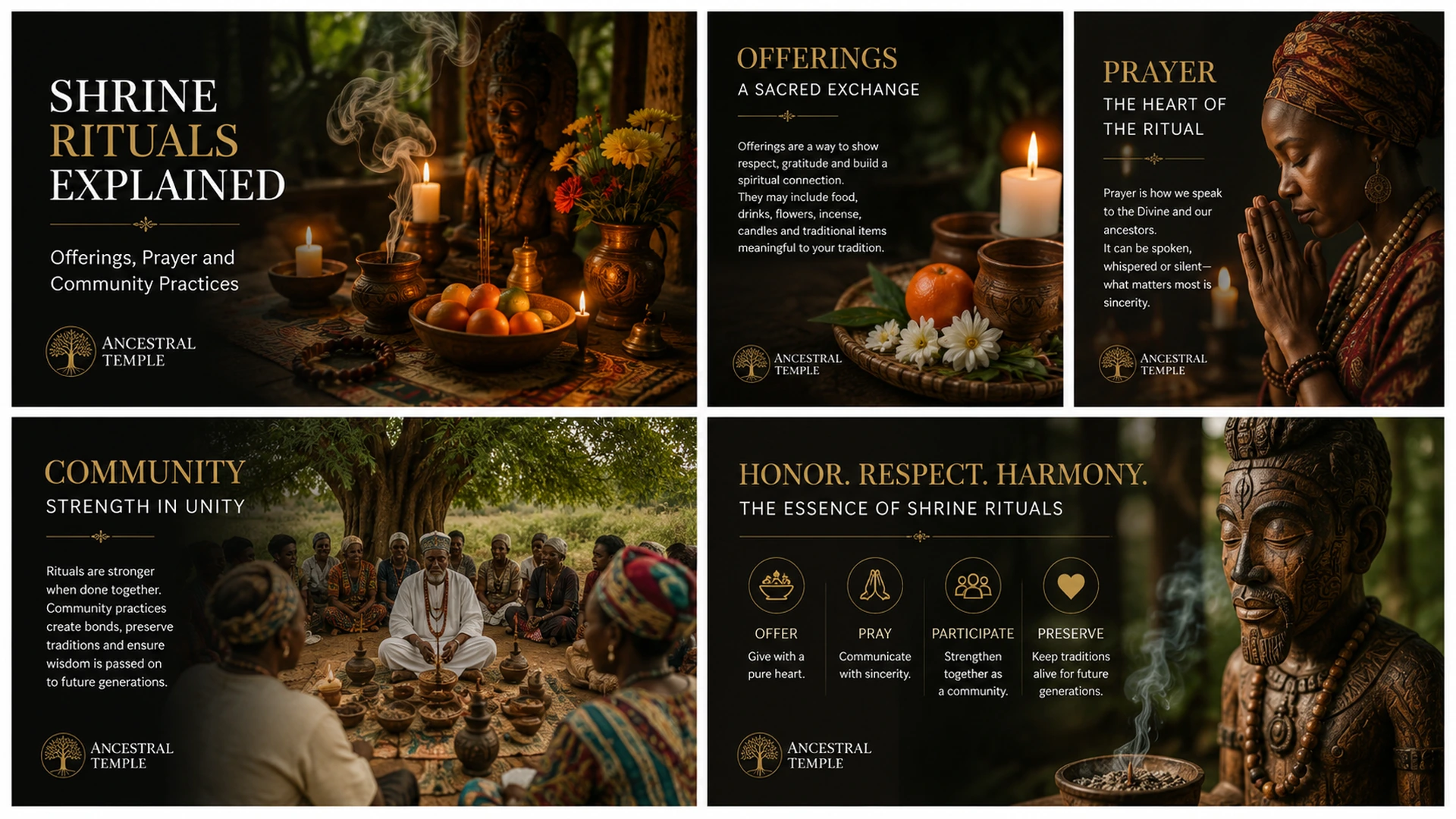
Quick Summary
Offerings, Prayer and Community Practices Search focus: shrine rituals | Intent: offerings, prayer, etiquette and community meaning 1. SEO Metadata Field Recommendation Recommended...
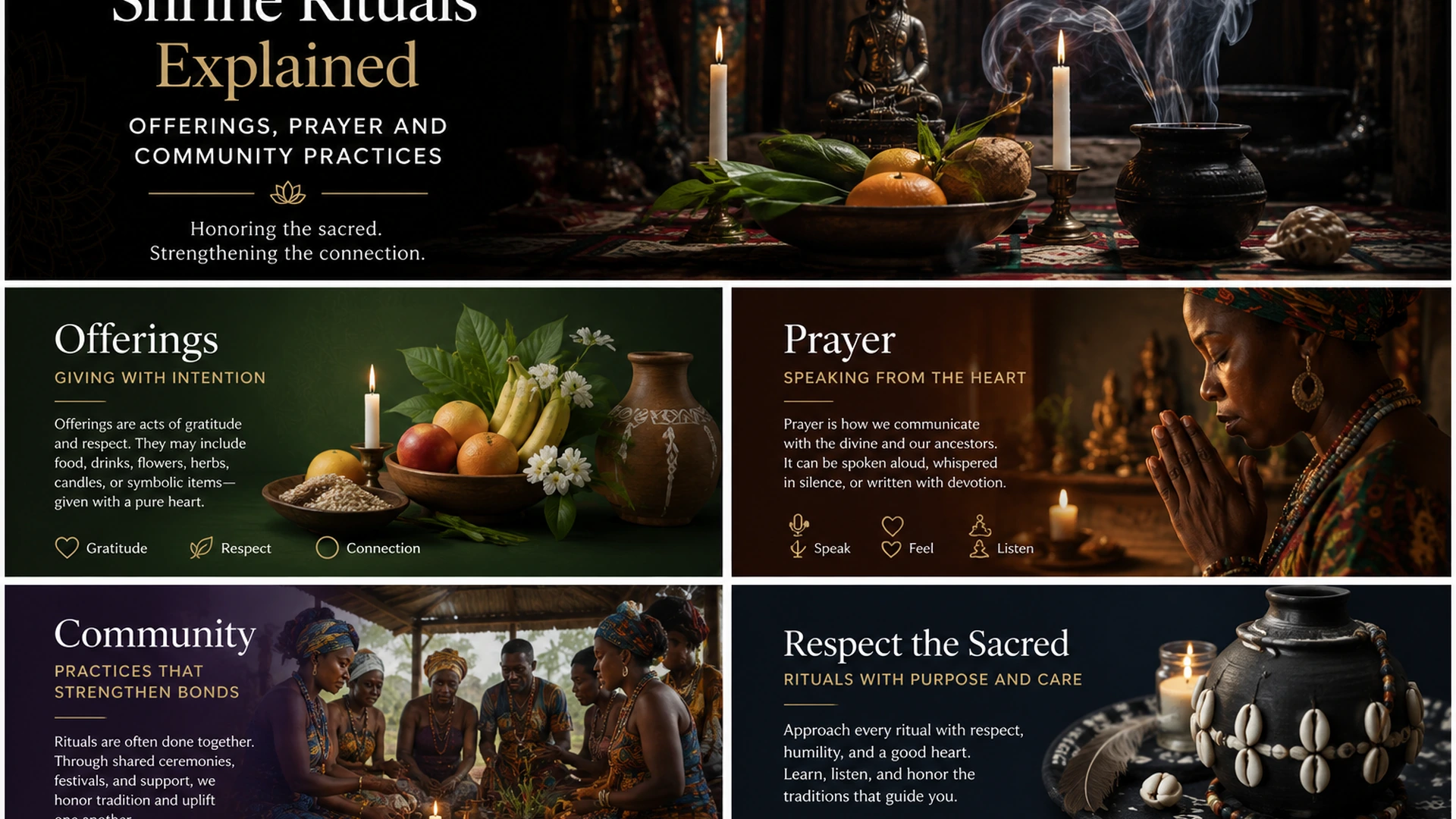
A shrine is not simply a decorated table or an old religious building. In a living tradition, it is a place made meaningful through relationship: people approach it, maintain it, remember stories there, offer gifts, speak prayers, fulfil vows, gather for festivals or protect a landscape understood as sacred. The exact actions depend on the religion, community, location, season and authority responsible for the site.
Because the word shrine is used for Shinto jinja, Hindu and Buddhist devotional spaces, Christian pilgrimage sites, Islamic sites of ziyārah, ancestral shrines and sacred natural places, no single “shrine ritual” applies everywhere. A respectful explanation must compare functions without blending unrelated practices into one invented ceremony.
Quick Answer
| Shrine Rituals in Simple Terms Shrine rituals are culturally specific practices performed at or around a sacred place. They may include purification, offerings, prayer, bows, songs, vows, processions, shared food, remembrance and community care. Their meaning comes from the tradition and its custodians. Visitors should follow local guidance rather than copying actions from another shrine or religion. |
|---|
Shrine Rituals at a Glance
| Feature | Explanation |
|---|---|
| Sacred focus | A deity, saint, ancestor, teacher, event, relic, natural feature, historical memory or community covenant |
| Common preparation | Cleaning, washing, removing footwear, silence, special clothing or crossing a marked threshold |
| Common offerings | Food, water, flowers, incense, lamps, candles, money, cloth, music, votive objects or service |
| Forms of prayer | Praise, gratitude, petition, confession, intercession, remembrance, vows, chants or silent reflection |
| Community roles | Priests, elders, custodians, descendants, volunteers, musicians, pilgrims, cooks, artisans and conservation workers |
| Public activity | Daily devotion, festivals, processions, teaching, pilgrimage, cleaning, repairs and communal meals |
| Restricted activity | Initiation rites, specialist prayers, sacrifice, sacred medicine, access to inner spaces or lineage knowledge |
| Visitor principle | Observe local rules, ask permission, do not improvise offerings and never treat sacred objects as props |
| Important limitation | Ritual participation does not guarantee healing, wealth, rain, fertility, protection or any other outcome |
What Is a Shrine?
A shrine is a place set apart because a community or worshipper associates it with sacred presence, memory or devotion. It may be a building, a room, a roadside structure, a household installation, a grove, a rock formation, a tomb, a spring or a designated area inside a larger religious complex. Its meaning is not determined by size. A small shelf maintained daily can be a living shrine, while a monumental building may function mainly as a historical site if ritual life has ended.
The word shrine is an English umbrella term. Local words carry more precise histories: jinja in Shinto, domestic or temple shrines in Buddhist traditions, home or temple spaces used for Hindu puja, dargah or mazar in some Muslim contexts, and named sacred places within African communities. Translation helps comparison, but it can also hide differences in theology, authority and access.
Shrine, altar, temple and sanctuary: the difference
| Term | Useful working definition |
|---|---|
| Shrine | A place associated with a sacred presence, person, event, ancestor, deity or natural feature; it may be independent or located inside another complex. |
| Altar | A prepared surface or focal point where offerings, liturgical objects or ritual actions are arranged. An altar can exist inside a shrine, church, temple or home. |
| Temple | A larger religious institution or building used for worship, teaching, priestly service, festivals or community life. Some temples contain multiple shrines. |
| Sanctuary | A sacred or protected area; in Christian usage it may mean the area around an altar or an officially recognized pilgrimage church, while in general English it may refer to a sacred refuge. |
| Sacred landscape | A wider environment—such as a grove, river, mountain or rock formation—whose spiritual meaning includes paths, boundaries, stories and community responsibilities. |
These categories overlap. The safest approach is to use the community’s own name first and explain the English term second. This prevents a Shinto jinja, a Catholic pilgrimage church and a Yoruba sacred grove from being treated as versions of the same institution.
What Shrine Rituals Usually Do
Rituals give structure to attention. They mark the transition from ordinary activity to sacred engagement, identify who may act, organize gifts and words, and connect present participants with inherited memory. UNESCO describes social practices and rituals as activities that help communities reaffirm identity, mark important events and express shared understandings of history and worldview. [1]
Across different traditions, a shrine ritual may perform one or several functions:
Express gratitude for life, harvest, family, protection, teaching or answered prayer.
Request guidance, mercy, intercession, well-being, rain, fertility, peace or reconciliation according to the community’s beliefs.
Remember ancestors, saints, martyrs, teachers, founders or historical events.
Fulfil a vow or promise made during illness, danger, travel or a life transition.
Repair or renew the relationship between a community and a sacred place.
Mark a festival, season, royal anniversary, pilgrimage or stage of life.
Transfer knowledge through music, story, craft, gesture, language and participation.
Support practical care of buildings, forests, water sources, paths and community institutions.
These functions may coexist, but they should not be assumed. A visitor who sees incense, food or a candle cannot determine its meaning without knowing the tradition and occasion.
A Common Ritual Pattern—Without Claiming a Universal Formula
Many shrine visits can be described through a loose sequence: preparation, approach, offering, prayer, response and departure. This is a comparative tool, not a ritual script.
| Stage | Possible form |
|---|---|
| 1. Preparation | Cleaning the body or space, washing hands, removing shoes, dressing appropriately, gathering offerings or entering silence. |
| 2. Approach | Crossing a gate, following a path, bowing, waiting in a queue, greeting custodians or observing a boundary. |
| 3. Offering | Presenting food, water, flowers, incense, light, money, music, cloth, labour or another authorized gift. |
| 4. Prayer or gesture | Speaking, chanting, singing, bowing, clapping, kneeling, prostrating, circling, standing silently or listening. |
| 5. Distribution or response | Receiving blessed food, hearing a prayer, taking part in a communal meal, receiving an amulet or simply leaving with no material object. |
| 6. Departure and responsibility | Giving thanks, cleaning, carrying out waste, keeping a vow, supporting the shrine or applying the ethical meaning in daily life. |
Some traditions omit several stages. Others add specialist rites that outsiders should not reproduce. A sequence observed at one shrine may also change during festivals, funerals, royal ceremonies or private consultations.
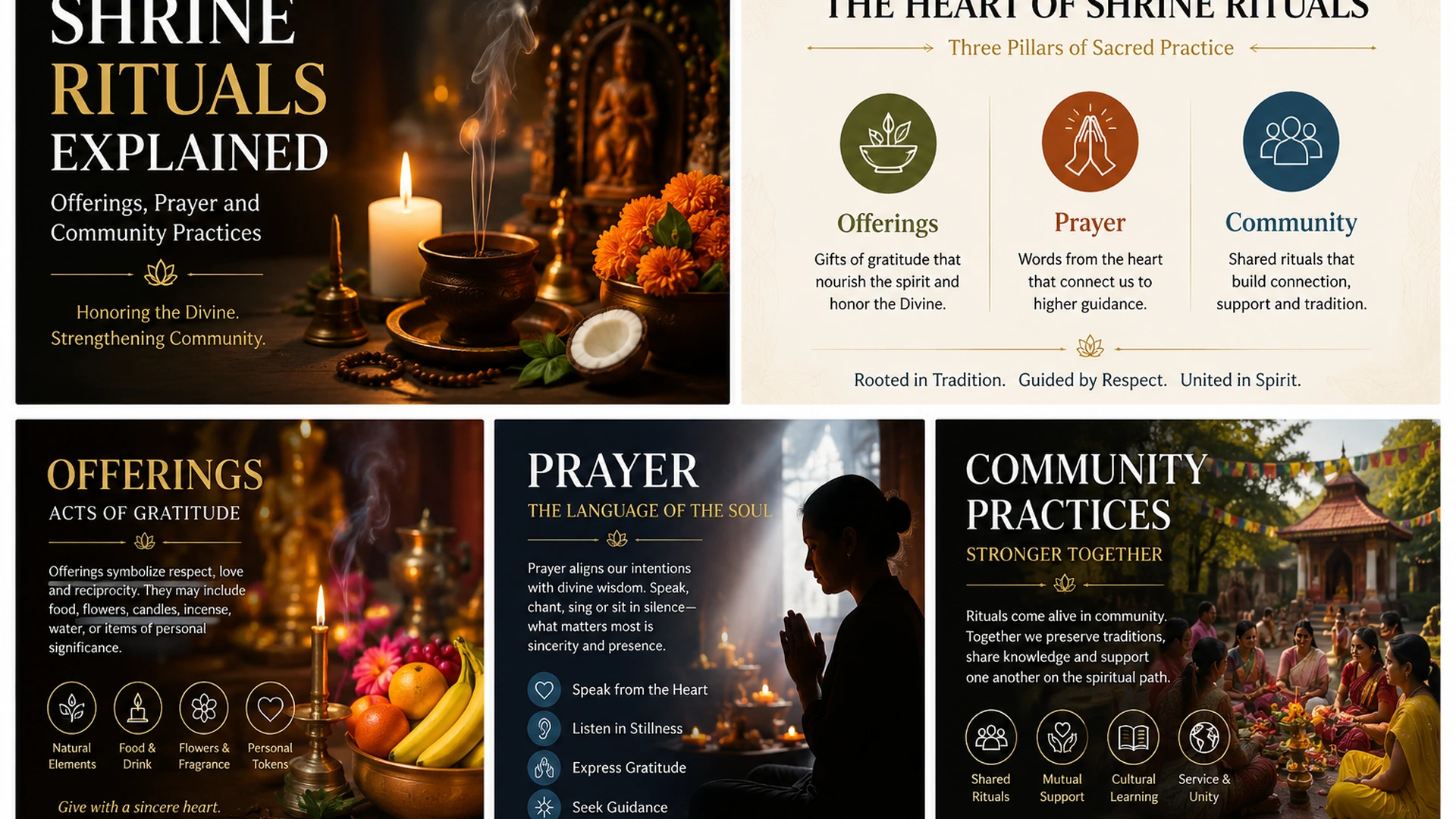
Shrine Offerings Explained
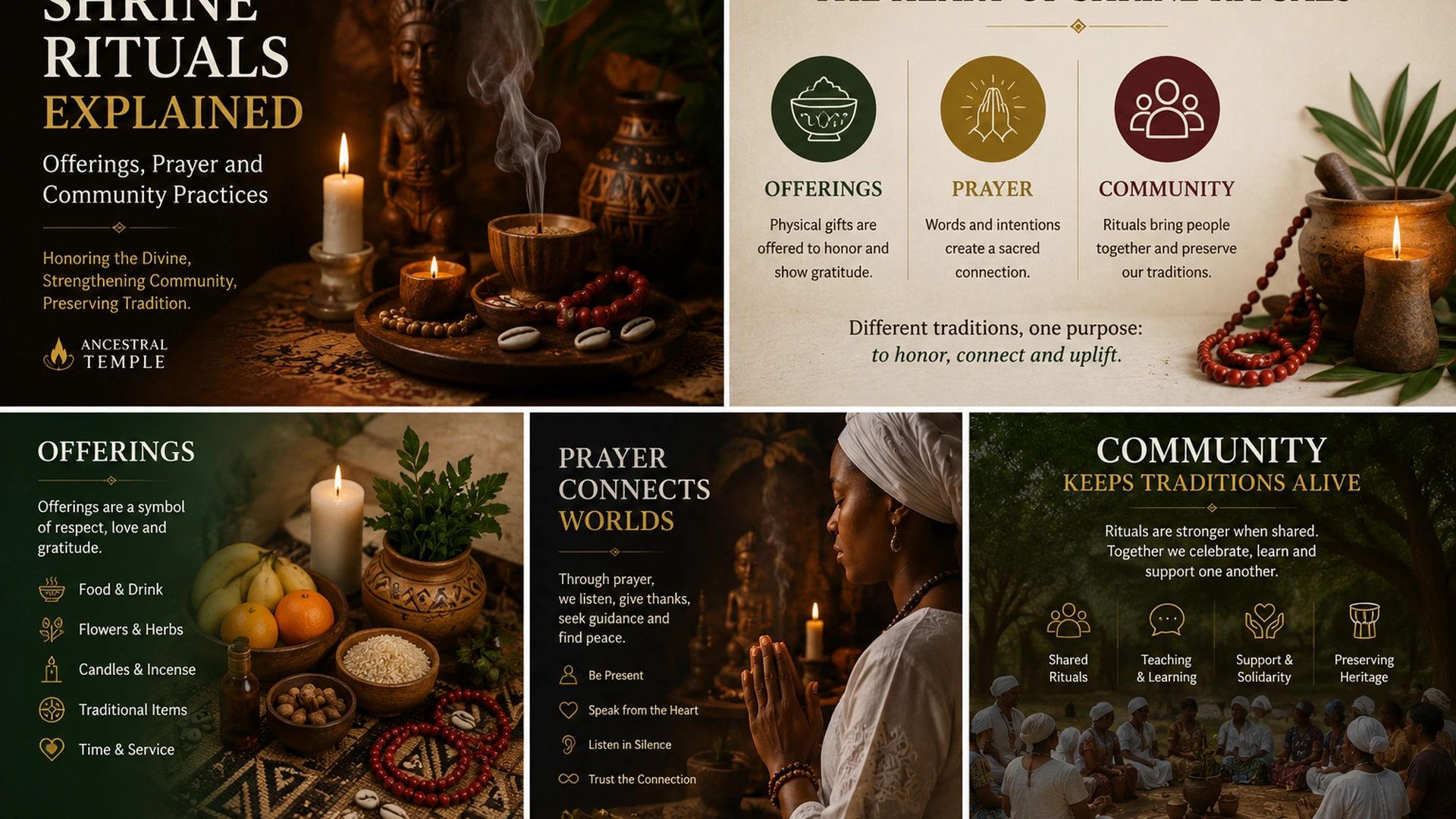
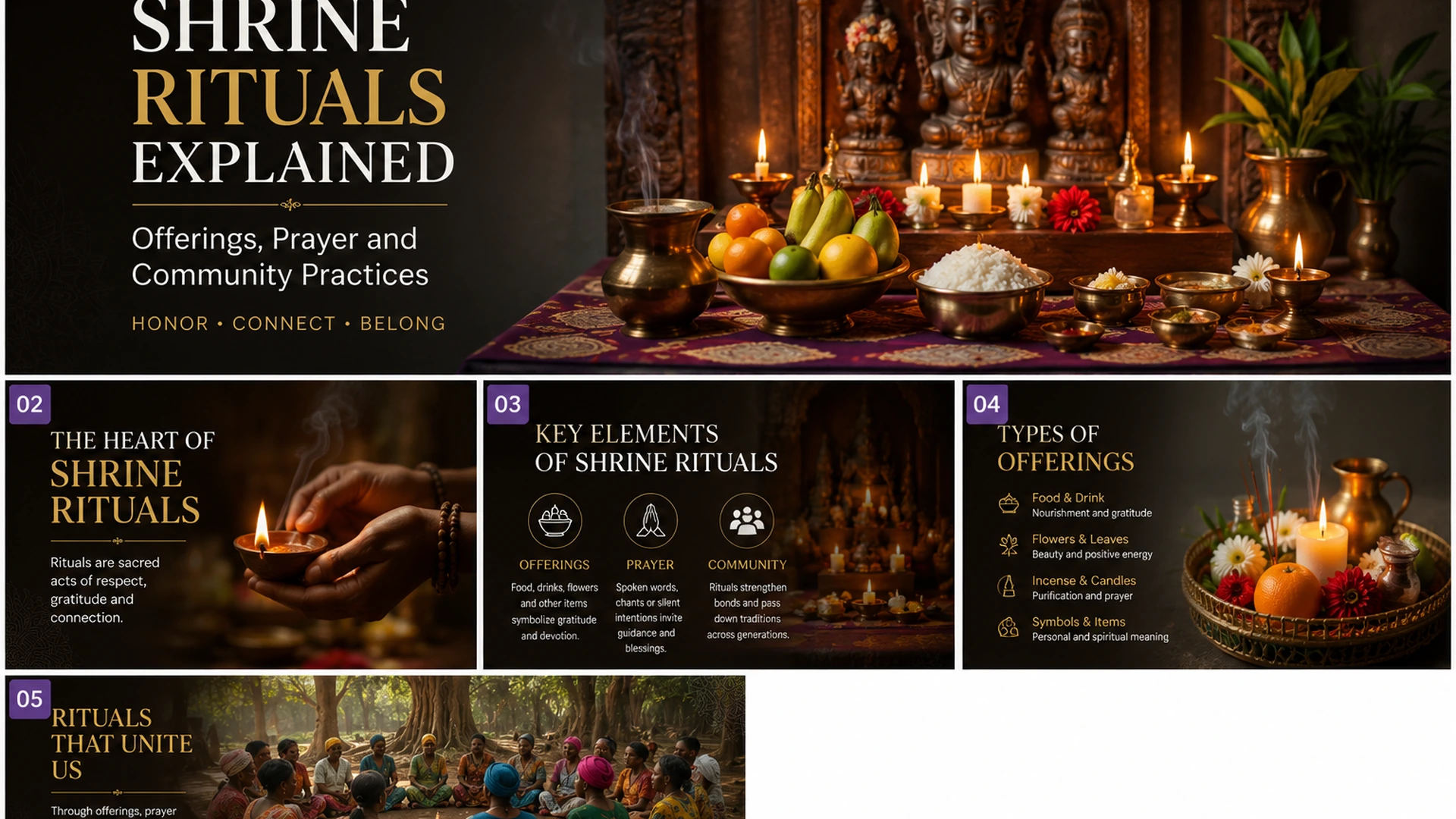
An offering is something presented within a recognized relationship. It may express hospitality, gratitude, reverence, merit, remembrance, fulfilment of a vow or support for the institution. It is misleading to describe every offering as payment for a supernatural result.
| Offering type | Possible meanings |
|---|---|
| Water | Purity, hospitality, refreshment, simplicity or daily renewal; common in several household and temple traditions. |
| Food and drink | Hospitality, thanksgiving, abundance, remembrance or participation in a sacred meal; rules about ingredients and later distribution vary. |
| Flowers and leaves | Beauty, impermanence, freshness, honour, seasonal connection or a culturally specific sacred association. |
| Incense or fragrance | Reverence, purification, sensory offering, prayerful atmosphere or honour; smoke rules and health concerns vary. |
| Lamps and candles | Light, presence, remembrance, prayer, wisdom or vigilance; fire safety and local rules matter. |
| Money | Support for shrine maintenance, clergy, festivals, charity or an act of respect; the amount and meaning are tradition-specific. |
| Cloth, plaques or votive objects | A vow, testimony, thanksgiving, identity, protection request or commemoration; not all objects may be photographed or removed. |
| Music, dance and recitation | A formal offering of skill, praise, memory or service performed by authorized participants. |
| Labour and maintenance | Cleaning, cooking, repairing paths, caring for forests, organizing visitors or supporting vulnerable community members. |
What happens to an offering afterward?
There is no universal answer. Food may be returned as blessed food, shared among worshippers, consumed by priests, left for a limited period, composted or disposed of according to local rules. Money may fund maintenance or religious activity. Flowers may be removed respectfully when they fade. Votive objects may remain for years, be stored, periodically burned or returned through a formal process. Visitors should never guess.
An unauthorized offering can create problems. Food may attract animals, plastic may pollute a grove, candles may create fire risk, alcohol may be forbidden, and plants or animal products may be illegal or culturally inappropriate. The most respectful offering is the one the shrine explicitly permits.
Prayer at Shrines: Words, Silence and Gesture
Prayer is not always spoken. It may be a formal liturgy, a memorized chant, praise poetry, a personal request, a vow, silent reflection, music or bodily gesture. The recipient of prayer also differs: God, a deity, kami, enlightened beings, ancestors, saints or a sacred presence recognized within the tradition.
| Prayer form | Purpose |
|---|---|
| Praise and adoration | Honouring divine or sacred qualities. |
| Thanksgiving | Recognizing a gift, survival, harvest, relationship or answered request. |
| Petition | Asking for help, guidance, peace, health or another need according to belief. |
| Intercession | Asking a saint, ancestor or revered figure to pray or mediate, where the tradition permits this idea. |
| Confession and repentance | Acknowledging wrongdoing and seeking forgiveness or moral change. |
| Vow | Promising an action, pilgrimage, gift or ethical commitment. |
| Remembrance | Speaking names, recounting history, mourning or maintaining ties with ancestors and the dead. |
| Contemplation | Remaining silent, observing an image or natural feature, meditating or listening. |
Bows, claps, kneeling, prostration, hand positions and processions are not interchangeable symbols. The same gesture can mean different things in different settings. Copying a gesture without understanding the place may be merely awkward; entering a restricted area or imitating a specialist rite can be disrespectful.
Shinto Jinja: Purification, Offering and Respect
In Shinto, a jinja is a sacred precinct where one or more kami are enshrined. Jinja Honcho explains that people visit to pay respects, express thanks, attend matsuri or make particular requests. The entire precinct—not only the building—is treated as sacred space. [2][3]
A common public visit may include a slight bow at the torii, purification of the hands and mouth at a water font, a small coin offering, and a sequence of two bows, two claps and one final bow. A visitor normally pays respects from outside the prayer hall and should not enter buildings or enclosed areas without invitation. [2]
The coin is not a fee for a guaranteed blessing. It is an expression of respect. Jinja Honcho also notes that priests and assistants clean the grounds and conduct offerings of food and drink accompanied by purification, while matsuri connect shrine life to the wider community. [3]
Hindu Puja: Hospitality, Darshan and Prasad
Hindu worship is internally diverse, but puja often uses the language of hospitality. The Harvard Pluralism Project describes offerings such as water, fruit, coconut, cloth, incense and an oil lamp presented before a deity. Worshippers may then receive prasad—the offering returned as grace—and participate in darshan, the auspicious act of seeing and being seen by the deity. [4]
A home shrine and a large temple are not identical settings. A household may conduct a brief daily puja, while a temple priest may perform more elaborate services at scheduled times. Regional languages, sects, deities, family lineages and local temple rules shape the sequence.
The offering is not merely symbolic décor. Flowers must be appropriate, food follows dietary and purity rules, and images or murtis are treated according to a theology of presence. A visitor should ask before entering a sanctum, photographing worship or placing an item on an altar.
Buddhist Shrines: Offerings, Merit and Daily Practice
Buddhist shrine practices vary across Theravada, Mahayana, Vajrayana and regional traditions. In Tibetan Buddhist households, the Smithsonian National Museum of Asian Art describes shrine rooms ranging from simple altars to dedicated rooms. Daily practice may include prayers, seven bowls of water, butter lamps and incense offered to buddhas and teachers. [5]
Smithsonian educational material on Tibetan shrines describes offerings as devotional worship and merit-making, with light, fragrance, food, music and cloth engaging the senses. [6] The purpose is not to feed an image as if it were an ordinary person. Offerings train generosity, honour enlightened qualities and support contemplation within a specific Buddhist worldview.
Visitors should not assume that every Buddhist shrine uses the same number of bowls, the same images or the same chants. Some objects may be consecrated, restricted or arranged according to a lineage. Photography can be prohibited even when the room is open.
African Shrine Practices Must Be Named Specifically
Africa does not have one shrine system. A rock shrine among Luo communities in western Kenya, a Yoruba sacred grove in Nigeria, a Buganda royal site in Uganda and a Christian pilgrimage shrine in Kampala belong to different languages, histories and authorities. Using “African ritual” as though it describes all of them erases the people who maintain the traditions.
Osun-Osogbo Sacred Grove: Worship, Festival and Custodianship
UNESCO describes the Osun-Osogbo Sacred Grove in southwestern Nigeria as an active Yoruba religious site containing shrines, sculptures, sacred places and worship points along the Osun River. Daily, weekly and monthly worship takes place, and an annual festival renews bonds among the goddess Osun, the people and the ruler of Osogbo. [7]
The grove also demonstrates that shrine practice includes land care and authority. Traditional laws, custodians and a management structure regulate hunting, fishing, tree cutting, farming and visitor pressure. A shrine here is not an isolated object; it is a sacred forest, river, artistic landscape and community institution.
Public descriptions of the festival do not authorize outsiders to reproduce sacrificial actions, prayers or specialist roles. The ethical lesson is to recognize the authority of priests, priestesses, the Ataoja and community institutions over access and interpretation.
Kit Mikayi: Prayer, Oaths and Safeguarding a Living Site
Kit Mikayi is a rock shrine associated with Seme and other Luo communities in western Kenya. UNESCO records that people have visited for prayer, oath-taking, rituals and the natural beauty of the site. Elders and respected community members guided major practices, while singing, dancing and food preparation involved wider participation. [8]
UNESCO placed the associated practices on the List of Intangible Cultural Heritage in Need of Urgent Safeguarding because of declining enactment, ageing bearers and pressure on the surrounding cultural space. This shows that shrine rituals survive through people, memory, land and intergenerational learning—not through architecture alone.
Historical beliefs connected some ceremonies with rain and harvest. Those claims should be reported as community belief, not as scientific evidence that a ritual controls weather.
Jongmyo Shrine: Ancestral Rite, Music and Descendant Responsibility
At Jongmyo Shrine in Seoul, the annual royal ancestral rite is organized by descendants of the Joseon royal family and combines prayer, food and wine offerings, music and dance. UNESCO describes it as a Confucian ancestral ritual concerned with filial piety and the peace of ancestral spirits. [9]
The example shows why a shrine ritual can also be a complex performing tradition. Musicians, dancers, ritual officials, descendants and heritage organizations all preserve different parts of the rite. Visitors witness a public cultural event, but they do not automatically become ritual officers.
Catholic Shrines: Pilgrimage, Intercession and Community Worship
In Catholic usage, a shrine is a church or other sacred place approved as a destination for pilgrimage for a particular religious reason. Vatican guidance emphasizes Scripture, liturgy, Eucharist, penance and approved forms of popular devotion. Pilgrims may offer praise, thanksgiving, petitions, vows and prayers asking the intercession of Mary or the saints. [10]
Candles, flowers, rosaries, ex-votos and written intentions may appear at shrines, but local rules differ. The central idea is not that the material object independently causes a result. The object expresses prayer, memory, gratitude or a vow within Catholic teaching.
Uganda offers an important living example. Kampala’s Munyonyo Martyrs’ Shrine commemorates the Uganda Martyrs and serves as a starting point for pilgrims travelling toward Namugongo, especially around the June 3 observance. Masses, devotions, hospitality and pilgrimage support connect sacred memory with regional community life. [12]
Islamic Ziyārah: Diversity and Debate
Islam does not have one universal category equivalent to every use of the English word shrine. The hajj and umrah to Mecca have a distinct status, while ziyārah refers more broadly to visiting revered places, tombs or holy sites in parts of the Islamic world. Oxford scholarship notes long histories of visitation to places such as Medina, Jerusalem, Najaf, Karbala and sites connected with Sufism. [11]
Practices vary by region, school, theology and community. Visitors may recite Qur’an, offer supplication to God, remember a revered person, give charity or participate in gatherings. Some Muslims support particular forms of shrine visitation; others object to practices they understand as improper intercession or innovation. A responsible comparative article must make this disagreement visible rather than declaring one position “the Islamic ritual.”
How Shrine Rituals Become Community Practices
A shrine remains active because people do work. Ritual is only one part of that work. Communities clean buildings, clear paths, cook, manage donations, teach children, rehearse music, welcome pilgrims, protect forests, document history, repair roofs, negotiate access and respond to environmental pressure.
| Community participant | Possible responsibilities |
|---|---|
| Custodians and clergy | Maintain ritual order, interpret rules, prepare sacred spaces and decide who may enter restricted areas. |
| Elders and descendants | Carry memory, genealogy, oral history, language, family obligations and inherited responsibility. |
| Women’s and youth groups | May organize food, singing, cleaning, teaching, fundraising, hospitality or specific ritual roles depending on the tradition. |
| Musicians, dancers and artisans | Preserve songs, instruments, clothing, images, vessels, architecture and performance knowledge. |
| Pilgrims and devotees | Bring prayer, gifts, testimony, labour, donations and renewed attention to the site. |
| Heritage and conservation workers | Address fire, erosion, waste, visitor pressure, biodiversity and documentation in partnership with custodians. |
| Local businesses and authorities | Manage transport, safety and economic activity, but can also create commercialization or crowding pressures. |
UNESCO stresses that rituals depend on broad community participation and can be affected by social change. [1] Safeguarding therefore cannot mean freezing people in the past. Living communities have the right to adapt schedules, technologies, language and visitor policies while protecting core authority and meaning.
Public, Private and Restricted Practices
A ritual visible in a public festival is not necessarily open for imitation. The procession may be public while the preparation of offerings is restricted. A shrine may welcome visitors to the grounds but prohibit access to an inner room. A museum may display an object while the originating community retains rules about its use, image or name.
Public: ordinary visiting hours, general prayer, authorized festivals, public teaching and designated visitor areas.
Permission-based: photography, interviews, placing offerings, entering an inner room, touching an object or joining a procession.
Restricted: initiation, lineage prayers, specialist divination, sacred medicine, sacrifice, secret names, gender- or age-specific rites and knowledge protected by custodians.
Closed: practices temporarily or permanently withheld from outsiders, media or publication.
“I found it online” is not permission. Cultural information can be legally accessible and still ethically inappropriate to reproduce as a step-by-step ritual.
How to Visit a Shrine Respectfully
Learn the shrine’s correct name and tradition before arriving.
Check official opening hours, dress guidance, footwear rules and photography policy.
Pause at gates, ropes, fences or signs; boundaries are part of the sacred space.
Follow the line and observe before acting. Do not block other people’s prayer.
Ask before leaving food, flowers, candles, incense, money or personal objects.
Never remove stones, plants, ashes, water, cloth, offerings or “souvenirs” from the site.
Do not touch images, tombs, vessels, altars or sacred trees unless invited.
Keep children supervised and avoid loud commentary during prayer or mourning.
Do not livestream vulnerable people, private vows, healing requests or funerary practices.
Use local guides and contribute to official maintenance or community programs where appropriate.
A respectful visitor does not need to perform every visible action. Standing quietly, following instructions and refraining from interference can be the most appropriate participation.
Common Misconceptions
“All shrine rituals are forms of ancestor worship”
False. Some shrines concern ancestors, but others are dedicated to kami, deities, buddhas, saints, martyrs, relics, historical events or sacred landscapes. Even ancestral rites differ in theology and social purpose.
“An offering is a payment for a miracle”
This is an oversimplification. Offerings may express gratitude, hospitality, devotion, merit, a vow, remembrance or institutional support. Traditions differ on whether and how divine response is understood.
“Anyone can copy a public ritual”
Visibility is not authorization. Public festivals often contain specialist roles, restricted preparation and inherited authority.
“Shrines are frozen remains of the past”
Many shrines are active places that adapt to migration, urbanization, tourism, law, conservation, technology and changing community needs.
“Every African shrine uses sacrifice or magic”
False and harmful. African shrine traditions are diverse, and practices must be described through named communities and reliable sources. Prayer, oaths, music, land care, royal memory, pilgrimage and community teaching may be as important as any offering.
“A ritual guarantees healing, rain, fertility or protection”
No ritual outcome should be presented as scientifically guaranteed. Religious belief can be meaningful without replacing healthcare, weather science, legal protection, financial planning or practical community action.
Key Takeaways
Shrine rituals are culturally specific; there is no universal sequence for every religion.
Offerings can express hospitality, gratitude, merit, remembrance, vows or practical support.
Prayer may be spoken, silent, sung or embodied through gestures that must be understood locally.
Shrines are maintained by communities through cleaning, teaching, music, pilgrimage, conservation and governance.
Shinto, Hindu, Buddhist, Yoruba, Luo, Confucian, Catholic and Islamic examples should not be blended into one system.
Public access does not grant permission to copy restricted rites or photograph private devotion.
Visitors should follow official guidance and never improvise offerings.
Claims of healing, protection, fertility, rain or prosperity belong to belief and must not be guaranteed.
People Also Ask
What is a shrine ritual?
A shrine ritual is a culturally recognized action performed at or around a sacred place. It may include preparation, offering, prayer, gesture, music, vows, remembrance, pilgrimage or community service. The meaning depends on the specific tradition and its custodians.
What offerings are commonly made at shrines?
Depending on the shrine, authorized offerings may include water, food, flowers, incense, lamps, candles, money, cloth, votive objects, music or labour. No item is universally appropriate, so visitors should follow local rules.
How do people pray at a shrine?
Prayer may involve formal words, silent reflection, chanting, singing, bows, claps, kneeling, prostration, processions or listening. Gestures differ among traditions and should not be copied across religions.
Can anyone leave an offering?
Not always. Some shrines provide a clear offering box or designated area, while others accept offerings only through clergy or custodians. Unauthorized food, fire, alcohol, plastic or objects can be unsafe or disrespectful.
What is the difference between a shrine and an altar?
A shrine is the wider sacred place or devotional focus. An altar is a prepared surface where offerings or ritual actions occur. An altar may stand inside a shrine, temple, church or home.
Why are some shrine rituals private?
Ritual knowledge may belong to a lineage, initiated group, priesthood, age set, gendered role or family. Privacy can protect sacred responsibility, vulnerable participants and community authority.
Do shrine rituals work?
Their religious meaning is understood within faith and culture. Scientific evidence does not establish that rituals guarantee supernatural outcomes. They can nevertheless support memory, identity, reflection, social solidarity and practical care.
Conclusion
Shrine rituals make a place active through relationship. An offering is placed, a name is remembered, a song is rehearsed, a path is swept, a lamp is lit, a vow is fulfilled or a community returns for an annual gathering. These actions connect sacred meaning with material responsibility.
Comparative study is useful when it reveals both shared human concerns and real differences. The goal is not to assemble a universal ritual from borrowed pieces. It is to understand why each community approaches its shrine in a particular way, who carries authority, what may be public, what must remain protected and how living sacred places continue through care.
Research Sources and Further Reading
[1] Social Practices, Rituals and Festive Events. UNESCO Intangible Cultural Heritage. https://ich.unesco.org/en/social-practices-rituals-and-00055 Framework for community identity, ritual participation and living heritage.
[2] Entering a Jinja. Jinja Honcho. https://www.jinjahoncho.or.jp/en/at-a-jinja/entering/ Official guidance on sacred precincts, purification, offering and public prayer etiquette.
[3] Jinja Honcho Q&A. Jinja Honcho. https://www.jinjahoncho.or.jp/en/faq/ Official information on daily offerings, matsuri, prayer and community role.
[4] Lamp Offerings: Hindu Worship. Harvard Pluralism Project. https://pluralism.org/lamp-offerings-hindu-worship Educational account of puja, offerings, arati, darshan and prasad.
[5] Tibetan Buddhist Shrine Room. Smithsonian National Museum of Asian Art. https://asia.si.edu/education/educator-resources/encountering-religion-in-asian-art/explore-by-object/object/tibetan-buddhist-shrine-room/ Household shrine rooms, water bowls, lamps, incense and daily prayer.
[6] Shrines in Action: Offerings. Smithsonian National Museum of Asian Art. https://asia.si.edu/interactives/sacred-spaces/shrines-in-action.html Offerings, sensory devotion and merit-making in Tibetan Buddhist shrines.
[7] Osun-Osogbo Sacred Grove. UNESCO World Heritage Centre. https://whc.unesco.org/en/list/1118/ Yoruba sacred grove, active worship, annual festival and community management.
[8] Rituals and Practices Associated with Kit Mikayi Shrine. UNESCO Intangible Cultural Heritage. https://ich.unesco.org/en/USL/rituals-and-practices-associated-with-kit-mikayi-shrine-01489 Luo shrine practices, community roles and safeguarding challenges.
[9] Royal Ancestral Ritual in the Jongmyo Shrine and Its Music. UNESCO Intangible Cultural Heritage. https://ich.unesco.org/en/RL/royal-ancestral-ritual-in-the-jongmyo-shrine-and-its-music-00016 Annual Confucian ancestral ritual, offerings, music, dance and descendant organization.
[10] Directory on Popular Piety and the Liturgy: Shrines and Pilgrimages. The Holy See. https://www.vatican.va/roman_curia/congregations/ccdds/documents/rc_con_ccdds_doc_20020513_vers-direttorio_en.html Catholic teaching on shrine prayer, pilgrimage, liturgy, vows and popular devotion.
[11] Islamic Pilgrimage and Art. Oxford Research Encyclopedia of Religion. https://academic.oup.com/edited-volume/62249/chapter-abstract/551428720 Historical diversity of hajj, umrah, ziyārah and sacred-site visitation.
[12] The Munyonyo Martyrs’ Shrine. Kampala Capital City Authority Tourism Portal. https://visitkampala.kcca.go.ug/business_details/the-munyonyo-martyrs-shrine Ugandan Catholic pilgrimage, worship and community programs.
Article Information
- Publisher
- Ancestral Temple
- Editor
- Ancestral Temple
- Last updated
- Jul 26, 2026
- Last reviewed
- Jul 26, 2026
- Content version
- 304866c54a
This educational article should be read as cultural and spiritual information, not as medical, legal, financial, or emergency advice.
Helpful Related Guidance
Explore This Topic
Related Topic Cluster
Dreams & Symbolism
About the Author
 Ancestral Temple
Spiritual guide and practitioner with decades of experience in ancestral wisdom, rituals, and divine guidance.
Related Posts
View All






Leave a Comment
We'd love to hear your thoughts.