
Sacred Herbs Used in Traditional Ceremonies
Cornerstone Content
Quick Summary
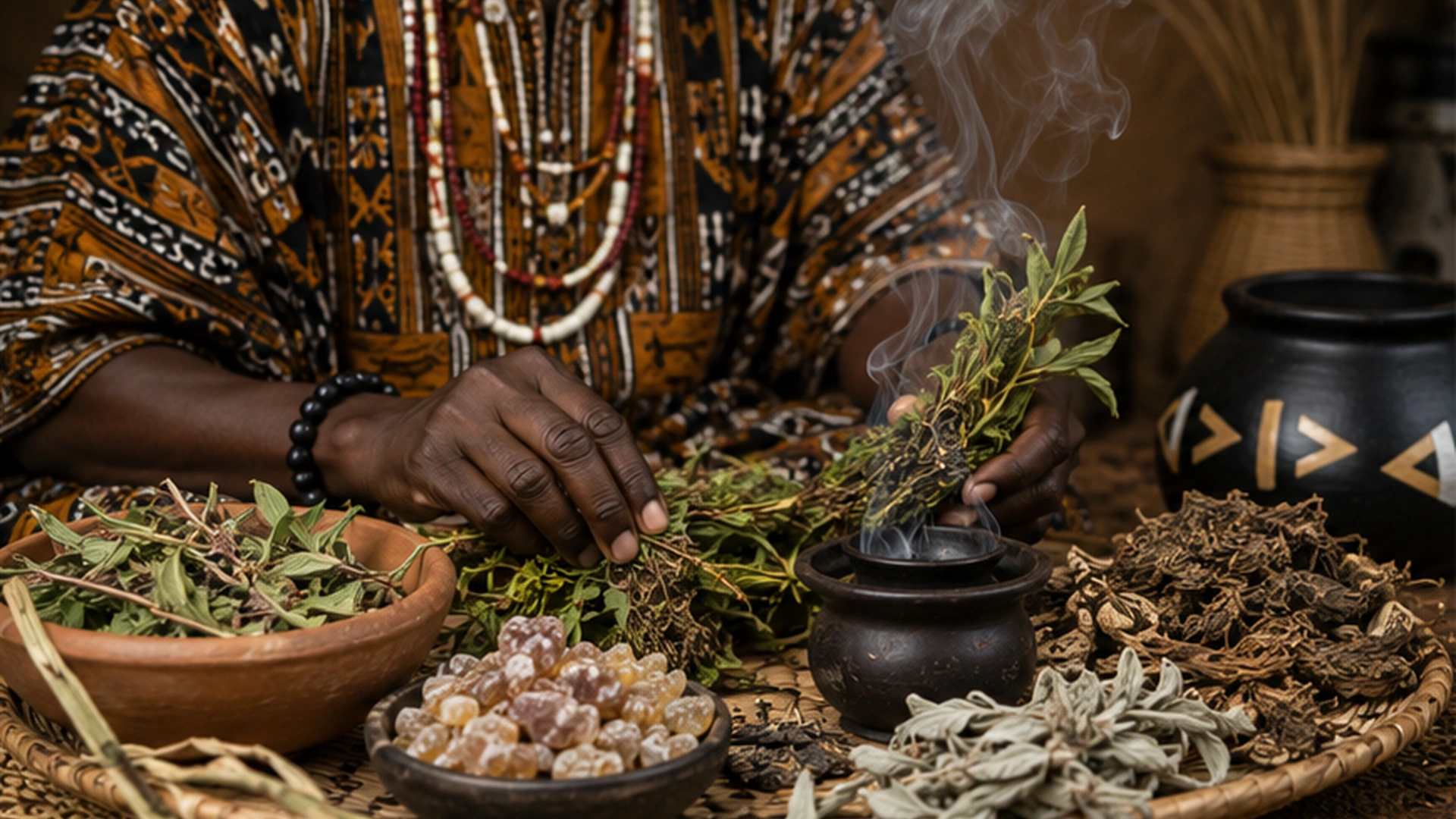
Plants used in traditional ceremonies may function as incense, offerings, adornment, hospitality, medicine, or markers of sacred space. This guide examines documented examples from specific African communities while protecting restricted knowledge and emphasizing safety, sustainability, and cultural authority.
Sacred Herbs Used in Traditional Ceremonies explains the cultural and historical meaning of sacred herbs used in traditional ceremonies without treating one tradition as universal. The article preserves safety cautions, distinguishes spiritual interpretation from medical or legal advice, and avoids guaranteed-result claims.
Plants have accompanied human ceremonies for thousands of years.
Leaves may be burned as incense, resins may perfume a worship space, seeds may be offered to guests, bark may mark initiation, and plant dyes may prepare a bride for marriage. In other settings, a plant is carried, displayed, planted beside a sacred place, or remembered in a song without being consumed at all.
The phrase sacred herbs is convenient but imprecise.
Many ceremonial materials are not herbs in the botanical sense. Frankincense and myrrh are resins from trees. Kola is a seed. Henna comes from a shrub. Iboga is a woody rainforest plant. Ceremonial traditions may also use grasses, roots, flowers, fruits, wood, oils, and cultivated crops.
A more accurate expression is often ceremonial plants and plant materials.
Their meanings are not universal. A plant may be sacred in one institution, medicinal in another, commercial in a third, and ordinary household material elsewhere. The same species may also have different names, preparations, and authorities across neighbouring communities.
This article therefore describes publicly documented examples without providing recipes, dosages, restricted prayers, initiation instructions, or instructions for ingesting psychoactive or toxic plants.
Key Points
“Sacred herb” is a broad popular term; many ceremonial materials are resins, seeds, shrubs, trees, roots, or dyes rather than botanical herbs.
A plant’s ceremonial meaning depends on the community, religious institution, lineage, place, and occasion.
Impepho is a name applied to several Helichrysum species in southern Africa; documented uses include burning aromatic plant material in ancestral and cleansing contexts.
Frankincense is resin from Boswellia trees, while myrrh comes from Commiphora species. Both have long histories in incense, worship, mourning, hospitality, and trade.
Kola nuts have important roles in hospitality, offerings, prayer, and ritual beginnings within particular Igbo and Yoruba settings.
Henna is used in marriage, birth, celebration, adornment, and protection practices across communities in North Africa and the Middle East.
Iboga is central to particular Bwiti religious traditions in Gabon and neighbouring areas, but it contains potent alkaloids and can cause fatal cardiac complications.
Public knowledge about a ceremonial plant does not authorize outsiders to reproduce restricted ceremonies or claim the authority of elders, priests, healers, diviners, or initiated custodians.
“Natural” does not mean safe. Plants may be toxic, contaminated, misidentified, allergenic, psychoactive, or dangerous when combined with medicines.
Burning plant material creates smoke and fine particles, so ventilation and health considerations matter.
Commercial demand can threaten ceremonial plants and the communities whose livelihoods depend on them.
Responsible education combines cultural specificity, safety, consent, conservation, and respect for living heritage.
Clear Definition
Sacred herbs used in traditional ceremonies are plants or plant materials whose presence, scent, colour, taste, smoke, placement, or preparation carries recognized religious, social, ancestral, or cultural meaning within a specific community.
Plain-Language Meaning
A ceremonial plant is not automatically magical.
It becomes meaningful through relationships:
Who gathered it
Who prepared it
Who is permitted to use it
Where it is used
What ceremony is taking place
Which prayers, songs, histories, or responsibilities accompany it
A handful of leaves purchased online does not reproduce the authority, history, or community relationships of a living tradition.
Why Plants Become Ceremonially Important
Plants Connect Ceremony With Place
Plants grow within particular climates and landscapes.
A dryland resin tree, rainforest shrub, coastal leaf, cultivated seed, or highland aromatic plant may connect a ceremony with the land where a community developed.
This connection can include:
Seasonal knowledge
Harvesting rights
Sacred forests
Family farms
Trade routes
Burial places
Community boundaries
Environmental responsibility
Scent Changes the Ceremonial Environment
Aromatic smoke and fragrance can distinguish ceremonial time from ordinary time.
Scent may mark:
The opening of prayer
The arrival of guests
Mourning
Preparation of a sacred space
A transition in a life-cycle ceremony
The presence of a religious office-holder
Smell is also closely tied to memory. A familiar resin or leaf can immediately recall a grandmother’s home, a church service, a wedding, a funeral, or a family gathering.
Plants Carry Visible Symbolism
Colour, growth, bitterness, sweetness, durability, and seasonal return may all become meaningful.
For example:
A bitter seed may represent seriousness or endurance.
A fragrant resin may mark reverence or hospitality.
A green leaf may represent vitality.
A plant dye may mark transition or celebration.
A tree may connect present families with older generations.
These interpretations vary and should never be presented as universal laws.
Plants Organize Social Relationships
A plant may help identify who welcomes guests, who speaks first, who blesses a marriage, who supervises an initiation, or who has the right to enter a sacred place.
The plant is therefore part of a social system, not an isolated object.
Ceremonial Use Is Not the Same as Medical Use
A plant can be ceremonial, medicinal, culinary, decorative, or commercial—sometimes all at once.
These categories should remain distinct.
Type of use
Main purpose
Important boundary
Ceremonial
Marks sacred time, transition, hospitality, remembrance, or authority
Meaning depends on community context
Medicinal
Intended to affect health or symptoms
Requires safety, dosage, identification, and interaction awareness
Culinary
Used as food, drink, flavouring, or stimulant
Food use does not prove medicinal safety at high doses
Decorative
Used for colour, fragrance, beauty, or display
Decoration may still carry cultural meaning
Commercial
Sold as resin, herb, perfume, supplement, or souvenir
Market labels may remove cultural context or misidentify species
A ceremonial use does not prove that a plant treats disease. A medicinal history does not prove that every preparation is safe. A commercial product labelled “traditional” does not prove authenticity.
Impepho in Southern African Contexts
Impepho or imphepho commonly refers to aromatic plants in the Helichrysum genus, although the exact species and local names vary.
The South African National Biodiversity Institute documents Helichrysum odoratissimum as a plant whose leaves and stems are burned as incense in some communities to invoke the goodwill of ancestors and for protective cleansing. SANBI also records medicinal and household uses, demonstrating that one plant can operate across ceremonial, therapeutic, and practical categories. (Source: South African National Biodiversity Institute, “Helichrysum odoratissimum.”)
Important distinctions include:
Impepho is not one universally standardized product.
Several Helichrysum species may be sold under similar names.
Xhosa, Zulu, Sotho, and other southern African communities do not necessarily use the same species or procedures.
A household remembrance practice is not identical to a healer’s or diviner’s work.
Burning a plant does not automatically summon an ancestor or prove spiritual authority.
Public descriptions often refer to incense, cleansing, communication, prayer, dreams, or remembrance. Restricted wording, specialist preparations, and initiatory details should remain with legitimate cultural custodians.
Why Botanical Identification Matters
Traditional names do not always correspond neatly to one scientific species.
A market bundle may contain:
A different Helichrysum species
A mixture of plants
A substitute collected in another region
Material contaminated during storage
This is one reason online instructions are risky. Misidentification can change both cultural meaning and medical safety.
Frankincense: Resin, Worship, and Trade
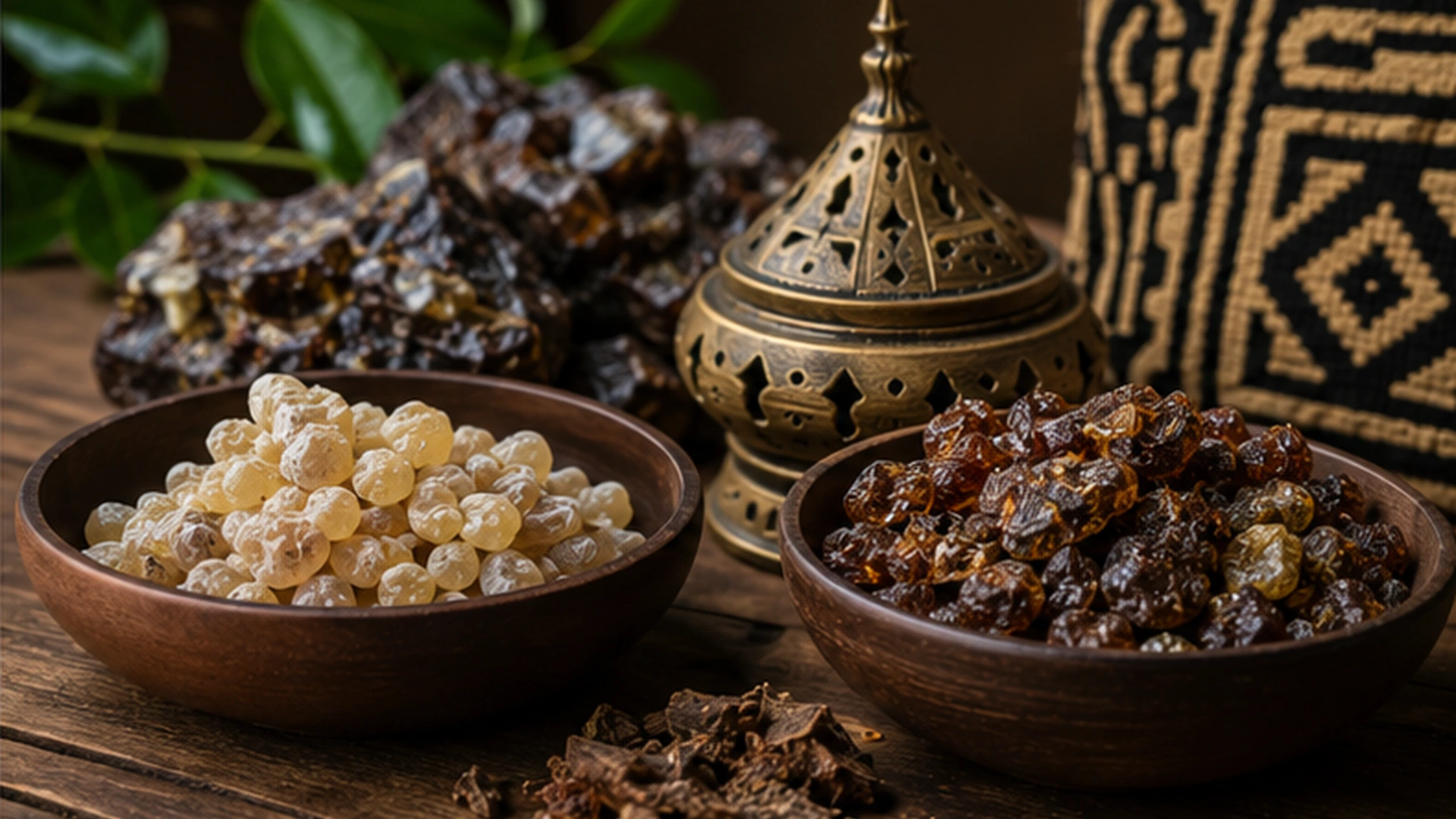
Frankincense is an aromatic resin obtained from trees in the Boswellia genus.
Kew Gardens notes that frankincense has been valued across long-distance trade and religious histories, while its Economic Botany Collection contains many resin specimens showing the material’s variation. Boswellia papyrifera, an important African frankincense species, is native across a broad region extending toward Eritrea and northeastern Uganda. (Sources: Royal Botanic Gardens, Kew, “Frankincense: resin with many stories” and Plants of the World Online.)
Frankincense has appeared in:
Christian worship
Muslim cultural and devotional settings
Ethiopian and Eritrean hospitality
Household fragrance
Mourning
Processions
Healing traditions
Trade ceremonies
It is especially important not to collapse all incense use into one religion. Ethiopian Orthodox churches, Muslim families, Catholic and Eastern Christian liturgies, and domestic coffee ceremonies may all use aromatic smoke, but the prayers, authorities, and meanings differ.
Frankincense in Ethiopian Social Life
In many Ethiopian homes, incense may accompany a coffee ceremony that welcomes guests and creates a shared social atmosphere. The ceremony centres on coffee preparation, hospitality, conversation, and respect; the incense supports the sensory environment rather than functioning as an isolated spell.
Regional, ethnic, religious, and household variations are substantial. Not every Ethiopian family performs the ceremony identically, and not every use of incense has the same spiritual interpretation.
Conservation Concerns
Frankincense trees face pressure from overharvesting, grazing, fire, land-use change, and poor regeneration in some regions. Sustainable harvesting requires careful tapping and recovery periods rather than repeated deep cuts.
Consumers should look beyond “premium” marketing and ask:
Which Boswellia species is this?
Where was it harvested?
Were local harvesters paid fairly?
Is the supply chain traceable?
Does harvesting support regeneration?
A sacred material loses part of its ethical meaning when demand harms the trees, workers, or communities connected with it.
Myrrh and Aromatic Resins
Myrrh is resin produced by various Commiphora species, many of which grow in the Horn of Africa and neighbouring drylands.
Frankincense and myrrh are often paired in popular writing, but they come from different genera and can have different scents, qualities, trade histories, and ceremonial roles.
Myrrh has been associated historically with:
Incense
Perfume
Anointing
Mourning
Burial practices
Religious offerings
Household fragrance
Trade
The term myrrh can also be used loosely in commerce. A product may come from a different Commiphora species or contain blended resins. Accurate identification and transparent sourcing matter.
No one should ingest a resin or essential oil simply because a historical source calls it sacred or medicinal.
Kola Nuts in Igbo and Yoruba Ceremonial Life
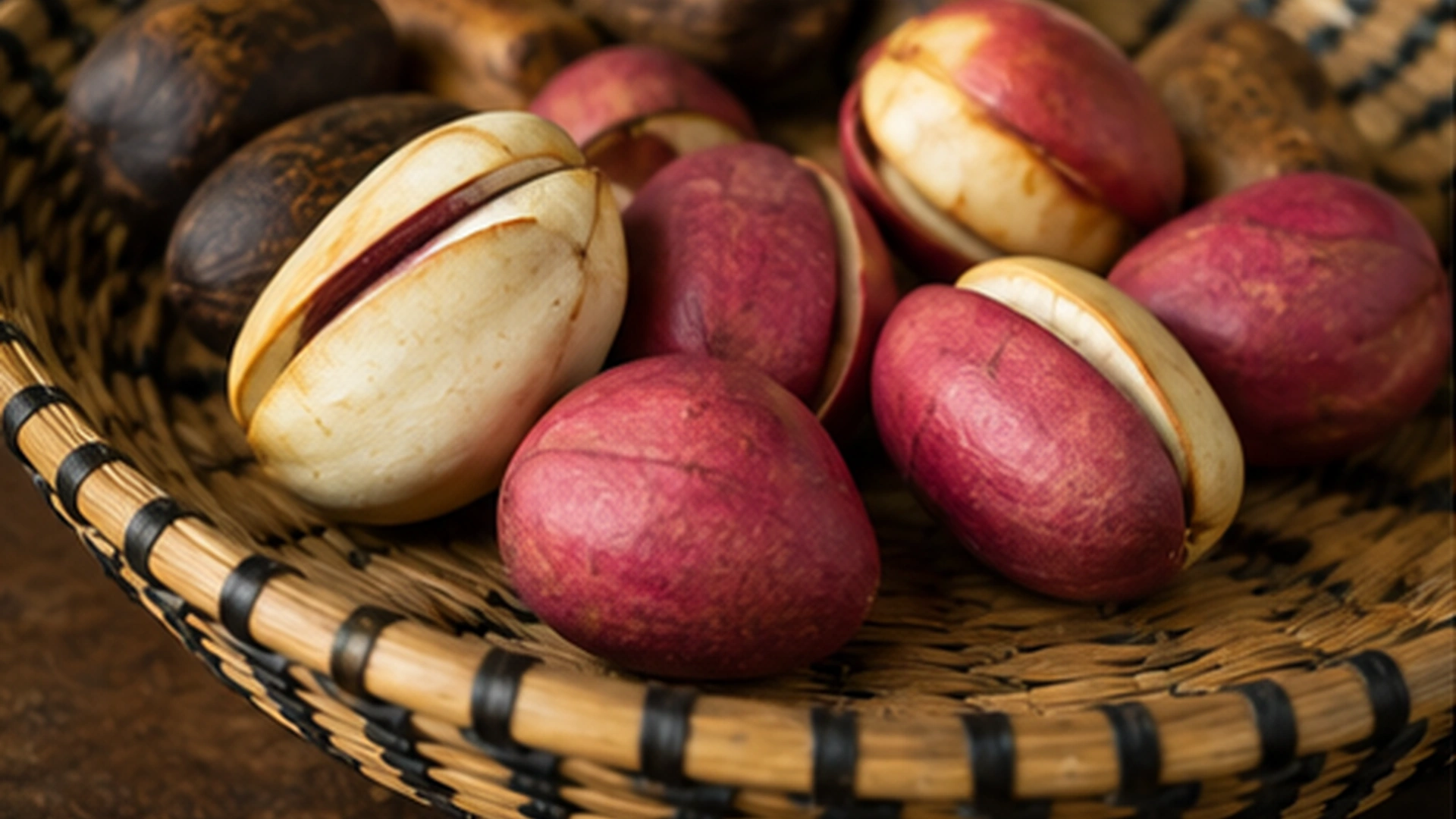
Kola nuts come from trees in the Cola genus and have important social, economic, and ceremonial roles in several West African communities.
The Smithsonian National Museum of African Art documents that, in Igbo communities, kola nuts and white chalk can function as offerings of hospitality and may precede both social and ritual undertakings. The museum also records Yoruba prestige bowls used to offer kola nuts to guests or deities. (Sources: Smithsonian objects “Chalk dish” and “Bowl with figures.”)
Kola may appear in contexts such as:
Welcoming visitors
Opening meetings
Marriage discussions
Prayer
Reconciliation
Offerings
Divination in specific institutions
Royal or lineage ceremonies
The person who presents, breaks, blesses, or distributes kola may hold a recognized family or community role.
Hospitality and Ritual Are Connected
Western categories often separate “social” hospitality from “religious” ceremony.
Kola traditions show that welcoming a guest, acknowledging elders, praying, and beginning an important discussion can belong to the same event.
The nut is not merely a stimulant or snack. It can make relationships visible.
Important Boundaries
Igbo and Yoruba customs are not identical.
Procedures differ by town, lineage, religion, and occasion.
Gender and seniority rules may vary.
A museum object cannot teach the full spoken procedure.
Kola contains caffeine and other active compounds; ceremonial respect does not remove physiological effects.
Henna in North African Ceremonies
Henna comes from the leaves of Lawsonia inermis, a shrub whose dried leaves are processed into a dye.
In 2024, UNESCO inscribed “Henna: rituals, aesthetic and social practices” on the Representative List of the Intangible Cultural Heritage of Humanity through a multinational nomination including Algeria, Egypt, Mauritania, Morocco, Sudan, and Tunisia, alongside countries in the Middle East. UNESCO describes henna as sacred to many participating communities and records its use in celebrations, life-cycle events, adornment, and social gathering. (Source: UNESCO Intangible Cultural Heritage, “Henna: rituals, aesthetic and social practices.”)
Henna may be used during:
Weddings
Engagements
Birth celebrations
Religious festivals
Family gatherings
Beauty and adornment practices
Protective or blessing traditions
The designs, songs, sequence, participants, and meanings vary widely.
Henna Is More Than a Pattern
The ceremonial importance may include:
Who applies it
Which relatives gather
What songs are performed
Whether the event marks transition
Which designs belong to a region or family
How the bride or participant is prepared
Copying a pattern from social media does not reproduce this social knowledge.
Safety Warning: “Black Henna”
Natural henna usually produces an orange-brown to reddish-brown stain. Products sold as “black henna” may contain additional chemicals such as para-phenylenediamine, which can cause serious skin reactions.
Ceremonial users should verify ingredients and avoid unknown mixtures, especially on children, damaged skin, or people with previous allergic reactions.
Iboga in Bwiti Traditions
Iboga (Tabernanthe iboga) is a Central African rainforest shrub associated with particular Bwiti religious traditions, especially in Gabon and neighbouring areas.
Academic literature documents iboga’s role in initiation, healing, religious identity, moral reflection, and relationships among individuals, ancestors, community, time, and place. It is not simply a “psychedelic herb” detached from Bwiti institutions. (Source: J. W. Fernandez and R. L. Fernandez, “Returning to the path.”)
Iboga is included here because it is widely discussed publicly, but it requires the strongest safety boundary in this article.
Iboga Is Medically Dangerous
Iboga contains alkaloids including ibogaine. Clinical literature links ibogaine exposure with QT interval prolongation, dangerous heart rhythm disturbances, neurological effects, and deaths. A safety study notes that reported fatalities have often involved cardiac events. (Source: Knuijver et al., “Safety of ibogaine administration in detoxification of opioid-dependent individuals.”)
This means:
Do not self-administer iboga or ibogaine.
Do not follow online dosing instructions.
Do not combine it with medicines or other substances.
Do not treat a ceremony as protection from toxicity.
Do not purchase unknown root bark or extracts.
Do not assume a retreat is medically safe because it uses spiritual language.
Describing Bwiti history does not authorize outsiders to imitate initiation or commercialize restricted knowledge.
Cultural Context Cannot Be Removed
Within Bwiti institutions, iboga may be connected with trained leaders, community participation, music, teaching, moral responsibility, and a larger religious worldview.
Commercial “iboga experiences” that extract the substance while ignoring community authority, medical risk, and Gabonese cultural ownership raise serious ethical concerns.
Leaves, Roots, and Plant Mixtures in Healing Ceremonies
Many African healing traditions use plant materials during ceremonies. However, a public educational article should avoid presenting formulae as universal or safe.
A healer, herbalist, diviner, medium, priest, and family elder may have different responsibilities.
A ceremonial mixture may be used for:
Washing
Fumigation
Anointing
Sprinkling
Carrying
Bathing
Display
Ingestion
These routes are not medically equivalent.
Skin application can cause allergy or burns. Smoke can irritate lungs. Ingestion can cause poisoning. A plant safe in food quantities may be dangerous as a concentrated extract.
Public Knowledge and Restricted Knowledge
A responsible article can describe that a plant is important without revealing how a restricted ceremony is performed.
Publicly Appropriate Information
Botanical identity when reliably known
General cultural region
Public museum or heritage descriptions
Conservation concerns
Broad ceremonial purpose
Safety warnings
Information That May Be Restricted
Exact prayers
Initiation sequences
Secret names
Specialist mixtures
Dosages
Ritual medicines
Sacred-site access rules
Divination procedures
Lineage-owned songs
The internet does not erase cultural ownership.
Who Has Authority to Use Ceremonial Plants?
Possible authorities include:
Family heads
Elders
Priests
Priestesses
Healers
Herbalists
Diviners
Initiated custodians
Shrine keepers
Religious clergy
Wedding specialists
Recognized community artists
These roles are not interchangeable.
A seller is not automatically a healer. A healer is not automatically a priest. An elder is not automatically authorized to reveal every lineage practice. A person who reads about a plant online does not gain ceremonial authority.
Safety: Natural Does Not Mean Harmless

The World Health Organization warns that some medicinal plants are inherently toxic and that herbal products can produce adverse effects. The CDC also notes that plants may be poisonous, misidentified, contaminated, or interact unpredictably with prescription medicines. (Sources: WHO safety-monitoring guidelines for herbal medicines; CDC Yellow Book guidance on herbal medicine.)
Major Risks Include
Incorrect species identification
Contamination with pesticides, fungi, metals, or other plants
Allergic reactions
Skin burns
Liver or kidney injury
Dangerous heart effects
Interactions with prescription medicines
Pregnancy risks
Childhood poisoning
Psychoactive effects
Unsafe smoke exposure
Smoke and Indoor Air
Burning leaves, wood, or resin produces particulate matter and other pollutants.
WHO notes that fine particles can penetrate deeply into the lungs and contribute to respiratory and cardiovascular harm. People with asthma, chronic lung disease, heart disease, pregnancy, or sensitivity to smoke may be at greater risk. (Source: World Health Organization, air-quality and particulate-matter guidance.)
Practical safety includes:
Avoiding heavy smoke in enclosed rooms
Keeping children away from hot charcoal and resins
Using stable fireproof containers
Preventing burns and house fires
Stopping if anyone develops breathing difficulty, dizziness, or irritation
Seeking urgent help for severe reactions
These precautions do not disrespect tradition. They protect participants.
Ceremonial Plants and Modern Healthcare
Ceremonial support may provide community, identity, prayer, comfort, and continuity.
It should not replace:
Emergency treatment
Antidotes
Cancer care
Infection treatment
Prenatal care
Mental-health treatment
Legal safeguarding
A person can value ceremonial practice while still using evidence-based healthcare.
A trustworthy practitioner should not demand that a patient stop prescribed medication without the involvement of a qualified medical professional.
Conservation and Ethical Sourcing
Ceremonial plants are living organisms, not unlimited commodities.
Demand can produce:
Overharvesting
Destruction of roots or bark
Loss of old trees
Habitat degradation
Theft from community land
Exploitation of harvesters
Replacement with misidentified species
Responsible Sourcing Questions
Is the species accurately identified?
Was it cultivated or wild harvested?
Does harvesting kill the plant?
Are local custodians involved?
Are workers paid fairly?
Is the material legally traded?
Does the seller make false medical claims?
Is there a less threatened alternative accepted by the community?
Conservation should not be imposed by outsiders without local participation. Communities that preserve plant knowledge should be central to decisions about cultivation, access, and benefit sharing.
Common Misconceptions
“All Sacred Herbs Are Medicinal”
False.
A plant may be ceremonial because of scent, colour, history, or social meaning rather than a medical effect.
“All African Ceremonies Use the Same Herbs”
False.
Plant traditions vary by community, ecology, religion, language, and institution.
“Impepho Is One Standardized Species”
False.
The name may refer to several Helichrysum species and local substitutes.
“Frankincense and Myrrh Are the Same”
False.
Frankincense generally comes from Boswellia species, while myrrh comes from Commiphora species.
“Kola Is Only a Stimulant”
False.
In specific West African contexts, kola also carries social, ceremonial, and religious importance.
“Henna Is Only Decoration”
False.
Henna can be part of family, marriage, blessing, transition, and heritage practices.
“Iboga Is Safe Because It Is Traditional”
False.
Iboga and ibogaine can cause life-threatening toxicity.
“Smoke Cleansing Cannot Harm the Lungs”
False.
Smoke contains fine particles and can worsen respiratory or cardiovascular conditions.
“Buying a Plant Gives You the Ceremony”
False.
Ceremony depends on authority, relationships, language, place, and community recognition.
How to Research a Ceremonial Plant Responsibly
1. Identify the community and region rather than searching only for “African sacred herb.”
2. Check whether the popular name refers to multiple species.
Frequently Asked Questions
What should readers know first about african spirituality and cultural history?
African spirituality and cultural history: Read clear guidance, key signs, practical steps, and private support from Ancestral Temple.
What causes sacred-herbs-used-in-traditional-ceremonies?
The safest next step is to compare the signs, prepare clear details, and request private guidance when the matter feels personal.
How does sacred-herbs-used-in-traditional-ceremonies work?
The safest next step is to compare the signs, prepare clear details, and request private guidance when the matter feels personal.
Is it possible to get private guidance for sacred-herbs-used-in-traditional-ceremonies?
The safest next step is to compare the signs, prepare clear details, and request private guidance when the matter feels personal.
How long does sacred-herbs-used-in-traditional-ceremonies take to understand?
The safest next step is to compare the signs, prepare clear details, and request private guidance when the matter feels personal.
Can sacred-herbs-used-in-traditional-ceremonies affect relationships, family, work, or personal peace?
The safest next step is to compare the signs, prepare clear details, and request private guidance when the matter feels personal.
Why do people seek spiritual guidance for sacred-herbs-used-in-traditional-ceremonies?
The safest next step is to compare the signs, prepare clear details, and request private guidance when the matter feels personal.
What signs should someone notice before asking about sacred-herbs-used-in-traditional-ceremonies?
The safest next step is to compare the signs, prepare clear details, and request private guidance when the matter feels personal.
When should someone contact a private spiritual guide?
The safest next step is to compare the signs, prepare clear details, and request private guidance when the matter feels personal.
What causes african spirituality and cultural history?
African spirituality and cultural history: Read clear guidance, key signs, practical steps, and private support from Ancestral Temple. The safest next step is to compare the signs, prepare clear details, and request private guidance when the matter feels perso
Article Information
- Publisher
- Ancestral Temple
- Editor
- Ancestral Temple
- Last updated
- Jul 26, 2026
- Last reviewed
- Jul 13, 2026
- Content version
- c43d5d618a
This educational article should be read as cultural and spiritual information, not as medical, legal, financial, or emergency advice.
Helpful Related Guidance
Explore This Topic
Role Of Elders In African Spiritual Practices · Libation Ceremonies In African Communities
Related Topic Cluster
African Spirituality And Cultural History
Complete Guide Why Homes Have Been Blessed Throughout HistoryAbout the Author
 Ancestral Temple
Spiritual guide and practitioner with decades of experience in ancestral wisdom, rituals, and divine guidance.
Related Posts
View All

Leave a Comment
We'd love to hear your thoughts.
I appreciated the distinction between sacred herbs and the broader category of ceremonial plants.