
Sandalwood Traditions
Cornerstone Content
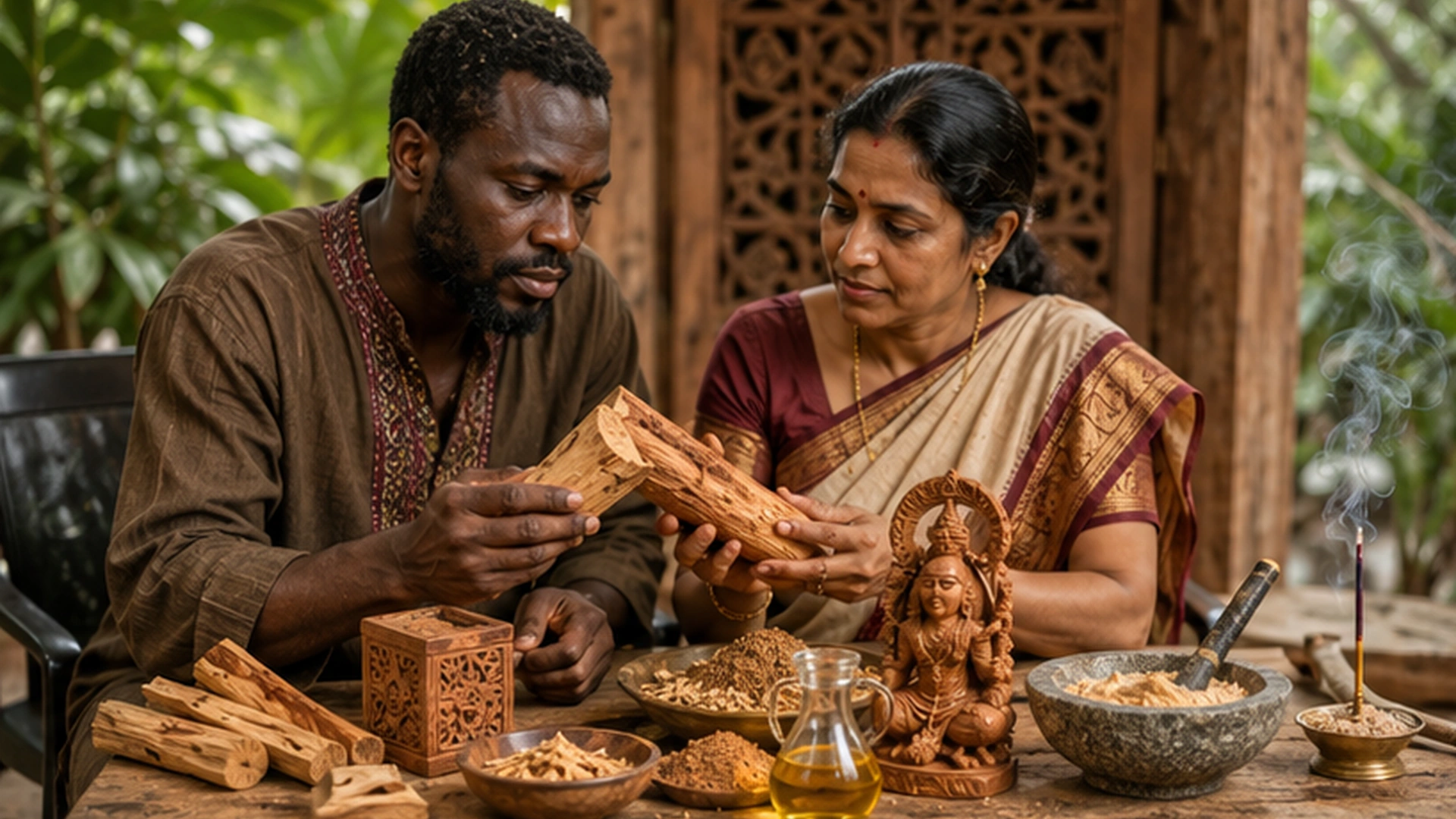
Quick Summary
Sandalwood has been used as incense, devotional paste, carving wood, perfume, funeral material, and trade commodity across many cultures. This article explains those traditions while distinguishing true sandalwoods from similarly named species and addressing safety, conservation, and ethical sourcing.
Sandalwood Traditions explains the meaning, background and cultural context of sandalwood traditions in clear educational language. The article answers the main topic near the beginning, preserves the original examples and highlights important distinctions for respectful understanding.
Sandalwood Traditions
Sandalwood is valued because its fragrance can remain in the heartwood for years.
The scent may be released by carving, grinding, heating, burning, or distilling the wood. Across different societies, sandalwood has entered temples, homes, workshops, funerals, perfume traditions, trade networks, and systems of medicine.
It has been made into:
Incense powder and sticks
Cooling or fragrant paste
Carved religious images
Prayer objects and decorative boxes
Perfume and cosmetic ingredients
Funeral and memorial materials
Household fragrance
Essential oil
These uses do not form one universal sandalwood tradition.
The word sandalwood is applied to several plants. Indian sandalwood, Western Australian sandalwood, Hawaiian sandalwoods, East African sandalwood, and red sandalwood are botanically and culturally different. A practice associated with one species or community should not be transferred automatically to another.
A responsible account of sandalwood therefore asks:
Which species is being used?
Where was it grown or harvested?
Which religious or cultural institution gives it meaning?
Was the material legally and sustainably sourced?
Is the information public or restricted?
True sandalwoods belong mainly to the genus Santalum, whose members are aromatic, hemiparasitic trees or shrubs distributed from South and Southeast Asia through Australia and the Pacific. (Kew Plants of the World Online: Santalum)
Indian sandalwood, Santalum album, is deeply embedded in South Asian religious, artistic, and fragrance traditions and is currently assessed as Vulnerable by the IUCN source cited by Kew. (Kew Plants of the World Online: Santalum album)
Sandalwood paste, commonly called chandan in several South Asian languages, may be applied to sacred images, ritual objects, or the forehead within specific Hindu and Jain settings.
Buddhist traditions include incense offerings, sandalwood imagery, and stories about early Buddha images carved from sandalwood. (The Metropolitan Museum of Art)
Jain ritual documentation includes the application of sandalwood paste to images of the Jinas alongside flowers, incense, lamps, food, and prayer. (Smithsonian National Museum of Asian Art)
Indian government forestry institutions describe sandalwood as culturally and religiously important in India and note its use in perfumery, carving, and ritual life. (Institute of Wood Science and Technology, India)
East African sandalwood, Osyris lanceolata, is not a Santalum species. It is a widely distributed hemiparasitic shrub or small tree that entered CITES Appendix II because of destructive international trade pressure. (Kew Plants of the World Online: Osyris lanceolata) (CITES: East African sandalwood Appendix II proposal)
Western Australian sandalwood, Santalum spicatum, has long-standing Aboriginal cultural, nutritional, and medicinal importance. Public descriptions do not authorise outsiders to reproduce restricted knowledge. (Government of Western Australia: Sandalwood)
Hawaiian sandalwoods, known as ʻiliahi, were heavily exploited after foreign commercial trade expanded in the late eighteenth and early nineteenth centuries. The trade damaged forests and Native Hawaiian lifeways. (State of Hawaiʻi: forest products and sandalwood history)
Sandalwood has moved through Silk Roads and maritime trade alongside other aromatics such as aloeswood, camphor, frankincense, and myrrh. (British Museum: Silk Roads large print guide)
“Red sandalwood” or red sanders, Pterocarpus santalinus, is a different hardwood and should not be confused with aromatic white sandalwood. (CITES timber species manual)
Sandalwood essential oil is concentrated. Essential oils may cause skin reactions and can be harmful when swallowed or misused. (Poison Control: Essential oils and misuse)
Burning sandalwood incense creates smoke and particulate pollution, so ventilation, fire safety, and consideration for people with respiratory illness are important.
Ethical sandalwood use requires species identification, legal documentation, traceable supply chains, fair compensation, regeneration, and respect for Traditional Owners and cultural custodians.
Clear Definition
Sandalwood traditions are the cultural, religious, artistic, medicinal, commercial, and household practices that use fragrant wood, paste, powder, incense, carvings, or oil from sandalwood and sandalwood-like plants.
Plain-Language Meaning
Sandalwood is fragrant wood.
People have used it to make spaces smell different, honour sacred images, mark the body, carve respected objects, prepare funerals, welcome guests, and create perfumes.
Its meaning depends on who is using it and why.
A sandalwood paste placed on a Hindu deity, a Buddhist image carved from fragrant wood, an Aboriginal food or medicine tradition, and an East African conservation problem are not the same practice.
What Is True Sandalwood?
The botanical genus Santalum includes aromatic trees and shrubs found from Asia through Australia and across Pacific islands. Kew describes the genus as containing root-parasitic or hemiparasitic plants whose roots attach to nearby host plants while still carrying out photosynthesis. (Kew Plants of the World Online: Santalum)
The fragrance is concentrated mainly in the mature heartwood and roots rather than the pale outer sapwood.
Important species include:
Santalum album — commonly called Indian or white sandalwood
Santalum spicatum — Western Australian sandalwood
Santalum austrocaledonicum — New Caledonian and Vanuatu sandalwood
Santalum paniculatum and other endemic species — Hawaiian sandalwoods
Santalum lanceolatum — northern Australian sandalwood
The scientific name matters because aroma, oil composition, conservation status, legal controls, and cultural history differ by species.
Indian Sandalwood and the Meaning of Chandan
Santalum album is commonly called Indian sandalwood, white sandalwood, or chandan. It has been cultivated and traded in South Asia for centuries and is especially associated with Karnataka and Tamil Nadu in modern India. Indian forestry institutions describe it as a tree of major religious, cultural, perfumery, and craft importance. (Institute of Wood Science and Technology, India)
Kew currently records its accepted native range as Java through northern Australia, while its long cultivation and cultural history in India have made “Indian sandalwood” the dominant international name. (Kew Plants of the World Online: Santalum album)
This distinction shows why botanical origin and cultural home are not always identical.
Sandalwood Paste
Sandalwood heartwood may be rubbed against a stone with water to produce a fragrant paste.
Depending on the institution, region, family, and occasion, the paste may be used to:
Mark the forehead
Adorn a sacred image
Fragrance the body
Cool the skin
Prepare ritual objects
Mark participation in worship
Honour a guest or religious figure
The paste is often associated with purity, cooling, devotion, dignity, and attention.
However, not every forehead mark is sandalwood, and not every Hindu community uses chandan in the same way. Marks may also be made with ash, clay, turmeric, saffron, kumkum, or other substances.
Sandalwood in Hindu Worship
In many Hindu contexts, sandalwood may be offered as paste, incense, fragrance, or carved material. It can be used during puja, temple service, festivals, domestic worship, and rites of passage.
Its cooling fragrance may symbolise:
Purity
Self-control
Auspiciousness
Respect
Devotion
The transformation of ordinary material into an offering
These meanings vary among Shaiva, Vaishnava, Shakta, regional, temple, and household traditions.
A public article should not present one temple’s preparation or mantra as a universal Hindu formula.
Sandalwood in Funeral Traditions
Sandalwood may appear in particular Hindu funeral and cremation practices as chips, powder, paste, or incense.
Its fragrance may express dignity, purification, honour, and farewell. Wealth, regional availability, caste history, family custom, and modern regulation affect how much sandalwood is used.
It is inaccurate to suggest that every Hindu cremation requires a full sandalwood pyre. High-quality sandalwood is expensive and scarce, and many families use only a small symbolic amount or none at all.
Sandalwood in Buddhist Traditions
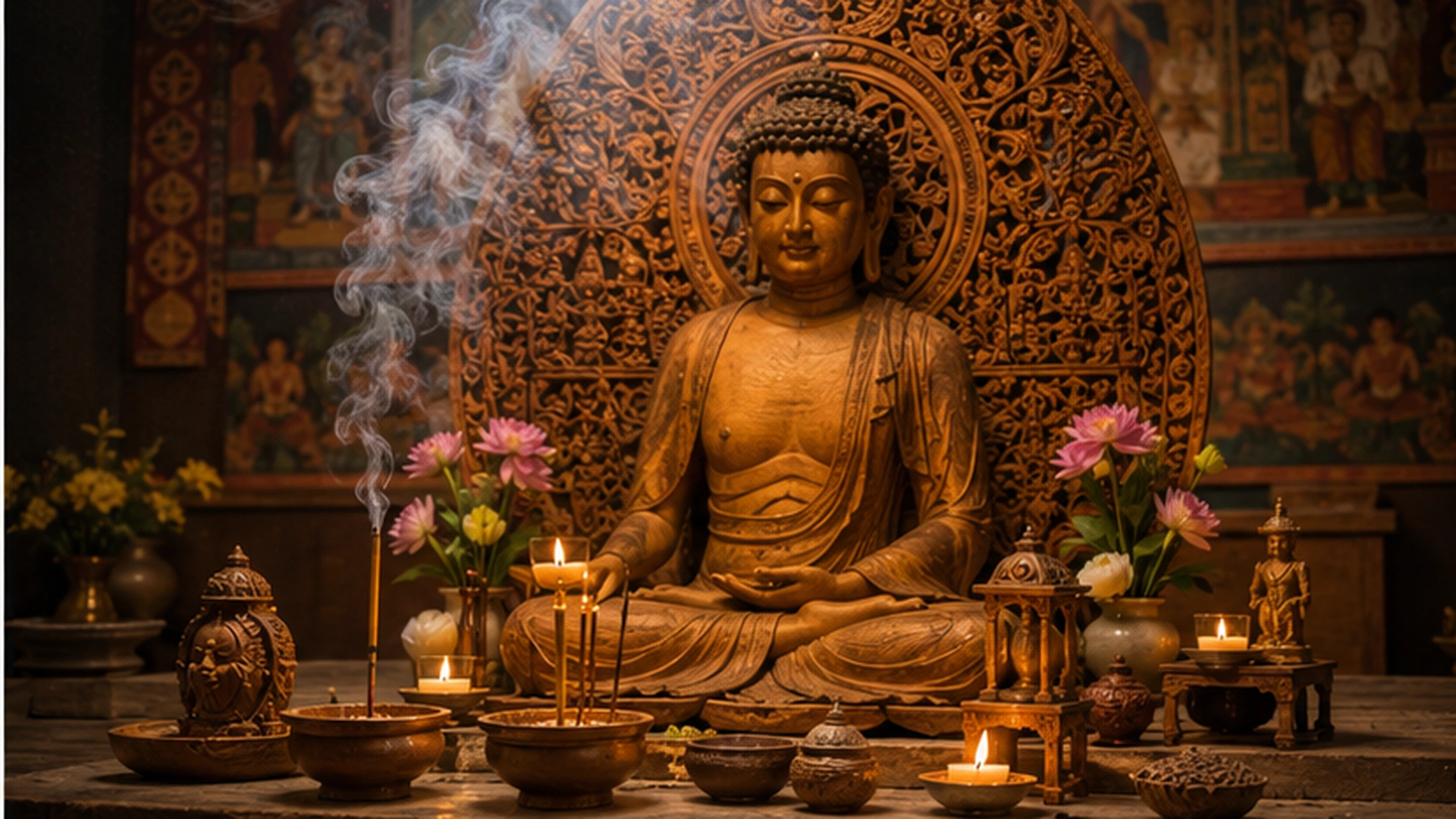
Fragrance is important in many Buddhist cultures because incense and perfume can function as offerings, support attention, and create a sensory environment for devotion.
Sandalwood appears in Buddhist stories, art, incense, and sculpture.
The Sandalwood Buddha Tradition
Museum sources preserve a widespread Buddhist story that the first image of the Buddha was carved from sandalwood while he was away teaching in a heavenly realm. The historical details of the legend vary, but the story helped make sandalwood an auspicious material for Buddhist images. (The Metropolitan Museum of Art) (British Museum: sandalwood Buddha tradition)
A Nepalese image of Avalokiteshvara in the Metropolitan Museum is carved from sandalwood, which the museum describes as pure and auspicious within the object’s religious context. (The Metropolitan Museum of Art)
This does not mean every Buddhist sculpture is made from sandalwood or that sandalwood is required in all Buddhist practice.
Incense and Fragrant Offerings
Sandalwood powder or blended incense may be offered before Buddha images, bodhisattvas, teachers, stupas, or sacred texts in different Buddhist communities.
Possible meanings include:
Respect
Moral discipline
Mindfulness
Generosity
The spread of virtuous conduct
The impermanence of fragrance and smoke
The exact interpretation depends on the school, country, monastery, and ritual.
Fragrance and the Ideal Buddha
Buddhist literary traditions sometimes describe the Buddha’s body as naturally fragrant, including comparisons with sandalwood. Smithsonian scholarship notes that incense, perfume, and sensory offerings help practitioners imagine and honour the perfected body of the Buddha. (Smithsonian National Museum of Asian Art)
This is religious and literary imagery, not a claim that sandalwood produces enlightenment.
Sandalwood in Jain Traditions
Jain worship may involve bathing and adorning images of the Jinas or Tirthankaras.
Educational material from the Smithsonian’s National Museum of Asian Art describes a ritual sequence in which sandalwood paste or red kumkum may be applied to particular points on a Jina image, followed by flowers, incense, a lamp, food offerings, and prayer. (Smithsonian National Museum of Asian Art)
The sandalwood paste can express:
Reverence
Purity
Beauty
Calmness
Mindful attention
Honour toward the liberated teachers
Jain communities and sects differ, and ritual authority belongs to practitioners rather than online writers.
Sandalwood in Zoroastrian Fire Traditions
Indian forestry publications note that sandalwood has been used in sacred fires within Zoroastrian communities. (Indian Council of Forestry Research and Education)
In Zoroastrian worship, fire is treated with great reverence. Fragrant, clean-burning wood may be offered within carefully regulated religious institutions.
This does not mean that anyone may imitate a fire-temple ceremony at home. Priestly roles, consecrated spaces, purity rules, and community authority are central.
Sandalwood Across Asian Trade and Court Culture
Sandalwood travelled widely because its fragrance, durability, and high value made it suitable for long-distance commerce.
The British Museum’s Silk Roads material lists sandalwood among aromatics that moved alongside aloeswood, camphor, frankincense, and myrrh across interconnected Asian trade routes. (British Museum: Silk Roads large print guide)
Sandalwood reached:
Temples and monasteries
Royal courts
Perfume workshops
Carving centres
Medicine markets
Household incense traditions
Maritime trading ports
In China, Japan, Korea, Tibet, Southeast Asia, and the Himalayan region, sandalwood could be used in incense blends, Buddhist sculpture, altar furnishings, writing materials, and luxury objects.
The meanings were not identical. A courtly carved object, a monastery incense offering, and a household fragrance practice should not be merged into one “Asian sandalwood ritual.”
Sandalwood Carving and Sacred Images
Sandalwood’s fine grain, fragrance, and ability to hold detail made it valuable for carving.
Objects may include:
Images of deities and bodhisattvas
Prayer beads
Boxes
Fans
Decorative panels
Small shrines
Combs and personal objects
Mysore and other South Indian carving centres became especially known for sandalwood craftsmanship. Indian government cultural material describes artisans producing detailed figurines and religious objects from the wood. (Government of Rajasthan: traditional sandalwood crafts)
The craft involves more than raw material. It depends on design knowledge, tools, apprenticeship, iconographic rules, and market access.
Conservation rules and wood scarcity now affect artisans who depend on authentic legal material.
Sandalwood in Perfumery and Household Fragrance
Sandalwood oil is valued as a perfume base because its warm woody aroma can support and extend other fragrances.
Historically and commercially, sandalwood has appeared in:
Attars
Incense
Soaps
Cosmetics
Hair products
Religious perfumes
Household fragrance
The word sandalwood on a label does not guarantee that the product contains natural Santalum album oil. It may contain:
Another Santalum species
East African sandalwood oil
Amyris or other substitute oils
Synthetic sandalwood aroma chemicals
A blended fragrance with little or no natural sandalwood
Transparent labelling should identify the botanical species and ingredient type.
East African Sandalwood
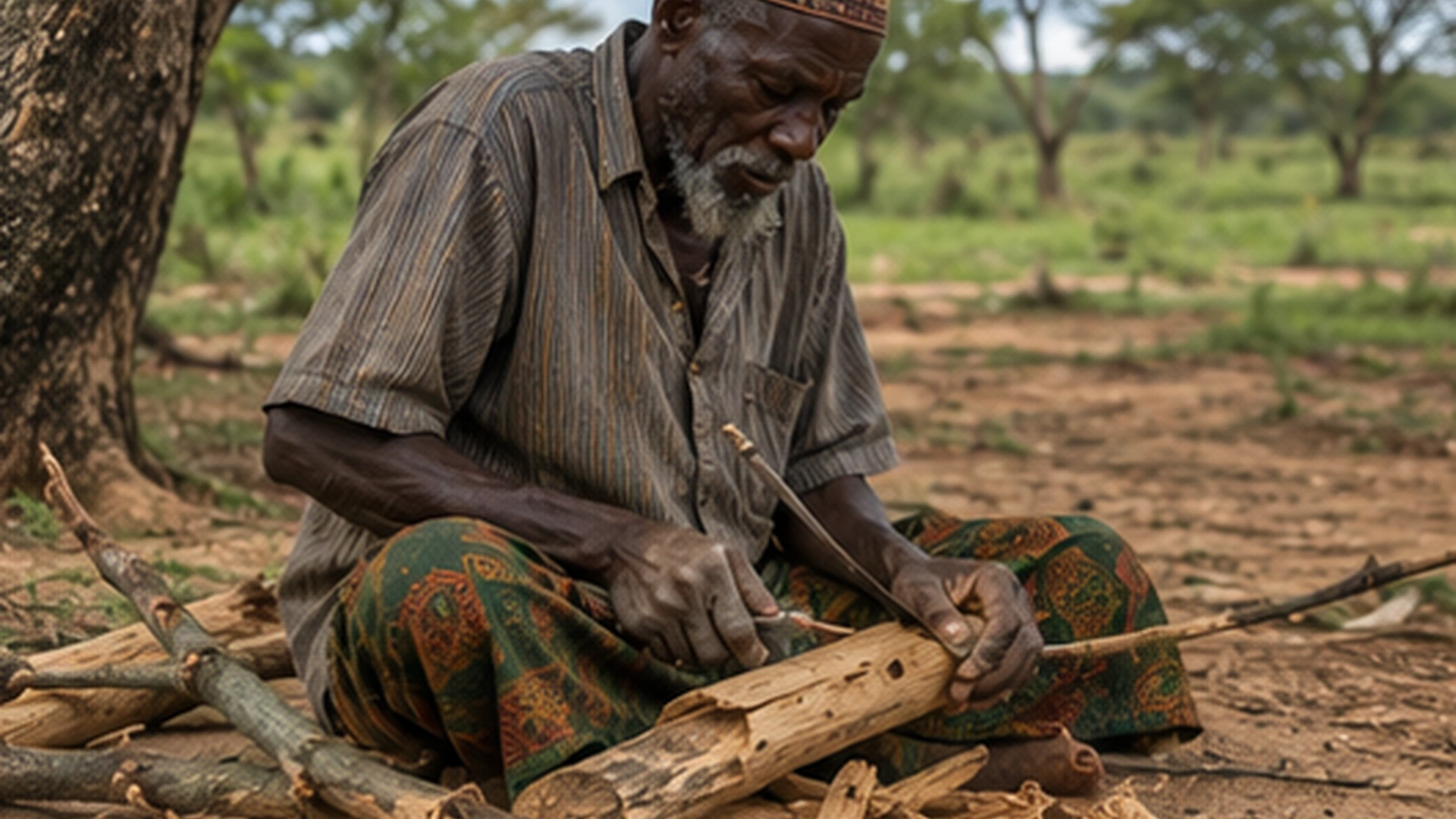
East African or African sandalwood is commonly associated with Osyris lanceolata.
It belongs to the sandalwood family, Santalaceae, but it is not a member of the true sandalwood genus Santalum. Kew describes it as a hemiparasitic shrub with a wide range extending through parts of Africa and into Asia. (Kew Plants of the World Online: Osyris lanceolata)
In East Africa, the plant has been valued for fragrant wood, oil, local medicine, fuel, and other uses. International perfume demand greatly increased harvesting pressure. (Peer-reviewed review of African sandalwood)
Trade and Illegal Harvesting
Because the useful fragrant material is concentrated in the wood and roots, harvesting can kill the entire plant.
CITES approved the inclusion of East African sandalwood in Appendix II in 2013 after Kenya and other range states documented severe exploitation and illegal international trade. (CITES: East African sandalwood Appendix II proposal)
Appendix II does not mean all trade is completely banned. It means international trade requires controls and evidence that exports are legal and not detrimental to the survival of the species.
Why This Matters in Uganda and East Africa
The species occurs in East African countries including Uganda, Kenya, Tanzania, Rwanda, Burundi, and Ethiopia within its wider range. (Kew Plants of the World Online: Osyris lanceolata)
Illegal extraction can cause:
Loss of mature seed-producing plants
Damage to host plants and surrounding vegetation
Erosion of community access
Smuggling and corruption
Loss of future livelihood opportunities
Substitution and mislabelling in fragrance markets
A consumer buying “African sandalwood oil” should ask for botanical identity, country of origin, CITES documentation where required, and evidence of legal cultivation or harvest.
Cultural Meaning Should Not Be Invented
The existence of local medicinal or ritual uses does not justify describing Osyris lanceolata as a universal African sacred tree.
Different communities may know and use the plant differently. Public education should avoid publishing restricted remedies or claiming that every East African community uses it for ancestor ceremonies, cleansing, or protection.
Aboriginal Australian Sandalwood Traditions
Western Australian sandalwood, Santalum spicatum, has been used by Aboriginal peoples for thousands of years.
Western Australian government sources describe it as culturally, medicinally, and nutritionally important and recognise Traditional Owners as the first custodians of sandalwood country. (Government of Western Australia: Sandalwood) (Western Australia DBCA: Sandalwood Order review)
Publicly documented uses include food and healing, but much Indigenous knowledge is owned and governed by specific peoples.
Respect requires:
Permission before recording knowledge
Protection of Indigenous Cultural and Intellectual Property
Traditional Owner participation in land management
Fair economic access to sandalwood industries
Avoidance of invented “Dreaming” stories
The word Dreaming in Aboriginal Australian contexts concerns law, country, ancestral relationships, and continuing responsibility. It should not be used casually as a marketing label.
Current Management Debate
As of July 2026, Western Australia was consulting on draft recommendations to reduce the annual wild sandalwood harvest from 2,500 to 2,000 tonnes while increasing monitoring, regeneration, and Aboriginal participation. (Government of Western Australia: 2026 wild sandalwood review)
This illustrates that a culturally important plant can also be the subject of ongoing scientific, economic, and political debate.
Hawaiian ʻIliahi and the Cost of Sandalwood Trade
Hawaiian sandalwoods are endemic Santalum species known collectively as ʻiliahi.
After foreign commercial trade expanded in the late eighteenth century, Hawaiian sandalwood became a major export to China. State of Hawaiʻi sources describe how intense harvesting, forest clearing, and economic pressure drove sandalwood populations toward collapse by the mid-nineteenth century. (State of Hawaiʻi: forest products and sandalwood history)
The trade was not simply a story of luxury perfume.
It involved:
Debt
Taxation
Forced or heavily imposed labour
Forest loss
Disruption of farming and fishing
Export dependence
Damage to Native Hawaiian lifeways
Hawaiian sandalwood history demonstrates how a sacred or valuable fragrance can become an instrument of colonial extraction.
Modern restoration must protect endemic species, Native Hawaiian cultural authority, dry-forest ecosystems, and the rights of families and communities connected with the land.
Sandalwood and the Meaning of Fragrance
Fragrance is invisible, temporary, and powerful.
Sandalwood may symbolise:
Purity
Calmness
Sacred presence
Hospitality
Memory
Dignity
Detachment
Devotion
Death and farewell
Prestige
These meanings are produced by context.
The same scent can remind one person of a temple, another of a funeral, another of a family perfume, and another of illegal logging.
Sandalwood and Cooling Symbolism
Sandalwood paste feels cooling when applied with water.
In South Asian religious and medical traditions, this physical sensation helped create symbolic associations with calmness, self-control, relief, and spiritual focus.
The metaphor can be powerful: anger is described as heat, while discipline and devotion are described as coolness.
However, cooling symbolism does not prove that sandalwood paste treats fever, infection, heat stroke, or skin disease.
Sandalwood in Mourning and Funerals
Sandalwood may accompany cremation, burial preparation, incense, memorial prayer, or care for the body in several traditions.
Possible meanings include:
Respect for the deceased
Fragrance during farewell
Purification
Dignity
Impermanence
Hope for a peaceful transition
Funeral practices are often private and highly regulated. Public articles should not reproduce restricted formulas, prayers, or body-preparation instructions.
Sandalwood Oil, Medicine, and Safety

Sandalwood has a long history in systems of medicine and body care.
Historical use does not prove that every modern health claim is effective or safe.
Essential Oil Is Concentrated
Sandalwood essential oil is produced by distilling fragrant wood.
It is not the same as:
Sandalwood paste
Incense powder
A carved object
A food ingredient
Fragrance oil
Poison Control warns that essential oils can cause skin rashes, may interact with medicines, and can be poisonous if swallowed or absorbed in harmful quantities. (Poison Control: Essential oils and misuse)
Responsible precautions include:
Do not swallow essential oil unless it is part of a specifically regulated product used under professional guidance.
Do not place it in the eyes, ears, or open wounds.
Do not apply undiluted oil to sensitive skin.
Keep bottles away from children and animals.
Stop use if a rash, breathing difficulty, dizziness, or swelling occurs.
Seek urgent medical help after significant accidental ingestion or a severe allergic reaction.
Sandalwood Does Not Replace Healthcare
Sandalwood should not be promoted as a guaranteed treatment for:
Cancer
Infection
Infertility
Depression
Anxiety disorders
Diabetes
Sexually transmitted infections
Spiritual attack
Ceremonial use, fragrance, and prayer may provide comfort, but they do not replace medical diagnosis or treatment.
Sandalwood Incense and Indoor Air
Burning sandalwood produces smoke.
Even natural incense releases particulate matter and combustion gases. Heavy smoke can irritate eyes and lungs, trigger asthma, and worsen indoor air quality.
Practical precautions include:
Use small amounts.
Open windows or provide ventilation.
Avoid prolonged daily smoke exposure.
Keep incense away from babies, animals, and people with respiratory disease.
Use stable, heat-resistant holders.
Keep embers away from curtains, paper, bedding, and dry vegetation.
Never leave burning incense unattended.
A spiritual meaning of purification should not be confused with medical sterilisation of the air.
Sandalwood Conservation
Sandalwood trees are vulnerable to overexploitation because their most valuable material develops slowly inside mature wood and roots.
Threats include:
Illegal logging
Root removal
Theft
Poor regeneration
Loss of host plants
Fire
Grazing
Land conversion
Climate change
Low payments to local custodians
Fraudulent trade documents
Kew cites Santalum album as Vulnerable, while East African sandalwood is regulated through CITES Appendix II. (Kew Plants of the World Online: Santalum album) (CITES: East African sandalwood Appendix II proposal)
The conservation status of each species should be checked separately.
Why Hemiparasitism Matters
Many sandalwoods are hemiparasitic.
Their roots connect with neighbouring host plants to obtain water and nutrients. This means conservation cannot focus only on planting isolated sandalwood seedlings.
Healthy populations depend on:
Suitable host species
Soil and rainfall
Protection from grazing
Genetic diversity
Long growth periods
Local ecological knowledge
The biology explains why simplistic “plant one tree for every bottle sold” claims may be misleading.
Ethical Sourcing Checklist
Before buying sandalwood, ask:
What is the scientific name?
Which country and region produced it?
Is it plantation-grown, community-managed, or wild harvested?
Does international trade require a CITES permit?
Can the supplier trace the material to harvest?
Were Traditional Owners or local custodians involved?
Were workers paid fairly?
Were roots and whole trees destroyed?
Does the seller support regeneration?
Is the product natural sandalwood, a substitute, or a synthetic fragrance?
A high price does not prove legality or cultural authenticity.
Common Misconceptions
“All Sandalwood Is the Same Species”
False.
Indian, Australian, Hawaiian, and African sandalwoods belong to different species, and some products called sandalwood are not Santalum at all.
“Red Sandalwood Is Fragrant White Sandalwood”
False.
Red sanders, Pterocarpus santalinus, is a different hardwood valued mainly for its colour and timber. (CITES timber species manual)
“Every Religion Uses Sandalwood the Same Way”
False.
Hindu, Buddhist, Jain, Zoroastrian, and household traditions have distinct practices and authorities.
“Sandalwood Is Always Sacred”
False.
It may be sacred, artistic, medicinal, commercial, decorative, or ordinary depending on context.
“Natural Sandalwood Oil Is Safe to Swallow”
False.
Essential oils are concentrated and may be poisonous when misused. (Poison Control: Essential oils and misuse)
“Burning Sandalwood Cleans the Air”
False.
It creates fragrance and may carry ritual meanings of purification, but it also produces smoke.
“African Sandalwood Is a Universal Ancestral Herb”
False.
Osyris lanceolata has specific local uses and a serious conservation history. It does not represent all African spiritual traditions.
“Expensive Sandalwood Must Be Legal”
False.
High prices can encourage illegal logging and laundering.
“A Sandalwood Object Gives Spiritual Authority”
False.
Ownership does not make someone a priest, monk, healer, elder, diviner, or cultural custodian.
Ethical and Cultural Boundaries
Sandalwood traditions should never be used to:
Encourage illegal logging or root removal
Buy CITES-controlled wood without legal documentation
Reproduce restricted ceremonies
Invent Indigenous stories
Claim Hindu, Buddhist, Jain, Zoroastrian, Aboriginal, Hawaiian, or African authority without recognition
Promise guaranteed healing, wealth, love, fertility, or protection
Replace medical or mental-health care
Sell synthetic fragrance as rare sacred wood
Pressure grieving families into buying expensive funeral materials
Apply essential oil to children, wounds, or sensitive areas without appropriate safety guidance
Burn heavy incense around people with asthma
Remove wood or bark from heritage trees
Publish private funeral or initiation knowledge
How to Research a Sandalwood Tradition Responsibly
1. Identify the botanical species.
2. Name the community, region, and historical period.
Frequently Asked Questions
What should readers know first about african spirituality and cultural history?
African spirituality and cultural history: Read clear guidance, key signs, practical steps, and private support from Ancestral Temple.
What causes sandalwood-traditions?
The safest next step is to compare the signs, prepare clear details, and request private guidance when the matter feels personal.
How does sandalwood-traditions work?
The safest next step is to compare the signs, prepare clear details, and request private guidance when the matter feels personal.
Is it possible to get private guidance for sandalwood-traditions?
The safest next step is to compare the signs, prepare clear details, and request private guidance when the matter feels personal.
How long does sandalwood-traditions take to understand?
The safest next step is to compare the signs, prepare clear details, and request private guidance when the matter feels personal.
Can sandalwood-traditions affect relationships, family, work, or personal peace?
The safest next step is to compare the signs, prepare clear details, and request private guidance when the matter feels personal.
Why do people seek spiritual guidance for sandalwood-traditions?
The safest next step is to compare the signs, prepare clear details, and request private guidance when the matter feels personal.
What signs should someone notice before asking about sandalwood-traditions?
The safest next step is to compare the signs, prepare clear details, and request private guidance when the matter feels personal.
When should someone contact a private spiritual guide?
The safest next step is to compare the signs, prepare clear details, and request private guidance when the matter feels personal.
What causes african spirituality and cultural history?
African spirituality and cultural history: Read clear guidance, key signs, practical steps, and private support from Ancestral Temple. The safest next step is to compare the signs, prepare clear details, and request private guidance when the matter feels perso
Article Information
- Publisher
- Ancestral Temple
- Editor
- Ancestral Temple
- Last updated
- Jul 26, 2026
- Last reviewed
- Jul 13, 2026
- Content version
- 6c8051e1ab
This educational article should be read as cultural and spiritual information, not as medical, legal, financial, or emergency advice.
Helpful Related Guidance
Explore This Topic
Traditional Cleansing Herbs Used Around The World · Spiritual Knowledge
Related Topic Cluster
African Spirituality And Cultural History
Complete Guide Why Homes Have Been Blessed Throughout HistoryAbout the Author
 Ancestral Temple
Spiritual guide and practitioner with decades of experience in ancestral wisdom, rituals, and divine guidance.
Related Posts
View All

Leave a Comment
We'd love to hear your thoughts.
The botanical section made the cultural differences much easier to understand.
I appreciated the explanation that East African sandalwood is not the same species as Indian sandalwood.