
History of Incense
Cornerstone Content
Quick Summary
Incense has moved through temples, homes, royal courts, funerals, trade routes, monasteries, mosques, churches, and family ceremonies for thousands of years. This guide traces its history without reducing diverse traditions to one universal meaning.
History of Incense
Incense is one of the oldest ways human communities have deliberately shaped the smell of a place.
People have burned resins, fragrant woods, bark, roots, leaves, seeds, flowers, and prepared mixtures in homes, temples, tombs, courts, monasteries, churches, and ceremonial spaces. The resulting fragrance could welcome guests, honour a divinity, distinguish sacred time, accompany mourning, perfume clothing, signal status, or preserve a connection with family and community memory.
There was no single moment when one civilization “invented” incense.
Aromatic burning developed in different regions using the plants, trade networks, religious institutions, and technologies available there. Ancient Egyptian temple incense, South Arabian resin trade, southern African impepho, Chinese mountain-shaped burners, Indian devotional offerings, Japanese incense games, Christian censers, and Ottoman household fragrance belong to distinct cultural histories.
The history of incense is therefore not one straight line from an ancient origin to modern incense sticks. It is a network of local practices connected by migration, trade, conquest, pilgrimage, religious transmission, craftsmanship, and changing ideas about fragrance.
Incense is aromatic plant or plant-derived material heated or burned to release fragrance.
It was not invented by one civilization; multiple societies developed incense practices independently and through exchange.
Ancient Mesopotamian homes and religious spaces included incense equipment, while ancient Egyptian temples used incense, myrrh, and scented oils as offerings. (Penn Museum and British Museum)
The Horn of Africa and South Arabia supplied valuable frankincense and myrrh to long-distance markets.
UNESCO documents an Incense Route extending more than 2,000 kilometres from southern Arabia toward the Mediterranean. (UNESCO World Heritage Centre)
Incense moved through the Silk Roads alongside sandalwood, aloeswood, camphor, frankincense, and myrrh. (British Museum: Silk Roads)
Buddhist transmission helped spread incense and incense implements from continental Asia to Japan, where a formal “way of incense,” or kōdō, later developed. (The Metropolitan Museum of Art: Japanese Incense)
Incense has served temple worship, household hospitality, funerals, purification, meditation, status, court culture, and artistic appreciation.
There is no single African, Asian, Christian, Muslim, Jewish, Buddhist, Hindu, or Indigenous meaning of incense.
Burning incense creates smoke and fine particles; ventilation and fire safety are important. (WHO and peer-reviewed health review)
Modern demand threatens some incense-producing trees, including agarwood-producing Aquilaria and Gyrinops species and certain frankincense populations. (Kew and conservation research)
Ethical sourcing should include species identification, legal trade, fair payment, community rights, and regeneration of source plants.
Clear Definition
Incense is an aromatic material heated or burned so that it releases fragrance into the air.
The word may refer to the raw material, a prepared mixture, a stick or cone, or the scented smoke itself.
Plain-Language Meaning
Incense works by using heat to release aromatic compounds.
Some incense burns by itself after lighting. Other forms are placed over charcoal or another heat source without being set directly on fire.
Its meaning depends on context.
The same frankincense resin may be:
Offered in a church
Burned during household hospitality
Sold as a perfume ingredient
Studied as a trade commodity
Used within a family remembrance practice
The material alone does not reveal the complete ceremony.
What Counts as Incense?
Incense can be made from many materials.
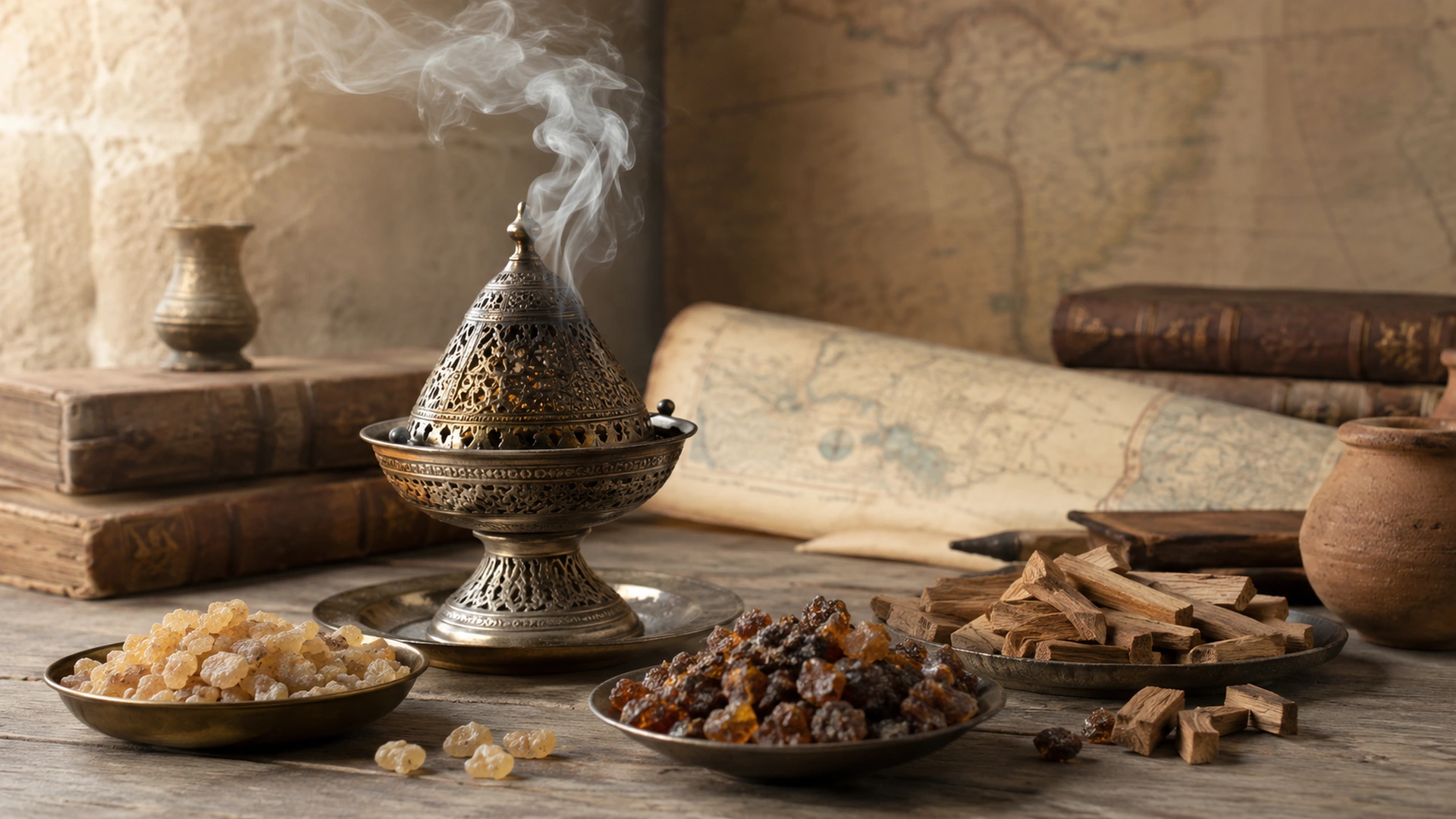
Resins and Gum-Resins
These are hardened plant exudates collected from trees or shrubs.
Examples include:
Frankincense from Boswellia species
Myrrh from Commiphora species
Benzoin from Styrax species
Copal, a trade name applied to several resins in different regions
Aromatic Woods
Fragrant heartwood or wood chips may be heated or burned.
Examples include:
Sandalwood
Agarwood, also called aloeswood, oud, gaharu, or eaglewood in different markets
Cedar and juniper in particular regional traditions
Leaves, Stems, Bark, Roots, and Seeds
Some communities burn locally available aromatic plants rather than imported resins.
In southern Africa, several Helichrysum species are associated with names such as impepho or imphepho. The South African National Biodiversity Institute documents Helichrysum odoratissimum as an aromatic plant whose leaves and stems are burned as incense in some ancestral, cleansing, household, and medicinal contexts. That documented use should not be converted into one standard procedure for every southern African community. (South African National Biodiversity Institute)
Prepared Incense
Ground aromatic ingredients may be combined with binders and shaped into:
Sticks
Cones
Coils
Pellets
Kneaded balls
Powders
Pastes
Recipes vary by region, manufacturer, religious institution, household, and historical period.
Direct-Burning and Indirect-Burning Incense
Direct-Burning Incense
Direct-burning incense contains enough combustible material to continue smouldering after it is lit.
Common examples include sticks, cones, and coils.
The flame is usually blown out, leaving a glowing ember that slowly releases smoke.
Indirect-Burning Incense
Indirect-burning incense does not normally remain lit by itself.
Resin grains, wood chips, or powdered mixtures are placed over:
Charcoal
Hot ash
A heated metal plate
An electric incense heater
This method allows the aromatic material to warm or char gradually.
Historical censers, temple burners, household braziers, and Japanese incense heaters show that incense technology developed far beyond the modern stick.
Why Humans Valued Aromatic Smoke
Scent Marked a Change in Place and Time
Fragrance could signal that an ordinary room had become a place of worship, mourning, hospitality, preparation, or reflection.
The visible smoke also transformed the appearance of a space, making the scented air part of the ceremony.
Aromatics Were Valuable Trade Goods
Many prestigious incense materials grew only in limited ecological regions.
Frankincense, myrrh, agarwood, sandalwood, camphor, and other aromatics became valuable because demand reached far beyond the places where they grew. Their movement supported caravan towns, ports, merchants, craftspeople, tax systems, and political power. (The Metropolitan Museum of Art)
Fragrance Created Social Memory
Smell is closely connected with memory.
Incense may remind a person of:
A grandmother’s home
A funeral
A church service
A Buddhist temple
A family coffee ceremony
A wedding
A seasonal celebration
The historical meaning of incense therefore lives not only in official texts but also in repeated family and community experience.
The Earliest History Is Difficult to Date
Archaeologists find burners, charred residues, botanical remains, inscriptions, and artistic scenes, but not every ancient fire was an incense fire.
Organic materials decay. The same vessel may have been used for food, perfume, medicine, fumigation, or ritual burning. Ancient plant names can also be difficult to match with modern species.
For that reason, it is more accurate to speak about early documented incense traditions than to claim one universally accepted date for the invention of incense.
Incense in Ancient Mesopotamia
Archaeological evidence from ancient Mesopotamia includes incense burners and altars from religious and domestic contexts.
The Penn Museum notes that some Mesopotamian houses had private chapels with altars and incense chimneys. The British Museum also holds Neo-Assyrian incense equipment from ancient Iraq, demonstrating that aromatic burning formed part of the material culture of worship and household life. (Penn Museum)
Incense in Mesopotamia could be connected with:
Offerings to deities
Temple service
Household devotion
Purification
Elite and royal ritual
It is difficult to identify every substance burned. Local plants could be used alongside aromatics obtained through trade.
Incense in Ancient Egypt
Ancient Egyptian temples were sensory environments involving music, food offerings, libations, oils, flowers, light, and fragrance.
British Museum material on Thebes states that incense, myrrh, and scented oils were regularly offered to deities. Egyptian art also depicts priests holding incense burners before shrines and sacred images. (British Museum)
Incense could be associated with:
Temple offerings
Ritual purification
Royal ceremonies
Perfume
Funerary preparation
Communication of honour and divine presence
Ancient Egyptians used more than one aromatic substance. It would be inaccurate to call every Egyptian incense frankincense or every funerary resin myrrh.
The Horn of Africa and South Arabia
The history of incense cannot be told only from the perspective of Mediterranean consumers.
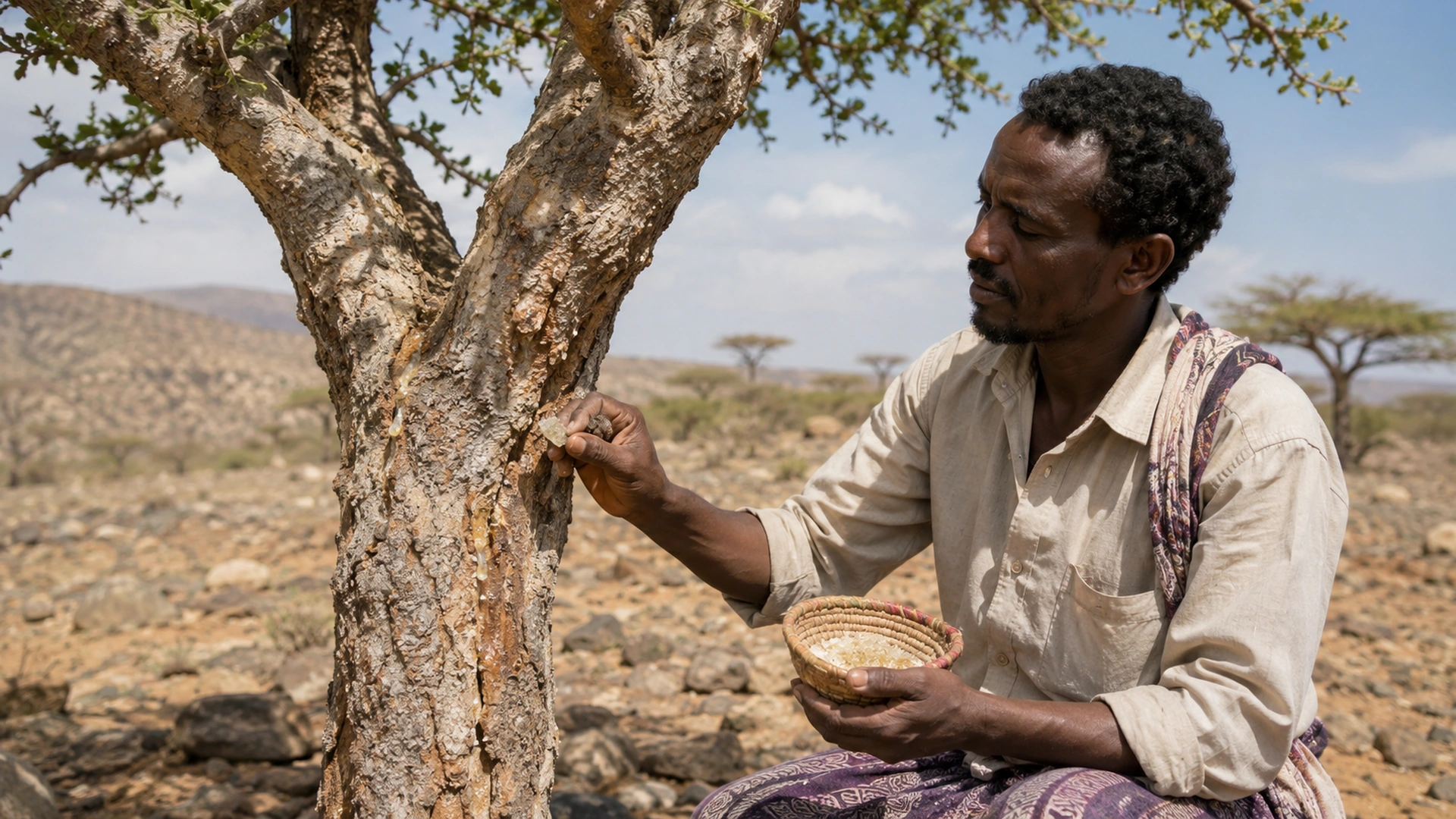
Major resin-producing landscapes lie in the Horn of Africa and southern Arabia. Boswellia and Commiphora species grow in parts of Ethiopia, Eritrea, Somalia, Kenya, Sudan, Uganda, Oman, Yemen, and neighbouring drylands, depending on the species. These plants are adapted to rocky slopes, seasonal rainfall, heat, and water scarcity.
The Metropolitan Museum of Art notes that aromatics, including frankincense and myrrh, were among the goods exported from ancient Ethiopia. South Arabian kingdoms also gained wealth and influence through control of incense production and trade. (The Metropolitan Museum of Art)
Harvesting required detailed environmental knowledge:
Which trees were mature
When tapping could begin
How deep a cut should be
When resin was ready to collect
Which trees needed rest
Who held access and land rights
The resins reached distant consumers only through the work of harvesters, pastoral communities, caravan workers, merchants, sailors, port communities, and traders.
The Incense Route
UNESCO’s Incense Route–Desert Cities in the Negev documents a trade network extending more than 2,000 kilometres from Yemen and Oman toward the Mediterranean. UNESCO’s Land of Frankincense in Oman preserves Boswellia-growing landscapes, caravan sites, and ports associated with centuries of resin trade. (UNESCO World Heritage Centre)
The term “Incense Route” can sound like one road, but the trade involved multiple land and maritime routes.
Goods travelled by:
Camel caravan
Red Sea shipping
Arabian Sea and Indian Ocean routes
Regional market networks
Mediterranean distribution systems
Incense moved alongside spices, textiles, ivory, precious metals, stones, and other high-value goods.
Trade also carried:
Religious ideas
Languages
Artistic forms
Technologies
Stories
Political influence
South Arabian Incense Burners
Ancient South Arabian cuboid burners provide direct evidence of incense use in homes, temples, and tombs.
The British Museum describes burners inscribed with names of aromatic substances and notes that only small amounts placed on glowing embers were needed to scent a space. Some burners were dedicated in temples or funerary settings, while others were associated with domestic use. (British Museum)
These objects show that incense was not only a raw commodity.
It also supported:
Stone carving
Inscription traditions
Temple offerings
Domestic fragrance
Funerary practice
Regional identities
Incense in the Greek and Roman Worlds
Frankincense, myrrh, and other aromatics became highly valued in Mediterranean temples, homes, feasts, and funerals.
The Metropolitan Museum of Art describes South Arabian and Horn of Africa aromatics reaching Roman and Asian markets through long-distance networks. Incense could demonstrate wealth because high-quality imported materials were costly and required extensive transport. (The Metropolitan Museum of Art)
Greek and Roman use did not erase earlier Egyptian, Arabian, African, or West Asian traditions. Mediterranean consumers participated in a much larger system whose source communities remained essential.
Incense in Jewish Scriptural Tradition
The Hebrew Bible places incense within a regulated sacred setting.
Exodus 30 describes a dedicated altar of incense and a special aromatic preparation containing pure frankincense. The same chapter presents scented anointing oil as holy and restricts copying sacred preparations for ordinary personal use. (Exodus 30)
This historical and religious context matters.
A modern product labelled “biblical incense” does not automatically reproduce an ancient formula, botanical identity, measurement system, priestly institution, or sacred authority.
Incense in Christianity
Christian relationships with incense developed over time and differ among churches.
The Gospel of Matthew names frankincense and myrrh among the gifts presented to Jesus. Later Christian interpretation connected incense with prayer, worship, honour, and divine presence, while myrrh was also associated with anointing, suffering, and burial. (Matthew 2:11 and John 19)
Incense became prominent in many:
Eastern Orthodox churches
Oriental Orthodox churches
Ethiopian and Eritrean Orthodox churches
Catholic churches
Some Anglican and other liturgical communities
Other Christian groups use little or no incense.
A censer or thurible may be swung so that smoke moves through the worship space. The exact prayers, movements, materials, and theological meanings vary by church tradition.
Incense in African Christian and Household Contexts
African incense histories are diverse.
Ancient Egyptian temple use, Ethiopian and Eritrean church incense, household coffee hospitality, Sudanese and Nubian religious history, Horn of Africa resin production, and southern African aromatic plant practices should not be merged into one “African incense ceremony.”
In Ethiopia and Eritrea, aromatic smoke may accompany religious worship, household hospitality, and coffee preparation, but household and liturgical practices are distinct. The region also has a long history as a producer and exporter of aromatics. (The Metropolitan Museum of Art)
In southern Africa, impepho may be associated in particular communities with ancestor reverence, remembrance, cleansing, healing, or household fumigation. The people, species, words, and procedures vary by language, location, and institution. (South African National Biodiversity Institute)
Incense in South Asian Religions
Incense is used in many Hindu, Buddhist, and Jain settings, but the practices are not identical.
It may accompany:
Temple offerings
Household shrines
Meditation
Festival worship
Processions
Respect for teachers or sacred images
The British Museum’s work on ancient Indian living traditions emphasizes that Hinduism, Buddhism, and Jainism developed distinct but interacting devotional arts and practices in South Asia. Incense belongs within those specific religious frameworks rather than one generic “Eastern spirituality.” (British Museum: Ancient India living traditions)
Materials may include sandalwood, agarwood, resins, flowers, spices, and prepared sticks, depending on period and region.
Buddhism and the Spread of Incense
As Buddhism moved through trade, pilgrimage, translation, and monastic networks, incense and incense implements also travelled.
The British Museum describes the Silk Roads as many interconnected land and maritime routes rather than one road. It notes that sandalwood, aloeswood, camphor, frankincense, and myrrh reached Tang China from Arabia and South and Southeast Asia. (British Museum: Silk Roads)
Within Buddhist contexts, incense may express:
Respect
Offering
Attention
Preparation of sacred space
Commemoration
Support for meditation
No single Buddhist explanation applies to every school, region, or ceremony.
Incense in China
Chinese incense history includes ritual, court, religious, scholarly, funerary, and household uses.
During the Han dynasty, mountain-shaped incense burners could represent cosmic landscapes. The Metropolitan Museum of Art notes that perforations among their peaks allowed smoke to emerge like vapour from grottoes, linking fragrance with artistic ideas about mountains, paradises, and numinous beings. (The Metropolitan Museum of Art: Nature in Chinese Culture)
Later trade brought imported aromatics into Chinese markets and court culture.
Incense became connected with:
Buddhist and Daoist worship
Ancestor remembrance
Court ceremony
Literati culture
Timekeeping
Interior fragrance
Artistic collecting
These meanings changed across dynasties and communities.
Incense in Korea
Korean incense history developed through local ritual life, court culture, Buddhism, and exchange with China and Japan.
The Baekje gilt-bronze incense burner, recovered from a temple site at Neungsan-ri, combines a dragon base, lotus form, mountain imagery, musicians, sacred animals, and a phoenix. It demonstrates how an incense burner could unite craftsmanship, Buddhist offering, cosmology, and royal or temple patronage. (Smarthistory: Baekje Gilt-bronze Incense Burner)
One famous object does not represent all Korean incense practice, but it shows how burners could become complex works of religious and political art.
Incense in Japan and the Development of Kōdō
The Metropolitan Museum of Art records incense wood in Japan in 595, shortly after Buddhism reached Japan from the continent. Incense and its implements were imported with Buddhist images and texts. By the late Nara period, court elites were also using incense in domestic life. (The Metropolitan Museum of Art: Japanese Incense)
During the Heian period, incense mixtures perfumed rooms, clothing, and hair and became associated with literature and refined court culture.
Later developments included:
Appreciation of individual incense woods
Named pieces of rare wood
Incense-comparison games
Poetry and literary references
Specialised utensils
Schools that transmitted knowledge
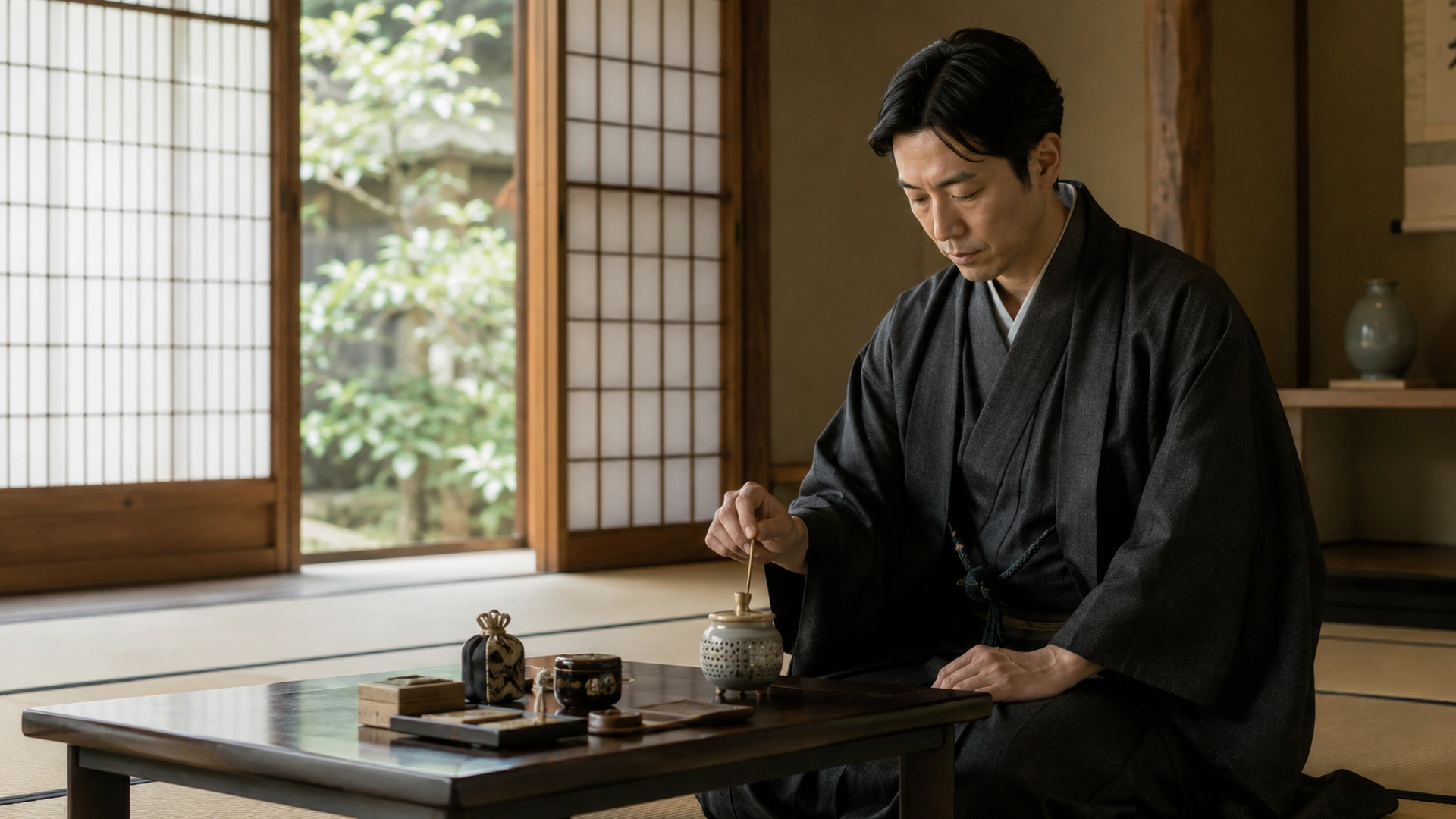
During the Muromachi period, formal etiquette for the “way of incense” developed alongside the tea ceremony. This tradition is commonly known as kōdō.
Kōdō is not simply lighting an incense stick.
It can involve warming a small piece of aromatic wood over carefully prepared charcoal and ash, then attending closely to its fragrance within a structured social and artistic practice.
Incense in Islamic Societies and Household Hospitality
Incense use in Muslim-majority societies has included domestic, courtly, commercial, perfumery, and devotional contexts.
The Metropolitan Museum of Art’s reconstruction of an eighteenth-century Damascus reception room notes that hosts used perfume sprinklers and incense burners to create a fragrant environment for guests. Mamluk-period incense burners also demonstrate that such objects could be valued domestic furnishings as well as works of metal art. (The Metropolitan Museum of Art)
Aromatic materials could include:
Frankincense
Agarwood or oud
Sandalwood
Musk mixtures
Rose-based fragrances
Regional blends sometimes described as bakhoor or bukhoor
Terms and recipes vary widely.
Household fragrance should not automatically be described as a formal Islamic ritual. It may involve hospitality, cleanliness, family custom, celebration, perfumery, or devotion depending on context.
Incense and the Silk Roads
The movement of incense reveals why historians now speak of Silk Roads in the plural.
Aromatics travelled through:
Arabia
The Horn of Africa
India
Southeast Asia
Central Asia
China
Korea
Japan
Mediterranean ports
The British Museum describes a Tang-period Chinese censer designed to remain upright while swinging and notes that aromatics from Arabia, South Asia, and Southeast Asia reached the Tang capital. (British Museum: Silk Roads)
Incense history is therefore also a history of:
Maritime technology
Caravan travel
Diplomacy
Monasteries
Port cities
Translators
Merchants
Botanical knowledge
Luxury consumption
What Incense Has Meant in Ceremonies
Offering
Smoke or fragrance may be presented to a divinity, sacred image, ancestor, saint, or honoured guest within a particular tradition.
Purification and Preparation
Incense may mark preparation for worship or distinguish ceremonial space from ordinary activity.
This is a cultural and religious meaning, not proof that smoke medically sterilizes a room.
Prayer and Attention
Some traditions connect rising smoke with prayer, while others use fragrance to support concentration, reverence, or awareness.
Mourning and Burial
Aromatics may accompany funerals, treatment of the body, remembrance, or the transition between life and death.
Hospitality
Fragrance may welcome guests, perfume clothing, or establish a generous household atmosphere.
Status and Refinement
Imported or rare aromatics could demonstrate wealth, education, courtly taste, or access to long-distance trade.
Ancestor Reverence and Family Memory
In particular communities, incense may accompany remembrance of deceased relatives or recognized ancestors.
Ancestor reverence should not automatically be labelled worship, and a recently deceased relative is not necessarily regarded as an ancestor in every tradition.
The History of Incense Burners
Incense burners are as culturally important as the materials they hold.
Historical forms include:
Stone cuboid burners in South Arabia
Egyptian hand-shaped or ladle-like burners
Mesopotamian altars and incense chimneys
Chinese mountain-shaped boshanlu burners
Korean lotus-and-mountain burners
Japanese kōro and small incense heaters
Christian censers and thuribles
Islamic metal burners with pierced geometric designs
Clay household braziers
The design controls heat, airflow, ash, and smoke.
It may also communicate:
Religious identity
Political authority
Cosmology
Wealth
Craftsmanship
Regional style
From Raw Materials to Incense Sticks
The modern incense stick is only one chapter in a much longer history.
Prepared sticks became especially widespread because they are:
Portable
Easy to measure
Relatively inexpensive
Suitable for household use
Easy to package and export
Some are cored sticks, with aromatic paste rolled around a bamboo splint.
Others are solid sticks, made without a wood core.
Modern products may contain:
Natural plant powders
Charcoal
Wood dust
Gum binders
Essential oils
Synthetic fragrance
Colourants
A product described as “traditional” may be industrially manufactured and may not disclose every ingredient.
Incense, Colonialism, and Global Commerce
European colonial expansion changed incense supply chains.
Colonial governments and companies documented, taxed, exported, classified, and sometimes reorganized access to aromatic plants. Botanical naming systems could help identify species, but they also separated plant materials from the languages and community knowledge through which they had long been understood.
Modern global commerce continues this pattern when brands sell “tribal,” “ancient,” or “mystical” incense without naming:
The source community
The plant species
The harvest region
The people who processed it
The ecological cost
A respectful history should restore producers, harvesters, craftspeople, and cultural custodians to the story.
Modern Wellness Culture and Commercial Claims
Incense is now marketed for:
Relaxation
Meditation
Yoga
Home fragrance
“Energy cleansing”
Sleep
Productivity
Spiritual protection
People may genuinely find fragrance calming or meaningful.
However, marketing should not claim that incense can guarantee:
Healing
Fertility
Wealth
Love
Removal of curses
Protection from all danger
Contact with ancestors
Treatment of mental illness
Cure of infection or cancer
Spiritual practice does not replace medical, psychological, legal, or financial support.
Incense Smoke and Indoor Air Quality
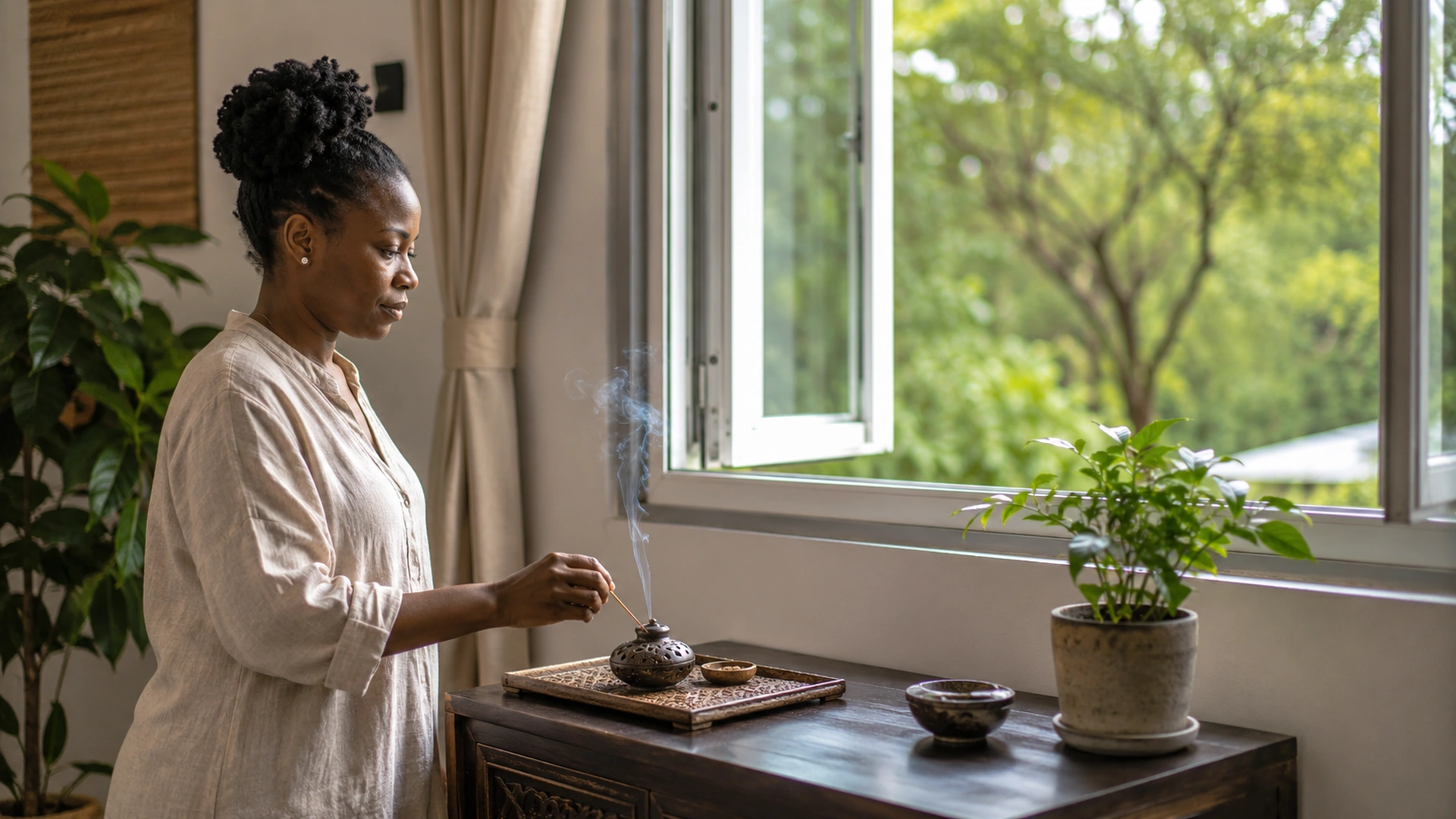
Incense smoke is still smoke.
Peer-reviewed reviews and environmental agencies report that burning incense can release particulate matter, carbon monoxide, volatile organic compounds, and other combustion products. The exact emissions depend on the ingredients, ventilation, burn time, room size, and burning method. (WHO and peer-reviewed health review)
Practical precautions include:
Use the smallest amount needed.
Open windows or provide effective ventilation.
Avoid continuous heavy burning.
Keep incense away from curtains, bedding, paper, children, and animals.
Use a stable, heat-resistant holder.
Never leave burning incense unattended.
Stop if anyone develops coughing, wheezing, headache, dizziness, or eye irritation.
Consider smoke-free fragrance methods for people with asthma or other respiratory conditions.
People who are pregnant, very young, elderly, or living with heart or lung disease may be more sensitive to smoke exposure.
Safety measures do not disrespect religious practice. They protect participants.
Incense and Fire Safety
Hot charcoal and smouldering sticks can ignite nearby material.
Important precautions include:
Place burners on non-flammable surfaces.
Allow charcoal and ash to cool completely.
Do not empty hot ash into plastic or rubbish bins.
Keep water or an appropriate extinguishing method nearby.
Use ceremonial processions only with trained participants and suitable equipment.
Check that hanging censers and chains are secure.
A beautiful burner is not automatically safe if it becomes hot, unstable, or overloaded.
Conservation of Frankincense Trees
Some frankincense-producing woodlands face poor regeneration.
Research on Boswellia papyrifera in Ethiopia has documented pressures including grazing, repeated tapping, fire, pests, land conversion, and limited establishment of young trees. Protecting seedlings and resting mature trees can improve the future of resin production. (Gidey et al. and recent conservation research)
Conservation must also protect livelihoods.
Harvesters need:
Secure land and access rights
Fair payment
Training and equipment
Time to rest trees
Support for regeneration
A meaningful share of retail value
Consumers cannot demand very cheap resin while expecting producing communities to carry the full cost of sustainability.
Agarwood, Oud, and Illegal Trade
Agarwood forms when certain Aquilaria and Gyrinops trees produce fragrant resin-rich wood in response to injury and biological processes.
Kew notes that agarwood is highly valued for incense, perfume, medicine, and ornament. Demand for wild material has contributed to trade controls under CITES, while illegal and unsustainable harvesting continues to threaten source populations. (Kew: agarwood and CITES)
Ethical buyers should ask:
Is the species legally traded?
Is CITES documentation required?
Is the material cultivated or wild sourced?
Can the seller identify the country and supply chain?
Are community rights and benefits documented?
A high price does not guarantee legality or sustainability.
Ethical Sourcing of Incense
Before buying incense, ask:
What plant species are included?
Where were they grown or harvested?
Is the ingredient list complete?
Was the product legally traded?
Were harvesters fairly compensated?
Does harvesting damage or kill the source plant?
Is the packaging making false medical claims?
Does the brand use cultural stereotypes?
Are endangered or restricted materials involved?
Ethical sourcing is not only about avoiding extinction.
It also concerns:
Labour
Cultural ownership
Land rights
Benefit sharing
Accurate naming
Safe ingredients
Honest marketing
Public and Restricted Knowledge
A public history of incense can discuss materials, trade, museum objects, broad religious uses, safety, and conservation.
It should not reproduce:
Restricted prayers
Initiation procedures
Secret incense formulas
Lineage-owned ceremonial instructions
Private funeral rites
Medical dosages
Sacred-site access rules
Purchasing incense does not make someone a priest, healer, diviner, elder, perfumer, or initiated cultural custodian.
Common Misconceptions
“One Civilization Invented Incense”
False.
Aromatic burning developed in multiple regions and was also transformed through trade and religious exchange.
“Incense Is Always Religious”
False.
It has also been used for hospitality, household fragrance, court culture, clothing, artistic appreciation, and social status.
“All Incense Traditions Mean the Same Thing”
False.
A South Arabian temple burner, Japanese incense game, Ethiopian church censer, Ottoman household burner, and southern African impepho practice belong to different histories.
“All Incense Is Frankincense”
False.
Incense may contain resins, woods, bark, roots, herbs, flowers, spices, binders, or synthetic fragrance.
“Smoke Purifies the Air Medically”
False.
Incense may have ceremonial meanings of purification, but combustion releases particles and gases.
“Natural Incense Is Automatically Safe”
False.
Natural materials may trigger allergies, produce smoke, be contaminated, or come from toxic or misidentified plants.
“Expensive Incense Is Always Authentic”
False.
Price does not prove species identity, cultural legitimacy, ingredient purity, legal sourcing, or fair labour.
“All African Incense Practices Are Ancestral”
False.
African communities include ancient Egyptian, Christian, Muslim, Indigenous, household, courtly, commercial, and secular fragrance traditions.
“Incense Can Guarantee Spiritual Results”
False.
No incense can guarantee protection, healing, money, love, fertility, or supernatural communication.
How to Study Incense History Responsibly
1. Identify the specific region, period, and community.
2. Distinguish the raw material from the ceremony.
Related Cultural Guides
For more context, continue with sandalwood traditions, cedar through history, olive oil symbolism and responsible ceremonial plant sourcing.
Frequently Asked Questions
What should readers know first about african spirituality and cultural history?
African spirituality and cultural history: Read clear guidance, key signs, practical steps, and private support from Ancestral Temple.
What causes history-of-incense?
The safest next step is to compare the signs, prepare clear details, and request private guidance when the matter feels personal.
How does history-of-incense work?
The safest next step is to compare the signs, prepare clear details, and request private guidance when the matter feels personal.
Is it possible to get private guidance for history-of-incense?
The safest next step is to compare the signs, prepare clear details, and request private guidance when the matter feels personal.
How long does history-of-incense take to understand?
The safest next step is to compare the signs, prepare clear details, and request private guidance when the matter feels personal.
Can history-of-incense affect relationships, family, work, or personal peace?
The safest next step is to compare the signs, prepare clear details, and request private guidance when the matter feels personal.
Why do people seek spiritual guidance for history-of-incense?
The safest next step is to compare the signs, prepare clear details, and request private guidance when the matter feels personal.
What signs should someone notice before asking about history-of-incense?
The safest next step is to compare the signs, prepare clear details, and request private guidance when the matter feels personal.
When should someone contact a private spiritual guide?
The safest next step is to compare the signs, prepare clear details, and request private guidance when the matter feels personal.
What causes african spirituality and cultural history?
African spirituality and cultural history: Read clear guidance, key signs, practical steps, and private support from Ancestral Temple. The safest next step is to compare the signs, prepare clear details, and request private guidance when the matter feels perso
Article Information
- Publisher
- Ancestral Temple
- Editor
- Ancestral Temple
- Last updated
- Jul 26, 2026
- Last reviewed
- Jul 13, 2026
- Content version
- 90125c6b10
This educational article should be read as cultural and spiritual information, not as medical, legal, financial, or emergency advice.
Helpful Related Guidance
Explore This Topic
Frankincense Vs Myrrh · Traditional Cleansing Herbs Used Around The World
Related Topic Cluster
African Spirituality And Cultural History
Complete Guide Why Homes Have Been Blessed Throughout HistoryAbout the Author
 Ancestral Temple
Spiritual guide and practitioner with decades of experience in ancestral wisdom, rituals, and divine guidance.
Related Posts
View All
Leave a Comment
We'd love to hear your thoughts.
I appreciated the explanation that incense did not have one single place of invention.