
What Is a Shrine? Meaning, Types and Ancestral Traditions
Quick Summary
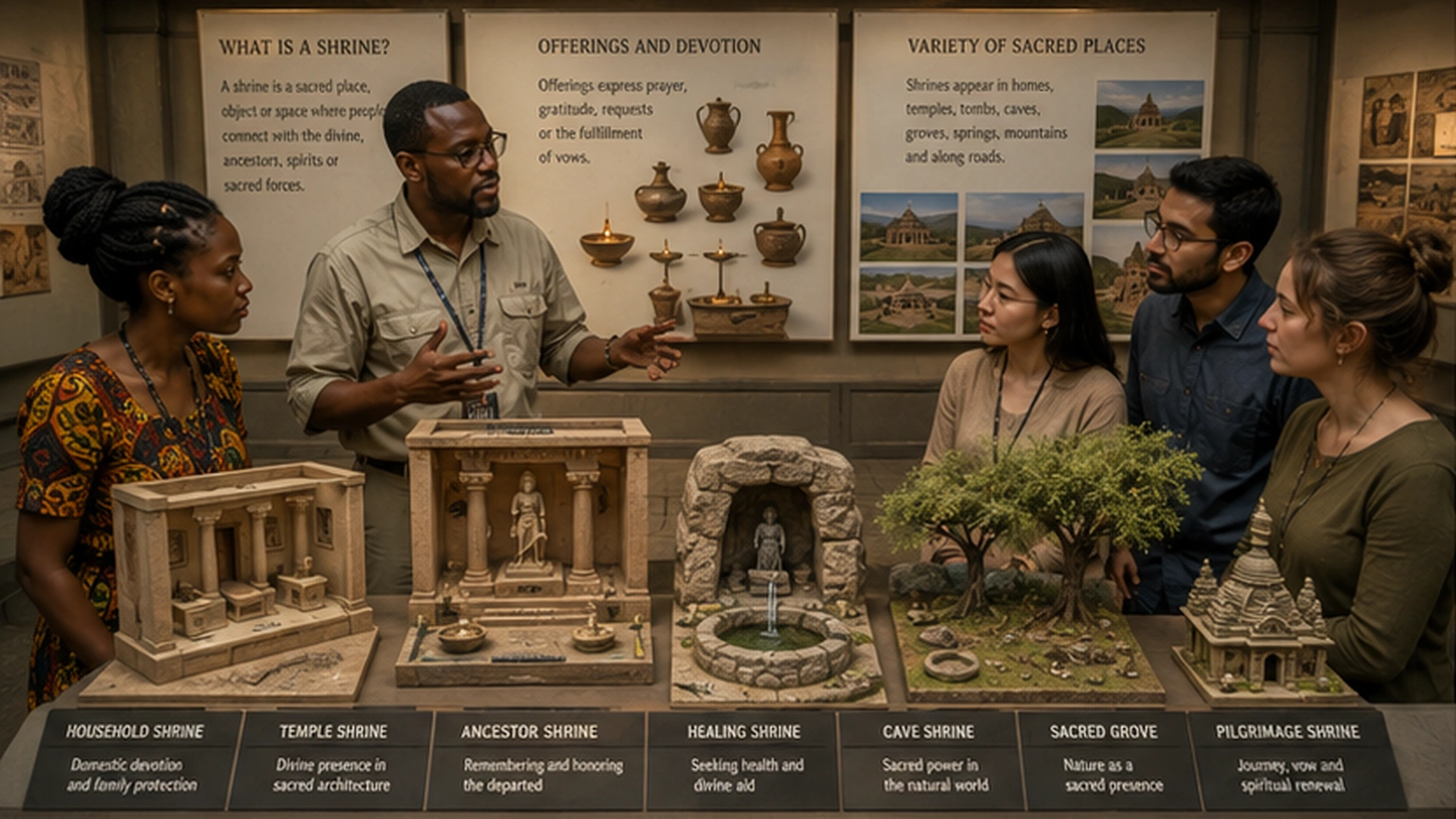
Ancient shrines were focused places of devotion, remembrance and sacred presence. They ranged from small household niches and roadside altars to royal ancestor halls, healing sanctuaries, cave shrines, sacred groves and pilgrimage centers.
A shrine is a focused sacred place, object or installation where people direct devotion, memory, offerings, prayer or ritual attention. An ancestral shrine is a shrine connected with family, lineage or community ancestors. Shrines may appear in homes, tombs, temples, caves, groves, springs, roadsides or pilgrimage places, and their meanings differ by culture.
Ancient shrines were places where people maintained relationships with gods, ancestors, saints, rulers, spirits, sacred objects, natural powers or the dead.
A shrine could be as small as a household niche containing a lamp and figurine or as large as a walled sanctuary with courtyards, altars, treasuries, processional routes and restricted inner chambers.
The word shrine is useful, but it can hide major cultural differences.
A:
- Mesopotamian temple chamber
- Egyptian household altar
- Greek healing sanctuary
- Roman roadside shrine
- Kushite divine chapel
- South Asian sacred tree
- Japanese ancestral complex
- African royal ancestor place
did not necessarily function in the same way.
Archaeologists identify probable shrines by combining evidence such as:
- Distinctive architecture
- Repeated offerings
- Divine or ancestral images
- Inscriptions
- Ash and burning
- Animal remains
- Lamps
- Incense burners
- Water installations
- Restricted access
One figurine or unusual vessel does not automatically prove that a room was a shrine. Context and repeated patterns matter.
Suggested scene: Diverse archaeologists introducing household, temple, ancestor, healing, cave, grove, spring and pilgrimage shrines through separate museum reconstructions.
Quick Summary
- A shrine is a focused sacred place, object or enclosure used for devotion, offerings, memory or ritual.
- Shrines may exist inside temples, homes, tombs, palaces, city gates or natural landscapes.
- Temples are generally larger institutions, while shrines are often more focused, although ancient terminology varies.
- Common shrine features include altars, images, lamps, incense, libation vessels and votive offerings.
- Some shrines served families; others belonged to cities, rulers, priesthoods or pilgrimage networks.
- Access could be public, restricted, seasonal, gendered, hereditary or priestly.
- Natural places such as caves, groves, springs, rivers and mountains could function as shrines without monumental buildings.
- Votive objects were given in petition, gratitude, commemoration, healing or fulfillment of vows.
- Archaeological interpretation remains uncertain when shrines were rebuilt, looted or stripped of organic materials.
- Modern replicas and commercial spiritual products should not be confused with historically consecrated shrines.
What Is an Ancestral Shrine?
An ancestral shrine is a place where a family, lineage, royal house or community remembers and honors ancestors according to its own tradition. It may be a household space, a grave-side installation, a royal memorial, a lineage altar, or a place connected with stories of origin and belonging. The exact practice depends on community authority, religion, family history and local rules.
Shrine, Temple, Sanctuary and Altar
- Term
- General archaeological meaning
- Shrine
- Focused sacred place or installation for devotion, offerings, memory or presence
- Temple
- Larger religious institution that may include several shrines, priests, storage and administrative areas
- Sanctuary
- Sacred precinct that may contain temples, shrines, altars, springs, treasuries and processional spaces
- Altar
- Surface or structure used for offerings, burning, libation, prayer or commemoration
- Cult image
- Image treated as a focus or embodiment of divine presence within a tradition
- Votive offering
- Object dedicated in petition, gratitude, remembrance or fulfillment of a vow
These definitions are analytical tools, not universal ancient categories.
Different languages and societies divided sacred space in different ways.
The Basic Purpose of a Shrine
A shrine concentrated attention and sacred relationship.
It could mark:
- Where a deity was believed to dwell
- Where an ancestor was remembered
- Where a miracle was believed to have occurred
- Where a ruler was honored
- Where a natural feature was considered powerful
- Where a community renewed political or religious identity
Shrines helped people:
- Offer food, drink, incense or light
- Ask for protection or healing
- Give thanks
- Remember the dead
- Renew political legitimacy
- Fulfill vows
- Seek guidance
- Mark sacred territory
Household Shrines
Household shrines brought religion into everyday domestic life.
They could contain:
- Small figurines
- Painted plaques
- Family or ancestral images
- Lamps
- Bowls
- Incense burners
- Amulets
- Food offerings
The Amarna-period house altar depicting Akhenaten, Nefertiti and their daughters shows that royal and religious imagery could appear in a domestic setting rather than only in large temples.
Household shrines might address:
- Family protection
- Childbirth
- Ancestors
- Food security
- Illness
- Local gods
- Domestic prosperity
Because wood, cloth, flowers and food usually decay, archaeologists often recover only the durable stone, ceramic or metal elements.
Article Information
- Publisher
- Ancestral Temple
- Editor
- Ancestral Temple
- Last updated
- Jul 26, 2026
- Last reviewed
- Jul 26, 2026
- Content version
- 6370f7dce1
This educational article should be read as cultural and spiritual information, not as medical, legal, financial, or emergency advice.
Helpful Related Guidance
Explore This Topic
Libation Ceremonies In African Communities · Ancestors And Shrines
About the Author
 Ancestral Temple
Spiritual guide and practitioner with decades of experience in ancestral wisdom, rituals, and divine guidance.
Related Posts
View All


Leave a Comment
We'd love to hear your thoughts.
This was a balanced and respectful introduction.
A beginner quiz about ancient shrines would be useful.
The culturally distinct examples made the topic clearer.
The key takeaways summarized the subject well.
How can sacred groves be preserved when buildings are absent?
The scientific boundaries were responsible.
I would enjoy an article about roadside shrines.
The article respected custodians and local communities.
Could you create an ethical checklist for visiting sacred ruins?
I liked the connection between shrines and political authority.
The article did not assign one universal meaning to every shrine.
A visual guide to shrine architecture would be useful.
The museum and UNESCO sources made the article trustworthy.
How do archaeologists interpret animal bones at shrines?
I appreciated the explanation that access restrictions were not always secrecy.
The article was detailed but easy to scan.
Can museums display objects from active shrines ethically?
The article respected living sacred sites.
I would enjoy a detailed article about anatomical votives.
The section on water shrines was fascinating.
How are votive deposits conserved after excavation?
The glossary would work well as an ancient religion knowledge hub.
The article avoided assuming every figurine was sacred.
Could you write more about cave acoustics in ritual?
I liked that markets and pilgrimage were discussed together.
The terminology table was useful.
I would enjoy an article about ancestor tablets and royal shrines.
The colonial collecting section was necessary.
How do archaeologists identify incense use?
I appreciated the warning about modern replicas.
The sensory description made ancient shrines feel more realistic.
I would like a full article about sacred springs.
The funerary chapel section was easy to understand.
A printable chart of shrine types would be helpful.
Thank you for separating religious belief from archaeological proof.
Can the same shrine serve several deities over time?
The section on restricted access added important context.
I would enjoy a detailed guide to healing sanctuaries.
The explanation of household shrines was very helpful.
How can archaeologists distinguish a shrine from an ordinary room?
I liked that natural shrines were treated seriously.
The archaeological evidence section was especially clear.
A separate article about votive offerings would be useful.
I appreciated the range from household niches to sacred landscapes.
The article clearly explained the difference between shrines and temples.