
Earth Signs Explained: Taurus, Virgo and Capricorn Traits
Quick Summary
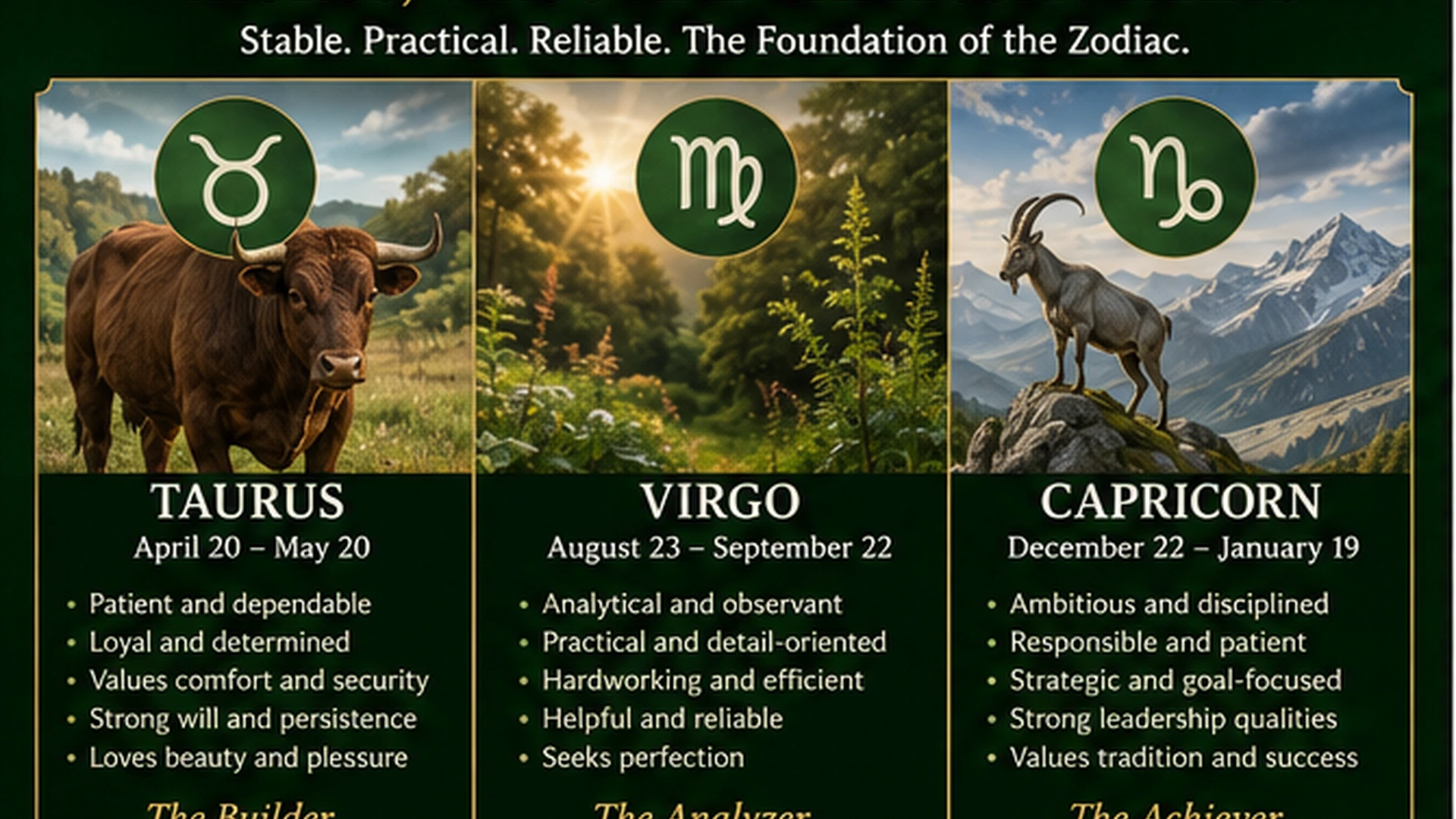
Taurus, Virgo and Capricorn are the three earth signs in Western astrology. They are traditionally associated with the tangible side of life: the body, land, food, shelter, work, r...
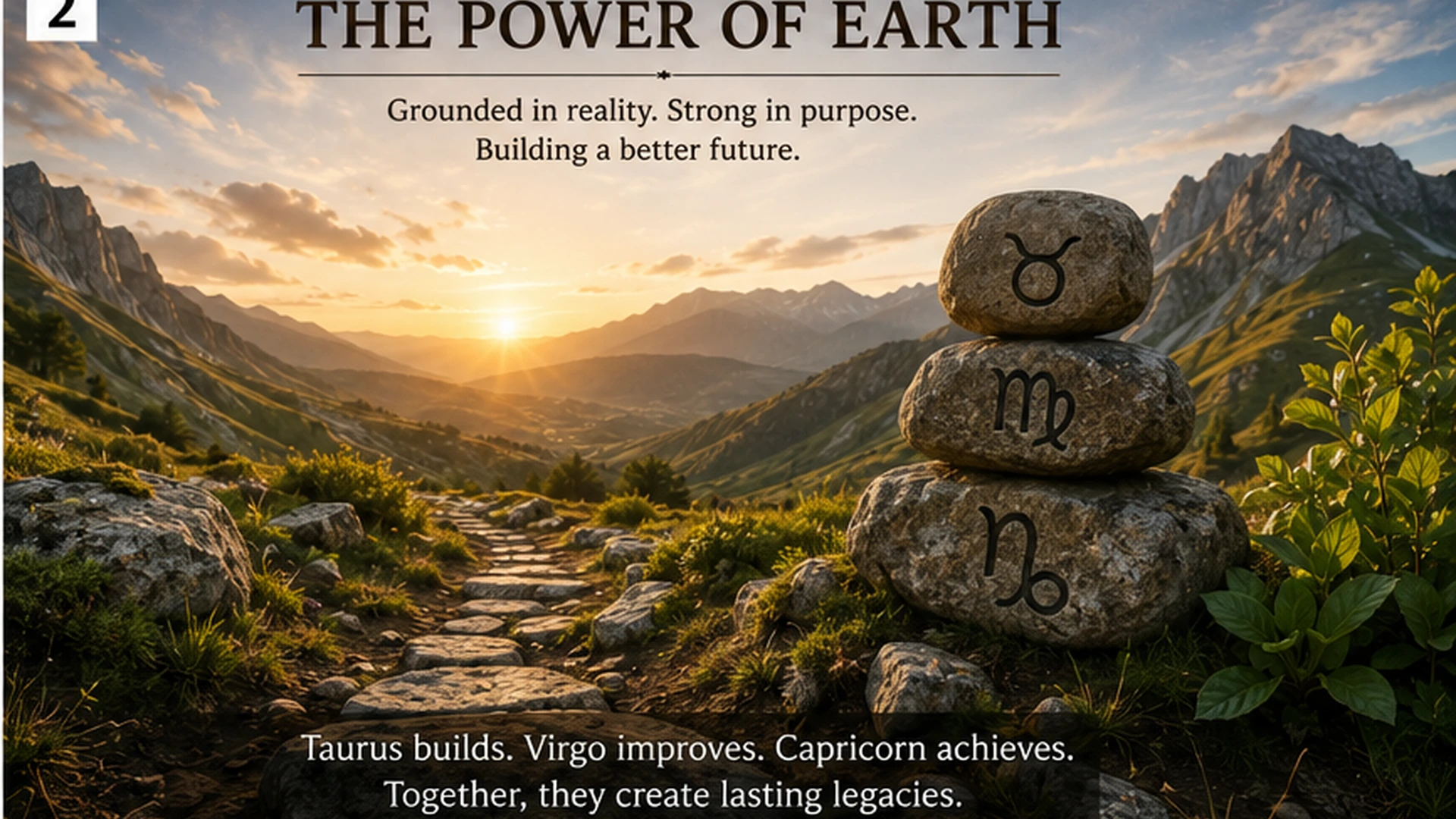
Taurus, Virgo and Capricorn are the three earth signs in Western astrology. They are traditionally associated with the tangible side of life: the body, land, food, shelter, work, resources, routines and results that can be seen or measured. For that reason, popular astrology often describes earth signs as grounded, dependable, realistic and patient.
Those shared words are only the beginning. Taurus, Virgo and Capricorn do not express “earth” in the same way. Taurus tends to stabilize and preserve. Virgo tends to examine, organize and improve. Capricorn tends to structure, direct and build toward a long-term goal. Their differences come partly from their three astrological modalities—fixed, mutable and cardinal—and from the planets traditionally assigned to them.
This guide explains the dates, meanings, strengths, challenges, love styles and working tendencies associated with the earth signs. It also examines where the system came from and clearly separates traditional astrology from scientific evidence.
Quick Answer
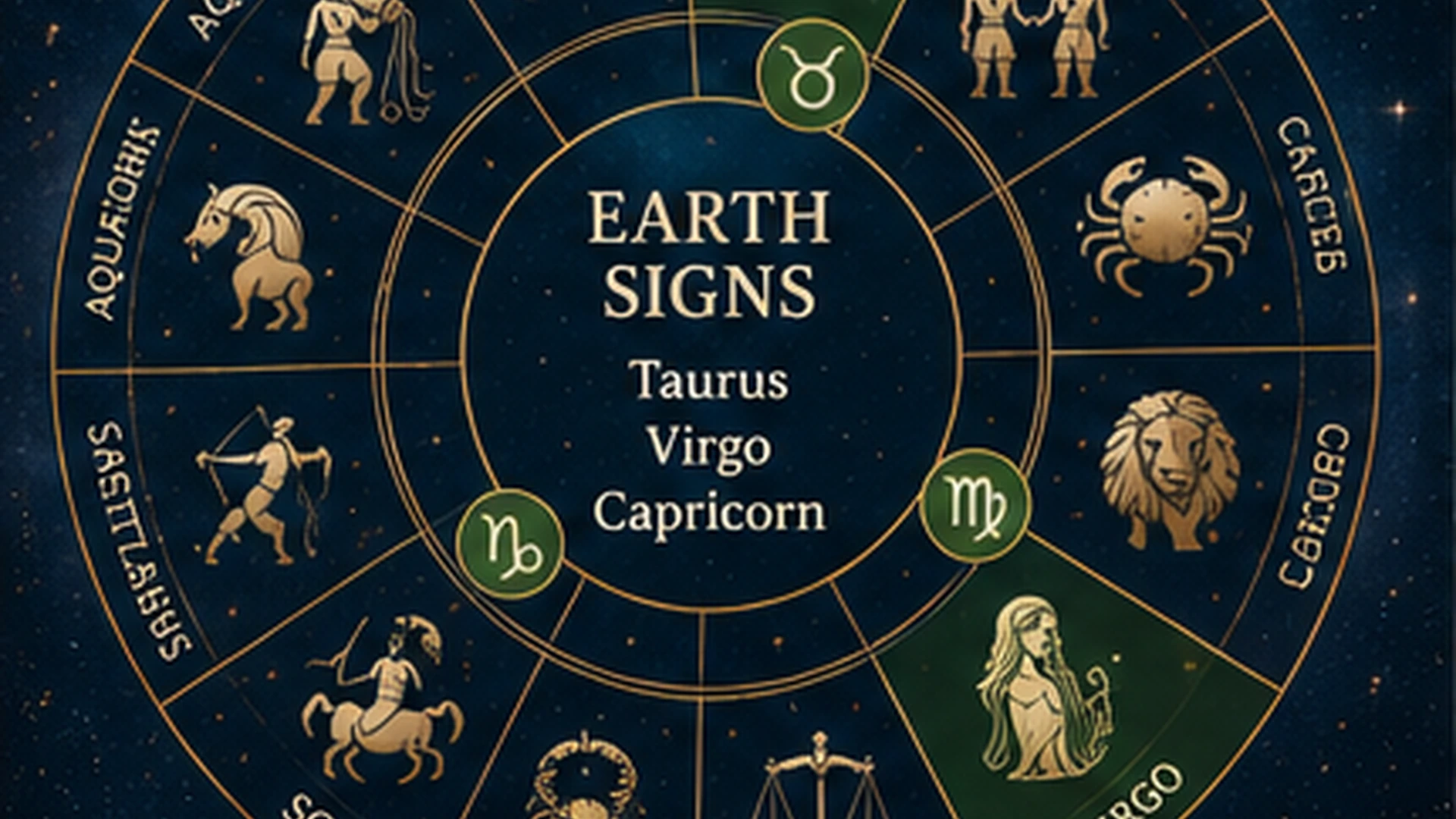
The three earth signs are Taurus, Virgo and Capricorn. In traditional Western astrology, earth represents practicality, stability, material reality and the ability to turn plans into concrete results. Taurus is fixed earth and preserves what is valuable; Virgo is mutable earth and improves systems; Capricorn is cardinal earth and organizes effort toward long-term achievement.
Earth Signs at a Glance
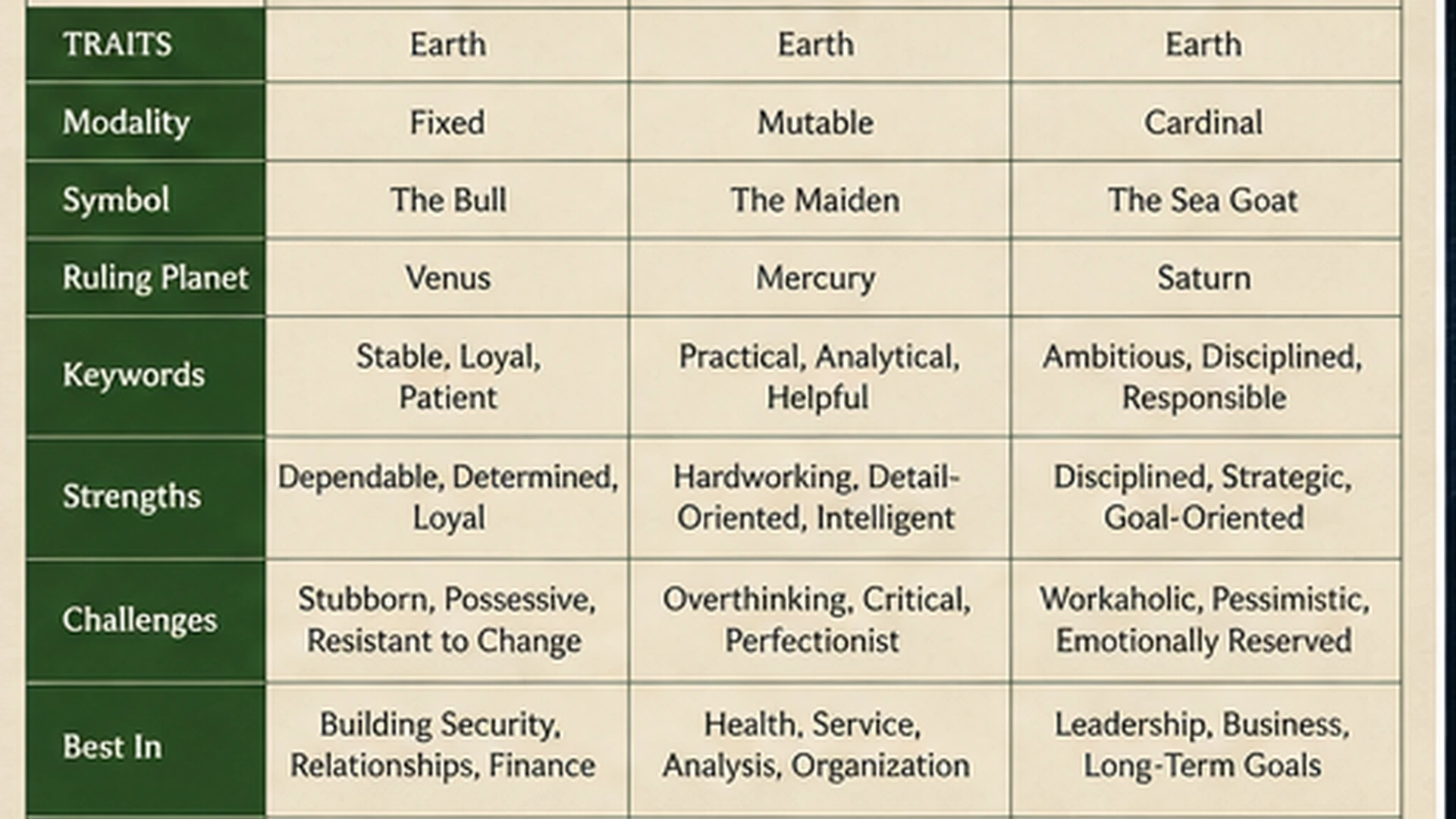
| Sign | Common tropical dates | Modality | Traditional ruling planet | Core earth expression |
|---|---|---|---|---|
| Taurus | April 20-May 20 | Fixed | Venus | Preserves stability, comfort and value |
| Virgo | August 23-September 22 | Mutable | Mercury | Sorts, analyzes, adapts and improves |
| Capricorn | December 22-January 19 | Cardinal | Saturn | Plans, structures, leads and builds |
The dates are approximate. The Sun can change signs on a slightly different date or time depending on the year and time zone, so people born near a boundary need an accurately calculated birth chart rather than a date-only list.
Specific culture or historical context: Modern educational symbolism inspired by long-used Western zodiac emblems; not presented as an ancient ritual
People shown: None
Location: Earth-toned studio opening onto a natural hillside landscape
Clothing: Not applicable
Architecture: Minimal stone setting, no identifiable sacred structure
Objects: Bronze bull, wheat sheaf, carved mountain goat, soil, stone and botanical details
Lighting: Warm sunrise side light with natural shadows
Composition: One balanced landscape composition with three distinct focal objects; spacious area for website cropping
SEO-friendly filename: earth-signs-taurus-virgo-capricorn-traits.webp
Image title: Taurus, Virgo and Capricorn Earth Signs
Alt text: Earth-toned still life with a bull, wheat and mountain goat representing Taurus, Virgo and Capricorn
Caption: Taurus, Virgo and Capricorn share the earth element but express it through different modalities.
Recommended placement: After the at-a-glance table
Article section supported: Introduction and definition
Important elements to avoid: Embedded words, zodiac labels, magical glow, crystal-ball clichés, ceremonial claims, split panels, borders, watermarks and distorted animal forms
What Does “Earth Sign” Mean in Astrology?
In traditional astrology, the twelve signs are grouped into four sets called triplicities: fire, earth, air and water. Each triplicity contains three signs. Taurus, Virgo and Capricorn form the earth triplicity.[1]
The word “earth” in this context is symbolic. It does not mean that people born under these signs contain more of a physical element, nor does it describe an astronomical category. Instead, astrologers use the element as an interpretive framework. Earth is associated with whatever is concrete, embodied, useful, durable or materially sustained.
Common earth themes include:
creating stability
maintaining resources
paying attention to practical details
valuing reliability and consistency
building skills through repetition
preferring evidence, experience or visible results
caring about physical comfort, health, work or security
These themes are archetypal rather than diagnostic. A person with an earth-sign Sun can be spontaneous, imaginative or emotionally expressive. Astrologers would normally look at the full birth chart—including the Moon, rising sign, planets, houses and aspects—rather than treating one Sun sign as a complete personality profile.
The Shared Traits of Taurus, Virgo and Capricorn
Practical thinking
Earth signs are traditionally described as asking, “How will this work in real life?” They often symbolize an interest in methods, resources, schedules and consequences. Where a fire-sign archetype may be motivated by inspiration and an air-sign archetype by ideas, earth tends to look for a workable form.
Practicality should not be confused with a lack of imagination. Earth symbolism is about application. A creative idea becomes a product, a garden, a budget, a trained skill, a building, a recipe, a routine or a completed project.
Reliability and consistency
Popular astrology associates earth signs with keeping promises, following routines and staying with responsibilities after initial excitement has faded. This quality can make earth-sign archetypes appear calm during difficult periods. They may prefer gradual progress to dramatic but unstable change.
The challenge is that consistency can become inflexibility. A familiar system may feel safe even after it has stopped being useful. Taurus can resist disruption, Virgo can keep correcting beyond what is necessary, and Capricorn can remain committed to a goal whose cost has become too high.
Awareness of material reality
Earth signs are linked with the material conditions that allow life to continue: food, money, housing, tools, land, health practices and daily labor. This does not mean that every earth-sign person is wealthy or financially skilled. It means that the tradition places material security and tangible outcomes within the earth symbolism.
A balanced expression may involve responsible planning and appreciation of quality. An imbalanced expression may involve fear of scarcity, excessive control, status anxiety or attachment to possessions.
Patience and gradual development
Earth processes are often slow. Crops grow over seasons. Skills improve through practice. Buildings need foundations. Astrological descriptions therefore associate earth signs with patience, endurance and respect for timing.
Taurus may wait until conditions feel secure. Virgo may proceed step by step to reduce error. Capricorn may accept delayed gratification for a long-term objective. Each can be persistent, although their motivations differ.
Sensory intelligence
Earth is also connected with embodiment and the senses. Taurus is the clearest example because of its Venus association, but all three signs may be described as noticing texture, quality, bodily comfort or environmental order.
This can appear as appreciation for food, craftsmanship, clean surroundings, nature, design, exercise, useful tools or a well-run home. It can also become over-focus on control, perfection or comfort when uncertainty needs to be tolerated.
Why the Three Earth Signs Are So Different
The zodiac combines four elements with three modalities. The modalities are cardinal, fixed and mutable, and they describe three different phases of action:
Cardinal signs initiate and organize.
Fixed signs stabilize and sustain.
Mutable signs adapt, revise and transition.
Each earth sign occupies a different modality. Capricorn is cardinal earth, Taurus is fixed earth and Virgo is mutable earth. This is the clearest structural explanation for why three signs associated with the same element can behave so differently.
Taurus Traits: Fixed Earth
Taurus is the second sign of the zodiac and is commonly assigned approximate tropical dates of April 20 to May 20. Its emblem is the bull. The British Museum's Late Babylonian zodiac list associates the second month with the “Bull of Heaven,” showing the deep historical roots of Taurus imagery.[2]
Taurus at its best
As fixed earth, Taurus represents preservation, continuity and the consolidation of value. The Taurus archetype asks what is worth keeping and how it can be made secure. This can appear as loyalty, patience, steadiness and the ability to create a comfortable environment.
Taurus is traditionally ruled by Venus, the planet associated in astrology with attraction, pleasure, beauty and value. In earth form, Venus is interpreted through physical and practical experiences: touch, food, music, gardens, quality materials, dependable affection and resources that support a stable life.
Commonly described Taurus strengths include:
patience
loyalty
calm persistence
appreciation of quality
resource awareness
sensuality
practical creativity
ability to maintain routines
Taurus challenges
The fixed quality can resist necessary change. Taurus is often stereotyped as stubborn, but the deeper symbolic idea is inertia: once time, trust or resources have been invested, letting go may feel unsafe or wasteful.
Potential challenges include:
remaining in familiar situations too long
confusing comfort with true security
possessiveness
reluctance to discuss change
delaying decisions until options narrow
becoming overly attached to routines or objects
A constructive Taurus approach is not constant change. It is learning to distinguish between stability that nourishes life and stability that merely prevents growth.
Taurus in relationships
Taurus is traditionally described as showing affection through presence, touch, consistency and practical support. Grand speeches may matter less than being dependable. Trust often develops slowly, but once established it may be strongly defended.
Conflict can arise when Taurus feels pressured, rushed or destabilized. Clear expectations and enough time to process change may produce better results than emotional ultimatums. At the same time, loyalty should not become an excuse to avoid needed conversations.
Taurus at work and with money
The Taurus archetype often fits work requiring patience, craft, aesthetic judgment, resource management or steady production. It may value predictable compensation and a pleasant working environment. Money can symbolize freedom from disruption, although a strong preference for security may sometimes discourage worthwhile experimentation.
Specific culture or historical context: Contemporary rural landscape; no claim of ritual use
People shown: A distant farmer may appear naturally in the background, not posed
Location: Fertile highland or Mediterranean-style pasture
Clothing: Practical neutral farm clothing if a person is included
Architecture: Low dry-stone walls and a simple distant barn
Objects: Bull, grass, earth, stone and farm tools in the distance
Lighting: Soft golden morning light
Composition: Bull as the main subject in the left or center third, landscape extending behind it
SEO-friendly filename: taurus-fixed-earth-sign-traits.webp
Image title: Taurus as a Fixed Earth Sign
Alt text: Calm bull in a fertile landscape representing the fixed earth symbolism of Taurus
Caption: Taurus is traditionally described as fixed earth: steady, preserving and resistant to unnecessary disruption.
Recommended placement: After the Taurus work and money section
Article section supported: Taurus traits
Important elements to avoid: Charging bull, glowing zodiac sign, sacrificial scene, fantasy horns, embedded text, logos, borders and staged stock-photo expressions
Virgo Traits: Mutable Earth
Virgo is the sixth zodiac sign and is commonly assigned approximate tropical dates of August 23 to September 22. Its familiar emblem is a maiden or virgin, often shown with grain. A Late Babylonian zodiac list connects the sixth month with a barley-stalk, while other scholarly treatments link the earlier imagery with a furrow or agricultural symbolism.[2][3]
Virgo at its best
As mutable earth, Virgo represents adjustment within practical systems. It notices what is incomplete, inefficient, disordered or in need of care. Virgo symbolism is therefore associated with analysis, skill, service, health routines, editing and improvement.
Virgo is traditionally ruled by Mercury. In astrology, Mercury symbolizes communication, categorization and thought. Expressed through earth, Mercury becomes methodical: instructions, lists, measurements, diagnostics, schedules, technical language and the ability to separate useful information from noise.
Commonly described Virgo strengths include:
careful observation
analytical thinking
craftsmanship
adaptability
conscientious service
organization
problem-solving
attention to health and maintenance
Virgo challenges
The wish to improve can become a belief that nothing is ever complete enough. Virgo stereotypes often focus on perfectionism, but a more useful interpretation is sensitivity to discrepancies. Virgo notices the gap between what exists and what could work better.
Potential challenges include:
excessive self-criticism
overthinking simple decisions
focusing on flaws while missing overall progress
offering advice before it is requested
difficulty resting when tasks remain
anxiety caused by unrealistic standards
A balanced Virgo expression uses discernment without turning every human experience into a problem to solve.
Virgo in relationships
Virgo is often described as showing care through useful action: remembering details, solving practical problems, helping with a task or creating order during a stressful period. Its affection can be understated but attentive.
Misunderstanding occurs when helpfulness sounds like criticism. Virgo may intend to improve a situation while another person hears disapproval. Healthy communication requires asking whether advice is wanted and recognizing that emotional presence can matter more than an efficient solution.
Virgo at work and with money
Virgo symbolism fits work involving analysis, editing, research, health systems, administration, quality control, technical skill or detailed service. It may be especially effective when a complex process needs to become clearer.
With money, Virgo may focus on tracking, budgeting and removing waste. However, fear of making an imperfect choice can delay useful investment or enjoyment. The growth task is to allow “sufficiently sound” decisions when complete certainty is impossible.
Specific culture or historical context: Historically inspired Mediterranean or Near Eastern agricultural setting, presented as an educational reconstruction rather than a claim about one exact community
People shown: Two adult agricultural workers with natural expressions and accurate hands
Location: Open-sided farm workspace beside mature grain fields
Clothing: Simple woven linen garments appropriate to a generalized ancient agricultural reconstruction; avoid mixing distinctive cultures
Architecture: Mud-brick or stone agricultural structure with timber supports
Objects: Grain, herbs, baskets, measuring bowl, wooden table and storage jars
Lighting: Clear late-afternoon natural light
Composition: Human activity in the foreground with fields visible beyond
SEO-friendly filename: virgo-mutable-earth-sign-traits.webp
Image title: Virgo as a Mutable Earth Sign
Alt text: Agricultural workers sorting grain and herbs to represent Virgo's practical and analytical symbolism
Caption: Virgo's mutable-earth symbolism emphasizes discernment, adaptation, maintenance and improvement.
Recommended placement: After the Virgo work and money section
Article section supported: Virgo traits and historical symbolism
Important elements to avoid: Maiden stereotypes, sexualized clothing, fake ritual, glowing symbols, inaccurate tools, mixed cultural costumes, embedded text, watermarks and distorted fingers
Capricorn Traits: Cardinal Earth
Capricorn is the tenth zodiac sign and is commonly assigned approximate tropical dates of December 22 to January 19. Its traditional figure is not simply a land goat but a goat-fish or sea-goat. The British Museum's Babylonian zodiac list identifies the tenth sign with a goat-fish, demonstrating that the composite image is ancient rather than a recent invention.[2]
Capricorn at its best
As cardinal earth, Capricorn represents the initiation and organization of practical effort. It is associated with planning, authority, boundaries, institutions, responsibility and achievement over time. If Taurus maintains and Virgo improves, Capricorn decides what structure must be built.
Capricorn is traditionally ruled by Saturn, which astrology associates with time, limits, duty, maturity and consequence. In earth form, Saturn emphasizes foundations, accountability and the understanding that durable outcomes require sustained effort.
Commonly described Capricorn strengths include:
discipline
strategic planning
responsibility
persistence
realistic goal-setting
leadership
respect for expertise
ability to work with limited resources
Capricorn challenges
Commitment to achievement can become over-identification with status, productivity or duty. Capricorn may fear failure, dependency or loss of control, and may therefore reveal vulnerability slowly.
Potential challenges include:
workaholism
pessimism presented as realism
emotional reserve
excessive concern with reputation
difficulty delegating
treating rest as something that must be earned
staying loyal to rigid hierarchies
A balanced Capricorn expression understands that authority is strongest when it includes ethics, flexibility and care for the people affected by a system.
Capricorn in relationships
Capricorn is traditionally described as cautious about commitment but serious once a relationship is chosen. It may express love by planning for the future, accepting responsibility and protecting shared stability.
Problems arise when emotional needs are managed like business tasks or when vulnerability is postponed indefinitely. Capricorn benefits from recognizing that trust is not only proven through endurance; it is also built through honest communication and mutual support.
Capricorn at work and with money
Capricorn symbolism naturally connects with careers, institutions, long-term projects, management and measurable progress. It may be comfortable with hierarchy when authority appears competent and earned.
With money, Capricorn often represents long-term planning, reserves and investment in durable value. The shadow side is scarcity thinking or the belief that financial achievement proves personal worth. Security is useful, but it cannot replace relationships, health or meaning.
Specific culture or historical context: Timeless mountain environment with practical stone construction
People shown: One small distant adult hiker may be included for scale, using appropriate safety equipment
Location: High mountain landscape
Clothing: Neutral modern hiking clothing if a person is shown
Architecture: Modest stone trail supports and a distant mountain shelter
Objects: Mountain goat, stone path, rock, snow patches and practical hiking equipment
Lighting: Crisp winter sunrise with realistic atmospheric depth
Composition: Goat in the foreground, ascending path guiding the eye toward the summit
SEO-friendly filename: capricorn-cardinal-earth-sign-traits.webp
Image title: Capricorn as a Cardinal Earth Sign
Alt text: Mountain goat beside an ascending stone path representing Capricorn's discipline and long-term ambition
Caption: Capricorn is cardinal earth, traditionally associated with structure, responsibility and sustained achievement.
Recommended placement: After the Capricorn work and money section
Article section supported: Capricorn traits
Important elements to avoid: Impossible cliffs, falling people, heroic fantasy armor, glowing zodiac symbols, text, logos, borders, deformed goat anatomy and unrealistic architecture
Taurus vs. Virgo vs. Capricorn
The clearest comparison is not “Which earth sign is best?” but “What does each sign do with earth?”
| Theme | Taurus | Virgo | Capricorn |
|---|---|---|---|
| Modality | Fixed | Mutable | Cardinal |
| Main impulse | Preserve | Improve | Build |
| Focus | Stability and value | Accuracy and usefulness | Structure and achievement |
| Traditional ruler | Venus | Mercury | Saturn |
| Typical strength | Steadiness | Discernment | Discipline |
| Typical challenge | Resistance to change | Perfectionism | Overwork or rigidity |
| Relationship style | Consistent and sensual | Helpful and attentive | Committed and future-focused |
| Stress response | Holds tighter to routine | Analyzes and corrects | Takes control and works harder |
Taurus preserves
Taurus wants a secure base and enough continuity to enjoy what has been created. It evaluates whether something is worth maintaining.
Virgo improves
Virgo works inside a system, noticing errors and adjusting methods. It evaluates whether something is useful and well executed.
Capricorn builds
Capricorn organizes people, time or resources toward a result. It evaluates whether something can endure and achieve its purpose.
A team containing healthy expressions of all three may be highly effective: Capricorn sets the structure, Virgo improves the process and Taurus maintains quality and continuity.
Earth Signs in Love and Friendship
Earth-sign relationship descriptions often emphasize reliability more than drama. These signs may value consistency, practical support, physical presence and shared plans. Yet each has a different emotional pace.
Taurus in love
Taurus usually symbolizes slow trust, sensual affection and loyalty. It may prefer predictable communication and a comfortable shared environment. Sudden instability can feel threatening.
Virgo in love
Virgo often symbolizes attentive care and the desire to make daily life work better. It notices details that others miss. It needs appreciation, but also permission to be imperfect.
Capricorn in love
Capricorn often symbolizes commitment, responsibility and long-range thinking. It may take relationships seriously and reveal softness gradually. It needs space to be valued for more than achievement.
Are earth signs compatible with one another?
Traditional astrology often considers signs of the same element naturally compatible because they share a basic language. Two earth signs may agree about reliability, planning or practical priorities.
Shared elements do not guarantee harmony. Taurus may experience Capricorn as overly focused on achievement. Capricorn may see Taurus as too resistant to change. Virgo may frustrate Taurus with constant adjustments, while Virgo may view Taurus as unwilling to improve. Two earth signs can also reinforce worry, routine or emotional reserve.
Compatibility depends on the complete charts, personal values, communication and lived circumstances. Sun-sign matching is a symbolic starting point, not a reliable predictor of relationship success.
How Earth Signs Relate to Fire, Air and Water
Earth and fire
Fire symbolism emphasizes enthusiasm, confidence and movement. Earth can give fire a practical structure, while fire can encourage earth to act before every risk has been removed. Conflict may occur when fire experiences earth as cautious or earth experiences fire as impulsive.
Earth and air
Air symbolism emphasizes ideas, communication and alternatives. Earth can help turn those ideas into a plan. Air can help earth reconsider assumptions. Difficulty arises when air wants conceptual freedom while earth wants clear evidence and commitments.
Earth and water
Water symbolism emphasizes feeling, intuition and emotional bonds. Traditional compatibility systems often consider earth and water supportive: water nourishes earth, while earth gives water a container. The metaphor can become unhealthy if earth tries to control emotion or water expects earth to carry every practical burden.
These comparisons are part of astrological interpretation, not scientific relationship testing.
Earth Signs at Work
Earth-sign archetypes are often described as strong where effort must become a reliable result. They may be drawn to roles involving systems, materials, quality, health, finance, construction, land, administration, craft or long-term planning.
Shared workplace strengths
translating plans into procedures
noticing resource limits
maintaining standards
creating schedules
following through
improving repeatable processes
protecting quality
preparing for foreseeable risks
Shared workplace risks
rejecting useful experimentation
measuring worth only through productivity
staying in an unhealthy workplace because it is familiar
micromanaging
prioritizing efficiency over human needs
ignoring rest until the body forces it
Taurus may excel at continuity and quality, Virgo at analysis and process improvement, and Capricorn at strategy and accountability. A healthy workplace needs all three abilities, but it also needs creativity, flexibility and emotional intelligence.
Earth Signs and Money
Astrology often links earth with resources, but that does not mean every earth-sign person is naturally rich, cautious or financially educated. Actual financial behavior is shaped by income, family history, opportunity, education, policy, health, personality and many other factors.
Symbolically:
Taurus is associated with value, security and material comfort.
Virgo is associated with tracking, budgeting and reducing waste.
Capricorn is associated with long-term planning, discipline and institutional resources.
The healthy expression is stewardship: understanding what resources are available and using them in line with real priorities. The unhealthy expression is allowing fear, status or control to dominate every decision.
Common Earth-Sign Strengths
Grounded judgment
Earth signs are often credited with seeing practical limitations that enthusiasm overlooks. This can prevent avoidable mistakes.
Endurance
They may continue through repetitive or difficult stages of a project. Their motivation often comes from seeing gradual progress.
Useful care
Earth-sign care is frequently described through action: preparing food, repairing something, checking details, organizing a plan or showing up consistently.
Respect for skill
Earth symbolism values competence developed through practice. It often recognizes the difference between an idea and a mastered craft.
Capacity to create stability
At their best, earth signs can build environments in which other people feel safe enough to grow.
Common Earth-Sign Challenges
Resistance to uncertainty
Earth seeks what can be trusted. Life, however, cannot always provide proof in advance. Excessive caution can become avoidance.
Over-control
Planning and standards are useful until they remove other people's agency or make adaptation impossible.
Material over-identification
Security, income, reputation and property matter, but none provides a complete measure of human worth.
Difficulty expressing vulnerability
Practical help may replace direct emotional communication. Loved ones may appreciate the help and still need to hear what is felt.
Perfectionism and productivity pressure
Virgo is most associated with perfectionism, but all earth signs can believe that rest must follow completion. Because life is never fully complete, rest is postponed.
How to Balance Earth Energy
Within astrological practice, “too much earth” is a symbolic phrase for an overemphasis on security, control, routine or measurable results. “Too little earth” is used for difficulty with consistency, organization, embodiment or follow-through.
Practical balancing ideas do not require belief in astrology. They include:
distinguish genuine risk from discomfort with novelty
schedule rest as maintenance, not a reward
practice naming feelings before proposing solutions
allow one area of life to be experimental
review whether a routine still serves its purpose
define “good enough” before beginning a task
spend time in nature without turning it into another achievement
build financial habits from evidence rather than zodiac stereotypes
These are general reflective practices, not medical or psychological treatment.
The Historical Origins of Earth Signs
The zodiac's Mesopotamian foundation
The twelve-part zodiac emerged gradually from ancient Mesopotamian astronomical and astrological traditions. A British Museum clay tablet from about 500 BCE lists months alongside zodiac signs, including the Bull of Heaven for Taurus, the barley-stalk for Virgo and the goat-fish for Capricorn.[2]
Historian of science John Steele dates the invention of the standardized zodiac to the late fifth century BCE and emphasizes that surviving Babylonian texts must be understood through philological, technical and historical analysis rather than by projecting modern concepts backward.[4][5]
This evidence supports the antiquity of the signs and their images. It does not prove that every modern personality description attached to Taurus, Virgo or Capricorn existed in exactly the same form in ancient Babylonia.
Greek and Hellenistic development
Babylonian astronomical knowledge circulated into the Hellenistic world, where Greek-language astrology developed a more recognizable system of natal charts, planets, signs and philosophical qualities. The twelve equal signs became geometrical 30-degree divisions of the ecliptic, even though the astronomical constellations differ in size.[3]
The later grouping of signs by element became part of Western astrological theory. Taurus, Virgo and Capricorn were classified together as the earth triplicity.[1] Over centuries, astrological traditions changed as texts moved through Greek, Latin, Arabic, Persian, Sanskrit and European intellectual settings. The Metropolitan Museum of Art notes that medieval Islamic-world objects used zodiac imagery derived through Greek astronomical traditions, demonstrating the continued movement and reinterpretation of zodiac symbols.[6]
Why historical caution matters
Modern online astrology often presents traits as timeless facts. Historical evidence is more complicated. The signs, planetary schemes, elemental groupings and personality interpretations developed in different periods and were transmitted through multiple languages and societies.
It is therefore more accurate to say that modern earth-sign traits belong to a long-evolving Western astrological tradition. They should not be attributed wholesale to one ancient culture, and they should not be presented as a universal African, Asian, Indigenous or global belief system.

Specific culture or historical context: Late Babylonian scholarly context, approximately first millennium BCE, represented through a modern museum-conservation setting
People shown: One adult Middle Eastern or international museum professional, shown respectfully
Location: Museum study room or conservation laboratory
Clothing: Modern professional conservation clothing and gloves
Architecture: Neutral museum interior
Objects: Clay tablet, conservation pad, magnifier, scale, archival tray and reference drawing without readable text
Lighting: Controlled soft museum lighting
Composition: Tablet as central subject, researcher's hands entering naturally from one side
SEO-friendly filename: ancient-origins-earth-zodiac-signs.webp
Image title: Ancient Origins of Taurus, Virgo and Capricorn
Alt text: Museum researcher examining a Late Babylonian-style clay zodiac tablet
Caption: The zodiac developed gradually in ancient Mesopotamia before being transformed through later Hellenistic and other traditions.
Recommended placement: After the historical origins discussion
Article section supported: Origins and cultural transmission
Important elements to avoid: Fake translated text, dramatic occult ritual, pyramids, mixed Egyptian-Babylonian imagery, fantasy glow, exposed restricted artifacts, embedded labels, logos, watermarks and inaccurate hand anatomy
Earth Signs in Astrology vs. Earth in Astronomy
Astrological signs and astronomical constellations are related historically but are not identical.
In tropical Western astrology, the zodiac is divided into twelve equal 30-degree signs beginning at the March equinox. Astronomical constellations, by contrast, are officially defined regions of the sky with unequal sizes. The International Astronomical Union recognizes 88 constellations and explains that constellation patterns are Earth-based perspectives rather than physically connected groups of stars.[7]
NASA likewise explains that astronomy is a science based on evidence and data, while astrology is a belief system that interprets celestial positions as descriptions or predictions about human life.[8]
This distinction means that “earth sign” is not an astronomical classification. Astronomers do not categorize Taurus, Virgo and Capricorn as personality elements. In astronomy, Taurus, Virgo and Capricornus are constellation names or sky regions. In astrology, Taurus, Virgo and Capricorn are equal symbolic sectors with interpretive meanings.
Are Earth-Sign Personality Traits Scientifically Proven?
No. Scientific research has not validated zodiac signs as reliable predictors of personality.
A large 1976 study of 3,074 young men found no correlation between zodiac signs and measured personality traits.[9] A well-known double-blind test published in Nature in 1985 examined claims that natal charts could accurately describe personality and did not provide support for the tested astrological claims.[10]
These findings do not erase astrology's cultural, historical or personal importance. People may use zodiac archetypes for storytelling, identity, reflection, entertainment or spiritual practice. The responsible boundary is to avoid presenting the traits as scientifically established facts or using a sign to diagnose health, predict fertility, guarantee compatibility, judge character or make high-stakes financial decisions.
Common Misunderstandings About Earth Signs
“Earth signs have no emotions”
Practicality and emotional restraint are not the absence of feeling. Astrology assigns emotional symbolism to many parts of a chart, not only the Sun sign. A person may express care through action rather than dramatic language.
“All earth signs are good with money”
Financial behavior is learned and shaped by circumstances. Astrology's resource symbolism should not be confused with financial competence.
“Earth signs are boring”
Stability may look quiet from the outside, but Taurus can be artistically sensual, Virgo intellectually intricate and Capricorn strategically ambitious. Predictability and depth can coexist.
“Taurus, Virgo and Capricorn are basically the same”
Their modalities create major differences. Fixed Taurus stabilizes, mutable Virgo adjusts and cardinal Capricorn initiates structure.
“A relationship is guaranteed to work because both people are earth signs”
No zodiac pairing guarantees relationship quality. Communication, safety, values, maturity and circumstances matter far more than a shared Sun-sign element.
“Your birthday alone reveals your whole chart”
A full natal chart depends on date, exact time and place. Even within astrology, the Sun sign is only one component.
How to Read Earth-Sign Descriptions Responsibly
Use earth-sign traits as questions rather than verdicts:
Do I seek stability because it supports me, or because change frightens me?
When does my attention to detail improve quality, and when does it become self-criticism?
Am I building a meaningful future, or only chasing approval?
Do I communicate affection directly as well as through practical help?
Which routines protect my health, and which prevent growth?
This approach turns a broad archetype into reflection without pretending that a birth date scientifically determines personality.
People Also Ask
What are the three earth signs?
The three earth signs in Western astrology are Taurus, Virgo and Capricorn. They form one of the zodiac's four traditional elemental groups.
What are earth signs known for?
Earth signs are traditionally associated with practicality, reliability, patience, material awareness and the ability to create concrete results. These are astrological themes, not scientifically proven personality categories.
How are Taurus, Virgo and Capricorn different?
Taurus is fixed earth and emphasizes preservation. Virgo is mutable earth and emphasizes adjustment and improvement. Capricorn is cardinal earth and emphasizes initiation, planning and structure.
Which planets rule the earth signs?
Traditional Western astrology assigns Venus to Taurus, Mercury to Virgo and Saturn to Capricorn.
Are earth signs emotional?
Yes, people of every zodiac sign experience emotion. Earth-sign descriptions often emphasize practical or restrained expression, but a full astrological interpretation would examine the entire birth chart.
Are earth signs compatible with water signs?
Traditional element-based astrology often views earth and water as supportive, but real relationship compatibility cannot be determined reliably from Sun signs.
Can two earth signs have a good relationship?
They may share values such as reliability and planning, but they can also reinforce rigidity or worry. Relationship quality depends on the individuals, not only their zodiac elements.
Which earth sign is the most ambitious?
Popular astrology most strongly associates Capricorn with ambition and long-term achievement. Taurus and Virgo can also be highly driven, but they may focus more on stability, craft, service or mastery.
Which earth sign is the most stubborn?
Taurus receives this stereotype because it is a fixed sign. Stubbornness is not guaranteed, and the fixed quality can also appear as loyalty and endurance.
What is the difference between an earth sign and an earth constellation?
“Earth sign” is an astrological elemental category. A constellation is an astronomically defined region of the sky. They belong to different systems of interpretation.
Frequently Asked Questions
1. Is Taurus always April 20 to May 20?
Those are common approximate dates in tropical astrology. The exact transition can vary by year and time zone, especially for people born near a sign boundary.
2. Is Virgo an earth sign even though Mercury rules it?
Yes. Element and planetary ruler are separate astrological classifications. Virgo is earth by element, mutable by modality and Mercury-ruled by traditional planetary assignment.
3. Why is Capricorn an earth sign?
Within the traditional system, Capricorn belongs to the earth triplicity and expresses it through the cardinal modality. Its symbolism emphasizes practical structure, responsibility and long-term results.
4. Which earth sign is fixed?
Taurus is the fixed earth sign.
5. Which earth sign is mutable?
Virgo is the mutable earth sign.
6. Which earth sign is cardinal?
Capricorn is the cardinal earth sign.
7. Do earth signs dislike change?
Taurus is most associated with resistance to disruption, but any person can welcome or resist change. Virgo is often described as adaptive, while Capricorn may initiate change when it serves a plan.
8. Are earth signs introverts?
No. Introversion and extraversion cannot be reliably inferred from a Sun sign. Earth symbolism may look reserved or measured, but many earth-sign individuals are socially confident.
9. Are earth signs spiritual?
They can be. Astrology often portrays earth spirituality as embodied and practical—connected with nature, craft, service, ancestry, place or daily discipline—but spiritual identity is personal and culturally shaped.
10. Do earth signs make good leaders?
They may bring planning, stability and follow-through. Leadership quality also requires communication, ethics, adaptability and care, none of which is guaranteed by a zodiac sign.
11. What careers suit earth signs?
Astrology commonly suggests fields involving resources, systems, health, land, design, finance, craft, management or analysis. Career choices should be based on skills, opportunity, interests and evidence rather than a sign alone.
12. Can someone have little earth in a birth chart?
Astrologers sometimes describe a chart with few planets in earth signs as “low earth.” This is an internal astrological interpretation, not a scientific measurement or diagnosis.
13. What does too much earth mean in astrology?
Astrologers may interpret a strong earth emphasis as practicality and endurance, with possible challenges involving rigidity, material preoccupation or fear of uncertainty. The meaning depends on the full chart and the astrologer's method.
14. Are Taurus, Virgo and Capricorn constellations too?
Taurus and Virgo are official astronomical constellations, while the corresponding astronomical constellation for Capricorn is usually called Capricornus. The astrological signs are equal sectors and do not exactly match the modern constellation boundaries.[3][7]
15. Should earth-sign traits guide medical or financial decisions?
No. Astrology should not replace qualified medical, psychological, legal or financial advice. Use reliable evidence and appropriate professionals for high-stakes decisions.
Key Takeaways
Taurus, Virgo and Capricorn are the three earth signs in Western astrology.
Earth symbolizes practicality, embodiment, stability, resources and tangible results.
Taurus is fixed earth: it preserves and sustains.
Virgo is mutable earth: it analyzes, adapts and improves.
Capricorn is cardinal earth: it initiates, organizes and builds.
Shared element does not make the three signs identical or guarantee compatibility.
The zodiac has ancient Mesopotamian roots and was transformed through Hellenistic and later traditions.
Astrological signs are not the same as astronomical constellations.
Scientific studies have not validated zodiac signs as reliable personality predictors.
Earth-sign descriptions are most responsibly used as cultural archetypes and reflective prompts, not deterministic facts.
Conclusion
Earth signs are often summarized with one word: grounded. A fuller explanation shows three different forms of groundedness. Taurus protects what has value. Virgo makes daily systems more useful. Capricorn creates structures that can last.
These archetypes have endured because they describe recognizable human concerns—security, skill, work, responsibility, comfort and the challenge of turning intention into reality. Their value is greatest when they are used with balance: historically informed, culturally respectful and honest about scientific limitations.
A birth sign does not define a person. It can, however, provide a symbolic language for asking practical questions about what we preserve, what we improve and what we are trying to build.
Research Sources and Further Reading
1. Encyclopedia.com. “Astrological Signs.” Overview of triplicities and the classification of Taurus, Virgo and Capricorn as earth signs.
2. British Museum. Tablet 77824 (1885,0430.15), Late Babylonian list of months and associated zodiac signs, approximately 500 BCE.
3. Mitton, Jacqueline. Cambridge Illustrated Dictionary of Astronomy. Cambridge University Press. Entry on the zodiac and the distinction between equal astrological signs and unequal constellations.
4. Steele, John M. “A Late Babylonian Compendium of Calendrical and Stellar Astrology.” Journal of Cuneiform Studies, vol. 67, 2015, pp. 187-215.
5. Steele, John. “Explaining Babylonian Astronomy.” Isis, vol. 110, no. 2, 2019.
6. Metropolitan Museum of Art. “Astronomy and Astrology in the Medieval Islamic World.” Heilbrunn Timeline of Art History.
7. International Astronomical Union. “The Constellations.” Official explanation of the 88 recognized constellations and their nature as defined sky regions.
8. NASA Space Place. “What Are Constellations?” Includes the distinction between astronomy and astrology.
9. Angst, J., and P. Scheidegger. “Signs of the Zodiac and Personality.” Sozial- und Präventivmedizin, vol. 21, no. 1, 1976, pp. 39-41. DOI: 10.1007/BF01994375.
10. Carlson, Shawn. “A Double-Blind Test of Astrology.” Nature, vol. 318, 1985, pp. 419-425. DOI: 10.1038/318419a0.
5. Internal Linking Plan
| Anchor text | Destination | Purpose |
|---|---|---|
| 12 zodiac signs in order | Existing comprehensive zodiac-order article | Connect broad zodiac readers to this element guide |
| zodiac elements explained | Future fire-earth-air-water guide | Build the central elements cluster |
| Taurus traits | Future Taurus profile | Deepen sign-specific intent |
| Virgo traits | Future Virgo profile | Deepen sign-specific intent |
| Capricorn traits | Future Capricorn profile | Deepen sign-specific intent |
| cardinal, fixed and mutable signs | Future modality guide | Explain the key structural distinction used here |
| astrology and astronomy | Future comparison article | Strengthen trust and evidence boundaries |
| zodiac compatibility | Future compatibility guide | Serve relationship-intent searches without overloading this page |
6. Recommended Supporting Articles
1. Zodiac Elements Explained: Fire, Earth, Air and Water
2. Cardinal, Fixed and Mutable Signs Explained
3. Taurus Traits: Strengths, Challenges, Love and Career
4. Virgo Traits: Strengths, Challenges, Love and Career
5. Capricorn Traits: Strengths, Challenges, Love and Career
6. Earth Sign Compatibility: Taurus, Virgo and Capricorn Pairings
7. Earth and Water Signs: Traditional Compatibility Explained
8. Earth and Fire Signs: Strengths and Common Conflicts
9. Astrology vs. Astronomy: Signs, Constellations and Scientific Evidence
10. The Ancient Mesopotamian Origins of the Zodiac
Article Information
- Publisher
- Ancestral Temple
- Editor
- Ancestral Temple
- Last updated
- Jul 26, 2026
- Last reviewed
- Jul 26, 2026
- Content version
- ab22445cfd
This educational article should be read as cultural and spiritual information, not as medical, legal, financial, or emergency advice.
Helpful Related Guidance
Explore This Topic
Related Topic Cluster
Dreams & Symbolism
About the Author
 Ancestral Temple
Spiritual guide and practitioner with decades of experience in ancestral wisdom, rituals, and divine guidance.
Related Posts
View All












Leave a Comment
We'd love to hear your thoughts.