
The Four Zodiac Elements: Fire, Earth, Air and Water Signs
Quick Summary
Western astrology groups the twelve zodiac signs into four elements: fire, earth, air and water. Each element contains three signs and acts as a symbolic shorthand for a style of e...
Western astrology groups the twelve zodiac signs into four elements: fire, earth, air and water. Each element contains three signs and acts as a symbolic shorthand for a style of expression. Fire is commonly associated with energy and initiative; earth with practicality and stability; air with ideas and communication; and water with emotion and intuition.
The four groups are easy to memorize: Aries, Leo and Sagittarius are fire signs; Taurus, Virgo and Capricorn are earth signs; Gemini, Libra and Aquarius are air signs; Cancer, Scorpio and Pisces are water signs. In traditional astrological language, each group of three is called a triplicity because its signs are spaced around the zodiac in a triangular pattern.
These categories are part of Western astrological tradition, not modern chemistry or astronomy. A person is also not reduced to one element. A complete natal chart contains the Sun, Moon, planets, angles and houses across many signs, so astrologers usually consider the overall elemental pattern rather than treating the Sun sign as a complete personality test.
This guide explains the four sign groups, their conventional meanings, their historical background, how elements differ from modalities, how astrologers discuss elemental balance and compatibility, and where scientific evidence places clear limits on astrological claims.
Quick Answer
| Quick Answer The four zodiac elements are fire, earth, air and water. Fire signs are Aries, Leo and Sagittarius. Earth signs are Taurus, Virgo and Capricorn. Air signs are Gemini, Libra and Aquarius. Water signs are Cancer, Scorpio and Pisces. Astrologers use these symbolic groups to discuss temperament and chart balance, but they are not scientifically proven personality categories. |
|---|
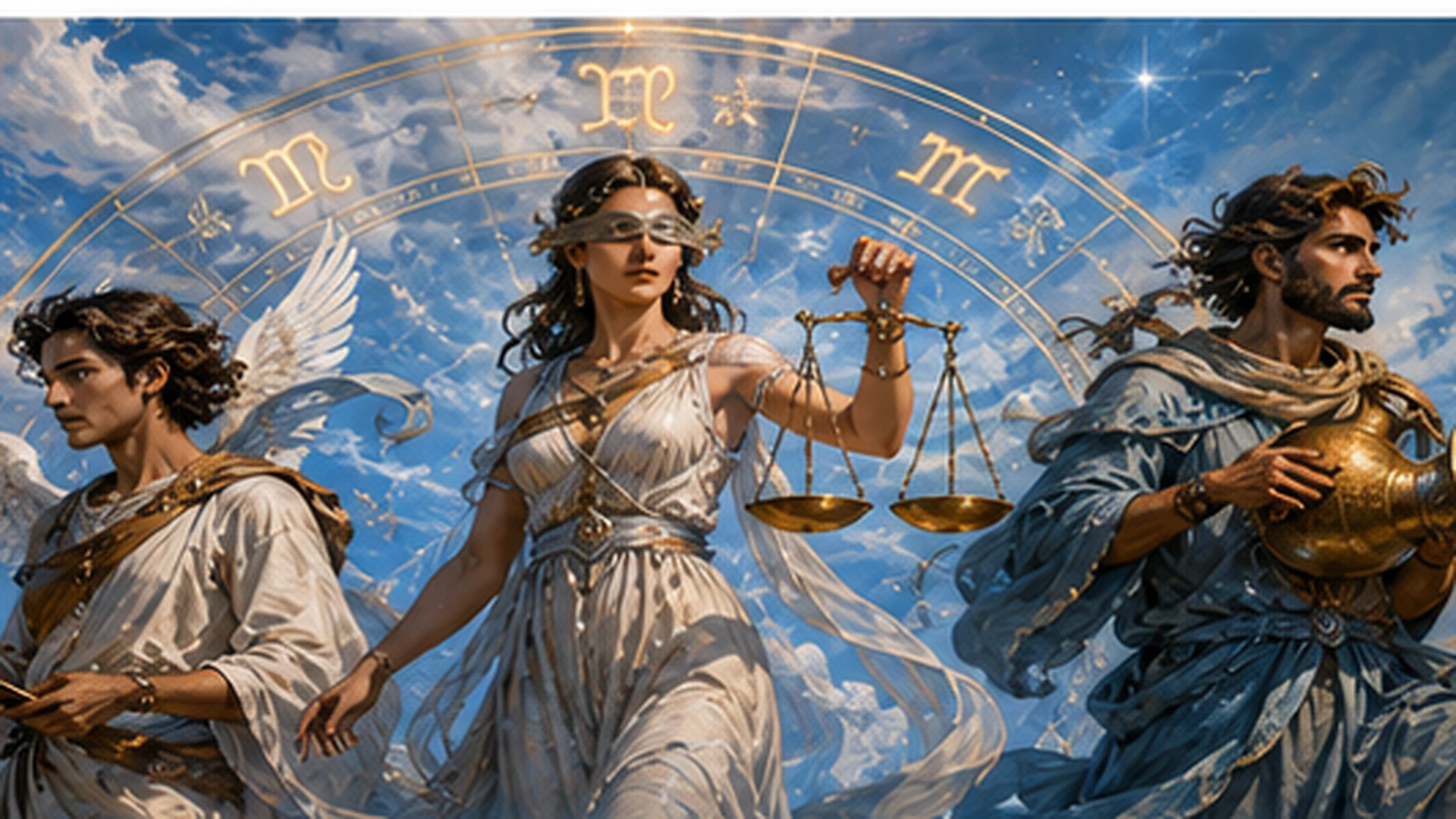
| Image number | 1 |
|---|---|
| Purpose | Featured image providing an immediate visual summary of the four zodiac elements without turning the page into a fantasy horoscope advertisement. |
| Detailed scene | A museum-quality brass zodiac wheel on a dark wooden table, surrounded in four balanced quadrants by a controlled candle flame, natural soil and green leaves, a soft moving white feather and sheer fabric, and a clear bowl of water with gentle ripples. Twelve small zodiac medallions appear around the wheel, with no written labels. |
| Specific culture or historical context | Contemporary editorial still life inspired by Western astrological symbolism and classical elemental theory; it must not claim to reproduce a particular ancient artifact. |
| People shown | No people. |
| Location | Quiet scholarly study or museum-style reading room. |
| Clothing | Not applicable. |
| Architecture | Dark wood, stone and softly blurred bookshelves in the background. |
| Objects | Brass zodiac wheel, twelve medallions, candle, soil, green leaves, feather, light fabric and clear water bowl. |
| Lighting | Balanced cinematic side lighting with warm fire highlights and cool reflections, realistic rather than magical. |
| Composition | Wide 16:9 full-frame editorial image; zodiac wheel centered, four materials clearly separated but visually unified; clean negative space near the upper left for website cropping, with no embedded text. |
| SEO-friendly filename | four-zodiac-elements-fire-earth-air-water.webp |
| Image title | The Four Zodiac Elements and Their Signs |
| Alt text | Astrological zodiac wheel surrounded by symbolic fire, earth, air and water materials in four balanced sections. |
| Caption | Western astrology groups the twelve signs into four elemental triplicities: fire, earth, air and water. |
| Recommended placement | Immediately after the introduction and Quick Answer. |
| Article section supported | Article overview and quick identification of the four zodiac elements. |
| Important elements to avoid | Embedded text, sign names, logos, watermarks, split panels, fantasy energy beams, glowing supernatural symbols, chemical-element imagery, random occult objects, smoke clouds or inaccurate zodiac symbols. |
What Are the Four Zodiac Elements?
In Western astrology, an element is one of four symbolic categories used to organize the twelve signs. Each element contains three signs, creating four triplicities. Signs in the same triplicity are separated by approximately 120 degrees on the idealized zodiac circle, the geometry associated with the astrological trine.
The element is meant to describe the general medium through which a sign expresses itself. It does not mean that an Aries person is literally made of fire or that a Cancer person is physically governed by water. It is a symbolic language. Modern astrologers often use it to discuss motivation, attention, emotional style and preferred ways of engaging with life.
| Element | Signs | Common symbolic focus | Possible strength | Possible imbalance |
|---|---|---|---|---|
| Fire | Aries, Leo, Sagittarius | Drive, vitality, confidence, inspiration | Courage and creative momentum | Impulsiveness, impatience or burnout |
| Earth | Taurus, Virgo, Capricorn | Practicality, resources, structure, embodiment | Reliability and follow-through | Rigidity, overcontrol or material fixation |
| Air | Gemini, Libra, Aquarius | Ideas, language, social connection, perspective | Communication and conceptual thinking | Detachment, inconsistency or overthinking |
| Water | Cancer, Scorpio, Pisces | Feeling, intuition, attachment, imagination | Empathy and emotional depth | Overwhelm, secrecy or weak boundaries |
These descriptions are interpretive conventions, not scientific diagnoses. Every element has constructive and difficult expressions, and every sign modifies its element in a different way.
The Historical Background of the Four Elements
The elemental scheme entered Western thought through ancient Greek natural philosophy. In the fifth century BCE, Empedocles of Acragas described four enduring “roots” associated with fire, air, earth and water, moved through processes he called Love and Strife. Later writers systematized the elements in philosophy, medicine and cosmology. [1]
Astrology developed through several cultural settings, including Mesopotamian celestial divination and Hellenistic scholarship. The twelve-sign zodiac was not originally a modern personality system. Ancient astrologers used signs, planets, aspects, houses, seasons and geographical correspondences for many kinds of judgments. Ptolemy’s second-century Tetrabiblos discusses four zodiacal triplicities and their triangular organization, although the exact history of attaching the familiar element labels to those triplicities is more complex than many popular summaries suggest. [2][3]
During the medieval period, astrology, astronomy, medicine and seasonal timekeeping often overlapped in scholarly practice. Surviving manuscripts show zodiac diagrams used alongside planetary, calendrical and medical material. Museums now study these manuscripts as historical evidence of how celestial beliefs shaped daily decisions, not as proof that the beliefs were scientifically correct. [4]
Modern popular astrology places greater emphasis on individual personality and self-description. The familiar short profiles of “fiery,” “earthy,” “airy” and “watery” people are therefore part ancient inheritance and part modern reinterpretation. A responsible guide should distinguish long historical continuity from meanings that became especially prominent in twentieth- and twenty-first-century astrology.
Why Three Signs Share Each Element
The zodiac alternates through the elements in a repeating sequence: fire, earth, air, water. After four signs, the sequence begins again. This creates three signs for each element and distributes each group across different seasons and modalities.
| Element | Cardinal sign | Fixed sign | Mutable sign |
|---|---|---|---|
| Fire | Aries | Leo | Sagittarius |
| Earth | Capricorn | Taurus | Virgo |
| Air | Libra | Aquarius | Gemini |
| Water | Cancer | Scorpio | Pisces |
The order above is arranged by modality rather than by calendar sequence. It shows why signs of the same element are similar but not interchangeable. Aries expresses fire through cardinal initiation, Leo through fixed concentration, and Sagittarius through mutable exploration. The same pattern applies to the other elements.
Elements and Modalities Are Different
An element describes the symbolic substance or style of a sign. A modality describes how that sign acts. The three modalities are cardinal, fixed and mutable.
Cardinal signs initiate, begin or redirect: Aries, Cancer, Libra and Capricorn.
Fixed signs stabilize, sustain or concentrate: Taurus, Leo, Scorpio and Aquarius.
Mutable signs adapt, distribute or transition: Gemini, Virgo, Sagittarius and Pisces.
No two signs share both the same element and the same modality. This is one reason their combinations are useful in astrological interpretation. “Fixed fire” describes Leo differently from “cardinal fire” Aries, while “mutable water” Pisces differs from “fixed water” Scorpio.
Fire Signs: Aries, Leo and Sagittarius
Fire symbolizes heat, movement, visibility and the power to transform. In contemporary Western astrology, fire signs are commonly described as active, expressive, hopeful and motivated by direct experience. They often prefer momentum over prolonged hesitation and may feel most alive when pursuing a challenge, creating something or inspiring others.
Fire is not simply aggression. At its best, it can symbolize courage, warmth, faith, generosity and the willingness to begin. When unbalanced, the same qualities may be interpreted as impatience, dramatic escalation, risk-taking without preparation or difficulty sustaining energy after the first burst of enthusiasm.
Aries: Cardinal Fire
Aries is interpreted as fire at the point of ignition. Its cardinal quality emphasizes beginnings, decisive movement and personal initiative. Astrologers often associate Aries with directness, competition and the need to test strength through action. Its challenge is learning that speed and courage work best when paired with awareness of consequences.
Leo: Fixed Fire
Leo is interpreted as fire that radiates steadily. Its fixed quality emphasizes creative identity, loyalty, performance and the wish to sustain a central purpose. Astrologers often describe Leo as warm, expressive and proud. Its challenge is distinguishing healthy confidence from dependence on attention or control of the stage.
Sagittarius: Mutable Fire
Sagittarius is interpreted as fire that spreads toward a wider horizon. Its mutable quality emphasizes movement, learning, belief, travel and the search for meaning. Astrologers often associate Sagittarius with optimism and candor. Its challenge is giving freedom a direction and recognizing when enthusiasm has outrun accuracy or commitment.
| Image number | 2 |
|---|---|
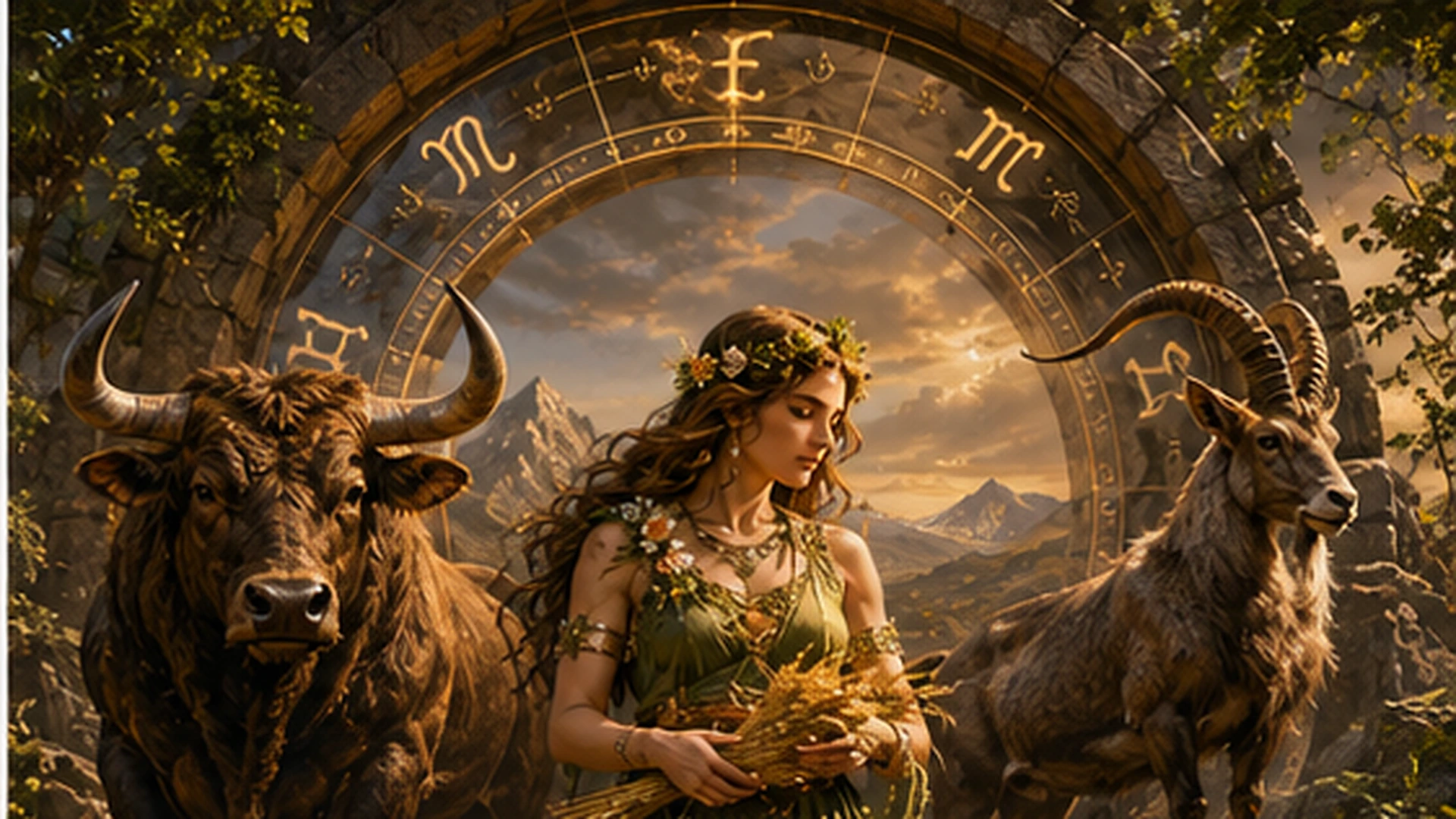
| Purpose | Illustrate fire-sign symbolism through a refined editorial still life rather than a literal fantasy scene. |
| Detailed scene | Three small brass medallions carrying accurate Aries, Leo and Sagittarius glyphs rest on dark red stone near a single controlled candle and sunlit red-rock textures. A few dried orange leaves and a polished compass suggest initiative, radiance and exploration. |
| Specific culture or historical context | Contemporary Western astrology editorial symbolism; not an ancient artifact and not tied to a specific religion. |
| People shown | No people. |
| Location | Warmly lit study table beside a window overlooking distant red hills. |
| Clothing | Not applicable. |
| Architecture | Minimal dark-wood interior with natural stone textures. |
| Objects | Three brass zodiac medallions, candle, compass, red stone and dried leaves. |
| Lighting | Strong golden sunrise light with realistic candle illumination; no supernatural glow. |
| Composition | Single full-frame 16:9 still life with the three medallions in a triangular arrangement and the landscape softly visible beyond. |
| SEO-friendly filename | fire-signs-aries-leo-sagittarius.webp |
| Image title | Fire Signs: Aries, Leo and Sagittarius |
| Alt text | Brass Aries, Leo and Sagittarius zodiac medallions arranged beside a candle and warm red stone. |
| Caption | Aries, Leo and Sagittarius form the fire triplicity in Western astrology. |
| Recommended placement | After the fire-sign profiles. |
| Article section supported | Fire signs and their shared symbolism. |
| Important elements to avoid | Wildfire, explosions, burning buildings, human danger, fantasy warriors, embedded text, captions, logos, watermarks, inaccurate glyphs or collage panels. |
Earth Signs: Taurus, Virgo and Capricorn
Earth symbolizes form, weight, fertility, resources and the conditions that make plans real. In modern Western astrology, earth signs are commonly described as practical, observant, patient and concerned with stability. They tend to evaluate ideas by asking whether they are useful, sustainable and supported by evidence or experience.
Earth is not merely materialism. It can symbolize craftsmanship, responsibility, bodily awareness, patience and care for what must be maintained. When unbalanced, astrologers may interpret it as inflexibility, excessive caution, perfectionism, possessiveness or measuring life only through visible results.
Taurus: Fixed Earth
Taurus is interpreted as earth that holds and cultivates. Its fixed quality emphasizes continuity, comfort, value and resistance to unnecessary disruption. Astrologers often associate Taurus with patience, loyalty and sensory appreciation. Its challenge is knowing when stability has become stagnation or attachment.
Virgo: Mutable Earth
Virgo is interpreted as earth that sorts, improves and adapts. Its mutable quality emphasizes analysis, skill, service and attention to systems. Astrologers often describe Virgo as discerning and useful. Its challenge is preventing high standards from becoming chronic criticism, anxiety or the belief that everything must be perfected before it can be shared.
Capricorn: Cardinal Earth
Capricorn is interpreted as earth organized toward a goal. Its cardinal quality emphasizes structure, authority, endurance and long-term achievement. Astrologers often associate Capricorn with discipline and strategic responsibility. Its challenge is allowing ambition to coexist with rest, emotional openness and flexibility.
| Image number | 3 |
|---|---|
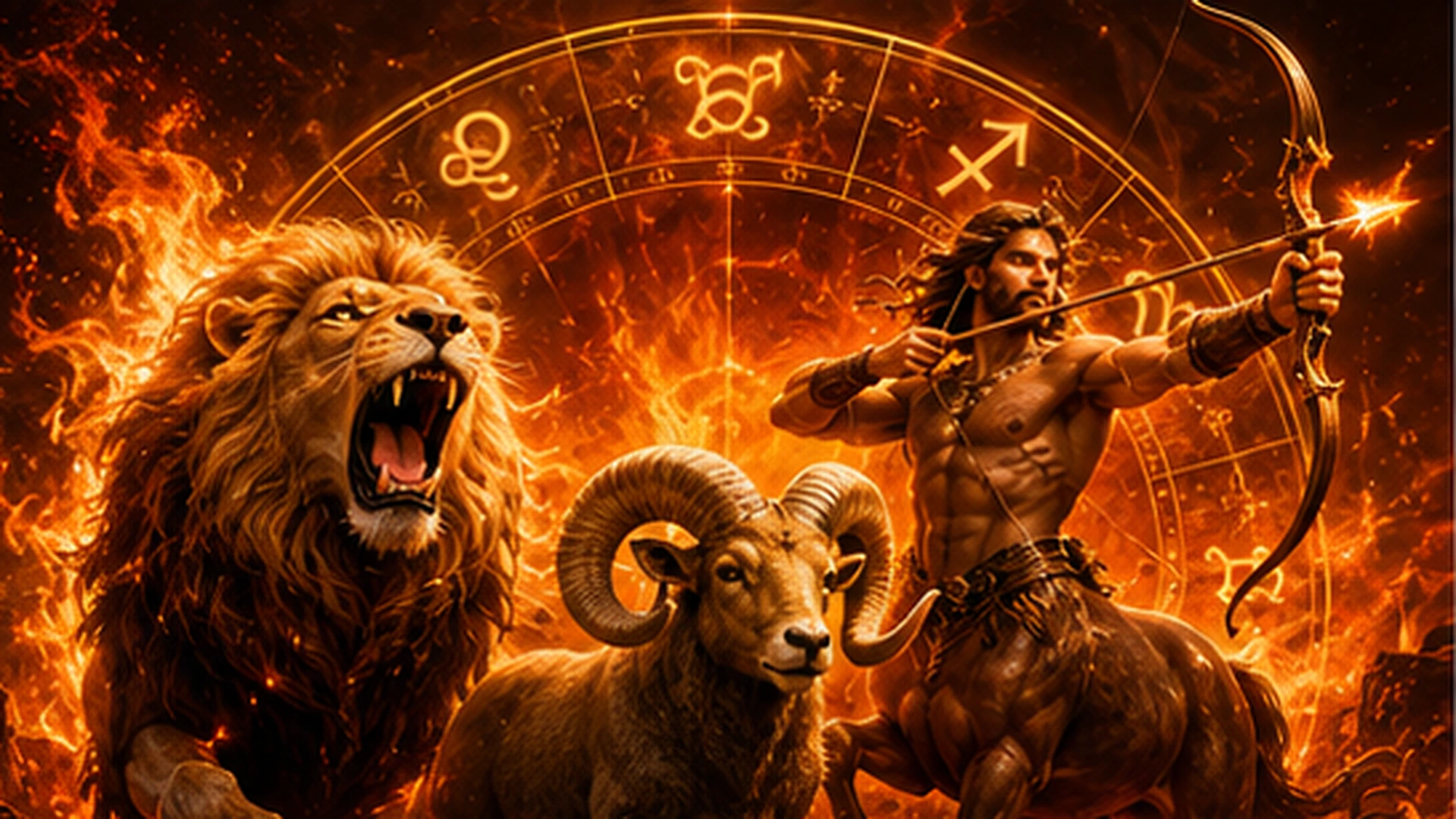
| Purpose | Represent earth signs through tangible materials, cultivation and craftsmanship. |
| Detailed scene | Three accurately engraved stone medallions for Taurus, Virgo and Capricorn lie on a potter’s workbench beside dark soil, green seedlings, grain, a clay bowl and a measuring tool. A garden or greenhouse is softly visible in the background. |
| Specific culture or historical context | Contemporary editorial interpretation of Western earth-sign symbolism; no claim of ritual use. |
| People shown | Only the natural hands of an adult craftsperson may appear shaping clay in the far background; face not required. |
| Location | Greenhouse-adjacent pottery or gardening studio. |
| Clothing | If hands are shown, simple neutral work clothing. |
| Architecture | Timber and glass greenhouse with practical shelves. |
| Objects | Three stone zodiac medallions, soil, seedlings, grain, clay bowl and measuring tool. |
| Lighting | Soft natural morning light with realistic green and brown tones. |
| Composition | Wide 16:9 documentary still life, medallions in foreground and cultivated plants giving depth. |
| SEO-friendly filename | earth-signs-taurus-virgo-capricorn.webp |
| Image title | Earth Signs: Taurus, Virgo and Capricorn |
| Alt text | Stone Taurus, Virgo and Capricorn zodiac medallions beside soil, seedlings, grain and handmade clay. |
| Caption | Taurus, Virgo and Capricorn form the earth triplicity in Western astrology. |
| Recommended placement | After the earth-sign profiles. |
| Article section supported | Earth signs and their shared symbolism. |
| Important elements to avoid | Mining imagery, piles of money, luxury branding, fantasy crystals, embedded labels, logos, watermarks, distorted hands, inaccurate glyphs or split-screen layout. |
Air Signs: Gemini, Libra and Aquarius
Air symbolizes movement, exchange, breath, language and the invisible connections between people and ideas. In contemporary Western astrology, air signs are commonly described as curious, communicative, social and mentally oriented. They often seek perspective through conversation, comparison and conceptual exploration.
Air is not the absence of emotion. It can symbolize the capacity to step back, name a pattern, negotiate fairly and connect separate viewpoints. When unbalanced, astrologers may interpret it as distraction, indecision, emotional distance, intellectualization or constant discussion without action.
Gemini: Mutable Air
Gemini is interpreted as air that circulates rapidly. Its mutable quality emphasizes questions, information, language and flexibility. Astrologers often associate Gemini with versatility and quick learning. Its challenge is developing depth, consistency and the ability to remain present after curiosity moves elsewhere.
Libra: Cardinal Air
Libra is interpreted as air that initiates relationship and comparison. Its cardinal quality emphasizes dialogue, balance, aesthetics and social coordination. Astrologers often describe Libra as diplomatic and partnership-oriented. Its challenge is making clear decisions without relying excessively on approval or avoiding necessary conflict.
Aquarius: Fixed Air
Aquarius is interpreted as air organized around a principle, network or future vision. Its fixed quality emphasizes systems, communities, ideals and independent thought. Astrologers often associate Aquarius with innovation and social perspective. Its challenge is remaining humanly connected while defending ideas or group identities.
| Image number | 4 |
|---|---|
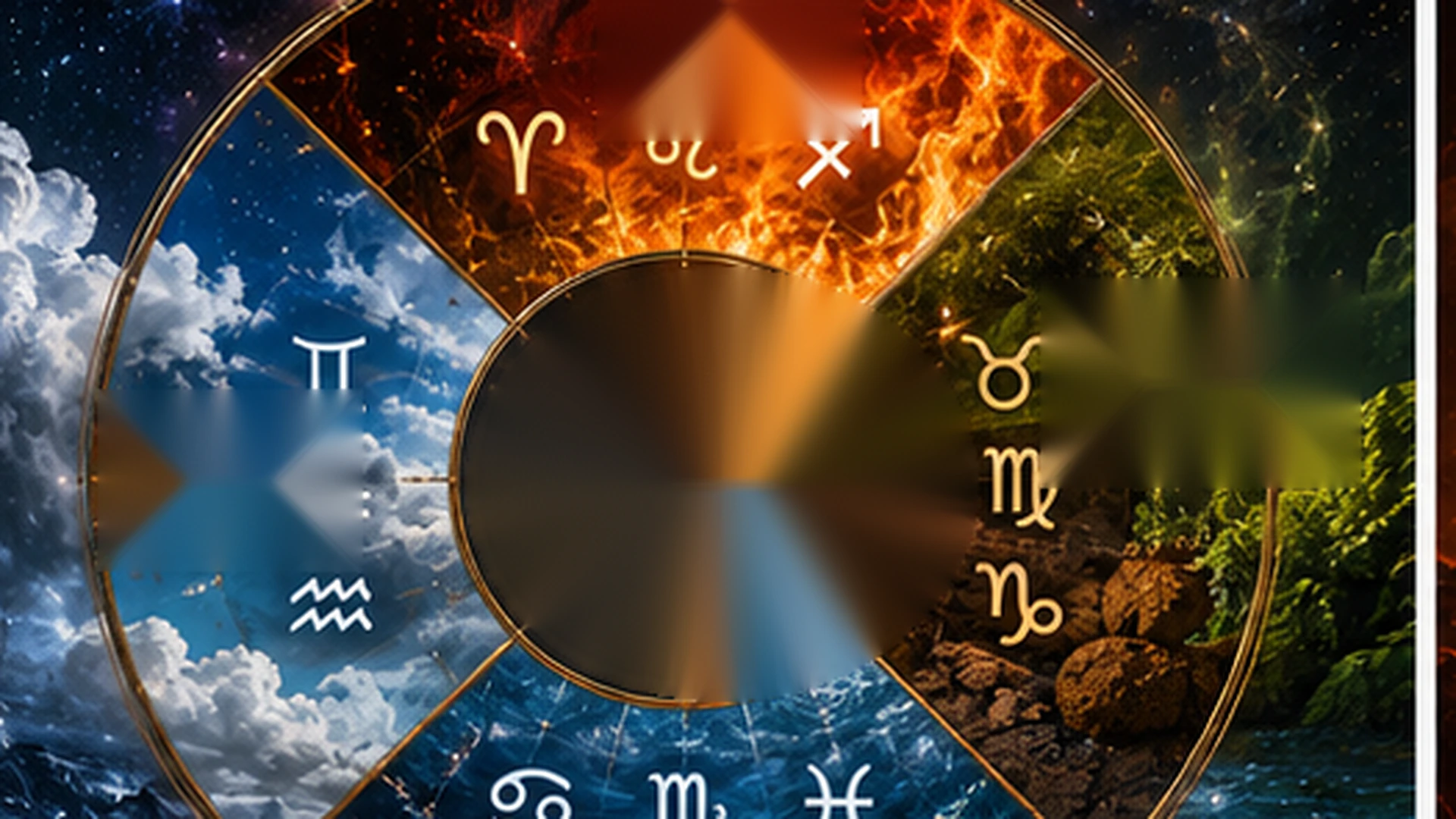
| Purpose | Visualize air-sign symbolism through movement, study and communication. |
| Detailed scene | Accurate silver medallions for Gemini, Libra and Aquarius rest on a bright writing desk beside an open notebook with blank pages, a fountain pen, a feather and a small balanced scale. Sheer curtains move gently through open windows overlooking a clear sky. |
| Specific culture or historical context | Contemporary Western astrology editorial symbolism; not a ceremonial setup. |
| People shown | No people. |
| Location | Sunlit library or creative studio. |
| Clothing | Not applicable. |
| Architecture | Tall windows, light wood desk and simple bookshelves. |
| Objects | Three silver medallions, blank notebook, pen, feather and small scale. |
| Lighting | Bright natural daylight with soft moving shadows. |
| Composition | Wide 16:9 scene with medallions and writing tools in sharp foreground, curtains and sky adding movement behind. |
| SEO-friendly filename | air-signs-gemini-libra-aquarius.webp |
| Image title | Air Signs: Gemini, Libra and Aquarius |
| Alt text | Silver Gemini, Libra and Aquarius zodiac medallions on a bright desk with a feather, notebook and balance scale. |
| Caption | Gemini, Libra and Aquarius form the air triplicity in Western astrology. |
| Recommended placement | After the air-sign profiles. |
| Article section supported | Air signs and their shared symbolism. |
| Important elements to avoid | Tornadoes, storms, flying objects, fantasy wings, readable notebook text, logos, captions, watermarks, inaccurate glyphs or collage panels. |
Water Signs: Cancer, Scorpio and Pisces
Water symbolizes feeling, memory, receptivity, bonding and the ability to move around what cannot be changed directly. In contemporary Western astrology, water signs are commonly described as sensitive, intuitive, imaginative and attentive to emotional undercurrents. They often understand situations through felt experience before they can explain them analytically.
Water is not simply sadness or fragility. It can symbolize empathy, creative imagination, loyalty, healing attention and profound adaptability. When unbalanced, astrologers may interpret it as emotional flooding, secrecy, avoidance, overidentification with other people’s needs or difficulty maintaining boundaries.
Cancer: Cardinal Water
Cancer is interpreted as water that initiates care and protection. Its cardinal quality emphasizes belonging, memory, home and the creation of emotional safety. Astrologers often associate Cancer with nurturing and responsiveness. Its challenge is caring without controlling, withdrawing or treating change as betrayal.
Scorpio: Fixed Water
Scorpio is interpreted as water that concentrates beneath the surface. Its fixed quality emphasizes emotional intensity, trust, privacy and transformation. Astrologers often describe Scorpio as perceptive and resilient. Its challenge is using depth without suspicion, testing, obsession or the need to control vulnerability.
Pisces: Mutable Water
Pisces is interpreted as water that dissolves boundaries and moves between forms. Its mutable quality emphasizes imagination, compassion, symbolism and receptivity. Astrologers often associate Pisces with creativity and spiritual sensitivity. Its challenge is maintaining practical limits and distinguishing empathy from self-erasure or escapism.
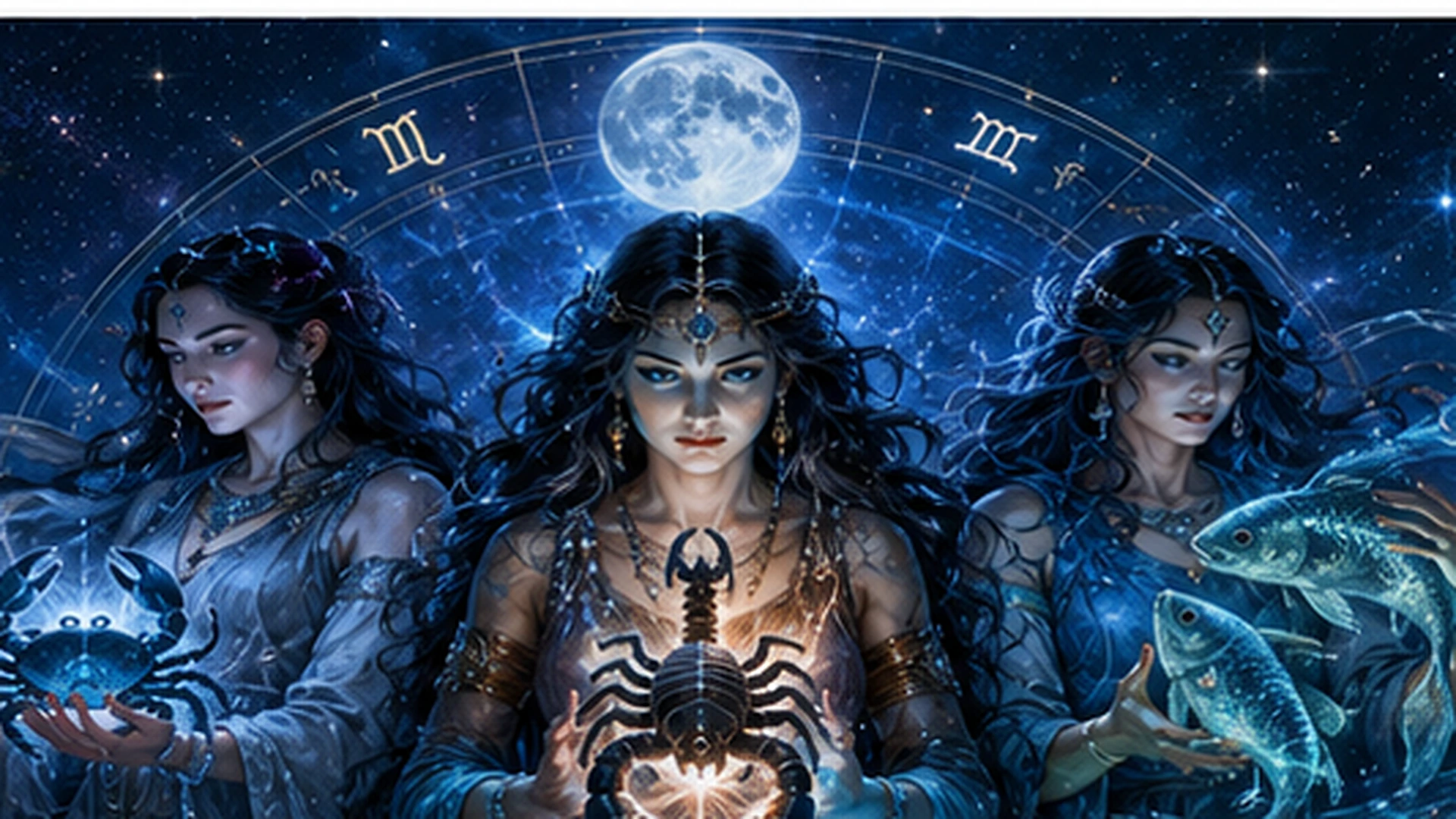
| Image number | 5 |
|---|---|
| Purpose | Represent water signs through reflection, depth and gentle movement without using fantasy mermaids or supernatural effects. |
| Detailed scene | Three accurate dark-silver medallions for Cancer, Scorpio and Pisces rest on smooth stones beside a clear reflective pool. A shell, a small glass vessel and ripples from a single falling drop create texture. Moonlight reflects naturally across the water, with reeds and distant shoreline softly visible. |
| Specific culture or historical context | Contemporary Western astrology editorial symbolism; not a specific sacred site or ritual. |
| People shown | No people. |
| Location | Quiet lakeside pavilion or landscaped reflecting pool at dusk. |
| Clothing | Not applicable. |
| Architecture | Minimal stone edge and natural reeds; no temple architecture. |
| Objects | Three zodiac medallions, smooth stones, shell, clear vessel and water ripples. |
| Lighting | Natural blue-hour and moonlit reflections, balanced enough to show detail. |
| Composition | Wide 16:9 low-angle photograph with medallions in the foreground and reflective water extending behind. |
| SEO-friendly filename | water-signs-cancer-scorpio-pisces.webp |
| Image title | Water Signs: Cancer, Scorpio and Pisces |
| Alt text | Cancer, Scorpio and Pisces zodiac medallions arranged beside a reflective pool with gentle ripples. |
| Caption | Cancer, Scorpio and Pisces form the water triplicity in Western astrology. |
| Recommended placement | After the water-sign profiles. |
| Article section supported | Water signs and their shared symbolism. |
| Important elements to avoid | Mermaids, underwater people, giant waves, floods, glowing magic, overly dark exposure, logos, captions, watermarks, inaccurate glyphs or split-screen layout. |
How to Find Your Zodiac Element
For a basic Sun-sign answer, identify your Western zodiac sign and match it to the table. Sun-sign dates are approximate because the Sun changes signs at a specific time that varies slightly by year and time zone. People born near a sign boundary should use an accurate birth chart rather than relying on a fixed date list.
| Your sign | Your element |
|---|---|
| Aries | Fire |
| Taurus | Earth |
| Gemini | Air |
| Cancer | Water |
| Leo | Fire |
| Virgo | Earth |
| Libra | Air |
| Scorpio | Water |
| Sagittarius | Fire |
| Capricorn | Earth |
| Aquarius | Air |
| Pisces | Water |
The Sun sign is only one placement. Your Moon, Ascendant, Mercury, Venus, Mars and other planets may occupy signs of different elements. Someone with a fire Sun can have a chart dominated by earth or water placements, depending on which chart factors an astrologer counts and how they weight them.
Elemental Balance in a Birth Chart
Astrologers sometimes count how many major planets and angles fall in signs of each element. This is called elemental balance or elemental emphasis. There is no single universal counting system. Some practitioners count the Sun through Saturn, while others include the Ascendant, Midheaven, outer planets or lunar nodes. Some assign extra weight to the Sun, Moon and Ascendant.
A dominant element does not automatically mean a person is “better” at that element. It may describe what is familiar, what receives attention or what becomes overused. An underrepresented element does not mean the quality is absent. Astrologers may interpret it as an area developed consciously, expressed through relationships, or activated by houses, aspects and life circumstances.
| Pattern | Common astrological interpretation | Responsible caution |
|---|---|---|
| Strong fire emphasis | High initiative, visibility or appetite for challenge | Can also show overextension; assess the whole chart and actual behavior. |
| Strong earth emphasis | Practical focus, endurance or concern with security | May reflect caution or control as much as competence. |
| Strong air emphasis | Mental activity, communication or social perspective | Does not prove intelligence and may coexist with emotional difficulty. |
| Strong water emphasis | Emotional receptivity, imagination or bonding | Does not prove psychic ability and may also indicate overwhelm. |
| Low count in one element | A quality approached indirectly or developed through experience | Never diagnose a deficit from one counting method. |
| Relatively even distribution | Ability to move among several styles | Balance on paper does not guarantee psychological balance. |
How Zodiac Elements Interact
Popular astrology often describes fire and air as mutually stimulating, while earth and water are described as mutually supportive. Fire can warm and animate air; air can feed fire. Earth can contain and direct water; water can soften and nourish earth. These are metaphors, not laws of relationship compatibility.
The so-called difficult combinations also have constructive possibilities. Fire and water can combine passion with emotional depth. Fire and earth can turn inspiration into achievement. Air and water can unite language with empathy. Air and earth can connect ideas with workable systems. The quality of a relationship depends on far more than two Sun-sign elements.
| Pairing | Possible ease | Possible tension | Constructive expression |
|---|---|---|---|
| Fire + Air | Momentum, enthusiasm, ideas and social energy | Escalation, restlessness or insufficient grounding | Turn inspiration into a shared plan with realistic pauses. |
| Earth + Water | Security, care, patience and practical support | Stagnation, worry, dependency or resistance to change | Use emotional trust to support sustainable growth. |
| Fire + Earth | Ambition plus execution | Different pace and risk tolerance | Let fire initiate while earth tests and completes. |
| Air + Water | Communication plus sensitivity | Thinking versus feeling; mixed signals | Translate emotion into words without analyzing it away. |
| Fire + Water | Passion, courage and emotional intensity | Reactivity or feeling overwhelmed | Use clear boundaries and cooling-off time. |
| Air + Earth | Strategy, analysis and workable ideas | Detachment versus rigidity | Test ideas in reality while remaining open to revision. |
| Same element | Shared language and easy recognition | Reinforcing the same blind spots | Invite other perspectives and practical checks. |
Using the Elements for Self-Reflection
The elemental framework can be used as a reflective vocabulary rather than a fixed verdict. A person might ask which kind of response is easiest under stress and which is missing from the moment.
Fire question: What action, courage or creative spark is needed?
Earth question: What practical fact, boundary, resource or routine will make this sustainable?
Air question: What needs to be named, discussed, compared or understood from another perspective?
Water question: What feeling, attachment, memory or intuitive response needs respectful attention?
This approach does not require believing that a birth chart causes behavior. It uses the four images as prompts for a more complete response. The goal is not to perform every element equally at all times, but to notice when one mode has crowded out the others.
The Four Elements Are Not Universal Across All Traditions
Fire, earth, air and water are the familiar elemental groups of Western astrology. They should not be presented as the only human way of organizing nature or celestial symbolism. Different philosophical and astrological traditions use different categories, relationships and cosmologies.
The Chinese system commonly translated as the “five elements” refers to wood, fire, earth, metal and water, often better understood as five phases or processes. Indian philosophical and astrological traditions may discuss five great elements, including space or ether, but their meanings and applications are not identical to the four Western triplicities. Combining these systems without context creates false equivalence.
A culturally responsible article should therefore name the system being discussed. This page concerns Western zodiac elements. Separate articles should explain other traditions through their own texts, scholars and practitioners.
Zodiac Signs, Constellations and Astronomy
In astrology, a zodiac sign is a thirty-degree symbolic division of the ecliptic. In modern astronomy, a constellation is an officially bounded region of the sky. The International Astronomical Union recognizes 88 constellations and defines them by boundaries rather than by astrological personality meanings. [5]
The zodiac constellations are not all the same angular size, and the astronomical Sun’s apparent path does not map neatly onto twelve equal constellations. Western tropical astrology instead anchors its zodiac to the seasonal cycle beginning at the March equinox. This is one reason an astrological sign and an astronomical constellation should not be treated as the same thing.
NASA explains the distinction plainly: astronomy studies celestial objects using evidence and scientific methods, while astrology is a belief system that interprets celestial positions as meaningful for personality or events. NASA notes that astrological claims are not based on scientific evidence. [6]
Scientific Limitations
The zodiac elements are not scientifically validated personality categories. They can function as cultural symbols, narrative archetypes or prompts for reflection, but that is different from demonstrating reliable predictive power.
A widely discussed double-blind study published in Nature tested whether natal charts could describe personality traits accurately under controlled conditions. The paper did not establish the claimed ability. [7] Other large-sample research has also failed to find a meaningful correlation between zodiac signs and measured personality traits. [8]
Scientific criticism does not erase astrology’s historical, artistic or personal importance. It does require accurate language. An article may say that astrologers associate water signs with emotional receptivity; it should not state that water signs are scientifically proven to be more intuitive or that elemental compatibility determines whether a relationship will succeed.
| Important distinction Astrological element descriptions are symbolic interpretations within a cultural tradition. They should not replace psychological assessment, medical care, financial advice, legal judgment or evidence-based decisions. |
|---|
Common Misunderstandings About Zodiac Elements
“Your Sun sign is your entire element.” A complete chart usually contains placements in several or all four elements.
“One element is strongest or best.” Astrology treats the elements as different functions, each with constructive and difficult expressions.
“People of the same element always get along.” Shared style can create ease or amplify the same weaknesses.
“Opposing elements cannot form good relationships.” Real compatibility depends on the full charts, communication, values and behavior.
“A missing element means a missing human capacity.” Counting methods vary, and people develop qualities through experience and context.
“The four elements are chemical elements.” They are inherited philosophical and symbolic categories, not entries on the periodic table.
“All cultures use the same four-element zodiac.” They do not; different traditions must be studied on their own terms.
“Astrology and astronomy make the same claims.” Modern astronomy is a science; astrology is a symbolic and divinatory tradition.
Key Takeaways
Fire signs are Aries, Leo and Sagittarius.
Earth signs are Taurus, Virgo and Capricorn.
Air signs are Gemini, Libra and Aquarius.
Water signs are Cancer, Scorpio and Pisces.
Each elemental triplicity contains one cardinal, one fixed and one mutable sign.
Elements describe symbolic style, while modalities describe how a sign acts.
A full birth chart can contain all four elements, so a person is more than a Sun-sign category.
Element compatibility is a metaphorical framework, not a guarantee of relationship success.
The four Western elements should not be confused with Chinese, Indian or other elemental systems.
Astrological element traits are culturally meaningful to many people but are not scientifically proven personality categories.
People Also Ask
What are the four zodiac elements?
The four elements in Western astrology are fire, earth, air and water. Each contains three zodiac signs and is used as a symbolic category for temperament and expression.
Which zodiac signs are fire signs?
Aries, Leo and Sagittarius are fire signs.
Which zodiac signs are earth signs?
Taurus, Virgo and Capricorn are earth signs.
Which zodiac signs are air signs?
Gemini, Libra and Aquarius are air signs.
Which zodiac signs are water signs?
Cancer, Scorpio and Pisces are water signs.
What is a triplicity in astrology?
A triplicity is a group of three zodiac signs traditionally connected by a triangular relationship. The four elemental triplicities are fire, earth, air and water.
What is the strongest zodiac element?
Astrology does not have one universally strongest element. A chart may emphasize one element, but each element has useful and difficult expressions.
Can you have more than one zodiac element?
Yes. Your Sun has one element, but the Moon, planets and Ascendant can occupy signs of other elements. A full chart usually includes several or all four.
Are fire and air signs compatible?
Astrologers often describe fire and air as stimulating, but compatibility cannot be determined from elements or Sun signs alone.
Are zodiac elements scientifically proven?
No. Scientific research has not validated zodiac elements as reliable personality or predictive categories.
Frequently Asked Questions
Is Aquarius a water sign because it is the Water Bearer?
No. Aquarius is an air sign. Its symbol carries water, but its traditional elemental classification is fixed air.
Is Scorpio a fire sign because it is intense?
No. Scorpio is fixed water. Astrological intensity is not exclusive to the fire element.
Why is Capricorn an earth sign?
Capricorn belongs to the earth triplicity and combines earth symbolism with cardinal modality, which astrologers interpret through structure, ambition and long-term building.
Do the elements affect zodiac dates?
No. The elements classify signs; they do not determine the calendar boundaries. Exact sign changes depend on the Sun’s calculated position for a specific year, time and location.
Can someone have no fire in a birth chart?
Depending on the factors counted, a chart may contain no major planets in fire signs. Astrologers interpret this cautiously and should not assume the person lacks courage, vitality or creativity.
How do astrologers calculate a dominant element?
Methods vary. Many count planets in signs by element, sometimes weighting the Sun, Moon and Ascendant more heavily. There is no single standardized scientific calculation.
Are elements more important than planets?
They answer different astrological questions. Planets symbolize functions, signs describe style, houses describe life areas, aspects describe relationships, and elements summarize patterns across signs.
Do opposite signs share an element?
No. Opposite signs usually belong to compatible but different elements: fire opposes air, and earth opposes water.
Are all fire signs extroverts?
No. “Fire” is an astrological symbol, not a clinical personality type. Introversion and extroversion cannot be determined reliably from a Sun-sign element.
Can the elements guide career choices?
They may be used as reflective prompts, but career decisions should be based on skills, interests, opportunities, values and practical evidence rather than an element alone.
Can zodiac elements diagnose emotional problems?
No. Astrology should not diagnose mental-health conditions. A qualified health professional should assess persistent distress or impairment.
Are elemental rituals necessary for zodiac balance?
No. Some spiritual practitioners use symbolic elemental exercises, but there is no evidence that a ritual is required to correct a birth chart or guarantee an outcome.
Is the fifth element ether part of Western zodiac signs?
The standard Western sign triplicities use four elements. Ether or quintessence appears in other philosophical frameworks, but it is not a fifth zodiac-sign triplicity.
Is Western elemental astrology the same everywhere?
No. Schools differ in technique, weighting and interpretation. Historical astrology also used triplicities in ways that are not identical to modern personality-focused astrology.
Should I use my Sun, Moon or Rising element?
Use all three for a broader symbolic picture. The Sun, Moon and Ascendant describe different astrological functions, and the full chart adds more context.
Conclusion
The four zodiac elements provide one of the clearest entry points into Western astrology. Fire describes initiative and vitality; earth describes form and practical continuity; air describes thought and exchange; water describes feeling and connection. Each group contains three signs, and each sign combines its element with a different modality.
The framework becomes more useful when it moves beyond stereotypes. Aries, Leo and Sagittarius do not express fire in the same way. Taurus, Virgo and Capricorn do not approach earth identically. The same distinction applies to air and water. A full chart also distributes planets across multiple elements, which makes any single-label personality claim incomplete.
Used responsibly, the elements can offer a memorable symbolic language for self-reflection and discussion. They should not be presented as scientific facts, guaranteed compatibility rules or universal cultural categories. The best approach is historically informed, culturally specific and honest about the difference between meaning and evidence.
Final Summary
| Final Summary Fire: Aries, Leo, Sagittarius. Earth: Taurus, Virgo, Capricorn. Air: Gemini, Libra, Aquarius. Water: Cancer, Scorpio, Pisces. These are the four Western astrological triplicities. They are symbolic interpretive categories, and a complete birth chart is more complex than a single Sun-sign element. |
|---|
Research Sources and Further Reading
[1] Stanford Encyclopedia of Philosophy — “Empedocles.” Academic overview of Empedocles’ four roots, Love and Strife, and the history of the classical elemental framework.
[2] Claudius Ptolemy, Tetrabiblos, Book I — “The Triplicities.” Surviving ancient astrological discussion of the zodiac’s four triangular groupings.
[3] Maria J. Mateus, “The Confused Triplicity Doctrine,” Urania Trust (2026). Specialist historical discussion of triplicities, winds, regions and the later elemental associations. Used cautiously as a focused history-of-astrology source.
[4] J. Paul Getty Museum — “Written in the Stars: Astronomy and Astrology in Medieval Manuscripts” and “Rising Signs: The Medieval Science of Astrology.” Museum scholarship on zodiac imagery, manuscripts and astrology’s medieval cultural role.
[5] International Astronomical Union — “The Constellations.” Official explanation of the 88 modern constellations as bounded regions of the sky and the difference between historical star patterns and scientific definitions.
[6] NASA Space Place — “What Are Constellations?” Explains the difference between astronomy and astrology and states that astrological claims are not based on scientific evidence.
[7] Shawn Carlson, “A Double-Blind Test of Astrology,” Nature 318 (1985): 419–425. Controlled test of natal-chart personality claims.
[8] J. Angst and P. Scheidegger, “Signs of the Zodiac and Personality,” Sozial- und Präventivmedizin 21 (1976): 39–41. Large-sample study reporting no correlation between zodiac signs and measured personality.
[9] CHANI — “An Introduction to the Zodiac Signs.” Representative modern practitioner explanation of elemental triplicities and contemporary symbolic interpretations. Used to describe living astrological practice, not scientific fact.
[10] NASA Science — “Solar System Symbols.” Background on symbols used historically in astronomy and astrology and the IAU’s caution about special symbols in scientific publication.
Editorial note: This article describes Western astrological symbolism and its historical development. It does not claim that zodiac elements scientifically determine personality, compatibility, health, finances or future events. Other cultural traditions use different elemental systems and should be represented through their own sources and custodians.
Article Information
- Publisher
- Ancestral Temple
- Editor
- Ancestral Temple
- Last updated
- Jul 26, 2026
- Last reviewed
- Jul 26, 2026
- Content version
- 55d4c9c95e
This educational article should be read as cultural and spiritual information, not as medical, legal, financial, or emergency advice.
Helpful Related Guidance
Explore This Topic
Related Topic Cluster
Dreams & Symbolism
About the Author
 Ancestral Temple
Spiritual guide and practitioner with decades of experience in ancestral wisdom, rituals, and divine guidance.
Related Posts
View All












Leave a Comment
We'd love to hear your thoughts.