
Ethiopian Spiritual Heritage
Quick Summary
Ethiopian spiritual heritage includes ancient Christian, Islamic, Jewish, Indigenous and local community traditions shaped by languages, sacred landscapes, manuscripts, pilgrimage, fasting, music, healing, festivals and long histories of coexistence and conflict.
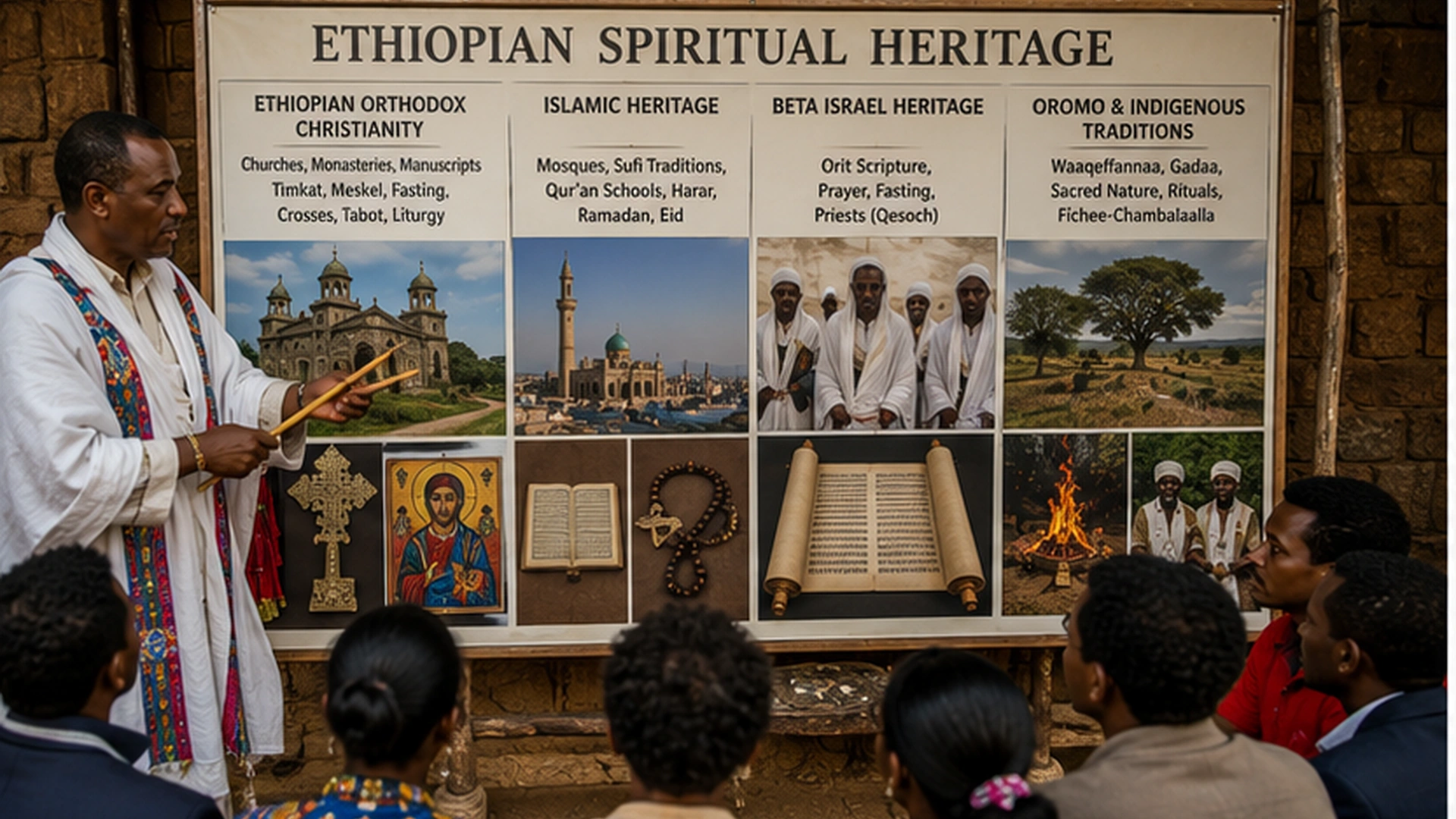
Ethiopia contains one of Africa’s most diverse and historically layered religious landscapes. Its spiritual heritage includes Ethiopian Orthodox Christianity, Islam, Beta Israel Judaism, Oromo Waaqeffannaa, Sidama traditions, local healing systems, monastic cultures, royal institutions and many community-specific practices.
No single tradition represents every Ethiopian. Amhara, Tigrayan, Oromo, Somali, Harari, Afar, Sidama, Gurage, Wolayta, Konso and other peoples maintain different languages, histories and religious identities.
Christianity became established in the Aksumite kingdom during the fourth century. Aksum later became one of the major historical centers of Ethiopian Christianity and remains an important archaeological and devotional landscape.
Islam also has deep roots in Ethiopia and the wider Horn of Africa, while Harar developed into an influential center of Islamic scholarship, worship, trade and urban culture.
Spiritual life is expressed through:
- Churches
- Mosques
- Monasteries
- Shrines
- Sacred landscapes
- Family practices
- Fasting
- Pilgrimage
- Music
- Manuscripts
- Ritual objects
- Ethical obligations
This article discusses public cultural evidence. It does not reveal restricted tabot traditions, private healing formulas, secret initiatory knowledge or confidential family ceremonies.
Suggested scene: Ethiopian cultural historian introducing Orthodox, Islamic, Jewish and Indigenous traditions through separate displays of churches, mosques, manuscripts, crosses, festivals and sacred landscapes.
Key Points
- Ethiopian spiritual heritage is plural and cannot be reduced to one religion or ethnic group.
- The Ethiopian Orthodox Tewahedo Church traces its institutional history to Aksum in the fourth century.
- The tabot is the most sacred object of an Ethiopian Orthodox church and is normally restricted from public view.
- Lalibela remains a major pilgrimage and devotional center with eleven medieval rock-hewn churches.
- Timkat commemorates Christ’s baptism through processions, tabot-centered worship and blessed water.
- Meskel commemorates the finding of the True Cross and is marked by the public lighting of the demera bonfire.
- Islamic heritage includes ancient mosques, Sufi devotion, Qur’anic education, pilgrimage and the walled city of Harar.
- Beta Israel heritage preserves distinctive Jewish liturgy, fasting, scripture and community history.
- Oromo Gadaa and Waaqeffannaa traditions connect Waaqa, moral order, generations, assembly and sacred landscapes.
- Healing scrolls, crosses and manuscripts should be interpreted through their religious and historical contexts, not as guaranteed supernatural products.
Religious and Cultural Diversity
- Tradition or setting
- Examples of heritage
- Ethiopian Orthodox Tewahedo Christianity
- Aksum, Lalibela, monasteries, tabot, liturgy, fasting, Timkat, Meskel, manuscripts and crosses
- Islam in Ethiopia
- Early Muslim history, Harar, mosques, Sufi traditions, Qur’anic learning, Ramadan, Eid and local pilgrimages
- Beta Israel Judaism
- Orit scripture, prayer, fasting, priests known as qesoch, purity traditions and community memory
- Oromo traditions
- Waaqa, Gadaa, qaallu institutions, thanksgiving, assembly, ethical order and sacred landscapes
- Sidama traditions
- Fichee-Chambalaalla New Year, clan leadership, family relationships, shared food and ethical teaching
- Local healing traditions
- Plant knowledge, prayer, spirit interpretation, protective manuscripts and community specialists
1. Aksum and the Establishment of Christianity
The Aksumite kingdom connected the African interior, the Red Sea, Arabia and the Mediterranean world.
Christianity became a royal religion during the reign of King Ezana in the fourth century. The Metropolitan Museum identifies this period as the beginning of institutional Ethiopian Christianity.
Aksum remains associated with:
- Royal monuments
- Early churches
- Pilgrimage
- Christian kingship
- Traditions concerning the Ark of the Covenant
UNESCO describes Aksum as the center of a powerful ancient civilization active between Africa, Arabia and the Greco-Roman world.
Historical evidence establishes Aksum’s political and religious importance. Specific sacred claims concerning the Ark belong to faith and should not be presented as archaeologically proven facts.
2. The Ethiopian Orthodox Tewahedo Church
Tewahedo means unity and refers to the Church’s Christological tradition.
The Ethiopian Orthodox Church developed distinctive forms of:
- Liturgy
- Monasticism
- Fasting
- Music
- Architecture
- Manuscript production
- Visual art
- Pilgrimage
Ge’ez remains the classical liturgical language, while Amharic, Tigrinya, Oromo and other languages may be used in teaching, preaching and local worship.
Article Information
- Publisher
- Ancestral Temple
- Editor
- Ancestral Temple
- Last updated
- Jul 26, 2026
- Last reviewed
- Jul 26, 2026
- Content version
- d264049cc2
This educational article should be read as cultural and spiritual information, not as medical, legal, financial, or emergency advice.
Helpful Related Guidance
Explore This Topic
Spiritual Knowledge · Community Healing Traditions Across Africa
About the Author
 Ancestral Temple
Spiritual guide and practitioner with decades of experience in ancestral wisdom, rituals, and divine guidance.
Related Posts
View All

Leave a Comment
We'd love to hear your thoughts.
This was a balanced and culturally respectful introduction.
A beginner quiz about Ethiopian spiritual heritage would be useful.
The separate community examples made the heritage easier to understand.
The key takeaways summarized the subject well.
How can young Ethiopians learn Ge’ez and manuscript traditions?
The medical safety boundaries were necessary.
I would enjoy an article about Ethiopian Marian devotion.
The article respected Ethiopian clergy, scholars and communities.
Could you create an ethical checklist for visiting monasteries and mosques?
I liked the connection between pilgrimage, landscape and community.
The article did not treat healing scrolls as magical products.
A visual guide to Ethiopian church objects would be useful.
The UNESCO and museum sources made the article trustworthy.
How does Fichee-Chambalaalla differ from other Ethiopian New Year celebrations?
I appreciated the distinction between Waaqeffannaa and the religions of all Oromo people.
The article was detailed but easy to scan.
Can museum-held manuscripts be digitally returned to Ethiopian communities?
The article respected sacred objects and photography rules.
I would enjoy a detailed guide to Harari Sufi traditions.
The Meskel section was easy to understand.
How do diaspora churches celebrate Timkat in colder countries?
The glossary would work well as an Ethiopian heritage knowledge hub.
The article separated public festivals from restricted sanctuary practice.
Could you write more about Saint Yared and church music?
I liked that Ethiopian traditions were not treated as one ethnic culture.
The religious diversity table was useful.
I would enjoy an article about Beta Israel festivals.
The Maqdala provenance section was necessary.
How are manuscripts preserved in rural monasteries?
I appreciated the healthcare warning around holy water and healing.
The discussion of Gadaa avoided reducing it to politics alone.
I would like a full article about Lake Tana monasteries.
The section on Ge’ez manuscripts was especially interesting.
A printable map of Ethiopia’s major sacred sites would be helpful.
Thank you for separating faith claims from archaeological evidence.
Can visitors enter every church at Lalibela?
The Harar section added important Islamic history.
I would enjoy a detailed article about Ethiopian cross designs.
The explanation of healing scrolls was balanced and respectful.
How do Ethiopian Orthodox fasting rules differ by season?
I liked that Islam, Beta Israel, Oromo and Sidama traditions were included.
The Lalibela section made it clear that the churches remain active places of worship.
A separate article about Timkat would be useful.
I appreciated the explanation of the tabot and why it should not be shown uncovered.
The article clearly showed that Ethiopian spirituality includes several religions and communities.