
Preserving Indigenous African Knowledge
Quick Summary
Preserving Indigenous African knowledge requires more than recording stories or uploading files. It depends on living languages, land, skilled practitioners, family and community institutions, ethical consent, restricted access, fair benefit-sharing, and systems that allow communities to control how their knowledge is taught, stored, interpreted and used.
Preserving Indigenous African Knowledge describes a culturally specific topic that should not be reduced to one universal African belief or practice. The article explains meaning, context and variation across communities while avoiding broad claims about all cultures or all practitioners.
Indigenous African knowledge is carried through people, language, practice, land, memory, institutions, objects, stories, songs, farming, healing, craft, law, spirituality and everyday work.
It is not one uniform body of information.
Pastoral knowledge in the Sahel, seed systems in Ethiopian highlands, forest knowledge in the Congo Basin, oral archives in Uganda, water-management traditions in North Africa and craft apprenticeships in West Africa belong to different communities, languages and historical environments.
Preservation does not mean freezing knowledge in the past.
Living knowledge changes through:
- Experimentation
- Migration
- Climate pressure
- New technologies
- Trade
- Schooling
- Religious change
- Political transformation
UNESCO’s Local and Indigenous Knowledge Systems programme identifies Africa as a priority region because of its exceptional linguistic, ecological and cultural diversity. UNESCO works with African Indigenous Peoples and local communities on biodiversity, climate adaptation, disaster-risk reduction, languages and cultural safeguarding.
Responsible preservation must protect community authority.
Some knowledge is public. Other knowledge may be:
- Sacred
- Medicinal
- Gender-restricted
- Lineage-based
- Initiatory
- Commercially sensitive
- Connected with endangered species
- Connected with sacred places
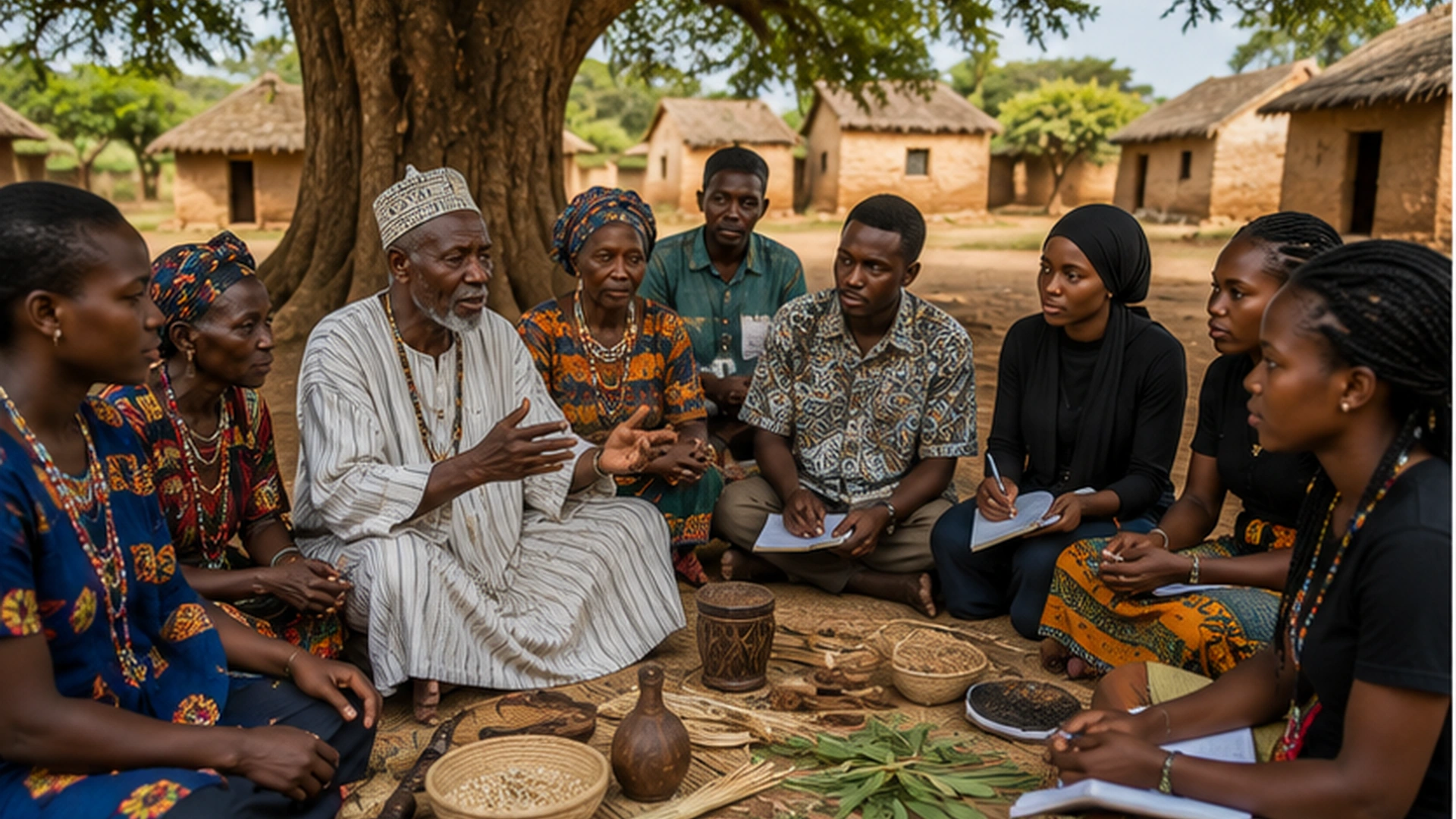
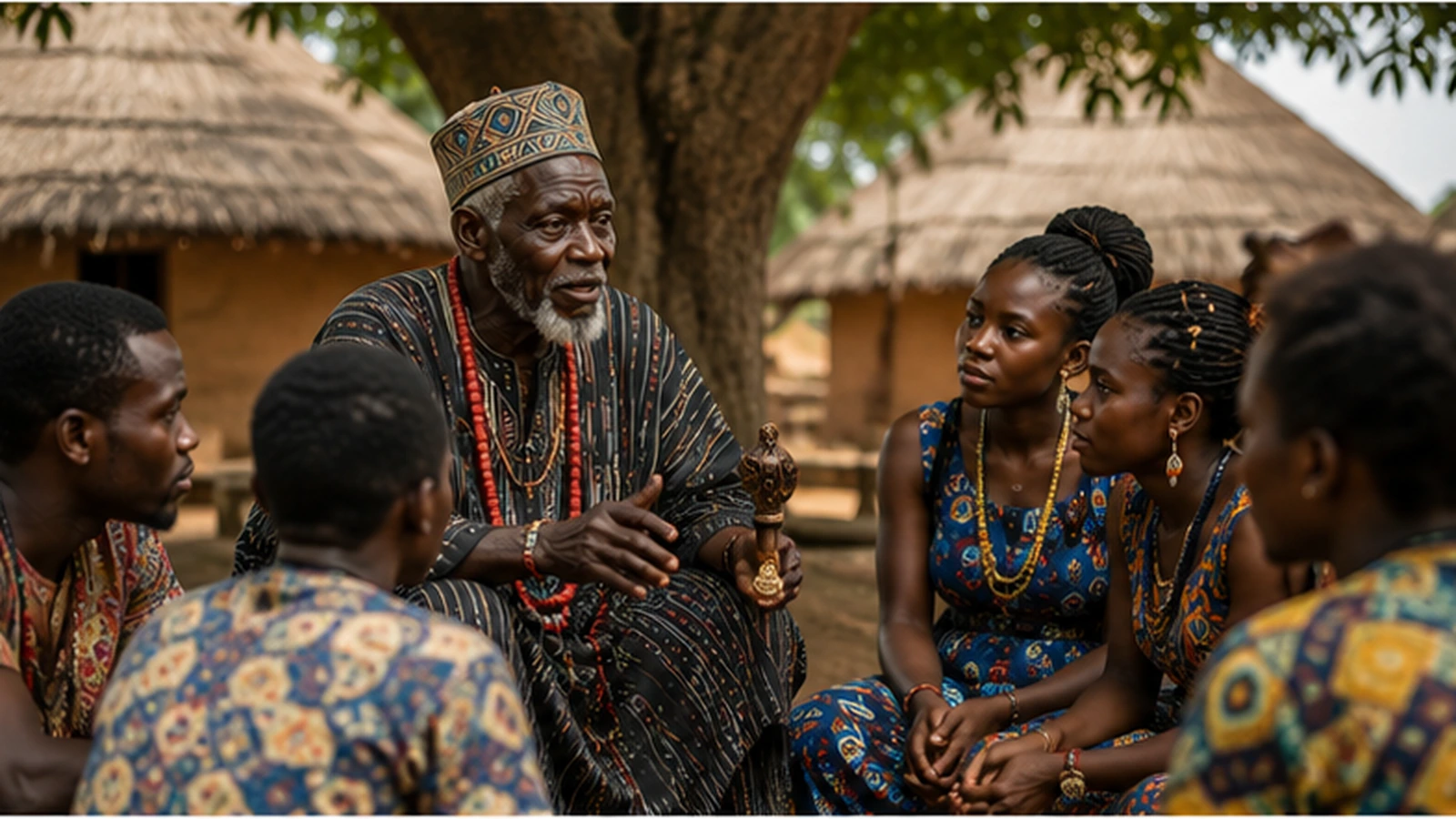
Suggested scene: Black African elders, youth, farmers, pastoralists, healers, craftspeople, linguists and archivists introducing distinct community-led preservation methods without combining them into one invented culture.
Key Points
- Knowledge survives best when communities retain land, language, livelihoods and authority.
- Oral traditions, apprenticeship and participation remain as important as written or digital recording.
- Not every tradition should be publicly documented.
- Free, prior and informed consent should guide recording, research and digitization.
- Community archives need locally agreed access rules, secure storage and long-term maintenance.
- African languages are knowledge systems, not optional translations.
- Women, elders, youth, farmers, pastoralists, fishers, healers and craftspeople may hold different forms of knowledge.
- Schools and universities should involve recognized knowledge holders as teachers and research partners.
- Traditional knowledge connected with medicines, seeds and genetic resources requires protection from misappropriation and biopiracy.
- Artificial intelligence and digital platforms create preservation opportunities but also risks of extraction, distortion and lost control.
What Preservation Really Means
- Preservation goal
- Practical meaning
- Continuity
- Knowledge remains useful and practiced across generations.
- Community control
- Knowledge holders decide what may be recorded, shared, translated or commercialized.
- Context
- Information remains connected to language, place, season, practice, history and authority.
- Access rules
- Public, private, sacred and restricted materials receive different levels of access.
- Benefit
- Communities receive educational, financial, institutional or cultural benefits.
- Adaptation
- Knowledge can respond to migration, technology, climate pressure and social change.
- Accountability
- Researchers, museums, governments and technology companies remain responsible for how knowledge is used.
1. Preserve Living Practice, Not Only Information
A database can store words, photographs and recordings, but it cannot replace the practice through which knowledge gains meaning.
Farming knowledge depends on:
- Soil
- Seed
- Rain
- Labor
- Observation
- Seasonal judgment
Healing knowledge depends on:
- Accurate identification
- Diagnosis
- Preparation
- Dosage
- Ethics
- Experience
Craft knowledge depends on:
- Hand movement
- Material preparation
- Tool care
- Repetition
- Quality judgment
- Apprenticeship
Preservation should therefore support:
- Practitioners
- Apprentices
- Workshops
- Farms
- Grazing systems
- Community institutions
- Local livelihoods
Communities should not be treated only as sources of cultural content.
2. Protect African Languages
Languages contain specialized categories for:
- Plants
- Animals
- Soils
- Weather
- Kinship
- Law
- Morality
- Spirituality
- Landscape
When a language weakens, knowledge may disappear even when selected facts have been translated into English, French, Portuguese or Arabic.
Translation may also flatten several local concepts into one broad foreign word.
Useful preservation measures include:
- Mother-tongue education
- Community dictionaries
- Local terminology projects
- Language recordings
- African-language radio
- Publishing
- Keyboard development
- Speech technology
- Support for writers and teachers
UNESCO notes that oral traditions and expressions transmit knowledge, cultural values and collective memory, while language is one of their essential carriers.
Article Information
- Publisher
- Ancestral Temple
- Editor
- Ancestral Temple
- Last updated
- Jul 26, 2026
- Last reviewed
- Jul 26, 2026
- Content version
- 44922401ca
This educational article should be read as cultural and spiritual information, not as medical, legal, financial, or emergency advice.
Helpful Related Guidance
Explore This Topic
Spiritual Knowledge · Community Healing Traditions Across Africa
About the Author
 Ancestral Temple
Spiritual guide and practitioner with decades of experience in ancestral wisdom, rituals, and divine guidance.
Related Posts
View All


Leave a Comment
We'd love to hear your thoughts.
This was a balanced and practical introduction.
A beginner quiz about knowledge preservation would be useful.
The examples across different knowledge domains made the article clearer.
The key takeaways summarized the topic well.
How can young people earn livelihoods through heritage work?
The focus on community wellbeing was important.
I would enjoy an article about digital archives in low-connectivity areas.
The article respected sacred and medicinal knowledge.
Could you create a checklist for universities working with communities?
I liked the long-term funding section.
The article connected knowledge preservation with land rights.
A visual guide to access levels would be useful.
The UNESCO, FAO, WIPO and IPBES sources made the article trustworthy.
How can local-language AI tools be governed safely?
I appreciated the explanation that copyright is not always enough.
The article was detailed but easy to scan.
Can traditional designs be protected from copying?
The article made benefit-sharing easy to understand.
I would enjoy a detailed guide to community protocols.
The section on youth as co-creators was encouraging.
How should museums return recordings made during colonial rule?
The glossary would work well as a knowledge-rights hub.
The article separated scientific testing from cultural respect.
Could you write more about Indigenous data governance?
I liked that oral performance was treated as more than text.
The table of preservation methods was useful.
I would enjoy an article about African community seed banks.
The biopiracy section was necessary.
How can healers protect plant knowledge from companies?
I appreciated the warning about rare-species locations.
The discussion of AI risks was timely.
I would like a full article about digital repatriation.
The apprenticeship section showed why skills cannot be learned from videos alone.
A printable preservation framework would be helpful.
Thank you for explaining that not everything should be public.
Can a community withdraw recordings after publication?
The section on women as knowledge holders was necessary.
I would enjoy a guide to free, prior and informed consent.
The explanation of restricted knowledge was responsible.
How can a small community fund long-term digital storage?
I liked that living practice was placed before collecting information.
The language-preservation section was especially important.
A separate article about community archives would be useful.
I appreciated the emphasis on community control and consent.
The article clearly explained that preservation is more than digitization.