
Astrology Across Civilizations
Cornerstone Content
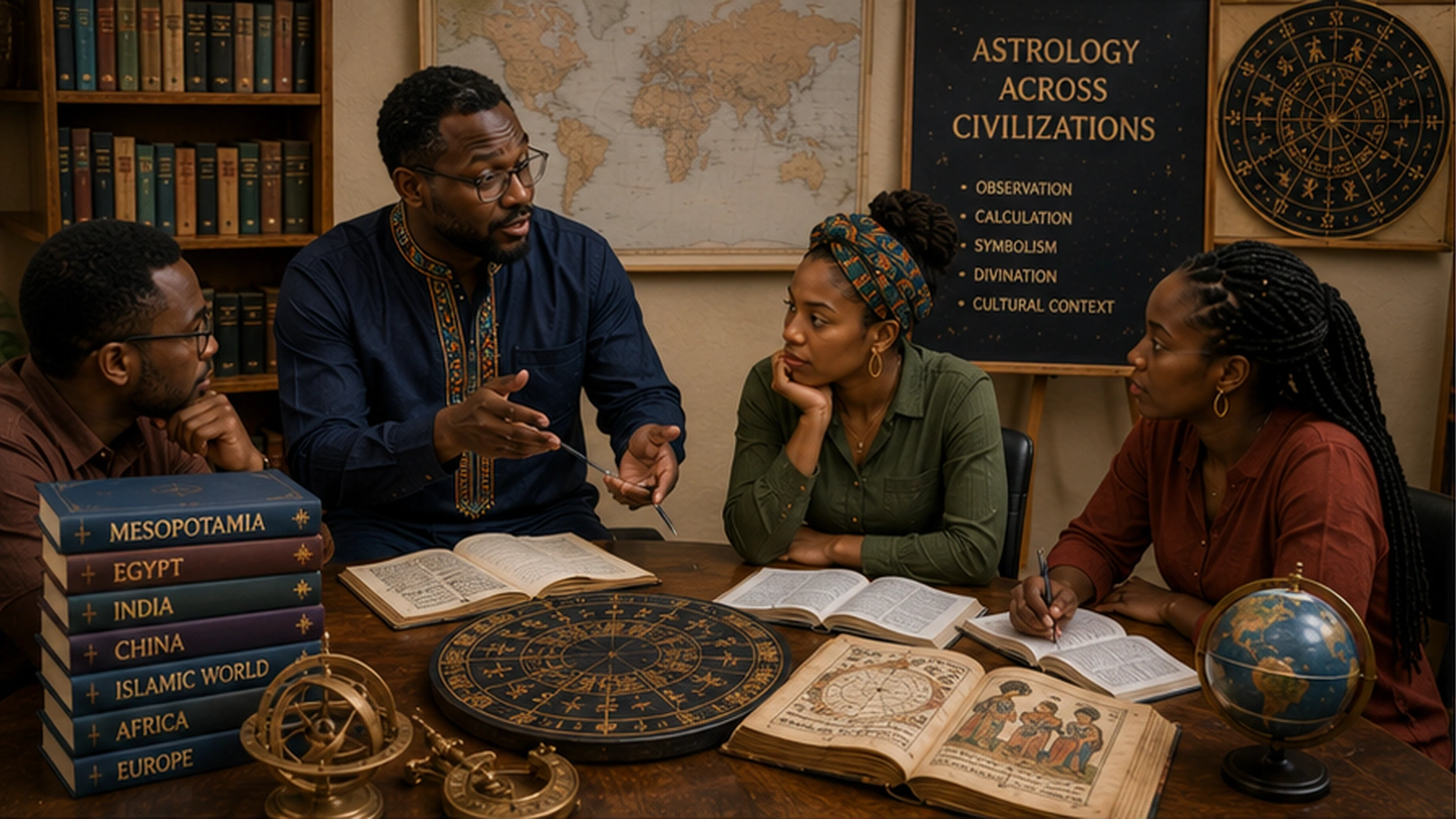
Quick Summary
Astrology did not develop as one universal system. Mesopotamian omen traditions, Hellenistic horoscopes, Indian Jyotisha, Chinese calendrical cosmology, Islamic scholarship, African manuscript traditions, and European astrology followed distinct histories while influencing one another through translation, trade, conquest, and scholarship.
Astrology has appeared in many civilizations, but it has never been one single universal tradition. Different societies watched the same sky while asking different questions about kingship, agriculture, calendars, health, fate, religion, weather, marriage, political change, and personal character.
The history of astrology is therefore not a simple story in which one culture invented a complete system and every other society copied it. It is a history of observation, mathematics, divination, translation, adaptation, disagreement, and cultural exchange.
Mesopotamian scholars recorded celestial omens for rulers and states. Babylonian astronomers standardized the twelve-sign zodiac. Greek-speaking scholars developed technical horoscopic astrology in the Hellenistic world, especially in Egypt. Indian scholars transformed imported and local astral sciences within Jyotisha. Chinese specialists developed distinct calendrical and political cosmologies. Scholars in Islamic societies translated, expanded, criticized, and illustrated astrological knowledge. African manuscript traditions, including Timbuktu, preserved evidence of astronomy and horoscope calculation. Medieval and Renaissance Europeans incorporated astrology into universities, courts, medicine, calendars, and printed almanacs.
These traditions should be compared carefully. Similar interest in stars does not prove identical beliefs, common origins, or interchangeable methods. Not every system of observing the sky is astrology, and not every divinatory tradition uses planets or zodiac signs.
Astrology remains historically and culturally influential, but scientific research has not established natal charts or zodiac systems as reliable predictors of personality or future events.
Suggested scene: Black African historian in a museum library comparing culturally distinct astronomical and astrological materials from Mesopotamia, Egypt, India, China, the Islamic world, Africa, and Europe.
Key Points
Astrology developed differently across civilizations.
Mesopotamia produced some of the earliest systematic celestial-omen traditions.
Babylonian astronomers standardized a twelve-sign zodiac by the late first millennium BCE.
Hellenistic Egypt became a major center for technical horoscopic astrology.
Indian Jyotisha combined local traditions with adapted Hellenistic methods.
Chinese astrology developed through distinct calendrical, imperial, and cosmological systems.
Islamic scholars translated and expanded Greek, Persian, Indian, and earlier knowledge while debating predictive claims.
African evidence includes Greco-Roman Egypt, North African scholarship, and Timbuktu manuscripts.
Medieval and Renaissance Europe integrated astrology into medicine, politics, agriculture, and education.
Modern astrology blends historical traditions, psychology, spirituality, media, and digital technology.
The traditions are culturally important but are not scientifically validated as reliable predictors.
What Does “Astrology Across Civilizations” Mean?
The phrase refers to the study of how different societies interpreted celestial movements and cycles as meaningful for human or earthly affairs.
Astrology may involve planets, stars, eclipses, lunar phases, zodiac signs, calendars, birth times, directions, seasons, or mathematically calculated charts. The exact techniques and claims depend on the tradition.
In one society, an eclipse might be interpreted as a warning concerning a ruler. In another, a birth chart might be used to discuss character or life circumstances. In another, a twelve-year animal cycle might organize social time. These systems should not be collapsed into one generic practice.
Astrology, Astronomy, Divination, and Calendar Knowledge
Field or practice
Primary concern
Astronomy
Scientific study of celestial bodies, motion, matter, energy, and the universe
Astrology
Symbolic or predictive interpretation of celestial positions and cycles
Divination
Practices intended to obtain hidden, spiritual, or predictive knowledge
Calendrical science
Organizing time through solar, lunar, stellar, or seasonal cycles
Ethnoastronomy
Study of how cultures understand and use the sky
Archaeoastronomy
Study of astronomical knowledge through archaeology and monuments
Historically, these categories frequently overlapped. The modern separation between astronomy and astrology became clearer as astronomy developed testable physical theories and specialized scientific institutions.
Mesopotamia: Celestial Omens and State Astrology
Ancient Mesopotamian scholars developed some of the earliest surviving systematic traditions of celestial divination. Scribes recorded eclipses, planetary appearances, unusual weather, lunar phenomena, and stellar events.
Their interpretations often concerned kings, warfare, disease, harvests, political stability, and the welfare of regions. Early astrology was therefore strongly connected with the state rather than only with private personality.
A Neo-Assyrian circular tablet in the British Museum contains constellation imagery and mathematical information associated with astrological calculation. It belonged to the scholarly environment represented by the Library of Ashurbanipal.
Mesopotamian scholars preserved observations over long periods. Their need to predict celestial events encouraged increasingly sophisticated calculation.
Babylonia and the Twelve-Sign Zodiac
Babylonian astronomers standardized the zodiac as twelve equal divisions of thirty degrees along the ecliptic. This mathematical system allowed the positions of the Moon and planets to be described more precisely than irregular constellation boundaries allowed.
A Late Babylonian clay tablet dated to about 500 BCE lists months together with associated zodiac signs. It is important evidence that zodiacal organization had become integrated into astronomy and calendrical practice by that period.
The Babylonian zodiac became one of the most influential foundations for later Western and Indian horoscopic astrology.
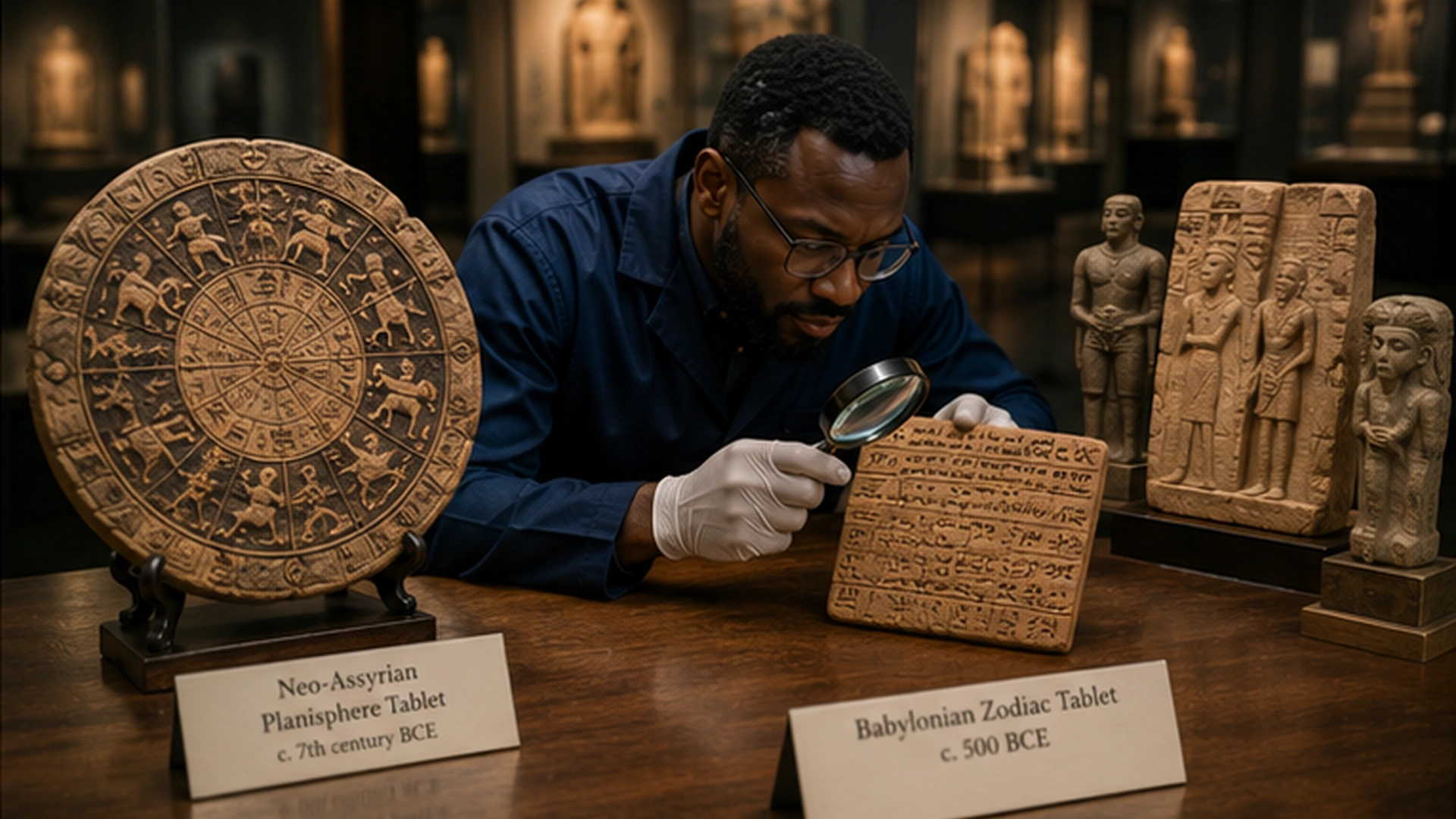
Suggested scene: African museum conservator examining a Late Babylonian zodiac tablet and Neo-Assyrian planisphere in a secure conservation room.
From Public Omens to Personal Horoscopes
Babylonian astrology gradually expanded from public celestial omens to horoscopes associated with individual births.
A personal horoscope recorded planetary and zodiacal conditions for a birth and connected them with possible future circumstances. This marked an important shift from interpreting the sky mainly for rulers and states to interpreting it for individuals.
The surviving horoscopes were generally concise and did not resemble modern psychological reports. They belonged to a scholarly culture combining calculation, omen interpretation, and record keeping.
Hellenistic Greece and Egypt: The Birth of Technical Horoscopy
After Alexander the Great’s conquests, Greek-speaking kingdoms connected Egypt, Mesopotamia, Persia, and parts of Asia. Scholars, texts, and calculations moved through these networks.
Hellenistic astrology combined Babylonian zodiacal and planetary traditions with Greek geometry, philosophy, and systems of angular relationship. Egypt provided a major intellectual and religious setting for this synthesis.
Techniques recognizable in later Western astrology developed in this environment, including the Ascendant, twelve places or houses, planetary rulership, aspects, and detailed interpretations of individual birth charts.
This system was not purely Greek, Babylonian, or Egyptian. It was a product of cultural exchange.
Ancient Egypt Before and After the Zodiac
Ancient Egypt had sophisticated calendars, decans, stellar observations, temple astronomy, and religious ideas concerning the sky before the standardized twelve-sign zodiac entered Egypt.
During the Ptolemaic and Roman periods, Egyptian monuments and manuscripts incorporated zodiac signs and planetary imagery influenced by Babylonian and Greek systems.
The Dendera Zodiac, created in the late Ptolemaic period, is one of the best-known examples. It should not be used to claim that the complete modern zodiac existed unchanged in Egypt thousands of years earlier.
The Roman World
Astrology became widespread throughout the Roman Empire. Practitioners served rulers, military leaders, wealthy households, merchants, travelers, and people concerned with marriage, inheritance, health, or political uncertainty.
Roman authorities sometimes consulted astrologers and sometimes expelled or restricted them, especially when predictions threatened political authority.
Zodiac and planetary imagery appeared on mosaics, coins, sculptures, jewelry, calendars, household objects, and funerary art.
India: Jyotisha and the Transformation of Horoscopic Astrology
India possessed advanced traditions of calendars, lunar mansions, ritual timing, mathematics, and astronomy before the arrival of Hellenistic horoscopic methods.
Translated and adapted Greek texts influenced Indian natal astrology, but Indian scholars transformed those methods within South Asian intellectual, religious, and linguistic traditions.
Jyotisha can include astronomy, calendrical calculation, astrology, ritual timing, and related disciplines. Common features may include a sidereal zodiac, nakshatras, planetary periods, divisional charts, marriage matching, and electional timing.
Illustrated horoscope scrolls known as janampatri could function as birth records and include planetary figures, signs, charts, and forecasts.
Why Indian Astrology Is Not Simply Western Astrology Shifted Backward
It uses its own technical vocabulary and textual traditions.
Lunar mansions are often central.
Planetary-period systems play a major role.
Divisional charts expand interpretation.
Regional schools use different methods.
Religious and philosophical frameworks differ.
China: Calendrical Cosmology and Imperial Astrology
Chinese astrology developed through distinct calendrical, cosmological, political, and observational traditions.
Chinese court specialists observed eclipses, comets, planetary gatherings, unusual stars, and atmospheric phenomena as signs concerning the emperor, government, and social order.
Chinese systems also developed through heavenly stems, earthly branches, yin and yang, five phases, lunar and solar calendars, and cycles of years, months, days, and hours.
The familiar twelve-animal zodiac is primarily a twelve-year calendrical cycle. It is not the same as the twelve equal signs of the Babylonian ecliptic zodiac.
Five Phases Are Not the Western Four Elements
Chinese wuxing—wood, fire, earth, metal, and water—describes dynamic phases, processes, and relationships. It should not be treated as a direct translation of fire, earth, air, and water in Western astrology.
Similar vocabulary does not prove identical meaning or origin.
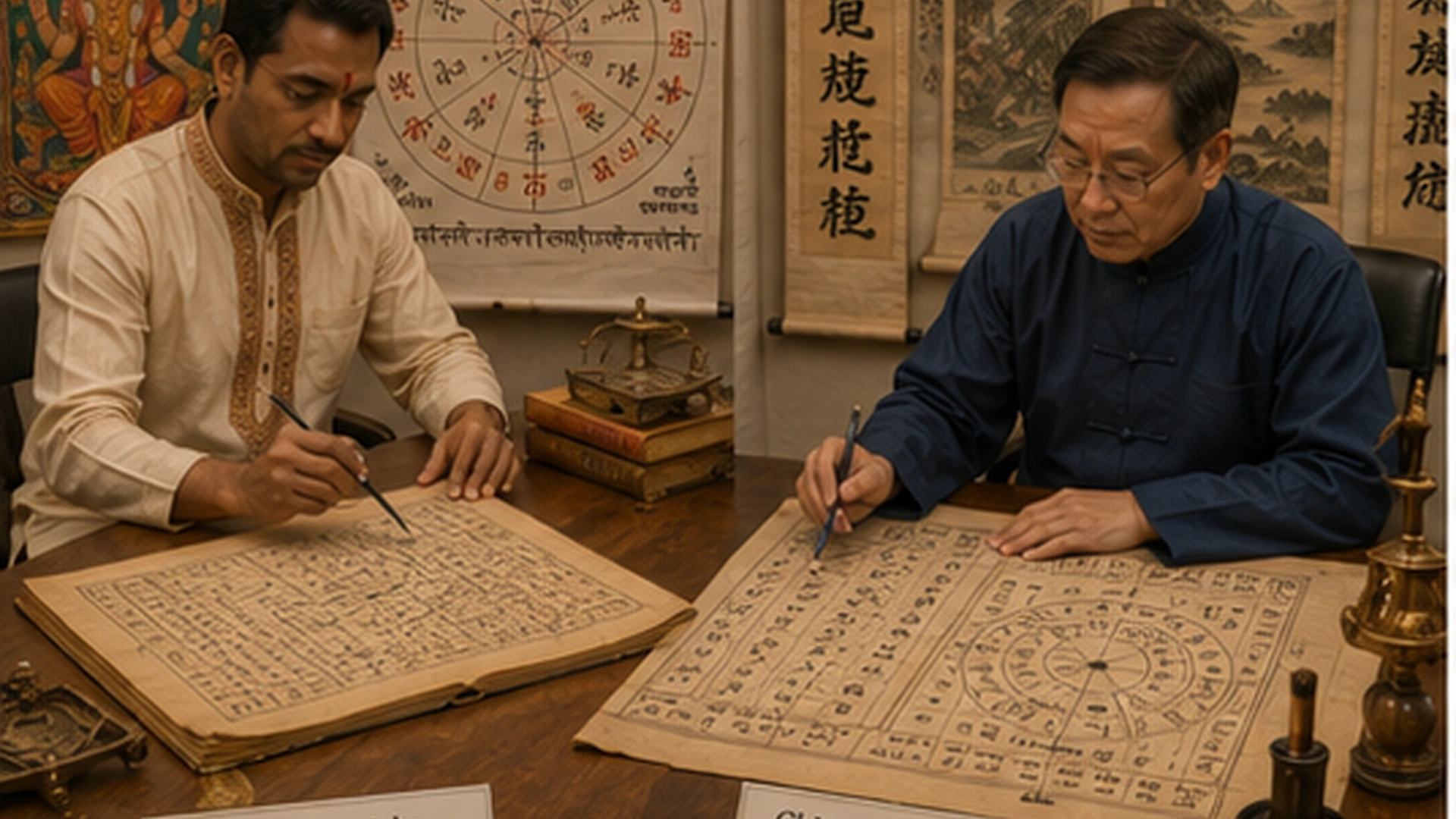
Suggested scene: Separate, culturally coherent study stations for Indian horoscope manuscripts and Chinese calendrical charts, viewed by Black African comparative-history students.
The Islamic World: Translation, Calculation, Debate, and Art
From the eighth century onward, scholars working in Arabic and Persian translated and studied Greek, Persian, Indian, and earlier astronomical and astrological texts.
Astrology depended on the ability to calculate celestial positions, so it interacted with astronomy, mathematics, geography, medicine, instrument-making, and court administration.
Important scholars such as Abu Ma‘shar, al-Biruni, and Nasir al-Din al-Tusi wrote about astronomical or astrological subjects, although their positions and purposes differed.
Medieval Islamic artworks depicted zodiac signs and personifications of the seven planets. A Metropolitan Museum tray commissioned by a Rasulid sultan in Yemen includes twelve zodiac signs and the Sun, Moon, Mars, Jupiter, Mercury, Saturn, and Venus.
Muslim scholars did not agree universally about astrology. Some accepted limited forms connected with natural cycles, weather, or medicine. Others rejected predictive claims as religiously or philosophically unacceptable.
Africa: Multiple Histories, Not One “African Astrology”
Africa contains thousands of communities and many distinct systems of celestial knowledge. There is no single historical astrology representing the entire continent.
African histories relevant to astrology include Greco-Roman Egypt, Coptic and Arabic manuscript traditions, North African scholarship, Islamic courts and schools, and West African manuscript libraries.
The Library of Congress exhibition on Timbuktu includes a manuscript discussing how to determine which star is ascendant and what that was believed to portend. The collection also includes works on astronomy, mathematics, medicine, law, commerce, and other fields.
Other African communities used the sky for agriculture, navigation, rainfall prediction, ritual calendars, political authority, oral history, and environmental knowledge. These systems should not automatically be called astrology.
Why Cultural Specificity Matters
Identify the community, language, region, and period.
Distinguish Islamic manuscript astrology from Indigenous divination.
Do not combine Egyptian zodiac imagery with unrelated West, East, Central, or Southern African traditions.
Avoid claiming that a modern commercial “African zodiac” represents the continent.
Use community-informed and scholarly sources where available.
Medieval Europe: Astrology in Medicine, Weather, and Universities
European scholars recovered and expanded ancient astrology through Latin manuscripts, Byzantine transmission, and Arabic-to-Latin translation.
Astrology appeared in universities, courts, monasteries, medical practice, weather forecasting, agriculture, and political advice.
Medical astrology connected zodiac signs and planets with body parts, illnesses, treatments, and timing. These historical systems are important for understanding medieval medicine but are not scientifically validated diagnostic tools.
Almanacs and calendar books brought astrological material to wider audiences.
Renaissance Astrology and the Growth of Modern Astronomy
Renaissance scholars studied Greek, Latin, Arabic, Persian, and Hebrew materials while improving observation and planetary tables.
The same mathematical knowledge could support navigation, calendar reform, eclipse calculation, astronomy, and horoscope construction.
As heliocentric astronomy, mechanics, and gravitational theory developed, astronomy increasingly separated from astrology as a scientific discipline.
Astrology continued in popular, courtly, medical, religious, and esoteric settings even after losing its former academic position.
The Americas and Colonial Exchange
Indigenous peoples across the Americas developed sophisticated calendars, horizon observations, architectural alignments, and cosmologies long before European colonization.
These traditions should not automatically be called Western-style astrology. Some were closely connected with ritual calendars, political authority, agriculture, and historical cycles.
European colonization introduced Greco-European astrological texts and Christian calendars, creating new forms of exchange, suppression, adaptation, and syncretism.
Responsible comparison avoids forcing Maya, Mexica, Andean, or other Indigenous systems into modern zodiac personality categories.
Modern Western Astrology
Modern Western astrology includes traditional, psychological, spiritual, evolutionary, humanistic, mundane, horary, and popular Sun-sign approaches.
Newspaper horoscopes simplified astrology by grouping readers according to Sun sign. Twentieth-century psychological astrology increasingly described planets and signs as symbols of personality and inner development.
Digital applications now calculate charts instantly and distribute interpretations globally. This accessibility also creates problems, including weak sourcing, invented ancient claims, privacy risks, and overconfident automated readings.
Globalization and Hybrid Astrology
Modern practitioners frequently combine Western tropical astrology, Indian sidereal techniques, Chinese zodiac animals, tarot, numerology, psychology, and spiritual language.
Creative synthesis can be meaningful when described honestly. It becomes misleading when a new hybrid is presented as an unchanged ancient tradition.
Every reading should identify which methods, calendars, rulerships, and cultural sources it uses.
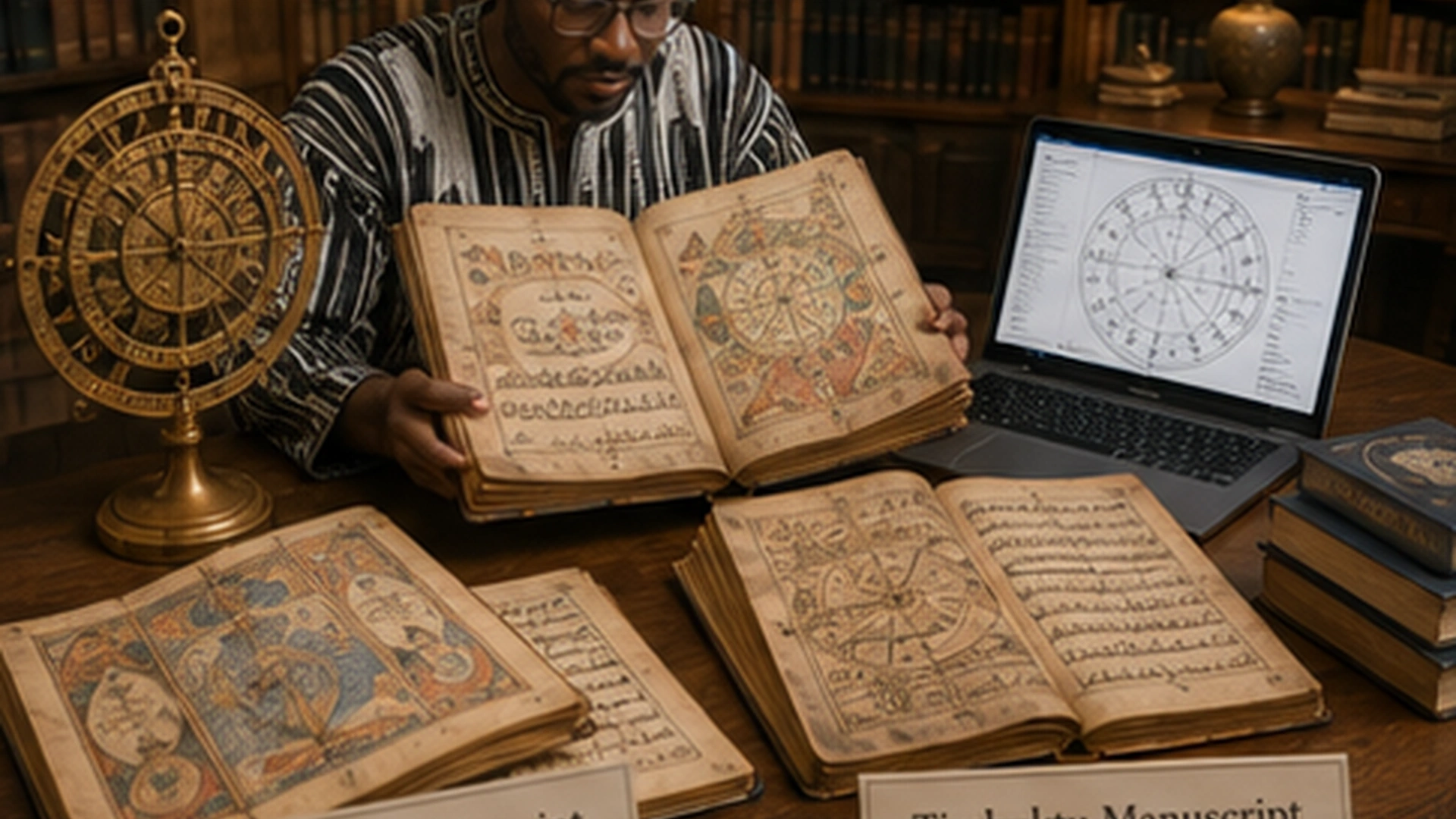
Suggested scene: African researcher comparing medieval Islamic, Timbuktu, European, and modern digital astrology sources in a library, with each tradition clearly separated.
A Comparison of Major Traditions
Tradition
Typical historical focus
Key structures
Important caution
Mesopotamian
Rulers, states, omens, eclipses
Celestial reports, omen series, later zodiac
Not originally modern personality astrology
Hellenistic
Individual horoscopes and fate
Zodiac, houses, aspects, Ascendant
Cross-cultural synthesis, not purely Greek
Indian Jyotisha
Birth, timing, ritual, marriage, life periods
Sidereal zodiac, nakshatras, dashas, divisional charts
Not Western astrology with shifted signs
Chinese
Calendar, state, cosmology, social time
Stems, branches, five phases, animal cycles
Not the same as the ecliptic zodiac
Islamic
Astronomy, courts, medicine, forecasting, art
Planetary tables, zodiac, translated texts
Scholars disagreed about legitimacy
African manuscript traditions
Astronomy, calendars, scholarship, horoscope calculation
Arabic manuscripts, local scholarly networks
Does not represent all African traditions
Medieval European
Medicine, weather, politics, calendars
Zodiac medicine, almanacs, university texts
Historical medicine is not modern evidence
Modern global
Personality, spirituality, media, coaching
Birth charts, apps, hybrid systems
Often mixes traditions without context
What All These Traditions Do Not Share
One universal zodiac
One common theology
One agreed theory of fate
One calendar
One set of planetary rulers
One method of calculating houses
One attitude toward prediction
One relationship with religion
One definition of astrology
Common Misconceptions
“Astrology was invented by one civilization”
False. Western horoscopic astrology emerged through several stages and cultural exchanges.
“Ancient Egypt invented the complete modern zodiac”
False. The standardized twelve-sign zodiac has Babylonian foundations and entered Egypt during the Hellenistic period.
“Chinese astrology is Western astrology with animals”
False. It belongs to different calendrical and cosmological traditions.
“Indian astrology is simply Western astrology using sidereal signs”
False. Jyotisha contains distinct texts, techniques, calendars, and philosophical frameworks.
“All Muslims historically rejected astrology”
False. Views varied, and scholars debated different forms and claims.
“Africa has one ancient zodiac”
False. African celestial traditions are diverse and culturally specific.
“Every sky tradition is astrology”
False. Celestial knowledge may concern calendars, agriculture, navigation, or religion without predictive horoscopes.
“Historical importance proves scientific accuracy”
False. Cultural influence and scientific validation are different questions.
Are Astrological Claims Scientifically Proven?
Astrological traditions contain real astronomical observations, mathematical calculations, historical artifacts, and cultural knowledge.
However, controlled scientific research has not established that natal charts, zodiac signs, or planetary positions reliably determine personality or predict individual events.
Astrology is best studied as cultural history, divination, religion, art, symbolism, or personal reflection rather than established physical science.
This distinction does not erase the intellectual achievements of historical astronomers and astrologers. It prevents symbolic claims from being confused with tested scientific explanations.
Ethical Boundaries
Do not diagnose illness or mental-health conditions from a chart.
Do not predict death as certainty.
Do not guarantee marriage, pregnancy, wealth, legal success, healing, or protection.
Do not use astrology to justify discrimination.
Do not pressure someone to remain in an unsafe relationship.
Do not present invented hybrid systems as ancient community traditions.
Do not demand large payments to remove planetary harm or curses.
Protect birth data and obtain consent before publishing another person’s chart.
How to Study Astrology Across Civilizations Responsibly
Identify the civilization, period, language, and location.
Separate astronomy, astrology, calendrical knowledge, and divination.
Use museums, universities, manuscript libraries, and community-informed scholarship.
Distinguish historical evidence from modern reconstruction.
Avoid treating similar symbols as proof of identical meaning.
Recognize translation, trade, conquest, and colonialism as forces of exchange.
State uncertainty when scholars disagree.
Avoid romanticizing or dismissing a tradition.
Keep scientific claims separate from cultural interpretation.
Respect living religious and cultural communities.
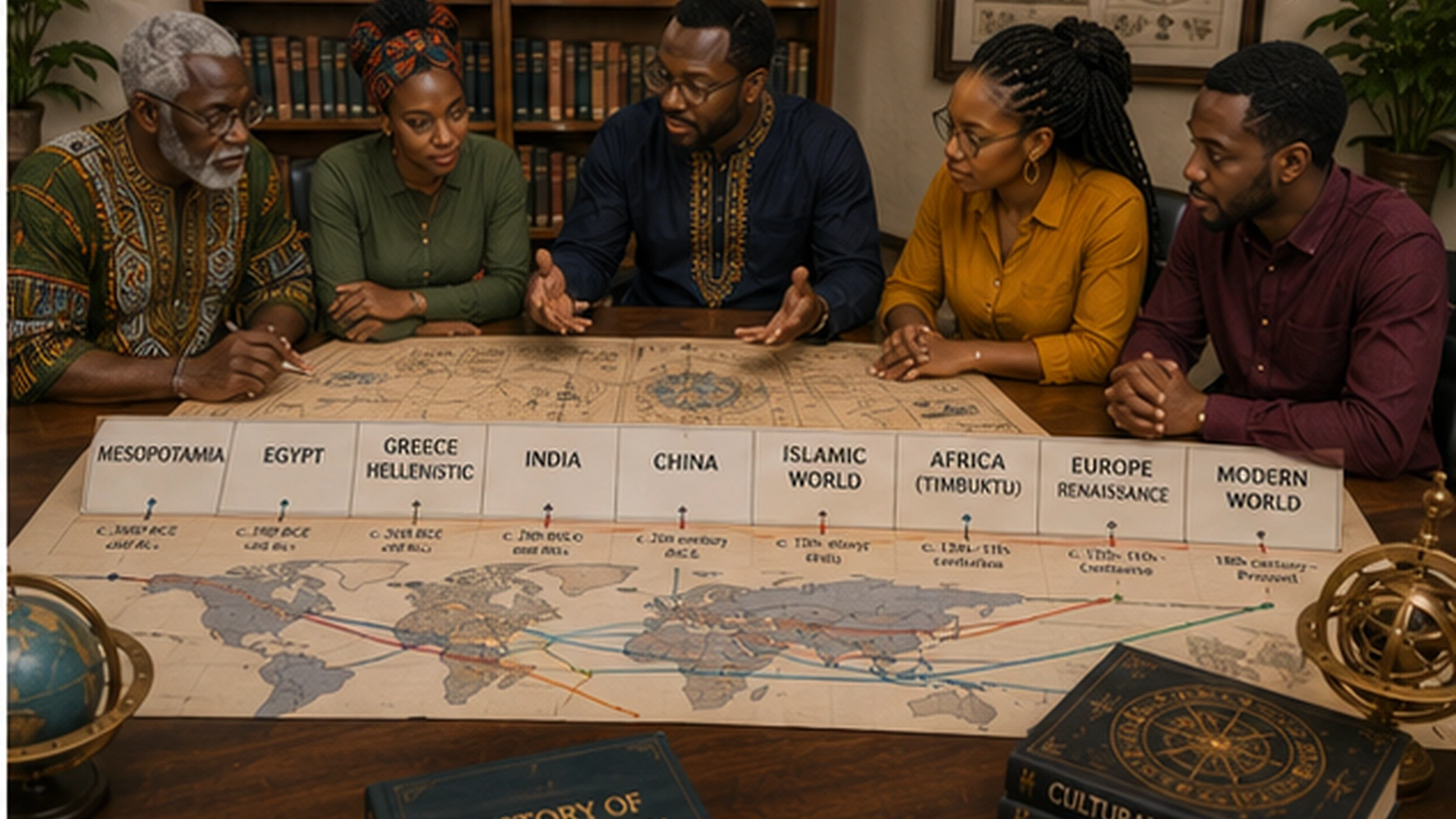
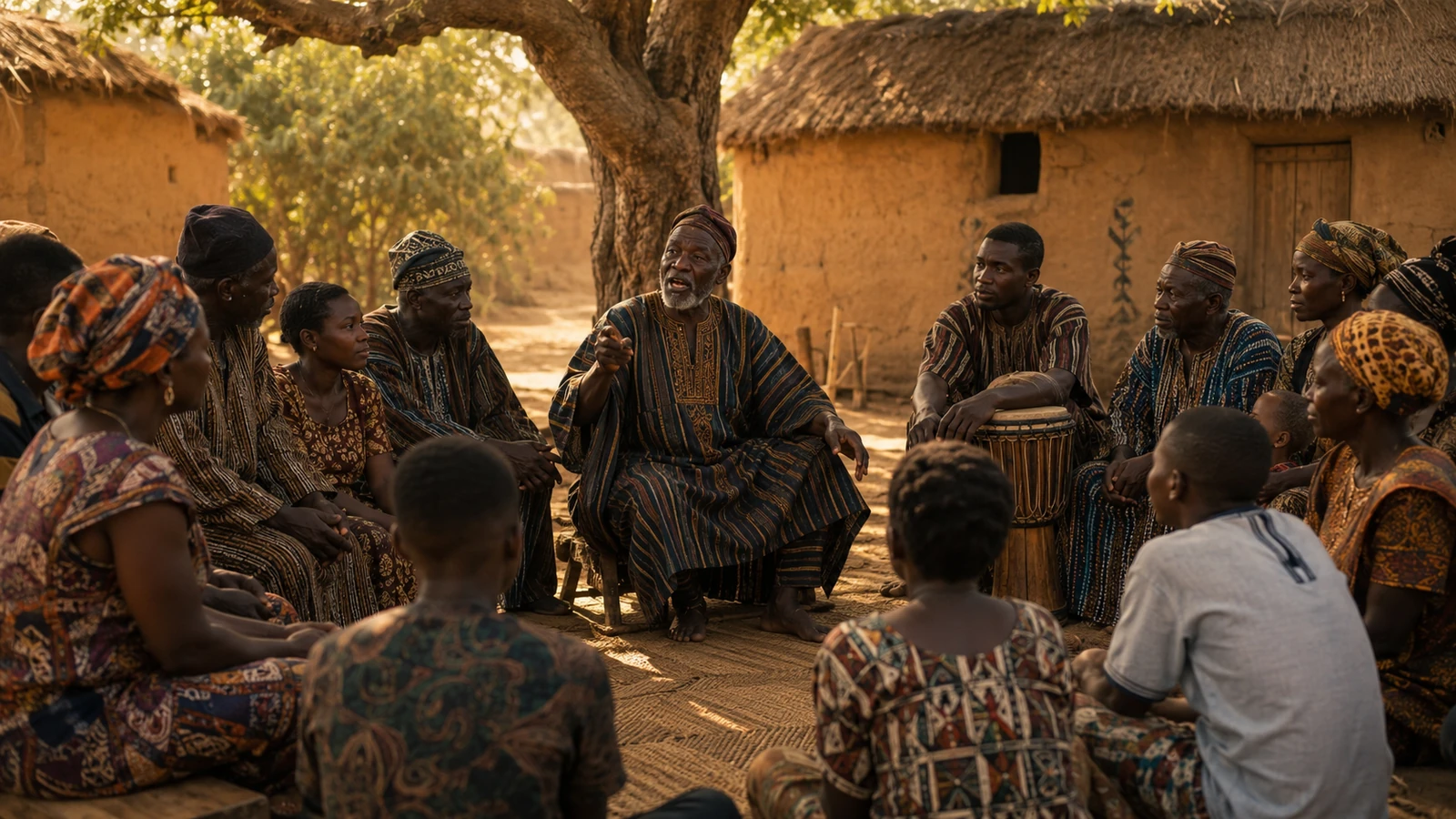
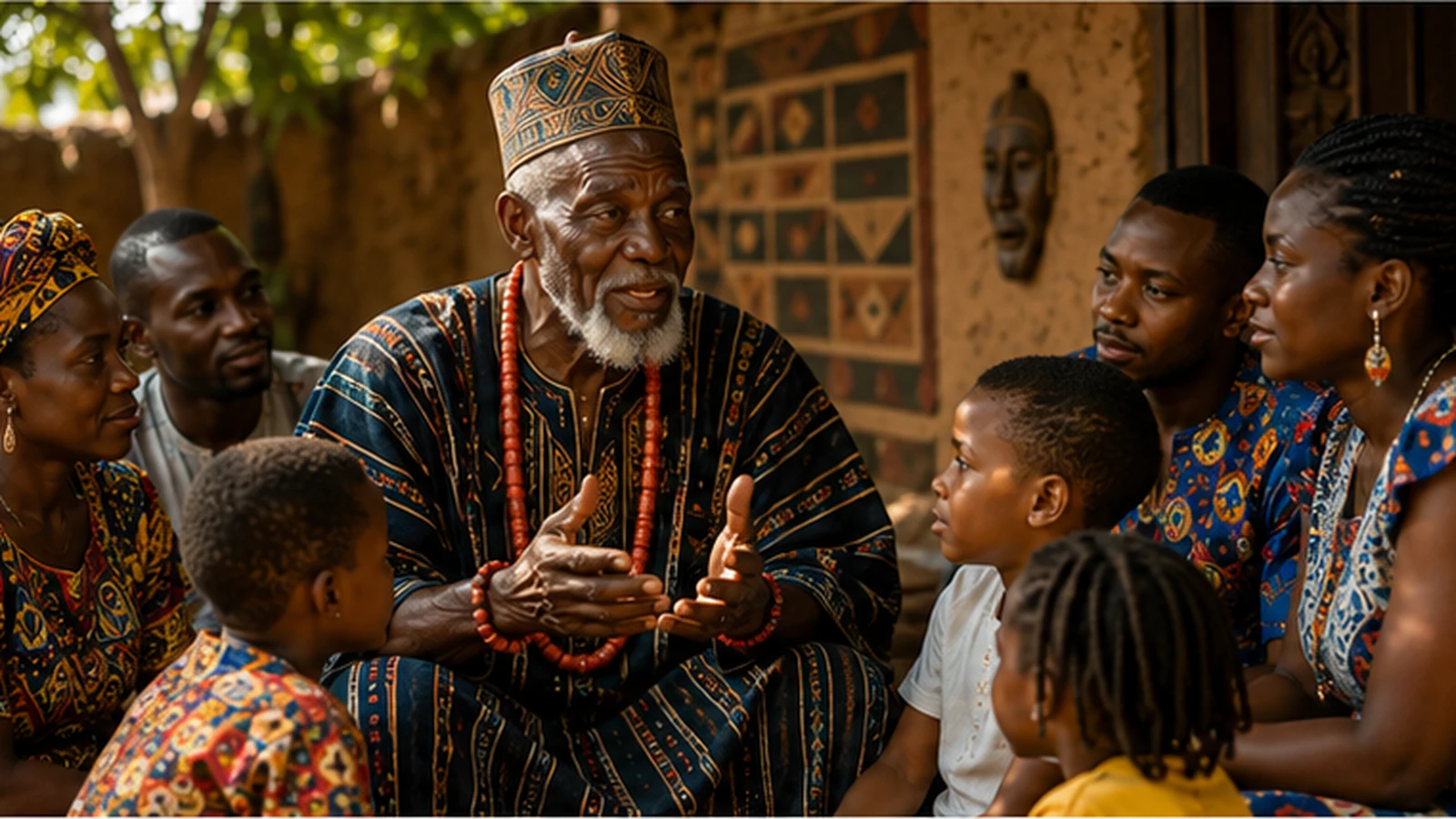
Suggested scene: Multigenerational African study group creating a careful comparative timeline of astrology across civilizations using museum catalogues, manuscript reproductions, and astronomy references.
Key Takeaways
Astrology did not develop as one universal system.
Mesopotamian celestial omens strongly influenced later astrology.
Babylonian scholars standardized the twelve-sign zodiac.
Hellenistic Egypt helped produce technical horoscopic astrology.
Indian Jyotisha transformed imported and local astral sciences into distinct traditions.
Chinese astrology developed through separate calendrical and political cosmologies.
Islamic scholars translated, calculated, debated, and illustrated astrology.
African histories include Egypt, North African scholarship, Timbuktu manuscripts, and many non-astrological sky traditions.
Medieval European astrology influenced medicine, weather forecasting, courts, and education.
Modern astrology often blends traditions and should disclose its sources.
Cultural significance does not establish scientific predictive accuracy.
People Also Ask
Where did astrology begin?
Systematic celestial divination has especially early surviving evidence in Mesopotamia, while later horoscopic astrology developed through Babylonian, Greek, Egyptian, and other interactions.
Did ancient Egypt invent astrology?
Egypt had ancient astronomical and calendrical traditions and later became a major center of Hellenistic astrology, but the standardized twelve-sign zodiac was Babylonian in origin.
Is Indian astrology the same as Western astrology?
No. Jyotisha uses distinct calculations, texts, lunar mansions, planetary periods, and philosophical frameworks.
Is Chinese astrology based on the same zodiac?
No. The Chinese animal cycle and related systems are calendrical and cosmological traditions distinct from the twelve equal ecliptic signs.
Was astrology practiced in Africa?
Yes, including in Greco-Roman Egypt, North African scholarship, and Timbuktu manuscripts, but Africa has no single universal astrology.
What role did Muslim scholars play?
They translated, preserved, corrected, debated, and expanded astronomical and astrological knowledge from Greek, Persian, Indian, and earlier sources.
Are all ancient sky systems astrology?
No. Many systems focus on calendars, navigation, agriculture, ritual, or storytelling without horoscope prediction.
Is astrology scientifically proven?
No. Controlled research has not established astrological charts as reliable predictors of personality or events.
Frequently Asked Questions
1. Where did astrology begin?
Systematic celestial divination has especially early surviving evidence in Mesopotamia, while later horoscopic astrology developed through Babylonian, Greek, Egyptian, and other interactions.
2. Did ancient Egypt invent astrology?
Egypt had ancient astronomical and calendrical traditions and later became a major center of Hellenistic astrology, but the standardized twelve-sign zodiac was Babylonian in origin.
Frequently Asked Questions
What should readers know first about african spirituality and cultural history?
African spirituality and cultural history: Read clear guidance, key signs, practical steps, and private support from Ancestral Temple.
What causes astrology-across-civilizations?
The safest next step is to compare the signs, prepare clear details, and request private guidance when the matter feels personal.
How does astrology-across-civilizations work?
The safest next step is to compare the signs, prepare clear details, and request private guidance when the matter feels personal.
Is it possible to get private guidance for astrology-across-civilizations?
The safest next step is to compare the signs, prepare clear details, and request private guidance when the matter feels personal.
How long does astrology-across-civilizations take to understand?
The safest next step is to compare the signs, prepare clear details, and request private guidance when the matter feels personal.
Can astrology-across-civilizations affect relationships, family, work, or personal peace?
The safest next step is to compare the signs, prepare clear details, and request private guidance when the matter feels personal.
Why do people seek spiritual guidance for astrology-across-civilizations?
The safest next step is to compare the signs, prepare clear details, and request private guidance when the matter feels personal.
What signs should someone notice before asking about astrology-across-civilizations?
The safest next step is to compare the signs, prepare clear details, and request private guidance when the matter feels personal.
When should someone contact a private spiritual guide?
The safest next step is to compare the signs, prepare clear details, and request private guidance when the matter feels personal.
What causes african spirituality and cultural history?
African spirituality and cultural history: Read clear guidance, key signs, practical steps, and private support from Ancestral Temple. The safest next step is to compare the signs, prepare clear details, and request private guidance when the matter feels perso
Article Information
- Publisher
- Ancestral Temple
- Editor
- Ancestral Temple
- Last updated
- Jul 26, 2026
- Last reviewed
- Jul 13, 2026
- Content version
- 27258a83cc
This educational article should be read as cultural and spiritual information, not as medical, legal, financial, or emergency advice.
Helpful Related Guidance
Explore This Topic
What Is Astrology · Spiritual Knowledge
Related Topic Cluster
African Spirituality And Cultural History
Complete Guide Why Homes Have Been Blessed Throughout HistoryAbout the Author
 Ancestral Temple
Spiritual guide and practitioner with decades of experience in ancestral wisdom, rituals, and divine guidance.
Related Posts
View All



Leave a Comment
We'd love to hear your thoughts.
I appreciated the explanation that astrology did not develop as one universal system.
The comparison between different civilizations was careful and easy to follow.