
Solstices and Equinoxes Explained: Meaning, Dates and Differences

Quick Summary
Solstices and equinoxes are four exact astronomical moments that organize the seasonal year. At the two solstices, the Sun reaches its farthest apparent position north or south of...
Solstices and equinoxes are four exact astronomical moments that organize the seasonal year. At the two solstices, the Sun reaches its farthest apparent position north or south of Earth’s celestial equator, producing the year’s greatest contrast in daylight between the hemispheres. At the two equinoxes, the center of the Sun crosses the celestial equator, and both hemispheres receive nearly equal shares of daylight. These events do not create an identical four-season climate everywhere, but they provide a global astronomical framework for tracking the changing Sun, day length and seasonal cycle. [3][4][8]
Their dates are often given as March 20 or 21, June 20 or 21, September 22 or 23, and December 21 or 22. The exact moment shifts because the calendar year is not exactly the same length as the seasonal year, leap-day corrections occur in a four-year pattern, Earth’s orbital speed is not perfectly uniform, and local time zones can place the same instant on different civil dates. [1][2]
Quick Answer
A solstice occurs when the Sun reaches its greatest apparent distance north or south of the celestial equator, giving one hemisphere its longest day and the other its shortest. An equinox occurs when the Sun crosses the celestial equator, bringing nearly equal daylight to both hemispheres. Each happens twice a year.
Solstices and Equinoxes at a Glance
| Event | Astronomical definition | Approximate date | Northern Hemisphere | Southern Hemisphere |
|---|---|---|---|---|
| March equinox | Sun crosses the celestial equator northward | March 19–21 | Astronomical spring begins | Astronomical autumn begins |
| June solstice | Sun reaches greatest northerly declination | June 20–22 | Most daylight; astronomical summer begins | Least daylight; astronomical winter begins |
| September equinox | Sun crosses the celestial equator southward | September 21–24 | Astronomical autumn begins | Astronomical spring begins |
| December solstice | Sun reaches greatest southerly declination | December 20–23 | Least daylight; astronomical winter begins | Most daylight; astronomical summer begins |
The names “spring,” “summer,” “autumn” and “winter” depend on hemisphere. For global writing, March equinox, June solstice, September equinox and December solstice are less ambiguous than “vernal equinox” or “summer solstice.” A June solstice is a summer event north of the equator and a winter event south of it.
What Is a Solstice?
A solstice is the instant when the Sun reaches its maximum apparent northward or southward position in the sky for the year. Astronomers describe this position using solar declination, an angular coordinate measured north or south of the celestial equator. At the June solstice, the Sun’s declination is at its greatest northern value; at the December solstice, it is at its greatest southern value. [10]
The word comes from Latin roots commonly translated as “Sun stands still.” The Sun does not physically stop. Instead, its sunrise and sunset positions, and its noon height, change progressively more slowly as the solstice approaches. The apparent north-south motion then reverses direction. To an observer who marks the horizon over many days, the turning point can look like a pause.
The June Solstice
At the June solstice, Earth’s North Pole is tilted most directly toward the Sun. The Sun is overhead at local solar noon near the Tropic of Cancer, approximately 23.4 degrees north latitude. The Northern Hemisphere receives its longest daylight period of the year, while the Southern Hemisphere receives its shortest. North of the Arctic Circle, the Sun may remain above the horizon for 24 hours; south of the Antarctic Circle, it may remain below the horizon. [4][12]
The December Solstice
At the December solstice, the geometry is reversed. The South Pole is tilted most directly toward the Sun, and the Sun is overhead near the Tropic of Capricorn. The Southern Hemisphere has its longest daylight period, while the Northern Hemisphere has its shortest. The event is therefore not globally a “winter solstice.” It is simultaneously the Northern Hemisphere winter solstice and the Southern Hemisphere summer solstice. [4][8]
What Is an Equinox?
An equinox is the instant when the center of the Sun crosses the plane of Earth’s equator. In sky coordinates, the Sun crosses the celestial equator and its declination is approximately zero. The March crossing is northward; the September crossing is southward. Neither hemisphere is then tilted more toward the Sun than the other, so sunlight is distributed nearly evenly between north and south. [3][4]
The word “equinox” comes from Latin terms for equal and night. That name describes the broad balance of the event, but it should not be read as a guarantee of exactly 12 hours of daylight and 12 hours of darkness at every location. The Sun is a disk rather than a point, sunrise and sunset are defined using its upper edge, and Earth’s atmosphere bends sunlight near the horizon. These effects make the measured daylight period slightly longer than 12 hours on the equinox at many locations. [6]
The March and September Equinoxes
The March equinox begins astronomical spring in the Northern Hemisphere and astronomical autumn in the Southern Hemisphere. The September equinox begins astronomical autumn in the north and spring in the south. Near the equator, the annual temperature pattern may not resemble the four seasons familiar in temperate climates, but the equinox remains a precisely defined astronomical event.
2026 and 2027 Solstice and Equinox Dates
The following times are calculated by the U.S. Naval Observatory in Universal Time. Universal Time provides one global reference; your local clock and even your local calendar date may differ. East Africa Time is UTC+3 throughout the year. [1][2]
| Event | 2026 Universal Time | 2026 East Africa Time | Seasonal meaning |
|---|---|---|---|
| March equinox | 20 March, 14:46 UTC | 20 March, 17:46 EAT | Spring north; autumn south |
| June solstice | 21 June, 08:24 UTC | 21 June, 11:24 EAT | Summer north; winter south |
| September equinox | 23 September, 00:05 UTC | 23 September, 03:05 EAT | Autumn north; spring south |
| December solstice | 21 December, 20:50 UTC | 21 December, 23:50 EAT | Winter north; summer south |
| Event | 2027 Universal Time | 2027 East Africa Time | Seasonal meaning |
|---|---|---|---|
| March equinox | 20 March, 20:25 UTC | 20 March, 23:25 EAT | Spring north; autumn south |
| June solstice | 21 June, 14:11 UTC | 21 June, 17:11 EAT | Summer north; winter south |
| September equinox | 23 September, 06:02 UTC | 23 September, 09:02 EAT | Autumn north; spring south |
| December solstice | 22 December, 02:42 UTC | 22 December, 05:42 EAT | Winter north; summer south |
Because an equinox or solstice is an instant, not a 24-hour festival imposed by nature, it can fall on one date in the Americas and the following date in Asia or Oceania. Articles should therefore include a time zone when giving an “exact date.” A date without a time zone is only an approximate civil-calendar answer.
Why Do the Dates Change From Year to Year?
The seasonal cycle does not fit into an exact whole number of civil days. The tropical year—the interval used to track the cycle of seasons—is about 365.2422 days. A common calendar year has 365 days, so the astronomical moments occur several hours later by the clock from one year to the next. The leap day added in most years divisible by four pulls the calendar back into alignment. Century rules refine the correction further.
Earth’s orbit is also slightly elliptical, and the planet moves faster when nearer the Sun and slower when farther away. That uneven orbital speed means the four astronomical seasons do not have exactly equal lengths. The Gregorian calendar is designed to keep the March equinox near March 20, but it does not force every equinox and solstice to occur on the same date or at the same clock time.
Time zones create another source of apparent disagreement. A September equinox at 00:05 UTC on September 23 occurs at 8:05 p.m. on September 22 in a time zone four hours behind UTC. Both dates can be correct for the same event when the locations differ.
What Causes Solstices, Equinoxes and the Seasons?
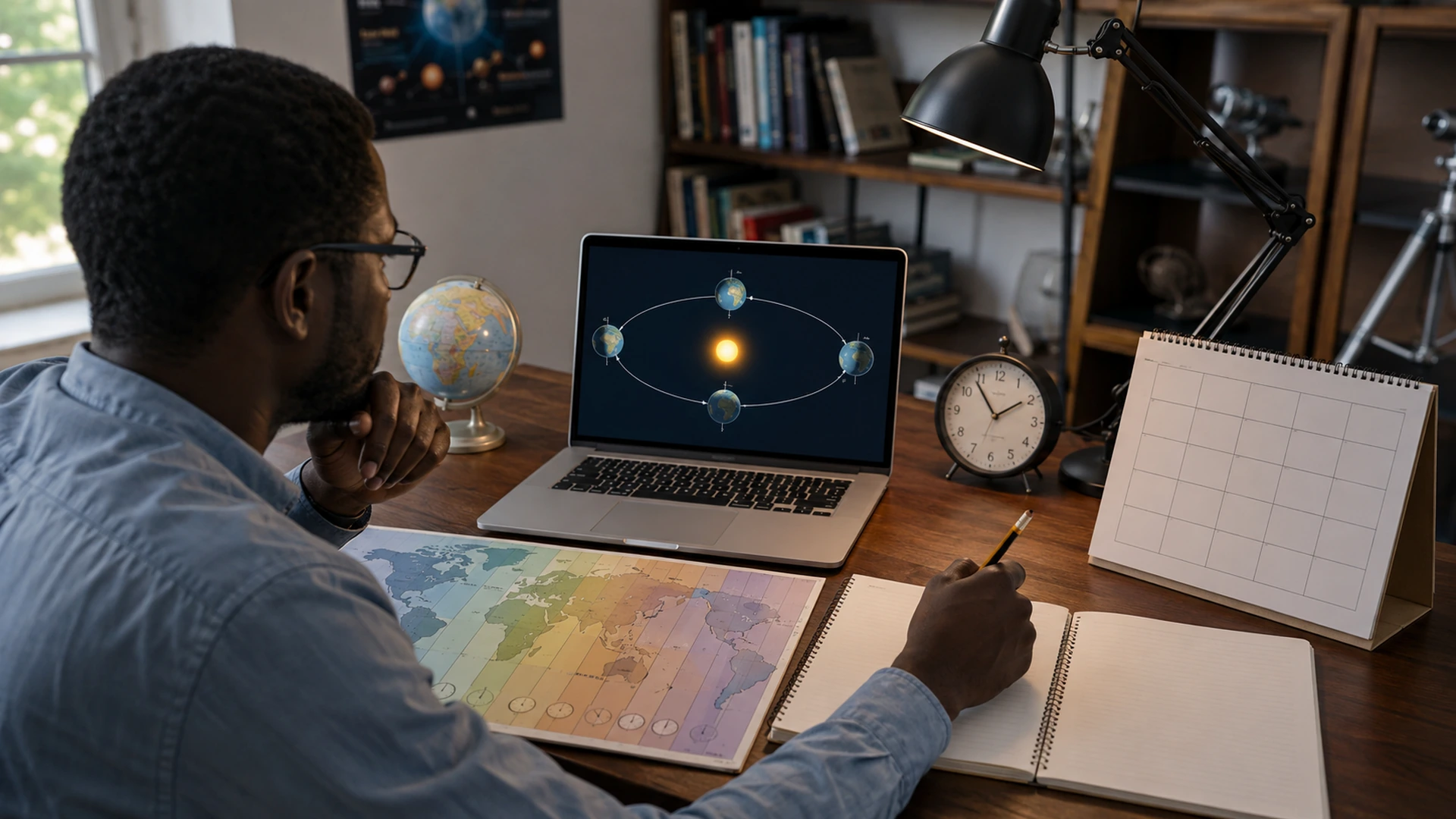
Earth’s rotational axis is tilted by about 23.4 degrees relative to the plane of its orbit around the Sun. The axis keeps nearly the same orientation in space during one orbit. As Earth travels around the Sun, one hemisphere is tilted toward the Sun for part of the year and away from it for the opposite part. The changing angle controls the height of the Sun in the sky, the length of its daily path above the horizon and the concentration of solar energy on the ground. [4][5][8]
When sunlight arrives more directly, the same amount of solar energy is concentrated over a smaller surface area, and the Sun remains above the horizon longer. When the rays arrive at a lower angle, their energy spreads over a larger area and passes through more atmosphere, while the daylight period is shorter. Seasonal temperatures respond to this changing energy input, although oceans, land, winds, altitude and regional climate create a delay and modify the result.
Why Earth’s Distance From the Sun Is Not the Main Cause
Earth’s orbit is not a perfect circle, but distance cannot explain opposite seasons in the two hemispheres. Earth reaches perihelion, its nearest point to the Sun, in early January—during Northern Hemisphere winter and Southern Hemisphere summer. It reaches aphelion, its farthest point, in early July—during Northern Hemisphere summer and Southern Hemisphere winter. The shared distance is the same for the whole planet, while axial tilt directs seasonal sunlight differently to north and south. [1][5]
The Solstice and Equinox as Exact Moments
People often call the entire calendar day “the solstice” or “the equinox,” which is practical in ordinary speech. Astronomically, however, each is a precise instant. The June solstice occurs at the moment the Sun’s apparent declination reaches its maximum northward value. The March equinox occurs when the Sun’s center crosses the celestial equator northward. The daylight pattern around that instant changes continuously rather than switching suddenly.
Solstice vs. Equinox: The Main Differences
| Feature | Solstice | Equinox |
|---|---|---|
| Number each year | Two: June and December | Two: March and September |
| Solar position | Maximum apparent north or south declination | Sun crosses the celestial equator |
| Daylight effect | Greatest contrast: longest in one hemisphere, shortest in the other | North and south receive nearly equal daylight |
| Seasonal role | Begins astronomical summer and winter | Begins astronomical spring and autumn |
| Sunrise and sunset position | Near annual extreme north or south along the horizon | Near the midpoint between annual extremes |
| Meaning of name | “Sun stands still,” referring to the apparent turning point | “Equal night,” referring to approximate balance |
| Common misconception | The Sun or Earth physically stops | Every location has exactly 12 hours of day and night |
Are Day and Night Exactly Equal on the Equinox?
Not usually. In an ideal geometric model, the center of the Sun would spend about 12 hours above the horizon and 12 below when it lies on the celestial equator. Almanac definitions of sunrise and sunset, however, use the upper edge of the Sun’s visible disk. Atmospheric refraction also makes the Sun appear slightly higher than its geometric position near the horizon. Together these effects add minutes of apparent daylight. [6]
The date on which measured day and night are closest to equal is sometimes called the equilux. It generally occurs a few days before the March equinox and a few days after the September equinox in the Northern Hemisphere, with the relationship reversed in the Southern Hemisphere. The exact date depends on latitude, horizon conditions and the sunrise/sunset definition.
At the equator, daylight stays close to 12 hours throughout the year, but it is still usually a little longer than 12 hours when measured from first appearance to final disappearance of the Sun’s upper edge. Near the poles, refraction and the Sun’s shallow angle to the horizon make the simple “equal day and night” phrase even less literal.
Why the Longest Day Is Not Always the Earliest Sunrise
The summer solstice is the day with the greatest total daylight in a hemisphere, but the earliest sunrise and latest sunset may occur on different nearby dates. Civil clock time is affected by the changing difference between apparent solar time and mean time, as well as by longitude within a time zone. The U.S. Naval Observatory notes that the earliest sunrise typically precedes the summer solstice and the latest sunset follows it at many mid-latitude locations. [7]
The same principle applies around the winter solstice: the earliest sunset can occur before the shortest day, while the latest sunrise can occur afterward. This is not a contradiction. The solstice concerns total daylight and solar declination; clock times of sunrise and sunset also reflect the uneven apparent solar day.
How the Events Differ by Latitude
Near the Equator
Near the equator, day length remains close to 12 hours throughout the year. Solstices and equinoxes still occur, but the contrast between longest and shortest day is small. Seasonal life may be organized more strongly by rainfall, wind, river cycles, food availability or agricultural calendars than by four temperature seasons. The Sun can pass nearly overhead twice a year at locations within the tropics, on dates determined by latitude rather than necessarily on an equinox.
In the Tropics
Between the Tropic of Cancer and Tropic of Capricorn, the noon Sun can reach the zenith. At the June solstice it is overhead near the northern tropic; at the December solstice it is overhead near the southern tropic. Communities in tropical regions can therefore observe both annual horizon shifts and overhead-Sun events, but local seasonal meanings vary widely.
At Mid-Latitudes
At mid-latitudes, the annual change in daylight is more pronounced. The summer Sun rises and sets farther toward the poleward side of the horizon, travels higher through the sky and remains visible longer. The winter Sun follows a shorter, lower path. This is the familiar pattern behind many temperate-zone descriptions of four seasons.
Near the Polar Circles
Near and beyond the Arctic and Antarctic Circles, the solstices mark the extremes of midnight Sun and polar night. At the equinoxes, the Sun crosses the celestial equator, but the local transition from continuous day to continuous night—or the reverse—takes place over a period affected by refraction and the Sun’s finite disk.
Astronomical Seasons vs. Meteorological Seasons
Astronomical seasons begin at the equinoxes and solstices, so their starting times vary slightly each year. Meteorological seasons use fixed three-month blocks to simplify climate records and comparisons. In the Northern Hemisphere, meteorological spring is March through May, summer is June through August, autumn is September through November and winter is December through February. The Southern Hemisphere uses the opposite seasonal names for those same month blocks. [9][13]
Neither system is universally superior. Astronomical seasons are based on Earth-Sun geometry. Meteorological seasons are practical for temperature statistics and forecasting. Many societies also use ecological, agricultural, religious or indigenous seasonal systems that do not divide the year into four equal parts.
Cultural and Historical Meaning
Human communities have watched the changing sunrise, sunset and noon Sun for thousands of years. These observations could help organize travel, planting, herding, harvest, ritual gatherings and political calendars. However, the meaning of a solar alignment cannot be assumed from geometry alone. Archaeologists distinguish what a structure demonstrably measures from what its builders may have believed, and interpretations can change as new evidence appears.
Nabta Playa in Southern Egypt
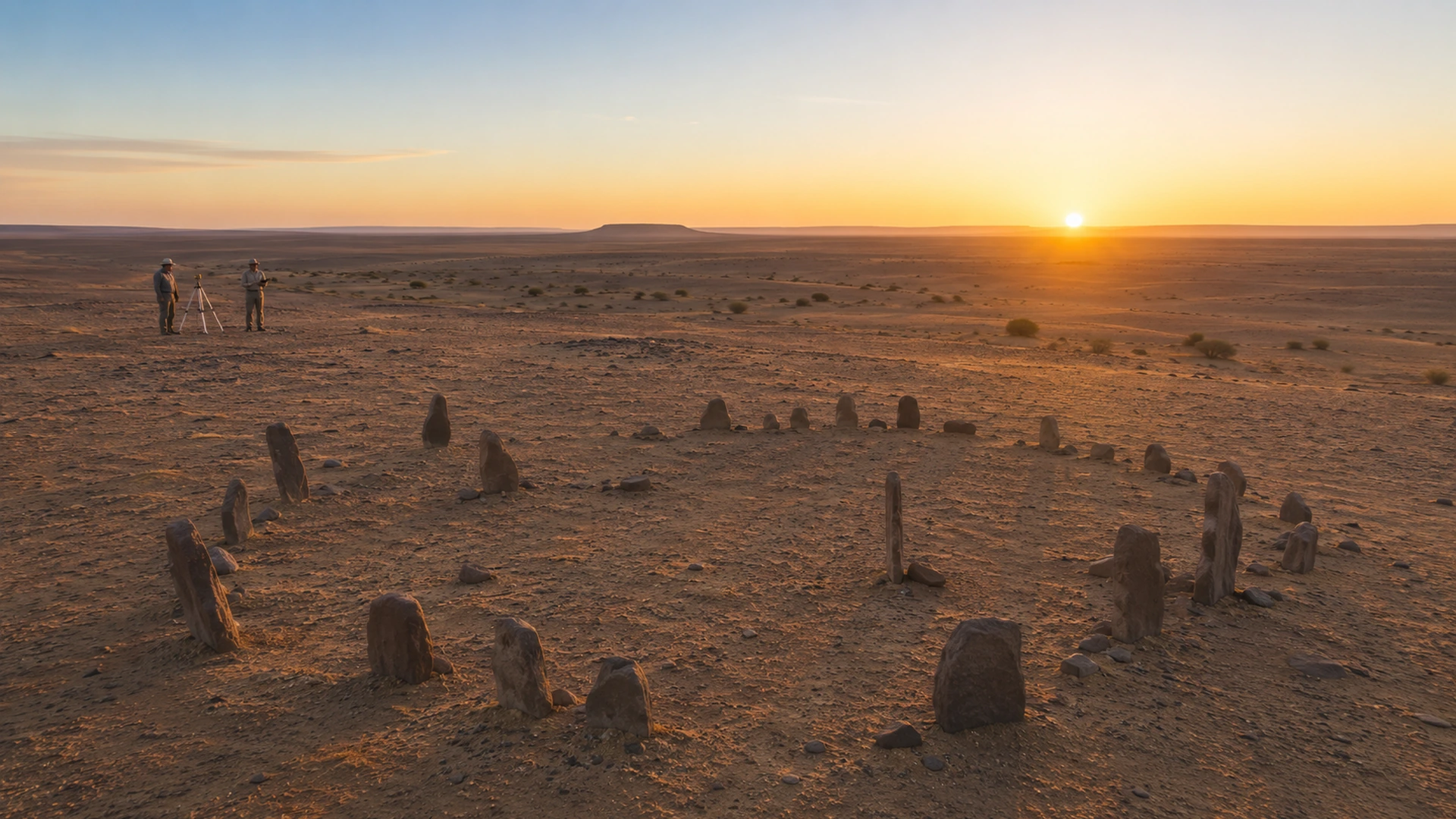
At Nabta Playa in Egypt’s Western Desert, stone arrangements have been interpreted by researchers as including north-south and summer-solstice alignments. The Smithsonian National Museum of African Art presents the site as an early calendar circle connected with stellar and solstitial observation, while university archaeological summaries describe a Neolithic pastoral landscape whose social and ceremonial meanings remain a subject of research. [11][14]
Nabta Playa should not be described as proof of one timeless “African solstice religion.” It belongs to a particular prehistoric environment and community history in northeastern Africa. The archaeological evidence supports careful discussion of sky observation and seasonal organization; it does not justify inventing ceremonies or claiming that all later African traditions descend from the site.
Chankillo in Peru
The UNESCO-listed Chankillo Archaeoastronomical Complex in Peru offers unusually strong evidence for systematic horizon observation. Its line of thirteen towers and observation points allowed solar rising and setting positions to be tracked across the year. UNESCO describes the complex as a calendrical instrument capable of marking solstices, equinoxes and other dates to within roughly one or two days. [10]
Chankillo shows that ancient solar observation was not limited to one region. Different societies developed distinct architectures, calendars and ceremonial systems in response to their landscapes. Comparison is useful when it respects those differences rather than merging them into a single imaginary ancient tradition.

Symbolic and Spiritual Interpretations
In modern spiritual writing, solstices are often associated with turning points, extremes, death-and-renewal imagery or the return of light. Equinoxes are frequently associated with balance, transition and reciprocity. These themes can be meaningful within a personal or community practice, but they are interpretations rather than universal properties measured by astronomy.
Cultural accuracy requires naming the community, place, period and source whenever a specific tradition is described. A contemporary wellness ritual should not be presented as an unchanged ancient ceremony. A European midwinter festival should not be treated as a global human custom. An African seasonal practice should not be generalized across the continent.
The scientific event and the cultural event may also have different boundaries. The astronomical solstice is a precise instant. A festival may last one night, several days or an entire season. Communities may schedule observances by a civil calendar, a lunar calendar, an agricultural sign or the nearest weekend rather than the calculated instant.
Common Misunderstandings
“The solstice lasts all day.” The solstice is an instant, although people commonly use the word for the civil day containing it.
“The equinox guarantees exactly 12 hours of day and night.” Day and night are close to equal, but the Sun’s disk and atmospheric refraction usually make daylight longer.
“Summer happens because Earth is closer to the Sun.” Axial tilt is the main cause; the hemispheres have opposite seasons at the same Earth-Sun distance.
“June is the global summer solstice.” June is summer in the Northern Hemisphere and winter in the Southern Hemisphere.
“The Sun rises due east everywhere on the equinox.” For an ideal level horizon and standard geometry, sunrise is near due east, but local topography, refraction and high-latitude effects complicate direct observation.
“Every culture celebrated the same four dates.” Societies used many calendars and seasonal markers. Similar sky events did not produce one universal ritual system.
“Weather changes immediately at the event.” The events mark astronomical geometry; seasonal temperature often lags because land and oceans store heat.

How to Observe Solstices and Equinoxes Responsibly
Choose a fixed observation point with a broad eastern or western horizon and record the exact location.
Observe the sunrise or sunset position every one or two weeks, rather than only on the four named dates. The annual movement becomes clearer as a sequence.
Use a compass carefully and account for the difference between magnetic north and true north if precision matters.
Photograph the horizon from the same position with the same framing. Do not trespass on archaeological, sacred or private land.
Never stare directly at the Sun. Use indirect observation, ordinary landscape awareness, or properly certified solar-viewing equipment. Do not look through cameras, binoculars or telescopes without a correctly mounted solar filter designed for the instrument. [15]
Record weather, horizon obstructions and clock time. Clouds and local terrain can hide the exact event even though the astronomical instant still occurs.
When visiting a heritage site, follow local rules and respect cultural custodians. Do not move stones, create new alignments or stage an invented ceremony for photographs.
Key Takeaways
Solstices occur when the Sun reaches its greatest apparent northward or southward declination.
Equinoxes occur when the Sun crosses the celestial equator.
The June and December solstices produce opposite seasonal effects in the Northern and Southern Hemispheres.
Day and night are nearly—but generally not exactly—equal on the equinox.
Earth’s axial tilt, not its changing distance from the Sun, is the main cause of the seasons.
Exact dates shift because the tropical year, leap-year calendar and time zones do not align perfectly.
Cultural meanings are diverse and should be tied to specific communities, evidence and historical periods.
The safest observation does not require looking directly at the Sun.
People Also Ask
What is a solstice in simple terms?
A solstice is the moment the Sun reaches its farthest apparent position north or south in the sky. It gives one hemisphere its longest daylight period and the other its shortest.
What is an equinox in simple terms?
An equinox is the moment the Sun crosses Earth’s equatorial plane. Both hemispheres then receive nearly equal amounts of daylight.
What is the main difference between a solstice and an equinox?
A solstice marks an extreme in the Sun’s north-south position and in seasonal daylight. An equinox marks a crossing of the celestial equator and a near balance of daylight between hemispheres.
What are the four annual events?
They are the March equinox, June solstice, September equinox and December solstice.
Why do the dates change?
The seasonal year is about 365.2422 days, not exactly 365. Leap-year corrections, uneven orbital speed and time zones shift the civil date and clock time.
Are day and night equal on the equinox?
They are close, but usually not exactly equal because the Sun has a visible disk and the atmosphere refracts sunlight near the horizon.
Does the whole world experience the same solstice?
The astronomical instant is global, but its seasonal meaning is opposite in the two hemispheres and its civil date can differ by time zone.
Do solstices and equinoxes cause immediate weather changes?
No. They mark changes in Earth-Sun geometry. Local weather varies, and seasonal temperatures often lag because Earth’s surface and oceans store heat.
Frequently Asked Questions
Can a solstice occur on June 19 or December 23?
Within the modern Gregorian calendar, dates cluster in a narrow range and can change over long periods. For practical current-year publishing, use an authoritative astronomical calculation rather than a permanent date rule.
Is the March equinox always on March 21?
No. In the twenty-first century it commonly occurs on March 19 or 20 in Universal Time; local dates depend on time zone.
Is the equinox a good time to balance an egg?
Eggs can be balanced on many days with patience and a suitable surface. No special gravitational effect at the equinox makes balancing uniquely possible.
Why is it still cold after the winter solstice?
The winter solstice marks minimum daylight, not minimum stored heat. Land and especially oceans take time to cool, so the coldest average period often follows later.
Why is it still hot after the summer solstice?
Maximum daylight occurs at the solstice, but Earth’s surface and oceans continue absorbing and retaining heat. This seasonal lag often places the hottest average weather later.
Can equinoxes and solstices be observed from Uganda?
Yes. The events are global. Near the equator, the change in day length is modest, but observers can track shifting sunrise and sunset positions, solar altitude and overhead-Sun dates.
Are solstice celebrations scientifically proven to change energy or health?
No scientific evidence shows that the astronomical instant guarantees spiritual, medical, fertility, financial or protective outcomes. Communities may still value the event culturally or spiritually.
Should “vernal equinox” be used in global writing?
Use it only with a hemisphere. “March equinox” and “September equinox” are clearer because spring and autumn occur in opposite hemispheres.
Conclusion
Solstices and equinoxes are the four principal turning points of the astronomical seasonal year. Solstices mark the Sun’s farthest apparent movement north or south and the greatest daylight contrast between hemispheres. Equinoxes mark the Sun’s crossing of the celestial equator and a near balance of daylight across the planet. The dates shift slightly, the local experience changes with latitude, and the same event carries opposite seasonal labels north and south.
Their human importance is broader than one scientific definition. Communities have used the changing Sun to organize calendars, subsistence, architecture, gatherings and symbolic reflection. Responsible interpretation begins by keeping the astronomy accurate, the history traceable and cultural meanings specific to the people and places that hold them.
Final Summary
A solstice is an annual extreme; an equinox is an equatorial crossing. Both are exact instants produced by Earth’s axial tilt and orbit. They do not create identical seasons everywhere, and they do not carry one universal spiritual meaning. Used carefully, they offer a powerful framework for understanding how measurable sky cycles, local environments and human calendars meet.
Research Sources and Further Reading
[1] U.S. Naval Observatory, Astronomical Applications Department. Earth’s Seasons - Equinoxes, Solstices, Perihelion, and Aphelion: 2026. Universal Time calculations for the 2026 seasonal events.
[2] U.S. Naval Observatory, Astronomical Applications Department. Earth’s Seasons - Equinoxes, Solstices, Perihelion, and Aphelion: 2027. Universal Time calculations for the 2027 seasonal events.
[3] NASA Science / Night Sky Network. Embracing the Equinox. Updated March 2026; definitions, 2026 equinox times and explanation of unequal day and night.
[4] NASA Earth Observatory. Seeing Equinoxes and Solstices from Space. Earth-satellite view of seasonal illumination and axial tilt.
[5] NASA Space Place. What Causes the Seasons?. Explanation of axial tilt and correction of the Earth-distance misconception.
[6] U.S. Naval Observatory. Length of Day and Night at the Equinoxes. Sunrise/sunset definitions, solar semidiameter and atmospheric refraction.
[7] U.S. Naval Observatory. Sunrise and Sunset Times Near the Solstices. Why earliest sunrise and latest sunset do not necessarily occur on the solstice.
[8] NOAA National Environmental Satellite, Data, and Information Service. Changing of the Seasons. Solstice, equinox and seasonal-light explanation.
[9] UK Met Office. Understanding Equinoxes and Solstices. Astronomical events, daylight nuance and seasonal definitions.
[10] UNESCO World Heritage Centre. Chankillo Archaeoastronomical Complex. Evidence for a solar calendrical landscape in Peru.
[11] Smithsonian National Museum of African Art. African Cosmos: Stellar Arts. Nabta Playa, Timbuktu astronomical manuscripts and African sky knowledge.
[12] NASA Scientific Visualization Studio. Solstice Animations. Visual explanation of Earth’s tilt and solstice geometry.
[13] NOAA National Weather Service. Meteorological and Astronomical Seasons. Difference between fixed meteorological seasons and astronomical seasons.
[14] University of Colorado Boulder. Oldest Astronomical Megalith Alignment Discovered in Southern Egypt. Research summary of proposed Nabta Playa summer-solstice alignments.
[15] NASA Science. Eclipse Viewing Safety. Solar-viewing safety and indirect pinhole-projection guidance.
Editorial maintenance note: Update the current-year date table annually using an authoritative astronomical source. Preserve the scientific/cultural distinction and review heritage claims when new archaeological research is published.
Article Information
- Publisher
- Ancestral Temple
- Editor
- Ancestral Temple
- Last updated
- Jul 26, 2026
- Last reviewed
- Jul 26, 2026
- Content version
- b676773f93
This educational article should be read as cultural and spiritual information, not as medical, legal, financial, or emergency advice.
Helpful Related Guidance
Explore This Topic
Related Topic Cluster
Dreams & Symbolism
About the Author
 Ancestral Temple
Spiritual guide and practitioner with decades of experience in ancestral wisdom, rituals, and divine guidance.
Related Posts
View All












Leave a Comment
We'd love to hear your thoughts.