
Great Zimbabwe: History, Culture, Architecture and Spiritual Heritage
Quick Summary
Great Zimbabwe was a major precolonial African city built by ancestors of Shona-speaking communities in what is now southeastern Zimbabwe. From the eleventh century onward, residen...
Great Zimbabwe was a major precolonial African city built by ancestors of Shona-speaking communities in what is now southeastern Zimbabwe. From the eleventh century onward, residents transformed a granite landscape into an extensive capital containing monumental dry-stone walls, earthen houses, courtyards, craft areas, water features, livestock spaces and sacred places. At its height, especially between the thirteenth and fifteenth centuries, the city stood at the centre of a powerful regional state and participated in trade networks extending toward the Indian Ocean.
Its importance is larger than the famous Great Enclosure. Great Zimbabwe demonstrates a distinctive form of African urbanism shaped by local materials, political ideas, household life, farming, cattle, craft skill, ancestry and landscape. It also exposes how colonial racism distorted archaeology: early European writers refused to accept that Africans had built the city, even when the material evidence pointed clearly to local origins.
Today, Great Zimbabwe is a UNESCO World Heritage Site, a national symbol and a place that remains spiritually meaningful to communities connected with the landscape. A responsible history therefore has to combine archaeology, African scholarship, heritage conservation and respect for living cultural authority. [1][2]
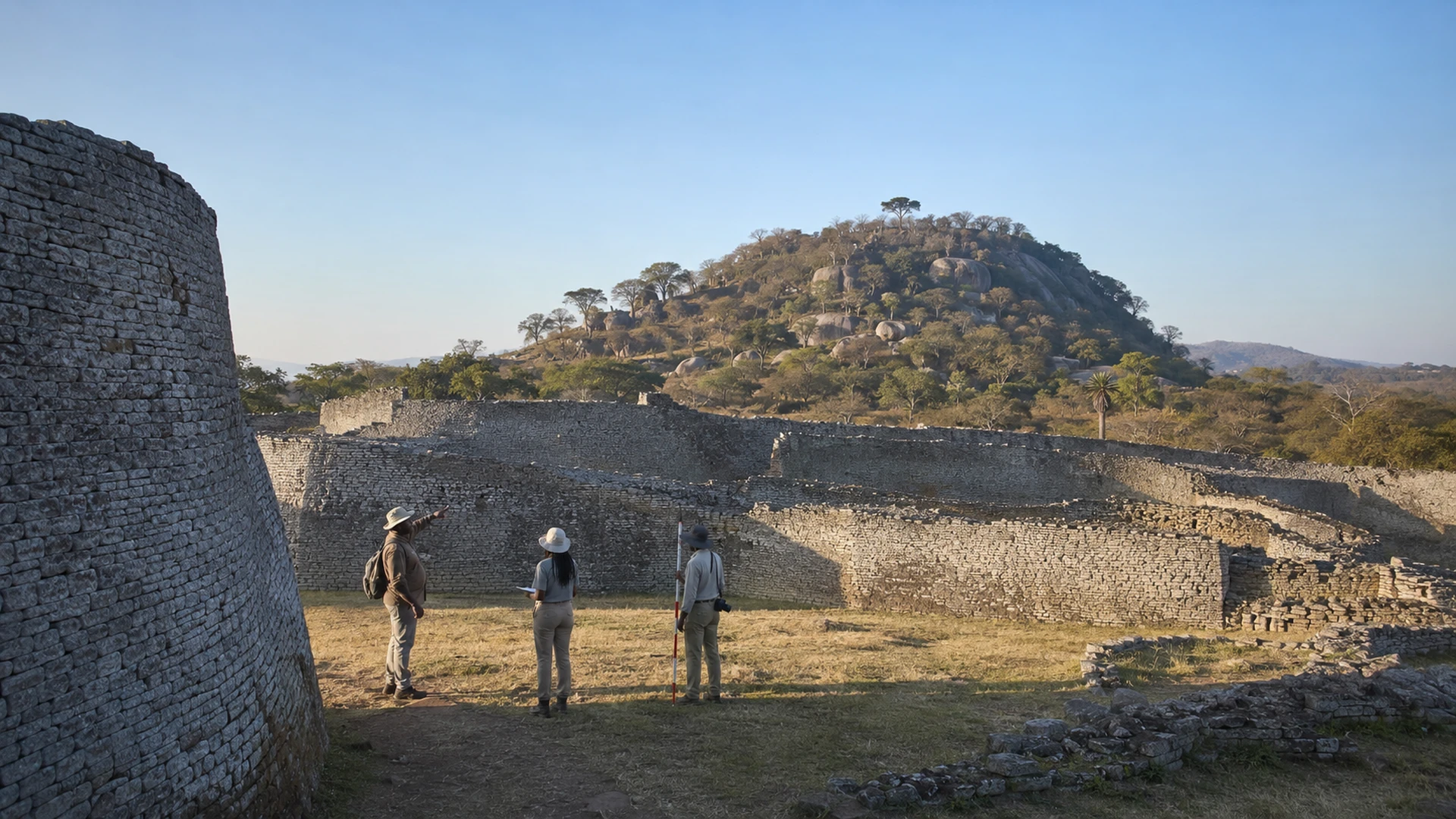
Specific culture or historical context: Present-day Great Zimbabwe National Monument near Masvingo, interpreted by Zimbabwean heritage professionals.
People shown: Three Black Zimbabwean adults in modern field clothing; no anonymous costumed crowd.
Location: Great Enclosure with the Hill Complex visible beyond.
Clothing: Contemporary practical heritage-field clothing, sun hats where appropriate, neutral colours.
Architecture: Archaeologically recognizable dry-stone walls, curved enclosure and distant granite hill; no invented towers or pyramids.
Objects: Field notebook, camera and measuring staff used unobtrusively.
Lighting: Warm sunrise with realistic stone texture and natural shadows.
Composition: 16:9 landscape; monument dominates the frame, people small enough to provide scale, clean sky and negative space suitable for website cropping.
SEO-friendly filename: great-zimbabwe-history-culture-architecture.webp
Image title: Great Zimbabwe: City of Stone and Living Heritage
Alt text: Zimbabwean heritage guide and archaeology students overlooking the Great Enclosure and Hill Complex at Great Zimbabwe
Caption: Great Zimbabwe combines monumental dry-stone architecture, extensive residential landscapes and continuing cultural significance.
Recommended placement: After the introduction and before Quick Answer.
Article section supported: Introduction, definition and significance.
Important elements to avoid: No foreign explorers as central figures, no fantasy palace, no Egyptian pyramids, no jungle overgrowth, no embedded text, logos, watermarks or exaggerated ruin damage.
Quick Answer
Great Zimbabwe was a large African city and capital built by ancestors of Shona-speaking peoples from about the eleventh century. It is important for its sophisticated dry-stone architecture, extensive urban landscape, farming and craft economy, regional political power, Indian Ocean-linked trade, sacred associations and role as a modern symbol of Zimbabwean identity.
What Was Great Zimbabwe?
Great Zimbabwe was a city, political centre and cultural landscape rather than a single palace or fort. The surviving archaeological property includes three famous monumental zones—the Hill Complex, Great Enclosure and Valley Enclosures—but settlement extended beyond those stone structures. Residents lived in circular houses built from dhaka or daga, a carefully prepared earth material, and used courtyards, work areas, livestock spaces, paths, springs and water-storage features.
UNESCO dates the major monumental city mainly between about 1100 and 1450 CE, while newer archaeological studies use broader ranges extending into the seventeenth century because different areas were built, occupied, reused or remembered at different times. The safest summary is that Great Zimbabwe rose from earlier farming settlements, expanded dramatically from the eleventh century, reached greatest political and architectural prominence between the thirteenth and fifteenth centuries, and continued to have later occupation and spiritual significance after the principal centre of power shifted. [1][2][5]
The name Zimbabwe is commonly connected with Shona expressions translated as “houses of stone” or “venerated houses.” The exact linguistic history is discussed by scholars, but the word became associated with the stone-built centres found across the Zimbabwean plateau. Great Zimbabwe is the largest and most celebrated among hundreds of related stone-walled sites in southern Africa. [2]
Great Zimbabwe Dates and Historical Timeline
| Period | Approximate dates | What the evidence suggests |
|---|---|---|
| Earlier settlement | Before the 11th century | Farming communities occupied the wider landscape before monumental construction. |
| Early urban growth | 11th–12th centuries | Population increased, political authority developed and stone walling expanded. |
| Major expansion | 13th–14th centuries | Great Zimbabwe became a leading regional capital; monumental enclosures, craft production and long-distance connections intensified. |
| Height of the city | 14th–early 15th centuries | The city supported a large population and its state influenced much of the Zimbabwean plateau. |
| Political and demographic shift | Mid-15th–16th centuries | Power and population redistributed toward centres including Khami and polities associated with Mutapa; Great Zimbabwe was not simply erased overnight. |
| Later occupation and sacred use | 16th century onward | Parts of the landscape continued to be inhabited, visited, remembered or used for spiritual purposes. |
| World Heritage recognition | 1986 | UNESCO inscribed Great Zimbabwe National Monument on the World Heritage List. |
These dates should not be treated as exact boundaries for every building. Radiocarbon dating, imported ceramics, glass-bead chronologies and stratigraphy provide ranges, while early destructive digging removed some contexts. Contemporary archaeological work continues to refine the sequence. [5][7]
Who Built Great Zimbabwe?
Great Zimbabwe was built by African communities ancestral to Shona-speaking peoples. Local granite, pottery sequences, settlement continuity, food remains, metalworking evidence, building techniques and radiocarbon dates all connect the city with regional African history.
This conclusion is not a recent political invention. In the early twentieth century, archaeologists David Randall-MacIver and Gertrude Caton-Thompson used stratigraphy, pottery and comparative evidence to reject claims that Phoenicians, Arabs, Israelites or other outsiders had built the ruins. Later research has made the African authorship even clearer.
The phrase “the Shona” must still be used carefully. Great Zimbabwe existed across several centuries, and the people who lived there did not necessarily organize identity exactly as modern ethnic categories do. It is more accurate to speak of ancestors of Shona-speaking communities and of the broader Zimbabwe tradition than to imagine one uniform group unchanged through time.
Why Was Great Zimbabwe Important?
Great Zimbabwe was important because it brought together political authority, a large population, monumental building, household production, cattle wealth, agriculture, metallurgy, regional exchange and sacred legitimacy in one influential centre.
Its importance can be summarized in six points:
For modern Zimbabwe, the site is also a national symbol. The country took its name from the ruins, and the Zimbabwe Bird appears on the national flag and other state emblems.
Great Zimbabwe Urbanism and Architecture
Great Zimbabwe’s urbanism cannot be understood by asking whether it resembled a compact medieval European city. Its built environment was dispersed across hills and valleys, with dense monumental zones connected to residential compounds, agricultural areas, water sources and routes through the landscape.
This is an important principle in African urban archaeology: cities may organize population, authority, production and ritual without a rectangular street grid or continuous stone buildings. Much of Great Zimbabwe’s architecture was made from earth, timber and thatch, materials that leave less visible remains than granite walls. Focusing only on stone can make the city appear emptier and more exclusively elite than it really was. [5][9]
The Hill Complex
The Hill Complex occupies a granite rise overlooking the settlement. It contains layers of walls, narrow passages, terraces and enclosures shaped around natural rock. UNESCO describes parts of it as associated with royal residence and ritual activity, while scholars debate how particular spaces changed over time.
Its elevated position made the hill visually powerful, but height should not automatically be translated into one fixed social meaning. Different rulers, households or ritual authorities may have used the complex in different periods. The Eastern Enclosure is especially important because six of the carved soapstone birds were found there.
The Great Enclosure
The Great Enclosure is the best-known structure at the site. Its curving outer wall is approximately 252 metres in circumference and reaches about 11 metres at its highest point. The wall is broad at the base and narrows upward, a practical engineering form that also creates a commanding visual surface. [2]
Inside are smaller walls, house remains, open spaces, a narrow parallel passage and the Conical Tower. The exact functions of these features remain debated. Earlier interpretations sometimes labelled the Great Enclosure a temple, palace, initiation centre or royal women’s residence as though one answer had been proven. Current scholarship is more cautious: the enclosure may have had changing residential, political, ceremonial and symbolic uses across time.
The Conical Tower is solid rather than hollow. Its shape has inspired comparisons with granaries, symbols of authority, male power or agricultural abundance, but none of these interpretations should be presented as certain fact.
The Valley Enclosures
The Valley Enclosures consist of multiple walled residential complexes spread through lower ground. They show that urban life was not confined to the hill or the Great Enclosure. House floors, courtyards, passages, pottery and everyday objects indicate occupation by families and communities with different resources and roles.
Newer scholarship challenges the idea that imported goods and high-quality walling map neatly onto a permanent division between elite and commoner. Social position may have been situational, relational and changeable. A household could gain authority through ancestry, cattle, skill, ritual office, marriage networks or access to land—not only through possession of foreign objects. [4]
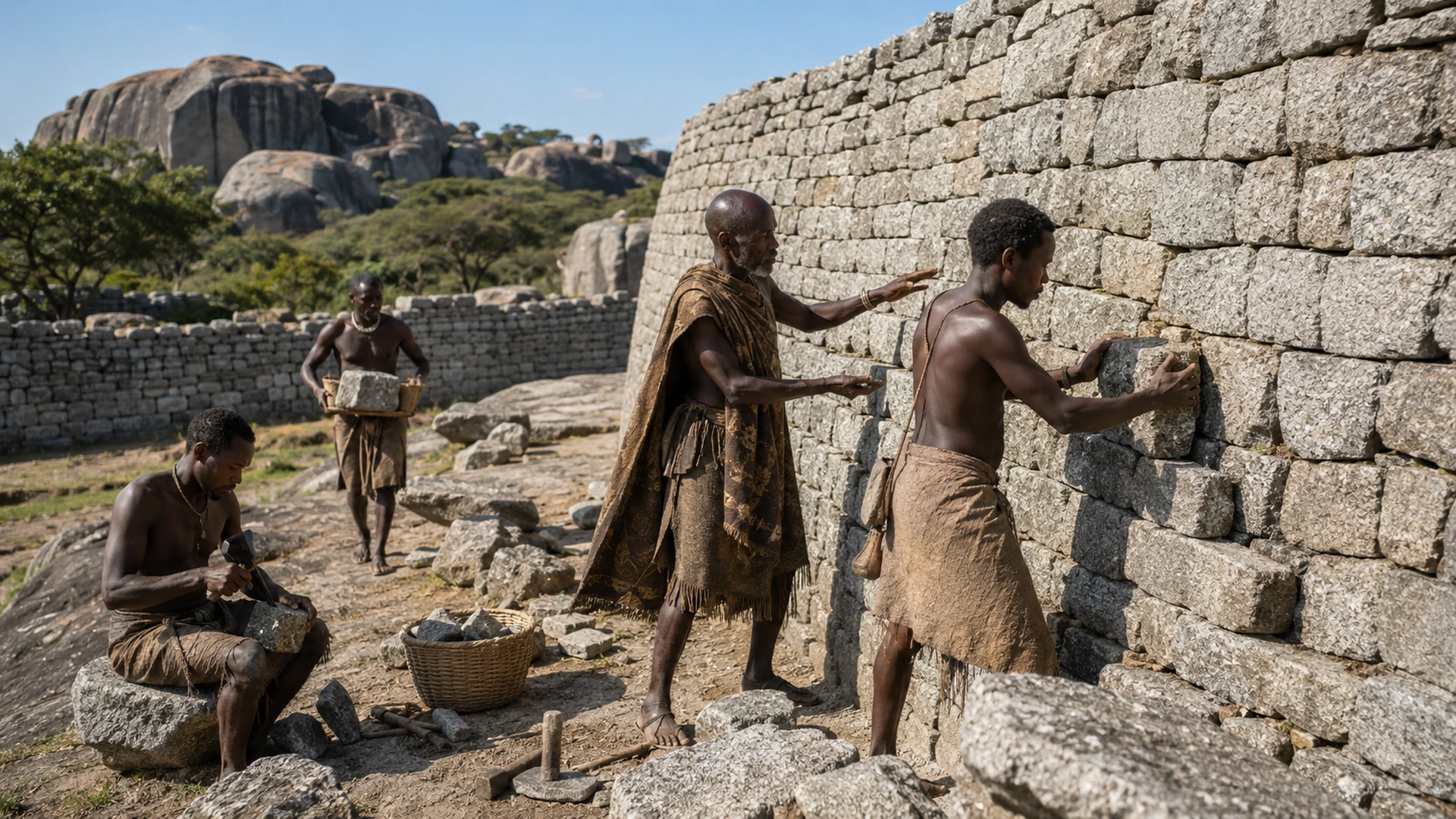
Specific culture or historical context: Great Zimbabwe during major construction between the thirteenth and fifteenth centuries; ancestors of Shona-speaking communities.
People shown: Black African adult craftspeople of different ages, including an experienced master builder guiding younger workers.
Location: Construction area near one of the enclosures, with granite outcrops visible.
Clothing: Simple, historically plausible southern African woven or hide garments; no Maasai, West African, Egyptian or modern construction clothing.
Architecture: Accurate dry-stone granite wall with curved alignment and no mortar.
Objects: Granite blocks, wooden carrying supports, stone hammers and baskets; no modern cement or metal scaffolding.
Lighting: Clear morning light revealing stone texture and careful hand placement.
Composition: Wide 16:9 side view showing both labour process and completed wall profile.
SEO-friendly filename: great-zimbabwe-dry-stone-wall-building.webp
Image title: Building Great Zimbabwe’s Dry-Stone Walls
Alt text: Historical reconstruction of African stone masons building a curved dry-stone wall at Great Zimbabwe
Caption: Great Zimbabwe’s walls were produced through skilled selection, shaping and stacking of local granite without mortar.
Recommended placement: After the Great Zimbabwe urbanism and architecture section.
Article section supported: Dry-stone masonry and construction.
Important elements to avoid: No enslaved chain gangs, foreign architects, pyramids, Roman tools, modern cement, giant impossible blocks, embedded text or fantasy costume.
How Were Great Zimbabwe’s Walls Built Without Mortar?
Builders used local granite that naturally fractures into relatively flat slabs. They selected, trimmed and stacked blocks in regular dry-stone courses. Stability came from several techniques:
The absence of mortar does not mean the construction was simple. Dry-stone masonry requires knowledge of weight, balance, friction, stone quality, drainage and wall geometry. Decorative chevron and herringbone patterns show that builders also used masonry for visual communication and prestige.
Architecture beyond stone
The majority of residents did not live inside bare stone chambers. Dhaka houses had carefully finished floors, walls, benches and storage features. Timber roofs and thatch created habitable domestic spaces. Because these materials decay, visitors can easily underestimate how architecturally rich the city once appeared.
Archaeologists reconstruct houses from floor rings, postholes, collapsed wall plaster, hearths and surviving earthen features. Any modern visual reconstruction should label uncertain roof forms, colours, furnishings and clothing rather than presenting artistic choices as proven facts.
Water, energy and environmental design
A large population needed reliable water, fuel, grazing and food. Recent studies emphasize springs, seasonal water movement, reservoirs and pits that may have helped capture or store water. Settlement planning extended beyond monumental cores, and water management helped sustain people living across a wider urban landscape. [5]
Construction and daily life also required wood for roofing, cooking, heating, metalworking and possibly wall preparation. These demands linked the city to surrounding woodland, farms and pasture. Environmental pressure mattered, but it should not be reduced to a simple story in which residents destroyed the landscape and suddenly abandoned the city.
The People of Great Zimbabwe
The people of Great Zimbabwe included rulers, lineage authorities, farmers, cattle keepers, potters, builders, metalworkers, traders, ritual specialists, household heads, children and visitors. Archaeology cannot recover every personal identity, but it reveals a city sustained by ordinary work as much as royal power.
Households and family life
Residential compounds contained houses, courtyards, cooking areas, storage, benches and activity spaces. Families prepared food, raised children, maintained buildings, produced cloth, repaired tools and participated in wider networks of obligation.
Spindle whorls show cotton spinning. Pottery served cooking, storage, serving and social display. Animal bones reveal diet, herding and hunting. Beads, bracelets and soapstone objects indicate adornment and personal identity. These everyday materials are crucial because they move the history away from kings and monuments alone.
Farming and livestock
Residents cultivated crops including sorghum, pearl millet and finger millet. Cattle were important for food, wealth, social relationships, political authority and agricultural work. Goats and sheep also contributed to household economies.
Cattle should not be understood only as market commodities. In many southern African societies, livestock could create relationships through marriage exchanges, gifts, compensation, feasting and political support. The exact institutions at Great Zimbabwe changed over time, but cattle were both material and social wealth.
Craft production
Great Zimbabwe supported metalworking, pottery, weaving, stone carving and construction. Archaeological finds include iron slag, ores, tuyères, crucibles and objects made from iron, copper, bronze, brass and gold. Craftspeople produced agricultural tools, weapons, ornaments and ritual or prestige objects.
Production was not necessarily controlled from one royal workshop. Shadreck Chirikure’s political-economic model emphasizes a mosaic of household, community and specialist activities. Rulers could claim shares or tribute through political and ancestral authority, but households also produced and circulated goods through their own relationships. [3]
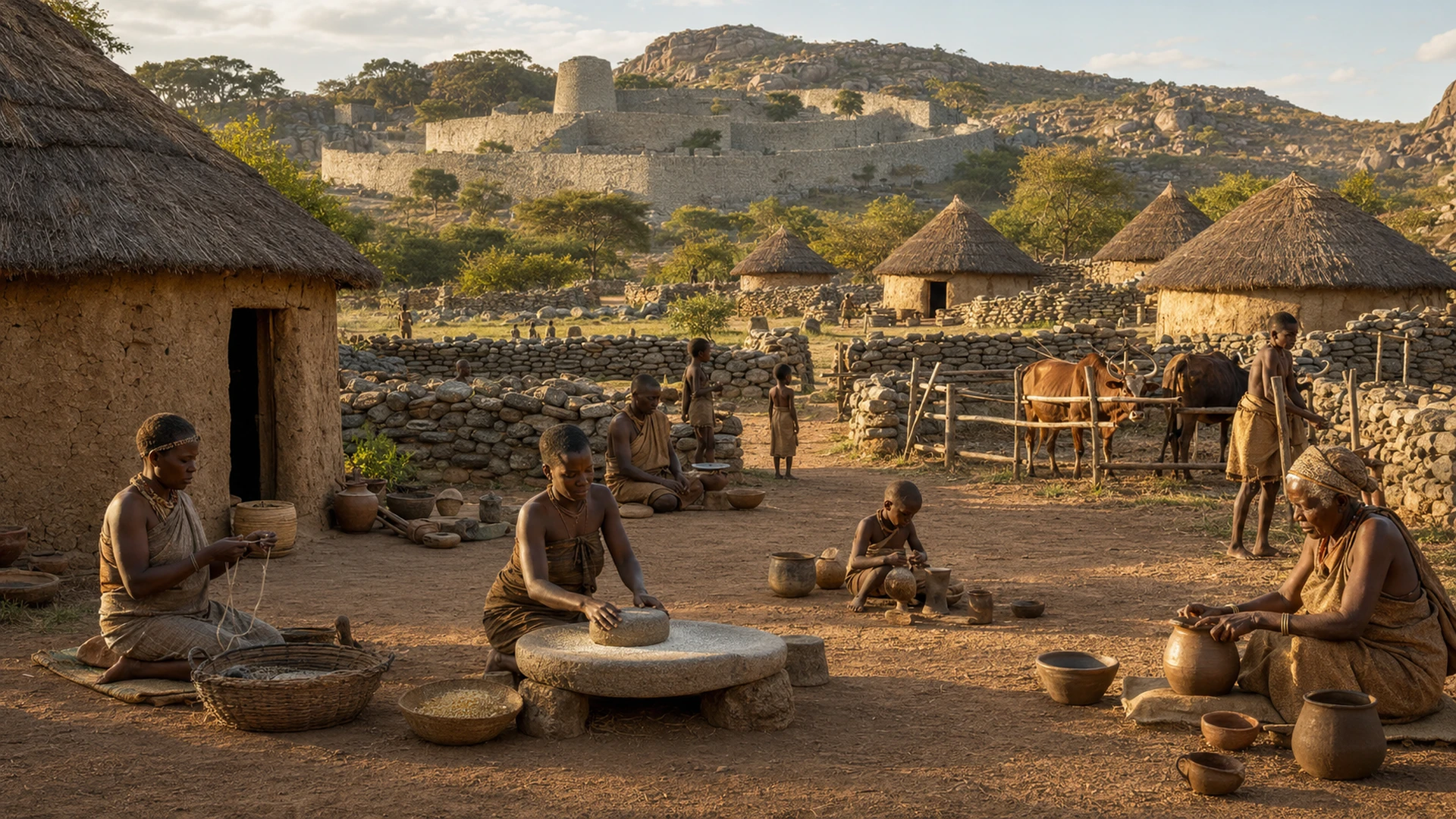
Specific culture or historical context: Great Zimbabwe at its urban height, showing ancestors of Shona-speaking communities without claiming one modern ethnic costume.
People shown: Black African adults, elders and children engaged in ordinary domestic and craft activities.
Location: Valley residential area below the monumental complexes.
Clothing: Historically plausible local woven cloth, leather and modest adornment based on regional archaeology; no modern printed fabric or unrelated ceremonial dress.
Architecture: Round dhaka houses, thatched roofs, courtyards and dry-stone compound walls.
Objects: Grinding stones, pottery, spindle whorls, baskets, grain, wooden tools and a small number of cattle.
Lighting: Warm late-afternoon natural light.
Composition: Wide 16:9 layered scene: household life in foreground, stone walls in middle ground and granite hill beyond.
SEO-friendly filename: great-zimbabwe-valley-urban-life.webp
Image title: Everyday Urban Life at Great Zimbabwe
Alt text: Historical reconstruction of families, crafts and dhaka houses in the Valley Enclosures of Great Zimbabwe
Caption: Most city life took place in residential compounds of earthen houses, courtyards, workshops and livestock spaces around the monumental walls.
Recommended placement: After the people, households and economy section.
Article section supported: People, culture and daily urban life.
Important elements to avoid: No generic village disconnected from the ruins, no mixed African costumes, no safari stereotypes, no palace fantasy, no overcrowded market scene or embedded text.
Great Zimbabwe Culture
The culture of Great Zimbabwe was expressed through language, household practice, food, architecture, craft, political relationships, burial and remembrance, objects, landscape and ritual. Archaeology preserves only part of this cultural world.
Pottery, textiles and personal display
Locally made pottery changed in form and decoration across time, helping archaeologists establish chronology and cultural connections. Cotton-spinning evidence indicates textile production, although cloth rarely survives. Beads and metal ornaments could communicate beauty, maturity, relationships or status.
Imported objects did not keep one fixed foreign meaning. Glass beads, cloth or ceramics could be renamed, exchanged, gifted, worn or used in ceremonies according to local values. This process is important: contact did not make Great Zimbabwe culturally dependent on the Indian Ocean world. Residents actively selected and transformed outside goods. [3]
Food, hospitality and political relationships
Food production connected households with wider authority. Grain, cattle, beer, meat and labour could move through hospitality, tribute, ritual, feasting, marriage and alliance. Archaeology cannot always distinguish these transactions, so it is risky to describe every movement of goods as taxation or commercial trade.
Art and stone carving
Soapstone was carved into bowls, figurines, decorated columns, pendants and the celebrated Zimbabwe Birds. Wood carving was probably also important, but most wooden objects decayed. Later Shona woodwork and stone sculpture help suggest possibilities, although modern objects should not be projected directly backward without evidence.
Trade and Culture in Great Zimbabwe
Great Zimbabwe participated in networks connecting the interior of southern Africa with the East African coast and wider Indian Ocean. Archaeologists have recovered glass beads, glazed ceramics, Chinese porcelain, Persian wares and coins associated with Kilwa. These finds demonstrate movement of people, goods and information across long distances. [1][2]
Gold and ivory from the interior were important exports, but the common statement that Great Zimbabwe became powerful only because rulers monopolized gold trade is too simple. Local agriculture, cattle, metallurgy, craft production, land, ancestry and political relationships were foundational. Imported objects occur in limited quantities and were not restricted consistently to one permanent elite class. [3][6]
Trade likely operated through relay networks. Producers, intermediaries and travellers moved goods between mines, homesteads, regional centres, rivers and coastal towns. Great Zimbabwe did not need to sit directly on the ocean to participate in Indian Ocean commerce.
What did Great Zimbabwe trade?
| Locally produced or circulated | Long-distance imports found archaeologically |
|---|---|
| Gold and gold objects | Glass beads from Indian Ocean networks |
| Ivory and animal products | Glazed ceramics and porcelain |
| Cattle and livestock products | Cloth, which rarely survives archaeologically |
| Grain and agricultural goods | Cowries and other marine materials |
| Iron, copper and crafted objects | Coins and selected prestige or gift objects |
| Pottery, textiles and labour | Ideas, styles and relationships carried by travellers |
This table does not imply that every listed item moved from the Great Zimbabwe capital itself or that rulers controlled every transaction. Trade and exchange occurred at multiple scales, from households to regional and overseas networks.
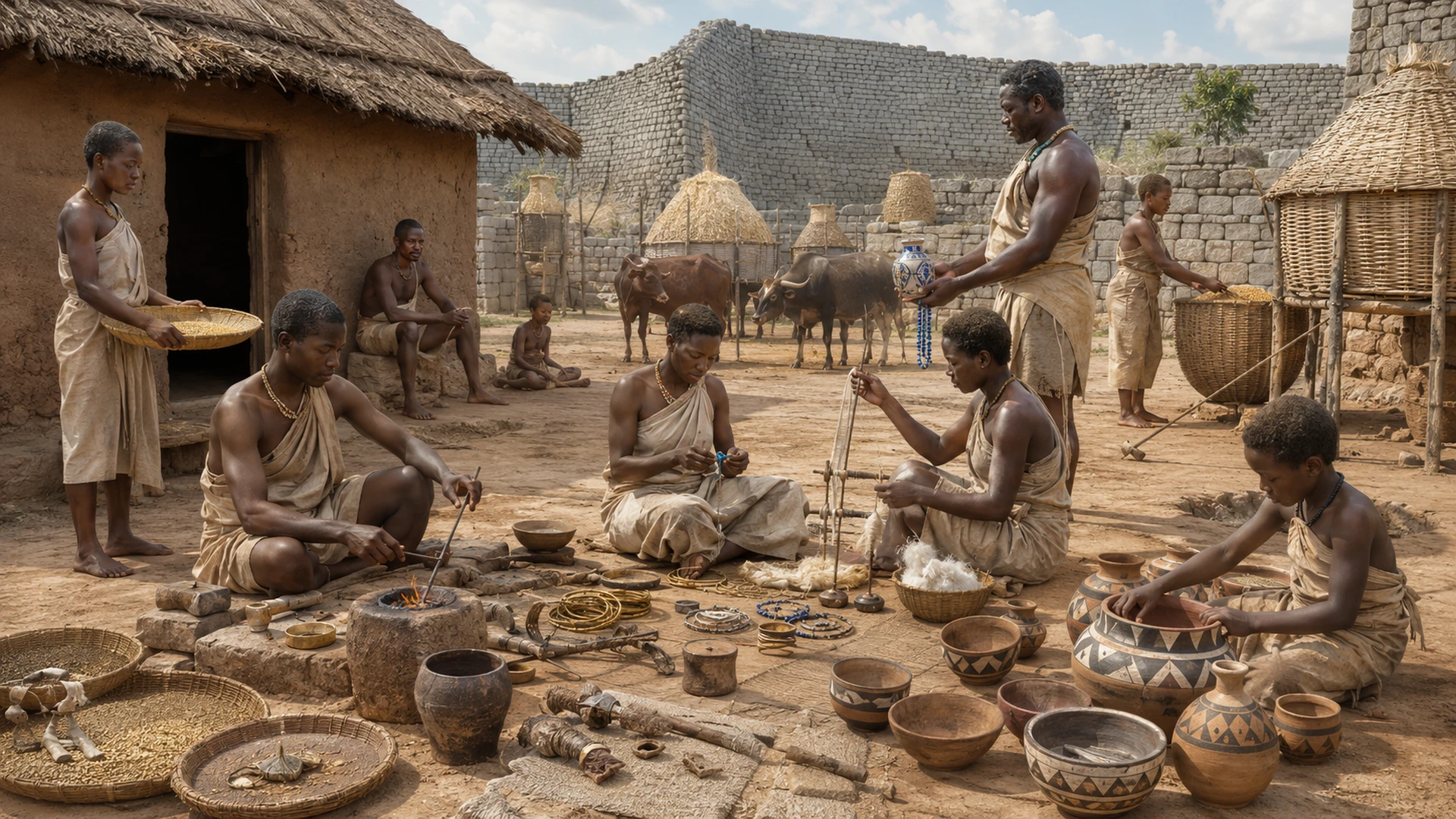
Specific culture or historical context: Great Zimbabwe’s regional and Indian Ocean-linked economy during its height.
People shown: Black southern African craftspeople, household members and one regional trader; no foreign group portrayed as founders or controllers.
Location: Residential-craft courtyard near a Valley Enclosure.
Clothing: Historically plausible local garments and modest ornaments; no Arab fantasy robes, European clothing or pan-African costume mixture.
Architecture: Dhaka house walls, courtyard and nearby dry-stone enclosure.
Objects: Small crucible, metal tools, spindle whorls, pottery, grain baskets, glass beads and one imported glazed vessel shown in realistic quantities.
Lighting: Bright but soft daylight with controlled highlights on metal and beads.
Composition: Wide 16:9 documentary reconstruction with local production central and imported objects secondary.
SEO-friendly filename: great-zimbabwe-trade-craft-economy.webp
Image title: Trade, Craft and Local Agency at Great Zimbabwe
Alt text: Historical reconstruction of craftspeople working metals and textiles while exchanging beads at Great Zimbabwe
Caption: Great Zimbabwe’s long-distance connections were built on strong local economies of farming, cattle, craft production and regional exchange.
Recommended placement: After the trade and culture section.
Article section supported: Economy, craft and Indian Ocean connections.
Important elements to avoid: No crowded Silk Road bazaar, no piles of treasure, no foreign rulers, no camels, no slave market, no modern coins or embedded labels.
Great Zimbabwe Social Structure
Great Zimbabwe was politically unequal, but its social structure should not be reduced to a permanent two-class system in which stone walls contained elites and everyone outside was a powerless commoner.
Monumental architecture, elevated spaces, cattle, ritual authority and access to labour indicate differences in power. Yet new excavations show that imported objects and desirable materials were not confined to one zone. Categories such as elite and commoner may have shifted according to occasion, lineage, age, gender, office, wealth, household success and relationships with rulers or ancestors. [4]
A useful model sees authority operating at several levels:
This framework is not a complete constitution. Great Zimbabwe left no surviving written administrative archive, so scholars reconstruct political life through archaeology, later historical sources and carefully controlled comparison.
Spiritual Heritage of Great Zimbabwe
Great Zimbabwe was not only an economic and political centre. Its hills, springs, entrances, carved birds, ancestral associations and restricted spaces carried spiritual meaning. UNESCO recognizes that the site continues to be used by contemporary communities for spiritual reasons. [1]
Sacred landscape and ancestry
The Chisikana Spring, sacred hills and the Mujejeje entrance are among places discussed in modern heritage research. Their significance comes from relationships among land, foundation histories, ancestors and community authority—not from the idea that every unusual rock or wall had one universal mystical meaning. [2]
An African-centred interpretation of political economy emphasizes a hierarchy of land, ancestors and belief in God as part of the moral basis through which rulers claimed custodial rights and shares in production. This does not mean every ancient ceremony can be reconstructed. It means that political and economic authority was embedded in a worldview, rather than operating as a secular bureaucracy separate from spiritual life. [3]
The Zimbabwe Birds
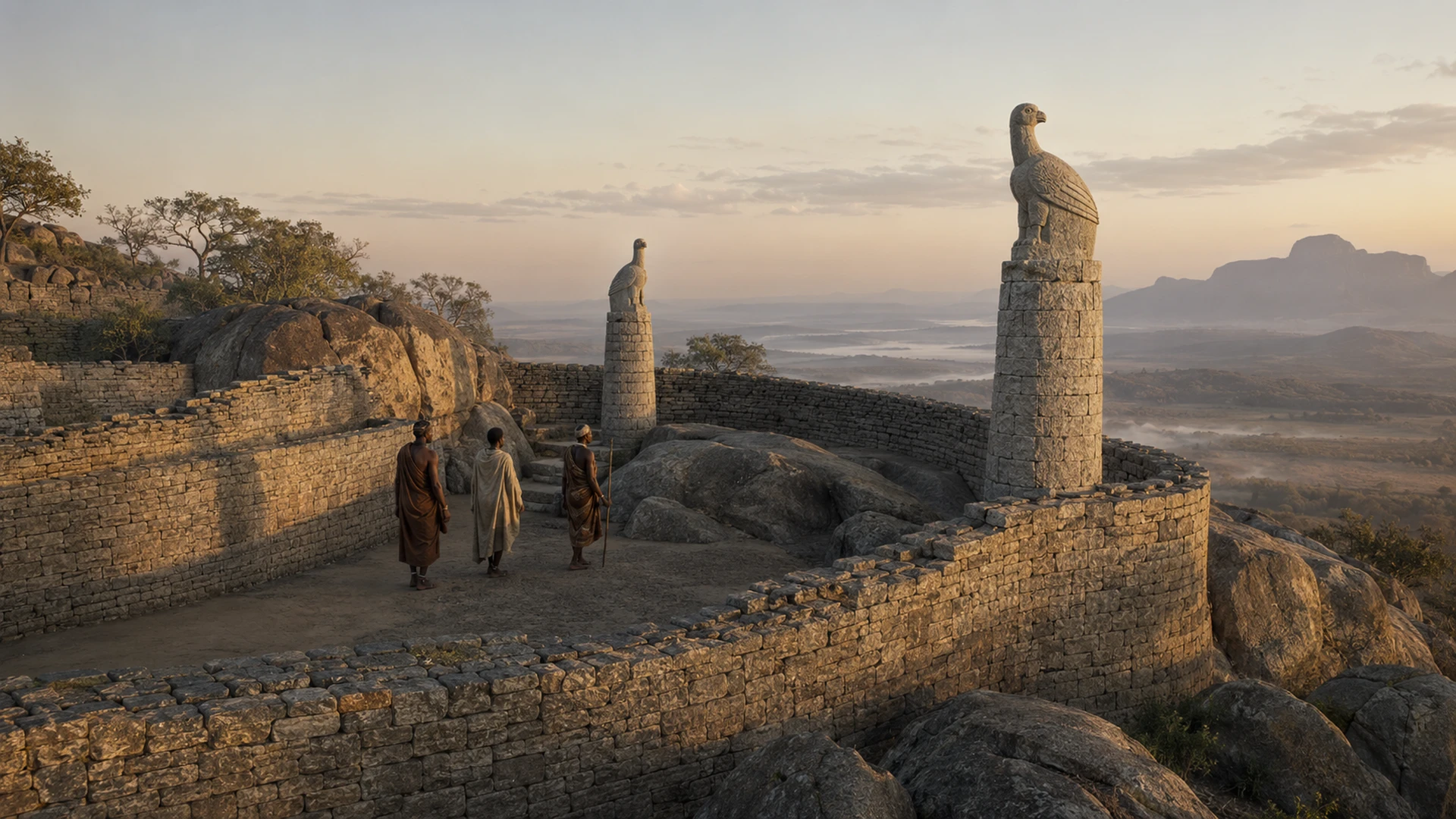
Eight carved soapstone birds are associated with Great Zimbabwe. Most were mounted on tall columns, and six came from the Eastern Enclosure of the Hill Complex. The sculptures combine human and avian features rather than copying one bird species precisely. [2][8]
Scholars have connected them with royal authority, ancestors, sacred leadership or birds of prey, but no single interpretation is universally accepted. Their later history is also political: several were removed during the colonial era, and the bird image was appropriated by Rhodesian institutions before becoming a symbol of independent Zimbabwe.
The Zimbabwe Bird now appears on the national flag, connecting the archaeological site with modern sovereignty. That national role should not erase the birds’ older religious and local meanings or the history of cultural-property removal.
Specific culture or historical context: Great Zimbabwe’s Hill Complex and Zimbabwe Birds; interpretation should remain public and non-instructional.
People shown: Three or four ancestors of Shona-speaking communities represented respectfully; no modern tourists in this historical reconstruction.
Location: Eastern Enclosure of the Hill Complex.
Clothing: Historically plausible local garments and restrained ornaments; no elaborate invented priest costumes.
Architecture: Accurate granite walls integrated with natural boulders and soapstone columns.
Objects: Two carefully proportioned Zimbabwe Bird sculptures on columns; no crystals, skulls, incense overload or unrelated symbols.
Lighting: Soft dawn light with subtle mist in the valley, not supernatural glow.
Composition: Wide 16:9 museum reconstruction with bird columns and architecture prominent; people secondary and respectful.
SEO-friendly filename: great-zimbabwe-birds-spiritual-heritage.webp
Image title: Zimbabwe Birds and the Sacred Landscape
Alt text: Historical reconstruction of soapstone Zimbabwe Bird columns in the Eastern Enclosure at Great Zimbabwe
Caption: The Zimbabwe Birds are linked with authority and religious meaning, although their precise ancient interpretation remains debated.
Recommended placement: After the spiritual heritage and Zimbabwe Birds section.
Article section supported: Sacred landscape, authority and national symbolism.
Important elements to avoid: No invented sacrifice, magical beams, Egyptian symbols, fantasy eagles, exposed restricted rites, modern flag inside the historical scene, text or watermarks.
Why Did Great Zimbabwe Decline?
Great Zimbabwe did not disappear in one sudden event, and “decline” can be misleading if it suggests that society simply failed. From the fifteenth century, political influence and population shifted toward other centres, including Khami to the southwest and states associated with Mutapa to the north.
Several factors may have interacted:
UNESCO’s older summary emphasizes overpopulation, food supply and deforestation. Contemporary scholarship urges a broader view that includes reoccupation, political transformation and the continuing life of the Zimbabwe tradition. A city can lose its role as a capital while its people, institutions and knowledge move elsewhere. [1][5]
Great Zimbabwe, Khami and the Wider Zimbabwe Tradition
Great Zimbabwe was neither the first nor the last stone-walled centre in southern Africa. Mapungubwe, in present-day South Africa, preceded its greatest expansion and was part of earlier regional state formation. Khami later developed distinctive platform architecture and became the capital of the Torwa dynasty.
These relationships should not be described as a simple ladder in which one city copied another and then vanished. Communities, dynasties, builders, traders and ritual ideas moved through overlapping networks. The term Zimbabwe tradition helps identify shared architectural and cultural patterns while leaving room for regional difference and political competition.
Colonial Myths and the Recovery of African History
When European travellers and colonizers encountered Great Zimbabwe, many refused to believe Africans had built it. They proposed Phoenician, Biblical, Arabian or other foreign founders. These claims were not neutral mistakes. They supported colonial arguments that Africans had no history of complex states and therefore no legitimate claim to land or political sovereignty.
Some early excavators removed objects and destroyed archaeological layers while searching for treasure or evidence of foreign origins. Scientific work by Randall-MacIver and Caton-Thompson demonstrated local African construction, but colonial authorities continued to suppress or minimize conclusions that contradicted racial ideology.
Recovering Great Zimbabwe’s history therefore involves more than correcting a date. It requires recognizing how archaeology was shaped by conquest, how African knowledge was dismissed and how local scholars and communities continue to reclaim interpretation. Shadreck Chirikure calls this a “confiscated past”: a heritage whose materials, narratives and authority were appropriated and must be critically restored. [10]
Great Zimbabwe Reconstruction: What Can Be Recreated Responsibly?
A reconstruction of Great Zimbabwe may mean several different things:
Responsible reconstruction should preserve uncertainty. Stone walls survive better than thatch, wood, textiles, food and sound, so a visually complete city will always include informed imagination. Artists should not fill every gap with foreign palaces, exotic rituals or costumes borrowed from unrelated African peoples.
Conservation also has to balance archaeological fabric with the site’s meaning to living communities. Webber Ndoro’s phrase “your monument, our shrine” captures a central tension: professional conservation may treat the site as a protected ruin, while local people understand it as an ancestral and sacred place. [9]
Great Zimbabwe’s Historical Significance Today
Great Zimbabwe is historically significant because it changes how African and global history are understood.
It proves that large-scale urbanism, state formation, long-distance commerce and monumental architecture developed in southern Africa through local knowledge and institutions. It demonstrates that global exchange did not require cultural dependence: residents incorporated imported goods into local economies and meanings. It also shows that archaeology must look beyond stone monuments to households, water, cattle, agriculture and living heritage.
For Zimbabwe, the site carries national significance. The country’s name, flag and public identity draw on the city and its birds. For local communities, however, the landscape is not only a national logo. It is connected with ancestry, place, custodianship and spiritual responsibility.
For the wider world, Great Zimbabwe is a warning against racialized history. The long refusal to accept African authorship shows how prejudice can shape supposedly scholarly interpretation. The correction of that record remains relevant wherever impressive African achievements are still described as mysterious or externally inspired.
Common Misunderstandings
“Great Zimbabwe was an empty stone fortress”
The surviving walls are only the most visible part of a populated city containing earthen houses, courtyards, crafts, livestock areas and water systems.
“Foreign traders built the city”
Imported beads and ceramics prove contact, not foreign construction. The architecture, settlement sequence and material culture are locally rooted.
“Every wall was defensive”
Walls could define residences, display authority, guide movement, create privacy, support ritual distinctions and shape courtyards. Some may have offered security, but defense is not a complete explanation.
“The Conical Tower was definitely a granary”
The tower is solid and its meaning remains debated. Agricultural symbolism is one hypothesis, not an established fact.
“Great Zimbabwe ended in one ecological disaster”
Environmental pressure may have contributed, but political change, migration, new centres and shifting networks also mattered.
“The Zimbabwe Birds have one proven meaning”
They are connected with authority and religion, but their exact ancient interpretation remains uncertain.
“The site belongs only to the past”
Great Zimbabwe remains a national heritage site and a spiritually meaningful landscape for contemporary communities.
Cultural and Ethical Boundaries
Responsible writing and visiting should follow several principles:
How to Study Great Zimbabwe Responsibly
Begin with the complete landscape rather than the Conical Tower alone. Compare the Hill Complex, Great Enclosure, Valley Enclosures, water sources, residential remains and surrounding environment. Use recent work by African archaeologists alongside UNESCO and museum summaries.
When two scholars disagree, identify the evidence behind each view. Architecture may support several uses over time. Oral traditions can preserve important knowledge, but they must be handled with attention to when, where and by whom they were recorded. Later Shona institutions can illuminate possibilities without serving as exact copies of fourteenth-century life.
Most importantly, do not ask only, “How did they build the walls?” Ask who grew food, transported stone, maintained water, spun cotton, raised cattle, taught apprentices, remembered ancestors and negotiated political relationships. Those questions reveal the city as a human community.
Key Takeaways
People Also Ask
What was Great Zimbabwe?
Great Zimbabwe was a large precolonial city and capital in southern Africa, known for dry-stone walls, residential compounds, craft industries, cattle, agriculture, regional political influence and Indian Ocean-linked trade.
Who built Great Zimbabwe?
African communities ancestral to Shona-speaking peoples built and inhabited Great Zimbabwe. Archaeology disproves old colonial claims of Phoenician, Arab or other foreign builders.
When did Great Zimbabwe exist?
The city developed from about the eleventh century and was most powerful between the thirteenth and fifteenth centuries. Some areas remained occupied or spiritually important afterward.
Was Great Zimbabwe really a city?
Yes. It supported a substantial population, specialized production, political authority, residential districts, monumental architecture, water systems and regional connections. Its dispersed form reflects African urbanism rather than a European street-grid model.
Why was Great Zimbabwe important?
It was a political capital, architectural achievement, economic centre, sacred landscape and regional trade hub. Today it is also a national symbol and major evidence of precolonial African state formation.
How were Great Zimbabwe’s walls built?
Builders stacked selected and shaped granite blocks in dry-stone courses without mortar. Wide bases, inward tapering, overlapping joints and skilled maintenance created stability.
What did Great Zimbabwe trade?
Networks associated with Great Zimbabwe moved gold, ivory, livestock, agricultural products, metals and crafts. Imported beads, cloth and ceramics connected the region with the Indian Ocean world.
What was the Great Enclosure used for?
Its exact functions changed or remain debated. Evidence supports residential, political, ceremonial and symbolic roles, but no single use has been conclusively proven for its entire history.
Why did Great Zimbabwe decline?
Political power and population gradually shifted toward other centres. Environmental pressures, changing trade and political networks, migration and new opportunities probably interacted.
Is Great Zimbabwe still sacred?
The site remains spiritually meaningful to communities connected with the landscape. UNESCO recognizes continuing spiritual use, and visitors should respect local custodianship and site rules.
Frequently Asked Questions
Is Great Zimbabwe older than Mapungubwe?
Mapungubwe reached political prominence earlier, especially in the thirteenth century, while Great Zimbabwe expanded into the region’s leading centre afterward. Both grew from longer southern African histories.
How many people lived at Great Zimbabwe?
Population estimates vary because most houses were built from perishable materials and occupation changed through time. Published estimates often range from more than 10,000 to around 20,000 at the city’s height; the exact number remains debated.
What is the Conical Tower?
It is a solid stone structure inside the Great Enclosure. Its ancient purpose is uncertain, and interpretations involving grain, authority or fertility are hypotheses rather than proven facts.
Were the walls built by slaves?
There is no evidence supporting a popular image of foreign rulers commanding enslaved African labour to build the city. Construction was a local skilled tradition organized within Great Zimbabwe’s own political and social institutions.
Did Great Zimbabwe trade directly with China?
Chinese ceramics found at the site show that objects travelled through Indian Ocean trade networks. They do not prove that Chinese merchants regularly reached the city itself; goods could pass through several intermediaries.
What happened to the Zimbabwe Birds?
Several birds were removed during the colonial era. Most were eventually returned to Zimbabwe. Their image became the central emblem on Zimbabwe’s national flag.
Can Great Zimbabwe be fully reconstructed?
Its stone architecture can be documented closely, but houses, roofs, clothing, sounds and many activities require informed interpretation. Ethical reconstructions should label uncertain details.
Who manages Great Zimbabwe today?
The National Museums and Monuments of Zimbabwe is responsible for management and conservation under Zimbabwean law, with World Heritage obligations and continuing community interests.
Conclusion
Great Zimbabwe was a city of stone, earth, cattle, grain, metal, cloth, water, memory and movement. Its walls remain extraordinary, but they were meaningful because people built, inhabited and maintained the wider landscape around them.
Understanding the city requires more than celebrating a monument. It means recognizing African engineering, household labour, political complexity, regional trade, sacred authority and the damage caused when colonial ideology denied African history. It also means respecting the site as living heritage whose interpretation is shared among archaeologists, national institutions and communities connected with the land.
Great Zimbabwe’s lasting significance lies in this combination: it is an archaeological city, a record of African urbanism, a spiritual landscape and a national symbol. Its history is not mysterious because Africans could not have built it. It is compelling because generations of African builders, families, rulers, craftspeople and custodians created a place whose meanings continue to be studied and renewed.
Research Sources and Further Reading
5. Internal Linking Plan
6. Glossary
7. Recommended Supporting Articles
Article Information
- Publisher
- Ancestral Temple
- Editor
- Ancestral Temple
- Last updated
- Jul 26, 2026
- Last reviewed
- Jul 26, 2026
- Content version
- ee589dd5e2
This educational article should be read as cultural and spiritual information, not as medical, legal, financial, or emergency advice.
Helpful Related Guidance
Explore This Topic
Related Topic Cluster
Dreams & Symbolism
About the Author
 Ancestral Temple
Spiritual guide and practitioner with decades of experience in ancestral wisdom, rituals, and divine guidance.
Related Posts
View All









Leave a Comment
We'd love to hear your thoughts.