
Indigenous Knowledge Systems in Africa
Quick Summary
Indigenous knowledge systems in Africa are living bodies of observation, skill, memory, ethics, and practice developed within specific communities. They include farming, pastoralism, medicine, food preservation, water management, architecture, oral history, biodiversity stewardship, and systems of community responsibility.
Indigenous knowledge systems in Africa are not a single collection of ancient customs. They are living, changing systems of observation, practical skill, memory, language, ethics, spirituality, and community responsibility.
Knowledge is developed through long relationships with particular landscapes, plants, animals, seasons, institutions, and histories. It may be transmitted through apprenticeship, storytelling, song, farming, herding, ritual, craft, healing practice, community meetings, and everyday work.
UNESCO's Local and Indigenous Knowledge Systems programme describes these systems as important for biodiversity, climate resilience, education, and sustainable development. FAO likewise recognizes knowledge held by farmers, pastoralists, fishers, forest communities, and gatherers as important for food security and ecosystem stewardship.
The word African must not hide diversity. Knowledge held by Mbororo pastoralists in the Sahel, San communities in southern Africa, Ethiopian highland farmers, Buganda bark-cloth makers, Amazigh water managers, or coastal fishing communities belongs to different languages, environments, and institutions.
This article discusses public examples. It does not reveal restricted healing formulas, sacred knowledge, initiation teachings, privately held locations, or commercially exploitable plant information.
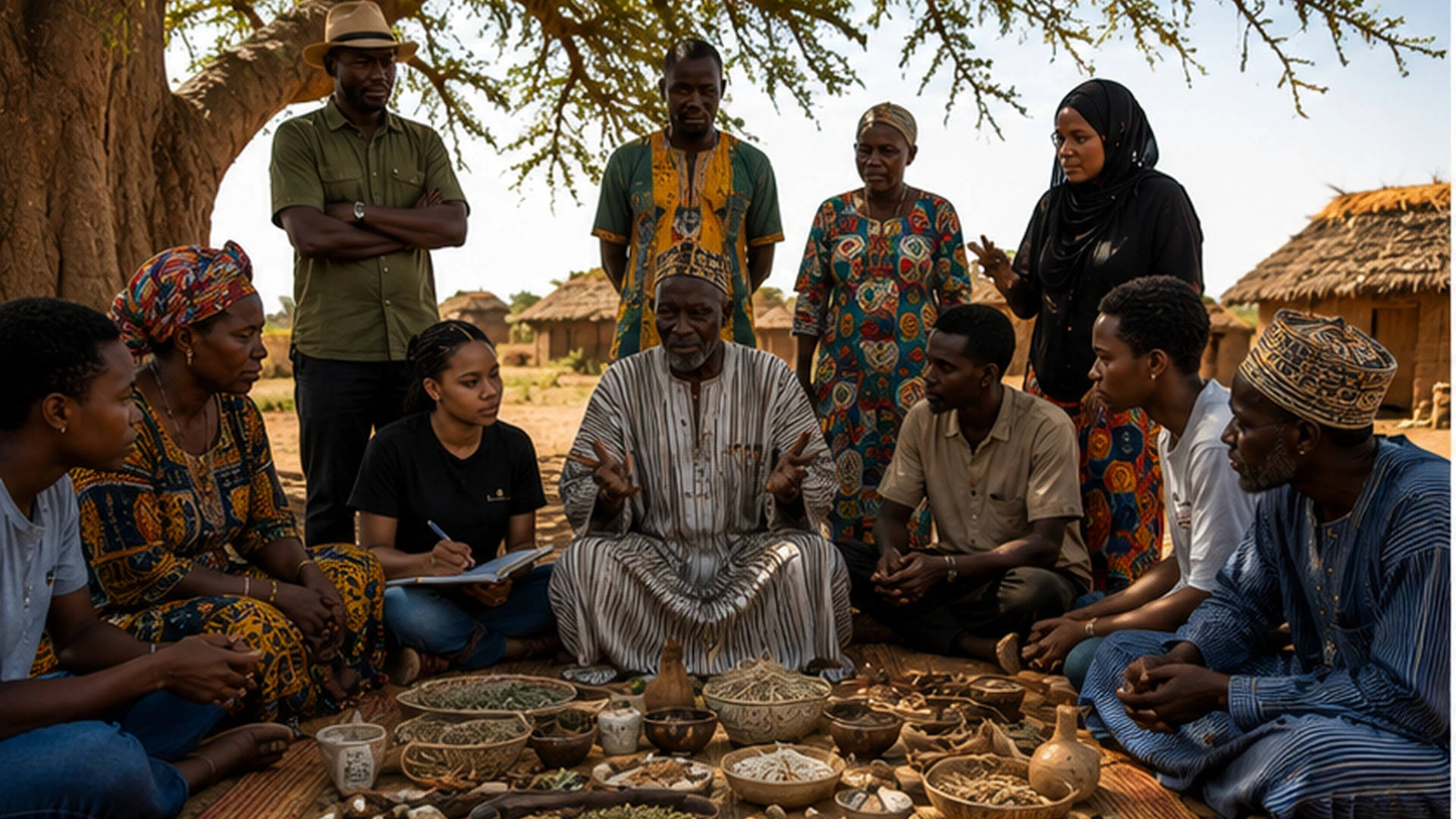
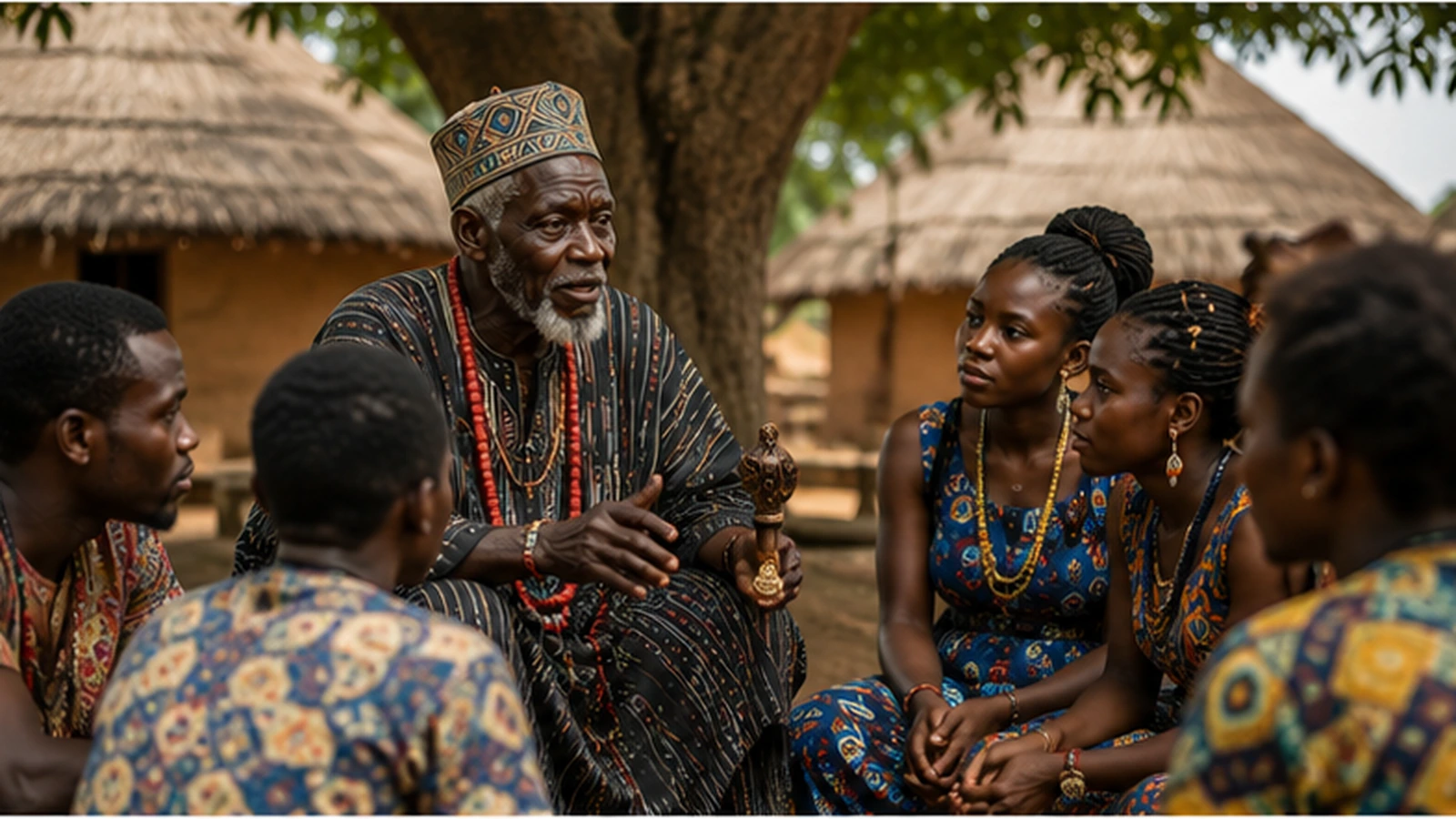
Suggested scene: Black African community educators introducing distinct knowledge systems—farming, pastoralism, healing, craft, oral history, water management, and biodiversity—without combining them into one invented culture.
Key Points
Indigenous knowledge is living, adaptive, and community-specific.
It includes ecological observation, agriculture, pastoralism, medicine, architecture, food, craft, law, language, and historical memory.
Knowledge is commonly transmitted through practice, apprenticeship, oral teaching, song, proverbs, and local languages.
Local knowledge can support climate adaptation, biodiversity conservation, food security, and disaster preparedness.
Women, elders, youth, farmers, pastoralists, healers, fishers, and craftspeople may hold different but complementary knowledge.
Not every inherited practice is automatically effective, safe, sustainable, or accepted by every community member.
Scientific and Indigenous knowledge can work together when collaboration is respectful and does not rank one system as inherently inferior.
Free, prior, and informed consent is essential before documenting or using community knowledge.
Sacred, private, medicinal, and commercially valuable knowledge may require restricted access.
Communities should receive recognition, control, and fair benefits when their knowledge contributes to research or commercial products.
What Is an Indigenous Knowledge System?
Feature
What it means
Community-based
Knowledge is rooted in the experience, institutions, language, and territory of a particular community.
Intergenerational
Skills and understandings are transmitted across generations but may be revised through new experience.
Practical
Knowledge is tested through farming, healing, herding, fishing, craft, architecture, and daily decision-making.
Relational
People, land, water, animals, ancestors, moral obligations, and social institutions may be understood as interconnected.
Context-specific
A technique effective in one climate, soil, or community may not be appropriate elsewhere.
Dynamic
Knowledge changes through experimentation, migration, trade, technology, conflict, and environmental change.
Governed
Communities may have rules about who may teach, use, own, reveal, or benefit from particular knowledge.
1. Why the Plural 'Knowledge Systems' Matters
Africa contains thousands of languages, environments, communities, and historical experiences. A single phrase such as African traditional knowledge can falsely suggest one uniform worldview.
Responsible writing identifies:
The specific community or knowledge holders
The location and ecosystem
The language used
The historical period
The gender, age, profession, or institution involved
Whether the knowledge is public, private, restricted, or sacred
For example, desert navigation, highland terracing, tropical forest medicine, lake fishing, and dryland pastoral forecasting are not interchangeable knowledge systems.
2. Knowledge Is Created Through Observation and Practice
Indigenous knowledge is sometimes described as inherited, but inheritance does not mean passive repetition.
Knowledge holders observe:
Rainfall patterns
Animal behavior
Flowering and fruiting
Soil texture
Water movement
Pests and diseases
Wind direction
Stars and seasonal cycles
Human health
The success or failure of previous decisions
Communities compare present conditions with remembered patterns and adjust practices. This makes knowledge experimental, although its methods may differ from formal laboratory science.
Article Information
- Publisher
- Ancestral Temple
- Editor
- Ancestral Temple
- Last updated
- Jul 26, 2026
- Last reviewed
- Jul 26, 2026
- Content version
- 375e30eccf
This educational article should be read as cultural and spiritual information, not as medical, legal, financial, or emergency advice.
Helpful Related Guidance
Explore This Topic
Spiritual Knowledge · African Spiritual Traditions
About the Author
 Ancestral Temple
Spiritual guide and practitioner with decades of experience in ancestral wisdom, rituals, and divine guidance.
Related Posts
View All


Leave a Comment
We'd love to hear your thoughts.
I appreciated the distinction between inherited knowledge and unchanging tradition.
The article clearly explained that Africa has many knowledge systems rather than one.