
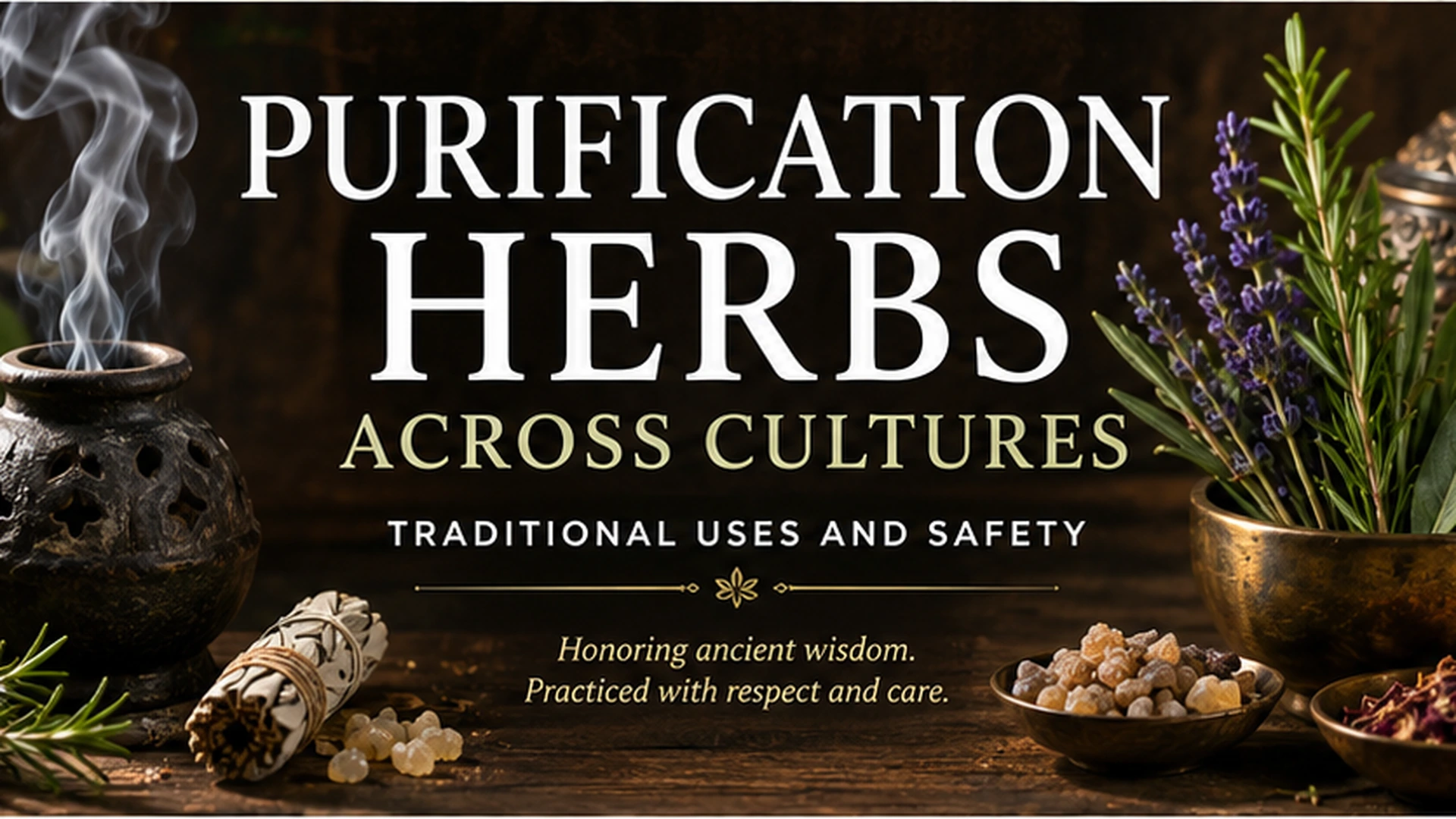
Purification Herbs Across Cultures: Traditional Uses and Safety
Quick Summary
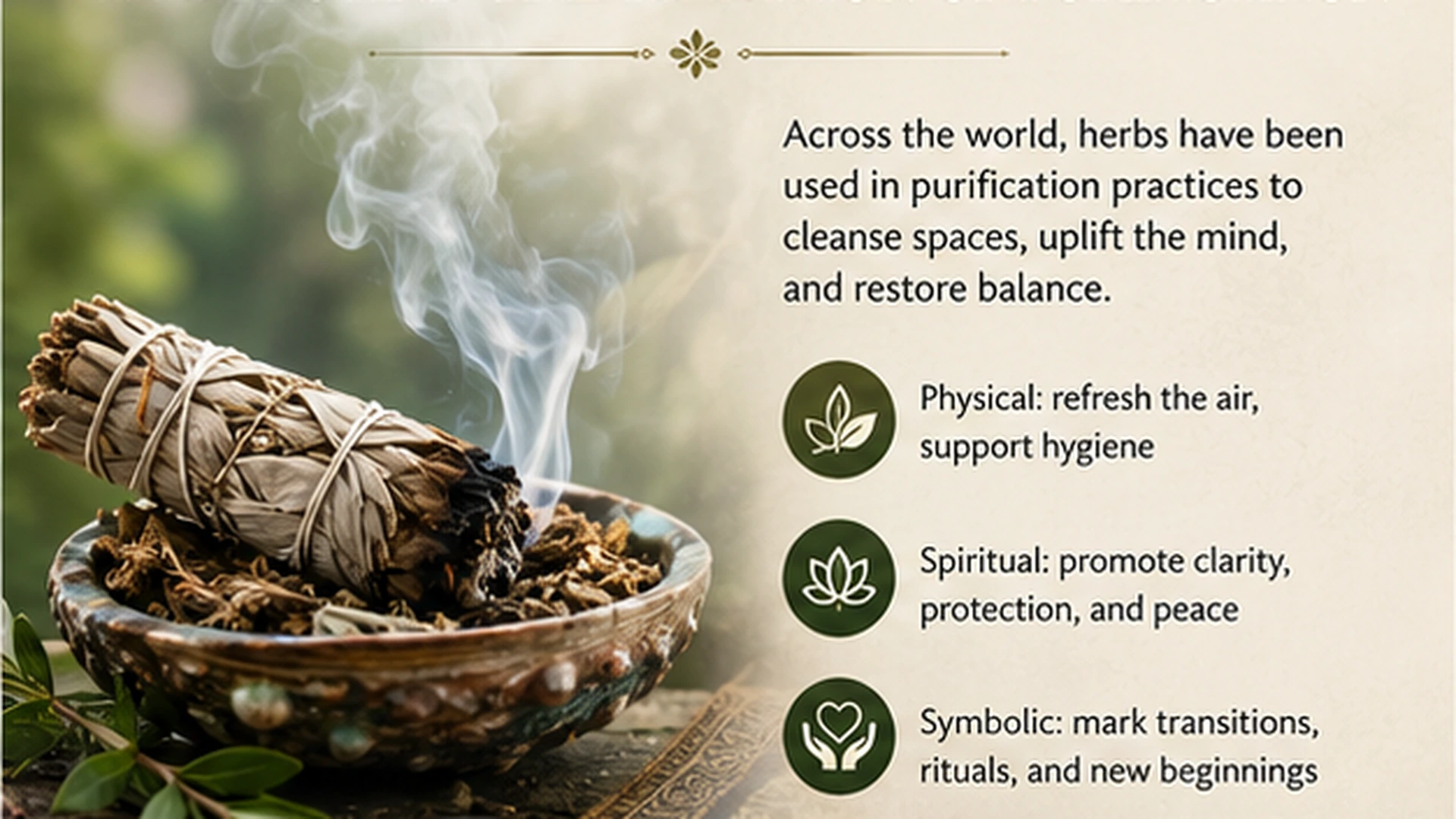
Purification herbs appear in religious ceremonies, household customs, healing traditions and seasonal observances around the world. Leaves may be burned, resins warmed on charcoal,...
Purification herbs appear in religious ceremonies, household customs, healing traditions and seasonal observances around the world. Leaves may be burned, resins warmed on charcoal, branches placed near a doorway, plants infused in wash water, or aromatic materials carried, offered or displayed. Yet the phrase "purification herb" can be misleading when it makes very different cultures seem interchangeable.
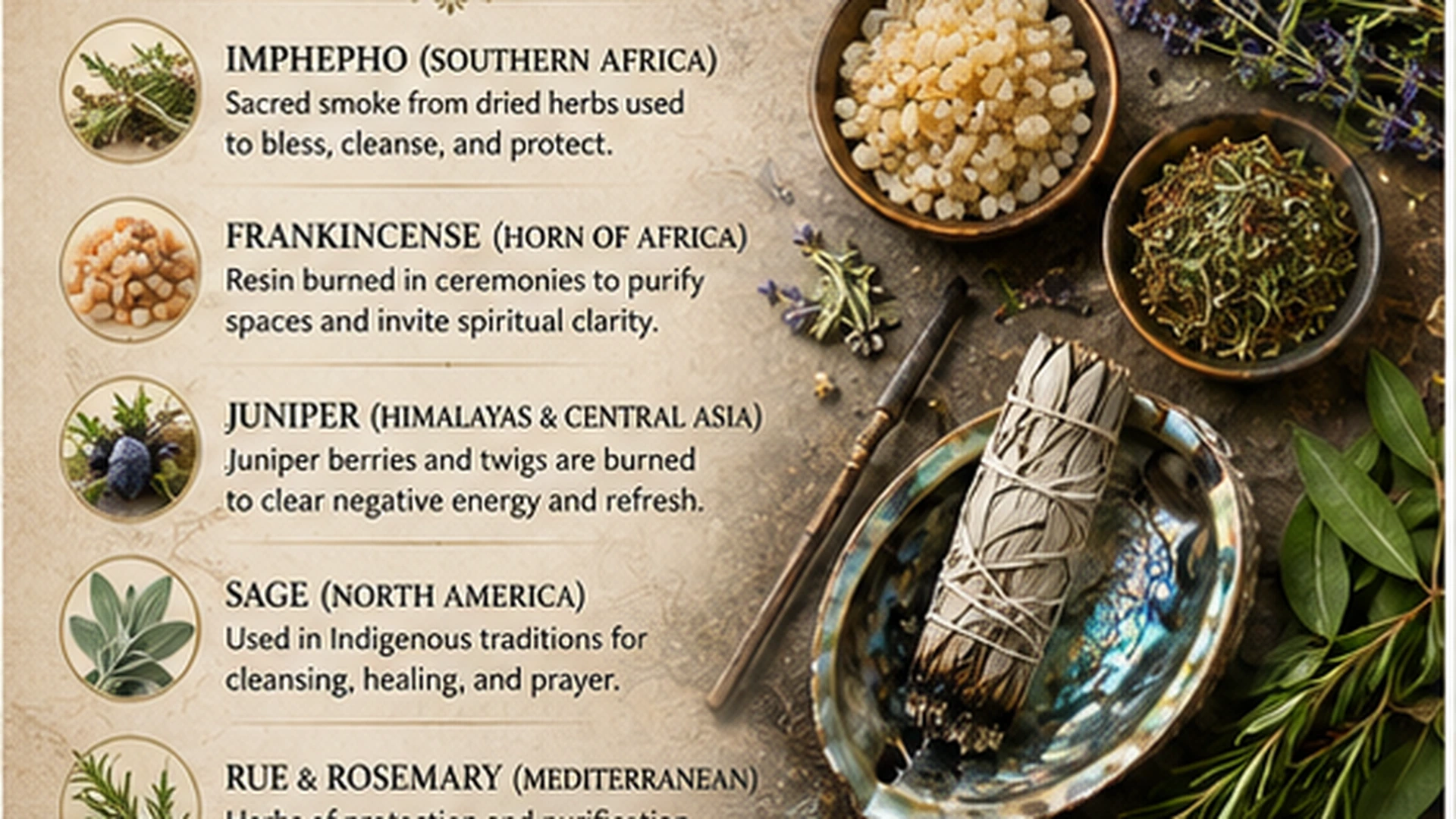
Aromatic smoke from Southern African imphepho, frankincense from the Horn of Africa and southern Arabia, juniper offerings in Tibetan Buddhist households, Indigenous uses of sage species in North America, and rue in Mediterranean or Latin American folk traditions do not belong to one universal system. Each practice has its own language, community authority, religious meaning, plant species and ethical boundaries.
Safety also matters. A plant can be culturally important and still irritate the lungs, skin or digestive system. Some herbs interact with medicines, some essential oils are poisonous when swallowed, and some plants are especially risky during pregnancy. Ritual or symbolic use does not prove that a plant can disinfect a room, remove toxins from the body or treat disease. [1-3]
| Quick Answer Purification herbs are plants or resins associated with symbolic cleansing, prayer, protection, renewal or preparation in specific cultural traditions. Common examples include imphepho in parts of Southern Africa, frankincense in African and Middle Eastern religious life, juniper in Himalayan offerings, particular sage species in Indigenous North American traditions and rue in Mediterranean folk practice. Their meanings are not interchangeable, and burning, bathing with or ingesting them can carry health, fire, ecological and cultural risks. |
|---|
| Field | Specification |
|---|---|
| Image number | 1 (featured image) |
| Purpose | Introduce the topic as a respectful comparison of separate traditions rather than a blended ritual scene. |
| Detailed scene | A modern African botanical museum with five distinct educational displays: Southern African Helichrysum, Horn of Africa frankincense resin, Himalayan juniper branches, a cultivated Southern California white sage plant, and Mediterranean rue behind protective glass. Three Black African adult visitors and a curator study the displays. Each plant is separated by space and museum design rather than merged into one arrangement. |
| Specific culture or historical context | Contemporary educational presentation of distinct plant traditions from Southern Africa, the Horn of Africa, Himalayan regions, Indigenous Southern California and the Mediterranean. |
| People shown | Three Black African adults and one Black African curator in modern clothing, natural expressions and respectful posture. |
| Location | Contemporary botanical museum or cultural heritage center in Africa. |
| Clothing | Modern smart-casual clothing with subtle African woven details; no ritual costumes. |
| Architecture | Clean stone, dark wood and glass display architecture with a small indoor courtyard. |
| Objects | Live or dried plant specimens, resin tears, herbarium sheets, woven harvesting basket and conservation labels that are not readable in the final image. |
| Lighting | Soft museum lighting with natural daylight and no supernatural glow. |
| Composition | 16:9 landscape; the visitors occupy the center while the five displays remain visibly distinct. Leave negative space for website cropping. |
| SEO-friendly filename | purification-herbs-across-cultures.webp |
| Image title | Purification Herbs Across Cultures in Context |
| Alt text | Museum and botanical display presenting purification plants from distinct cultural traditions in separate educational settings |
| Caption | Plants connected with purification are best understood within their own communities, landscapes and historical contexts. |
| Recommended placement | Immediately after the Quick Answer. |
| Article section supported | Introduction and Quick Answer. |
| Important elements to avoid | No collage, embedded text, fantasy smoke, invented ceremony, mixed cultural costume, logos, watermarks or plants presented as one universal ritual bundle. |
What Does Purification Mean in Traditional Practice?
Purification can refer to preparation, renewal, boundary-making, remembrance or restoration of social and spiritual order. In one setting, fragrant smoke may accompany prayer. In another, water infused with leaves may be used before a ceremony. Elsewhere, a resin is offered at a shrine, or an aromatic branch marks a transition such as a new year, funeral, initiation or return home.
The meaning is not always "removing evil energy," a phrase commonly used in modern wellness marketing. Purification may instead mean becoming ritually ready, honoring ancestors, marking sacred space, welcoming guests, remembering the dead, restoring calm, or signaling a fresh beginning. The plant may be important because of its scent, color, local ecology, religious history, relationship with a specialist or words spoken during its use.
Traditional medicine and ritual practice also overlap in some societies, but they are not identical. The World Health Organization describes traditional medicine as diverse systems of knowledge and practice that developed in particular historical and cultural settings. Safety depends on practitioner competence, product quality, communication, regulation and appropriate use. [1]
| Practice form | What may be used | Possible cultural function | Primary safety concern |
|---|---|---|---|
| Smoke or incense | Leaves, needles, bark, resin or prepared incense | Offering, preparation, remembrance, boundary-marking or scenting space | Particulate matter, asthma triggers, burns and fire |
| Herbal wash or bath | Fresh or dried leaves infused in water | Preparation, symbolic cleansing, comfort or transition | Skin irritation, contamination, eye exposure and unsafe ingestion |
| Carried or displayed plant | Bundle, branch, amulet filling or potted plant | Identity, blessing, memory, protection or household custom | Misidentification, allergy, child or pet exposure |
| Oil or concentrated extract | Essential oil or infused oil | Fragrance, anointing or modern adaptation | Poisoning, chemical burns, photosensitivity and interactions |
| Tea or swallowed preparation | Leaf, root, seed, bark, resin or powder | Traditional medicine or household remedy - not automatically purification | Dose uncertainty, toxicity, pregnancy risk and herb-drug interactions |
| Important Distinction A ritual cleansing practice is not the same as sterilizing a surface, treating an infection or medically "detoxifying" the body. If hygiene is the goal, use evidence-based cleaning, safe water, ventilation and medical care when needed. Do not substitute smoke or herbs for prescribed treatment. |
|---|
Southern Africa: Imphepho and Helichrysum Species
The name imphepho is associated with aromatic Helichrysum plants in South Africa, including species documented under Xhosa and Zulu common names. The South African National Biodiversity Institute describes Helichrysum odoratissimum as a strongly aromatic plant used as perfume and insect repellent. SANBI also records that leaves of Helichrysum nudifolium are burned as incense during ritual ceremonial occasions connected with ancestors. [4-5]
These records do not mean that every Helichrysum species has the same use, chemistry or cultural meaning. The genus contains many species, common names can overlap, and local knowledge determines which plant is appropriate. It is therefore inaccurate to market any silver-leaved "everlasting" as authentic imphepho without verified identification and provenance.
Imphepho is often discussed online as a universal African cleansing herb. That description erases regional differences and can turn living traditions into a generic product. A respectful article should identify the plant, people and setting whenever evidence allows, and should avoid teaching restricted ceremonial details.
| Field | Specification |
|---|---|
| Image number | 2 |
| Purpose | Show imphepho as a living Southern African plant tradition connected to botanical knowledge and responsible cultivation. |
| Detailed scene | A realistic documentary scene at a community herb garden in South Africa. A Black South African adult horticulturalist and an older community knowledge holder examine cultivated Helichrysum plants with silvery leaves and small yellow flowerheads. Cut stems dry on shaded mesh racks while labeled botanical reference sheets remain out of readable focus. |
| Specific culture or historical context | Contemporary South African cultivation and documentation of Helichrysum species associated with Xhosa and Zulu names, without staging a private ceremony. |
| People shown | Two Black South African adults, one horticulturalist and one elder or community advisor. |
| Location | Community botanical garden in the Eastern Cape or KwaZulu-Natal. |
| Clothing | Everyday work clothing, sun hats and practical aprons; no ceremonial costume. |
| Architecture | Open-sided shade structure beside planted herb beds, local stone edging and simple drying racks. |
| Objects | Living Helichrysum plants, drying mesh, hand lens, notebook, woven basket and clean pruning tools. |
| Lighting | Soft morning light with realistic plant texture and restrained color. |
| Composition | 16:9 landscape; living plants dominate the foreground, people at center, drying area visible in background. |
| SEO-friendly filename | imphepho-helichrysum-south-africa.webp |
| Image title | Imphepho and Helichrysum Knowledge in South Africa |
| Alt text | South African horticulturalist and community elder examining cultivated Helichrysum plants known as imphepho |
| Caption | Imphepho refers to culturally important aromatic plants whose identity and use depend on species, region and community knowledge. |
| Recommended placement | After the Southern Africa subsection. |
| Article section supported | Southern Africa: Imphepho and Helichrysum Species. |
| Important elements to avoid | No staged spirit-summoning scene, no fantasy smoke, no mixed African costumes, no labels or text inside the image, no wild overharvesting, logos or watermarks. |
Horn of Africa and Southern Arabia: Frankincense Resins
Frankincense is not a leaf herb but an aromatic gum-resin obtained from Boswellia trees. Kew records Boswellia sacra as native to Ethiopia, northern Somalia, southern Yemen and Oman, and notes that the resin has been valued for its fragrant smoke across many cultures for thousands of years. Related Boswellia species from Somalia, Ethiopia, Sudan and southern Arabia also enter regional and international trade. [6-7]
Frankincense has appeared in ancient trade, Christian liturgy, Islamic social and religious settings, household scenting and traditional medicine. Its use should not be reduced to a single claim such as "clears negative energy." In some contexts, the smoke is an offering; in others, it marks hospitality, prayer, remembrance or sacred space.
Species identification matters because commercial frankincense can come from several Boswellia trees with different ranges and conservation pressures. Kew has documented concerns about habitat change and over-tapping in parts of the Horn of Africa. Responsible sourcing therefore includes traceability, fair compensation for producing communities and harvesting methods that allow trees to recover. [7]
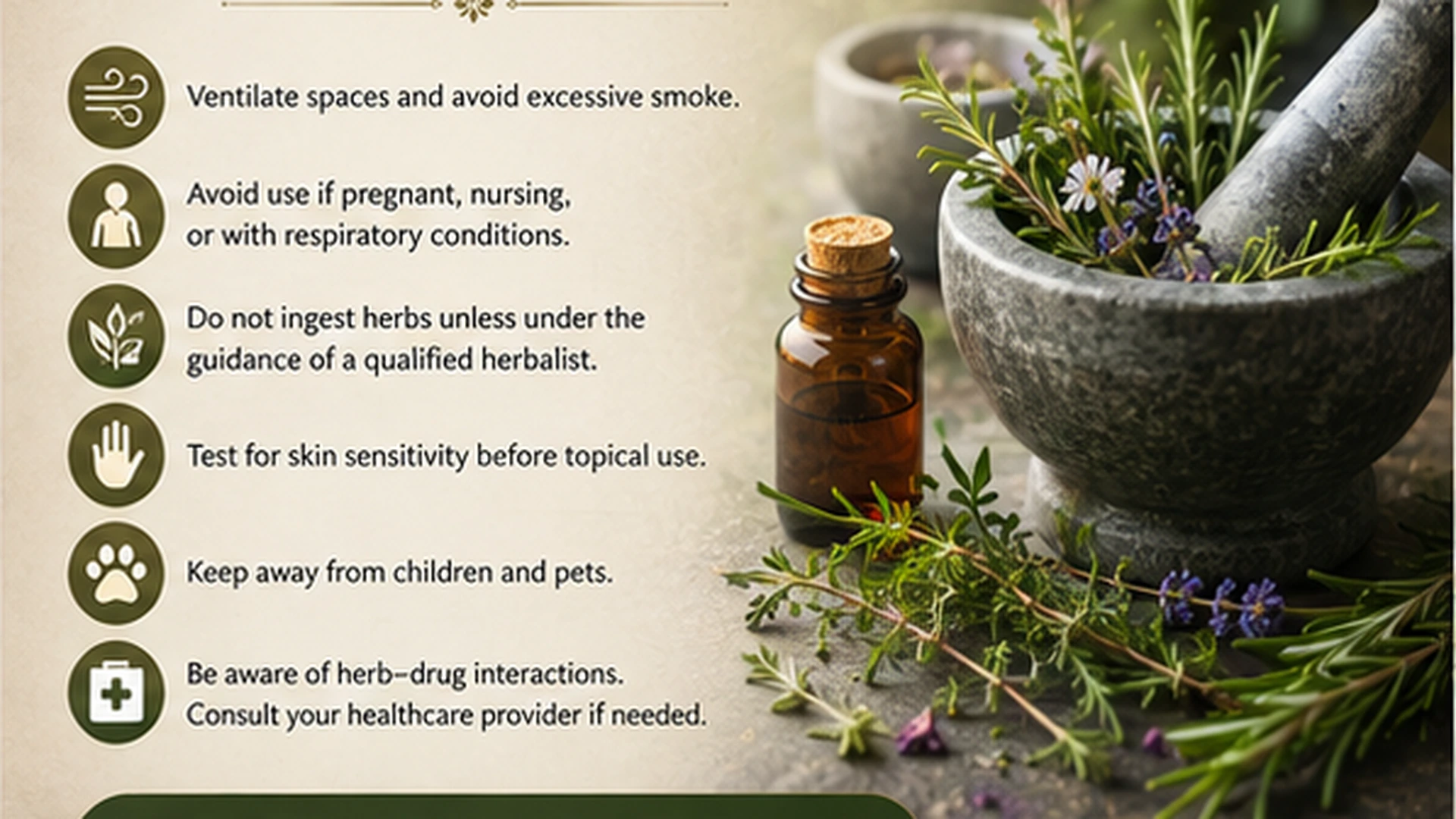
Burning resin still produces smoke. Use a stable heatproof burner, limit the amount, keep rooms ventilated and avoid exposing babies, people with asthma or other respiratory disease, and anyone who develops headaches, coughing or eye irritation.
| Field | Specification |
|---|---|
| Image number | 3 |
| Purpose | Present frankincense as a harvested tree resin with ecological and economic context. |
| Detailed scene | Realistic editorial photograph of a Somali or Ethiopian frankincense collector beside a mature Boswellia tree on a rocky escarpment. The collector makes a shallow, careful tap with a traditional knife while previously hardened resin tears are gathered into a small woven basket. A younger adult records tree condition and harvest date for a cooperative. |
| Specific culture or historical context | Contemporary sustainable frankincense harvesting in the Horn of Africa, grounded in Boswellia ecology and community trade. |
| People shown | Two Black African adults from a local harvesting community, one experienced collector and one cooperative recorder. |
| Location | Dry rocky woodland or escarpment in northern Somalia, Somaliland, Eritrea or Ethiopia, without claiming a precise village. |
| Clothing | Practical regional work clothing and head covering appropriate for sun and terrain. |
| Architecture | Natural landscape with no staged temple or fantasy ruin. |
| Objects | Boswellia tree, small tapping knife, hardened resin tears, woven basket and field notebook. |
| Lighting | Warm early-morning light, natural dust and realistic bark texture. |
| Composition | 16:9 landscape; tree and collector fill the left two-thirds, open landscape and second worker on the right. |
| SEO-friendly filename | frankincense-harvesting-horn-of-africa.webp |
| Image title | Sustainable Frankincense Harvesting in the Horn of Africa |
| Alt text | Frankincense collectors carefully harvesting resin from a Boswellia tree in the Horn of Africa |
| Caption | Frankincense connects religious history, regional livelihoods and the long-term health of Boswellia woodlands. |
| Recommended placement | After the frankincense subsection. |
| Article section supported | Horn of Africa and Southern Arabia: Frankincense Resins. |
| Important elements to avoid | No excessive wounds on the tree, no fantasy caravan, no pharaoh imagery, no mixed regional costume, no embedded text, logos or watermarks. |
Tibetan and Himalayan Traditions: Juniper Smoke Offerings
In Tibetan Buddhist households and nomadic communities, aromatic plants can accompany daily offerings and prayer. The Smithsonian Center for Folklife and Cultural Heritage describes household burning of juniper leaves, wild sage, flowers or monastery incense. The Smithsonian's Asian art resources also note juniper incense at domestic shrines, while the Rubin Museum describes purificatory juniper smoke during Losar observances in Himalayan communities. [8-10]
These practices are offerings and acts of religious preparation within Tibetan and Himalayan settings. They should not be renamed "smudging," a term associated with other histories, or copied as an anonymous wellness technique. The species, prayers, household customs and relationship to Buddhist teachings matter.
Juniper smoke is still combustion smoke. A small traditional quantity in a well-ventilated setting does not eliminate exposure. People with asthma, chronic lung disease, smoke sensitivity or young children in the home may prefer an unsmoked alternative such as prayer, water offerings, flowers or an electric aromatic warmer used according to its instructions.
| Field | Specification |
|---|---|
| Image number | 4 |
| Purpose | Show Himalayan juniper incense within a recognizable household religious setting while keeping smoke exposure modest. |
| Detailed scene | A respectful documentary-style Tibetan Buddhist household shrine in a Himalayan home. A Tibetan adult places a very small amount of juniper on a metal incense burner near an open window. Seven water bowls, a butter lamp and religious images are present, while an older family member sits nearby in quiet prayer. Smoke is thin and immediately moves toward the window. |
| Specific culture or historical context | Contemporary Tibetan Buddhist domestic offering practice in a Himalayan region; not a generic New Age cleansing scene. |
| People shown | Two Tibetan adults from the same household. |
| Location | Modest highland home in Ladakh, Tibet, Nepal or Bhutan without claiming a precise community. |
| Clothing | Everyday regional clothing suitable for a cool highland home. |
| Architecture | Whitewashed or earthen interior with timber beams, household shrine and open window. |
| Objects | Small juniper branches, metal incense burner, water bowls, butter lamp and prayer beads. |
| Lighting | Soft morning window light; minimal visible smoke and no dramatic beams. |
| Composition | 16:9 landscape; shrine on one side, household members on the other, open window clearly visible. |
| SEO-friendly filename | tibetan-juniper-incense-offering.webp |
| Image title | Tibetan Juniper Incense in a Household Shrine |
| Alt text | Tibetan household offering a small amount of juniper incense beside an open window and family shrine |
| Caption | Juniper smoke in Tibetan Buddhist households forms part of prayer and offering traditions, not a universal cleansing method. |
| Recommended placement | After the Tibetan and Himalayan subsection. |
| Article section supported | Tibetan and Himalayan Traditions: Juniper Smoke Offerings. |
| Important elements to avoid | No temple spectacle, dense smoke, magical glow, mixed Asian costumes, visible mantras as gibberish text, logos or watermarks. |
Indigenous North America: Sage Is Not One Plant or One Practice
The word sage can refer to unrelated or distantly related plants. White sage in the Southern California sense is Salvia apiana. "White sagebrush" used in parts of the Plains and Intermountain West may refer to Artemisia ludoviciana. Big sagebrush is Artemisia tridentata. These plants differ botanically, ecologically and culturally.
The U.S. National Park Service records ceremonial and cleansing uses of Artemisia species among particular Plains and Southwestern peoples, including Apsaalooke, Cheyenne, Arapaho and Lakota communities. These examples show why it is better to name the people and plant than to say "Native Americans use sage" as though hundreds of nations shared one practice. [11]
Salvia apiana has especially serious cultural and ecological concerns. The California Native Plant Society, working with Indigenous advocates, reports widespread poaching driven by commercial demand and emphasizes that white sage is deeply rooted in the cultures of Indigenous communities of Southern California and northern Baja California. The organization recommends avoiding wildcrafted products and supporting cultivation and Indigenous-led conservation. [12]
A respectful reader does not need to recreate a closed or community-specific ceremony. Learning the plant's history, avoiding poached bundles, growing locally appropriate plants and supporting Indigenous conservation are meaningful alternatives to trend-driven consumption.
| Field | Specification |
|---|---|
| Image number | 5 |
| Purpose | Center Indigenous-led conservation and cultivation rather than commercialized smudge products. |
| Detailed scene | Realistic documentary photograph at an Indigenous-led native plant nursery in Southern California. Kumeyaay, Tongva, Chumash or other regional Native adults tend rows of cultivated Salvia apiana, inspect seed heads and prepare young plants for restoration. A conservation biologist records plant health while pollinating bees visit the flowers. |
| Specific culture or historical context | Contemporary Indigenous-led white sage conservation in Southern California or northern Baja California. |
| People shown | Three Indigenous adults from a regional community and one conservation collaborator; no anonymous pan-Indian styling. |
| Location | Native plant nursery beside coastal sage scrub habitat. |
| Clothing | Modern outdoor work clothing, hats and gloves as needed. |
| Architecture | Shade house, propagation tables and natural scrub landscape. |
| Objects | Live white sage plants, seed envelopes, propagation trays, watering tools and field notebook. |
| Lighting | Bright but soft late-afternoon light with clear plant detail. |
| Composition | 16:9 landscape; flowering white sage in foreground, people working at center, habitat behind. |
| SEO-friendly filename | indigenous-white-sage-conservation.webp |
| Image title | Indigenous-Led White Sage Conservation |
| Alt text | Indigenous plant stewards cultivating white sage at a Southern California native plant nursery |
| Caption | Ethical engagement with white sage begins with Indigenous authority, cultivated sourcing and protection of native habitat. |
| Recommended placement | After the Indigenous North America subsection. |
| Article section supported | Indigenous North America: Sage Is Not One Plant or One Practice. |
| Important elements to avoid | No commercial smudge bundles, headdresses, invented ceremony, pan-Indian costume, wild stripping of plants, text, logos or watermarks. |
Mediterranean and Latin American Folk Practice: Rue and Rosemary
Rue, Ruta graveolens, appears in Mediterranean, European and Latin American folk traditions associated with blessing, protection, the evil eye and household cleansing. Rosemary also appears in religious, funerary and domestic customs across parts of Europe and the Mediterranean. These traditions vary by region, family and religious history; neither plant has one universal meaning.
Rue requires unusually strong safety warnings. Contact with fresh rue followed by sunlight can cause phytophotodermatitis, including redness, blistering and later dark pigmentation. Medical literature also reports severe poisoning after ingestion and reproductive risks. Rue should not be swallowed as a cleansing tea, used to induce menstruation or abortion, or applied to skin before sun exposure. [16-18]
Rosemary is familiar as a culinary herb, but concentrated rosemary essential oil is not equivalent to food seasoning. Essential oils can cause poisoning, skin irritation or medication interactions when misused. Use only products labeled for the intended route, keep them away from children and pets, and do not assume that a natural fragrance is safe to drink or apply undiluted. [13]
| High-Risk Plant Warning Rue is not a suitable do-it-yourself cleansing herb for ingestion or direct skin application. Pregnancy, suspected pregnancy, fertility concerns, liver or kidney disease, anticoagulant use and any plan to swallow concentrated herbal products require professional medical advice. |
|---|
Traditional Use Does Not Equal Proven Medical Effect
Historical or living use is evidence that a practice matters culturally. It is not automatically evidence that the plant kills pathogens, treats mental illness, cures respiratory disease, improves fertility or removes environmental toxins. Cultural documentation and clinical evidence answer different questions.
Herbal products can vary in species, plant part, dose, growing conditions, storage, contamination and adulteration. WHO guidance emphasizes quality control, including contaminants and residues, and the need to monitor interactions with medicines. [2-3]
If a reader is seeking help for infection, poisoning, infertility, anxiety, breathing difficulty or another health problem, the appropriate response is medical assessment. A ritual may provide meaning or comfort alongside care, but it should not delay diagnosis or replace urgent treatment.
Safety Guide for Smoke, Baths, Oils and Ingestion
1. Identify the Plant Correctly
Common names are unreliable. "Sage," "cedar," "incense" and "imphepho" may refer to multiple species. Buy from a transparent supplier that provides the scientific name, plant part, country or region of origin and intended use.
Do not harvest unfamiliar wild plants. Misidentification can expose users to toxic look-alikes, pesticide drift, roadside contamination or protected species laws.
2. Treat Smoke as Smoke
The U.S. Environmental Protection Agency states that burning almost anything produces particulate matter and can release harmful combustion byproducts. It recommends proper ventilation when candles or incense are burned indoors. [14]
Use the smallest amount, open windows, avoid confined bedrooms, keep smoke away from infants and children, and stop immediately if anyone coughs, wheezes, develops chest tightness, headache or eye irritation. People with asthma, COPD, severe allergies or smoke-triggered migraines should consider smoke-free alternatives.
Never leave embers unattended. Use a stable heatproof container, keep water or an extinguisher nearby, and check for local fire restrictions.
3. Do Not Turn Ritual Herbs Into Unsupervised Medicine
Do not drink a plant simply because it is sold as cleansing, detoxifying or spiritual. Some herbs affect the liver, kidneys, heart rhythm, blood clotting, blood sugar or nervous system. Others may interact with prescriptions or over-the-counter medicines.
NCCIH and WHO both advise taking herb-drug interactions seriously. People using warfarin, digoxin, transplant medicines, seizure medicines, antidepressants, diabetes medicines or other narrow-therapeutic-index drugs should discuss herbal supplements with a qualified clinician or pharmacist. [2,15]
4. Be Cautious With Skin and Bath Use
Aromatic plants can cause contact dermatitis. Use a small patch test for non-irritating, properly identified plant preparations, avoid broken skin and keep material away from eyes and genital tissue. Stop if burning, swelling, blistering or a spreading rash occurs.
Bath water is not sterile. Do not place raw herbs into surgical wounds, postpartum tears, circumcision wounds or infected skin. Seek clinical care for wounds, fever or spreading redness.
5. Essential Oils Are Concentrates
Essential oils contain concentrated volatile chemicals and should not be treated like leaves or culinary herbs. Poison Control notes that misuse can cause serious poisoning, that skin allergy is possible and that bottles must be kept out of the reach of children and pets. [13]
Do not ingest an oil unless a licensed professional specifically recommends a regulated product for that route. Follow label dilution instructions, avoid damaged skin and discontinue use if irritation occurs.
6. Pregnancy, Breastfeeding and Fertility Need Extra Caution
Pregnancy changes the risk calculation because some plant constituents can stimulate the uterus, alter hormones or lack adequate safety data. Rue is a clear example of a plant that should be avoided in pregnancy and never used to induce abortion. [17-18]
Pregnant or breastfeeding people should not assume that a low dose, external use or traditional reputation guarantees safety. Discuss herbs, resins, incense exposure and essential oils with a maternity-care clinician.
7. Protect Children and Pets
Children have smaller bodies and may be more vulnerable to smoke, concentrated oils and accidental ingestion. Pets can also react differently to aromatic compounds. Keep burners, oils, herbs, resins and infused liquids locked away, and contact a poison service or veterinarian promptly after accidental exposure.
| Situation | Lower-risk approach | Avoid |
|---|---|---|
| You want a symbolic fresh start | Clean the room, open windows, use prayer, music, water, flowers or a cultivated local plant | Dense smoke in a closed room or claims of medical detox |
| You value a cultural plant outside your own tradition | Learn from community-led sources, support conservation and avoid restricted ceremonies | Buying poached plants or copying sacred practice from social media |
| You have asthma or smoke sensitivity | Use a smoke-free ritual or perform it outdoors away from others | Incense, charcoal and bundles indoors |
| You take regular medication | Ask a pharmacist or clinician before swallowing any herbal product | Assuming tea or supplements cannot interact |
| You are pregnant or breastfeeding | Choose non-ingested, smoke-free symbolic practices after clinical advice | Rue, unknown mixtures, essential oil ingestion and heavy smoke |
| You want to use an herbal bath | Use correctly identified material, clean water, short contact and intact skin | Eyes, wounds, internal use, unknown powders or strong essential oils |
Cultural Respect and Ethical Sourcing
Respect is not achieved by adding the word "sacred" to a product. It begins with accurate naming, transparent sourcing, community authority and restraint. Some knowledge is public; some is family-based, initiated or restricted. A responsible article can explain the existence and context of a tradition without publishing a ceremonial script.
Avoid pan-cultural bundles that combine white sage, palo santo, imphepho, frankincense and Himalayan juniper as though they were ingredients in one universal system. Such products often erase geography, religious meaning and conservation concerns.
Name the community and region. Do not use "African," "Native" or "Eastern" as substitutes for specific cultural context.
Know the scientific name. Common names can conceal different species and risks.
Prefer cultivated, traceable material. Avoid wildcrafted white sage and poorly documented resins.
Support local and Indigenous stewardship. Buy from community-led growers and conservation initiatives where appropriate.
Do not promise outcomes. Describe beliefs as beliefs and documented uses as traditions, not guaranteed effects.
Leave private knowledge private. Do not publish restricted songs, prayers, initiation details or specialist formulas.
Common Misunderstandings
| Misunderstanding | More accurate explanation |
|---|---|
| "All smoke purifies the air." | Smoke adds particles and combustion byproducts to indoor air. Fragrance or ritual meaning does not equal air cleaning. |
| "Natural means non-toxic." | Plants produce biologically active chemicals. Dose, route, species and individual health determine risk. |
| "White sage is the universal cleansing plant." | White sage is a culturally significant Southern California and northern Baja plant with serious poaching and appropriation concerns. |
| "African cleansing herbs are one tradition." | Africa contains many peoples, religions and plant systems. Imphepho, frankincense and other aromatic materials have distinct regional histories. |
| "A traditional use proves medical effectiveness." | Traditional use documents cultural practice; clinical effectiveness requires separate scientific evidence. |
| "Essential oil is just a stronger herb." | Essential oils are concentrated chemical mixtures and can poison, burn or sensitize the body when misused. |
Key Takeaways
Purification herbs belong to specific cultural, religious, historical and ecological contexts.
Imphepho, frankincense, juniper, sage species, rue and rosemary are not interchangeable.
Ritual purification is not the same as disinfection, medical treatment or detoxification.
Smoke exposure, poisoning, pregnancy, skin reactions and medication interactions require real caution.
Scientific names, traceable sourcing and community-led information reduce cultural and safety errors.
Smoke-free, non-ingested symbolic practices are often the safer option for children, pregnancy, asthma and shared indoor spaces.
People Also Ask
What herbs are used for purification?
There is no universal list. Examples include Helichrysum species called imphepho in parts of Southern Africa, Boswellia resins used as frankincense, juniper in Tibetan and Himalayan offerings, particular sage species in Indigenous North American traditions, and rue or rosemary in some Mediterranean folk customs.
Is burning herbs indoors safe?
Burning plant material produces smoke and particulate matter. Risk is higher in poorly ventilated rooms and for children, pregnant people, people with asthma or COPD, and anyone sensitive to smoke. Use minimal amounts, ventilate well or choose a smoke-free practice.
Do cleansing herbs remove toxins from the body?
There is no general scientific evidence that ritual smoke, herbal baths or unspecified detox teas remove toxins from the body. The liver, kidneys, lungs and digestive system perform normal elimination. Suspected poisoning requires urgent medical care.
What is imphepho?
Imphepho is a name associated with aromatic Helichrysum plants in South Africa, including species documented under Xhosa and Zulu names. Use and meaning vary by species, region and community.
Why is frankincense used in purification?
Frankincense produces fragrant smoke and has long histories in religious offerings, sacred spaces, hospitality and remembrance across African, Middle Eastern and other traditions. Its specific meaning depends on the community and ceremony.
Is white sage endangered?
Its legal conservation status is more complex than a single label, but Indigenous advocates and conservation groups report habitat loss, commercial poaching and cultural harm. Avoid wildcrafted products and support cultivated, Indigenous-led conservation.
Can purification herbs interact with medication?
Yes. Swallowed herbs and concentrated extracts may alter drug absorption, metabolism, bleeding, blood sugar or other effects. Tell clinicians and pharmacists about every supplement and herb you use.
Is rue safe for cleansing?
Rue can cause severe skin reactions after sun exposure and can be toxic when swallowed. It is especially inappropriate during pregnancy or for attempts to induce menstruation or abortion.
Frequently Asked Questions
Can I make a purification tea from any aromatic herb?
No. Aroma does not indicate that a plant is edible. Some aromatic herbs are toxic, contaminated or unsafe with medication. Use only a correctly identified food or medicinal product for its labeled route and consult a qualified professional.
Are herbal baths safer than smoke?
They avoid combustion, but they can still cause allergy, irritation, infection risk or accidental ingestion. Use clean water, correctly identified material and intact skin, and keep mixtures away from eyes and wounds.
Can I burn herbs around a baby?
Avoid exposing babies to smoke. Their lungs are developing and they cannot move away from irritants. Choose a smoke-free symbolic practice.
What should I do if smoke triggers wheezing?
Stop the burning, move to fresh air and follow the person's prescribed asthma plan. Seek urgent care for severe breathlessness, bluish lips, inability to speak normally or symptoms that do not improve.
Are store-bought smudge bundles ethically sourced?
Not necessarily. Packaging may omit species, location and harvesting method. White sage is frequently sold without traceability. Prefer transparent cultivated sources and community-led suppliers.
Can essential oils purify a room?
They may add fragrance, but they do not replace cleaning or ventilation. Diffused oils can irritate some people and may be unsafe for children or pets. Follow product directions.
Why avoid copying a ceremony from a video?
A video may omit cultural authority, language, preparation and ethical boundaries. Some ceremonies are restricted, and imitation can misrepresent or commercialize living traditions.
Is rosemary safe because it is used in food?
Culinary rosemary in normal food amounts is different from concentrated extracts or essential oil. Do not swallow rosemary essential oil or apply it undiluted.
How do I know whether an herb is contaminated?
Look for scientific name, lot number, origin, quality testing and a reputable supplier. Avoid products with vague labels, mold, unusual color, chemical odor or unknown powders.
Can herbs replace professional spiritual guidance?
A plant product cannot replace community knowledge, pastoral care, counseling or a qualified traditional practitioner. Be cautious of sellers who guarantee outcomes or demand escalating payments.
What is a respectful alternative to white sage?
Use a locally abundant, cultivated plant from your own cultural or family tradition, or choose a non-plant practice such as cleaning, opening windows, prayer, water, music or quiet reflection.
When should I contact poison control or emergency services?
Seek immediate help after swallowing essential oil or a toxic herb, severe vomiting, confusion, seizure, breathing difficulty, widespread blistering, collapse or suspected poisoning. Use your local emergency number or poison center.
Conclusion
Purification herbs reveal how people use plants to mark boundaries, prepare for prayer, remember ancestors, renew households and express relationships with place. Their importance deserves more than a generic list of "cleansing herbs." It requires attention to botanical identity, cultural authority, historical change and ecological stewardship.
The safest and most respectful approach is also the most specific: know the plant, know the community, know the route of exposure and know the limits of the evidence. Fragrant smoke can be meaningful and still affect indoor air. A traditional bath can be comforting and still irritate skin. A sacred plant can be valued and still be threatened by poaching. Cultural respect and safety are not obstacles to tradition; they are part of responsible practice.
| Final Summary Purification plants should be studied as culture-specific practices, not universal products. Avoid medical detox claims, dense indoor smoke, unidentified herbs, essential oil ingestion, rue use in pregnancy, wildcrafted white sage and any practice that delays medical care. Choose traceable plants, community-led sources and smoke-free alternatives whenever risk or cultural uncertainty is high. |
|---|
Research Sources and Further Reading
1. World Health Organization - Traditional medicine Q&A (2025)
2. World Health Organization - Key technical issues of herbal medicines with reference to interactions with other medicines (2021)
3. World Health Organization - Guidelines for assessing quality of herbal medicines with reference to contaminants and residues
4. South African National Biodiversity Institute - Helichrysum odoratissimum
5. South African National Biodiversity Institute - Helichrysum nudifolium
6. Royal Botanic Gardens, Kew - Boswellia sacra
7. Royal Botanic Gardens, Kew - Frankincense: resin with many stories
8. Smithsonian Center for Folklife and Cultural Heritage - Tibetan Buddhism in nomadic communities
9. Smithsonian National Museum of Asian Art - Domestic shrines
10. Rubin Museum - Losar celebrations across Himalayan cultures
11. U.S. National Park Service - White sagebrush and Plains cultural use
12. California Native Plant Society - White Sage Protection and Indigenous-led conservation
13. Poison Control - Essential oils: poisonous when misused
14. U.S. Environmental Protection Agency - Sources of indoor particulate matter
15. National Center for Complementary and Integrative Health - Herb-drug interactions
16. PubMed - Rue-associated phytophototoxicity
17. PubMed Central - Traditional uses and toxicology of Ruta graveolens
18. PubMed Central - Toxicities of herbal abortifacients
5. Internal Linking Plan
| Anchor text | Suggested destination | Purpose |
|---|---|---|
| African spiritual traditions | Understanding African Spiritual Traditions: A Historical Introduction | Connect the article to the site's cultural foundations cluster |
| sacred herbs and incense | Future Sacred Herbs and Incense hub | Build a plant and material-culture topic cluster |
| ancestral remembrance traditions | Relevant ancestor reverence article | Support the imphepho section without making universal claims |
| frankincense trade routes | Future Horn of Africa frankincense article | Add historical, ecological and economic depth |
| white sage conservation | Future cultural respect and conservation article | Address sourcing and appropriation in detail |
| indoor smoke safety | Future incense smoke safety article | Capture health and household safety intent |
| consult a qualified practitioner | Relevant consultation or educational page | Offer a responsible next step without guaranteeing outcomes |
6. Supporting Article Recommendations
1. Imphepho in Southern African Traditions: Species, Meanings and Cultural Context
2. Frankincense from the Horn of Africa: Trees, Trade and Religious Use
3. White Sage: Indigenous Cultural Meaning, Conservation and Ethical Sourcing
4. Incense Smoke and Indoor Air: Practical Safety for Homes and Ceremonies
5. Herbal Baths Across Cultures: Meaning, Hygiene and Skin Safety
6. How to Read an Herbal Product Label: Species, Plant Part, Dose and Testing
7. Rue in Mediterranean Folk Tradition: History and Serious Safety Risks
8. Juniper Incense in Himalayan Religious Life: Offerings, Renewal and Context
Article Information
- Publisher
- Ancestral Temple
- Editor
- Ancestral Temple
- Last updated
- Jul 26, 2026
- Last reviewed
- Jul 26, 2026
- Content version
- eb0bbd5e1e
This educational article should be read as cultural and spiritual information, not as medical, legal, financial, or emergency advice.
Helpful Related Guidance
Explore This Topic
Related Topic Cluster
Dreams & Symbolism
About the Author
 Ancestral Temple
Spiritual guide and practitioner with decades of experience in ancestral wisdom, rituals, and divine guidance.
Related Posts
View All











Leave a Comment
We'd love to hear your thoughts.